

Superconductivity – pairing up with nanotechnology
Nanostructures remain crucial both in attempts to better understand superconductivity, as well as efforts to apply it
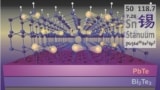 Read article: Superconductivity – pairing up with nanotechnology

Nanostructures remain crucial both in attempts to better understand superconductivity, as well as efforts to apply it
Read article: Superconductivity – pairing up with nanotechnology
Researchers develop the first multiterminal memristor device using polycrystalline 2D MoS2
 Read article: Multiple terminal memtransistors step up to mimic brains
Researchers point the way to optimizing the photochromic response of TiO2/Ag nanocomposites for numerous applications, using GISAXS and optical transmission measurements
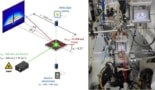 Read article: Shedding light on photochromic responses
Textiles present an exciting opportunity for energy scavenging thanks to developments to incorporate energy-generating devices on these flexible platforms, as presented at innoLAE 2018
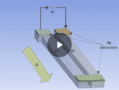 Read article: Energy harvesting coiled up in your favourite chair – update from innoLAE 2018
Smart skin made from piezotronic ZnO nanowire has more than 20 times more devices per square centimetre than the number of mechanical receptors in a human finger, as reported at innoLAE 2018
 Read article: Smart skin sensing density exceeds a fingertip
Integrating carrier dynamics with wave optics calculations reveals for the first time dependences on size and temperature in nanowire LEDs that do not affect their planar and bulk counterparts
 Read article: Nanowire LEDs require combination modelling
The devices, which are based on ferromagnetic helical nanostructures integrated with silver nanoantennas that produce mechanical force in response to light, could find use in applications such as lab-on-a-chip technology, microfluidics and nanoscale assembly
 Read article: High-temperature superconductivity gets agile
Block copolymer self-assembly aligns with shear stresses that arise from adding an inorganic topcoat that has a different coefficient of thermal expansion from the substrate
 Read article: Self-assembly responds well to stress
We take you through some of the highlights of the year both within IOP Publishing and beyond in nanoscale science and technology
 Read article: Highlights of nanotechweb.org 2017 – the movie
As bacteria evolve to fend off traditional antibiotics, nanomaterials may play a key role in tackling infectious disease
 Read article: Nanotechnology takes on microbial drug resistance