

Engineers reinvent the inductor after two centuries
On-chip devices made from intercalated graphene exploit the mechanism of kinetic inductance
 Read article: Engineers reinvent the inductor after two centuries

On-chip devices made from intercalated graphene exploit the mechanism of kinetic inductance
Read article: Engineers reinvent the inductor after two centuries
New device might be used to record action potentials from multiple neurons as well as electrical signals on the nanoscale – for example, across just one synapse
 Read article: Semiconductor nanosensor measures membrane potential
Researchers have made the first “passive” optical devices from Ti3C2Tx and C60 that allow for one-way transmission of light
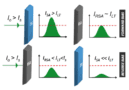 Read article: 2D MXenes make photonic diodes
The devices, which are based on ferromagnetic helical nanostructures integrated with silver nanoantennas that produce mechanical force in response to light, could find use in applications such as lab-on-a-chip technology, microfluidics and nanoscale assembly
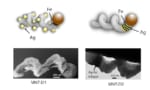 Read article: Mobile nanotweezers move sub-micron particles
New biomimetic genetically-engineered ligand-targeted nanoplatform shows promise
 Read article: Liposome-like nanovesicles target tumours
Graphene’s heaviest cousin shows promise for nanoelectronics, spintronics and potential quantum-computing applications
 Read article: Stanene grows on silver
Devices might be used to make ultra-efficient integrated photonics circuits, in quantum photonics and optical communications
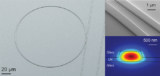 Read article: Lithium niobate makes ultra-high-Q resonators
New results could benefit scientists working on developing colloidal formulations with an improved shelf life, lubricants, drug-delivery systems and anti-bacterial surfaces
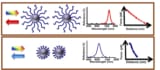 Read article: Simple spectroscopic technique to study polymer behaviour at interfaces
Study could boost understanding of interstellar space
 Read article: Individual atoms traced during diffusion
Quasiparticles could be put to work in optical circuits
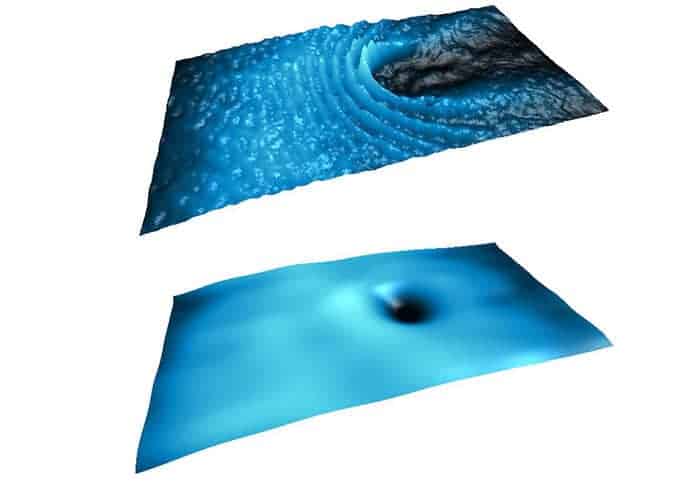 Read article: Superfluid polaritons seen at room temperature