

Porous carbon aerogels might power future Mars missions
Materials could be used to make electrodes in supercapacitors that operate at ultralow temperatures
 Read article: Porous carbon aerogels might power future Mars missions

Materials could be used to make electrodes in supercapacitors that operate at ultralow temperatures
Read article: Porous carbon aerogels might power future Mars missions
New devices can be erased, positioned and shaped using electric fields
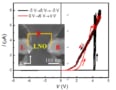 Read article: Ferroelectric domain wall diodes get flexible
Researchers have extended the spin coherence time of a single-molecule quantum bit beyond 1 millisecond for the first time
 Read article: Molecular qubits stick around for longer
Cobalt atoms on black phosphorous "learn" by adapting in response to an applied voltage
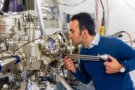 Read article: Interconnected single atoms could make a ‘quantum brain’
Precisely controlling nuclear excitations could aid the development of ultraprecise clocks as well as batteries that can store huge amounts of energy
 Read article: Atomic nuclei go for a quantum swing
New technique might help in the development of a quantum internet
 Read article: Qubit needle detected in a haystack of nuclear spins
Nanostructured material could find use in detectors for ultrafast optoelectronic applications
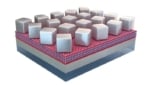 Read article: Plasmonic metasurface gives high-speed optical WiFi a boost
New optical "shaking" technique switches an antiferromagnetic material into a ferromagnetic one in just a few picoseconds
 Read article: Light-induced lattice vibrations could speed up data recording
Health and safety guidelines should be revised to consider the effects of air purifiers on droplets in confined spaces, say researchers
 Read article: Air purifiers could spread viruses in confined spaces
Shell-shaped structures use a pressure-based mechanism to climb ladders and slopes without motors or batteries
 Read article: Polymer gels snap and jump on their own