

Liquid phase-change material behaves like water
Results from neutron scattering experiments on glassy antimony alloy will be important when making novel non-volatile memories
 Read article: Liquid phase-change material behaves like water

Results from neutron scattering experiments on glassy antimony alloy will be important when making novel non-volatile memories
Read article: Liquid phase-change material behaves like water
New nanostructure inspired by a sea anemone might be a cost-effective alternative to traditional wastewater treatments
 Read article: Biomimetic coagulant makes water safe to drink
First ever magnetic condensates made of two different atomic species could help shed more light on many-body phenomena
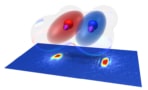 Read article: Dipolar quantum mixture makes its debut
Perforated membranes made from the carbon sheet might be used to filter drinking water
 Read article: Graphene filters go large
New sensor mimics the dermis-epidermis interface in human skin and can measure the direction of applied pressure in real time
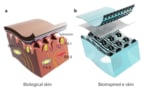 Read article: Bioinspired e-skin could help domestic robots sense touch
New results help explain earlier contradictions
 Read article: Surface plasmons reveal their secrets
Dual-functionality materials not only shield electronic devices from electromagnetic waves, they also dissipate excess heat in these devices at the same time
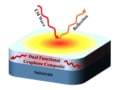 Read article: Cool graphene composites block EM radiation
The first ever battery-like bioelectrochemical system could be used to generate biofuel while capturing CO2
 Read article: Purple bacteria produce hydrogen from waste water
All-optical technique could benefit nanometrology, medical and biophysics applications as well as help stabilize positioning systems in microscopes
 Read article: Kerker scattering locates particles with subatomic precision
New “magneto-ionic” technique could help advance spintronics technologies for the post CMOS-world
 Read article: Controlling magnetism using a proton pump