

California’s water saving brings bonus effects
Greenhouse gas emissions and electricity usage also reduced


Greenhouse gas emissions and electricity usage also reduced
Gas vesicles make microbes stand-out in images
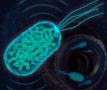 Read article: Bacteria engineered to have ultrasound signature
Astroparticle Physics European Consortium calls for increased spending on future facilities
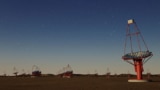 Read article: European astroparticle physicists release 10-year vision
Researchers turn greenhouse gas into rock and water into hydrogen
 Read article: Carbon dioxide can make useable fuel
New optical technique improves accuracy of temperature measurements
 Read article: Water supercooled to record-breaking low temperature
Geophysicist Terry Wallace takes over at Los Alamos National Laboratory
 Read article: New Los Alamos boss insists US national security remains top focus for the lab
Ultralow-frequency signals could be lurking in Gaia observations
 Read article: Wandering stars could reveal gravitational waves from supermassive black holes
With local residents still unable to return to their homes near the stricken Fukushima-Daiichi nuclear-power plant, Bruce Drinkwater and Rob Malkin describe their travels to Japan to see if ultrasonic arrays can image the reactor’s current condition
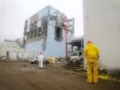 Read article: What next for Fukushima?
Researchers at North Carolina State University have developed a mathematical model for computing radiation treatments that could substantially reduce side effects, while delivering the same results as conventional radiotherapy (Phys. Med. Biol. 63 015036)
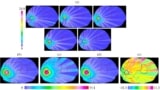 Read article: Radiotherapy algorithm could reduce side effects
Identifying and correcting changes in neural firing rates during object interaction improves control of a brain–computer interface
 Read article: Online correction improves robotic arm control