

Twisters turn up the current in superconductors
Vortices in resistance-free current flow could explain a strange current effect


Vortices in resistance-free current flow could explain a strange current effect
Now Demosthenes Kivotides, Carlo Barenghi and David Samuels at the University of Newcastle in the UK have discovered another surprising feature of liquid helium. They have predicted that the coupled motion of the normal and superfluid components can give rise to an intriguing structure that contains three vortex rings (Science 2000 290 777). In the […]
The so-called optical activity of materials has been studied extensively since then, so it is perhaps surprising that there is anything new to discover. However, José Goulon of the European Synchrotron Radiation Facility (ESRF) in Grenoble, France, and co-workers at the ESRF, the University of Paris and Purdue University in the US have recently observed […]
Devices made from silicon dominate the microelectronics industry, so silicon should be the material of choice for anyone designing new electronic devices that will be integrated with microelectronic circuits. This also applies to the optoelectronic devices that act as gateways between the electronic realm and the worlds of photonics and optical communications. Most optoelectronic components […]
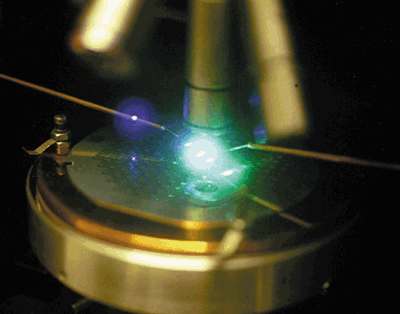 Read article: Silicon lasers start to take shape
Now Luis Garay, James Anglin, Ignacio Cirac and Peter Zoller at the University of Innsbruck in Austria have proposed a realistic way to make an artificial “sonic” black hole in a tabletop experiment (L J Garay et al. 2000 Phys. Rev. Lett. 85 4643). In the February issue of Physics World, Ulf Leonhardt of the […]
Super-fast drops could improve printing, lithography and surgical techniques
Ancient paradox lends a hand to modern astronomy
Benchtop 'black holes' could bridge the gap between relativity and quantum mechanics
US experts identify the hottest topics in particle physics and astronomy
 Read article: 11 key questions about the universe
Light brought to a halt in ultracold gas could be used in quantum computation