Author
Array
(
[0] => linkedin
[1] => facebook
[2] => twitter
[3] => google-plus
[4] => youtube
)
Array
(
[0] => linkedin
[1] => facebook
[2] => twitter
[3] => google-plus
[4] => youtube
)
Array
(
[0] => linkedin
[1] => facebook
[2] => twitter
[3] => google-plus
[4] => youtube
)
Array
(
[0] => linkedin
[1] => facebook
[2] => twitter
[3] => google-plus
[4] => youtube
)
Array
(
[0] => linkedin
[1] => facebook
[2] => twitter
[3] => google-plus
[4] => youtube
)
No Author
Author archive
“We know that cosmic radiation at aircraft altitudes is several orders of magnitude more intense than that experienced at ground level because there is less protection from our atmosphere”, says Bob Bentley, project scientist at MSSL. But scientists are currently unsure how much of the radiation penetrates into the cabins of aircraft and what risk […]
Heeger, MacDiarmid and Shirakawa made their breakthrough in the late 1970s, when they discovered that the electrical conductivity of a certain form of polyacetylene increased by a factor of ten million when it was doped with iodine. Subsequent developments have produced diverse applications for the technology: conductive plastics are used in anti-static materials, filters for […]
In the late 1950s, Weber became intrigued by the relationship between gravitational theory and laboratory experiments. His book, General Relativity and Gravitational Radiation, was published in 1961, and his paper describing how to build a gravitational wave detector first appeared in 1969. Weber’s first detector consisted of a freely suspended aluminium cylinder weighing a few […]
Kroemer and Alferov share the prize for their work on semiconductor heterostructures – devices that contain thin layers of different semiconductors, usually based on gallium arsenide, stacked on top of each other. In 1957 Kroemer, then working at the RCA company in Princeton, published the first proposal for a heterostructure transistor. His theoretical work showed […]
During the rapid expansion of the universe after the big bang, the ‘outward’ kinetic energy of the explosion fought against the ‘inward’ gravitational pull of matter. The evolution of the universe is therefore directly linked to the amount of mass (or equivalently energy) it contains. The idea of dark matter was proposed to explain why […]
Read article: Shadow cast on dark matter
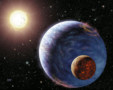
Many planets have been discovered outside our solar system, but they are usually detected by observing the wobble of the parent star induced by the gravitational pull of the orbiting planet. Zapatero Osorio’s team, however, observed the floating planets directly by optical and infrared imaging. The objects are dim and reddish – the characteristics of […]
Read article: ‘Floating planets’ challenge theorists
In a photonic crystal the periodic variation of the dielectric constant results in a range of ‘forbidden’ frequencies called a photonic bandgap (PBG). Electromagnetic waves with a ‘forbidden’ frequency cannot propagate through the crystal. This phenomenon can be exploited to create a waveguide. Adding a strip of linear defects to the PBG material destroys the […]
Universities across Europe are scrapping their traditional degrees in favour of British-style qualifications. But some physicists on the continent believe this will lead to a drop in standards
Read article: New era for European Universities
Julian Barbour reviews the play God and Stephen Hawking by Robin Hawdon
Read article: Hawking: the cardboard creation
Superconducting magnets are a common tool in many physics and chemistry laboratories, and are used in a host of research applications, including solid-state physics, nuclear-magnetic-resonance chemistry and particle physics. Outside the research lab, the only truly widespread use of superconducting magnets is in magnetic resonance imaging (MRI) in medicine. However, applications of superconducting magnets are […]
Read article: Superconductivity leaves the lab
Copyright © 2026 by IOP Publishing Ltd and individual contributors