Author
Array
(
[0] => linkedin
[1] => facebook
[2] => twitter
[3] => google-plus
[4] => youtube
)
Array
(
[0] => linkedin
[1] => facebook
[2] => twitter
[3] => google-plus
[4] => youtube
)
Array
(
[0] => linkedin
[1] => facebook
[2] => twitter
[3] => google-plus
[4] => youtube
)
Array
(
[0] => linkedin
[1] => facebook
[2] => twitter
[3] => google-plus
[4] => youtube
)
Array
(
[0] => linkedin
[1] => facebook
[2] => twitter
[3] => google-plus
[4] => youtube
)
No Author
Author archive
Two of the outstanding challenges in physics identified in our millennium survey last month were the nature of “dark matter” and a proper understanding of nuclear structure. This month we look at these challenges in greater detail. Dark matter is matter that does not interact with electromagnetic radiation: it cannot be seen with telescopes and […]

As a physicist, you have the advantage of a three-way choice when it comes to developing a career. You can become a scientist, opt for work that involves science outside the laboratory, or consider offers from the broad range of employers who are keen to recruit you to do something quite different. Let’s start with […]
For as long as I can remember, the major research universities in the US have repeated the mantra that “good research makes good teaching”. When challenged about the need for investment in research personnel or facilities by those who think a university’s proper role is to educate undergraduates, university administrators often claim that the institution’s […]
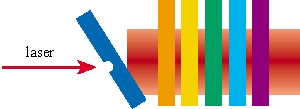
About 20 years ago Toshi Tajima and John Dawson, then at the University of California at Los Angeles, suggested that laser-produced plasmas could be used to accelerate particles to high energies. The essential feature of their proposal was that the electrons would be accelerated by plasma waves moving at close to the speed of light […]
 Read article: Nuclear physics with lasers
Experiments deep underground are searching for new particles that could simultaneously solve one of the biggest mysteries in astrophysics and reveal wha's beyond the Standard Model of particle physics
 Read article: The search for dark matter
Italy is paying over half of the cost of the SwFr 71million experiment, with voluntary contributions from Belgium, France, Germany and Spain covering the rest. The experiment will start taking data in May 2005. CERN will send around 1018 muon neutrinos to Gran Sasso every year. However, only about 2500 of these will interact with […]
The experiments were carried out by Thomas Udem from the Max-Planck Institute for Quantum Optics in Garching and colleagues. Udem and colleagues placed four atomic clocks – one rubidium clock, two caesium clocks and a hydrogen maser – in an air conditioned basement at Wessling in Germany and recorded their time difference every 4 seconds […]
Confirmation that the universe is flat – expanding at just the right rate not to collapse – came from measurements of ripples in the cosmic background radiation left over from the big bang. Gamma-ray bursts have been one of the hottest topics in astrophysics in the 1990s and earlier this year astronomers found that a […]
Light from the planet is almost completely obliterated by the bright glare from the star. Although the reflected signal is 10-20,000 times weaker than the glare from tau Bootis, the planet studied by Cameron and co-workers is still the brightest and hottest planet among the extra-solar planets discovered so far. It also has one of […]
In quantum teleportation the quantum state of an object held by “Alice” is instantaneously sent to “Bob”. The new technique works by having two optical cavities that both contain a single trapped atom with three energy levels – two ground states and one excited state. The cavities are designed so that the photon emitted when […]
Copyright © 2026 by IOP Publishing Ltd and individual contributors


