Author
Array
(
[0] => linkedin
[1] => facebook
[2] => twitter
[3] => google-plus
[4] => youtube
)
Array
(
[0] => linkedin
[1] => facebook
[2] => twitter
[3] => google-plus
[4] => youtube
)
Array
(
[0] => linkedin
[1] => facebook
[2] => twitter
[3] => google-plus
[4] => youtube
)
Array
(
[0] => linkedin
[1] => facebook
[2] => twitter
[3] => google-plus
[4] => youtube
)
Array
(
[0] => linkedin
[1] => facebook
[2] => twitter
[3] => google-plus
[4] => youtube
)
No Author
Author archive
NASA’s Mission Control Center hoped that the Deep Space Two micoprobe had landed safely and gone into a ‘sleep’ safety mode. But all attempts to contact the probes have failed. During re-entry the spacecraft had to break communications with Earth, which means that no information about the probes’ final moments exist. However, researchers at NASA […]

The JIF scheme is funded by the UK government and the Wellcome Trust, the world’s largest biomedical research charity. It was set up after several reports found that a shortage of state-of-the-art research equipment was making it difficult for universities in the UK to remain at the forefront of international research. Nearly £320m has been […]
XMM will be in a highly elliptical orbit to keep it away from interference caused by the Sun’s glare. The telescope’s large size and unusual orbit explains why XMM was launched from Ariane 5, which is the largest heavy-lift vehicle currently in service. XMM consists of three advanced X-ray telescopes. They each contain 58 high-precision […]
In a series of interviews with a wide cross-section of students who remained in the physics programme, Booth and Ingerman discovered that many students could not adequately explain the links between the basic maths courses and the more advanced physics modules – for example, between Fourier analysis and electromagnetism. They explain that students do not […]
Physics in the 20th century is founded on the twin pillars of quantum mechanics and the theory of relativity. However, in spite of the enormous successes of each theory individually, the two appear to be incompatible. This embarrassing contradiction at the very heart of theoretical physics remains one of the great outstanding challenges in science. […]
 Read article: Quantum gravity presents the ultimate challenge to theorists
Quantum mechanics is the most accurate theory we have to describe the world, but there is still much about it that we do not fully understand
 Read article: Quantum theory: weird and wonderful
Our understanding of the universe has advanced immeasurably in the last century, and there seems no end to the wealth of new discoveries as we approach the next millennium
 Read article: Astrophysics and cosmology: the golden age
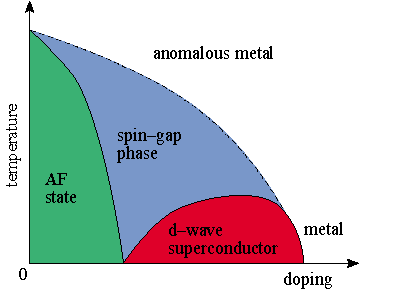
Even a decade and a half after the discovery of high-temperature superconductivity in ceramic compounds containing copper-oxide planes, these materials continue to puzzle condensed-matter theorists. The challenge is not simply to find a reasonable formula that predicts the uniquely high values for the superconducting transition temperature in the cuprates. Rather, superconductivity is but one aspect […]
 Read article: Explaining high-Tc superconductors
Although the basic building blocks of matter and their interactions have been placed on a firm theoretical footing, many fundamental questions remain unanswered and await the experiments of the future
 Read article: Particle physics: the next generation
Joseph Rotblat says scientists need to accept responsibility for the human and environmental consequences of their research,.
 Read article: The social conscience of scientists
Copyright © 2026 by IOP Publishing Ltd and individual contributors


