Author
Array
(
[0] => linkedin
[1] => facebook
[2] => twitter
[3] => google-plus
[4] => youtube
)
Array
(
[0] => linkedin
[1] => facebook
[2] => twitter
[3] => google-plus
[4] => youtube
)
Array
(
[0] => linkedin
[1] => facebook
[2] => twitter
[3] => google-plus
[4] => youtube
)
Array
(
[0] => linkedin
[1] => facebook
[2] => twitter
[3] => google-plus
[4] => youtube
)
Array
(
[0] => linkedin
[1] => facebook
[2] => twitter
[3] => google-plus
[4] => youtube
)
No Author
Author archive
Galaxies with extremely large redshifts are hard to detect as the radiation they emit shifts to longer wavelengths that are easily absorbed by giant intergalactic hydrogen clouds. Another problem is that their luminosity is dimmed by the vast distances the photons travel, while any radiation that does reach the Earth is absorbed by our atmosphere. […]

Governments that have signed the CTBT – which will come into force this September – are concerned that countries such as Iran, India and Iraq might try to develop so called ‘sub-critical’ nuclear tests. These explosions are below the 1 kiloton limit agreed in the CTBT. To check if the 321 seismic stations that make […]
This is not the first time that astronomers have considered using rotating platters of liquid – usually mercury – for a central mirror. For example, a mercury-based telescope would cost one hundredth that of a glass mirror. But previous techniques had one particular flaw – the telescope could not be tilted without destroying the shape […]
The clusters were produced by expanding a deuterium gas jet into a vacuum. A laser beam focussed near the top of the plume heats the clusters, causing them to explode. This creates a small plasma of high energy (keV) deuterium ions which collide with each other and undergo a fusion reaction. The experiment converted laser […]
The 1860s and 1870s form one of the most exciting periods in physics, probably on a par with the 1920s and 1930s when quantum mechanics was developed. James Clerk Maxwell was working on his theory of the electromagnetic field, Rudolf Clausius introduced the concept of entropy in thermodynamics, and kinetic theory was starting to become […]
As part of the redesign we have also moved the In Depth and Patent News services to the News section, and moved WebWatch to a new expanded Reviews section. We have also put the 1997 and 1998 indexes for Physics World magazine online, and plan to update the 1999 index every month. Those PhysicsWeb users […]
Two of the oldest and largest physical societies in the world celebrate anniversaries this year. The Institute of Physics, which publishes this magazine, can trace its roots back to the Physical Society that was formed in London 125 years ago. And the American Physical Society (APS) is currently celebrating its centennial. Other venerable societies of […]
Sascha Hilgenfeldt, Siegfried Grossman and Detlef Lohse extended the model by making the bubble’s temperature dependent on its volume and by making an allowance of the small emissivity of the weakly ionized gas inside the bubble. The latter term allows for the fact that experiments have shown that only Nobel gases remain inside the bubble […]
The glass tube in a conventional fluorescent light is coated on the inside with a phosphor layer and filled with a discharge material, usually mercury. Electrons excite the mercury atoms from the ground state into a short-lived excited state. Ultraviolet light is emitted as the atoms return to the ground state and this is absorbed […]
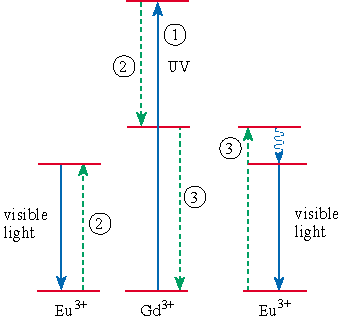 Read article: Phosphors help switch on xenon
Recent experiments in fluid mechanics are shedding light on the intricate motion displayed by non-spherical objects as they fall, a problem that has puzzled physicists for centuries
 Read article: Flutter and tumble in fluids
Copyright © 2026 by IOP Publishing Ltd and individual contributors


