Quantum effects help make DNA unstable
Proton tunnelling can create genetic mutations, say researchers
 Read article: Quantum effects help make DNA unstable

Proton tunnelling can create genetic mutations, say researchers
Read article: Quantum effects help make DNA unstable
Drums made from the 2D carbon sheet might be used to detect antibiotic resistance quickly and simply by monitoring bacterial movement
 Read article: Graphene ‘drums’ pick up vibrations from individual bacteria
Technology could make indoor areas as safe as outdoors, say physicists
 Read article: Far-UVC light zaps airborne pathogens in realistic conditions
Technique could provide fresh insights into the life cycle of viruses like SARS-Cov-2
 Read article: Super-resolution microscopy reveals coronavirus-replicating machinery
Study sheds new light on how bacteria swim in complex fluids
 Read article: Bacterial swimming in complex fluids better understood with new experiment, model
Researchers reveal how some spiders can float and drift like a balloon by exploiting the electric field present in the atmosphere
 Read article: Simulations shed light on interactions that help spiders fly
A visionary biophysics project has emerged from the COVID-19 pandemic
 Read article: The Human Organ Atlas: a ‘Google Earth’ for our bodies
A new synchrotron-imaging technique is helping researchers shed a new light on human anatomy. Jon Cartwright zooms in
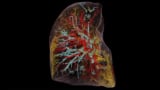 Read article: Drawing up a ‘Google Earth’ of the human body
Only the first of two electrons transferred from a cell to an external mineral determines the rate of iron-based bacterial respiration
 Read article: The first electron counts – how anaerobic microbes ‘breathe’ iron
Fluorescence microscopy technique enables observation of biomolecular patterns in their native state down to the nanometre scale, by rapidly cooling cells to –196 °C
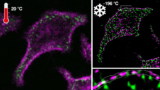 Read article: Ultrafast cryo-arrest of living cells reveals biomolecular patterns with unprecedented resolution