

UK physics scoops extra money
The JIF scheme was set up in 1998 by the UK government and the Wellcome Trust – the world’s largest biomedical research charity – to provide much-needed funding for university labora...


The JIF scheme was set up in 1998 by the UK government and the Wellcome Trust – the world’s largest biomedical research charity – to provide much-needed funding for university labora...
Although researchers have proposed a wide variety of explanations for sonoluminescence, they are in broad agreement that the oscillating bubbles reach very high temperatures. Until now, however, singl...
In a photonic crystal the periodic variation of the dielectric constant results in a range of ‘forbidden’ frequencies called a photonic bandgap (PBG). Electromagnetic waves with a ‘f...
Nothing can travel faster than light. Despite a recent raft of reports in the media, this statement is as true now as it ever was. Nonetheless, experiments over the past 20 years have been forcing us ...
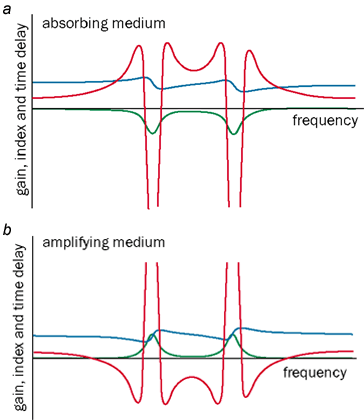 Read article: No thing goes faster than light
Converting electrical signals into optical pulses is one of the speed ‘bottlenecks’ in current telecommunications systems. To reach high data speeds, a series of electro-optic devices call...
Dielectric mirrors are made of multiple layers of transparent materials, each of which reflects a small fraction of the light that hits it. At a specific layer thickness, the reflected light waves mer...
Klaus Dieter Liss from the European Synchrotron Radiation Facility in Grenoble, France, and colleagues have created a cavity that traps X-ray photons between two thin plates of silicon (Nature 404 371...
Four years ago John Pendry of Imperial College, London, described how a composite copper structure could be used to create a material with negative electric permittivity, and more recently he proposed...
Thomas’s group measured the spatial distribution of water in the glass rods from which the optical fibres are drawn. They discovered that water diffuses into the molten, flowing glass much faste...
The method works by solidifying a resin that hardens when exposed to light. The resin is solidified into a three-dimensional grid by placing it in the interference pattern set up by four intersecting ...
