

Cloudships in our future

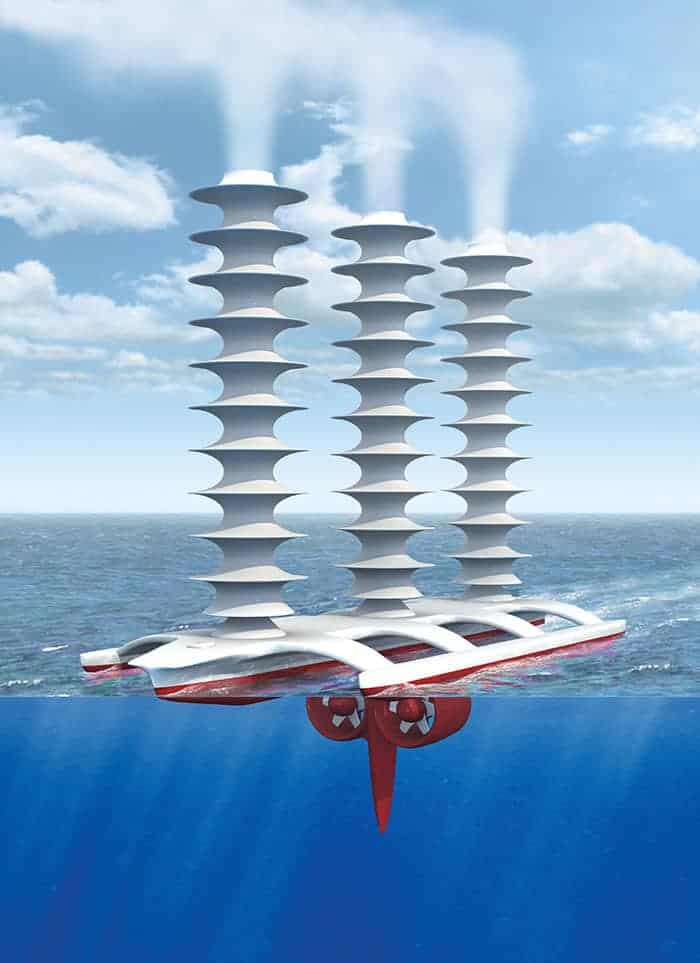
Artistic illustration of a cloudship. The ship has three tall columns spewing vapour into the air as it floats on the surface of a calm blue sea

Imagine a fleet of hundreds of stark, white, multi-hulled ships gliding majestically across the Pacific Ocean, untended by human hands. From each of these ships, three tall, ridged, spinning funnels reach skyward, sucking up seawater and spraying it high into the air. The spray seeds low-lying clouds with tiny salt particles, creating new condensation centres within the clouds that make them more reflective. By doing so, they increase the cooling effect that comes from reflecting incoming radiation back into space.

These so-called cloudships – the turn-of-the millennium brainchild of engineer Stephen Salter and physicist John Latham – are but one of a number of intriguing geoengineering concepts that aim to counter (or at least help mitigate) the effects of climate change. They, along with many other similarly outlandish ideas, are vividly brought to life in the pages of Oliver Morton’s new book, The Planet Remade: How Geoengineering Could Change the World. Morton is a journalist, and his book manages the rare knack of being both accessible and detailed. In it, he guides the reader through the history, politics and broad science of various geoengineering schemes, including the aforementioned cloudships, carbon capture from the air, the cultivation at sea of clouds of photosynthetic plankton and the formation of enormous stratospheric veils.

Most of the book is spent emphasizing the details and potential applications of this last concept, in which aerosols are injected into the stratosphere to help reduce the amount of solar radiation reaching the Earth’s surface. The idea takes its inspiration from large-scale volcanic eruptions like that of Mount Pinatubo in June 1991, when this previously quiet peak dumped 20 million tonnes of sulphur dioxide into the atmosphere, temporarily forming a haze that cooled the globe by about 0.5 °C. Morton paints a vivid picture of veil-making, exploring not only the scientific principles behind such veils but also the kinds of aircraft and airships that would be needed to weave one across the skies. In the book’s conclusion, he also details a scenario for how the application and politics of veil-making might conceivably play out.

To suggest that The Planet Remade is just a discussion of various geoengineering concepts, however, would be to do it a considerable injustice. The book’s real strength lies in its superb richness, not only in its careful consideration of the impacts and politics of geoengineering but also in how it weaves its wide tapestry from so many varied, fascinating anecdotes. These include such gems as the seemingly outrageous proposal (by a British biologist, Julian Huxley) to improve the northern hemisphere by nuking the Arctic ice-cap out of existence; and physicist Freeman Dyson’s solution for lowering carbon-dioxide levels by growing sycamores on every uncultivated patch of land on which it was possible to plant them.

In an unexpected aside, the book also explores another striking human intervention in the Earth’s workings, but one that is less readily recognizable as a form of geoengineering: the large-scale manufacturing of fertilizer. Nitrogen availability is a limiting factor in the growth of many crops, and for it to be usable in biological synthesis, it needs to be “fixed” – that is, converted from its inert atmospheric form to ammonia. The development of the nitrogen-fixing Haber process in the early 20th century, Morton notes, “changed the conditions under which the human race lives” – accommodating a quadrupling of the human population and having an enormous impact on the nature of the Earth’s nitrogen cycle.

If the book’s greatest strength lies in its wonderful level of detail and history, its (infrequent) departures from this state of affairs reveals its only real weakness: Morton’s occasional tendency towards poetic philosophizing, which for this reader becomes, in places, a little too florid and relatively less compelling. My other small gripe with the work lies in its use of a new compound term, “earthsystem”. The expression is specifically introduced as a conceit to encourage readers to consider the Earth as a dynamic, interdependent network of parts – an essence, as Morton puts it, found “in all the Earth’s interplay of energy of matter”, in “the flows of energy which drive the cycles of carbon, water, nitrogen and life’s other essentials that roll ceaselessly round the planet and down through the eons”.

While the term certainly achieves this thought-provoking goal, it is not made clear why this “earthsystem” requires differentiating from the established geological term “Earth System”, the meaning of which appears to be identical. Overall, however, The Planet Remade was enriching and a pleasure to read – with much to appeal to both those unfamiliar and those more intimate with the concepts, history and politics of geoengineering.

  • 2015 Granta Books £20.00/$29.95hb 448pp

Skateboard videos reveal the physics of doing an ‘ollie’

Here’s a problem for keen students of classical mechanics: how can a skateboarder cause their board to leap into the air by pressing down on it with their feet?

What I’ve described is a trick called the “ollie”, which first emerged on the skateboarding scene in the late 1970s and is now an essential part of the skating repertoire. There’s a fascinating paper in the journal Physics Education, which shows how digital videos of people doing an ollie can be analysed to get to grips with the physics underlying the trick.

The above image shows six video frames of someone executing an ollie – with time moving from right to left over a period of about 2 s. If you delve into the paper, you will find out how its authors – Marco Adriano Dias, Paulo Simeão Carvalho and Deise Miranda Vianna – used video images to track the motion of the tail of the board as well as its front and back wheels. This was then compared to a free-body diagram analysis of the forces of the board.

(more…)

Art McDonald explains why neutrinos continue to amaze physicists

The neutrino was first proposed in 1930 by Wolfgang Pauli to explain a mysterious deficit of energy that was observed in the study of nuclear decay. Pauli famously joked that he had done a terrible thing by postulating a particle that could not be detected. But the particle was detected in 1956, and since then just about every discovery in neutrino physics has thrown up more questions than answers.

Because it does not fit in with the Standard Model, the neutrino is a prime target for the discovery of new physics. There have already been four Nobel prizes awarded for neutrino physics and thousands of physicists are working on experiments worldwide hoping to make the next big discovery.

In this podcast, Nobel laureate Art McDonald talks about the new SNO+ experiment that is located more than 2 km underground in a Canadian mine and which will look for hypothetical process called neutrinoless double-beta decay. Its discovery would be another bombshell in the history of neutrino physics because it would mean that the neutrino is its own antiparticle. Knowing the decay rate would also provide a direct measurement of the mass of the neutrino – a poorly known and much sought after quantity.

As well as being a laboratory for fundamental physics, SNO+ will also be an important tool for geophysicists studying the Earth’s crust – as McDonald explains. Other, more practical, applications of neutrino physics include fusion energy, says McDonald, who makes it very clear that the mysterious neutrino still has a lot more to give to science.

Coherent terahertz radiation created in laser plasmas

Bright pulses of coherent terahertz radiation have been created by firing a laser at specially designed targets. Developed by physicists in China and the UK, the new technique could lead to the development of compact yet intense terahertz sources with a wide range of applications, including condensed-matter physics, biomedical imaging and even wireless communications.

Terahertz radiation falls between the infrared and microwave regions of the electromagnetic spectrum. As well as being a useful probe of collective excitations in solids, terahertz radiation is able to pass through materials such as clothing and packaging, and therefore could be used for security scanning. However, it has proven to be very difficult to create practical terahertz sources and detectors – so applications have so far been limited.

Coherent terahertz radiation can be created using quantum-cascade lasers, but the best devices today are relatively low power. Much more powerful terahertz sources can be made by slamming beams of high-energy electrons into solid targets – but this must be done at large accelerator facilities.

Ripped electrons

Now, Yutong Li of the Institute of Physics of the Chinese Academy of Sciences and Xiaohui Yuan of Shanghai Jiao Tong University, and colleagues, have generated pulses of coherent terahertz radiation using a laser-driven plasma wakefield accelerator. This is a relatively new accelerator technology whereby an intense laser pulse is fired at a target. The pulse rips electrons from their atoms to create huge electric-field gradients, which then accelerate the electrons to energies as high as several gigaelectronvolts.

Physicists already know that terahertz radiation is emitted when laser pulses are fired at a metal-coated plastic target. While there are several different physical processes involved in this emission, Li and colleagues focussed on a specific process called “coherent transition radiation” (CTR). This occurs when the accelerated electrons pass through the metal coating on their way out of the target. As they move from the metal into the air, the electric field associated with the electrons changes rapidly and this leads to the emission of electromagnetic radiation.

Li and colleagues developed their terahertz source at the Laboratory for Laser Plasmas at Shanghai Jiao Tong University. They used 30 fs-long pulses of infrared light that each deliver 2 J of energy. Their design involved firing the pulses at a number of different metal and plastic targets. They found that the plastic targets with microns-thick metal coatings generated about 10 times more terahertz radiation than did similarly sized bare plastic targets.

Energetic emissions

The team reckons that each laser pulse produces a pulse of coherent terahertz radiation that has about 400 μJ of energy. This is comparable to sources based on electron accelerators, which have delivered about 600 μJ per pulse.

Potential applications of an intense laser-based coherent terahertz source include the study of charge-carrier dynamics in semiconductors, lattice vibrations and spin precession. Sources could also be used for medical imaging of the skin and teeth. Because terahertz signals are at a higher frequency than microwave communications, it could also be possible to develop terahertz-based wireless-communication systems capable of much higher data-transmission rates than are possible today.

The terahertz source is described in Physical Review Letters.

Did solar superflares spark life on Earth?

A stormy young Sun may have provided the early Earth with the ingredients and climate needed to kick-start life. That’s the claim of NASA scientists, who say that powerful solar eruptions may have warmed the Earth at a time when the Sun was relatively cool. They also say that the Earth’s life-giving supply of nitrogen was synthesized by energetic particles from the Sun.

Having a clear idea of the necessary conditions for life to emerge on Earth is a key scientific goal – both to trace our own origins and to better gauge which of the many thousands of known exoplanets may hold life. A particular sticking point in developing a clear picture of Earth’s early evolution was that four billion years ago, when life-friendly conditions were developing, the young Sun wasn’t luminous enough to warm our planet. Despite its storminess, the Sun was 30% dimmer then than it is today.

Cool and stormy

“Back then, Earth received only about 70% of the energy from the Sun than it does today,” says solar scientist Vladimir Airapetian at NASA’s Goddard Space Flight Center in Maryland. “That means Earth should have been an icy ball. Instead, geological evidence says it was a warm globe with liquid water. We call this the ‘faint young Sun paradox’.”

Another problem lies with the fact that a key component for the building blocks for life is nitrogen (N) – but at that time, only unreactive molecular nitrogen (N2) was present in the atmosphere. A very energetic process would have been necessary to break apart the molecular nitrogen into atomic nitrogen, allowing it to recombine into more biologically suitable forms. The latest research by Airapetian and colleagues shows that charged particles from the solar storms could have both broken apart the nitrogen and provided the heat required for life.

For clues on how the young Sun behaved, scientists study Sun-like stars in our galaxy at different ages. Apart from confirming that the young Sun would have been relatively faint, the studies also show that young stars frequently produce powerful flares. These are giant bursts of light and other radiation that are similar to the flares we see on the Sun today. Such flares are often accompanied by huge clouds of solar material, called coronal mass ejections (CMEs), being shot out into space.

Superflare showers

NASA’s Kepler mission has found Sun-like stars that are young, and many of these are seen to produce “superflares” – enormous explosions so rare today that we only experience them once every 100 years or so. But Kepler’s data show these young stars producing as many as 10 superflares a day. Based on these observations, Airapetian and colleagues say that clouds of charged particles ejected due to a young Sun’s stormy outbursts triggered changes in the early Earth’s atmospheric chemistry.

The team simulated how the superflares would interact with our planet, and found that they would have distorted the Earth’s magnetic field – which was also weaker at the time – by creating large gaps around the poles. These gaps provided gateways for the energetic solar particles to penetrate the atmosphere. “Our calculations show that you would have regularly seen auroras all the way down in South Carolina,” says Airapetian.

Hotting up

The charged particles would travel down the magnetic-field lines and collide with the molecular nitrogen as well as the carbon dioxide, which was split into carbon monoxide and oxygen. The free nitrogen and oxygen atoms would have then combined to form nitrous oxide (N2O) – a powerful greenhouse gas – and hydrogen cyanide (HCN). Indeed, nitrous oxide is some 300 times more powerful at warming the atmosphere than carbon dioxide. The team’s calculations showed that if even 1% of the carbon dioxide in the atmosphere was N2O, it would be sufficient to warm up the Earth’s surface to a temperature that could support liquid water, as well as the beginnings of life. “Changing the atmosphere’s chemistry turns out to have made all the difference for life on Earth,” says Airapetian.

The researchers also believe that the HCN could have provided a nitrogen source for biological molecules such as amino acids. Indeed, the daily dose of solar particles may also have provided the huge amount of energy needed to create complex molecules such as RNA and DNA that eventually seeded life.

At the same time, constant solar showers and radiation could also be quite detrimental. The magnetic onslaught could even rip off a planet’s atmosphere if its magnetosphere is too weak. Determining where the balance lies will help us to determine which extrasolar star systems could potentially harbour life. “We want to gather all this information together – how close a planet is to the star, how energetic the star is, how strong the planet’s magnetosphere is – to help search for habitable planets around stars near our own and throughout the galaxy,” says team-member William Danchi. Working with others in related fields, the researchers hope to come up with a “robust description of what the early days of our home planet looked like – and where life might exist elsewhere”.

The work is published in Nature Geoscience.

Protons swim with ease through shark jelly

Scientists in the US have discovered that a jelly-like material found in the skin of sharks and some other fish has the highest proton conductivity ever measured in a biological material. The jelly occurs in special pores that help the creatures to hunt by sensing the extremely weak electric fields created by prey. As well as providing important clues about how this poorly understood sensory system works, the team believes that the discovery could also lead to the development of new types of electrical sensors.

Some fish, including rays, skates and sharks, can sense electric fields as small as 5 nV/cm, which allows them to detect muscle contractions and other physiological activity in potential prey. They sense the fields using arrays of electrosensory organs in their skin called ampullae of Lorenzi (AoL). An individual AoL comprises a canal that is filled with a jelly-like substance that comes into contact with the external environment via a pore in the creature’s skin. The inner end of the canal terminates in a sac (or “alveolus”) containing cells that transmit electrical signals from the jelly to the fish’s nervous system.

However, scientists do not have a good understanding of how tiny electrical signals are conducted along the AoL from the external environment to the alveolus. Now, Marco Rolandi of the University of California, Santa Cruz, and colleagues have discovered that AoL jelly is an extremely good conductor of protons – something that could help to explain how it can transmit weak electric fields.

Jelly sandwich

The team tested samples of jelly from three different fish: the bonnethead shark; the longnose skate and the big skate. The jelly was sandwiched between two electrodes made of palladium, which can absorb and release large numbers of protons. A voltage is applied across the electrodes, causing protons from the positive electrode to enter the jelly and travel to the negative electrode. The proton current is easily measured because it is identical to the electrical current that flows through the voltage supply.

While these measurements showed that the jelly is a good proton conductor, they do not provide an accurate value of the conductivity. This is because the protons must overcome contact resistance when they exit and enter the palladium electrodes, which affects the conductivity measurement. To get around this problem, measurements were also made using two gold electrodes that were placed in the jelly between the two palladium electrodes. Measuring the voltage across the gold electrodes and the current through the palladium electrodes allowed the team to make an accurate calculation of the conductivity of the jelly.

The tests revealed that the proton conductivity of the jelly is as high as 2 mS/cm, which is the highest value ever measured in a biological material. “The first time I measured the proton conductivity of the jelly, I was really surprised,” says team member Erik Josberger of the University of Washington, adding: “The conductivity was only 40 times smaller than Nafion.” Nafion is a solid plastic material that is designed specifically to have extremely high proton conductivity for use in fuel cells and other commercial applications.

Water chains

The researchers believe that the high proton conductivity in the AoL jelly is related to the presence of a chain-like molecule called keratan sulphate. This is an acid, which means that each keratin-sulphate molecule can provide a free proton for conduction. The team believes that these protons are able to travel through the jelly along chains of water molecules that form around keratan sulphate.

“The observation of high proton conductivity in the jelly is very exciting,” says Rolandi. “We hope that our findings may contribute to future studies of the electrosensing function of the ampullae of Lorenzini and of the organ overall, which is itself rather exceptional.”

The measurements are reported in Science Advances.

Christoph Gerber: atomic-force microscope pioneer

Christoph Gerber

Where would nanotechnology be without the AFM?

Nanotechnology would be at a far less advanced stage had the scanning tunnelling microscope (STM) and atomic force microscope (AFM) not been invented. Seeing is believing; so when you can image individual atoms on a surface, it has a major impact. The STM took scientists into uncharted territory by offering the ability to image surfaces in 3D at the atomic scale, but the AFM opened up the field much further – from numerous applications in the semiconductor industry and surface science to biological and medical applications, to mention a few. We really couldn’t foresee this at the time.

Didn’t we already have atomic resolution with the electron microscope?

The breakthrough with STM and AFM was that you don’t need to have a vacuum to do experiments, and the techniques are not limited in spatial resolution by diffraction. The AFM is sensitive to a range of surface interactions that include chemical, mechanical, electrostatic, capillary, electromagnetic and other forces, and you can use them for different experiments. Recently at IBM Research Zurich, Leo Gross and Gerhard Meyer have been able to pick up a surface molecule with the tip and use it to image adsorbed molecules on a surface, thus revealing the chemical bonds present.

How did the AFM evolve from the STM?

The STM was invented in 1981 and five years later Gerd Binnig and Heinrich Rohrer shared the Nobel Prize for Physics for the work. Since the STM can only image electrical conducting surfaces, the question was, how can we image atomic detail in non-conductive surfaces? This idea was discussed at the first workshop devoted to the STM, which was held in Austria in 1985, when researchers began to confirm the atomic-scale 3D imaging reported by IBM three years earlier. Everyone present realized that something very special had happened: we were witnessing the beginning of nanoscience. At that time, Gerd and I were on sabbatical leave based in Cal Quate’s group at Stanford University and also IBM Research Almalden. Gerd suggested that it might be possible to measure the interactive forces, rather than the current, between tip and sample, and that perhaps we could do this with a cantilever. We did a rough calculation and realized that in order to get atomic resolution we needed to be able to detect forces at the level of 10–10 N or even 10–11 N!

How did you go about detecting such a tiny force?

I started to design a configuration of the first system. The heart of the device was a very thin gold foil just a few microns thick used as a cantilever. We took a fragment from a crushed diamond obtained from the stylus of a record player and glued it onto the cantilever to serve as a tip. Since the STM can measure displacements of 10–4 Å, it was the obvious choice to measure the tiny forces that deflected the cantilever. The device also had to be very rigid to minimize mechanical vibrations and prevent the tip from crashing into the surface. Within five months we had a working system. We did not get atomic resolution straight away but we were close enough to submit a journal paper. Within a year we had a more advanced instrument based on a batch-fabricated silicon cantilever that showed atomic resolution for the first time on a graphite surface. Atomic resolution on non-conductive surfaces took researchers a further eight years.

How did the community respond to the invention?

The AFM was welcomed very favourably by the scientific community – unlike the STM, which was initially thought to be too exotic and was not expected to work. As soon as we had presented the AFM, people immediately started to improve on our ideas – for instance using lasers to detect the cantilever motion – and by the late 1980s it had really taken off.

What has been the biggest impact of AFM?

The AFM has become the most versatile nano-toolkit we have, and it has stepped out into so many other disciplines operating over a vast temperature range and essentially in all environments. To date there are more than 350,000 publications on their AFM, more than 700 patents and the original AFM paper (Phys. Rev. Lett. 56 930) has been cited more than 9000 times. The AFM is also easily combined with other technologies to make it even more powerful. One impressive recent advance came in biology, where Toshio Ando and colleagues at Kanazawa University in Japan developed a high-speed AFM capable of imaging cellular machinery dynamically in real time. It took the group some 15 years to achieve this goal, which would be almost impossible to undertake today with current funding philosophies. Back in the 1980s we were just asked to be original, which was the culture of IBM at that time.

Is it right that the Nobel prize was only credited to the STM?

Yes. The AFM is not as closely connected to the STM as is often claimed. The STM will always be in an academic setting, for example, whereas the AFM has branched out into numerous disciplines. To a certain extent, the AFM has surpassed the STM because it is a tool that is applicable to so many different fields.

Where might the AFM take us next?

As an example, the original AFM is part of an exhibition at the Science Museum in London called “The making of the modern world”. The nearby Apollo capsule is therefore in good company because an AFM has already been sent to the Martian surface and one is currently on board the European Rosetta mission to investigate stardust on the nanoscale. It seems not even the sky is the limit for AFM technology.

Rosetta and bedbugs, LIGO and dark matter, arXiving science and more…


By Tushna Commissariat

Space missions and insects are not the most usual of bedfellows. But in a wonderful example of how space technology can be translated into practical devices for use here on Earth,  a UK company has repurposed and adapted an analyser used onboard the Rosetta mission – that in 2014 landed a probe on a comet for the first time – to sniff out bedbugs. The pest-control company, Insect Research Systems, has created a 3D-printed detector that picks up bodily gas emissions from bedbugs – such a device could be of particular use in the hotel industry, for example, where many rooms need to be quickly scanned. The device is based on the Ptolemy analyser on the Philae lander, which was designed to use mass spectroscopy to study the comet’s surface.

“Thanks to the latest 3D-printing capabilities, excellent design input and technical support available at the Campus Technology Hub, we have been able to optimize the design of our prototype and now have a product that we can demonstrate to future investors,” says Taff Morgan, Insect Research Systems chief technical officer, who was one of the main scientists on Ptolemy. In the TEDx video above, he talks about the many technological spin-offs that came from Ptolemy – skip ahead to 13:45 if you only want to hear about the bedbugs, though.

(more…)

‘Magnetic-charge ice’ slides into view

A new material called “magnetic-charge ice” has been created by physicists in the US. The magnetic properties of the material can be manipulated at the nanometre scale and the material could someday be used to encode data at higher densities than current magnetic memories. The techniques used to create and control the new material could also lead to the realization of other artificial magnetic systems.

Water ice has a tetrahedral structure that is distorted such that each hydrogen atom is shifted either towards or away from its nearest oxygen atom. The chemist Linus Pauling postulated in 1935 that, in the lowest energy lattice state, every oxygen atom has two protons shifted towards it and two shifted away. This constraint cannot simultaneously be satisfied everywhere, making ice a “frustrated” system. For other materials, such as certain mineral crystal lattices, the atomic spins also follow Pauling’s ice rules and have been dubbed “spin ices”.

In 2006 researchers led by Peter Schiffer of Pennsylvania State University created an artificial spin ice using nanometre-sized ferromagnetic particles for the individual atomic spins. This allowed them to measure the orientations of individual magnets and image directly the physics of frustration. Subsequently, researchers have shown that spin ices can be studied independently of the specific orientations of individual domains simply by considering them as lattices of north and south poles, which are considered positive and negative magnetic charges, respectively.

Broken ice rules

Now, materials physicist Yong-Lei Wang and colleagues at the Argonne National Laboratory in Illinois have created an arrangement of nanomagnets that, when placed in an axial magnetic field, give rise to a magnetic-charge ice with the same square lattice of positive and negative magnetic charges as Schiffer’s original spin ice. This occurs even though the patterns of the magnetic domains are completely different to those of the magnetic charges and do not obey Pauling’s ice rules. Therefore, one important finding of the research is that there is no unique arrangement of spins for a given arrangement of magnetic charges. “I would say that the ice rules are not relevant here,” explains Schiffer – now at the University of Illinois at Urbana-Champaign – who was not involved in the new work.

The researchers also found they could manipulate the spins in their new lattice in ways not practically possible in Schiffer’s original structure. By flipping the spins with a magnetic force microscope (an atomic force microscope with a magnetic tip), they could alter which poles were positive and which negative. The structure had eight different possible orders of the positive and negative poles, with three different energies. The researchers could switch the spins in a specific region to select the order of their choice. Subsequently, they could read back the configuration by scanning over the sample with the magnetic force microscope without applying a magnetic field.

Finally, they could also switch the spins back by reversing the direction of the applied magnetic field. Together, these processes could form the basis of a readable, writeable and eraseable memory that could be used for data storage. “In our technique, you can simply replace our atomic tip with a hard-disk recording head,” explains Wang.

Inconvenient field

However, Wang points out that the need for an axial magnetic field does complicate matters. “You need some magnet around your hard drive – that part is not very convenient for real applications,” he says. “Perhaps in future, people can derive some other method to control the spins – maybe with the help of electric current or voltage.”

The researchers’ immediate plans include exploring the research potential of the control technique they have developed to study the new material. Wang believes it may allow them to control the properties of superconductors by creating potentials that can trap magnetic-flux quanta called superconducting vortices. “When a superconducting vortex moves between such pinning potentials, the critical current and some other properties of the superconductor can change,” he says.

Materials physicist Will Branford of Imperial College London is impressed. “In the early stages of doing these sorts of artificial lattices, we were mimicking real lattices,” he explains. “Here we’re saying ‘OK, we can write whatever we want – so what else could we write?’ I think it will have a lot of impact.” Peter Schiffer agrees. “This work demonstrates, once again, the excitement around artificial spin ice,” he says. “One can design the geometrical lattice of moments to obtain interesting physics and then measure and manipulate the moments on the nanoscale.”

The research is published in Science.

Mega-tsunamis shaped ancient Martian shoreline

Mega-tsunamis, triggered by huge meteorite impacts, played a key role in creating and shaping the shorelines and costal terrains on early Mars, according to the latest work by an international team of researchers. Thanks to new geological mapping of the northern Martian plains, the team has identified vast sedimentary deposits that were most likely deposited by two massive tsunami events that occurred a few million years apart. According to the researchers, the gigantic waves have left indelible marks on the Martian surface and suggest that the planet once had cold, salty oceans that were conducive to life.

Geologists and planetary scientists have long thought that a large ocean existed in the northern regions of Mars, some 3.4 billion years ago. But after searching for more than 50 years, they have not been able to identify the remnant features of a shoreline along a constant elevation, making it very difficult to verify the existence of such an ocean. But thanks to new geomorphic and thermal image-mapping of the circum-Chryse and north-western Arabia Terra regions of the northern plains of Mars, Alexis Rodriguez of the Planetary Science Institute in Tucson, Arizona, and colleagues believe that huge tsunamis reshaped the early Martian landscape.

Deep impact

“Our discovery offers a simple solution to this problem; widespread tsunami deposits distributed within a wide range of elevations likely characterize the shorelines of early Martian oceans,” says Rodriguez. By combining numerical analyses with the imaging data, the researchers conclude that two meteorite impacts millions of years apart created 30 km-wide marine impact craters. Such events could have generated onshore waves that were nearly 120 m high and which moved several hundred kilometres inland.

“About 3.4 billion years ago, a big meteorite impact triggered the first tsunami wave. This wave was composed of liquid water. It formed widespread backwash channels to carry the water back to the ocean,” says team member Alberto Fairén, who is currently a visiting scientist at Cornell University in the US.

The team’s analyses also suggested that within the early Martian ocean, impact craters of this size were formed every three million years. But during the intervening millions of years, Mars went through a frigid climate change, when water turned to ice. “The ocean level receded from its original shoreline to form a secondary shoreline, because the climate had become significantly colder,” says Fairén. Evidence for such a climate change is reflected in the morphology of the tsunami deposits. The older tsunami left behind “enormous boulder-rich deposits, and as the wave retreated back into the ocean it formed widespread backwash channels”, according to Rodriguez.

Icy flows

In contrast, the younger tsunami’s sediments were mainly made up of rounded lobes of ice, thanks to the climate. “These lobes froze on the land as they reached their maximum extent and the ice never went back to the ocean – which implies the ocean was at least partially frozen at that time,” explains Fairén, adding that the team’s work provides solid evidence for the existence of very cold oceans on early Mars. “It is difficult to imagine Californian beaches on ancient Mars, but try to picture the Great Lakes on a particularly cold and long winter, and that could be a more accurate image of water forming seas and oceans on ancient Mars,” he adds.

As these icy lobes have still retained their well-defined boundaries and their flow-related shapes, it follows that the ancient ocean was briny. “Cold, salty waters may offer a refuge for life in extreme environments, because the salts could help to keep the water liquid. If life existed on Mars, these icy tsunami lobes are very good candidates to search for biosignatures,” says Fairén.

Indeed, these long-lasting lobes still retain much of the original deposits and could tell us more about the ancient ocean’s composition. Rodriguez points out that sampling these materials is crucial and could be a key target for future robotic Mars landers or even human missions. But he also adds that because the materials are relatively close to the Mars Pathfinder landing site, our current technology could have tested them too.

The researchers have also identified some areas inundated by the tsunamis where the water seems to contain lacustrine (fluvial) sediments, including “evaporates” (water-soluble mineral sediments). They plan to characterize these terrains and assess their potential for future exploration.

The research is published in Scientific Reports.

Copyright © 2026 by IOP Publishing Ltd and individual contributors