Nature’s unknown unknowns

US university students who want to tick the “science” box on their list of graduation requirements without much effort often choose courses on natural hazards. Such students frequently describe these earthquake and volcano (“shake and bake”) courses as “mics” (from Mickey Mouse), “guts” or other terms indicating “a course your dog could pass”. As one student-created wiki page (www.yalewiki.org) puts it, “A gut class is a class that is known to have a light workload, easy grading, or both.”

Textbooks for such classes make heavy use of spectacular images of destruction and nicely explain natural processes in simple terms. However, they are often misleading, in that they imply that the science of disasters is well understood and that it is obvious what society should do to avoid, mitigate or manage disasters when they occur. In doing so, they fail to convey the humility in the face of the complexities of nature that natural-hazard scientists relearn after most major disasters. Although we can use complicated algorithms to draw pretty-coloured pictures and maps of potential hazards, the Earth is not obligated to comply with them, and often doesn’t. A spectacular example is the great 2011 earthquake and tsunami off Japan’s Tohoku coast, which were much bigger than expected from the national hazard map. As Science magazine explained afterwards, “The seismic crystal ball is proving mostly cloudy around the world.”

Susan Kieffer’s book The Dynamics of Disaster is quite different from these simplistic texts. In it, Kieffer, a professor emerita at the University of Illinois, uses her deep expertise in the physics of geological processes to give an unconventional and insightful treatment of natural hazards, including volcanoes, earthquakes, tsunamis, rogue waves, hurricanes and landslides. Her approach – explaining sophisticated physical concepts using non-technical language – works surprisingly well. A passage in which she explains the book’s title nicely encapsulates her style. “Disasters are dynamic,” she writes. “They occur when energy stored in the earth in one form or another is suddenly unleashed in a way that harms humans. The release is episodic and often unpredictable. For a few brief moments of geological time, the normal processes of the earth seem to go crazy as their usually staid pace changes abruptly and briefly to a vigorous, forceful, and catastrophic tempo.”

Kieffer describes these processes as involving a change in conditions that sets in motion a change of materials. As an analogy, she describes what happened as her husband overinflated a bicycle tyre: the rising pressure suddenly changed the tyre from a stressed whole to flying pieces. Each discussion begins with descriptive examples and then discusses the mechanics.

Perhaps the best section involves landslides. Using examples from Norway, Switzerland, China, Italy, Alaska, California, Wyoming and even Mars, Kieffer explains that although all landslides involve material sliding under the influence of gravity and overcoming friction, they are very variable in terms of the materials involved and how they behave. The chapter ends with the humble admission “Geoscientists have come up with such a bewildering array of proposals for how [landslides] move that it may sound as if we simply don’t know what we are talking about. Some of the processes proposed almost certainly occur some of the time in some of the landslides. Not all of the processes occur all of the time or in all places. The large number of hypotheses and mechanisms proposed is simply testimony to the awesome complexity of our world, not to our ignorance.”

The book explains that natural-hazard science often involves what Donald Rumsfeld, the former US secretary of defence, once called “unknown unknowns – things we don’t know we don’t know”. In large part, our knowledge is incomplete because the most destructive events are so rare. For the same reason, deciding how much of our limited resources we should invest in mitigating these risks is a difficult question. Here, Kieffer uses the analogy of car crashes; the (relatively high) probability that one may happen doesn’t affect our willingness to use cars. Hence, she asks, “If you lived on a coastline and learned there was a probability that a tsunami would sweep away your house roughly every thousand years, would you sell it immediately and move away?”

This book is part of a recent trend – one that is just beginning, but is likely to grow – in which scientists, especially young ones, seek to move beyond the “disasters are bad” view presented in beginner classes to a more sophisticated and nuanced view. The challenge is to honestly assess what we know, admit what we don’t, and try to both learn more and make sensible policies given the limits of our knowledge. This book is a good place to start for anyone interested in these challenges, either from general interest, a desire to teach better or a wish to make a career in this important and exciting field.

  • 2013 W W Norton £18.99/336pp

Personal views on the International Year of Light


By James Dacey

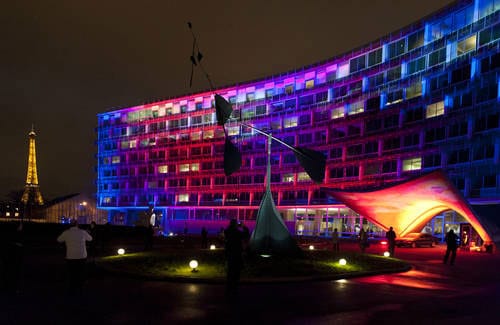
“In the beginning there was light – the Big Bang,” said Steve Chu, talking on Monday at the UNESCO headquarters in Paris during the opening ceremony of the International Year of Light and Light-based Technologies (IYL 2015). Chu – a Nobel-prize winner and former US energy secretary – was among a smorgasbord of speakers at the two-day event, which brought together scientists, artists, politicians and many others with a particular interest in light and its applications.

Being a journalist, I was at the event with my own light-based technology, the humble SLR camera. I was recording a series of interviews with people at the event, including Chu, to get their thoughts on what the year of light means to them. As I’ve mentioned in a previous article, the fact that “light” is such an all-encompassing theme can also make it difficult to get a handle on what IYL 2015 is all about. I hope that the resulting video – to be published on physicsworld.com next week – will bring clarity to some of the initiatives and projects in the spotlight this year.

(more…)

Cellular model of tissue growth could shed light on metastasis

A simple yet potentially very useful model of how living cells interact to create tissue has been created by Anatolij Gelimson and Ramin Golestanian of the University of Oxford in the UK. The simulation considers how individual cells in a colony are simultaneously drawn together by chemical signalling and driven apart by cell division and death. The research suggests that below a certain rate of division and death, the colony tends towards a compact and tissue-like steady state. Above this optimum rate, however, the cells spread increasingly far apart. Although the researchers stress that the model is highly schematic, they hope it could one day provide insights into what causes cancer cells to spread around the body.

As they grow, living cells communicate with each other by excreting chemicals that attract or repel neighbouring cells – a process called chemotaxis. While some bacteria and other single-celled organisms can respond to these chemicals by swimming, the cells that make up the tissues in our bodies move by complex mechanisms that are not well understood. The rate at which the cells move depends on the concentration of the chemical signal in the surrounding environment. Cell movement is also affected by the local density of cells, with cells moving from regions containing lots of cells – such as the bulk of a tissue – to regions with fewer cells, such as the surface of a tissue. This means that the faster the cells divide and die, the faster the cells will expand outwards from the surface of the tissue.

Opposing attraction

Gelimson and Golestanian set out to understand how these two phenomena work together to control the density of tissue. They considered cases in which chemotaxis is attractive – that is, it draws cells together. In this scenario, the amount of chemical attractant increases as the density of cells increases, and this encourages cells to stick together. This also counteracts the tendency of cell division and death to push the cells apart. By calculating the equation of motion for a particular cell, the researchers found that when the rate of cell division and death is below a certain threshold value, these opposing tendencies keep each other in check, and the density of the tissue remains constant as the tissue grows. This is analogous to the situation seen in healthy organs, the researchers suggest, and also in benign tumours.

Above a specific rate of cell division and death, however, the cells move away from each other so rapidly that chemotaxis cannot draw the colony back together. In this regime, the area occupied by the tissue diverges, causing the cells to spread all over the body. The researchers suggest that this discrete cut-off between a stable tissue and the cells spreading apart might provide insight into how a previously benign tumour can suddenly become metastatic and spread throughout the body.

Unexpected competition

The nature of the interplay between density and chemotaxis surprised Gelimson and Golestanian. “Population density is a local effect, whereas chemotaxis is non-local – cells send and receive these signals as chemicals that will travel all the way across the system,” says Golestanian. “But in our equations they appeared in very similar ways and thus they could actually compete with each other, which was not something we expected.”

The biophysicist Herbert Levine of Rice University in the US told physicsworld.com that “There is a new idea here, and there is a methodology to try to figure out what that new idea might lead to.” However, he adds that “The open issue is: is there really a match between these assumptions and some actual experimental realization right now? That’s less clear to me.” In particular, he is sceptical about any direct connection with cancer, as he says cancer cells often stick to each other because of interactions between their protein coats, and the cancers where cells stick to each other are often more likely to spread effectively because they survive transport through the bloodstream better. “To me, that’s an important part of the problem, and I think the work needs to be extended in that direction,” he concludes.

The research is published in Physical Review Letters.

Magnetic levitation spins up waxy ‘tektites’ in the lab

Solid wax models of “splash-form tektites” – tiny pieces of natural glass that are created when asteroids or comets impact the Earth – have been created in the lab for the first time by researchers in the UK. Using magnetic levitation to produce a state of weightlessness, the team created its own wax models of tektites that come in a variety of shapes – from spheres and elongated dumbbell-like shapes to doughnut formations. Geologists have long been keen to understand exactly how and when tektites form, but until now the shapes of the tektites have been derived solely from numerical simulations. The new experimental technique shows, for the first time, that the models are indeed correct.

When an asteroid or comet smashes into the Earth, a large, very hot, quantity of impact material is created and molten rock is ejected from the Earth’s surface. Tiny drops of this liquid spin and cool to form a natural glass before dropping back to the planet’s surface. Tektites are found mainly in Australasia, Central Europe, North America and the Ivory Coast – in areas associated with extraterrestrial impacts.

Spinning shapes

These droplets of splashed rock often have rotation imparted by the impact, and the shape of such spinning droplets as they fly through free space depends on the rate of spin. Rotation first deforms a droplet to create a flattened sphere. If it is spinning fast enough, the droplet assumes a more elongated shape, and as it becomes unstable it begins to pull apart and look like a dumbbell. Most importantly though, the tektites cool as they travel through the atmosphere, and so completely solidify into their final shapes before they fall to the ground. A fraction of those that survive the trip are studied by geologists to determine the type and age of the rock that was impacted. They are also used to correlate known impact sites and prehistoric extinction events, or to find impact sites that have not yet been discovered.

We could gain even more information from tektites if we understood exactly how they form in the air, but recreating such shapes in the lab is a daunting task. “There aren’t many materials that can hold molten rock, and even then you need to spin and cool a single droplet of it simultaneously,” says Kyle Baldwin of the University of Nottingham in the UK. Baldwin, together with Richard Hill, also from Nottingham, and Samuel Butler of the University of Saskatchewan in Canada, have come up with a way to do just that.

Levitated drops

The trio uses a superconducting magnet that has a strong enough field strength and field gradient to levitate diamagnetic materials – water, alcohols and wax – which are weakly repelled by magnetic fields. The researchers create their tektites by first melting wax on a hot plate, pipetting it into the magnetic field and spinning it up using carefully directed air flow. The floating wax is then allowed to cool and solidify into whatever shape it forms because of its rotation, thereby recreating some of the conditions that tektites experience as they form in the air.

Baldwin told physicsworld.com that the highly deformed shapes had only been calculated numerically using sophisticated computing and had never been measured directly by experiment. Indeed, others had tried to recreate tektites in the lab before, but in previous cases the liquid drops were either imaged while still in rotation (they never solidified) or were in contact with some kind of surface before they solidified, which affects their final shape.

“This is the major contribution of our work, to recreate the shapes of equilibrium and confirm, for the first time, that the shapes predicted by simulations are in agreement with the shapes made though experiment,” says Baldwin, pointing out that “computer simulations are only effective if they begin from an initial agreement with experiment and extrapolate forward into more complicated systems. Until now, this validation had been lacking.” Butler, who has carried out previous research on simulating tektite formation, provided supporting simulation evidence that the shapes created by the Nottingham researchers were indeed the actual equilibrium shapes of spinning liquid droplets. The team also found that above a certain droplet size (∼0.5 ml), the tektites wrinkled as they solidify – this may be similar to the surface wrinkling seen in natural tektites.

Ketchup or wax?

Thanks to the obvious difficulty of using actual molten rock in a lab, there exist a variety of analogues used by geophysicists who study the fluid mechanics of lava/magma flows. These include ketchup, honey and paraffin wax. Baldwin and colleagues chose the latter, for the simple reason that wax is solid at room temperature, and by heating it to a temperature of only about 55 °C, they could easily melt it and inject it as a liquid into the magnet bore without too much difficulty, while also giving them ample time to perform the experiment.

Splash-form tektites are one of four types that have been found. Because they are distinguished primarily by the idea that their shape is dominated by their rate of rotation, they can be perfectly recreated in the team’s experiments. “That, however, is not to say that this technique could not be extended to recreate the conditions found in the other types of tektites, such as aerodynamics,” says Baldwin. “One might imagine experimenting with, for example, the influence of air flow, bubbles, impact speed, etc to further examine the variety of conditions tektites are under as they form, but this is speculation at the moment.”

In the future, the team also plans on applying its experimental method to investigate rubble-pile asteroids, which are spun up by solar winds and deform into various shapes. These are so small that gravitational effects alone cannot explain how they hold together, but they are also too large for molecular cohesion to be sufficient.

The research is published in Scientific Reports.

The ever-expanding Zooniverse

In this podcast, Physics World journalist James Dacey catches up with Lintott to find out about the opportunities and challenges presented by inviting the general public into scientific analysis. Lintott talks about the overwhelming response he received when he launched his first citizen-science initiative in 2007 – an ongoing project called Galaxy Zoo that invites the public to help with the classification of galaxies by examining astronomical images. “We discovered that people are not just capable of doing the tasks that we set them, but also using that beautifully human quality of being distracted by interesting and unusual things in all sorts of different directions,” says Lintott.

Lintott believes that many citizen scientists are motivated by the desire to contribute to the scientific enterprise. He says that by getting involved with the “messy” business of dealing with raw data, citizen scientists can have a more genuine experience of doing science than the view that is often portrayed in films and the media. “Sometimes you can’t make a decision about a particular galaxy because it’s fuzzy or it’s edge on to us. I think what these projects really do is give people a sense of what that’s like,” he says. Lintott says that, for some people, involvement in citizen science can lead to a deeper interest in science and even going on to study science in a formal context or pursuing a career in science.

But while Lintott is keen to promote the opportunities presented by citizen science, he is also aware that certain aspects of these projects still need to be developed. For instance, he talks about the need to communicate the outcomes of citizen-science projects in a way that is accessible to general audiences. “We’re publishing in a way that frankly furthers our careers and makes the projects likely to get money and which communicates with our professional colleagues,” says Lintott, slightly tongue-in-cheek. Lintott is currently exploring alternative models for disseminating the research.

In the spirit of citizen-science initiatives, we opened up our interview to the Physics World audience by allowing people to submit questions for Lintott via our Facebook page. Towards the end of the podcast, Lintott tackles a couple of your questions.

If you want to find out more about these citizen-science projects, take a look at the Zooniverse website. Lintott was also profiled in our special 25th anniversary issue as one of the five people who are changing the way physics is done. Finally, you may want to take a look at this recently published feature article about another citizen-science initiative: the launch of two smartphone apps that allow the public to join in the hunt for ultrahigh-energy cosmic rays.

Paris ushers in the International Year of Light

By Matin Durrani in Paris

It was a grey and dank morning yesterday in the French capital, with even the top of the Eiffel Tower shrouded in clouds – perhaps not the most auspicious weather for the official opening ceremony of the International Year of Light and Light-based Technologies (IYL 2015) here at the headquarters of the UN Educational, Scientific and Cultural Organization (UNESCO).

Inside the conference hall, however, all was brightly lit. The stage was bathed in beams of light in all the colours of the rainbow as the 1500 or so delegates first watched an official IYL 2015 video and then listened as a series of dignitaries voiced their backing for the initiative.

These included a message of support from UN director-general Ban Ki-moon read out by an official and a video recording from Irina Bokova, UNESCO director-general. There were also speakers from Ghana, Mexico, New Zealand, Russia and Saudi Arabia – the five nations that took a key role in getting IYL 2015 approved by the UN in late 2013.

(more…)

Women shun fields that are perceived to require ‘innate ability’

The notion that natural ability or brilliance are required to excel in certain fields could explain the lack of women in those subjects, according to a survey of US academics. The survey, carried out by researchers also in the US, found that the more academics associate innate talent with success in their discipline, the more likely that women will be under-represented in that field.

Led by Sarah-Jane Leslie of Princeton University and Andrei Cimpian of the University of Illinois at Urbana-Champaign, the team surveyed more than 1800 academics across 30 disciplines, including 104 physicists. Using an online, anonymous questionnaire, individuals were asked – on a scale of one to seven – to score how important they believed natural ability and hard work applied to being successful in their fields. The survey also asked participants to rate the importance they thought their colleagues attached to the same qualities. Physics scored an average of 4.41 – the fifth highest of the 30 subjects. “Disciplines that emphasized the need for a special and unteachable brilliance tended to see much larger gender gaps,” says Leslie. Indeed, the proportion of female PhD graduates in physics in the US stands at 18% compared with 49.5% in neuroscience, where researchers gave it a score of 3.83.

Stereotypical subjects?

The researchers hypothesize that the under-representation of women is down to the stereotype that women have less natural ability in subjects such as physics, and that they are more likely to succeed by hard work. How academics judge women in their field and whether women see themselves as suited to work in a particular field could then be influenced by such stereotypes. The researchers also looked at several other explanations for the effect, but found no support for them. For example, they tested whether the same fields that valued natural talent demand longer hours that women may be less willing or able to work, resulting in lower female participation. However, no link was found.

Leslie recommends that physicists seeking to improve diversity should avoid using terms like brilliance and genius when teaching and supervising students, and instead emphasize the need for hard work and dedication. “I would also strongly encourage people to consider sharing personal anecdotes of how they’ve overcome challenges and struggles to get where they are,” says Leslie. Indeed, in a follow-up study, which is currently undergoing peer review, the researchers say they have found “very promising” evidence that a field that values brilliance reduces womens’ motivation to pursue a career in that area.

Provocative hypothesis

“It’s a very promising, provocative hypothesis,” says Andrew Penner, a specialist in gender studies at the University of California, Irvine. “My hope is that it will encourage new research looking further into how people think about ability, for example, looking at when students become aware of differences in how different fields conceptualize ability.” Penner agrees that the strategy of playing down innate ability and focusing more on hard work when teaching is “promising”. “Not only does it have the promise of helping redress the issue of gender inequality, but even if it isn’t successful in creating a better gender balance, it will likely make life better for women and men, and that would be a good thing,” he adds.

The research is published in the journal Science.

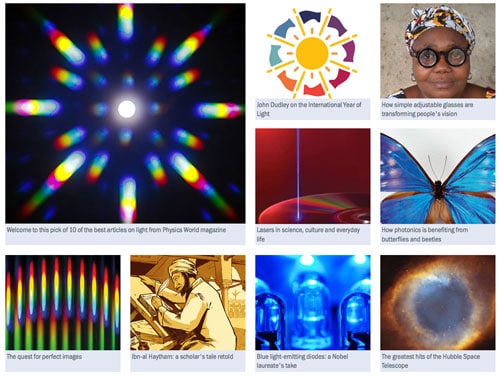
Enjoy 10 of the best Physics World articles on light

By Matin Durrani

The International Year of Light (IYL 2015), which officially launches today at the headquarters of the UN Educational, Scientific and Cultural Organization (UNESCO) in Paris, is a brilliant initiative, but if you’re wondering how to find out more about the science and applications of light, then I’ve got the perfect place for you to start.

That’s because Physics World magazine is launching today a great, free-to-read digital edition containing 10 of our very best feature articles on the science and applications of light.

(more…)

Let the International Year of Light begin

Print

By Luisa Cifarelli

Today sees the official launch of the International Year of Light and Light-based Technologies (IYL 2015) with an opening ceremony at the headquarters of the UN Educational, Scientific and Cultural Organization (UNESCO) in Paris. The idea for IYL 2015 was initiated by the European Physical Society (EPS), of which I was president for two years from 2011 to 2013. The EPS proposal was first officially welcomed – and then endorsed – by UNESCO, with full UN backing coming in December 2013.

(more…)

Entangled and stringy videos, a new chat show about the heavens, Hawking and Newton hit the Oregon Trail and more

By Hamish Johnston

This week’s Red Folder begins with a pair of videos that attempt to explain some of the most difficult concepts in physics. First up is a video featuring physicist and filmmaker Derek Muller, who does a lovely job of explaining quantum entanglement with the help of a few cardboard cut-outs and a couple of spinning avatars (see above).

(more…)

Copyright © 2026 by IOP Publishing Ltd and individual contributors