Even a thin atmosphere can keep a planet spinning freely, giving it a day-and-night cycle like Earth’s, say astronomers in Canada and France. The result implies that many of the planets lying within the habitable zones of “dim suns” – the most common type of star – could have terrestrial-type climates.
“It was a surprise,” says Jérémy Leconte, an astronomer at the University of Toronto. “We didn’t expect that there would be such a strong effect.”
Astronomers have so far discovered more than 1000 exoplanets – planets orbiting stars other than the Sun – and it is becoming clear that our tiny portion of the universe could contain vast numbers of such planets. What is not yet clear is how many of these planets could actually harbour life.
Most stars, known as orange and red dwarfs, are cooler, fainter and smaller than the Sun; so to stay warm, a habitable planet must huddle close to the star. But the closer a planet is to its sun, the stronger are the tidal forces that the star exerts on the planet. These tides can affect how fast the planet spins. In extreme cases, these tides are so strong that they produce “tidal locking”, forcing the planet to spin as slowly as it revolves. This means that one side of the planet forever faces the star, while the other side forever faces away, creating a world with a permanent day side and a permanent night side. The night side may get so cold that air freezes there, robbing the planet of an atmosphere.
Long, cold nights
Fortunately, because the Sun is much brighter than the typical star, the one planet with a pleasant climate – Earth – lies so far away that it spins freely, so most latitudes enjoy a short (24-hour) cycle of day and night. However, solar tides have dramatically slowed the spins of Mercury and Venus. Mercury spins once every 58.65 days – exactly two-thirds of its 88-day-long year. As a result, the day is so hot that it could melt lead and the night is colder than on Saturn.
Solar tides have also slowed the spin of Venus, which revolves around the Sun every 225 days and rotates every 243 days. The slight mismatch arises, scientists believe, because winds in its thick atmosphere, whose surface pressure is 93 times the that of the Earth, rub against the planet’s surface and alter its spin.
Leconte and his colleagues wondered what would happen if a planet with a thinner atmosphere, like that of the Earth, revolved close to an orange- or red-dwarf star. To their surprise, the calculations indicate that, in many cases, such a world can still rotate freely. For example, a planet orbiting a red-dwarf star that is 60% as massive as the Sun does not suffer tidal locking, even if it is only a third as far from the star as Earth is from the Sun. That distance puts the planet in the red-dwarf’s habitable zone, where temperatures are pleasant and liquid water can exist. And if the planet’s atmosphere is 10 times thicker than that of the Earth, the planet can be even closer and still rotate freely.
Locked yet lively
What are the implications for habitability? “It’s a tricky question,” Leconte says. On the one hand, the climate of a freely spinning planet can mimic Earth’s. On the other hand, the day side of a tidally locked planet could also support life, because previous studies have found that an atmosphere can ferry heat to the night side, so that the air does not freeze and disappear.
Jack Lissauer, a planetary scientist at NASA’s Ames Research Center in Moffett Field, California, calls the result interesting and important. “It applies to a lot of planets,” he says, because orange- and red-dwarf stars are common, and some even have known planets in their habitable zones. But, like the researchers, he doubts that the new work says much about the planets’ ability to host life, noting that the close-in worlds of small stars face other challenges. For example, a planet near its star speeds through space quickly, as Mercury does, so asteroids and comets can smash into the world so fast they may eject its atmosphere – hardly a good condition for living beings. In contrast, asteroid and comet impacts probably helped the Earth by bringing it much of its water.
Leconte and colleagues describe their work in Science.
Science and the ballot box. (Courtesy: iStockphoto/stocksnshares)
By Michael Banks
Yesterday evening I went to the Royal Society in London to hear what the three main political parties in the UK have to say about science. The event was held because in May voters in the UK will be heading to the polls to choose their next government. The three parties had therefore sent their main science representatives to the Royal Society to spell out their intentions.
Chairing the debate was space scientist Maggie Aderin-Pocock of University College, London. She had the unenviable task of keeping science minister Greg Clarke (Conservative), Liberal Democrat science spokesperson Julian Huppert, and shadow universities, science and skills minister Liam Byrne (Labour) in check. For non-UK readers, it’s worth pointing out that the Conservatives have been in coalition with the Liberal Democrats since 2010.
Harnessing the technology, and curiosity, of the public in the pursuit of scientific discovery is nothing new. For at least 15 years, Internet-connected computers have been exploited collectively to number-crunch data generated by everything from the hunt for extraterrestrial radio signals to experiments on how proteins fold. While there are still no signs of alien intelligence, this distributed approach to problem-solving has produced results – such as the discovery of dozens of new quasars by the Einstein@Home project. To date, however, such “citizen science” initiatives have processed data collected by professional scientists. Two new projects, based at the University of Wisconsin–Madison and the University of California, instead rely on observations carried out by members of the public, via a gadget that has become a fundamental part of many people’s day-to-day existence: the smartphone.
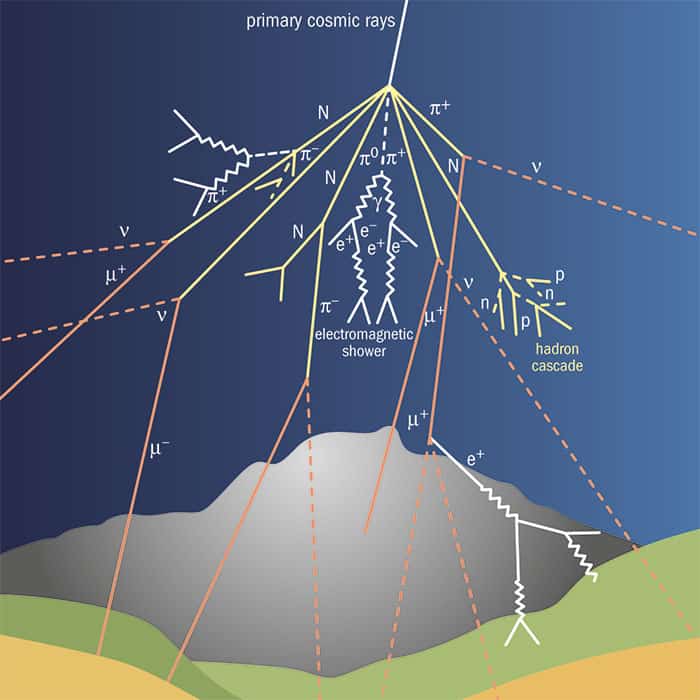
As their names suggest, both apps – the Distributed Electronic Cosmic-ray Observatory (DECO) and Cosmic Rays Found in Smartphones (CRAYFIS) – transform smartphones into miniature cosmic-ray detectors. They use the CMOS chips inside phones’ onboard cameras to detect the secondary particles produced when cosmic rays – energetic, charged subatomic particles arriving from beyond the solar system – collide with air molecules in the Earth’s atmosphere (figure 1 below).
Figure 1: Schematic figure showing particle tracks emanating from a single primary cosmic ray in the sky. Secondary particle tracks labelled include the pion, muon, neutrino, proton, neutron, electron and positron.
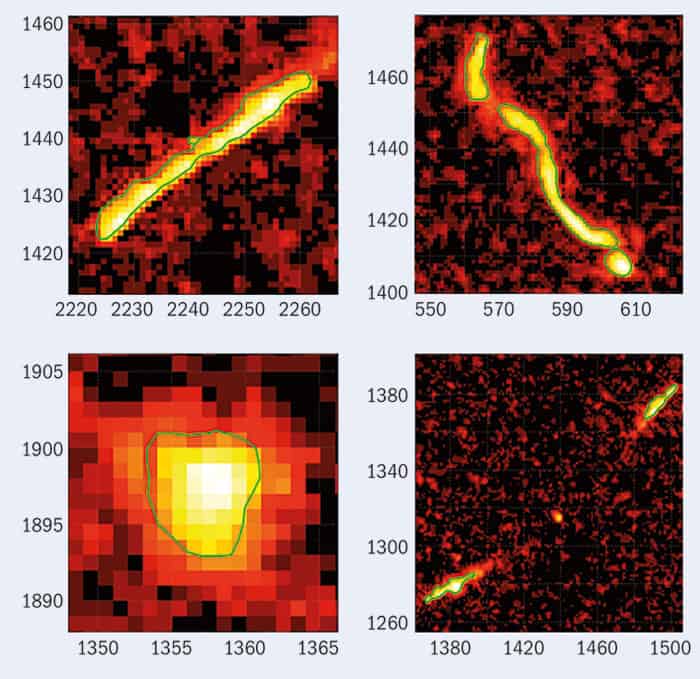
All you need to get started is to download the app from the Internet (see links at the end of this article), plug your phone in and then place it face-up on an opaque surface. With the camera obscured in this way, the CMOS pixels are more or less shielded from visible photons but remain exposed to particles from cosmic-ray showers, such as higher-energy photons and muons, which can pass through walls, tables and plastic phone cases to generate a measurable voltage when they ionize atoms of silicon. The resulting pattern of bright pixels is stored within the phone as a stream of data, which is then uploaded to a central server to be analysed whenever a wireless Internet connection becomes available (figure 2 below).
The two apps, which were in the final stages of beta development as Physics World went to press, will be used as educational tools, providing both school students and members of the public with a hands-on, readily available means for exploring aspects of astrophysics, particle physics and nuclear physics. But it is hoped that they could also be used to carry out original research.
According to CRAYFIS developer Daniel Whiteson of the University of California, Irvine, the near ubiquity of smartphones makes them ideal instruments to try and intercept the particle showers produced by the very highest-energy cosmic rays – the origins of which still remain a mystery to physicists.
Figure 2: Four particle-detection images from the DECO smartphone app which picks up particles from cosmic-ray showers, such as higher-energy photons and muons.
He points out that existing cosmic-ray observatories occupy thousands of square kilometres of land and cost tens of millions of dollars to build, whereas a smartphone-based detector network would require no physical space and its costs would be limited to the computing equipment needed to collect and process data. “There are something like two billion smartphones out there,” he says. “It is a valuable infrastructure that we need to take advantage of.”
Pocket detectors
This is not the first time that mobile phones have been used as radiation detectors. For several years, apps have allowed smartphone users to detect radon leaks at home or to record cosmic-ray doses onboard aircraft, for example. A year ago, physicists at the Idaho National Laboratory in the US said that they had developed a new algorithm that allows CMOS cameras to be used as detectors of ionizing gamma rays and which, among other things, could be used to carry out initial measurements of fallout in the event of a nuclear meltdown. Astronomers, meanwhile, have known for many years about the tracks left by cosmic rays in the images they take with CCD cameras, which they usually regard as background radiation that needs removing.
The latest work inverts that logic, based as it is on algorithms that search for signals of cosmic rays against a background of ambient radioactive decays, thermal fluctuations and electronic noise. Conventional cosmic-ray observatories use numerous particle detectors that are fixed in space and spread sparsely over large areas of the Earth’s surface in order to maximize the chances of intercepting the particle showers from the most scientifically interesting rays – those that strike the atmosphere with at least 1019 eV. Scientists have still to identify an astrophysical process with enough power to generate such ultrahigh-energy cosmic rays, and have not yet observed enough of the rays to pinpoint their origin in the sky, given that only about one of them arrives over any given square kilometre of land every century. Detecting them in sufficient quantities would require a far larger facility than the biggest that exists today – the 3000 km2, $53m Pierre Auger Observatory in Argentina. (See “100 years of cosmic rays” by Alan Watson, August 2012 pp35–40.)
The appeal of turning instead to mobile phones is that, in principle at least, bagging more rare events is simply a question of getting more people to download the app. The idea of using the “mini particle detector in your pocket” as Whiteson puts it, came to Whiteson and his particle-physicist colleague Michael Mulhearn of the University of California, Davis over beers one evening in late 2013 while they were working on the Large Hadron Collider (LHC) at CERN in Geneva. Their work on the ATLAS and CMS detectors meant they had experience of the CMOS technology used in smartphones, but at the same time they had become frustrated with working inside large collaborations. “We asked ourselves how we could do something interesting on a smaller scale,” says Whiteson, “and as we were chatting and playing with our phones it occurred to us that the phones themselves could provide the answer.”
Figure 3: Cosmic Rays Found in Smartphones (CRAYFIS) – transform smartphones into miniature cosmic-ray detectors – a screenshot from the CRAYFIS app gives a readout.
The pair then set about calculating how many smartphones would be needed to do real scientific research, given the limited size and efficiency of phones’ CMOS sensors. As they explain in a paper published on the arXiv preprint server (arXiv:1410.2895), they worked out that to be confident of intercepting almost every shower produced by cosmic rays with an energy of at least 1020 eV, some 1000 activated phones would be needed in each square kilometre of coverage – the idea being that at least five phones should register a hit within five seconds of one another in order to distinguish signals from (uncorrelated) noise. The researchers also calculated how big an area they would need to cover in order to match Pierre Auger’s “exposure” – the product of its observing area, field of view and duration of data taking – and the answer they came up with was 825 km2. They therefore concluded that the total number of phones needed would be around 825,000.
The magic million
As Whiteson admits, that is a lot of phones. Nevertheless, he is confident of meeting the target. He and his colleagues were due to release the CRAYFIS app at the end of 2014, having held it back while upgrading their servers to handle the large number of expected users. Within several weeks of publicizing the project in mid-October, they had signed up some 50,000 people to help test the beta version of the app, and were planning for “one big PR push” before 2015. They were also designing a number of ways to maximize interest, such as getting users involved in data analysis and adding the names of particularly productive individuals to future scientific papers. “I think we can reach the one million mark,” he says.
Alan Watson of the University of Leeds, one of three physicists to propose the Pierre Auger Observatory in the early 1990s, praises the two apps as “really imaginative” and notes that their developers have the advantage of not having to “deal with the farmers.” Instead, as he puts it, “you will have one million landlords who are taking part voluntarily.” However, Watson questions just how well a smartphone-based network will be able to perform. In particular, he takes issue with the assumption by Whiteson and colleagues that smartphone cameras will have an 80° field of view, estimating the real figure to be closer to 45°. He also points out that using muons to measure cosmic rays’ energy, as Whiteson’s group is planning to do, relies on uncertain model-based values of muon production rates.
Pierre Auger spokesperson Karl-Heinz Kampert of the University of Wuppertal in Germany has a more fundamental objection. He argues that individual smartphones have such a low probability of detecting particles from a cosmic-ray shower that any hits they do register are likely to be drowned out by background noise. In addition, he thinks it is unlikely that the number density of phones will ever get high enough to meet the five-phone triggering criterion. Kampert also believes the California researchers have overestimated the energy and angular resolution possible with a smartphone network.
Doubts about just how much research these apps will be able to carry out are shared as well by DECO creator Justin Vandenbroucke of the University of Wisconsin–Madison. As Vandenbroucke points out, not even the iconic distributed-computing project set up to search for signs of alien intelligence, SETI@home, has managed to attract as many participants as a smartphone-based cosmic-ray observatory would need (it currently has around 120,000 active users). He adds that interpreting the results obtained by smartphones will be complicated by the fact that a portion of a cosmic-ray shower is absorbed as it passes through the walls of buildings and that this absorption varies from user to user. Rather than using DECO to calculate cosmic rays’ energy and direction, his group is instead concentrating on the more basic identification of particle events recorded by phones – muons for example, tending to leave straight tracks within CMOS images. “We have the philosophy that if we can do extensive air-shower cosmic-ray physics that is great but if not there is still a lot we can do in education and outreach.”
DECO is publicly available and has so far been downloaded several thousand times, according to Vandenbroucke. There are a number of minor technical issues that still need ironing out, he says, such as the fact that the shutter-effect sound cannot currently be switched off on certain smartphone models – which can prove quite irritating when images are captured once every second or so, as they are with DECO. Vandenbroucke and his colleagues are also working on a user-friendly interface to allow participants to analyse their own data, and are working with teachers to integrate the technology into school curricula. In addition, he says, they plan to collaborate with the CRAYFIS team. “These apps make the science more accessible,” he adds. “People are used to reading about the LHC but here they can use the exact same detector principles on a much smaller scale using their own devices.”
Whiteson too believes the smartphone detectors could prove a valuable asset in school classrooms. But he is adamant that their use need not be limited to education. “We might get only 100,000 users and do no science, but we could get 50 million and if we did we would have 50 times the observational power of the world’s biggest telescope,” he says. “We might also see things we hadn’t anticipated. When you build something new you often get unexpected results.”
I actually really disliked physics in high school, but I was good at mathematics and science, so I thought my dislike of physics might be something I could recover from. Then when I went to university, I had an incredible physics teacher who showed me the beauty of it. What attracted me was the fact that we have this human invention called mathematics, and somehow it correlates with the real world. I still find that extremely profound. In some sense, it’s the greatest mystery of all, and it’s why I became a theorist. I did my PhD in particle physics with Geoffrey Chew at the University of California, Berkeley, and I was a sort of “physics groupie” – in my spare time I was reading biographies of Dirac and other great physicists as well as learning about quantum field theory and the Higgs boson.
Did you ever think about continuing in physics?
I thought about it, but the early 1980s was not a great time for theorists in particle physics. We had all these theories, but we weren’t sure what experiments were going to be built that could actually test them. There also weren’t a lot of jobs available. But what led me away from physics wasn’t disillusionment – it was more that I had developed this other passion as well, for film.
How did you become interested in film?
I was always interested in it in a populist kind of way, but it wasn’t until I was an undergraduate that I became aware of European film and started seeing cinema as a medium that could be serious and surprisingly deep. Then when I was at Berkeley, I lived in an in-law apartment with this older lefty couple who were real cineastes, and that’s when I realized that people actually make movies – they don’t just emanate from Hollywood fully formed. I found Eastern European cinema particularly fascinating. It was amazing that these directors, who often worked under very restrictive political conditions, were making remarkable films with depth and complexity that revealed something profound about human existence.
How did you get into filmmaking as a career?
I started out by writing a script, which was almost like being a theorist: I went from sitting in my room by myself with a paper and a pencil, coming up with a theory of the world and not getting paid much, to writing a script in pretty much the same conditions. When I realized I needed to learn more practical skills, I answered an ad for an intern in a local production. I worked on a variety of things – location scouting, art department, craft services and so on – and afterwards I became an assistant in the edit room. Gradually I began to specialize in working with actors in post-production to fix and add lines. That area of filmmaking is called ADR, and it became my “day job” while I was working on my script and shooting my first film, which was about a fictional painter and writer in Eastern Europe trying to adapt to the changes of glasnost.
How did you get involved with Particle Fever?
I had always thought I might do something about science in order to justify the fact that I started my film career with a physics PhD. Then some investors told me about a physicist, David Kaplan, who had presented them with a proposal for a documentary about an experiment that might not work, and even if it did, it might not find anything. They thought it was a bad idea, but of course I thought it sounded great. So I contacted David and told him that although I wasn’t interested in doing a traditional, informational physics documentary, if we could make it into something that was character-driven, where I could use my narrative storytelling techniques, I would be really excited. He was all for that as well, so that’s how we got started.
What was your favourite part about making the film?
My favourite part of any project is finishing it, but when I think back on the process, I really enjoyed working with the physicists in Particle Fever, because it meant I was in that world again. It was really satisfying to reconnect with my feelings about physics. Also, on a dramatic film, the period when you actually get to interact with actors is relatively short, but with Particle Fever I got to work with the physicists for five years, and that was very rewarding.
Any advice for today’s physics students?
Follow your passion. Physics is an incredible endeavour and like anything worth doing, it’s hard, with a lot of frustration, but the rewards are great. Ironically, I think I’d give the same advice to filmmakers. In both physics and filmmaking, you don’t know what’s going to happen, but if you really love it and you’re committed to it, then I think it leads to a very worthwhile life. When I gave a talk to some students recently, they asked me what I thought the best thing was about being a physicist, and I told them you get paid to think about the mysteries of the universe. That’s a pretty good gig.
Did you manage to solve Physics World’s festive puzzle, published last month? In case you missed it, take a look at part 1 and part 2 and see how you fare. The puzzle was created for Physics World by Colin of the UK’s Government Communication Headquarters (GCHQ), whose full identity cannot be revealed.
Spoiler alert: the solution in full is posted below.
Nitrogen-vacancy (NV) impurities in diamond have optical and electronic properties that make them ideal for developing quantum technologies, including quantum computers and quantum sensors. However, creating NVs with nanoscale precision has proven difficult and a barrier to making practical devices. Now, physicists in the US and Australia have developed a new technique for making NV centres at precise locations within tiny, high-quality optical cavities.
Atomic impurities, or defects, in natural diamond give rise to the pink, blue and yellow hues often seen in the precious stones. One such defect involves two adjacent carbon atoms in the diamond lattice being replaced by a nitrogen atom and an empty lattice site (or vacancy). When illuminated with laser light of a certain colour, the NV centre emits light of another colour. The intensity of this light depends on the spin of the electron in the NV. An important property of the NV centre is that the spin is shielded from the surrounding environment and can therefore be used to store and process quantum information.
A challenge facing quantum-device developers is how to get light into and out of the NV in an efficient way. This could be solved by coupling the NV to an optical cavity, but conventional methods for creating NVs – such as ion implantation – are not accurate enough.
Atom-scale positioning
“To benefit from the enhanced emission made possible by optical cavities, NVs need to be positioned at a particular spot inside these cavities so that the two structures optimally interact,” explains team leader Evelyn Hu of Harvard University. “The problem is that cavities that are ‘matched’ to NV centres are challenging to fabricate. The NV centre is atom-sized, and thus understanding how to place it within exactly the right place in the cavity is difficult too.”
Using NVs grown by a technique called “delta doping” might be a solution to this problem, she says, because it allows us to position an NV in a cavity with unprecedented accuracy in the horizontal plane. “The term ‘delta-doped’ comes from mathematics – the ‘delta function’ – and in this case indicates that the NVs are intentionally created only within a 2D plane, and should not exist elsewhere,” explains Hu.
The cavity used by the team is called a “photonic crystal nanobeam” and is made by drilling a line of equally spaced holes (each about 150 nm diameter) in diamond. The cavity supports standing electromagnetic waves, and is designed to resonate at the frequency of the light emitted by an NV, thereby enhancing the light output of the NV.
Centring NVs inside a nanobeam
The researchers achieved their accurate positioning by first identifying the horizontal plane in which the NVs are located. “We are able to identify the z co-ordinates of delta-doped NVs – that is, we are able to work out the plane in which all of the NVs in a sample are located,” says Hu. “By forming the nanobeams around this plane, we are sure that all of the NVs are centrally located inside it.”
“Our cavities are also very high quality, which means that optical losses are kept to a minimum,” Hu says. “Indeed, we measured quality factors (Q) as high as 24,000. Previous experiments reported values of up to 6000.”
The team, which includes scientists from the University of California at Santa Barbara, the University of Chicago and the University of Technology in Sydney, says that it would now like to be able to accurately position the NVs in 3D – that is, within each horizontal plane.
The curvature of a gravitational field across a distance of about 1 m has been measured for the first time by studying clouds of ultracold atoms interfering with one another in the presence of large, nearby masses. The measurement – made by physicists in Italy and the Netherlands – could be used to make better maps of the Earth’s gravitational field, search for oil and provide a new way of measuring the Newtonian constant of gravity.
Atom interferometry has been used for more than a decade to study gravity – the basic idea being to fire a series of upward and downward laser pulses at a cloud of ultracold atoms held in an evacuated vertical column. The lasers split the atoms into two clouds that travel upwards at different rates and so reach different heights over a certain time. Governed as they are by quantum mechanics, the atoms behave like waves, and so the two clouds become slightly out of phase as a result of taking two different paths.
Using further laser pulses, the clouds are made to recombine at a certain point in the column, with the interference between the atoms revealing the phase difference between the clouds. This phase shift is related to the gravitational field experienced by the atoms, which can therefore be calculated. Last year a group led by Guglielmo Tino of the University of Florence extended this idea by making simultaneous measurements on two such “gravimeters” separated by a vertical distance of about 50 cm.
Measuring Newton’s G
To ensure that there was a measurable gravitational effect on the atoms, the researchers surrounded the vacuum column with large cylindrical masses. The gradient of the field was then the difference in gravitational field at the two locations divided by the distance between the two gravimeters. From the gradient and the gravitational field of the masses, Tino and colleagues then worked out a value for Newton’s gravitational constant G, which defines the gravitational attraction between two masses.
Tino and colleagues in Florence, the University of Bologna and the European Space Agency in Noordwijk, have now used the same apparatus to measure gravity at not two different heights but three. This has let them measure the change in the gravitational gradient as a function of height – its curvature – caused by the large masses near the trajectories of the clouds. The experiment also allows two simultaneous measurements of G to be made, something that could shed light on an important mystery surrounding the value of G.
G is a notoriously difficult fundamental constant to measure, and is currently defined to four significant figures, which is much less precise than other fundamental constants. While several different experimental techniques have been used to measure G in labs around the world, they give results that disagree to a much larger degree than the known experimental uncertainties of each measurement. This suggests that either unknown systematic effects are at work or, tantalizingly, that G is not necessarily constant in space or time.
Better gravity maps
Tino’s set-up could also, in principle, be used to make very accurate measurements of how the Earth’s gravitational field changes from location to location. This would improve the spatial resolution of gravity anomaly maps of the Earth, which are used to locate underground oil and mineral reserves.
Tino and colleagues are now looking at how they could further extend their system to include multiple interferometers that could be used to measure high-order derivatives of the gravitational field.
In what could be described as the West Country’s answer to Diwali, the city of Bath in the UK has just hosted an eight-day festival of light, featuring colourful public artworks based on lighting technologies. “Illuminate 2015” was one of the first events on the calendar in this International Year of Light, the UNESCO-supported celebration of light science and its applications. I popped along to the event last Thursday to find out what it was all about and I’ve put together this short film, which includes the event’s creative director Anthony Head explaining what the festival is all about.
“It’s a subtle introduction to experimenting with science,” says Head, referring to the fact that many of the exhibits are interactive and involve some playful experimentation. One such exhibit, called “Light Painting”, invited the general public to create images that were then projected onto some of the local buildings. Another exhibit, called “Sonic: Sullis”, enabled people to create sounds and light projections by simply disturbing water contained in a box.
A controversial claim by the DAMA group that it has detected dark matter in an underground lab in Italy might turn out to be true after all, according to physicists in Europe and the US. The new research reconciles the claimed detection with apparently null results from other experiments, as well as indirect astrophysical evidence. It proposes that dark matter interacts with ordinary matter not via one of the four known fundamental forces but instead through a fifth force mediated by an axion-like particle.
Dark matter is an as-yet-unknown substance that does not emit electromagnetic radiation but which numerous observations suggest makes up at least 80% of the matter in the universe. DAMA, a collaboration of physicists from Italy and China, says it has directly observed dark matter in a sodium-iodide detector located beneath Gran Sasso mountain east of Rome. The basis for its claim is a seasonal variation in the number of tiny flashes of light that should occur when dark matter collides with nuclei in the detector. The group argues that this variation – which peaks in June and has a minimum in December – is just what would be expected as the Earth moves through a “halo” of dark matter surrounding the Milky Way.
Discovery or background effect?
Having collected a whopping 1.33 tonne-years of data, DAMA says there is almost no chance that its results are a statistical fluke. It now reports a confidence level of 9.3σ, which is well above the 5σ usually required for a discovery in particle physics. The problem is that a number of rival groups operating different kinds of detectors have reached sensitivities that they say should have allowed them to also detect dark matter, assuming the DAMA claim to be correct, but that they have failed to do so. While there is little doubt that DAMA has detected an annual modulation, many physicists take issue with the group’s interpretation of its results. Some argue that the modulation could simply be a yet-to-be-determined background phenomenon.
However, as pointed out by Eugenio Del Nobile of the University of California,Los Angeles, such exclusions rely on theoretical assumptions about the kinds of interaction taking place inside the detectors. In the latest work, Del Nobile and two colleagues – Chiara Arina of the University of Amsterdam and Paolo Panci of the Institut d’Astrophysique de Paris – have shown how a certain kind of force-mediating particle can reconcile the various experimental results.
Unlike the force-carrying particles of the Standard Model, which have a spin of 1, the proposed particle is spin-0. In that sense it is like the famous Higgs boson, which is known as a “scalar” particle. However, unlike the Higgs boson, the quantum state of the new particle changes when its spatial co-ordinates are reversed, a property that earns it the title “pseudoscalar”. This also makes it similar to the hypothetical axion, which is another contender for dark matter.
A new spin on interactions
This asymmetry would make any collisions between incoming dark-matter particles and detector nuclei sensitive to the spin of those nuclei. Protons and neutrons would organize themselves into pairs with opposite spin to minimize the energy of the nucleus, and consequently interactions would involve, at most, a single unpaired proton or neutron. This contrasts with the “spin-independent” interactions generally assumed to take place inside detectors. These involve a summing across all protons and neutrons, and are therefore much stronger – which is why some detectors use heavy targets such as xenon.
To calculate the effect of the pseudoscalar mediator, Del Nobile and colleagues assumed that it acts equally on all quark types – quarks being the fundamental components of protons and neutrons. This, they explain, results in dark matter interacting much more strongly with protons than with neutrons. And as they point out, that would favour DAMA as a dark-matter target, because its constituent sodium and iodine nuclei contain odd protons. Other dark-matter detectors use xenon or germanium, which contain odd neutrons. This would therefore be much less sensitive than DAMA and explain why DAMA alone has measured a strong annual signal.
The team has also shown that the pseudoscalar interaction could explain an excess of gamma rays observed at the centre of the galaxy in terms of annihilating dark-matter particles. Del Nobile stops short of arguing that his group’s analysis now makes it more likely that DAMA has seen dark matter, cautioning that the work involved simplifying the properties of the galactic dark-matter halo. But he says the onus is now on rival experimental groups to “spell out their assumptions” when claiming to have ruled out the DAMA result. He adds that the pseudoscalar model could be tested at colliders producing K or B mesons.
Unnecessary complication
However, Juan Collar of the University of Chicago believes that Del Nobile and colleagues might have complicated things unnecessarily. Has the DAMA dark-matter mystery been solved at last? Collar, who has provided tentative support for the DAMA claim by observing a statistically limited annual modulation in data from the CoGeNT dark-matter detector in the US, says that the apparent conflict between experimental results might be resolved if dark matter were to collide with electrons, rather than nuclei. “Having said that,” he adds, “I think it is very interesting that these authors can still find room to wiggle while limiting themselves to nuclear-recoil interactions.”
Pop physics: some of the subgenres used in a study of pop music. (Courtesy: Gamaliel Percino, Peter Klimek and Stefan Thurner/PLOS ONE 10.1371/journal.pone.0115255)
The researchers used the online music database Discogs to sort the material on 500,000 albums into 15 musical genres and 374 subgenres. You can see examples of some of the subgenres in the above image. They discovered that as a genre of music becomes more popular, it becomes less complex as all its constituent artists and songs start sounding the same. Music.Mic’s Tom Barnes explains in his article how this ties in with various trends in the music industry, where he says “uniformity sells”.