Optical tweezers grab nanometre-sized objects

Optical “nanotweezers” that can grasp and move objects just a few tens of nanometres in size have been created by researchers in Spain and Australia. The new tool is gentle enough to grasp tiny objects such as viruses without destroying them, and works in biologically-friendly media such as water. The nanotweezers could find a range of uses, from helping us to understand the biological mechanisms underlying diseases to assembling tiny machines.

Controlling the placement of individual molecules is critical in medicine, for example, where investigating the origin of diseases often requires manipulating viruses or large proteins. The accurate placement of tiny objects such as carbon nanotubes is also expected to play an important role in the development of nanotechnologies such as molecular motors and other tiny devices.

Beating the diffraction limit

While nanometre-sized objects can be moved around using conventional optical tweezers, the precision to which this can be done is subject to the diffraction limit – about 300 nm for visible light. However, this limit does not apply to near-field light waves. These exist near light-emitting regions and drop rapidly in intensity across distances that are much smaller than the diffraction limit.

In the 1990s some researchers suggested that a near-field scanning optical microscope could be capable of trapping and manipulating objects as small as a few nanometres. This type of microscope captures near-field light by scanning a tiny aperture – usually tens of nanometres in diameter – just a few nanometres above the object of interest.

Too hot to handle?

Turning such a microscope into optical tweezers involves firing laser light through the aperture, thus focusing it to a tiny spot of near-field light. As in current optical tweezers, the intensity gradient of the light across the spot draws tiny dielectric objects to the spot’s centre, where the electric field is strongest. In principle, this could allow tiny objects to be held and manipulated with nanometre precision. However, experimental tests of this technique were never done because of the concern that the concentrated light at the tip of the microscope would be so intense that it would damage heat-sensitive objects or even the microscope tip itself.

Now, Romain Quidant at the Institute of Photonic Sciences in Barcelona and colleagues have shown that tiny objects can be successfully trapped and manipulated using light of much lower intensity than had been contemplated in earlier designs. The team’s set-up involves a 1-μm-diameter optical fibre with an 85-nm-wide bow-tie-shaped aperture milled into its end (see image above).

A firm handshake

Quidant and colleagues reduced the intensity using a new technique called self-induced back action (SIBA) trapping that relies on adjusting the local field intensity in real time, based on the behaviour of the specimen. “The trapped object plays an active role in the trapping mechanism,” says Quidant. He explains that the trapping process is like a firm handshake that neither crushes nor releases the object. This method reduces the intensity of light needed to hold the object by several orders of magnitude, which removes the possibility of damage to the tip or object.

Quidant and colleagues used a near-infrared laser the power of which could be modulated between 2–5 mW. The researchers showed that polystyrene beads 50 nm in diameter – about the size of the virus that causes yellow fever – suspended in water could be successfully trapped and held for longer than 30 min. As well as firing the laser down the fibre so that light emerged from the aperture, the team also looked at an alternative set-up in which the laser was shone through an external lens that focused it onto the aperture. However, the researchers concluded that this external illumination configuration was inferior because the position of the aperture had to be fixed, which limited the mobility of the sample.

“We foresee this technique could become a universal tool in nanoscience, in any research where the non-invasive manipulation of nano-objects would be required,” says Quidant.

The nanotweezers are described in Nature Nanotechnology.

Neil Turok urges caution on BICEP2 results

Yesterday, researchers from the Background Imaging of Cosmic Extragalactic Polarization (BICEP2) telescope at the South Pole revealed that they have detected the first evidence for the primordial B-mode polarization of the cosmic microwave background (CMB). The astronomers claimed that the primordial B-mode polarization signal – which is related to primordial gravitational waves that flowed through the early universe – is the first direct evidence for cosmic inflation and has been measured to a statistical certainty of 3σ. Now, cosmologist and Perimeter Institute director Neil Turok, who worked on an inflationary model of his own with Stephen Hawking in the 1990s, urges caution and says that extensive experimental confirmation is necessary before BICEP2’s results can be considered as evidence for inflation.

Ugly tweaks

“If…and it’s a big if…this is true, it would be spectacular evidence for what happened at the Big Bang,” Turok told physicsworld.com. While he agreed that at first glance, the BICEP2 observations are in keeping with inflation “as suggested over 30 years ago, wherein space–time would resonate with the aftershocks of inflation and would ring like a bell”, a closer look at the discrepancy between the new results and previous data from the Planck and WMAP telescopes is what worries Turok.

I believe that if both Planck and the new results agree, then together they would give substantial evidence against inflation!

Neil Turok
Photo of Perimeter Institute director Neil Turok

Indeed, the tensor-to-scalar ratio of 0.20 that BICEP2 measured is considered to be significantly larger than that expected from previous analyses of data. But the BICEP2 researchers said in their press conference yesterday that they believe certain tweaks could be made to an extension of the ΛCDM cosmological model that could make the two results agree.

“But these tweaks would be tremendously ugly….and in fact, I believe that if both Planck and the new results agree, then together they would give substantial evidence against inflation!” exclaims Turok, further explaining that “[we] must be careful before we treat them as true”.

Inflationary recipes

Astrophysicist Peter Coles, who is based at the University of Sussex in the UK, is also cautious about the BICEP2 data interpretations. He told physicsworld.com, “It seems to me though that there’s a significant possibility of some of the polarization signal in E and B [modes] not being cosmological. This is a very interesting result, but I’d prefer to reserve judgement until it is confirmed by other experiments. If it is genuine, then the spectrum is a bit strange and may indicate something added to the normal inflationary recipe.” He also cautions that if true, the results would constitute an important consistency check on a certain class of inflationary theories, but would not be direct evidence. “In order to be direct, we would have to be able to state categorically that it couldn’t be generated in any other way. I don’t think we can say that.” Indeed, Coles has set up a general “straw poll” on his blog, asking people to vote on the results. At the time of writing, his results show that most people believe that it is too soon to decide.

If it is genuine, then the spectrum is a bit strange and may indicate something added to the normal inflationary recipe

Peter Coles

Turok says that the BICEP2 experiment “is absolutely heroic”, but also that possible contamination could have occurred during data taking. Although the telescope is based in the South Pole – one of the clearest places on Earth for observational astronomy – there could be noise thanks to the Earth’s atmosphere. He also says that the signal could be contaminated thanks to signals from dust in the galaxy (known as synchrotron radiation), as well as due to lensing, because the observations are made through galactic clusters. The BICEP2 team says in its paper that it has ruled out contamination from synchrotron radiation and dust at a statistical significance of about 2.3σ. But Turok is unimpressed with those values, and points out that the final 5σ discovery that the team claimed needs to be better explained.

Extraordinary proof?

While he extends his “kudos” to the team for going after a really fascinating question, Turok currently remains a sceptic. “I will quote Carl Sagan and say ‘extraordinary claims require extraordinary evidence’, and they don’t have extraordinary evidence just yet.” He reiterates that the BICEP2 and Planck/WMAP discrepancies need to be resolved, and that result will be essential because “something has got to give”. He urges other experiments to confirm the results and suggests that the combined observational results should then fit a simple yet detailed cosmological model before the BICEP2 observations can be thought of as proof of primordial gravitational waves or indeed inflation.

“I am a humble theorist,” says Turok with a laugh, “now the real task is for the experimental community to scan and replicate results…it might take months or years and there is still everything to play for but we should have an answer relatively soon.”

The BICEP2 results are available here.

Related stories

Making brain-busting ideas easier to grasp

With all the talk yesterday of evidence for inflation and signs of primoridal gravitational waves imprinted on the cosmic microwave background, many non-physicists (and probably quite a few physicists too) might have been left scratching their heads at the implications of the findings obtained by the BICEP2 experiment at the South Pole.

Unfortunately, there’s no getting away from the fact that many concepts in physics are hard and that cutting-edge experiments are incredible feats of technical endeavour. We can, though, all take solace from the fact that physicists at the frontiers of research have often spent decades living and breathing their subjects, which means they know the basics of their own field far better than anyone else.

All of which underlines the importance for any good physicist of a decent physics education – in fact, if you haven’t already, you might want to download our free PDF of the March issue of Physics World magazine. It includes tips, tricks and techniques for helping you to teach and learn physics from those in the know.

One feature examines the use of “doodling” to help you follow a lecture. Rather than laboriously scribbling down everything a lecturer says, the idea is to create a piece of annotated visual art showcasing the key points of the lecture. By thinking visually, you’re more likely to remember what was said. And to illustrate the concept, we invited professional “science doodler” Perrin Ireland to doodle a lecture given by the great Richard Feynman 50 years ago.

You can see Ireland’s Feynman doodle here, but we also invited you to send in doodles of your own. Our favourite so far is by 51-year-old reader Tracey, who is currently preparing for a GCSE in mathematics in Oxfordshire, UK. Her partner is a physicist who subscribes to Physics World and it was while flicking through the March issue of the magazine that she noticed Ireland’s doodle. Tracey also enjoys art and her doodle, pictured above, is painted in watercolours.

Before this she worked as a volunteer in classes run by Oxfordshire County Council to help adults pick up basic maths skills and also served as a learning support assistant in maths and English classes at a local college. “The mathematician I used to help is brilliant and he inspired me to study GCSE maths, which he is currently teaching me,” says Tracey. “Maths is not a natural subject for me, although I enjoy the challenge of it and I can understand how a lot of students fear the subject!”

If you’ve got a doodle of your own up your sleeve, do link to it below or e-mail us at pwld@iop.org.

And if you don’t get Physics World each month, simply join the Institute of Physics to get access via our apps or desktop version via this link for just £15/€20/$25 for 12 issues a year.

BICEP2 finds first direct evidence of cosmic inflation

The first evidence for the primordial B-mode polarization of the cosmic microwave background (CMB) has been detected by astronomers working on the Background Imaging of Cosmic Extragalactic Polarization (BICEP2) telescope at the South Pole. The polarization signal is the first direct evidence for cosmic inflation and has been measured to a statistical certainty of 3σ. The primordial B-mode polarization is related to primordial gravitational waves that are thought to have abounded in the early universe.

Cosmologists believe that when the universe was very young – a mere 10–35 s after the Big Bang – it underwent a period of extremely rapid expansion, known as “inflation”, when its volume increased by a factor of up to 1080 in a tiny fraction of a second. About 380,000 years after the Big Bang, the CMB – the thermal remnant of the Big Bang – came into being. Over the years, the CMB has been measured with great accuracy, but these observations brought some problems: the CMB showed that the entire observable universe seemed to be homogeneous, flat and isotropic, while the physics of the Big Bang suggests that it should be highly curved and heterogeneous.

Inflation was first proposed in 1980 by the physicist Alan Guth, and is currently the best way to resolve these conundrums. It suggests that the entire observable universe originated in a small causally connected region that expanded at an exponential rate so that the horizon became much larger and space could be flat. Inflation also serves the purpose of ironing out any anisotropies or curvature of space, putting the universe into a rather simple state that is only mildly pertubated by quantum fluctuations. Such fluctuations are thought to have occurred in a “microscopic inflationary region” that eventually magnified to cosmic size, becoming the seeds for the growth of structure in the universe – everything from stars to galaxies. There are also variations in temperature of about 100 µK in the CMB (which is normally at an even temperature of 3 K), which reveal density fluctuations in the early universe.

Extreme gravitational conditions

Scientists also believe that rather extreme gravitational conditions prevailed during the universe’s infancy. Gargantuan primordial gravitational waves are thought to have propagated through the universe during the first moments of inflation and this would have produced a so-called cosmic gravitational-wave background (CGB). This gravitational-wave background would, in turn, have left its own imprint on the polarization of the CMB – a sort of “curl” component or rotation that is known as the primordial B-mode polarization.

Photograph of the BICEP2 telescope

This is why researchers the world over have been keen to detect the primordial B-mode polarization – it would be evidence of primordial gravitational waves and so inflation. And it is this B-mode polarization that the BICEP2 collaboration has detected for the first time. There is also another similar component known as non-primordial B-mode polarization, which is caused by gravitational lensing, and this was detected last year by the South Pole Telescope (SPT). There are also other polarization variations, known as E-mode or gradient variations, that describe how the magnitude of polarization changes over the CMB.

Scientists cannot distinguish between the polarization caused by gravitational waves, which has a tensor component, and that caused by density waves, which have a scalar component, simply by looking at the temperature variations of the CMB. Also, the primordial B-mode polarization is thought to be much weaker than the E-mode, making it even more difficult to detect. However, certain measurements on the polarization angles that can be detected at each point on the sky provide extra information and allow scientists to differentiate between the tensor and scalar components, providing a “tensor-to-scalar” ratio. This ratio has been measured by BICEP2 to be 0.20 with a statistical significance of about 3σ. The possibility that the ratio is zero is ruled out with a statistical certainty of 7σ.

A value of 0.20 is considered to be significantly larger than that expected from previous analyses of data from the Planck and WMAP telescopes. “This has been like looking for a needle in a haystack, but instead we found a crowbar,” says BICEP2 co-leader Clem Pryke of the University of Minnesota. Craig Hogan, director of the Fermilab Center for Particle Astrophysics, told physicsworld.com that “If it’s confirmed, it is truly profound – the first direct evidence not only for inflation, but of a quantum behaviour of space and time. The image of polarization is a relic imprint of roughly a single quanta of graviton action.”

According to the BICEP2 collaboration, its results suggest that “the long search for tensor B-modes is apparently over, and a new era of B-mode cosmology has begun”.

The BICEP2 results are available here.

  • In this video Andrew Jaffe of Imperial College London explains why cosmologists believe that the universe underwent a period of vast and raid growth when it was just fractions of a second old.

Read more

Web bill-of-rights, cosmic popular culture, origami microscopes and more


By Tushna Commissariat

This week, the Web celebrated its silver anniversary. In March 1989 CERN scientist Tim Berners-Lee proposed a rather contemporary way of linking and sharing information and so the Web was born. There have been numerous stories on the subject this week, but most interesting of all was a Guardian article where Berners-Lee called for the development of an “online Magna Carta” – a bill of rights to enshrine and protect the independence of the Web. “We need a global constitution – a bill of rights,” he said. You can read more about the 25th anniversary at the “World Wide Web Consortium”.

(more…)

Harvesting the Earth’s infrared energy

Man has shown considerable ingenuity in seeking out renewable energy – chasing after wind, tides, biomass, sunshine and more. But there is one source that we have not yet tapped – the 1017 W of infrared thermal radiation emitted by the Earth into outer space as a result of the warmth it receives from the Sun.

“Wherever there is an opportunity to generate energy, scientists should be working on it,” says Steve Byrnes of Harvard University in US. “Although there is an enormous amount of infrared energy flowing in the environment, it has not been properly evaluated in the context of energy generation. The rapid improvement in mid-infrared technology over the past 20 years…enables us to imagine new mid-infrared devices and applications.”

Byrnes and colleagues at Harvard, including Federico Capasso, co-inventor of the infrared quantum-cascade laser, have investigated two possible ways to make an “emissive energy harvester” (EEH) that could extract some of this infrared power.

Two possible approaches

The techniques are broadly comparable to the two types of solar electricity generation, explains Byrnes. “In the first, ‘solar thermal’, sunlight heats an object and a turbine runs on the temperature difference between the hot object and the cooler environment,” he says. “We can make a ‘thermal EEH’ in an analogous way: an object radiatively cools and a turbine runs on the temperature difference between the cool object and the warmer environment.”

The team envisages that such a thermal EEH device would consist of a “hot” plate at the temperature of the Earth and air, with a “cold” plate on top made from a very emissive material that is cooled by radiating heat to the sky. The surface of the Earth, at a temperature of about 275–300 K, is much warmer than the 3 K of outer space.

The team calculated how much power this type of design could generate at a test site at Lamont, Oklahoma, that had measurements of downwelling long-wave infrared radiation. The data for the amount of infrared radiation received helped the researchers calculate the ideal performance of the device given the likely amount of infrared radiation emitted and the temperature conditions.

Working day and night

Year-round, the devices would produce an average of 2.7 W/m2, or 0.06 kWh/m2 per day, the researchers calculated. “We have found that infrared emissions can generate a substantial amount of energy, during both day and night,” says Byrnes.

In principle, the Earth has enough EEH power to supply all of humanity many times over, write the scientists in PNAS, but this power density is quite low for large-scale generation applications. For example, a photovoltaic panel with an efficiency of 1.5% would generate the same total energy at the Lamont site as an EEH. That said, heating the EEH devices with sunlight could boost their power generation by a factor of five.

Because the devices work best when there is little downwelling radiation – either when the air is cold and dry (as may be the case in winter), or when the ground is hot (more typical conditions during the summer) – the power output would be roughly the same throughout the year. Over the course of a day, power would be likely to peak in the afternoon and evening, when the ambient temperature is highest.

Optoelectronic harvesting

The second option for solar power is “solar photovoltaic”, where sunlight is converted directly into electric current. “We can make an ‘optoelectronic EEH’ in an analogous way,” explains Byrnes. “An antenna radiates infrared radiation into the sky and by interacting with a diode it can directly create usable electrical power.”

This approach relies on the antenna being cooler than the diode because of the infrared radiation it emits. This temperature difference means that current formed as a result of electrical noise only flows in one direction, creating a voltage. Given recent technological progress, the design could be feasible but is not yet a reality.

Byrnes and colleagues envisage that this type of EEH would be laminated onto solar panels to allow the devices to generate power at night or onto solar water heaters, rather than being deployed on its own.

“In recent years there have been fantastic developments in nanophotonics and infrared physics and engineering, by us and by other researchers around the world,” says Byrnes. “This study has clarified an important goal to work towards, but a sustained, collaborative research effort is essential to actually get there.”

The team reported the study in PNAS.

Graphene-like iron made in the lab

Atom-thick layers of iron have been made in the tiny holes of a perforated piece of free-standing graphene. The work was done by an international team, which has also done calculations that suggest the new material has some potentially useful exotic properties, such as a large magnetic moment. However, the team believes the 2D structure becomes thermodynamically unstable when it is more than 12 atoms wide: a problem that would have to be overcome before the material could be put to work in practical applications such as magnetic data storage.

At first glance, a free-standing 2D metal seems impossible. This is because the bonding between atoms in a metal is mediated by conduction electrons, which are free to move in any direction. As a result, metals tend to have 3D crystal structures and no tendency to form planar sheets. This is unlike crystalline carbon, which is held together by highly directional covalent bonds that allow free-standing atom-thick sheets of graphene to exist. While single epitaxial layers of metal atoms can be created on a substrate, these are not true 2D materials because the atoms are bonded to the underlying structure.

Plugging a gap

In the new research, Mark Rümmeli and colleagues at the Leibniz Institute for Solid State and Materials Research in Dresden, Germany, and at institutes in Poland and Korea studied the behaviour of metal atoms at the edges of holes in graphene. They grew a sheet of graphene by chemical vapour deposition on a surface and detached it by etching the substrate with an iron-chloride solution. This left trace amounts of iron on the surface of the graphene. Irradiating the graphene with an electron beam created small holes and also encouraged the iron atoms to move around. The edge atoms of graphene are the most reactive because they contain dangling bonds; so when the mobile iron atoms encounter the edge of a hole, they bond to it. This continues with iron atoms bonding to the other iron atoms around the edge, until the hole is completely sealed with a 2D square lattice of iron.

The group’s theoretical calculations show that the largest thermodynamically stable sheet would be about 12 atoms across – or just 3 nm – wide. The largest sheets observed in the experiment were only 10 atoms wide. Beyond this, the tendency of iron to form a 3D structure wins out over the bonding between the iron and carbon atoms at the edges. “The atoms usually form a tiny crystal that sticks to one of the edges,” explains Rümmeli, who is now at the Institute for Basic Science in Korea.

History has shown that when someone comes up with an unexpected new material, someone else usually comes up with an unexpected use for it
Mark Rümmeli, Institute for Basic Science, Korea

Other calculations suggest that changes in the electronic band structure of the iron when it forms a 2D lattice should give it a substantially larger magnetic moment than bulk iron. This, the researchers speculate, could make it useful for magnetic memories. Rümmeli stresses, however, that more basic science must be done before the membranes could be considered for practical applications. “History has shown that when someone comes up with an unexpected new material,” he says, “someone else usually comes up with an unexpected use for it.” The team plans to try to make other 2D metals by the same method and investigate their properties.

Stability problems

Pietro Gambardella, a materials scientist at ETH Zurich, says the work is very interesting from a fundamental perspective, but he remains sceptical of potential engineering applications. “If you have something that breaks down when it becomes larger than 12 atoms across, it’s clearly quite unstable,” he says, “so it’s difficult to see how you could use it in a device without it breaking down.”

Arkady Krasheninnikov, an electronic-structure theorist at Aalto University and the University of Helsinki, both in Finland, is more optimistic. “At present, it’s clearly too unstable to be useful outside the laboratory,” he says, “but it’s quite astounding that such a 2D structure can even exist. Now people can start looking for ways to make it more stable.” He suggests that it might potentially be stabilized by sandwiching it between two layers of graphene. “Hopefully, it will keep its peculiar magnetic properties,” he says.

The research is published in Science.

Cracking the earthquake lights mystery and out-of-this-world technology

In case you missed it, I was at the APS March meeting in Denver, Colorado last week and I was blogging about a whole host of interesting talks and sessions that I attended. Although I am back in Bristol now, there were one or two other talks that I thought covered some very interesting physics, so here’s a catch-up.

Slip slidin’ away
Seasoned physicsworld.com readers will remember that earlier this year, we featured a rather intriguing story on the phenomenon of earthquake lights – the mysterious and unpredictable glowing lights that seem to appear before some earthquakes. First documented in the 1600s and seen as recently as the Fukushima earthquake of 2011, the “unidentified glowing objects” add to the long list of possible earthquake precursors, and so are of interest. The study that we wrote about in January looked at 65 well-documented events of such lights and concluded that they may occur thanks to a particular type of geological fault – a subvertical fault – causing the earthquake.

But Troy Shinbrot and Theodore Sui of Rutgers University in the US have taken a decidedly different approach to the matter. The duo told us journalists gathered in the press room that they are looking to granular physics to provide a possible explanation of earthquake lights, suggesting that the shifting and “cracking” of materials in the ground around a geological fault could be the cause.

Shinbrot and Sui have been carrying out a variety of experiments using flour and other granular materials and studying the electrical signals such systems exhibit if they are put through the same sorts of flow, jamming and slip events that occur in earthquake zones. The various granular systems all developed electrical charges at levels that cannot be explained with known physical mechanisms, according to Shinbrot.

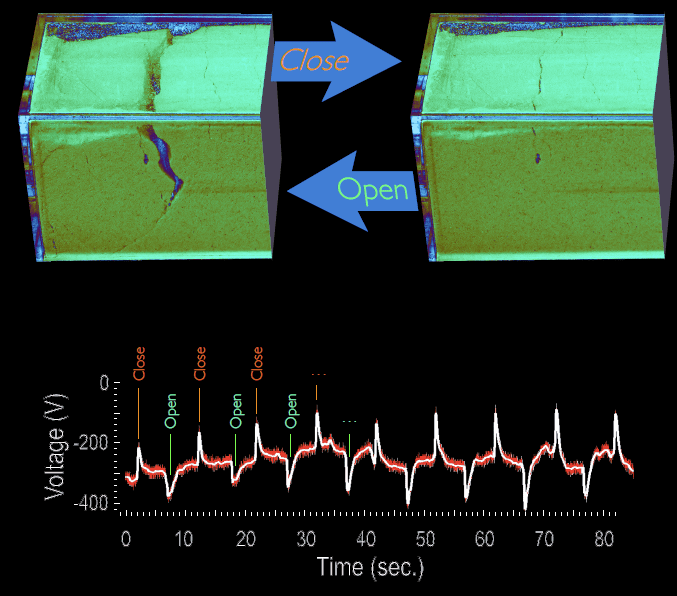
“It is quite surprising to us,” said Shinbrot, “to get hundreds of volts by the very low stress, small-scale experiments, essentially consisting of tipping a bed of flour.”  He went on to explain that they saw a peak in the voltage each time a crack opened up or closed in the flour in one experiment. Another experiment showed them that voltage spikes coincided with a slip event in a material and that the voltage magnitude grew with the spread of such events. A third granular shear experiment carried out using large polymeric discs also saw the same voltage peaks coinciding with slip events, but further let the researchers conclude that the voltages traced the surfaces of the grains and not their bulk properties.

Laboratory image of voltages developing due to racks in powder

Indeed, this means that the internal grain material is not so much the issue as each grain’s surface area and the possible slip-sliding motions that occur, meaning that the grain surfaces may have a major role to play. Some of Sui’s experiments are looking into the importance, if any, of the size of a particle in granular charging and he found that size really does not matter!

Shinbrot and Sui hope that their experiments could help towards developing a new theory to explain charging in granular material, while also paving the way  to coming up with a means to pinpoint the epicentre of an earthquake. Also, their work could be rather useful in industry – to monitor the production of ceramics, pharmaceuticals, and other products that require uniform, high-quality powder blends.

Concentrated sunlight
In another session that looked at polymers used to store and convert energy, Emily Warren from the Colorado School of Mines talked about using and adapting NASA thermonuclear devices to produce terrestrial generators. NASA has long developed and used compact, high-temperature, high-concentration solar thermoelectric generators to power its satellites. For example, the Mars rovers use a radioisotope thermonuclear generator that converts heat from plutonium-238 to electricity.

Warren and her colleagues hope to adapt that technology to use in far more “down-to-earth applications”, as it were. Unlike photovoltaic solar cells, which convert light to electricity, thermoelectric generators produce electricity directly from heat. Warren explained that such solar thermoelectric generators could potentially be more efficient than photovoltaics. They are also robust, are scalable and modular – they could be adapted for use in everything from computer to power generators – and would be environmentally friendly.

SuperKamiokande finds that neutrinos change flavour at night

More electron neutrinos from the Sun reach the surface of the Earth during the night than during the day, according to an 18-year study by physicists working with the SuperKamiokande neutrino detector in Japan. The finding offers further confirmation of a prediction made nearly 30 years ago that neutrinos travelling through dense matter change flavour at different rates than neutrinos travelling through empty space. The results also suggest that neutrino detectors of the future could be used to study the interior of the planet.

Electrically neutral and interacting only via the weak force, neutrinos are fiendishly hard to detect – indeed, most neutrinos from the Sun travel straight through the Earth without interacting at all. But several exceptionally sensitive detectors around the world have managed to snare these elusive particles, revealing in the process that neutrinos “oscillate” between different types, or “flavours”, as they travel. In fact, this unusual behaviour explains the long-standing mystery of why far fewer solar neutrinos are captured by electron-neutrino detectors than expected: the electron neutrinos are simply changing into muon and tau neutrinos on their journey to Earth.

At neutrino energies below about 2 MeV, about half of all electron neutrinos from the Sun change flavour before reaching the Earth. For neutrinos of higher energies, however, a larger fraction change, meaning that fewer electron neutrinos are detected. This phenomenon is known as the Mikheyev–Smirnov–Wolfenstein (MSW) effect. In 1986 the Soviet physicists Stanislav Mikheyev and Alexei Smirnov expanded on work carried out in 1978 by the US theorist Lincoln Wolfenstein, who pointed out that the presence of large numbers of electrons in dense objects such as the Sun and the Earth could affect neutrino-oscillation rates.

Reverse oscillation

Physicists working with the SuperKamiokande detector in Japan are now the first to see evidence of the MSW effect on neutrinos that have travelled through the Earth. Buried deep under a mountain about 300 km west of Tokyo, SuperKamiokande detects neutrinos using 50,000 tonnes of water in a cylindrical vessel. The detector incorporates more than 11,000 photomultiplier tubes, which search for the Cerenkov radiation given off by the high-energy electrons or muons that are created when a neutrino interacts with the water.

By looking through years’ worth of data from SuperKamiokande, the team found that the flux of solar neutrinos during the night was about 3.2% greater than that measured during the day. In other words, the Earth has caused muon and tau neutrinos to change back to electron neutrinos, effectively reversing the change that occurred during their journey from the Sun. While the result agrees with the predictions of the MSW effect, the statistical significance is 2.7σ. This is boosted to 2.9σ when the data are combined with a much weaker measurement made by the Sudbury Neutrino Observatory (SNO) in Canada.

Strong indication

Andrew Renshaw of the SuperKamiokande team cautions that the statistical significance is much lower than the 5σ needed for a “discovery” in particle physics and just below the 3σ level that is considered “evidence”. “We tend to claim that this is a strong indication for the MSW effect,” he told physicsworld.com. Because it took 18 years for SuperKamiokande to get to the 2.7σ level, it is likely that data from future neutrino detectors will be needed to take the measurement over 5σ.

The relatively low statistical significance of the results – and the fact that they are broadly in line with other neutrino-oscillation studies – means that the measurements do not represent a significant improvement in our current understanding of neutrino-mixing parameters. However, neutrino expert David Wark of the University of Oxford, who was not involved with the day/night measurement, points out that “neutrino theory is nowhere near as well developed as some other areas of particle physics”. “Every new effect we can observe helps us fill in the puzzle, so it is very interesting any time somebody measures something new,” he adds.

Super goes Hyper

Looking to the future, both Renshaw and Wark believe that it could be possible to use the MSW effect to probe the Earth’s interior. However, Wark says that a detector that could do so would be “a truly vast experiment”, although he adds that HyperKamiokande – the proposed successor to the current detector – has this week been selected by the Science Council of Japan as one of its highest priority new big-science projects.

“HyperKamiokande will be 25 times the size of SuperKamiokande, so we will get a much larger data set,” says Wark. “Whether it would be big enough to make measurements of the Earth’s density with interesting sensitivity, I am not sure, but we will certainly be looking at that as we further develop HyperKamiokande.”

The day/night measurement is described in Physical Review Letters.

The electronics wonderkid from Ulan Bator

One inspiring example of the power of online technology to break down global barriers to education is the story of Battushig Myanganbayar from Ulan Bator in Mongolia. In 2012, aged just 15, he took a free online course called “Circuits & Electronics” offered by the Massachusetts Institute of Technology (MIT) and surprised many people by achieving a perfect score. Myanganbayar has since moved to the US, where he has started an undergraduate degree at MIT that he hopes it will serve as a launch pad to a fruitful career in science.

In this video, Physics World journalist James Dacey visits MIT to meet Myanganbayar and find out more about this remarkable student. Myanganbayar explains that he wanted to learn about how devices such as the iPhone work but he had no experience of such topics through Mongolian state education. “Every time when I learn new stuff, every time when I’m working on a new project, I think about how it could bring happiness for people in the future and that gave me a lot of energy,” he explains.

As if his personal achievements are not impressive enough, Myanganbayar has also created a series of videos on YouTube in which he explains some of the more difficult concepts from the MOOC in Mongolian, having translated them from the original English versions. In this film, Dacey also asks Myanganbayar about how he is finding the transition to a new culture and how he is settling into university life. Just as he did with the online electronics course, Myanganbayar seems to be taking everything in his stride and he talks about how he has developed a keen interest in photography since arriving at MIT.

The course on circuits and electronics that helped Myanganbayar secure his place at MIT is an example of a new development in education known as massive open online courses, or MOOCs. These short courses are free to anyone in the world with a suitable Internet connection and they typically combine video lectures with assignments such as problem sets and extended projects. The MIT electronics course is offered through an online platform known as edX, which was launched in 2012 thanks to initial investments by MIT and Harvard University. You can watch another short film, “Physics lab for the YouTube generation”, about how the MIT physics department is now starting to incorporate the edX technologies into its undergraduate teaching programme.

“The electronics wonderkid from Ulan Bator” was produced in conjunction with the March 2014 issue of Physics World, which is a special issue about education.

And don’t forget that if you want to read Physics World each month, then you can do so through our digital edition, which can be accessed online or via our Apple and Android apps simply by becoming a member of the Institute of Physics. You can join the Institute as an IOPimember quickly and easily online. This membership includes an annual digital subscription to Physics World.

Copyright © 2026 by IOP Publishing Ltd and individual contributors