NASA’s WISE telescope poised for second life as asteroid hunter


A dormant NASA space telescope is to be given a new lease of life – to sniff out near-Earth objects that could be on a collision course with our planet. Agency officials have decided to reactivate WISE, the Wide-field Infrared Survey Explorer that was mothballed in 2011 after spending two years studying the universe.

Originally launched in late 2009, WISE’s main aim was to perform an all-sky survey in the infrared using its 40 cm- diameter telescope to uncover newly born stars and brown dwarfs hidden outside our solar system. Before its hydrogen coolant began running low in late 2010, the telescope was also used for four months to search for comets and asteroids that could pose a threat to our planet (dubbed the NEOWISE project). During 2010 WISE observed about 158,000 rocky bodies out of approximately 600,000 known objects. Its discoveries included 21 comets, more than 34,000 asteroids in the main belt between Mars and Jupiter, and 135 near-Earth objects, some of which were potentially hazardous, before finally being put into hibernation in early 2011.

Space rocks

Using WISE in this way was considered such a success that Lindley Johnson, head of NASA’s Near-Earth Objects Program, has decided to reboot the craft. Scientists believe that the quickest way to protect our planet is to dust off WISE and get it up and running again. Indeed, NASA officials state that many of the asteroids that they are spotting are larger than the Chelyabinsk asteroid that made its way across Russian skies in February, injuring 1500 people when its shockwave left debris and shattered glass in its wake.

The infrared telescope will be revived next month to discover and characterize NEOs that are orbiting within 45 million kilometres from Earth’s path around the Sun. NASA anticipates WISE will use its telescope and infrared cameras to discover about 150 previously unknown NEOs and characterize the size, albedo and thermal properties of about 2000 others – including some that could be candidates for the agency’s recently announced asteroid initiative.

“The team is ready and after a quick checkout, we’re going to hit the ground running,” says Amy Mainzer, NEOWISE principal investigator at NASA’s Jet Propulsion Laboratory in Pasadena. “NEOWISE not only gives us a better understanding of the asteroids and comets we study directly, but it will also help us refine our concepts and mission plans for future, space-based near-Earth-object cataloguing missions.”

After it is reactivated, WISE it will only be used until 2017, when it will slip from its 500 km Sun-synchronous orbit. Lindley Johnson estimates that reinstating the craft will cost about $5m per year in running costs. In a report earlier this month, Johnson said that bringing the telescope out of retirement may be possible within his department’s $20m budget, but that it would be much more feasible if the budget were doubled to $40m in 2014, as has been requested by the Obama administration. However, it remains unclear whether the extra funding will be secured. “Given the current budget environment, we need to ensure that we would have the necessary funding available to pay for the reactivation and operations for a long enough time to make it worthwhile,” Johnson told physicsworld.com.

Particle art lights up Victorian ice well

By James Dacey

“The finished work is everything I had hoped for and more – it takes my breath away!”

That was the reaction of artist Lyndall Phelps upon seeing her physics-inspired installation in London, which will open to the public this Saturday. Entitled Covariance, the work was inspired by the SuperKamiokande neutrino observatory in Japan – reflecting the machinery of particle detectors and the way in which particle physicists visualize their data. The kaleidoscopic artwork is housed in a Victorian ice well beneath the London Canal Museum, in reference to the subterranean location of many large particle-physics experiments.

Phelps is an artist who often creates works inspired by science, where she looks in particular for the personal and emotive themes that can exist within academia. For this latest project, she worked in collaboration with Ben Still, a particle physicist from Queen Mary, University of London. The pair was commissioned to work on the project by the Institute of Physics (IOP) as the first in a programme of artists-in-residence called Superposition.

(more…)

Too hot to handle

The second law of thermodynamics is alive and well. Not only does everything we do generate waste – from cooking to working in an office and even just breathing to oxidize whatever food we have eaten – we also have entropy marching on, churning out ever more disorder. Making electricity is no exception. The process of constructing solar panels or wind turbines increases entropy and generates waste; so does the generation of electricity with gas, coal, oil or nuclear power. The creation of waste is inevitable. The question is: what do we do with it?

This question rests particularly heavily on the nuclear industry. Although everything on the planet is radioactive to some degree, history has shown that when the specific activity of a material rises to a sufficiently high level, such as that found in spent nuclear fuel, disposing of this material as waste has proved to be entirely untenable. This is true even though many common household items – bleach, paint and motor oil among them – actually qualify as hazardous waste, and the typical controls required for disposing of them are fairly similar to those required for low-level radioactive waste. If we can cope with these types of waste, we should also manage to handle the radioactive stuff; from a scientific or technical point of view, the issue is not insurmountable.

The real problem lies with politics, which in the US and many other countries has continually blocked any long-term solutions involving the permanent disposal of high-level waste. In Too Hot to Touch, William and Rosemarie Alley tackle this problem head on as they review the history of nuclear waste in the US. The book focuses largely on the story of the would-be nuclear repository at Yucca Mountain, Nevada, but it also covers events from the beginning of the nuclear age all the way to 2012. The Alleys form a good team: William is a geologist and former chief of hydrogeology at Yucca Mountain, while his wife Rosemarie is a writer. Throughout, they do a great job of keeping the reader interested in the timeline and historical details. Only a few times do the authors veer off their scientific-review theme to either criticize those who are religious or to make unquantified statements such as their claim that caesium-137 in the body emits “dangerous radiation” (it would have been more helpful to compare it with naturally occurring concentrations of beta-gamma emitters such as potassium-40). Overall, the book is well written, informative and substantive.

Many fun facts are woven into this history. For example, the book describes how the father of the former US vice-president Al Gore, himself a legislator, suggested disposing of nuclear waste along the border between North and South Korea. Al Gore Sr’s idea was to create a no-man’s land that used the “psychological fear” aspect of the waste to prevent troops from crossing. The nation’s history of dumping waste in the oceans and other cases of reckless waste disposal by the US government is also sternly addressed. Overall, the book ascribes substantial incompetence not only to US politicians in general but also more directly and overtly to officials at the US Department of Energy (DOE) and its predecessor organizations ERDA and the Atomic Energy Commission. It even calls out Steven Chu – a Nobel laureate and the most recent past head of the DOE – and President Obama for ignoring the overwhelming amount of science and engineering that went into establishing Yucca Mountain as a viable repository for spent fuel.

The book’s contents are not all bad news for the nuclear industry. The Alleys do bring up one of the chief selling points for nuclear technology, which is that the energy an average citizen of a rich country uses in a lifetime would only generate an amount of spent fuel you could fit into a Coke can. They also acknowledge – and even devote a whole chapter to – the successes of the Waste Isolation Pilot Plant (WIPP) in New Mexico. This DOE facility is a deep geological repository for the permanent isolation of transuranic waste (mainly items contaminated with plutonium) from the biosphere. Unlike Yucca Mountain, it is not only under budget but also ahead of schedule, with a substantially impressive safety and quality record. I am, however, quite biased on this point, being an employee at the WIPP; I and others take great pride in the work we do by safely and permanently removing these hazards from the biosphere. (In addition to my service to WIPP operations and engineering, I also support a dark-matter telescope project housed inside the WIPP repository and am the radiochemistry laboratory director for emergency response applications. There is never a lack of work to do for the WIPP!)

The factors that made the WIPP such a success, whereas Yucca Mountain has still not opened, are discussed in detail in the book but one factor is definitely good geology (with others being public acceptance and political support). The WIPP is situated in the south-western corner of a salt deposit that has a cross-sectional area larger than Florida, and which, at the location of the WIPP, is 600 m thick. Such a configuration makes for a stable, long-term geological repository, allowing it to meet all state and federal regulatory, safety and quality requirements.

The book goes into a great deal of detail over the technical aspects of repository geology, showing how geological knowledge grew and evolved over Yucca Mountain in tandem with the changing politics and regulations, and how these various facets played out in time, bringing us where we are today. I would have liked to have seen it cover more about the remotely handled transuranic waste programme currently under way at the WIPP, along with the progress going on there to make it capable of receiving waste that is “greater than class C” (which means, in simple terms, low-level waste that requires disposal in a geological repository rather than shallow land burial). Still, the real focus of the nuclear industry today is on high-level waste and spent fuel, so it perhaps makes sense that this is where the book keeps the reader focused, too. Overall, this is an excellent book and a nice technical review for anyone wanting to comprehend why the task of dealing with this trash has been so mired in obstacles throughout its history.

Web life

So what is the site about?

Altmetric is a London-based start-up firm specializing in “alternative article-level metrics”. Unlike more traditional ways of gauging the importance of a scientific paper, such as counting the number of citations or looking at the reputation of the journal that published it, alternative metrics attempt to measure a paper’s impact using factors such as the number of blog posts about the paper and the number of times that it gets mentioned on Twitter and other social media. Altmetric’s blog, like many run by commercial firms, is partly geared towards advertising the company’s own products, which include a numerical “score” that reflects how often a paper has been discussed in the publications, blogs and social-media sites that Altmetric monitors. However, the blog also covers more general issues surrounding the emerging field of altmetrics and the related open access movement in scholarly publishing (see “The reality of open access”). Some posts, for example, offer case studies on ways that particular papers have been shared via social media or discuss the type of information that next-generation altmetrics might offer.

What if I don’t care whether my papers are popular on Twitter or not?

In that case, you are either less shallow than most people or you are already so well known that you have become blasé about publicity. Congratulations. However, there are reasons other than vanity for wanting to quantify other people’s responses to your work. Citations and a journal’s impact factor are still important barometers, of course, and the online versions of some journals (including many of those produced by IOP Publishing, which also publishes Physics World) have also started to provide additional data on how many people have downloaded papers or bookmarked them using online reference managers such as Mendeley and CiteULike. However, funding organizations increasingly want to know how a grant applicant’s work is affecting people outside the research community as well as in it. Think about the last scientific paper you wrote. How many people read it? What did they think of it? Did they share it with their colleagues? Their friends? Journalists? If you can demonstrate that, say, 14 people, including two journalists, found your last paper interesting enough to blog about, while 23 others passed it on to their Twitter followers, it might just tip the balance in your favour the next time you find yourself applying for funding.

That could be useful – but who’s behind it?

Altmetric was founded in 2011 by Euan Adie, a former medical geneticist who had previously worked on online research tools at Nature. Later that year the firm won start-up funding in a competition run by the publishing giant Elsevier and it has subsequently received support from Digital Science, which (like Nature) is part of the Macmillan group of publishers. The editor of the blog, Jean Liu, has a background in neuroscience and also writes a personal blog called The Portable Brain.

Can you give me a sample quote?

From a post about the altmetrics of a paper on bio-inspired dynamical surfaces: “These special surfaces, which were inspired by the sweeping motions of motile cilia, were created by applying a novel material that has the ability to repel bacteria that make up biofilms. It works like this: some kind of stimulus (e.g. electrical voltage, mechanical stretching or air pressure) is applied to the material, deforming the surface and dislodging any biofilms that are attached. The practical applications are immense: notably, the material could be painted on the hulls of ships, then used to stop “biofouling” by the easy removal of accumulated gunk (biofilms and barnacles).

For a paper with such useful applications (biofouling is a huge problem for mariners), how can one define the outcomes that would constitute impact? Even after more development and rigorous testing takes place, it may take years for the new technology to be adopted by shipbuilders. And so, for the time being, we should try to look for more immediate indicators of academic and online impact … altmetrics can be excellent early indicators of research uptake in society.”

Profile of the Institut Laue-Langevin

The Institut Laue-Langevin (ILL) is a small nuclear reactor that was built in the French city of Grenoble in the late 1960s to provide a source of neutrons for global science. Today the ILL still provides one of the most intense neutron sources in the world, as scientists and engineers come from far and wide to use the facility.

This video provides you with an overview of the “vintage” technology at this facility, explaining how researchers use neutrons to study the fundamental properties of matter. “One of the key things you can do with neutrons is to explore the magnetic structures of materials,” explains the institute’s director Andrew Harrison. “I think it’s fair to say that 90-odd per cent of all that we know at the atomic level about magnetic materials is derived from neutron scattering.”

While the institute itself is more than 40 years old, the components have been changed and upgraded regularly over the years. “The average lifetime for which an instrument remains competitive and world class is about 10 or 15 years, so we’re constantly upgrading,” explains Harrison. “The latest wave of that started about 12 years ago – we’ve upgraded about two-thirds of our suite”.

Unforgettable blue

Anyone who has visited the reactor at the ILL will tell you that one of the most memorable experiences is viewing the pool surrounding the reactor core, which glows a bright blue with Cerenkov radiation. The film takes you inside the reactor core to explain how neutrons are generated from nuclear reactions then harnessed for scientific experiments. ILL engineer and scientist Giuliana Manzin talks about the extensive work that has been carried out to ensure the safety of the facility, something that she is aware is firmly in the public consciousness since the Fukushima Daiichi nuclear disaster in 2011.

Today at the ILL – which has recently secured its funding until 2023 – there is also a strong focus on the biosciences. “One of the things we’re able to do now, for example, is simulate biological membranes through synthetic materials and look at the way small molecules or even viruses are absorbed through those artificial cell walls,” says Harrison. “Through doing that we can devise ways to block the ingress of pathogens or viruses into materials.”

Kepler telescope goes into retirement…for now

By Tushna Commissariat

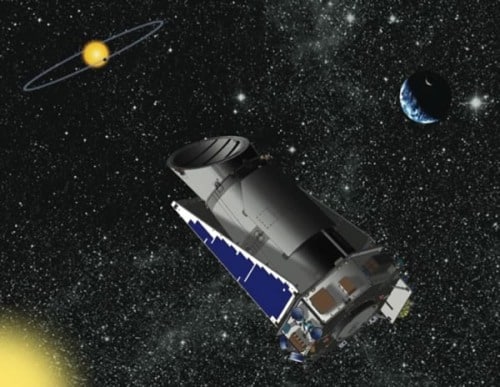
A few months ago, I wrote a blog about NASA’s Kepler space telescope being in a spot of trouble, as the spacecraft shut down and went into “safe mode”. The problem was that two of the four gyroscope-like “reaction wheels” that help the telescope remain steady and pointed in a particular direction had broken. Since May, researchers have been looking at ways and means to fix the problem or work around it.

Unfortunately, after analysing and testing the systems, the Kepler Space Telescope team has decided to end its attempts to restore the spacecraft to full working order, and is now “considering what new science research it can carry out in its current condition”.

(more…)

Neutron study aims to improve HIV drugs


A neutron study of a common component of HIV drugs has revealed that the component is not as good at bonding as had been thought. The study, performed by an international group of researchers, highlights aspects of the drug component that could be improved to make it better at mitigating the effects of HIV.

HIV is a virus that replicates through use of a person’s immune system. HIV implants genetic information into the immune system’s T-cells, which then produce copies of the virus until they die. Once enough T-cells have died from churning out HIV, the person is unable to ward off other infections and they are said to be suffering from AIDS.

Inhibiting tactics

The best known way of tackling HIV is through antiretroviral drugs (ARVs). These medical cocktails consist largely of chemicals known as “reverse transcriptase inhibitors”, which prevent HIV from generating its DNA in a T-cell, and “protease inhibitors”, which prevent an enzyme known as HIV-1 protease from chopping up newly made proteins into the right segments to construct a functional HIV. Protease inhibitors do the latter by bonding to HIV-1 protease themselves, so that the enzyme cannot bond – and chop up – anything else.

Previously, scientists have studied how protease inhibitors bond to HIV-1 protease through use of X-ray crystallography. X-rays scatter off an atom’s electron cloud and so give an indication of an atom’s location and what it is bonded to. But protease inhibitors bond to HIV-1 protease largely with hydrogen bonds and since hydrogen atoms have only one electron they are almost invisible to X-rays. According to biochemist Andrey Kovalevsky at Oak Ridge National Laboratory in Tennessee, US, hydrogen bonds can be inferred only from very high-resolution X-ray crystallography, which is difficult to perform on protease inhibitors and enzymes.

Now Kovalevsky, together with Paul Langan at Oak Ridge and colleagues from elsewhere in the US, the UK and France, has tried a more direct approach to study the interactions between protease inhibitors and HIV-1 protease – neutron crystallography. Unlike X-rays, neutrons scatter off atomic nuclei but, more importantly, they scatter just as well off hydrogen as any other type of atom. As a result, neutrons can directly pinpoint the location of hydrogen bonds and how strong they are.

Growing challenges

Kovalevsky and colleagues performed their study on a protease inhibitor known as Amprenavir, using the continuous neutron beam at the Institut Laue-Langevin (ILL) in Grenoble, France. Neutron beams are generally weaker than X-ray beams and therefore need larger crystals off which to scatter. However, proteins such as HIV-1 protease do not readily form large crystals; growing them was one of the international group’s main challenges. “You have to try different methods for crystal growth,” says Kovalevsky. “It’s a very time-consuming and arduous job.”

X-ray studies of the interactions between Amprenavir and HIV-1 had suggested that there were seven hydrogen bonds between the molecules, says Kovalevsky. The latest neutron-scattering results from ILL, however, show that there are in fact just four hydrogen bonds, two of which are weaker than previously thought.

Kovalevsky believes that by tailoring the geometry and functional groups of protease inhibitors like Amprenavir, drug designers will be able to make them form stronger hydrogen bonds with HIV-1 protease. “Now we know we just blindly took it for granted that we have all this hydrogen bonding, which we don’t,” says Kovalevsky. “Neutron crystallography comes in here as a very powerful technique.”

Anna Llobet, an expert in neutron scattering at Los Alamos National Laboratory in New Mexico, US, says that the latest ILL study is one of just a handful that have used neutrons to examine the effectiveness of drug interactions with disease targets. “This is not really a new physics development or application at all, but it is significant for understanding drug binding – both for computational analysis, [and computer] drug design, etc,” she says.

However, chemist Claudiu Supuran at the University of Florence in Italy believes that the interpretation of neutron-scattering results, in particular the strength of hydrogen bonds, is still somewhat subjective. He also says that the efficacy of a drug is the result of more than one type of bonding and that Amprenavir is known to be effective at tackling HIV-1 protease in other ways. “I agree it is a nice paper, but it has added 1% to our knowledge on designing protease inhibitors,” he adds.

The research is published in the Journal of Medicinal Chemistry.

  • Take a look at our video on the myriad of activities that take place at the ILL and how researchers there use neutrons to study the properties of matter.

US firm seeks funding for novel ‘slingatron’ prototype


A US company has launched a fund-raising campaign to build a prototype “slingatron” that could be used to propel a 100 g object to a speed of one kilometre per second. HyperV Technologies, based in Virginia in the US, is now attempting to raise $250,000 via the crowd-funding website Kickstarter to build the device, which it says will pave the way for a full scaled-up version that can launch much heavier cargo into space.

Spin me right round

A slingatron is based upon an old-fashioned weapon known as a “sling” – it involves a heavy mass on the end of a rope, which a person whirls around their head with increasing frequency before letting go, sending the object flying. However, with the slingatron the rope is replaced by a spiral track spinning at a constant frequency. When an object is released from the middle, it follows the track round with an increasing radius, getting faster and faster as it does so. The larger the final radius – and the greater the spin frequency – the faster the object travels when it leaves.

The idea for this sort of mechanical propulsion is not new. In 2006 it was revealed that the US Defense Advanced Research Projects Agency budgeted around $3m to explore whether a slingatron could accelerate masses to extremely high speeds without using rockets, before claiming that the approach was unpromising.

HyperV claims that its last prototype, the 2-m-tall “Mark II Slingatron”, successfully accelerated a 230 g object to 100 m s–1. The challenge with the next, crowd-funded prototype is to demonstrate that a 5-m-wide slingatron can generate speeds that are 10 times greater, and to pave the way for an even bigger slingatron that can launch cargo faster than 11 km–1 – quickly enough to go into orbit. HyperV believes that the concept will be far cheaper than conventional rocket launches, although it will only be suitable for non-human cargo that can withstand a g-force of 60,000.

Interesting approach

Dennis Bushnell, chief scientist at NASA’s Langley Research Center in Virginia, points out that a NASA study conducted early this century found slingatrons to be “the most interesting ‘gun’ approach”, in terms of cost and capacity, to launch cargo into space. “It is well worth serious further study,” he says. “[But] whether [HyperV] has pockets deep enough to plough through the issues is to be determined.”

However, Jim Fiske at California-based LaunchPoint Technologies, which has previously investigated a method to launch objects using a stationary magnetic rail, is sceptical of HyperV’s idea. “I must confess that I don’t see much advantage in spending money on such a project,” he says. “Wouldn’t it make far more sense to accelerate the vehicle directly and leave the track stationary?” Indeed, money may well be a stumbling block – currently, only $24,760 had been pledged to the project. “We knew going into it that it was a long shot,” says HyperV spokesperson Chris Faranetta. “Our main objective with the Kickstarter was to get the public thinking and caring about the slingatron.”

Take a look at this video to learn more about HyperV’s slingatron project.

Highly sensitive skin-like sensor lights up at touch

A skin-like sensor array that can convert touch directly into light signals has been built from individual-nanowire light-emitting diodes by researchers in the US. The new device appears to be more sensitive to touch than even human skin. It might be ideal in robotics applications, in next-generation touchscreen pads, for improved human–machine interfaces, biological imaging and optical microelectromechanical systems (MEMS), to name but a few.

Unlike the other four human senses – vision, hearing, smell and taste – touch remains stubbornly difficult to mimic in the laboratory. A good artificial skin needs to be highly sensitive to touch over areas at least as small as 50 microns and respond quickly to applied pressure. Researchers have already succeeded in making sensor arrays for such electronic skin, or “e-skin”, from assembled nanowires or microstructured rubber layers that change their capacitance or resistance in response to pressure or force. But these materials are only able to map applied strain distribution at resolutions of millimetres, at best.

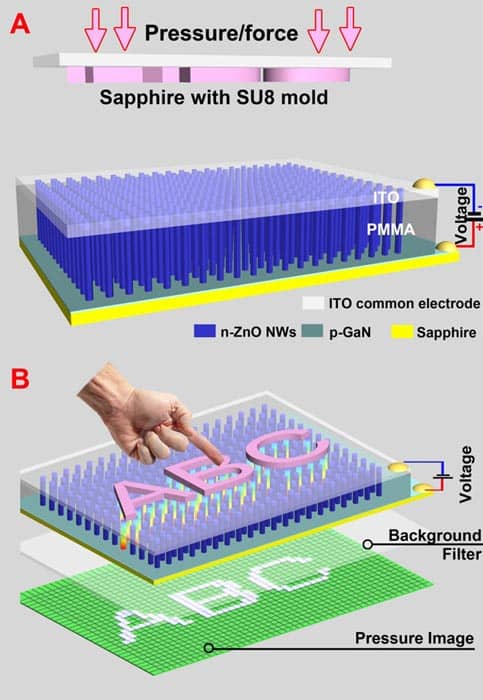
A team led by Zhong Lin Wang at the Georgia Institute of Technology may now have gone a long way in resolving this problem by developing the first individual LED-based pressure/force sensor array for fast mapping of strain at distances smaller than just three microns. The pixel density of the new device is also extremely high at 6350 dots per inch (dpi), which is a 1000 times better than the previous record for such sensors. Each pixel is made up of a LED comprising single zinc-oxide nanowires grown atop p-doped gallium nitride and is sensitive to locally applied pressure, force and strain thanks to the so-called piezophototronic effect.

Piezoelectric potentials

Piezoelectric materials produce a polarization charge when subjected to mechanical strain, as the symmetry of the component crystals becomes distorted. Piezophototronic devices rely on this principle to control electron transport and recombination by the polarization charges present at the ends of individual nanostructures adjacent to the p–n junction, where the light is generated. In the new work, the strained zinc-oxide nanowires create a piezoelectric charge at both their ends, which forms a piezoelectric potential, explains Wang. This potential distorts the band structures in the wire, which allows electrons to remain in the region of the p–n junction longer and so enhances the LED’s light-emitting efficiency.

Illustration showing how the new device works

The light output from the device varies with applied pressure. This output signal is electroluminescence light that can easily be integrated with on-chip photonic technologies for fast data transmission, processing and recording. And instead of using conventional “cross-bar” electrodes for sequential data output, the pressure image or map is received in parallel for all of the pixels, says Wang. This means that the output signal can be detected much faster (in just 90 milliseconds) than in the traditional designs based on piezo-resistance or -capacitance effects.

“This approach may be a major step towards digital imaging of mechanical signals by optical means with potential applications in touchpad technologies, personalized signatures, bio-imaging and optical MEMS,” Wang told physicsworld.com. “Such sensor arrays could also be fabricated on flexible substrates (such as PDMS or carbon fibres) since patterned zinc-oxide nanowires can be grown on any surface using low-temperature solution-based growth methods, something that could open up a host of other application areas.”

The team made its devices using a low-temperature chemical growth technique to create patterned arrays of zinc-oxide nanowires on a gallium-nitride thin-film substrate. The researchers then flooded the spaces between the nanowires with a PMMA thermoplastic and used an oxygen plasma to etch away enough of the PMMA to expose the tops of wires. The final steps consisted of forming an ohmic contact with the underlying gallium-nitride film using a nickel–gold electrode and depositing a transparent indium-tin-oxide film on top of the array as the common electrode.

More sensitive robots and better prosthetics?

The sensor arrays can detect pressure changes as small as 10 KPa, which is similar to a gentle finger tap. In addition to possibly providing robots with a more sensitive sense of touch, which would allow them to adjust the force they use to grasp things, the new devices might also come in handy for improving human prosthetics. They might even be used to improve something called electronic-signature mapping. Here, the sensors would record the pressure or force applied when a person signs their name, as well as the speed with which they write, to make signatures much more secure.

The team says that it will now be looking at how to improve the spatial resolution of the arrays even further. This might be done by reducing the diameter of the nanowires so that many more can be fitted onto an individual array and by using higher-temperature fabrication processes.

The research is published in Nature Photonics.

Physicists get to grips with complex systems

A team of researchers in the US has worked out a scheme for optimal control of complex systems, where one event can lead to another. The researchers have studied how best to intervene in so-called self-organized critical systems, which are constantly poised on the brink of a cascade, so as to suppress or manage “avalanches” and propagating crises. The approach might potentially be applied to real landslides and avalanches, forest fires and perhaps even economic crises.

Risk assessment

Sometimes the best way to prevent a big crisis is to bring on a small one. Large snow avalanches can be avoided by using explosives to trigger smaller ones and the same strategy has been discussed for earthquake control. But it might be risky and potentially costly to trigger even little cascade events in complex systems such as these.

To find the best balance between avoiding catastrophic cascades and inducing small ones, Pierre-André Noël, Charles D Brummitt and Raissa M D’Souza from the University of California, Davis in the US, considered as their model the standard example of self-organized criticality (SOC) – the sand pile. A pile of sand, to which grains are slowly being added at the apex, is always prone to avalanches of any size – from just a few tumbling grains to a landslide of the whole pile surface – because of “chain reactions” in grain collisions. There is no telling at the outset how big an avalanche might be. But the probability of it occuring decreases – in a mathematical relationship know as a “power law” – as the event gets bigger. That is the signature of SOC and it has been seen in models of earthquakes, forest fires, ecosystem collapses and economic fluctuations.

Whether such behaviour applies in the corresponding real-world examples remains controversial. Systems engineer John Doyle of the California Institute of Technology says that power laws in such cases are generally illusory, caused by poor data analysis. “There are no examples in nature or technology that are plausibly examples of SOC,” he says.

All the same, SOC and sand piles might offer at least an analogue of how cascades and failures can propagate through complex systems consisting of many interacting components – particularly when these components are joined into branching networks of interaction, such as power grids and ecosystems.

Strain release

As power blackouts such as those that struck the eastern seaboard of North America in 2003 showed, major cascades in these systems can be hugely costly and even fatal. One way to avoid such catastrophes is to release any build-up of “strain” in the system before it develops into a big cascade by intentionally triggering a smaller one. But that might be costly, both in terms of the amount of intervention needed and the consequences of the smaller events. Given a particular “cost function” that specifies the cost of an event of a particular size, says Noël, “there is an optimal level of control – to avoid catastrophic failures, say – that does not push too hard”.

To show this in a sand pile, the researchers developed a model in which the grains are linked into interaction networks that specify which of them will affect others. They considered that all cascades have a cost proportional to their size, and calculated the fraction of forced cascades (denoted μ) that minimizes the total cost. In their model, the only means a controller has of inducing or suppressing cascades is to specify where in the network a new grain lands – akin to dropping snow or starting a forest fire in a particular location.

Noël and colleagues found that, in general, there is an optimal value of μ between 0 (no cascades at all) and 1 (all cascades are triggered). Trying too hard to suppress cascades (making μ too small) can be counterproductive, pushing the system towards the “critical” state in which a major cascade is likely.

Real-world problems

Alessandro Vespignani, a specialist on complex networks at Indiana University in Bloomington, says that among those working on self-organized criticality, “this phenomenology was already known and not surprising”. However, he adds that the new work shows how to express the problem in formal terms, which could point the way to more nuanced theoretical treatments.

Noël agrees that the general approach of “strain relief” is already well understood. “Our contribution is to identify the general mechanism behind this type of behaviour, and provide a way to track it analytically,” he says.

But it is still unclear how this quantitative strategy could be implemented in real-world systems, according to Vespignani. Frank Schweitzer, a specialist in complex social systems at the Swiss Federal Institute of Technology (ETH) in Zurich, shares that concern. “In real-world systems, it’s often impossible to control where a cascade starts,” he says. “It’s often easier to control connectivity or node capacity, neither of which is touched in the proposed model.” He thinks that some of the more sophisticated strategies already employed, such as “load-shedding” in power grids, will remain preferable.

“It’s difficult to extrapolate to real-world scenarios because they’re so much more rich than this simple model,” Noël admits. “But the model begins to define what to measure and which mechanisms matter.”

The research is published in Physical Review Letters.

Copyright © 2026 by IOP Publishing Ltd and individual contributors