US firm seeks funding for novel ‘slingatron’ prototype


A US company has launched a fund-raising campaign to build a prototype “slingatron” that could be used to propel a 100 g object to a speed of one kilometre per second. HyperV Technologies, based in Virginia in the US, is now attempting to raise $250,000 via the crowd-funding website Kickstarter to build the device, which it says will pave the way for a full scaled-up version that can launch much heavier cargo into space.

Spin me right round

A slingatron is based upon an old-fashioned weapon known as a “sling” – it involves a heavy mass on the end of a rope, which a person whirls around their head with increasing frequency before letting go, sending the object flying. However, with the slingatron the rope is replaced by a spiral track spinning at a constant frequency. When an object is released from the middle, it follows the track round with an increasing radius, getting faster and faster as it does so. The larger the final radius – and the greater the spin frequency – the faster the object travels when it leaves.

The idea for this sort of mechanical propulsion is not new. In 2006 it was revealed that the US Defense Advanced Research Projects Agency budgeted around $3m to explore whether a slingatron could accelerate masses to extremely high speeds without using rockets, before claiming that the approach was unpromising.

HyperV claims that its last prototype, the 2-m-tall “Mark II Slingatron”, successfully accelerated a 230 g object to 100 m s–1. The challenge with the next, crowd-funded prototype is to demonstrate that a 5-m-wide slingatron can generate speeds that are 10 times greater, and to pave the way for an even bigger slingatron that can launch cargo faster than 11 km–1 – quickly enough to go into orbit. HyperV believes that the concept will be far cheaper than conventional rocket launches, although it will only be suitable for non-human cargo that can withstand a g-force of 60,000.

Interesting approach

Dennis Bushnell, chief scientist at NASA’s Langley Research Center in Virginia, points out that a NASA study conducted early this century found slingatrons to be “the most interesting ‘gun’ approach”, in terms of cost and capacity, to launch cargo into space. “It is well worth serious further study,” he says. “[But] whether [HyperV] has pockets deep enough to plough through the issues is to be determined.”

However, Jim Fiske at California-based LaunchPoint Technologies, which has previously investigated a method to launch objects using a stationary magnetic rail, is sceptical of HyperV’s idea. “I must confess that I don’t see much advantage in spending money on such a project,” he says. “Wouldn’t it make far more sense to accelerate the vehicle directly and leave the track stationary?” Indeed, money may well be a stumbling block – currently, only $24,760 had been pledged to the project. “We knew going into it that it was a long shot,” says HyperV spokesperson Chris Faranetta. “Our main objective with the Kickstarter was to get the public thinking and caring about the slingatron.”

Take a look at this video to learn more about HyperV’s slingatron project.

Highly sensitive skin-like sensor lights up at touch

A skin-like sensor array that can convert touch directly into light signals has been built from individual-nanowire light-emitting diodes by researchers in the US. The new device appears to be more sensitive to touch than even human skin. It might be ideal in robotics applications, in next-generation touchscreen pads, for improved human–machine interfaces, biological imaging and optical microelectromechanical systems (MEMS), to name but a few.

Unlike the other four human senses – vision, hearing, smell and taste – touch remains stubbornly difficult to mimic in the laboratory. A good artificial skin needs to be highly sensitive to touch over areas at least as small as 50 microns and respond quickly to applied pressure. Researchers have already succeeded in making sensor arrays for such electronic skin, or “e-skin”, from assembled nanowires or microstructured rubber layers that change their capacitance or resistance in response to pressure or force. But these materials are only able to map applied strain distribution at resolutions of millimetres, at best.

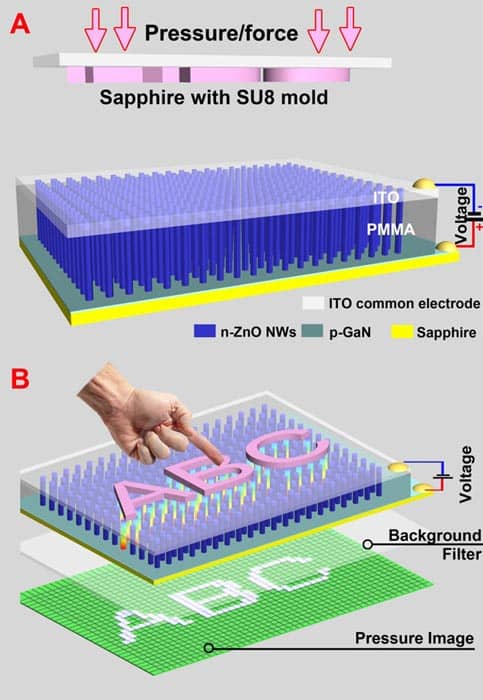
A team led by Zhong Lin Wang at the Georgia Institute of Technology may now have gone a long way in resolving this problem by developing the first individual LED-based pressure/force sensor array for fast mapping of strain at distances smaller than just three microns. The pixel density of the new device is also extremely high at 6350 dots per inch (dpi), which is a 1000 times better than the previous record for such sensors. Each pixel is made up of a LED comprising single zinc-oxide nanowires grown atop p-doped gallium nitride and is sensitive to locally applied pressure, force and strain thanks to the so-called piezophototronic effect.

Piezoelectric potentials

Piezoelectric materials produce a polarization charge when subjected to mechanical strain, as the symmetry of the component crystals becomes distorted. Piezophototronic devices rely on this principle to control electron transport and recombination by the polarization charges present at the ends of individual nanostructures adjacent to the p–n junction, where the light is generated. In the new work, the strained zinc-oxide nanowires create a piezoelectric charge at both their ends, which forms a piezoelectric potential, explains Wang. This potential distorts the band structures in the wire, which allows electrons to remain in the region of the p–n junction longer and so enhances the LED’s light-emitting efficiency.

Illustration showing how the new device works

The light output from the device varies with applied pressure. This output signal is electroluminescence light that can easily be integrated with on-chip photonic technologies for fast data transmission, processing and recording. And instead of using conventional “cross-bar” electrodes for sequential data output, the pressure image or map is received in parallel for all of the pixels, says Wang. This means that the output signal can be detected much faster (in just 90 milliseconds) than in the traditional designs based on piezo-resistance or -capacitance effects.

“This approach may be a major step towards digital imaging of mechanical signals by optical means with potential applications in touchpad technologies, personalized signatures, bio-imaging and optical MEMS,” Wang told physicsworld.com. “Such sensor arrays could also be fabricated on flexible substrates (such as PDMS or carbon fibres) since patterned zinc-oxide nanowires can be grown on any surface using low-temperature solution-based growth methods, something that could open up a host of other application areas.”

The team made its devices using a low-temperature chemical growth technique to create patterned arrays of zinc-oxide nanowires on a gallium-nitride thin-film substrate. The researchers then flooded the spaces between the nanowires with a PMMA thermoplastic and used an oxygen plasma to etch away enough of the PMMA to expose the tops of wires. The final steps consisted of forming an ohmic contact with the underlying gallium-nitride film using a nickel–gold electrode and depositing a transparent indium-tin-oxide film on top of the array as the common electrode.

More sensitive robots and better prosthetics?

The sensor arrays can detect pressure changes as small as 10 KPa, which is similar to a gentle finger tap. In addition to possibly providing robots with a more sensitive sense of touch, which would allow them to adjust the force they use to grasp things, the new devices might also come in handy for improving human prosthetics. They might even be used to improve something called electronic-signature mapping. Here, the sensors would record the pressure or force applied when a person signs their name, as well as the speed with which they write, to make signatures much more secure.

The team says that it will now be looking at how to improve the spatial resolution of the arrays even further. This might be done by reducing the diameter of the nanowires so that many more can be fitted onto an individual array and by using higher-temperature fabrication processes.

The research is published in Nature Photonics.

Physicists get to grips with complex systems

A team of researchers in the US has worked out a scheme for optimal control of complex systems, where one event can lead to another. The researchers have studied how best to intervene in so-called self-organized critical systems, which are constantly poised on the brink of a cascade, so as to suppress or manage “avalanches” and propagating crises. The approach might potentially be applied to real landslides and avalanches, forest fires and perhaps even economic crises.

Risk assessment

Sometimes the best way to prevent a big crisis is to bring on a small one. Large snow avalanches can be avoided by using explosives to trigger smaller ones and the same strategy has been discussed for earthquake control. But it might be risky and potentially costly to trigger even little cascade events in complex systems such as these.

To find the best balance between avoiding catastrophic cascades and inducing small ones, Pierre-André Noël, Charles D Brummitt and Raissa M D’Souza from the University of California, Davis in the US, considered as their model the standard example of self-organized criticality (SOC) – the sand pile. A pile of sand, to which grains are slowly being added at the apex, is always prone to avalanches of any size – from just a few tumbling grains to a landslide of the whole pile surface – because of “chain reactions” in grain collisions. There is no telling at the outset how big an avalanche might be. But the probability of it occuring decreases – in a mathematical relationship know as a “power law” – as the event gets bigger. That is the signature of SOC and it has been seen in models of earthquakes, forest fires, ecosystem collapses and economic fluctuations.

Whether such behaviour applies in the corresponding real-world examples remains controversial. Systems engineer John Doyle of the California Institute of Technology says that power laws in such cases are generally illusory, caused by poor data analysis. “There are no examples in nature or technology that are plausibly examples of SOC,” he says.

All the same, SOC and sand piles might offer at least an analogue of how cascades and failures can propagate through complex systems consisting of many interacting components – particularly when these components are joined into branching networks of interaction, such as power grids and ecosystems.

Strain release

As power blackouts such as those that struck the eastern seaboard of North America in 2003 showed, major cascades in these systems can be hugely costly and even fatal. One way to avoid such catastrophes is to release any build-up of “strain” in the system before it develops into a big cascade by intentionally triggering a smaller one. But that might be costly, both in terms of the amount of intervention needed and the consequences of the smaller events. Given a particular “cost function” that specifies the cost of an event of a particular size, says Noël, “there is an optimal level of control – to avoid catastrophic failures, say – that does not push too hard”.

To show this in a sand pile, the researchers developed a model in which the grains are linked into interaction networks that specify which of them will affect others. They considered that all cascades have a cost proportional to their size, and calculated the fraction of forced cascades (denoted μ) that minimizes the total cost. In their model, the only means a controller has of inducing or suppressing cascades is to specify where in the network a new grain lands – akin to dropping snow or starting a forest fire in a particular location.

Noël and colleagues found that, in general, there is an optimal value of μ between 0 (no cascades at all) and 1 (all cascades are triggered). Trying too hard to suppress cascades (making μ too small) can be counterproductive, pushing the system towards the “critical” state in which a major cascade is likely.

Real-world problems

Alessandro Vespignani, a specialist on complex networks at Indiana University in Bloomington, says that among those working on self-organized criticality, “this phenomenology was already known and not surprising”. However, he adds that the new work shows how to express the problem in formal terms, which could point the way to more nuanced theoretical treatments.

Noël agrees that the general approach of “strain relief” is already well understood. “Our contribution is to identify the general mechanism behind this type of behaviour, and provide a way to track it analytically,” he says.

But it is still unclear how this quantitative strategy could be implemented in real-world systems, according to Vespignani. Frank Schweitzer, a specialist in complex social systems at the Swiss Federal Institute of Technology (ETH) in Zurich, shares that concern. “In real-world systems, it’s often impossible to control where a cascade starts,” he says. “It’s often easier to control connectivity or node capacity, neither of which is touched in the proposed model.” He thinks that some of the more sophisticated strategies already employed, such as “load-shedding” in power grids, will remain preferable.

“It’s difficult to extrapolate to real-world scenarios because they’re so much more rich than this simple model,” Noël admits. “But the model begins to define what to measure and which mechanisms matter.”

The research is published in Physical Review Letters.

Welcome to the arXiv galaxy

By Matthew Chalmers

With almost a million articles accrued over the past two decades, the arXiv preprint server has become an indispensable tool for physicists.

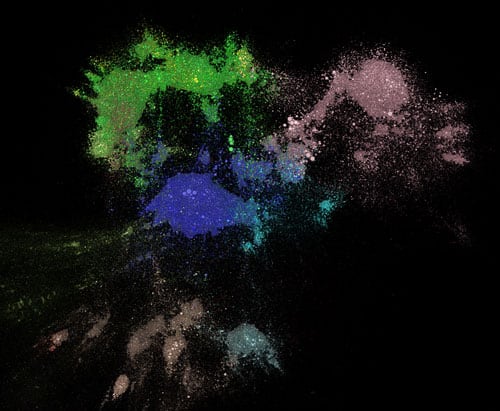
Now, thanks to a website called Paperscape developed by theoretical physicists Damien George at the University of Cambridge in the UK and Rob Knegjens at Nikhef in the Netherlands, its vast content can be visualized in all its glory.

The interactive graphic is based on a nifty algorithm that groups arXiv papers that cite each other together, as if they were linked by invisible springs, but forces those that don’t to repel each other. The resulting map resembles an irregularly shaped galaxy in which each “star” is a scientific paper, revealing how the various categories of research (shown in different colours) relate to each other.

(more…)

Shedding light on the masses of exotic nuclides

The masses of 33 rare, exotic neutron-heavy nuclides have been measured with high precision by scientists at the Argonne National Laboratory’s CAlifornium Rare Isotope Breeder Upgrade (CARIBU) facility in the US. The findings are crucial to understanding how elements that are heavier than iron might have formed. Following the mass measurements, the researchers also compared simulations of astrophysical nuclear reactions using both the measured masses and theoretical models.

Elements and their stellar forges

Fusion in stars is responsible for the production of elements as heavy as iron. However, the formation of some of the heavier elements remains a mystery. It is thought that half of the elements from iron to uranium are formed in stellar explosions such as supernovae via what is known as the rapid neutron-capture process or r-process – but this is not very well understood.

The r-process involves a nucleus capturing a neutron forming a neutron-rich nuclide that subsequently undergoes beta decay. Nuclides may undergo several transformations involving neutron captures and beta decays to work their way up from iron to uranium, for example. The exact path taken in this process depends strongly on the mass of the nuclei involved, in addition to the temperature and neutron density. A precise measurement of the masses of neutron-rich nuclear species would improve our understanding of the conditions under which heavy elements form in their stellar forges.

Studying exotic nuclei with Penning traps

The new measurements were made by Jonathon Van Schelt at the Argonne Physics Division and colleagues using the Canadian Penning Trap (CPT) mass spectrometer. The CARIBU facility began operations in 2011 and uses californium-252 as its fission source. Its gas catcher is larger and more complex than previous models and is capable of coping with a higher ion current than previously demonstrated. From the assorted nuclei produced in the fission reaction, a magnetic spectrometer in CARIBU selects those nuclei that need to be studied and directs a beam of them towards the CPT mass spectrometer.

Inside the CPT, these nuclei are subjected to electric fields at different frequencies and then fired at a detector. The time-of-flight to the detector helps to determine the resonant frequency for the nuclei being studied. Comparing this resonant frequency with that of a well-known nuclear species used for calibration allows the scientists to compute the mass of the nucleus with high precision, at a level of about 100 parts per billion.

“Penning-trap mass spectrometry is a well-established technique,” says Susanne Kreim from the Max Planck Institute for Nuclear Physics in Heidelberg, Germany, who was not involved in the new research. “The masses presented in this work have mostly already been measured by other such experiments. The technical achievement is demonstrating high-precision measurements using the new CARIBU facility with a high-intensity gas catcher. It was important for the Penning-trap community to show that this method is reliable, as the results show good agreement with previous Penning-trap measurements.”

The abundance of elements

Understanding explosive stellar nucleosynthesis may one day help to tell us why heavy elements such as gold or lead exist and why iron is so much more abundant that gold. In the r-process path, isotopes with long half-lives, such as tin (Sn), may cause a bottleneck in the production of even heavier elements.

“The question I chose to try to answer”, says Van Schelt, “was ‘Under what temperature and density conditions does the r-process move quickly enough to get past the possible tin bottleneck and produce heavier elements?'”

In the absence of measured masses for the nuclides in the r-process path, theorists have needed to construct “mass models”, which contain many approximations. Using the masses for tin and antimony that they had measured, Van Schelt and colleagues then ran simulations at different temperatures and neutron densities to compare their measurements with the theoretical mass models. The simulations using only the mass models showed that it was far easier to get past the Sn bottleneck – in about a second – than it should have been at those temperatures and densities.

Kreim adds that “the CARIBU team has shown that firm conclusions within a classical r-process model can only be drawn if the input parameters, masses of neutron-rich nuclei in this case, have small uncertainties”.

“The study of the r-process has been ongoing for 50 years, and this experiment is only one small step,” Van Schelt points out. “While the CPT has measured the masses of some potentially important nuclides, most of the r-process path remains without such measurements. There also remain additional questions in nuclear physics beyond masses, such as the half-lives and neutron-emission rates of the nuclei involved. CARIBU can help study these as well.”

The research is published in Physical Review Letters.

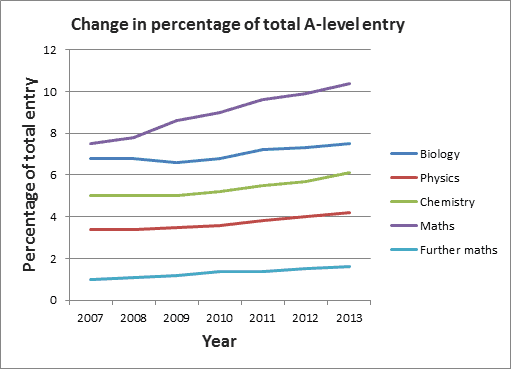
Why are school pupils flocking to physics?

By Matin Durrani

Getting more people interested in physics is something we hear about all the time here at Physics World.

When I was in India last year, for example, I lost count of the number of times physicists said there weren’t enough people going into the subject. Engineering and medicine seemed to be the top choices for technically minded Indian students going to university.

A worrying decline in interest in physics was a message I also heard while in Korea earlier this year.

(more…)

Explaining the second quantum revolution


The first quantum revolution was a revolution in atomic and subatomic physics, and it brought us not only the iPad and the Higgs boson but also a range of excellent popular-science books. While the atomic wonderland of the “Mr Tompkins” books now seems dated, George Gamow’s images of gazelles being diffracted by bamboo groves and cars leaking through garage walls still capture vividly the strangeness of the micro world.

The second quantum revolution, in which quantum mechanics was applied first to information theory and then to information technology, is harder to popularize. This is not because quantum information processing is particularly complex but because there are no simple images that will carry you any distance into the field. To understand quantum information is to understand the mathematics describing it; without the mathematics you can have only the haziest picture of what the field is all about.

Fortunately, the crucial mathematics is quite simple and with a few basic results you can make enormous progress. In The Quantum Divide, Christopher Gerry, a theoretical physicist, and Kimberley Bruno, a school teacher and vice principal, have done an impressive job in cutting the necessary mathematics down to the absolute minimum, below what I previously thought was possible. While the proverbial “educated layman” might struggle at times, many readers of Physics World will have little difficulty; anyone who has completed the first year of a physics degree will have more than enough background knowledge to understand the book.

Bell’s theorem is perhaps the founding result of quantum information theory, although the field did not blossom into its current form until many years after John Bell formulated it. In essence, Bell showed that any local realistic theory about how the world works is inconsistent with quantum mechanics. Here “local” means obeying relativity and in particular the requirement that information cannot travel faster than light, while “realistic” means that the results of measurements implicitly exist in the world before the measurements are made, with the measurement acting simply to reveal these pre-existing results. Einstein was unhappy with the ideas that eventually led to this theorem, not just because of the challenge to locality but also because of the apparent implication that observations, in effect, create the world. Unfortunately for Einstein, subsequent experiments have confirmed Bell’s predictions.

In its traditional form, Bell’s theorem is subtle and its derivation quite hard to follow. Gerry and Bruno have sidestepped this by describing a later variant that was invented by Lucien Hardy, developed by Thomas Jordan and subsequently popularized by David Mermin. This version begins with four statements about the outcomes of four possible sets of measurements that could be performed on a pair of particles. These four statements, if taken together, are contradictory: any three of them can be true, but it is easy to show that it is impossible for all four statements to be simultaneously true if measurements are simply revealing a pre-existing reality. It is, however, straightforward to design a quantum mechanical situation in which all four statements are true, thus immediately ruling out any naive description of the quantum world.

Gerry and Bruno carefully describe Hardy’s argument in a particularly simple way, allowing the reader to see how the result can be worked out. Not all of their explanations are equally successful; in particular, I found the discussion of apparent faster-than-light communication in quantum tunnelling unclear. Overall, however, they have done an excellent job.

An unusual feature of The Quantum Divide is that the authors do not content themselves with theory but always describe relatively simple experiments that demonstrate the expected behaviour. These experiments are taken from quantum optics – the study of light and its interactions with matter at the fundamental single-particle level – reflecting Gerry’s research in theoretical quantum optics and his textbook, published jointly with Peter Knight, in the same field. While some of the experiments are subtle and difficult to understand, others are entirely straightforward. Concentrating on this single field allows the reader to gradually build up an understanding of the experimental methods, and therefore to puzzle through the trickier scenarios.

The use of light in these experiments can, at first sight, make the results seem less surprising than they really are. The result of overlapping light waves from two sources – leading to constructive and destructive interference – is studied at school and many quantum information experiments are, in effect, little more than exotic interference effects. This view, however, misses the point: the behaviour of single photons provides a far better conceptual model for the reality underlying the physical world than the behaviour of single billiard balls or other large objects that are commonly used as examples. The debate as to whether objects are really particles or really waves is fundamentally sterile: in fact, they are really just like light.

This leads, of course, to the philosophical problems of quantum mechanics – one of which is apparently answered up front by the book’s subtitle, Why Schrödinger’s Cat is Either Dead or Alive. Gerry and Bruno cheerfully adopt a relatively standard Copenhagen interpretation of quantum mechanics for most of the book. In this approach, sometimes called a “psi-epistemic” view (see “The life of psi”, May pp26–31), quantum mechanics says nothing about how the world really is but only describes what we can know about it. Since I have learnt about quantum information in a many-worlds, “psi-ontic” community, in which the quantum state is considered to be the true reality, this approach seems odd to me and I am not certain whether the authors completely believe their own public view.

However, as they make clear, these philosophical questions determine only how we think about the experiments we perform and in practice all of the different interpretations make the same predictions for any experiment we can imagine performing at the present time. Can we really say whether Schrödinger’s cat is alive and dead at the same time? It is hard to beat Bill Clinton’s reply made in a different context: that depends on what the meaning of the word is is.


Earth’s ‘second moon’ target of proposed mission


The Earth’s “second moon” is the target of an innovative concept for a space mission. The proposal – put forward by a researcher in Italy – would see a light and cheap-to-launch satellite travel to the near-Earth asteroid, Cruithne. Among the novel features of the mission is the idea of having two independent “nano platforms” that can be deployed to conduct scientific surveys once the satellite has reached its destination.

Also known as asteroid 3753, Cruithne is a five-kilometre-wide near-Earth object (NEO). While presenting no risk of colliding with us, the asteroid is locked in a 1:1 mean motion resonance with the Earth. This means that the two bodies take approximately the same time to complete an orbit of the Sun, so they appear as if they are chasing each other. Viewed from Earth, Cruithne is seen to weave a bean-shaped path, coming closest at a distance of 12,500,000 kilometres away – a habit that has lent it the nickname of the Earth’s “second moon”.

Relic of the early solar system

Cruithne is of great scientific interest. As with many small asteroids, its composition should still preserve its original chemical make-up – unaltered by high internal pressures and temperatures – which could tell us more about how the solar system formed. For the purposes of a visiting survey satellite, however, Cruithne’s large orbital inclination presents a particular challenge to reaching it, one that certainly tests the mettle of any proposed space mission. “The [new] study proposes a novel mission approach for the survey of near-Earth asteroids based on small and flexible satellites,” says paper author Pierpaolo Pergola, an aerospace engineer from the University of Pisa.

The efficiency of the mission comes primarily from making use of an electric ion-propulsion system. This would use power generated from solar arrays to produce and accelerate high-temperature plasma in two thrusters – which would enable the craft to travel at high speeds while using relatively small amounts of fuel for a space mission of this type. By saving in propellants, launch costs are lowered and mass can instead be allocated to a greater payload. “This is especially convenient for a high-total-impulse mission,” says Pergola, explaining that in a classical chemical-propulsion system – with more conventional trajectories – one would need more fuel.

The proposed payload in this case would be two subsidiary nano-platforms, which could be deployed at the destination to conduct detailed surveys. Pergola explains that the ideal candidate for this would be 2U CubeSats (with dimensions of 20 × 10 × 10 cm), the miniaturized research platforms that have brought affordable research opportunities in recent years. Despite their size, CubeSats can achieve a range of applications – such as employing accelerometers, mass spectrometers or particle probes – while still being lighter together with the mother satellite than one single expansive and less manoeuvrable probe. With the main spacecraft acting as a telecommunications relay to Earth, and as a radiation shield during space travel, the mission design overcomes two of the exiting hazards that are associated with using CubeSats for deep-space applications.

No need to slingshot

Furthermore, as the mission would go straight from Earth to Cruithne without having to slingshot around anything else en route, such a mission would save on transit time and complexity while offering a highly flexible launch window. In total, the spacecraft is expected to weigh around 100 kg and would be expected to reach Cruithne in around 320 days. Such a survey mission could potentially help pave the way to subsequent robotic landing missions, human explorations or even asteroid-mining endeavours, claims Pergola.

While this interesting mission proposal certainly seems to have potential, a trip to Cruithne may not be quite “written in the stars” as yet. “For the time being, [this] is a proof of concept,” explains Pergola, who reports having received positive feedback on the principle from colleagues. He adds: “I’m aware that there is a growing interest worldwide toward applications of the CubeSat standard in more exotic missions, like [this] one.”

As yet, however, Pergola does not have a clear picture of all the expenses involved in such a mission.

The proposed mission is reported in Advances in Space Research.

Tractor beam produced with unstructured light


Researchers in Florida and Singapore have produced a method of dragging objects on the surfaces of fluids that they believe could lead to new techniques for micromanipulation. The team has shown that its “tractor beam” can manipulate objects over macroscopic distances along a chosen interface of two materials with different refractive indices.

Push and pull

While science fiction has long relished tales of unfortunate vessels being dragged to their doom by tractor beams, the more benign ambitions of physicists include optical micromanipulation of particles in biomedical experiments and chemical engineering. Any scientist trying to produce an attractive force from radiation has to contend with the fact that photons carry momentum and when a particle absorbs a photon it must absorb that momentum, pushing the particle away from the light source. But what if the object does not absorb the radiation?

Groups such as Pavel Zemánek‘s at the Institute of Scientific Instruments of the Academy of Sciences in the Czech Republic have irradiated objects symmetrically off-axis so that they scatter light forward, giving them recoil momentum directed back toward the light sources. Other researchers such as David Grier’s team at New York University have created “optical conveyor belts” – streams of backward-moving optical traps that reel objects in. These are all approximations, however, to true tractor beams, which would use a single, unstructured beam of light to pull the object.

In the new research, members of Aristide Dogariu‘s group at the University of Central Florida, together with colleagues at the National University of Singapore, show that simple, unstructured light passing from a fluid of low refractive index to one of higher refractive index pulls transparent objects suspended at the interface back towards the light source. In the late 1800s, the mathematician Hermann Minkowski showed that a photon’s momentum increases proportionally as the refractive index of the medium through which it is propagating increases. If a transparent object is suspended at the interface between these two media, photons exit the object with greater momentum than they had on entry. To conserve momentum, therefore, the object at the interface must be pulled in the opposite direction to the photon flow, whatever the refractive index of the object itself. This photonic force will be far too weak to overcome the surface tension and actually free the object from the interface.

Photonic forces

“It’s very hard to take a floating object on the surface of a fluid and either pull it out of the fluid or push it down into the fluid,” Dogariu explains. Practical effects can be produced, however, if the object is illuminated at an oblique angle to the interface, in which case photons still pass through the object from a lower to a higher refractive index medium, but there is a transverse component to the resulting force. This transverse component can be used to pull objects along the interface. The researchers tested this by obliquely illuminating oil droplets on the surface of water. They found that the droplets within the illumination spot of the beam showed an obvious movement towards the light source, whereas droplets not illuminated showed, on average, no such movement.

Despite the fact that it can only pull objects around at the interface between two fluids, Dogariu believes that the research could have important applications. “The properties of many systems are practically determined by their interfaces, from colloidal systems to cell biology,” he says. “What we are after is practically being able to manipulate the properties of these interfaces with optical forces.” He lists optical sorting as one principal application. All particles will absorb some photons passing through them, and when a particle absorbs a photon instead of transmitting it, it will be pushed rather than pulled. “If you have two species that have different levels of absorption, they will have different absolute velocities on the surface,” he explains.

Grier, who was not involved with this work, is more sceptical about the potential for direct application of the work. He points out that a similar technique called photophoresis already exists that sorts particles in suspension according to how much they are pushed by radiation. He is also concerned that, if particles absorb radiation, they will dissipate heat, which could lead to hydrodynamic effects disrupting the movement. Nevertheless, he is intrigued by the fundamental physics of the research and thinks that it could lead to interesting further work. “The medium has largely been ignored in the process of scaling up tractor beams,” he says. “This paper really introduces the idea that you can use the medium as part of the process.”

The research is published in Nature Photonics.

Australian science communicator Peter Pockley dies

By Matin Durrani

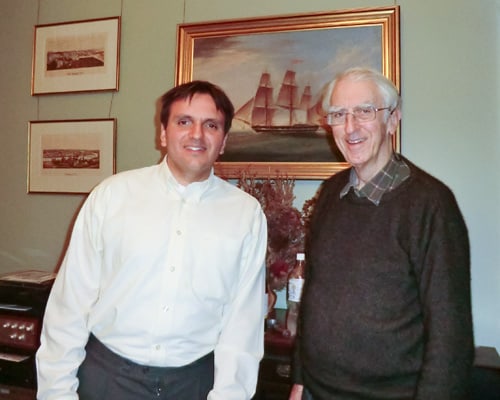
Physics World was saddened to learn today – via a Tweet from the Australian Nobel-prize-winning astronomer Brian Schmidt – of the death of veteran Australian science journalist Peter Pockley.

Peter, who was 78, had contributed numerous articles to Physics World over the years, focusing mainly on the ups and downs of science policy in Australia, of which he had an in-depth knowledge. He died peacefully at his home in Sydney on 11 August 2013.

(more…)

Copyright © 2026 by IOP Publishing Ltd and individual contributors