Electrical processes provide the initial spark for eyesight

Researchers in the US claim to have overturned our understanding of the way in which the visual process is initiated by light entering the eye. They suggest that the initial trigger is provided by electrical processes rather than structural changes in the retina, as has been believed for the past 50 years. The work was carried out by a team led by Kenneth Foster at Syracuse University in the US.

It is long established that the first stage in vision is when light arrives at the retina at the back of the eye and individual photons are absorbed by photoreceptor molecules. Biophysicists have noted that this absorption causes parts of these molecules known as chromophores to change shape. It was believed that this process, in turn, electrically polarizes the chromophores, thereby establishing an electric field that triggers further molecular chemical processes that result in a signal being sent to the brain.

But Foster and his colleagues had their doubts about this explanation and they wanted to determine whether this shape-changing – a process known as isomerization – is in fact the first process in vision. So, the researchers set out to suppress the chromophores to prevent them from changing shape to see what effect this had.

The work involved synthesizing chromophores that were missing a key chemical group. These chromophores were then incorporated into living single-celled algae known as Chlamydomonas reinhardtii. After a series of tests, Foster’s team noted that, despite this change, the algae continued to respond to light stimuli in the same way.

The researchers argue that a redistribution of electrons within chromophores is enough to polarize the chromophores and that a change of shape is therefore not necessary for the initial trigger. Foster told physicsworld.com that this mechanism was in fact proposed in the 1970s but the biochemical procedures have not been available to prove this idea experimentally until now.

Foster believes that a better knowledge of the physics and biochemical operations in the vision process could lead to applications. “[The chemical-receptor proteins] are the target for about half of all pharmaceuticals, so a better understanding of their design could have medical significance,” he says.

These findings are reported in Chemistry and Biology.

Where should the Square Kilometre Array be built?

Coloured hands


The $1.5 billion Square Kilometre Array (SKA) will be the biggest and most advanced radio telescope ever built. Which of the two competing bids do you think should win?

  • Australia / New Zealand
  • Southern Africa

Have your say by voting in our Facebook poll

Yesterday, the founding board of the SKA project the unveiled the process and timeline for selection of the host site for the telescope. Sites in southern Africa and Australia/New Zealand have been shortlisted to host the central core of the SKA telescope, and a final decision on the location is expected to be made in early 2012 by the SKA board of directors.

“Selection of the host site for the SKA will be made in terms of characteristics for the best science as well as the capability and cost of supporting a very large infrastructure, taking the political and working environment into account,” said Richard Schilizzi, director of SKA.

Last week’s Facebook poll was a more light-hearted affair as we celebrated Physics World‘s Invisibility Science special issue. We asked readers to choose their favourite use of invisibility as a plot device from a selection of science-fiction works. The clear winner was John McTiernan’s 1987 action thriller, Predator, which received 40% of the vote.

Hubble – one million and going strong

hubble 2 .jpg

By Tushna Commissariat

I have already raved on about the awesomeness of the Hubble Space Telescope in my blog entry about its 21st anniversary in April this year. Now, the telescope has crossed yet another milestone – on Monday 4 July the Earth-orbiting observatory logged its one-millionth science observation! The image above is a composite of all the various celestial objects ranging through stars, clusters, galaxies, nebulae, planets, etc that Hubble has catalogued over the years. Click on the image for a hi-res version. [Credit: NASA, ESA and R Thompson (CSC/STScI)]

The telescope has had a significant impact on all fields of science from planetary science to cosmology and has provided generations with breathtaking images of our universe ever since it was launched on 24 April 1990 aboard Discovery’s STS-31 mission.

Hubble’s counter reading includes every observation of astronomical targets since its launch. The millionth observation made by Hubble was during a search for water in the atmosphere of an exoplanet almost 1000 light-years away from us. The telescope had trained its Wide Field Camera 3, a visible and infrared light imager with an on-board spectrometer on the planet HAT-P-7b, a gas giant planet larger than Jupiter orbiting a star hotter than our Sun. HAT-P-7b has also been studied by NASA’s Kepler telescope after it was discovered by ground-based observations. Hubble now is being used to analyse the chemical composition of the planet’s atmosphere.

“For 21 years Hubble has been the premier space-science observatory, astounding us with deeply beautiful imagery and enabling ground-breaking science across a wide spectrum of astronomical disciplines,” said NASA administrator Charles Bolden. He piloted the space shuttle mission that carried Hubble to orbit. “The fact that Hubble met this milestone while studying a far away planet is a remarkable reminder of its strength and legacy.”

Hubble has now collected more than 50 terabytes – the archive of that data is available to scientists and the public at http://hla.stsci.edu/

And take a look at this Physics World article by astrophysicist Mark Voit where he looks at the most iconic images Hubble has produced over the years – Hubble’s greatest hits

The NASA video below was created last year for the 20th Hubble anniversary celebration and tells you how you could send a message to Hubble that will be stored in its archive.

Cloaking space–time

Our view of the world is determined by what our eyes see, our ears hear and our noses smell, or what the philosopher Bertrand Russell termed “sense data”. But we know from simple optical illusions that our eyes can be fooled – things are not necessarily always what they seem. However, the techniques that physicists have recently developed to manipulate the path taken by light and other electromagnetic radiation are not mere tricks of the eye: they are real advances that can result in some fascinating and useful effects.

By making specially engineered “metamaterials”, we can now create primitive versions of Harry Potter’s invisibility cloak. After diverting light around an object – like water flowing round a tree stump in a river, or cars parting to either side of a traffic island – we can seamlessly reintegrate it afterwards. Our senses are subverted, not by trickery, but because the light reaching our eyes is the same as if the object were not there. By changing the paths of light rays through space to hide an object at a selected location, we are able to make what is called a “spatial cloak”.

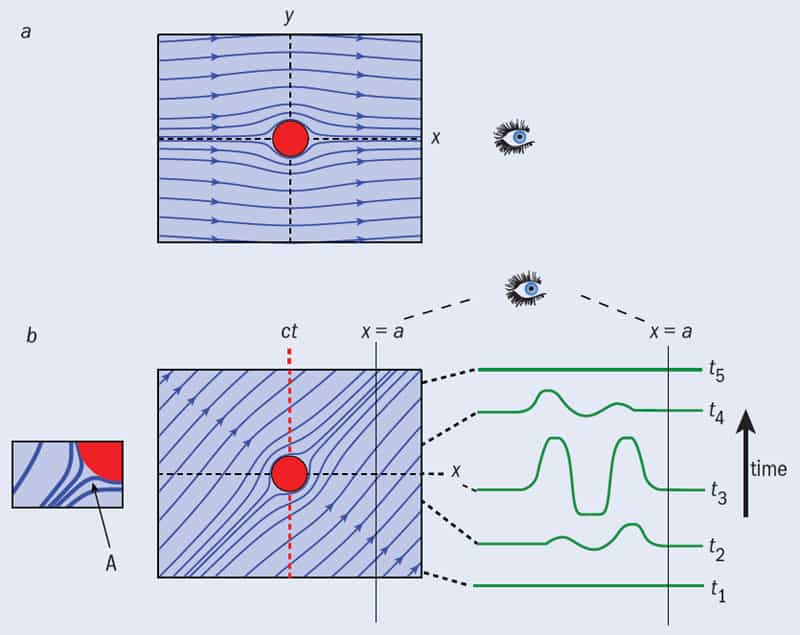
But imagine if we could make a cloak that operates not only in space but in time as well. To understand how such a “space–time” cloak might work, consider a bank housing a money-filled safe. Initially, all incoming light continuously scatters off the safe and its surroundings, revealing the rather dull scene of an undisturbed safe visible to surveillance cameras. But imagine, near some specified time, splitting all the light approaching the safe into two parts: “before” and “after”, with the “before” part sped up, and the “after” part slowed down. This would create a brief period of darkness in the stream of illuminating photons. If the photons were a stream of cars on a motorway, it is as if the leading cars were to speed up and those trailing behind were to decelerate, creating a gap in the traffic edged by bunches of cars (a dark period with bright edges – see t3 in figure 1).

Now imagine that during the moment of darkness, a safe-cracker enters the scene and steals the money, being careful to close the safe door before he leaves. With the safe-cracker gone, the process of speeding up and slowing down the light is reversed, leading to an apparently untouched, uniform illumination being reconstituted. As far as the light reaching the surveillance cameras is concerned, everything looks the same as it did beforehand, with the safe door firmly shut. The dark interval when the safe was cracked has literally been edited out of visible history.

To complete our motorway analogy, it is as if the cars have acted to first open up and then close a gap in traffic, leaving no disturbance in the flow of vehicles. There is now no evidence of that temporary car-free interlude, during which the proverbial chicken may even have crossed the road without getting squashed. So by manipulating how light travels in time around a region of space, we can, at least in principle, make a space–time cloak that can conceal events – an “event cloak”, if you will.

Transform and go

Both space and space–time cloaks use a general method called “transformation optics”, whereby cloak designers decide what route they want light to take before calculating what sort of material the light should pass through to achieve that aim. The point is that light rays travel along paths that can be mathematically altered – for example from straight lines to curves. However, to create the desired distortions of the ray paths, we need our material to be carefully designed, a process that is usually expressed in terms of coordinate transformations. We can then use Einstein’s “principle of covariance”, which says that all physical theories are independent of the coordinates used, to calculate the material properties that will produce the desired light trajectories. Whereas regular (i.e. spatial) invisibility cloaks apply this principle only in space (figure 1a), an event cloak applies it in space–time (figure 1b) – after all, time is as much a coordinate as space, with both appearing in Maxwell’s equations for the electromagnetic field.

What is remarkable is that the event cloak leaves the light rays undeviated from their path from source to detector – they do not curve in space, instead they curve in space–time. It is their speed, not direction, that changes as a function of both position and time. But because our proposal is based on speeding light up in some places and slowing it down in others, we have to ensure that the average speed of the light in our material is less than it would be in a vacuum. After all, since nothing can travel faster than light in a vacuum, our method, which involves speeding up part of the light, would otherwise not work. Another important detail is ensuring that the cloaking light rays do not point towards the past. The simple circular space–time cloak of figure 1b, although ideal for explanatory purposes, unfortunately does include such rays. Thankfully, the design can be modified to remove such features.

From dream to reality

It is easy to imagine all sorts of things that could be done with an event cloak – from the big and fanciful to the small and potentially more useful. Making one in practice would, of course, be another challenge entirely. What we would need is a set of parallel metamaterial layers, each containing an array of tiny metallic elements, the conduction electrons in which would interact with light in a way that could be easily controlled. Such tiny elements, or “meta-atoms”, are the usual way of building up the metamaterials used in ordinary spatial cloaks, but what we need is a more adaptable interaction. In particular, we want to be able to independently adjust the response of each layer in the metamaterial as time passes.

Assuming such a material can be made, illuminating light travelling perpendicular to the layers would not “see” a heterogeneous structure, but a smooth effective medium – if, that is, its wavelength is much bigger than both the meta-atoms and the spacing between the metamaterial sheets. However, because of the presence of addressable metallic elements, the average speed of the light through the material can be dynamically adjusted. The metamaterial properties can thus be controlled so that they produce the characteristic dark-spot intensity null of the space–time cloak at the desired space and time.

Events occurring in the cloakable space between the central layers (figure 2a) near the chosen time will occur in the dark, and so be hidden from – and unsuspected by – any observer. Although this dark spot can exist over as long a distance as we like, it moves, and lasts only for a relatively short time that depends on the performance and thickness of the metamaterial. For example, a metre-scale cloaking device would only be able to cloak an interval of a nanosecond or so, while current technological limitations would probably reduce this by a factor of 10 or even 100.

Assuming that a future generation is able to produce a high-performance, macroscopic, fully functioning space–time cloak, one party trick that it could perform would be to create the illusion of a Star Trek-type transporter (figure 2b). What we would need to do is take our metamaterial cloak made from meta-atoms much smaller in size than the wavelength of light and carve a central corridor down the middle. As the null in the illuminating light passes over the central region, someone could run in the dark from one end (A) of the corridor to the other (B). But as far as any outside observer is concerned, it would appear as if the person had instantly relocated from A to B in true Star Trek style.

More plausibly, consider an experiment that cloaks a small box containing excited atoms (figure 2c). The atoms will spontaneously decay, emitting photons according to the usual exponential Poisson statistics. However, the light emitted by the atoms as the intensity null passes over the box is affected by the closing of the cloak. What this means is that any light emitted during the cloaked interval is compressed into a much shorter time period, escaping the cloak as a brief but intense flash of light. This phenomenon is more than just of abstract interest because it could be the first ever experimental signature produced by a working space–time cloak.

Finally, a space–time cloak could be used to control the flow signals in an optical routing system (figure 2d), where one node might need to receive and process signals simultaneously from different channels. For example, one channel might be a clock signal that the external circuit demands is never interrupted, while the other channel may contain data that nevertheless must be processed as a priority. This conflict could be resolved by a space–time cloak that briefly opens up a gap in the clock signal. The node could process the priority bits during the gap, and then seamlessly reconstitute the clock signal by closing the cloak. This would enable an “interrupt-without-interrupt” operation that might be useful in quantum computing, which inherently deals with correlated data channels.

Practical questions

Although mathematics can tell us the precise electromagnetic properties required of a space–time cloak, actually making such a device is well beyond current metamaterials technology. For example, the material has to be able to couple the electric and magnetic fields in a specific way. What is surprising is that this exotic coupling has the side effect of making it appear to the light as though the medium is in motion, despite remaining stationary. If, however, we are content with making an imperfect space–time cloak, then such a device does lie within the range of current technology and would involve building the cloak from optical fibre. We estimate that an event cloak in 3 km-long fibre with a 1 km-long opening section, a 1 km long operating section and a 1 km-long closing section, could obscure events lasting up to several nanoseconds.

Optical fibres are potential candidates because their refractive index can be increased simply by raising the intensity of the beam they carry, thereby slowing the light as required. This could be done by suddenly increasing the intensity of a “control” beam, with the resulting intensity step-change travelling down the fibre and inducing a travelling change in light speed. If the fibre also contained a second, constant, “monitor” beam, photons in that beam would travel faster than the control beam before the intensity increase, but more slowly afterwards – exactly what is needed to open the dark interval in our space–time cloak.

We could then transfer this monitor beam into another fibre with a new control beam that this time suddenly decreases in intensity. This reverses the previous speed differential, closing down the dark interval, and recreating the original unvarying monitoring light beam. To return to our motorway analogy, it is as if the intense part of the control beam is a shower of rain moving along with part of the traffic, forcing only those drivers to slow down. The gap in traffic opens when the trailing cars are rained on and slow down, and closes when the rain shower switches to instead drench the leading cars, making them slow down as the trailing cars speed up.

In practice, such a cloak would be imperfect because we are only able to modify the electrical properties of the fibres, since they are non-magnetic. This imperfection leads to stray reflections, allowing the cloak to be detected. To remove all reflections we would have to modify both electric and magnetic properties. Fortunately, though, the details of what was going on inside the cloak would still remain hidden.

The road ahead

Although lots of researchers around the world are trying to make spatial cloaks – in some cases with a good deal of success – no-one has yet tried to demonstrate a space–time cloak in the lab. However, there seems to be no obvious reason why such a cloak – and an experimental signature confirming it, such as the atoms-in-the-box test – could not be achieved quite soon, perhaps even within a few years. Once the principle has been shown, we can then start looking into applications along the lines suggested above, particularly the idea of being able to use an event cloak to resolve computational conflicts in optical processing systems.

Ultimately, it may even be possible for the operation of a space–time cloak to be triggered by events preceding those to be hidden by the device. One possible downside, though, is that covert processing and computation could then be instigated by rogue data infiltrating a system, without the system ever being aware that it had been hacked. To return to our analogy of a chicken crossing the road through a gap in the traffic, it is as if a particularly devious and clever chicken actually choreographs the whole routine beforehand by manipulating the speed limits (to open up the gap) and then again after crossing (to close it again). So while we may never know why the chicken crossed the road, at least we can imagine how it did it.


Drumming to a cooler quantum beat

Physicists in the US have developed a new method to cool tiny quantum drum, putting it into a long-lived quantum ground state. The tiny device could be used as a new method of storing quantum information or as a motion sensor. It could also help advance the field of quantum acoustics which explores the quantum nature of mechanical vibrations.

“We are currently just at the cusp of making engineered massive objects that obey the rules of quantum mechanics, which are normally observed only at the atomic scale,” explains John Teufel, a research affiliate who designed the drum and carried out the experiment with his team at the National Institute of Standards and Technology (NIST) in Colarado, US.

Quantum percussions

The micro-drum is a quantum-mechanical resonator made from aluminium. It is 100 nm thick and 15 µm wide and is incorporated into a superconducting cavity in the set-up. The team cools the drum to microkelvin temperatures, bringing it to its quantum ground state with its range of motion approaching zero. In other words, the amplitude of its “beats” approaches zero. The circuit is designed so that the drum motion can influence the microwaves inside an electromagnetic cavity. The researchers created strong interactions between microwave light oscillating at 7.5 GHz and the drum vibrating at radio frequencies of 11 MHz.

Cool tool

The researchers use a technique similar to laser cooling of atoms – sideband cooling – only they use microwaves instead of laser light. The microwaves can be used to measure and control the drum vibrations, and vice versa. What is different about the Teufel team’s cooling technique is that the entire apparatus is mounted in a traditional cryostat before the sideband cooling is started. “This gives us a big head-start because most laser cooling experiments begin at room temperature. Here the combination of low temperature pre-cooling and microwave sideband cooling is the niche that gives us our advantage,” explains Teufel. The cryogenic cooling reduces the drum energy to about 30 quanta. Sideband cooling then reduces the drum temperature from 20 mK to below 400 µK, steadily lowering the drum energy to just one-third of one quantum. This means that for two-thirds of the time the drum is in its ground state (with no quanta) and for about one-third of the time there is some energy.

Information and sensors

The drum motion will persist for hundreds of microseconds, much longer than recorded before. “Because of these long time scales we could potentially encode quantum information into the motion of the drum where it can be temporarily stored before using microwave light to retrieve it” explains Teufel. This would be very useful in quantum computing. He also wants to combine the new circuit with superconducting quantum bits to create and manipulate the motion of relatively large objects at quantum scales. “For me it is the fundamental level of this research that is most exciting,” he claims.

For me it is the fundamental level of this research that is most exciting John Teufel, NIST

But on a more practical level, Teufel says that because the system measures the minute drum beats, it could also serve as a motion sensor – sensing minuscule position changes in quantum systems. He also points out that drum movements are universal and could easily be integrated into quantum circuits. “I would really like to exploit the ‘quantumness’ of this circuit,” says Teufel.

The first engineered object to be coaxed into the quantum ground state was developed by researchers last year and won third place in the Physics World 2010 Breakthrough of the Year award. Compared to that first drum, the NIST drum has a higher quality factor, so it can hold a beat longer, and it beats at a much lower frequency.

The research has been published in a paper in Nature.

Gorilla inspired by the work of Roger Penrose

Tensor1.jpg

By James Dacey

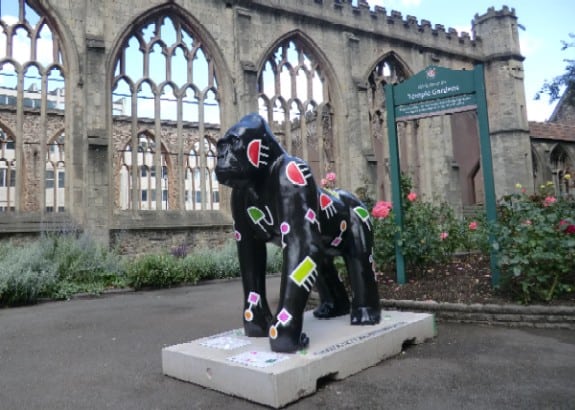
Say hello to Tensor. His striking pelt has been inspired by the English mathematical physicist Roger Penrose, who created a visual language for representing complex mathematical expressions.

Tensor has just appeared today in a quiet public garden in central Bristol, just around the corner from the offices of physicsworld.com. He is one of a band of 60 life-sized decorated gorillas that will be appearing around the city to celebrate Bristol Zoo’s 175th anniversary.

Last year, the organizers of this public art exhibition approached IOP Publishing (which publishes physicsworld.com) to ask if it would like to sponsor and design a gorilla for the show. The challenge was taken on by in-house artist Fred Swist, collaborating with art director Andrew Giaquinto, and the pair came up with the idea of using Penrose’s graphical tensor notation. These pictorial elements, used in physics and pure maths, comprise simple shapes connected by lines. For instance, they have been used to visualize interactions between particles and fields in spin networks.

“The project was quite challenging, as we were trying to render complex mathematical notations into striking and colourful visual forms, to appeal to a wider audience,” said Swist.

Tensor is among the more high-brow of the gorillas as his cooler mates include an Elvis gorilla, a Funky Gibbon, and a Spidermonkey in trademark red and blue. But in addition to entertaining Bristolians and visitors to the city, there is also a serious note to the Wow! Gorillas exhibition. It is designed to promote Bristol Zoo’s gorilla conservation project and Wallace and Gromit’s Grand Appeal, which raises funds for the Bristol Royal Hospital for Children. When the exhibition comes to a close in mid-September, the life-sized painted gorillas will be sold at a charity auction and the funds will be donated to these causes.

IOP Publishing celebrates a decade in Moscow

IOP Publishing celebrates a decade in Moscow
Celebrating in Moscow

By Hamish Johnston

Last week several of my colleagues were in Moscow to celebrate the 10th anniversary of IOP Publishing’s office in that city. A reception was held at the office in the P N Lebedev Institute and speeches given – including one by Jerry Cowhig, the former managing director of IOP Publishing (which publishes physicsworld.com) who had been a driving force in the firm’s Russian campaign.

The company’s first office in Russia (then still in the USSR) opened in St Petersburg (then Leningrad) in 1990. In his speech Jerry summed up the goal of the offices: “[To] bring western research into Russia…[and to] bring Russian research into the West.”

Another highlight of the event was an award for the outstanding paper published in 2010 by a Russian author in an IOP journal. The award was scooped by Nataliya Chistyakova and her co-authors from Moscow State University for their paper “Mössbauer study of isomorphous substitutions in Cu2Fe1-xCuxSnS4 and Cu2Fe1-xZnxSnS4 series” published in Journal of Physics: Conference Series.

As well as encouraging Russian physicists to publish in its own journals, IOP Publishing produces English versions of six Russian journals in partnership with the Russian publisher Turpion. These include two physics titles – Quantum Electronics and Physics-Uspekhi – with the other four covering mathematics and chemistry.

Quantum memory works at room temperature

A quantum memory for photons that works at room temperature has been created by physicists in the UK. The breakthrough could help researchers to develop a quantum repeater device that allow quantum information to be transmitted over long distances.

Quantum bits (or qubits) of information can be transmitted using photons and put to use in a number of applications, including cryptography. These schemes rely on the fact that photons can travel relatively long distances without interacting with their environment. This means that photon qubits are able, for example, to remain in entangled states with other qubits – something that is crucial for many quantum-information schemes.

However, the quantum state of a photon will be gradually changed (or degraded) due to scattering as it travels hundreds of kilometres in a medium such as air or an optical fibre. As a result, researchers are keen on developing quantum repeaters, which take in the degraded signal, store it briefly, and then re-emit a fresh signal. This way, says Ian Walmsley of the University of Oxford, “you can build up entanglement over much longer distances”.

Difficult to repair

A quantum memory, which stores and re-emits photons, is the critical component of a quantum repeater. Those made so far in laboratories must be maintained at extremely cold temperatures or under vacuum conditions. They also only tend to work over very narrow wavelength ranges of light and store the qubit for very short periods of time. Walmsley and his colleagues argue that it isn’t feasible to use such finicky systems in intercontinental quantum communication – these links will need to cross oceans and other remote areas, where it’s difficult to send a repair person to fix a broken cryogenic or vacuum system.

Moreover, they should also absorb a broad range of frequencies of light and store data for periods much longer than the length of a signal pulse. Walmsley calls this combination a “key enabling step for building big networks”. The broad range of frequencies means the memory can handle larger volumes of data, while a long storage time makes it easier to accumulate multiple photons with desired quantum states.

Working towards this goal, Walmsley and his team made a cloud of caesium atoms into a quantum memory that operates at an easy-to-achieve temperature of about 62 °C. Unlike previous quantum memories, the photons stored and re-emitted do not have to be tuned to a frequency that caesium electrons would like to absorb. Instead, a pulse from an infrared control laser converts the photon into a “spin wave”, encoding it in the spins of the caesium electrons and nuclei.

Paint it black

Walmsley compares the cloud of caesium atoms to a pane of glass – transparent, so it allows the light through. The first laser paints the glass black in a sense, allowing it to absorb all the light that reaches it. However, instead of becoming dissipating as heat and as it would in the darkened glass, the light that passed into the caesium cloud is stored in the spin wave.

Up to 4 µs later, a second laser pulse converts the spin wave back into a photon and makes the caesium transparent to light again. The researchers say that the caesium’s 30% efficiency in absorbing and re-emitting photons could increase with more energetic pulses from the control laser, while the storage time could be improved with better shielding from stray magnetic fields, which disturb the spins in the caesium atoms.

Even at 30% efficiency, Ben Buchler of the Australian National University in Canberra calls the device “a big deal” because it absorbs a wide band of photon frequencies. Due to Heisenberg’s uncertainty principle, the ultra-short single-photon pulses from today’s sources don’t have well defined energies, so an immediately useful quantum memory must be able to absorb a wide range of frequencies – which Buchler says high-efficiency memories can’t yet do.

Noise not a problem

Background noise, or extra photons generated in the caesium clouds that are unrelated to the signal photons, was a major concern for room-temperature memories. “People thought that if you started using room-temperature gases in storage mode, you’d just have a lot of noise,” says Walmsley.

Temperatures near absolute zero suppress these extra photons other memories. But because the control and signal pulses in the Oxford team’s set-up are far from caesium’s favoured frequencies, the cloud was less susceptible to photon-producing excitations and the noise level remained small even at room temperature.

Hugues de Riedmatten of the Institute of Photonic Sciences in Barcelona, Spain, says that the researchers showed that the remaining noise is fundamental to the system, not caused by their set-up. If improvements cannot further reduce the noise, it will be challenging to maintain the integrity of the signal across a large, complex network, he explains.

Nevertheless, he says, “This approach is potentially very interesting because it may lead to a quantum memory for single photon qubits at room temperature, which would be a great achievement for quantum-information science.”

The work is described in a paper to be published in Physical Review Letters and a preprint on arXiv.

Rotating cylinder puts a new spin on slow light

Physicists in the UK and Canada claim to have demonstrated for the first time how a spinning medium can rotate a transmitted image. According to the researchers, the phenomenon could be used to encode images with extra data.

It has long been known that a moving medium can shift the position of passing light. The reason is that the light’s photons can be absorbed by the medium’s atoms, which jump into a higher energy state as a result. A moment later, these atoms return to their original state, re-emitting the photons. But by this time the atoms have moved slightly, so the photons continue their path from that new position.

In 1859 the French physicist Hippolyte Fizeau demonstrated this “photon drag” in the longitudinal direction by shining light through flowing water. More than 100 years later, in 1976, the British physicist Reginald Jones demonstrated it similarly in the transverse direction, by shining light near the edge of a spinning glass disc. But until now, it seems, no-one has ever shown that an image formed by light can be rotated. The problem is that the atoms are so quick to re-emit absorbed photons that the change in an image’s rotation is barely perceptible.

Slowing down light

Sonja Franke-Arnold and colleagues at the University of Glasgow, UK, have joined forces with physicists at the University of Ottawa, Canada, to perform the feat by relying on another phenomenon: slow light. Many media slow down light a little from its usual speed of 3 × 108 m/s in a vacuum. However, in a few media, given the right conditions, the speed – the light’s group velocity, not that of the individual photons – can be reduced dramatically. Because slow light takes so much longer to pass through a medium, any photon drag should be enhanced.

To test this idea, Franke-Arnold’s group shone a rectangular beam of green light into a cylinder made of ruby, which they spun at up to 30 revolutions per second. Ruby is a well known slow-light material, and transmits light with a group velocity of just a few tens of metres per second. By changing the rotation of the ruby from clockwise to counter-clockwise, the researchers could detect a rotation of the light rectangle by about one-third of a degree (see figure). What is more, when they ramped up the intensity of the light, the rectangle’s rotation increased to about 10° – probably because the photons were then undergoing several absorption and re-emission cycles.

“Very beautiful demonstration”

Ortwin Hess, an expert in slow light at Imperial College London and the University of Surrey, calls it a “very beautiful demonstration” of rotary photon drag. He suggests that the phenomenon could be extended to a broad range of wavelengths using special man-made media known as metamaterials. “It’s very interesting, indeed,” he says.

Franke-Arnold’s group believes that one application could be in image encoding: just as the intensity of an image supplies data, so too could the image’s rotation. For now, however, the researchers are keen to further investigate rotary photon drag. “We have a few ideas – like more complex images,” says Miles Padgett, of the University of Glasgow, who was also involved in the work.

The paper was published last week in Science 333 65.

‘Carpet’ makes objects invisible to sound

Researchers in the US have made a “carpet cloak” that makes objects invisible to sound waves. The device is the first such cloak to work in air and could be used to improve the acoustics in concert halls or even to control unwanted noise.

The first light-based invisibility cloak was built in 2006 and the first for sound followed in 2010. Such cloaks are made from special man-made materials that are engineered to have optical or acoustic properties that vary throughout the device. As a result, incoming light or sound waves bend around the cloak and rejoin at the far side as if the cloak – and anything inside it – was never there.

In practice, however, it is extremely difficult to create materials with all the right properties and all cloaks built so far are extremely limited in how they work. The first sound cloak, for example, works in water not air and only works if the sound is propagating in 2D. Another important limitation of many cloaks is that they only work within a narrow band of frequencies.

Under the carpet

Carpet cloaks are a special type of invisibility cloak that offer a way of getting round some of these problems. These cloaks are placed over an object sitting on a reflective surface and render the object invisible. The first optical carpet cloak was made in 2009 and now Steven Cummer and colleagues at Duke University in the US have made a carpet cloak for sound. And, unlike previous acoustic cloaks, it works in air rather than water.

This latest device is made from a set of square plastic plates, each with a hole at its centre. The size of hole has a strong effect on how a sound wave behaves when it is fired straight at the plate. As it passes through the plate, the wave acts if it has entered a region where the mass density of the air has suddenly increased. However, if the wave arrives at a glancing angle to the plate, the hole has little effect and the wave behaves as if it is propagating through air.

The team chose plates that are 5 mm across, 1 mm thick and with a 1.6 mm diameter hole. Layers of the plates were assembled into a 3D chevron-shaped structure (see figure) that was placed upon a hard “ground plane” that reflects sound. The object to be cloaked was placed under the device and sound from a speaker was directed at it. A microphone was then moved throughout the room to map out the sound intensity as a function of position to see how sound scatters from the cloak.

Nearly identical patterns

The team found that the intensity pattern obtained when the cloak and object are present is nearly identical to the pattern obtained from the empty ground plate. The pattern, however, is very different when just the object is present. According to the team, the difference between the patterns from the cloaked object and empty surface are a result of some of the sound being absorbed by the cloak – a problem that most cloak designs suffer from.

The team’s measurements show that the cloak works well over a bandwidth of 1–5 kHz. “Theoretically it should work well below 1 kHz as well, but because the wavelengths are so long it is hard to measure those lower frequencies in our set-up,” explained Cummer. This 0–5 kHz frequency range is about the same as a human voice.

To operate at frequencies above about 6 kHz the size of the plastic plates would have to be reduced. “We can definitely cover the whole range of human hearing (say to 0–15 kHz) without too much trouble,” he said.

This operating range impresses Nicholas Fang of the Massachusetts Institute of Technology who said “The technology is very promising as it is broadband. For example, it might improve sound reflections in auditorium or theatre rooms.”

Designing acoustic surfaces

Cummer agrees, pointing out that the design could be used to give a room an acoustic layout that is different from its actual physical layout. Walls that are smooth to the eye could be made to appear rough to sound and vice versa. This could aid architects and acoustic engineers when designing concert halls, for example.

José Sánchez-Dehesa of Universidad Politécnica de Valencia in Spain believes that further applications could be possible if the concept of the carpet cloak could be extended to vibrations in solid materials. This could be used, for example, to cloak sensitive instruments from vibrations says Sánchez-Dehesa. Looking even further into the future he says that the concept could even be used to protect buildings from earthquakes.

Cummer’s team is now working on a 3D pyramid-shaped cloak and is also trying to develop a similar cloak that works in water rather than air.

The research is described in Phys. Rev. Lett. 106 253901.

Copyright © 2026 by IOP Publishing Ltd and individual contributors