Fermilab homes in on Higgs mass

Experiments at Fermilab have narrowed the range of possible masses for the Higgs Boson – the elusive particle that physicists hope to see for the first time at the Large Hadron Collider (LHC). The results rule out about one quarter of the previous mass range for the Higgs and boost the chances that it will be rather lightweight – and therefore more difficult to detect.

The Higgs boson is predicted by the Standard Model of particle physics, and its existence provides an explanation for how elementary particles acquire mass. The Standard Model does not, however, predict the exact mass of the Higgs boson and its measurement is expected to be a major achievement of the LHC at CERN in Switzerland.

The ease with which the LHC will find the Higgs is partially dependent on the particle’s mass. A Higgs heavier than about 140 GeV/c2 is more likely to decay into pairs of Z or W bosons, which would cause a distinct signal in the LHC’s detectors. By contrast, a lighter Higgs would favour a decay to b–quarks, which would be more difficult to see against the background of other events.

The latest from the Tevatron collider at Fermilab in Chicago eliminates masses in the 158–175 GeV/c2 range to a confidence of 95%. When combined with previous searches for the Higgs and constraints imposed by the Standard Model, the Higgs mass is most likely be in the 114–158 GeV/c2 or the 175–185 GeV/c2 range.

Waiting around

If the Higgs weighs in towards the bottom of the 114–158 GeV/c2 range it could be five or more years before the LHC finds the particle. On the other hand, if it is at the top of this range – or at 175–185 GeV/c2 – its existence could be established within a year or so.

The latest constraint was a joint effort of Tevatron’s two main experiments – CDF and DZero. Each experiment has recorded about 500,000 billion proton-antiproton collisions since 2001 and the two experiment teams worked independently to sift through the data in search of evidence for the Higgs. While neither caught sight of the particle, the results were then combined to create the mass-exclusion limits.

There is still a chance that the Higgs could be spotted in the vast amount of data collected at the Tevatron. Indeed, scientists working at the collider are currently trying to persuade US funding bodies to run the facility for a few more years to boost the chances of spotting the Higgs – rather than shut it down in 2011 as planned.

The results were presented at the International Conference on High Energy Physics, which is currently taking place in Paris. A preprint of the paper is available at arXiv:1007.4587.

Getting beneath Mona Lisa’s skin

Leonardo da Vinci is revered for his ability to blend tones and colours without a brushstroke in sight, an effect that imbues Mona Lisa with such natural grace in Leonardo’s famous portrait. But, despite sharing admiration for the grand master, art historians cannot yet agree on how exactly Leonardo managed to generate this effect referred to as sfumato after the Italian “fumo” for smoke.

The uncertainty is largely because the French art authorities are, naturally, not very keen on the idea of scientists taking samples from great works of art. Now, however, a group of physicists based at the Louvre in Paris have come up with a number of answers without removing a drop of paint.

Laurence de Viguerie led a team at the centre for research and restoration of the museums of France to analyse seven paintings at the Louvre using X-ray fluorescence spectroscopy. The results confirm the reputation of Leonardo as an experimental artist who also possessed a highly dextrous hand.

Dramatic shadows

We know Leonardo’s studio had a strong culture of experimentation, but there are very few texts to describe his methods in detail. Walter Philippe

To create the natural flesh colours in the Mona Lisa, Leonardo overlaid four separate layers of paint, beginning with a priming layer of lead white and finishing with a varnish. The key to producing such dramatic shadows was to include several sublayers of glaze – with different thicknesses and with varying amounts of added pigments including iron and manganese.

“We know Leonardo’s studio had a strong culture of experimentation, but there are very few texts to describe his methods in detail,” says Walter Philippe, a member of the Louvre science team.

Recent developments in the analysis software meant that the researchers could determine the thickness of individual sublayers in the shadow, which are as thin as 1–2 µm. “Leonardo showed a great deal of skill and patience in combining his layers some of which are incredibly thin,” says Philippe.

Another celebrated artist from the high renaissance is Rafael, who is said to have learned a lot from Leonardo, having produced a lot of work in the same studio. The Louvre team intends to develop its research by using the X-ray method to look for similarities and differences in the techniques of these two renaissance artists.

“Scientific techniques provide important evidence about how the works were made, how the appearance of the works has changed over the years, and about the date and authorship of the works,” says Martin Kemp, an art historian at the University of Oxford.

“Leonardo reformed the way nature is represented according to the ‘rules’ of nature, and introduced new modes of communication between the figures in the painting and the spectator,” Kemp explained.

This research is explained in Angewandte Chemie.

Gamma-ray burst could kill off ocean life

A cosmic gamma-ray burst striking the Earth could be harmful to ocean plankton at depths of up to 75 m, according to a team of Cuban researchers. These organisms account for up to 40% of the ocean’s photosynthesis, so such an event could have a serious impact on Earth’s carbon dioxide levels.

Gamma-ray bursts (GRBs) are the most luminous electromagnetic events known to occur in the universe, releasing up to 1044 J of gamma-ray energy in a narrow beam over several seconds. They come in two types, long and short, with the former the most common and thought to be caused by the core-collapse of a supernova. To date the GRBs observed have been in distant galaxies and not our own Milky Way. However, some researchers believe that a GRB was responsible for the Ordovician mass extinction approximately 450 million years ago.

With this in mind, a team of biologists and physicists at the Central University of Las Villas, in Santa Clara, Cuba have modelled what might happen should a nearby GRB – about 6000 light-years away – strike Earth today. “Our wish was to link astrophysics with environmental science, which is quite an unexplored area. We wanted to know how stellar explosions might affect the evolution of life on Earth,” physicist Rolando Cárdenas told physicsworld.com.

Ripping electrons

The danger for plankton living in the oceans would not be the gamma-rays themselves but the flashes of ultraviolet (UV) radiation caused by the interaction of the gamma-rays with the atmosphere. The initial arrival of gamma-rays from the GRB would rip electrons from gas molecules. These electrons would then excite other molecules creating an emission of UV energy. According to Cárdenas about 1–10% of the incident gamma-ray energy reaches the ground in the form of UV light and has the potential to damage plankton. The reminder comes in the form of visible or infra-red light which is less dangerous to life.

In order to model the effect of this UV radiation, the team examined the typical albedo for the Earth’s oceans in order to calculate the UV spectrum at different depths. They also took into account the optical quality of the water because not all oceans are as clear as others. Combining these with several other factors they found that a UV flash could penetrate up to 75 m in clear water, damaging a crucial enzyme required for photosynthesis and well as causing the plankton to divert energy from photosynthesis to repairing damaged DNA.

This suppression of the plankton’s ability to photosynthesize could have a profound effect on the Earth’s climate. Carbon dioxide is consumed in great quantity by ocean-based plankton with just one species, Prochlorococcus marinus, accounting for 20% of the entire biosphere’s photosynthesis. The plankton are also the first link in many of the ocean’s food chains and their demise at the hands of a GRB would have a knock-on effect all the way up the food chain.

Rare in metal-rich galaxies

However, GRBs are rare in galaxies like the Milky Way. “The most likely explanation for this is that the Milky Way is more metal rich – with many elements heavier than helium – and GRBs occur less in metal rich environments,” explains Andrew Levan, a GRB researcher at the University of Warwick, UK. Despite this rarity, a GRB strike on Earth isn’t that far fetched. “GRBs are likely to happen in our galaxy around every 10 million years or so. To affect the Earth it would have to be lined up with us and not too far away. However, it is plausible that over the Earth’s 4.5 billion year history we could be affected by a GRB,” Levan added.

The findings have been accepted for publication in Astrophysics and Space Science and a pre-print is available on arXiv.

Science-writing tips from a high flyer

AJOYA.jpg

By Louise Mayor

We were delighted to hear that Mark Williamson won “Best Space Submission” in the Aerospace Journalist of the Year Awards 2010, for an article published in Physics World last March.

His victorious piece, Up close and personal, is about how planetary astronomy has developed from a science of entirely remote observation to one of immersive experimentation.

I caught up with Mark to find out his reaction to winning, and his thoughts on writing for Physics World in particular. Also – perhaps with selfish motives – I found out his tips for successful science writing.

Mark said that he was pleased to win the award, and explained that each of the categories is judged by other writers: “So it’s a sort of peer review,” he said.

I asked Mark whether writing for Physics World requires a different approach to some of the other publications he contributes to, such as Engineering & Technology and Space Times. But as he explained, “Physics World has a very different readership from the other magazines I write for, but I have exactly the same attitude to writing as for any other audience.

“It’s clear that a majority of the readership has a professional interest in physics, so you have to find a reason for them to read your article on space technology. You have to make it relevant, or at least interesting, to them.

“On the other hand, many physics graduates and readers of Physics World never work in physics, which is why a few years ago there was a drive to make the magazine more relevant to this audience too. Apart from that, physicists are not only interested in physics…are they?”

(more…)

Quantum theory survives its latest ordeal

A simple experiment that sends photons through three slits provides the best proof yet of an important axiom of quantum theory called Born’s rule, say physicists in Canada and Austria. The confirmation also provides important guidance to those seeking the holy grail of physics – a quantum theory that includes gravity.

When a beam of particles such as photons or electrons is fired at two closely spaced slits, the resulting interference pattern occurs because the particles behave like waves. The intensity of the pattern can be calculated by squaring the sum of the waves that travel through each slit. This is the consequence of Born’s rule, which defines the probability that a measurement on a quantum system will yield a certain result.

Couples only

In the case of three slits, the calculation produces three terms describing interference between waves travelling through the three possible pairs of slits. There are, however, no “third-order” terms involving waves travelling through all three slits.

While Born’s rule has been central to quantum theory since the 1920s, it has not been tested experimentally with any degree of rigour. Now, Gregor Weihs of the University of Innsbruck in Austria and colleagues at the University of Waterloo in Canada have done a three-slit experiment that shows there is no third-order interference.

The measurement begins with the creation of a single photon that is fired at a mask with three slits – each 30 µm wide and separated by 100 µm. Once it has passed through the slits, the photon strikes a position sensitive detector. Single photons are fired at a rate of about 40,000 per second and a plot of photon intensity versus position gives the interference pattern as described by Born’s rule.

Summing up

To test the rule, the team repeat the measurement with one slit open at a time – and then with the three possible two-slit configurations. If Born’s rule is correct, all of these measurements should sum to give the same interference pattern seen when all three slits are open. Weihs and colleagues saw this to within 1% of the intensity of the pattern, confirming Born’s rule.

According to Weihs, any violation of Born’s rule would mean that Schrödinger’s equation – the cornerstone of quantum theory – would have to be modified. “The existence of third-order interference terms would have tremendous theoretical repercussions – it would shake quantum mechanics to the core”, he said.

However, the discovery of such a violation would be very welcome because a revised quantum theory could lead to a much sought after unified theory that incorporates the present day quantum and gravitational theories.

Providing an answer

“The question then is how radical a revision will be needed”, explains Rafael Sorkin of the Perimeter Institute for Theoretical Physics in Canada. “This experiment provides an answer by telling us that (to the accuracy achieved so far) nature is satisfied with the two-slit type of interference we already know, but does not exhibit new forms of interference involving three or more alternatives”.

Weihs told physicsworld.com that the team is now doing a similar experiment with beam splitters replacing the three slits – which should allow them to reduce the experimental uncertainty. They also plan to repeat the experiment with four and five slits.

The work is reported in Science 329 418.

New technique opens a gap in graphene

Researchers in Germany and Switzerland have developed a new way to make extremely narrow graphene ribbons with specific widths and electronic bandgaps. The ribbons also have smooth edges, something that is crucial for making electronic devices out of graphene.

Graphene is a flat sheet of carbon just one atom thick – with the carbon atoms arranged in a honeycomb lattice. Since the material was first created in 2004, its unique electronic and mechanical properties have amazed researchers who say that it could be used in a host of device applications. Indeed, graphene might even replace silicon as the electronic material of choice in the future.

However, unlike the semiconductor silicon, graphene has no gap between its valence and conduction bands. Such a bandgap is essential for electronics applications because it allows a material to switch the flow of electrons on and off. One way of introducing a bandgap into graphene is to make extremely narrow ribbons of the material.

Cutting or unzipping

Until now, these graphene nanoribbons were made using top-down approaches, such as “cutting” the ribbons from larger graphene sheets or “unzipping” carbon nanotubes. Such methods produce ribbons that are relatively wide (more than 10 nm across) with rough edges. For high-efficiency electronics devices, the ribbons need to be much smaller than 10 nm wide and, importantly, their edges need to be smooth because even minute deviations from the ideal edge shapes, “armchair” and “zigzag”, seriously degrade graphene’s electronic properties.

The new technique, developed by a team led by Roman Fasel of the Swiss Federal Laboratories for Materials Science and Technology (Empa) and Klaus Müllen from the Max Planck Institute for Polymer Research in Germany, is a simple, surface-based bottom-up chemical process. It involves first spreading specially designed halogen-substituted bianthryl monomers onto gold and silver surfaces under a high vacuum. Next, the monomers are made to link up to form polyphenylene chains.

‘Important first step’

Fasel and colleagues then remove hydrogen atoms from the polymers by heating up the ensemble. This leads to the polymer chains interconnecting to form planar, aromatic graphene ribbons that are just one atom thick, 1 nm wide and up to 50 nm long. The ribbons are narrow enough to have an electronic bandgap and thus switching properties. “Such switching is an important first step for the shift from silicon microelectronics to graphene nanoelectronics,” say the researchers.

And that is not all: the edges of the graphene ribbons are smooth and armchair-shaped, and the ribbons themselves are either straight or zigzagged, depending on the monomers used to make them. The smooth edges will be important for studying fundamental experimental physics too, says the team – for example, observing how magnetic properties of the ribbons change with different edge structures. Until now, previous methods to make graphene nanoribbons always produced rough edges that were difficult to study

The new technique could also be used to dope the graphene ribbons by using monomers containing nitrogen or boron atoms. And monomers with additional functionalities should allow the researchers to create positively and negatively doped ribbons – for making p–n junctions in transistors, for instance.

Solar cells

Going further still, a combination of various monomers might even allow heterojunctions (interfaces between different types of graphene nanoribbon, such as those with large or small bandgaps) to be created. Such structures could be used in applications like solar cells or high-frequency devices. Fasel and colleagues have already shown that this technique is viable by connecting three separate graphene ribbons together using two suitable monomers.

The team, which includes scientists from ETH Zürich and the Universities of Zürich and Bern, is now working on creating the nanoribbons on semiconductor surfaces, rather than on just metallic substrates as in this work. This will be critical for making real-world electronic devices.

The results are reported in Nature.

Einstein’s Universe: the scientist, the man, the musician

Albert Einstein was the kind of physicist that you don’t really find anymore – making so many remarkable contributions to so many different areas of physics.

But in addition to his scientific achievements, a lot is made about Einstein’s colourful personal life, not least his lifelong passion for music.

Sharing this passion is particle physicist Brian Foster of the University of Oxford who has teamed up with the British musician Jack Liebeck to create a special show about Einstein. Currently touring the UK, “Einstein’s Universe” involves a special lecture, interspersed with classical music, which explores Einstein’s legacy to physics and the role music played in his life.

In this exclusive video report for physicsworld.com, I caught up with the pair on the day of a recent performance at St George’s concert hall in Bristol, UK.

Escapism from research

During our interview, Foster talked about how music inspired Einstein and how it offered a form of escapism from his research. “He often said that he had more pleasure in life from playing the violin than from anything else he did,” Foster explained.

“We have indications from his wife in a letter that he would often come out of his study when they lived in Berlin, and scratch his head, play a few chords on the piano, then go back to his study and write down some new ideas that he’d had.”

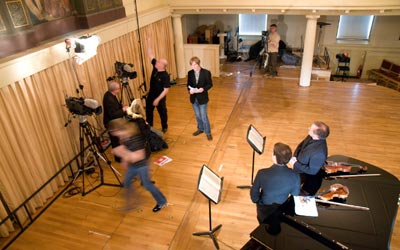
Filming at St George's, Bristol

The Oxford professor also highlighted Einstein’s own musical abilities. “I think it’s true that Einstein was a very good, competent, violinist in his youth. It’s clear that he could play on a stage in front of an audience with professional musicians and not make a fool of himself.

“He used his fame to become acquainted and friends with many of the great musicians of his day. He was great friends with Fritz Kreisler the violinist and [Gregor] Piatigorsky the cellist, and they played chamber music often together.”

Briefing the stars

In a separate interview, I also caught up with Foster and Liebeck together just before their performance. You can enjoy the full version of their duet in a separate video on physicsworld.com.

When worlds collide: physics meets music

Albert Einstein was the kind of physicist that you don’t really find anymore – making so many remarkable contributions to so many different areas of physics. But in addition to his scientific achievements, a lot is made about Einstein’s colourful personal life, not least his lifelong passion for music.

Sharing this passion is particle physicist Brian Foster of the University of Oxford who has teamed up with the British musician Jack Liebeck to create a special show about Einstein. Currently touring the UK, “Einstein’s Universe” involves a special lecture, interspersed with classical music, which explores Einstein’s legacy to physics and the role music played in his life.

Like Einstein, Foster is another physicist with a passion for music and he also plays the violin. Part of the Einstein performance involves Foster joining Liebeck on stage for a duet.

I caught up with the pair on the day of a recent performance at St George’s concert hall in Bristol, UK. I was treated to a preview as the pair performed an arrangement of a violin sonata by Mozart, which you can enjoy in full in the above video.

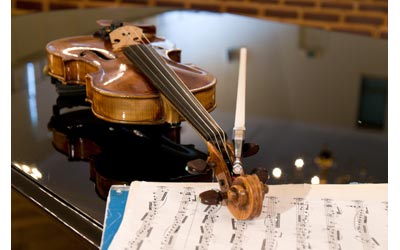
Liebeck's violin

Young performer of the year

Liebeck, who was recently named young British classical performer of the year at the Classical Brit Awards, explained to me how the collaboration came about and why he believes the format works so well.

“I remember certainly when I was at school that it’s a really good idea to keep things interesting,” he explained. “The idea of mixing disciplines is a way to keep an audience going. If you just had science talked at you for an hour and a half, I think quite quickly the eyes droop and people go into their own worlds.”

You can enjoy my interview with Foster in a separate video on physicsworld.com.

It's bigger, farther, faster…

bigstar.jpg


By Hamish Johnston

Scientists – and particularly astronomers – are always discovering things that are bigger, faster or farther than before.

This often makes for a good story – but is it news?

A case in point is the biggest star ever that has been found by a team of astronomers using several European Southern Observatory (ESO) telescopes. (The star was actually discovered some time ago, but getting an accurate mass was no mean feat).

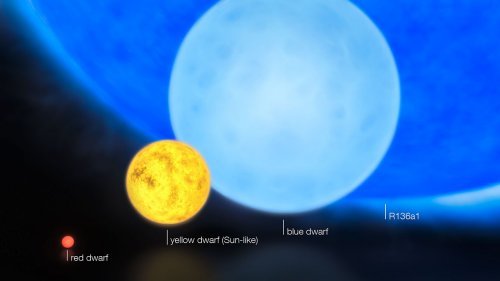
It’s called R136a1 and is twice as massive as the previous contender. This doesn’t sound that impressive until you realize that it’s a whopping 300 times more massive than the Sun. You can see it compared to the Sun in the above artist’s impression from the ESO.

That’s big, but the universe is a humungous place full of very big things just waiting to be discovered. And next week or next month or next year someone is bound to find an even bigger star.

When we discussed the possibility of covering this discovery at our last news meeting we decided that biggest wasn’t enough – there had to be some scientific significance.

The obvious question to ask is “does this discovery improve our understanding of star formation and evolution?”

I suspect the answer is “it tells us that conventional models of star formation – most of which put an upper limit on star size of about 20 solar masses – are even more deficient than previously thought”.

This is, of course, very important to folks trying to improve models of star formation but I don’t think it merits a news story – particularly because astronomers have known for some time that their models can’t cope with huge stars.

BBC Radio 4 did deem the discovery newsworthy and interviewed lead astronomer Paul Crowther of the University of Sheffield on this morning’s Today programme. You can listen to the interview here.

Crowther explains that the finding is significant because it suggests the existence of a third class of stars that end their lives in extremely bright supernova explosions – but unlike their lighter counterparts, leave behind no black holes or neutron stars.

And that’s an interesting story in itself!

Climate chairman clarifies his media strategy

By James Dacey

In an act bearing a striking resemblance to a U-turn, Rajendra K Pachauri – the chairman of the Intergovernmental Panel on Climate Change – has sent a second letter to his associated scientists to clarify the panel’s stance on dealing with the media.

Louvre.jpg
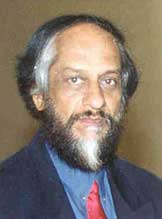
Pachauri moved quickly

Pachauri triggered a furore last week when a leak revealed a letter he had sent to members of the working groups on the upcoming IPCC 5th assessment report, which advises them to “keep a distance from the media” if asked about IPCC work.

This notion of climate scientists working in isolation was strongly criticised by several high profile bloggers, including University of South Carolina geographer Edward Carr, a member of the adaptation working group. Carr accused the IPCC of having a “bunker mentality” and said that the only way the organization can avoid future damaging episodes like “Climategate” is to operate with “complete openness”.

However, Carr has since revealed that Pachauri has now sent a second letter in an attempt to clear up the situation. Carr has published an extract from this letter on his blog

“In my letter, I cautioned you to ‘keep a distance from the media’ if asked about your work for the IPCC. This was a poor choice of words on my part and not reflective of IPCC policy. My only intent was to advise new authors not to speak ‘on behalf of the IPCC’ because we are an intergovernmental body consisting of 194 states.”

The clarifying letter seems to have washed with Carr who describes it as “articulate, clear and eminently reasonable – everything the original letter was not”.

The fifth assessment report is due to be published in 2013 and 2014 and follows on from the fourth assessment released in 2007.

Copyright © 2026 by IOP Publishing Ltd and individual contributors