Low-frequency ultrasound triggers targeted drug delivery

Conventional medication is often limited by low drug effectiveness or intolerable side effects caused by the drug reaching parts of the body where it’s not needed. As such, there’s increasing interest in developing methods for targeted drug delivery, to increase the efficacy and safety of pharmacological treatments.

One promising approach for localized drug delivery lies in the use of low-intensity ultrasound as a safe and practical way to trigger targeted drug release from circulating nanocarriers. Previous investigations using perfluorocarbon (PFC) nanodroplets as the drug carriers, however, have proved either effective or safe, but not both.

In their latest study, researchers from the University of Utah have shown that such PFC nanodroplets can be activated using low-frequency ultrasound, providing effective drug release with a favourable safety profile. Writing in Frontiers in Molecular Biosciences, the team also describes an optimized method for reliable manufacture of the nanocarriers, to help in the clinical translation of this approach.

“Delivery of medication into specific parts of the body has been a dream of medicine,” says Jan Kubanek, the study’s senior author. “This prevents the problems associated with taking drugs in the common way, which affects the entire body and all organs, often triggering substantial side effects.”

Drug release mechanisms

The nanocarriers comprise polymeric nanodroplet shells, of roughly 500 nm in diameter, filled with inert PFC cores mixed with a drug. When exposed to ultrasound, the PFC cores expand, stretching the droplet’s shell and releasing the encapsulated drug. This expansion arises due to either the mechanical or the thermal effects of ultrasound, with high-frequency ultrasound accentuating thermal mechanisms and low-frequencies causing mechanical disruption.

Most studies to date have investigated nanodroplets with PFC boiling points below body temperature, activated by high-frequency (1 MHz or greater) ultrasound. These low-boiling point PFCs, however, run the risk of spontaneous drug release – having been observed to more than double in size after 24 h at room temperature. High-boiling point PFCs are safer and more stable but to date have not demonstrated effective drug release, likely because they are less affected by the thermal mechanisms associated with high-frequency ultrasound.

To identify suitable ultrasound parameters to trigger drug release from high-boiling point nanodroplets, the team examined three different PFC cores – perfluoropentane (PFP, with a boiling point of 29°C), decafluoropentane (DFP, 55°C) and perfluorooctylbromide (PFOB, 142°C) – loaded with the anaesthetic drug propofol.

The researchers measured the level of drug released into organic solvent upon exposing the nanodroplets to either low-frequency (300 kHz) or high-frequency (900 kHz) ultrasound. At 900 kHz, they observed an increase in drug release with decreasing PFC boiling point, supporting the hypothesis of a thermal mechanism. They also saw a quadratic dependence of drug release on ultrasound pressure, in accordance with the fact that ultrasound-delivered thermal energy is proportional to pressure squared.

Propofol release versus PFC core boiling point

In contrast, sonication at 300 kHz produced a linear dependence of drug release on ultrasound pressure, consistent with a mechanical rather than a thermal effect. The researchers also found that for all three PFC cores, 300 kHz ultrasound released a greater percentage of drug (an average of 31.7%) than 900 kHz (20.3%).

These findings suggest that low-frequency ultrasound could open the path to using stable, high-boiling point cores such as PFOB as release actuators. The mechanical nature of drug release at low frequencies could also be of benefit for clinical translation, as it does not induce any heating of the target tissue.

“We developed a method to produce stable nanocarriers repeatably, and identified ultrasound parameters that can activate them,” says first author Matthew Wilson in a press statement.

Safe and sound

Kubanek and colleagues evaluated the safety of the high-boiling point PFOB-based nanodroplets in the brain of a macaque monkey. They delivered six doses at one-week intervals and analysed blood samples for markers of toxicity to the liver, kidney or spleen, as well as assessing immune system activation.

The blood biomarkers showed that the nanodroplets were well tolerated, with no detectable side-effects, an important factor for potential clinical translation. Only blood glucose showed a significant change following administration, which may have been caused by the animal’s diet.

The team also demonstrated that PFOB nanodroplets loaded with the anaesthetic ketamine or an immunosuppressant drug exhibited a similar sensitivity to ultrasound as propofol-loaded nanodroplets. “We are now testing the release of other psychoactive drugs, including ketamine, in non-human primates,” says Kubanek. “If we could release these locally, we would avoid the commonly observed side effects and thus open these emerging treatments of mental disorders to many more people.”

The researchers have now begun investigating the delivery of anti-cancer drugs into the brains of mice with glioblastoma. Kubanek notes that the nanocarriers could also be used to target drugs to tumours elsewhere in the body. “Through these developments in rodents and non-human primates, we are aiming to bring the method to humans as soon as possible,” he tells Physics World.
Clams and algae collaborate to harvest sunlight very efficiently

I think it’s safe to say that photosynthesis is one of the most important biochemical processes at work here on Earth – and possibly elsewhere in the universe. I know that it is chemistry, but physicists have long had a fascination with the process. They include Yale University’s Amanda Holt and Alison Sweeney, who have teamed up with the marine scientist Lincoln Rehm of Drexel University to study how a symbiotic relationship between giant clams and algae makes extremely efficient use of sunlight.

The photosynthesizing algae reside on the mantle of the clam. This is a cloak-like structure between the two shells of the clam. The algae produce organic molecules that provide energy to the clam. In return, the clam uses its filter-feeding system to provide the algae with nitrogen and other nutrients.

What makes this relationship interesting is how efficient it is at converting sunlight into chemical energy. At the cellular level, photosynthesis is nearly 100% efficient in converting sunlight. But when it occurs in a large-scale system like a field of crops or an ecosystem, this efficiency drops to about 3%. In contrast, giant clam/algae systems are known to achieve efficiencies as high as 67%. Now, Holt, Sweeney and Rehm may have discovered why.

Vertical pillars

Within the mantle, the algae cells are arranged in vertical pillars that are about 0.1 mm in diameter. The pillars sit below a thin translucent membrane, which the trio had previously shown scatters sunlight into the horizontal plane – thereby illuminating the sides of the pillars.

New simulations and calculations done by the researchers suggest that this pillar design should achieve a conversion efficiency of about 43% in bright tropical sunlight. Eager to understand why their analysis came up short of the measured value of 67%, the trio then looked at how the clam changes the spacing between the pillars as light levels change throughout the day. By integrating these dynamics into their model, they were able to reproduce the 67% figure.

The scientists report their findings in Physical Review D. You can read an accompanying description of the research in Physics, in which Mark Buchanan also explains how the research could boost our understanding of other living systems that harvest sunlight – and could lead to better solar cells.

If this work has piqued your interest in the physics of photosynthesis, check out “Is photosynthesis quantum-ish?”, by the science writer Philip Ball. This feature article looks at the debate surrounding the role that quantum physics plays in photosynthesis.

Can you solve this pistachio packing problem?

It sounds like a question you might get in an exam: given a full bowl of N pistachios, what size container do you need for the leftover 2N non-edible shells?

That tasty problem has now been examined by physicists Ruben Zakine and Michael Benzaquen from École Polytechnique in Palaiseau, France.

The issue of how the pistachio shells pack turns out to be a tough nut to crack given that pistachios come in different shapes and sizes with the shells being non-symmetric.

Pistachios are usually served in a bowl as a snack along with another bowl or container in which to place the discarded shells.

Carrying out experiments by placing 613 pistachios in a two litre cylinder, they found, in a nutshell, that the container holding the shells needs to be just over half the size of the original pistachio bowl (for well packed) or three-quarters (for loosely packed).

Zakine and Benzaquen say that numerical simulations on packing pistachios shells could be carried out to compare with the experimental findings.

They also say that the work extends beyond just nuts. “Our analysis can be relevant in other situations, for instance to determine the optimal container needed [for] mussel or oyster shells after a Pantagruelian seafood diner,” they write.

LEGO creates ‘space bricks’ made from meteorite dust

LEGO has teamed up with the European Space Agency (ESA) to create several “space bricks” made from a 4.5 billion-year-old meteorite.

The particular meteorite was discovered in north-west Africa in 2000 and is a “brecciated stone” that contains large metal grains, chondrules and other stone meteorite elements.

By mixing meteorite dust with polylactide and a bit of “regolith simulant”, the team was able to 3D-print bricks that mimic and behave just like LEGO bricks.

The idea behind the initiative is to test how material on the surface of the Moon, known as the lunar regolith, could be used as a future building material.

“No-one has ever built a structure on the Moon, so we have to work out not only how we build them but what we build them out of, as we can’t take any materials with us,” notes ESA science officer Aidan Cowley, adding that while the bricks are a “little rougher” than usual, the results are “amazing”.

Fifteen bricks will go on display at the LEGO House in Billund, Denmark, as well as at selected LEGO stores including Leicester Square in the UK and 5th Avenue in New York.

The meteorite bricks apparently click and snap together just like normal LEGO bricks but they unfortunately only come in one colour – space grey.

Charmonium’s onion-like structure is revealed by new calculations

Calculations by physicists in China and the US suggest that the charmonium meson has a distinct onion-like structure. The team used a simplified version of quantum chromodynamics (QCD) and extensive computer simulations show that the subatomic particle comprises nested layers, each containing different types of constituent particles.

“Charmonium is made [primarily] of a pair of charm quark and antiquark, and is one of the simplest hadrons,” explains Xingbo Zhao of the Institute of Modern Physics and University of Chinese Academy of Sciences, who is one of the team members. “Its constituent quarks are very massive compared to the [up and down] quarks that make up the proton and the neutron,” explains Zhao.

“It is sometimes dubbed as the hydrogen atom within quantum chromodynamics,” he adds. This is because, like the hydrogen atom, it is a fundamental, relatively simple system that provides deep insights into the underlying forces and interactions that define its properties.

Strong interaction

The strong interaction bind quarks into composite objects called hadrons (which include mesons like charmonium) through the exchange of gluons. This is similar to how electromagnetic interactions between charged particles are mediated by photons, the quanta of the electromagnetic field.

However, QCD – the theory of strong interactions – is significantly more complex than quantum electrodynamics – which is the theory describing the electromagnetic interaction. This complexity makes accurate calculations of the properties of hadrons extremely challenging. Complexity has also led researchers to use simplified versions of QCD, whose validity must be confirmed by comparing their predictions with experimental data.

In their recent study, Zhao and colleagues examined charmonium using a simplified theory, where the number of constituent particle states is artificially limited and not all the intricate aspects of quark interactions are considered.

This approach, known as basis light-front quantization, allowed the team to numerically compute the distribution of mass and pressure inside charmonium. In the mathematical machinery of QCD, these distributions are encoded in gravitational form factors.

Energy and force distributions

“Gravitational form factors describe how a hadron, such as the proton, interacts with a graviton, the quantum of gravity,” said Zhao. “They are interesting because they encode the energy and force distributions inside the hadron.”

The knowledge of these form factors allowed the researchers to deduce the structure of charmonium, showing where the stable charm and anti-charm quarks (known as valence quarks) are located, as well as the regions occupied by the virtual quarks constantly born and disappearing into the vacuum (called wee partons). Moreover, the study reveals that the structure of charmonium also includes entire virtual hadrons, such as pions, kaons and eta mesons, as well as glueballs consisting only of gluons.

“We found that charmonium is a layered system like an onion!” explained Zhao. “At the core are the valence quarks. Then, the valence core is surrounded by the so-called wee partons. The outermost layers of charmonium are glueballs and meson clouds. This layered structure is consistent with the picture established in high-energy collision experiments.”

Confirmation and implications

These findings represent a significant advancement in our understanding of strong interactions, confirming that approximate methods of QCD can accurately describe experimental data.

The researchers believe that the mass and pressure distributions inside charmonium that they derived can be measured with high precision in future high-energy collision experiments, such as those planned at the upcoming Electron-Ion Collider in the US. This would further validate the basis light-front quantization method.

The research is described in a paper in Physical Review D.

“I find this paper very interesting for two reasons,” explains Volker Burkert, of the Thomas Jefferson National Accelerator Facility in Virginia, who was not involved in this study. “First, it studied a particular type of hadrons, with one charm quark and one anti-charm quark, which are much heavier compared to quarks in a proton. Second, I find it of particular interest that the pressure structure of this particle is predicted to have several zero crossings. This may indicate that there are nearly disconnected pressure regions. It would be extremely interesting if this could be experimentally verified.”

Prospects and challenges

Zhao and colleagues hope to further refine their approach to study the structure of charmonium in even greater detail. For example, their method currently does not allow to differentiate the contributions of glueballs and mesons to the outermost shell of charmonium.

Additionally, the constant improvement of computer technology, crucial for such calculations, is expected to enhance the accuracy of their analyses and enable the application of their method to study other hadrons.

“In the future, we aim to extend our method to study the proton, neutron, and even nuclei,” concluded Zhao. “For complex systems like the proton, gluons play a crucial role. We need a better treatment of these interactions and, more importantly, a sophisticated computational scheme to handle the large scale of calculations required. Basis light-front quantization is designed to achieve this on near-term supercomputers or, ideally, on future quantum computers.”

Novel ‘glassy gel’ materials are strong yet stretchable

A new class of materials known as “glassy gels” could find use in areas ranging from batteries to adhesives, thanks to their unique set of physical properties.

Meixiang Wang, a post-doctoral fellow from Michael Dickey’s group at North Carolina State University, discovered these new materials while trying out different mixtures for making gels that she hoped would be useful ionic conductors.

Standard gels, such as those used to make contact lenses, are polymers with an added liquid solvent. The liquid weakens the interactions between the chains of molecules forming the polymer, allowing the gel to extend easily but leaving it soft and weak mechanically. In contrast, glassy polymers, like those suitable for airplane windows, contain no liquid and have strong interactions between their constituent polymer chains. This renders them stiff and strong but, in some cases, brittle.

Glassy gels, made by adding liquid solvent to glassy polymers, combine these properties: offering the high stiffness and high strength of glassy polymers alongside high extensibility – they can be stretched to over five times their original length without breaking.

“I thought it was eye-popping when Meixiang told me that these were the toughest gels ever reported by an order of magnitude, and had mechanical properties similar to plexiglass – even though plexiglass has no liquid, whereas these glassy gels are around 60% liquid,” Dickey tells Physics World.

Further tests by the research group, in collaboration with Wen Qian at the University of Nebraska–Lincoln, revealed that the glassy gels also show efficient electrical conduction (Wang’s original aim), good adhesive properties, shape memory characteristics and the ability to self-heal after being cut.

This unusual set of properties, detailed in Nature, is due to the solvent being an ionic liquid (salts in the liquid state). The ionic liquid solvent makes the glassy gels highly stretchable by pushing their polymer chains further apart. But simultaneously, its ions are strongly attracted to charged or polar molecules in the polymer, thereby keeping the polymer chains in place and making the material hard. The solvent ions also conduct electricity, resulting in better conduction than found in common plastics with similar stress–strain characteristics.

While the details of the ion–polymer bonding mechanism are not yet clear, early results indicate that it is electrostatic forces that act over a reasonably large distance. This, Dickey believes, is what makes the materials stiff despite containing so much liquid.

Another plus point for these new materials is their one-step manufacture. The mixture of ionic liquid solvent and liquid precursor of glassy polymers is simply poured into a mould before being cured for five minutes at room temperature with UV light to harden it ready for use.

“In contrast, almost all thermoplastics are made in chemical plants then shipped as resin to factories for melt processing,” says Dickey. He adds that glassy gels could also be 3D printed, and that products made from them would be easier to recycle than those manufactured from multiple plastics, which contain different constituents in order to get the required functionality.

In the future, Dickey plans to investigate why glassy gels are so sticky, alongside “tweaking the properties to optimize for particular applications” by changing the ratio of solvent to polymer and using differing types of both constituents. Optimized glassy gels could prove useful as mechanically robust, adhesive and conductive “separators” for keeping the two electrodes in a battery apart, for example, as adhesives, gaskets or seals, or even as heat-driven soft robotic grippers, since the material softens if sufficiently heated.

First, however, Dickey admits that a greater understanding of the gels’ characteristics – including UV stability and degradation over time – is required. But he is encouraged by enquiries from prospective users and optimistic about the potential for this chance discovery by Wang which, as he puts it, “was a bit of serendipity enabled by a researcher who was willing to follow her curiosity”.

New diffractive camera hides images from view

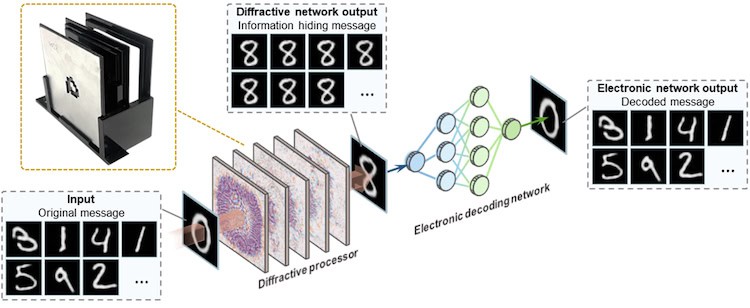
A schematic of the experiment

Information security is an important part of our digital world, and various techniques have been deployed to keep data safe during transmission. But while these traditional methods are efficient, the mere existence of an encrypted message can alert malicious third parties to the presence of information worth stealing. Researchers at the University of California, Los Angeles (UCLA), US, have now developed an alternative based on steganography, which aims to hide information by concealing it within ordinary-looking “dummy” patterns. The new method employs an all-optical diffractive camera housed within an electronic decoder network that the intended receiver can use to retrieve the original image.

“Cryptography and steganography have long been used to protect sensitive data, but they have limitations, especially in terms of data embedding capacity and vulnerability to compression and noise,” explains Aydogan Ozcan, a UCLA electrical and computer engineer who led the research. “Our optical encoder-electronic decoder system overcomes these issues, providing a faster, more energy-efficient and scalable solution for information concealment.”

A seemingly mundane and misleading pattern

The image-hiding process starts with a diffractive optical process that takes place in a structure composed of multiple layers of 3D-printed features. Light passing through these layers is manipulated to transform the input image into a seemingly mundane and misleading pattern. “The optical transformation happens passively,” says Ozcan, “leveraging light-matter interactions. This means it requires no additional power once physically fabricated and assembled.”

The result is an encoded image that appears ordinary to human observers, but contains hidden information, he tells Physics World.

The encoded image is then processed by an electronic decoder, which uses a convolutional neural network (CNN) that has been trained to decode the concealed data and reconstruct the original image. This optical-to-digital co-design ensures that only someone with the appropriate digital decoder can retrieve the hidden information, making it a secure and efficient method of protecting visual data.

A secure and efficient method for visual data protection

The researchers tested their technique using arbitrarily chosen hand-written digits as the input image. The diffractive processor successfully transformed these into a uniform-looking digit 8. The CNN was then able to reconstruct the original handwritten digits using information “hidden” in the 8.

All was not plain sailing, however, explains Ozcan. For one, the UCLA researchers had to ensure that the digital decoder could accurately reconstruct the original images despite the transformations applied by the diffractive optical processor. They also had to show that the device worked under different lighting conditions.

“Fabricating precise diffractive layers was no easy task either and meant developing the necessary 3D printing techniques to create highly precise structures that can perform the required optical transformations,” Ozcan says.

The technique, which is detailed in Science Advances, could have several applications. Being able to transmit sensitive information securely without drawing attention could be useful for espionage or defence, Ozcan suggests. The security of the technique and its suitability for image transmission might also improve patient privacy by making it easier to safely transmit medical images that only authorized personnel can access. A third application would be to use the technique to improve the robustness and security of data transmitted over optical networks, including free-space optical communications. A final application lies in consumer electronics. “Our device could potentially be integrated into smartphones and cameras to protect users’ visual data from unauthorized access,” Ozcan says.

The researchers demonstrated that their system works for terahertz frequencies of light. They now aim to expand its capabilities so that it can work with different wavelengths of light, including visible and infrared, which would broaden the scope of its applications. “Another area [for improvement] is in miniaturization to further reduce the size of the diffractive optical elements to make the technology more compact and scalable for commercial applications,” Ozcan says.

Sliding ferroelectrics offer fast, fatigue-free switching

Three years ago, researchers from institutions in the US and Israel discovered a new type of ferroelectricity in a material called boron nitride (BN). The team called this new mechanism “slidetronics” because the change in the material’s electrical properties occurs when adjacent atomically-thin layers of the material slide across each other.

Two independent teams have now made further contributions to the slidetronics field. In the first, members of the original US-Israel group fabricated ferroelectric devices from BN that can operate at room temperature and function at gigahertz frequencies. Crucially, they found that the material can endure many “on-off” switching cycles without losing its ferroelectric properties – an important property for a future non-volatile computer memory. Meanwhile, a second team based in China found that a different sliding ferroelectric material, bilayer molybdenum disulphide (MoS2), is also robust against this type of fatigue.

The term “ferroelectricity” refers to a material’s ability to change its electrical properties in response to an applied electric field. It was discovered over a 100 years ago in certain naturally-occurring crystals and is now exploited in a range of technologies, including digital information storage, sensing, optoelectronics and neuromorphic computing.

Being able to switch a material’s electrical polarization over small areas, or domains, is a key part of modern computational technologies that store and retrieve large volumes of information. Indeed, the dimensions of individually polarizable domains (that is, regions with a fixed polarization) within the silicon-based devices commonly used for information storage have fallen sharply in recent years, from roughly 100 nm to mere atoms across. The problem is that as the number of polarization switching cycles increases, an effect known as fatigue occurs in these conventional ferroelectric materials. This fatigue degrades the performance of devices and can even cause them to fail, limiting the technology’s applications.

Alternatives to silicon

To overcome this problem, researchers have been studying the possibility of replacing silicon with two-dimensional materials such as hexagonal boron nitride (h-BN) and transition metal dichalcogenides (TMDs). These materials are made up of stacked layers held together by weak van der Waals interactions, and they can be as little as one atom thick, yet they remain crystalline, with a well-defined lattice and symmetry.

In one of the new works, researchers led by Kenji Yasuda of the School of Applied and Engineering Physics at Cornell University made a ferroelectric field-effect transistor (FeFET) based on sliding ferroelectricity in BN. They did this by sandwiching a monolayer of graphene between top and bottom layers of bulk BN, which behaves like a dielectric rather than a ferroelectric. They then inserted a parallel layer of stacked bilayer BN – the sliding ferroelectric – into this structure.

Yasuda and colleagues measured the endurance of ferroelectric switching in their device by repeatedly applying 100-nanosecond-long 3V pulses for up to 104 switching cycles. They then applied another square-shaped pulse with the same duration and a frequency of up to 107 Hz and measured the graphene’s resistance to show that the device’s ferroelectricity performance did not degrade. They found that the devices remained robust after more than 1011 switching cycles.

Immobile charged defects

Meanwhile, a team led by Fucai Liu of the University of Electronic Science and Technology of China, in collaboration with colleagues at Ningbo Institute of Materials Technology and Engineering (NIMTE) of the Chinese Academy of Sciences, Fudan University and Xi Chang University, demonstrated a second fatigue-free ferroelectric system. Their device was based on sliding ferroelectricity in bilayer 3R-MoS2 and was made by sandwiching this material between two BN layers using a process known as chemical vapour transport. When the researchers applied pulsed voltages of durations between 1 ms and 100 ms to the device, they measured a switching speed of 53 ns. They also found that it retains its ferroelectric properties even after 106 switching cycles of different pulse durations.

Based on theoretical calculations, Liu and colleagues showed that the material’s fatigue-free properties stem from immobile charged defects known as sulphur vacancies. In conventional ferroelectrics, these defects can migrate along the direction of the applied electrical field.

Reporting their work in Science, they argue that “it is reasonable to assume that fatigue-free is an intrinsic property of sliding ferroelectricity” and that the effect is an “innovative” solution to the problem of performance degradation in conventional ferroelectrics.

For their part, Yasuda and colleagues, whose work also appears in Science, are now exploring ways of synthesizing their material on a larger, wafer scale for practical applications. “Although we have shown that our device is promising for applications, we have only demonstrated the performance of a single device until now,” Yasuda tells Physics World. “In our current method, it takes many days of work to make just a single device. It is thus of critical importance to develop a scalable synthesis method.”

ITER fusion reactor hit by massive decade-long delay and €5bn price hike

The ITER fusion reactor currently being built in France will not achieve first operation until 2034 – almost a decade later than previously planned and some 50 years after the project was first conceived in 1985. The decision by ITER management to take another 10 years constructing the machine means that the first experiments using “burning” fusion fuel – a mixture of deuterium and tritium (D–T) – will now have to wait until 2039.  The new “baseline” was agreed as a “working reference” by ITER’s governing council and will be further examined before a meeting in November.

ITER is an experimental fusion reactor that is currently being built in Cadarache, France, about 70 km north-west of Marseille. Expected to cost tens of billions of euros, it is a collaboration between China, Europe, India, Japan, Korea, Russia and the US.  Its main aim is to generate about 500 MW of fusion power over 400 seconds using a plasma heating of 50 MW, a power gain of 10. The reactor would also test a “steady state” operation under a power gain of five.

Yet since its conception in the 1980s (see timeline below), ITER has been beset with cost hikes and delays. In 2016, a baseline was presented in which the first deuterium plasma would be delayed until 2025.

This first plasma, however, would have been a brief machine test before further assembly, such as adding a divertor heat-exhaust system and further shielding. “The first plasma [in 2025] was rather symbolic,” claims ITER director-general Pietro Barabaschi, who took up the position in October 2022 following the death of former ITER director general Bernard Bigot.

ITER would only have reached full plasma current in 2032 with the first D–T reaction waiting until 2035 after the installation of additional components.

A new ‘baseline’

Barabaschi notes that since 2020 it was “clear” that the 2025 “first plasma” date was no longer achievable. This was due to several reasons, one of which was the COVID-19 pandemic, which led to supply-chain and quality-control delays.

Manufacturing issues also emerged such as the discovery of cracks in the water pipes that cool the thermal shields. In early 2022 the French Nuclear Safety Authority briefly halted assembly due to concerns over radiological shielding.

Officials then began working on a more realistic timeline for construction to allow for more testing of certain components such as the huge D-shaped toroidal-field coils that will be used to confine the plasma.

The plan now is to start operation in 2034 with a deuterium-only plasma but with more systems in place as compared to the previous “first plasma” baseline of 2025. Research on the tokamak would then be carried out for just over two years before the machine reaches full plasma current operation in 2036. The reactor would then shut down for further assembly to prepare for D-T operation, which is now expected to begin in 2039.

Speaking today at a press conference, Barabaschi notes that the delay will cost an extra €5bn. “We are still addressing the issue of cost with the ITER council,” adds Barabaschi, who did not want to be drawn on how much ITER will now cost overall due to the “complexity” of the way it is funded via “in-kind” contributions.

Sibylle Günter, scientific director of the Max Planck Institute for Plasma Physics in Garching, Germany, says that depite the news being of “no cause for celebration”, ITER is still relevant and necessary. “We are not aware of any project that will analyse the challenges as comprehensively as ITER in the foreseeable future,” she adds. “ITER has also already achieved ground-breaking engineering work up to this point, which will be important for all the fusion projects now underway and those still to come.”

In the meantime, some changes have been to ITER’s design. The material used for the “first wall” that directly faces the plasma will change from beryllium to tungsten. Barabaschi points out that tungsten is more relevant for a potential fusion demonstration plant, known as DEMO.

Officials were also celebrating the news this week that the 19 toroidal-field coils have been completed and delivered to the ITER site. Each coil – made of niobium-tin and niobium-titanium – is 17 m tall and 9 m across, and weighs about 360 tonnes. They will generate a magnetic field of 12 T and store 41 GJ of energy.

Timeline - the way to ITER

1985 US president Ronald Reagan and Soviet Union leader Mikhail Gorbachev, at their first summit meeting in Geneva, resolve to develop fusion energy “for the benefit of all mankind”.

1987 Work on the conceptual design begins, with the EU and Japan joining the US and Russia on the project. Conceptual design completed two years later.

1992 Work on the engineering design begins with teams at San Diego, Garching and Naka. Completed in 1997.

1998 US withdraws due to €10bn price tag.

2001 Revised design completed, resulting in the cost of the project being halved to €5bn.

2003 US re-joins ITER with China and South Korea also signing up. Partners meet but fail to agree on a site leading to an 18-month stalemate.

2005 The EU and Japan agree on ITER’s home being Cadarache in southern France.

2006 India joins ITER. The ITER Organization is formally established by treaty and civil engineering begins.

2010 Detailed design finalized. Cost estimate rises to around €15bn, with building construction starting.

2011 Construction delays push back the date of first plasma from 2016 to 2019, revised to 2020 a year later.

2014 An independent report warns that the project is in “a malaise” and recommends a management overhaul. Manufactured components of the reactor begin to arrive for assembly.

2016 ITER Council agrees new “baseline” plan with first plasma set for 2025 and deuterium–tritium fuel only being used from 2035 onwards.

2020 Assembly of ITER begins while the COVID-19 pandemic hits the project’s supply chain and quality control.

2024 New “baseline” announced for start of operation in 2034.

Physics cookbook is fun but fails to gel

There’s a lot of physics in a cup of tea. Compounds in the tea leaves start to diffuse as soon as you pour over hot water and – if you look closely enough – you’ll see turbulence as your milk mixes in. This humble beverage also displays conservation of momentum in the parabolic vortex that forms when tea is stirred.

Tea is just one of the many topics covered in Physics in the Kitchen by George Vekinis, director of research at the National Research Centre “Demokritos” (NCSRD) in Greece. In writing this book, Vekinis – who is a materials physicist by training – joins a long tradition of scientists writing about cooking.

The book is full of insights into the physics and chemistry underlying creative processes in a kitchen, from making sauces and cooking vegetables to the use of acid and the science behind common equipment. One of the book’s strengths is that, while it has a logical structure, it is possible to dip in and out without reading everything.

Talking of dips, I particularly enjoyed the section on sauces. My experience in this area is confined to rouxs that are thickened with flour, and I was surprised to discover that Vekinis considers this to be a “bit of a cheat”. Sauces prepared in the “Greek way”, he points out, often don’t involve starch at all.

Instead, a smooth sauce can be made just by heating an acid such as wine or lemon with egg and broth. This ancient method, which the author describes in a long section on “Creamy emulsion or curdled mess?”, involves the extraction of small molecules and requires extra care to prevent curdling or splitting.

However, as a food physicist myself, I did have some issues with the science in this and later sections.

For example, Vekinis uses the word “gel” far too loosely. Sometimes he’s talking about the gels created when dissolved proteins form a solid-like network despite it mostly being liquid – such as the brown gel that appears below a roast ham or chicken that has cooled. However, he also uses the same word to describe what you get when starch granules swell and thicken when making a roux sauce, which is a very different process.

Moreover, Vekinis describes both kinds of gel as forming through “polymerization”, which is inaccurate. Polymerization is what happens when small molecular building blocks bond chemically together to form spindly, long-chain molecules. If these molecules link up, they can then form a branched gel, such as silicone, which has some structural similarities to a protein gel. However, the bonding process is very different, and I found this comparison with polymer science unhelpful.

Meanwhile, in the section “Wine, vinegar, and lemon”, we are told that to prepare a smooth sauce you have to boil “an acidic agent as a catalyst for a polymerization reaction” and that “dry wine does the job too”. Though the word is sometimes used colloquially, what is described here is not, in the scientific sense, a catalytic reaction.

Towards the end of the book, Vekinis moves beyond food and looks at the physics behind microwaves, fridges and other kitchen appliances. He describes, for example, how the oscillation of polar molecules such as water in microwaves produces heating that is completely distinct to a conventional oven.

It’s well known that a microwave oven doesn’t heat food uniformly and the book describes how standing waves in the oven produce hot and cold spots. However, I feel more could have been said about the effect of the shape and size of food on how it heats. There has been interesting work, for example, investigating the different heating patterns in square- and round-edged foods.

Overall, I found the book an enjoyable read even if Vekinis sometimes over-simplifies complicated subjects in his attempts to make tricky topics accessible. I shared the book with some teacher friends of mine, who all liked it too, saying they’d use it in their food-science lessons. They appreciated the way the book progresses from the simple (such as heat and energy) to the complex (such as advanced thermodynamic concepts).

Physics in the Kitchen is not meant to be a cookbook, but I do wonder if Vekinis – who describes himself as a keen cook as well as a scientist – could have made himself clearer by including a few recipes to illustrate the processes he describes. Knowing how to put them into practice will not only help us to make wonderful meals – but also enhance our enjoyment of them too.

  • 2023 Springer £17.99hb 208pp
Copyright © 2026 by IOP Publishing Ltd and individual contributors