Solving the mystery of the Alhambra’s purple gold

Overlooking the city of Granada in southern Spain, the Alhambra palace and fortress is an icon of the Islamic Golden Age. Now, researchers at the University of Granada may have solved one of its modern mysteries: why sections of its gold decorations are turning purple.

Constructed principally between the 13th and 14th centuries by the Nasrids – the last Muslim dynasty in the Iberian Peninsula – the Alhambra contains colourful geometric patterns throughout its rooms, courtyards and gardens. “The Nasrids had a fear of empty space, so they filled the walls with tiles, paints and other decorative features,” says Carolina Cardell, a mineralogist who led the research.

During a restoration in the 19th century, many of the Alhambra’s deteriorating walls were covered in a thin layer of gypsum plaster, rendering them a beige colour. Then, beginning in the 1990s, staff noticed a purple discolouration forming on plasterwork in some of its muqarnas, which are honeycomb-like decorations in the ceilings created from tin gilded with gold.

Purple haze

After analysing samples using electron microscopes fitted with spectroscopes, Cardell and her colleague Isabel Guerra believe they finally understand the source of the discolouration. Nanoparticles, they say, are forming in the gold surfaces due to a two-step corrosion process. Because these nanoparticles are 70 nm in diameter, their surface electrons oscillate in resonance with incident light, creating a purple shimmer.

Step one in the corrosion process stems from the same phenomenon that causes screws in a garden shed to corrode at different rates from the metal structures they hold together. When two metals in electrical contact are exposed to humidity, the least “noble” one will react with the environment. At the Alhambra, imperfections in the gold gilding meant that, over time, tiny bits of tin began poking through to the surface and forming compounds upon reaction with the atmosphere.
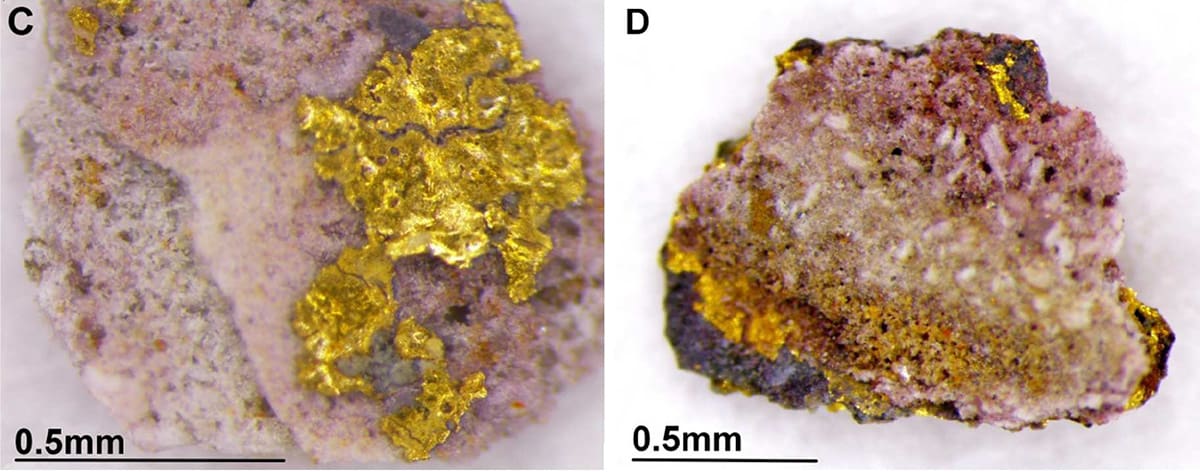
An image showing curling, pitted flakes of gold leaf over a plaster surface, and a cross-section of the same material showing layers of purplish discolouration as well as gold

While the gold in the muqarnas is unaffected by this so-called galvanic corrosion, it nevertheless becomes soiled from the breakdown of tin compounds. Sections of the gold surface beneath this grime are then deprived of oxygen, allowing tiny anode–cathode cells to form and leading to dissolution in the oxygen-deficient areas. Over the centuries, this second corrosion step has sculpted the gold surfaces, leaving them scarred by pits and nanoparticles.

Corrosive marine breath

Both phases of the corrosion are exacerbated by high concentration of chlorides in the local atmosphere, which act as an electrolyte. Even though Granada is more than 50km inland, chlorides are brought to the city via marine aerosols.

Cardell emphasizes that the purple colouration is only seen in semi-open areas exposed to the highest humidity. “Visitors would be unlikely to notice, but you will see them if you know where to look,” she says. Jose Maria Bastidas, at Spain’s National Centre for Metallurgical Research in Madrid, fears that the damage to the affected gold is irreversible. “This work shows the importance of maintaining stable temperatures and relative humidity wherever possible,” he said.

Part of the challenge for conservators is determining whether gold colouration is intentional. Since Roman times, artisans have created purple pigments by dissolving gold in a solvent called aqua regia (HNO3 + HCl). The Ancient Egyptians were also known to create “red gold” by tarnishing the metal’s surface with silver–gold sulfide.

“For the most part, our lack of understanding of why gold tarnishes really influences the decisions we make for treating the object,” says Jessica Routleff-Jones, a metals conservator based in London who has worked with several national museums. “If this research could categorically say that the patination is a by-product of the environment and not there because of human intervention, then we might be more inclined to remove it by polishing.”

David Hradil, an inorganic chemist at the Czech Academy of Sciences, is impressed by the novelty of the research, which is published in Science Advances. “In technology there are various ways to prepare purple gold nanoparticles, but I have not yet come across such a mechanism of spontaneous degradation of gold,” he says.
Schrödinger’s buses spotted in Bristol, X-rays track swarming bees

The UK city of Bristol has a strong connection to quantum mechanics because it gave the world Paul Dirac, who made pioneering contributions to the development of the theory. Now, it seems that buses serving the city are behaving in a quantum-like way.

Passengers using a smartphone app that tracks the progress of Bristol buses have noticed that the existence of an approaching bus depends on whether the user clicks on that bus. When a user makes this “measurement” the bus either remains live on the app or vanishes. This is much like the cat in Schrödinger’s famous thought experiment, which illustrates the paradox of quantum superposition and the role of measurement in quantum mechanics.

The operator First Bus explains that its app does not show the actual position of its buses, but rather where the vehicles are expected to be according to its schedule. Apparently, this also applies to individual buses that have been cancelled. When a user taps on a specific bus, they are given a live update of the service, so if that bus is not in service it will vanish from the app.

This article in Bristol Live makes a very good case for the quantum paradox of “Schrödinger’s bus”.

X-rayed swarm

X-rays were discovered in 1895 by Wilhelm Röntgen, who instantly recognized how they could be used to peer inside optically opaque objects. Since then, increasingly sophisticated X-ray imaging techniques have been used in medicine, science and engineering.

Now, researchers at Colorado University Boulder have used X-ray computed tomography (CT) to study swarms of bees. These swarms comprise thousands of worker bees that follow a queen and form a structure that would normally hang from the branch of a tree.

The physicist Orit Peleg and colleagues used a queen to coax worker bees into a swarm in their lab – in front of a small CT imaging system. They were able to resolve individual bees within the swarm and their results showed that the structure of the swarm is described by a scaling law such that each layer of bees in the swarm supports the same proportion of its weight within the structure. Although a bee can support as many as 35 of its colleagues, the team found that bees in a swarm must lift at most four other bees. As a result, the insects can easily form stable structures containing thousands of individuals.

Peleg and colleagues describe the research in Scientific Reports.

A broad review on the safety of aged lithium-ion batteries

Want to learn more on this subject?

Concerns about the safety of lithium-ion batteries have motivated numerous studies on the response of fresh cells to abusive, off-nominal conditions, but studies on aged cells are relatively rare. This talk reviews all open literature on the thermal, electrical, and mechanical abuse response of aged lithium-ion cells and modules to identify critical changes in their behavior relative to fresh cells. We outline data gaps in aged cell safety, including electrical and mechanical testing, and module-level experiments. Understanding how the abuse response of aged cells differs from fresh cells will enable the design of more effective energy storage failure mitigation systems.

Want to learn more on this subject?

Judy Jeevarajan is vice-president and executive director of the Electrochemical Safety Research Institute (ESRI) at UL Research Institutes (formerly Underwriters Laboratories, Inc.). She has worked in the field of batteries for more than 25 years, with a primary focus on lithium-ion chemistry.

Jeevarajan serves in the technical working groups and committees for standards organizations such as UL, Society of Automotive Engineers, International Civil Aviation Organization/Society of Aerospace Engineers, Radio Technical Commission for Aeronautics, International Electrotechnical Commission, and American National Standards Institute. She currently leads an effort under the American Institute of Aeronautics and Astronautics to develop a space safety standard for battery systems. She also serves as a member of the Informal Working Group and Dangerous Goods Panel under the United Nations. Jeevarajan is a member of the Great Lakes Energy Institute Advisory Board at Case Western Reserve University.

Before joining Underwriters Laboratories Inc., she worked for NASA at the Johnson Space Center (JSC) in Houston for 12 years, serving as group lead for Battery Safety and Advanced Technology. Prior to becoming a civil servant at NASA, Jeevarajan worked onsite for five and a half years at NASA-JSC for Lockheed Martin Space Operations.

Jeevarajan earned an MS in chemistry from the University of Notre Dame and PhD in chemistry (electrochemistry) from the University of Alabama. She has won numerous NASA awards, including the NASA Exceptional Service Medal and the NASA-NESC Engineering Excellence Award. She also received the 2019 American Institute of Aeronautics and Astronautics Aerospace Power Systems Award, and India Energy Storage Alliance Woman Leader of the Year 2020–Energy Storage Systems Award.

Yuliya Preger is a senior member of technical staff in the Energy Storage Technology and Systems Group at Sandia National Labs. She has served as the principal investigator for multiple projects funded by the Department of Energy on the safety and reliability of grid energy storage systems. Her research interests include battery cell level degradation and abuse response, application of power electronics to energy storage safety, using battery data for improved energy storage modeling, and system level energy storage safety. She is co-founder of batteryarchive.org, the first public repository for easy visualization and comparison of battery degradation data across institutions.


Why not sign up for our other Battery Series webinars? Look out for more to be added in coming months. Even if you’re not able to join the live event, registering now enables you to access the recording as soon as it’s available.

Is the 2022 FIFA World Cup really carbon neutral?

The 2022 FIFA World Cup is about to kick off in Qatar, with millions of football fans across the planet set to be gripped by sporting drama. But in the years leading up to the event, concerns have been raised over the environmental impact of the seven huge new stadia that have been built in and around Doha for the event.

In this episode of Physics World Stories, podcast host Andrew Glester talks to Gilles Dufrasne from the not-for-profit organisation Carbon Market Watch. Dufrasne has co-authored a recent report that questions the claim by FIFA – football’s governing body – that the 2022 World Cup will be a carbon-neutral event. Among other things, Dufrasne discusses why the idea of “transportable stadia” is good in principle but challenging in practice.

Given that most sporting events take place at the local level, Glester then catches up with representatives from local sports teams in Physics World‘s home city of Bristol, UK, to learn about their attempts to inspire more sustainable behaviours.

Peter Smith from Bristol Sport talks about initiatives at Bristol City Football Club to reduce the environmental impact, which includes redistributing the first team’s excess food to local food banks during home and away matches in the second tier of English football. Later, Xeena Cooper speaks about why she founded the Bristol Dodos, a local cricket team that began life as part of the Extinction Rebellion environmental movement.

Proton’s puzzling electromagnetic structure is observed in new experiment

New electron scattering data from the US suggest that the electromagnetic structure of the proton may differ from theoretical predictions – an observation that partially corroborates earlier measurements done in 2000. The explanation for the anomaly is unclear, but the researchers believe more insights may emerge as increasing computing power allows theoreticians to perform direct calculations of the interactions between the proton’s constituent quarks.

The quarks inside a proton are bound by the strong interaction and the theory of quantum chromodynamics (QCD) describes how this interaction is mediated by gluons. The process is similar to how photons mediate the electromagnetic interaction in quantum electrodynamics, however, unlike photons, gluons interact with each other as well as with the particles they bind. This makes calculations highly non-linear and often puts direct QCD predictions of collisions beyond available computing power. Researchers therefore rely on approximations, one of which is chiral effective field theory.

In 2000, researchers at the Mainz Microtron in Germany used the Compton scattering of virtual photons produced by collisions between electrons and liquid hydrogen to measure the generalized electric and magnetic polarizabilities of the proton. These show how easily a body deforms in response to electromagnetic excitations.

Disagreement with theory

Theory suggests the electric polarizability should decrease as one focuses deeper into the proton as the structure becomes stiffer. However, if the proton was assumed to have its conventional structure, the experimental data appeared inconsistent with the scattering pattern predicted by chiral effective field theory. “These measurements came with a large uncertainty, and in view of the lack of independent confirmation [the observation] was viewed with some reservation”, says Nikos Sparveris of the Thomas Jefferson National Accelerator Facility in Virginia and Temple University in Philadelphia.

In the new research, Sparveris and colleagues repeated the Compton scattering experiment, but used some advanced capabilities of the Jefferson lab to reduce the uncertainties. “We throw electrons at a proton, a virtual photon is exchanged between the electron and the proton, and then a real photon is produced at the end,” explains Sparveris. “The real photon produced exposes the system to the electric and magnetic field that you need to allow the polarizability to be measured; the energy of the virtual photon defines the scale of the observation.” The researchers measured the reaction at different energies and momenta exchanged in collisions – which defined the wavelength of the virtual photon.

If the proton becomes stiffer on smaller scales, the measured electric polarizability should drop smoothly with the wavelength of the virtual photon. Like the Mainz data from 2000, however, the Jefferson Lab data also seem to deviate from this trend.

Smaller, but there nonetheless

“At some point there is some local enhancement – a plateau or small bump where it temporarily increases before falling off again,” says Sparveris.“What we see [from the new results] is that there is indeed something there, not at the magnitude that was originally suggested – it appears to be smaller…but now we have two independent groups reporting it the question from the theory side is: if indeed something is really there, what can explain it?”

More theoretical insights may come soon increasing as computational power makes it possible to perform full lattice QCD simulations of the collisions at Jefferson Lab. “They will most likely be able to do it in the next few years,” says Sparveris. The experimentalists intend to perform more measurements to confirm that the peak does indeed exist and map out its shape. “Further into the future one would ideally like to measure this through an independent reaction channel, and this could potentially become available at Jefferson Lab if a positron beam were to become available.”

“Such intriguing data!” says experimental nuclear physicist Ronald Gilman of Rutgers University in New Jersey. “The structure of the proton is complicated, and over many decades we keep finding that the simple assumptions we make before we can measure some property are just wrong…So it would be great if here again we have something new to learn!” He adds, however, that: “If the old uncertainties were underestimated a factor of two – which is not crazy — the significance of the peak would be much reduced, and you can just about imagine a smooth curve describing all the data pretty well… I would really like to see another new result of similar quality to this one before I become absolutely convinced.”

University of Maryland theoretical physicist Xiangdong Ji is more sceptical: “Every model predicts a monotonic decrease,” he says; “I would go so far as to say that the monotonic decrease is a generic feature of the theory that must be true.” He would therefore require an extremely high level of statistical significance to accept a contradictory conclusion: “[The researchers] have three data points, one of which looks slightly higher than the other ones – I think it’s not a statistically meaningful measurement,” he concludes.

The research is described in Nature.

Clearing the path for future Black physicists

Headshot photo of Wesley Sims

“To be a Negro in this country and to be relatively conscious is to be in a rage almost all the time.”

Those words, spoken by James Baldwin in a 1961 radio interview, are painfully true to this day. We’re nearly two and a half years removed from the brutal murder of George Floyd, which resulted in a national uprising of civil unrest and a public outcry for justice and acknowledgment that our lives matter. You would think the amount of coverage and attention would have resulted in some major societal shift.

But symbolic victories do not always translate to tangible change. How does a Black person find joy in a world where white supremacy still reigns and racial disparities in health, economics and more are as apparent as ever?

Isolation and lack of representation

Some might say that education, particularly higher education, is the societal equalizer that can counteract the effects of systemic oppression. But for Black physicists there is no sense of reprieve. It is easy to feel lonely and isolated because there is very little Black representation in physics. Of the 3820 physics PhDs conferred in the US to the classes of 2018 and 2019, only 18 recipients (less than half a percent) were African American, according to data from the American Institute of Physics.

I am pretty sure that all Black physicists can relate to attending conferences early in their career and feeling the constant need to prove themselves, to prove that they belong. You feel the anxiety of entering that hotel ballroom and not seeing anyone among the hundreds of attendees who resembles you. And let us not forget the pressure of representing the entire race when you are the only Black person in your breakout groups. Unless you attend conferences such as those sponsored by the National Society of Black Physicists, this is typically the reality for a young Black person in the field. It takes significant time and experience to transcend the sense of imposter syndrome. And even when you do, you still cannot help but recognize the lack of representation.

That sense of isolation poses a problem when young people make career choices. Representation and exposure are major factors for the students making those life decisions. It is crucial that future Black physicists see and be empowered by those who look like them and that they be exposed to a full spectrum of career possibilities. So as a Black physicist, I feel not only the need to make contributions to the physics community at large but also the responsibility and obligation to give back, to mentor and to be a role model to inspire.

Pathways for inclusion

Fortunately, despite the overall lack of change resulting from the recent national focus on race, there has been significant investment in diversifying representation in engineering and the physical sciences. Several federal and private institutions are working to establish pathways for minority inclusion, with an emphasis on supporting minority-serving institutions. That is one development that makes me hopeful for the future.

One new initiative is the $100 million IBM-HBCU Quantum Center, with which I am involved. The goals, according to IBM, are “to build a sustainable quantum research and education programme by increasing the number of Black students educated in Quantum Information Science and Engineering (QISE), strengthening research efforts of faculty at HBCUs [historically Black colleges and universities] in QISE, and providing opportunities for scholarship, fellowships, and internships for HBCU undergraduate and graduate students”. Particularly in a rapidly evolving field like QISE, it’s essential that we increase opportunities for students who might otherwise not be involved.

My research collaboration, which is supported by the IBM-HBCU Quantum Center, was recently awarded a three-year grant from the NSF. Along with supporting research in quantum electrodynamics, the money will go toward building a leadership and trainee plan that focuses on increasing access for students from populations that are historically underrepresented in science, technology, engineering and mathematics. The funding will allow me to leverage an established collaboration to provide additional mentorship and training as well as hands-on summer research opportunities for physics undergraduates at Morehouse College, where I am an assistant professor. This and similar collaborations create opportunities for students to enter and thrive in QISE.

Joy in clearing a path

I felt accomplished after receiving that first federal grant. I would categorize it as a time of happiness. I perceive happiness as a fluctuating, fleeting experience that is inherently dependent on an external stimulus. Happiness, like sadness or fear, is an emotion that can change. Now, as a result of the support from that grant, I can provide opportunities for students that foster their futures and the future of the physics community. That brings me joy. Unlike happiness, joy is a long-lasting state of being. Even on days that are harder than others, joy gives one the strength and power to continue. In my case, the joy of understanding the impact I am having on the future keeps me going.

So if there is any joy as a Black physicist, I would say it is the joy of clearing the proverbial path for the next generation of Black physicists and a new generation of leaders who can compete in the existing world, who can imagine a new one, and who are driven to do both.

Maybe one day we can look back and make a joyful noise, for we have done great things.

Capturing carbon dioxide with batteries and supercapacitors

Want to learn more on this subject?

Electrochemical CO2 capture is rapidly emerging as a next-generation technology for mitigating greenhouse gas emissions.1 In this presentation, Alexander Forse reviews recent progress from his research group on understanding and improving electrochemical CO2 capture by (i) carbon-based supercapacitors, and (ii) quinone-based batteries.

Carbon-based supercapacitors benefit from their simplicity and sustainable materials, but a major challenge is to increase electrochemical CO2 capture capacities, which currently lag far behind those of quinone systems. Alexander shows that by varying the charging protocol, CO2 capacity increases can be obtained.2 At the same time, our measurements provide new insights into the molecular mechanisms of electrochemical capture, which may aid the design of improved systems. Secondly, for the case of quinone-based batteries, a major practical limitation is oxygen sensitivity. It has been proposed that this issue can be overcome by tuning the quinone chemistry, but there is a trade-off between redox potential and CO2 capture strength that is discussed here.3

Alexander outlines potential strategies to overcome performance trade-offs in electrochemical CO2 capture, and describes the advantages and disadvantages of different electrochemical CO2 capture systems.

References
1Diederichsen, Sharifian, Kang, Liu, Kim, Gallant, Vermaas, Hatton, Nat Rev Methods Primers, 2, 68 (2022).
2Binford, Mapstone, Temprano, Forse, Nanoscale, 14, 7980–7984 (2022).
3Bui, Hartley, Thom, Forse, J. Phys. Chem. C., 126, 33, 14163–14172 (2022).

Want to learn more on this subject?

Alexander Forse is assistant professor in materials chemistry at the University of Cambridge. The Forse Group researches new materials that help with climate change mitigation. Alexander holds a UKRI (UK Research and Innovation) Future Leaders Fellowship and recently received the Anatole Abragram Prize for pioneering applications of NMR spectroscopy to the characterization of new materials for electrochemical energy storage and carbon-dioxide capture.


Shorter courses of radiation therapy prove safe and effective

Hypofractionated radiotherapy – in which higher doses of radiation are delivered over fewer treatment sessions – offers advantages for both patients and healthcare providers. Completing their treatment in fewer weeks means that patients require less trips to the hospital, less time off work, and reduced transportation and parking costs. For the hospitals, faster patient throughput can increase treatment capacity and reduce costs.

An increasing body of research demonstrates that hypofractionation is effective and feasible in many tumour types. And at this week’s ASTRO Annual Meeting, new results from two clinical studies reinforce the viability of this treatment technique.

Faster breast-cancer treatment

Speaking at an ASTRO plenary session, principal investigator Frank Vicini reported the results of NRG/RTOG 1005, a phase III trial performed at 276 sites across the USA, Canada, Switzerland, Israel, Hong Kong, Japan, Republic of Korea and Singapore. The study found that for patients with high-risk, early-stage breast cancer, a three-week course of radiotherapy with a concurrent boost is equally safe and effective as four to six weeks of treatment.

For patients with a low risk of recurrence, previous studies have shown that hypofractionated radiotherapy can be used to reduce treatment times following breast-conserving surgery. Patients with higher risk disease require an additional radiation boost to the lumpectomy site, which has been demonstrated to reduce the risk of local tumour recurrence by 20–30%. But if this boost is delivered after the radiotherapy, it adds at least another week to the treatment duration, negating the benefits of the hypofractionation.

“Our objectives were to determine if local recurrence for a boost delivered concurrently with hypofractionated whole-breast irradiation over three weeks was no worse than local recurrence for a boost delivered sequentially,” explained Vicini, a radiation oncologist at GenesisCare, noting that the study exclusively examined patients with high risk for local recurrence.

The trial randomized 2262 patients to receive either conventional or hypofractionated whole-breast irradiation (WBI). The conventional treatment comprised WBI delivered over four to five weeks (50 Gy in 25 or 42.7 Gy in 16 fractions), followed by a sequential boost (12 or 14 Gy) to the tumour bed delivered over six to seven days. Patients in the second group received hypofractionated WBI over three weeks (40 Gy in 15 fractions), with the boost (8 Gy in 15 fractions) delivered concurrently. Most patients (81%) were treated using 3D conformal radiotherapy, the remainder received intensity-modulated radiotherapy.

At a median follow-up of 7.4 years, the three-week treatment was found to be non-inferior to the longer treatment for local recurrence. The five-year and seven-year rates of in-breast tumour recurrence were 1.9% and 2.6% in the hypofractionated group, compared with 2.0% and 2.2% in the conventional group.

“Just as critical, the treatment-related adverse effects were similar,” said Vicini. “There were no statistically significant differences in the distribution of any of the adverse effects, with overall toxicity very low.” He noted that at three years, there were also no differences in cosmetic results between the two treatment groups.

“This approach cuts treatment time for these patients in half,” Vicini noted. “Now the comfort level is there to say to higher-risk patients, ‘I can offer you this option, and it works just as well’.”

Next, the researchers plan to investigate whether more patients, such as those whose cancer has spread to the lymph nodes, can benefit from this three-week approach. They will also examine whether it’s possible to shorten the overall treatment time even further.

Treating high-risk prostate cancer

Also highlighted at the ASTRO conference, a phase III trial performed at 12 sites in Canada demonstrated that men with high-risk prostate cancer can be treated with just five weeks of radiotherapy.

“If we treat high-risk prostate cancer patients conventionally it’s about eight weeks of radiation therapy, the idea was to decrease the number of days that the patients come to the hospital,” explained lead author Tamim Niazi, from McGill University and Jewish General Hospital.

While previous studies have confirmed the safety and efficacy of moderately hypofractionated radiotherapy for patients with low-, intermediate- or mixed-risk prostate cancer, the Prostate Cancer Study 5 (PCS5) is the first randomized trial in to show the same results specifically in men with high-risk disease.

The trial randomized 329 patients with high-risk prostate cancer to receive either conventionally fractionated prostate radiation (76 Gy in 38 daily sessions) or moderately hypofractionated radiation (68 Gy in 25 daily sessions). All patients also received radiation to the pelvic lymph nodes and long-term androgen deprivation therapy.

“At seven years from randomization, the overall survival for these high-risk prostate cancer patients is about 82%, almost identical between the two arms,” said Niazi. “Prostate cancer-specific survival was 95 to 96.4% at seven years, again almost identical. Importantly, distant metastases-free survival at seven years is almost identical, almost 92% in both arms.”

The team noted that side effects were also similar between the treatment arms, with no grade 4 toxicities in either, and no significant differences in grade 3 or higher acute and delayed genitourinary and gastrointestinal toxicities.

“This is the first moderate hypofractionated radiation therapy exclusively in high-risk prostate cancer patients,” Niazi concluded. “The survival outcomes were pretty much identical, therefore we conclude that hypofractionated radiotherapy is as effective as conventional fractionation, with similar and acceptable toxicity. Moderate hypofractionation radiotherapy should be considered as a new standard-of-care for external-beam radiotherapy of high-risk prostate cancer patients.”

Looking further ahead, Niazi says that one future path could be ultra-hypofractionation – reducing the number of fractions further to potentially just five treatments for suitable patients.

Celebrating joy in #BlackInPhysics week, open-access publishing supports climate justice

In this episode of the Physics World Weekly podcast we celebrate #BlackInPhysics week (24–28 October), which is an annual event that is dedicated to celebrating Black physicists and revealing a more complete picture of what a physicist looks like.

The theme for 2022 is “finding joy in the diverse Black community” and Physics World – together with Physics Today – is publishing a series of essays by Black physicists on this topic. In this podcast, two essayists, Joyful Mdhluli of South Africa’s University of the Witwatersrand and Larissa Palethorpe of the University of Edinburgh in the UK, talk about finding joy while doing their PhDs.

It is also International Open Access Week in the scholarly publishing community, and this year’s theme is “open for climate justice”. This podcast features an interview with the communication expert  Rosalind Donald of the American University in Washington DC, who talks about her research on climate justice and the importance of open-access publishing in that field.

Donald has recently published an open-access paper that looks at on how communities in Miami, Florida, are experiencing and responding to the climate crisis. The research is described in Environmental Research: Climate. This journal is published by IOP Publishing, which has also put together a collection of open-access papers that are related to the UN sustainable development goals.

The joy of connecting quantum black dots

As a child, I used to like dot-to-dot drawings. I never really considered myself artistic, but I enjoyed the fact that if I followed the numbers and connected the dots, the “big picture” would ultimately be revealed. This was very rewarding to me. In many ways, it felt like a discovery.

In science, it’s often the big picture that we initially observe, and this usually leads to probing questions about its origins, form and nature, delving ever deeper until we deduce the fundamental building blocks that comprise the big picture. It’s almost like the reverse of a very sophisticated dot-to-dot drawing.  At this fundamental level, the building blocks (or elementary particles) often lie within the quantum world, and it was quantum theory that propelled my journey into physics.

As an undergraduate studying chemistry, I was mesmerized by spectroscopy – a technique that uses light to probe, characterize and quantify different types of matter (solids, liquids or gases). I was struck by the fact that this technique could take “invisible” light (for example, ultraviolet or infrared light) and use it to probe the “invisible” air, accurately detecting unseen trace gas particles like carbon monoxide or sulphur dioxide. Through spectroscopy, these trace gases become “visible” and appear in the form of spectral absorption peaks at specific wavelengths, thus providing a unique spectral fingerprint for each gasThis information can then be used to determine which types of gas are present, and their abundance.

The more I asked, “How this could be?” the more I found myself being drawn towards fundamental physics. The idea of making the unseen visible has stayed with me ever since. It’s amazing to think that the principles of quantum mechanics underpin this powerful technique. Not only that, but quantum theory more generally gives rise to many other technologies such as lasers, the semiconductor, MRI, GPS, electron microscopy, cryptography and quantum computing just to name a few.

QDot technology

A more recent development in quantum mechanics is the rise of quantum dot (QDot) technology. A QDot is a semiconducting particle with optical and electronic properties that are governed by the rules of quantum mechanics due to their size of just a few nanometres – about 10,000 times smaller than the width of a human hair. These nanoparticles emit light of a specific wavelength when a blue LED shines on them. The wavelength emitted depends on the size of the nanoparticle and determines the colour observed.

Not surprisingly, QDot technology has found its way into flat-panel displays for modern television sets, due to the high colour saturation that can be achieved over a narrow spectral bandwidth. Furthermore, since QDots can be tuned to a determined size to release specific wavelengths, we can use them to achieve high colour rendering and overall better colour production. Each QDot TV typically contains billions of quantum dots that ultimately comprise the big picture.

Connecting the dots

As an early-career Black physicist and the son of Jamaican parents living in the UK, I very much felt like I was a quantum dot – a quantum black dot (QBD), if you will. In my research field, it was rare for someone who looked like me to be at the same seminar, conference or even in the same field. Against a backdrop of blue light, I had to find a way to radiate at different wavelengths, while knowing that the real powers of QBDs are harnessed when they’re connected and working collectively. In this endeavour, I was fortunate to discover and eventually meet many prominent African-American physicists, some while they visited the UK, others while I visited the US. I was also made aware of and eventually attended a conference for Black physicists in the US, as well as connecting with scientists from Africa and the Caribbean. These interactions helped strengthen my conviction that from a global perspective, there were plenty of QBDs just like me.

My thoughts soon turned to future generations in the UK. I wanted the situation to be different for them, so I engaged heavily with schools and set up several outreach initiatives for young people, trying to do what I could to change their landscape for the future. I also engaged with the handful of Black undergraduates in my department, encouraging them to assist with such endeavours. It was pleasing to know that they were, in the main, fully on board. Most stayed connected after graduating and, year after year, the group grew in number until it reached a critical mass. A unique identity was emerging for ambitious young Black people with a passion for physics and for positive change within their community.

This effort culminated in the formation of The Blackett Lab Family – the UK’s first national network of Black physicists – in 2020. The group now has visibility and has become a voice for Black physicists in the UK. Furthermore, it provides an accessible means of support to anyone pursuing physics or related fields from high school through to professorial level. More recently, the Blackett Lab Family has received funding to connect African-American physicists with UK-based Black physicists through a speaker series in the UK as well as sending a UK delegation to conferences in the US, further strengthening the global community of Black physicists. Such exciting programmes are only possible because the QBDs across the UK are connected and can act collectively.

When I reflect on my career so far, it really has been a case of connecting QBDs in various ways over time and space. Often, QBD connections bring a deeper joy and enrichment to the overall discipline, and further enhance that vital sense of belonging. In many ways, though I am still a QBD, I now know that I’m part of a much larger national and global community of physicists from across the pan-African diaspora. The more we continue to connect, represent and inspire, the more we will reshape, sharpen and enrich the image of the big picture showing who physicists are and what we do.

Copyright © 2026 by IOP Publishing Ltd and individual contributors