Art, science and the Anthropocene: tales of life on a warming planet

In Works and Days by the Ancient Greek poet Hesiod, a vengeful Zeus contrives to punish humanity for acquiring the gift of fire from Prometheus. He achieves this by delivering to them Pandora – a woman who comes with a jar full of “countless evils” that are promptly unleashed upon the Earth. While the story was perhaps intended as piece of theodicy, let us for a moment re-imagine it in the context of human-driven climate change. Having mastered the ability to burn fossil fuels, humanity now finds itself beset with plagues in the form of melting ice caps, rising sea levels, disease outbreaks, extreme weather, habitat loss and mass extinction.

In the face of such tribulations, it is easy to become pessimistic when considering the future that lies before us. It is therefore no mean feat that the entrancing stories in Tomorrow’s Parties: Life in the Anthropocene all touch upon the one thing left at the bottom of Pandora’s vessel – hope. Compiled by Hugo Award-winning publisher and editor Jonathan Strahan, this anthology of science-fiction stories is part of the Twelve Tomorrows series from MIT Press. The book presents 10 rich tales – by writers from across the globe, including the US, Nigeria, China, Bangladesh, the UK and Australia. In each case, they imagine how life will continue, come what may, as we forge further into the Anthropocene – the current geological era in which humans have had such a huge impact on the environment.

The back cover of the book promises musings on the question “what will life be like in a climate-changed world?” and many of the stories in the collection choose to tackle this head-on. For example, humanity has retreated underwater in Sarah Gailey’s “When the tide rises”. Meanwhile in Daryl Gregory’s “Once upon a future in the west” wildfires so vast that they choke California in a “dense, sandpaper fog” are the key setting for the whacky interlinked stories of one family, the “last” cowboy and an elderly Tom Hanks.

The impact of the climate crisis plays out in the background in some of the other stories. In Justina Robson’s “I give you the Moon”, a young man living in a pandemic-ravaged world applies what he learnt while remote-operating an ocean-cleaning crab robot to help realize his dream of going on a “Viking adventure”. Efforts to regrow reefs on the coast of Australia in the face of storms and rising sea levels provide a backdrop to the interpersonal drama of James Bradley’s “After the storm”.

All of these tales are interesting, but two stories in Tomorrow’s Parties stood out for their fascinating perspectives. Borrowing from the current political zeitgeist in the US, Greg Egan imagines a volunteer group that responds to cyclones from the unlikely point of view of a climate-change-denying infiltrator seeking to expose “crisis actors”. Egan paints a delicately layered picture of someone in the grip of doublethink (accepting conflicting views about a subject, mostly due to political indoctrination) that still, in keeping with the book’s overarching theme, offers hints of hope in the end. Malka Older’s “Legion”, meanwhile, is preoccupied with acts of bearing witness. It imagines how ubiquitous video technology could be used to tackle violence against women, but with a main character who is himself revealed to be a perpetrator of such abuse.

All of the stories in the anthology are beautifully composed and well chosen. In fact, the only real criticisms I could make concern its non-fiction components, which includes an interview with the prominent science-fiction author Kim Stanley Robinson (best known, perhaps, for his Mars trilogy). On the one hand, I found his musings – that a deadly heatwave might finally push nations to try more “radical”, geoengineering-based solutions to the climate crisis –  resonated with me more sharply in the wake of the record-breaking temperatures seen here in the UK. However, the positioning of the conversation at the front of the work, before the alleged “main course” of the story collection, felt like a weirdly self-shrinking choice. It also makes me wish that the book could have further explored the intent and motivations of the authors behind the tales actually published in the work.

The introduction, meanwhile, disappointed the former liberal arts tutor in me because it churned out, seemingly without a shred of irony, a variant of that familiar, lazy and hackneyed student essay opener: “Miriam-Webster defines science fiction as…” Such an introduction belies the brilliance of the tales in this work, which deserve a write-up as imaginative, eloquent and engaging as they are.  But, all in all, these are trivial quibbles. For the science-fiction enthusiast, Tomorrow’s Parties is less of a Pandora’s jar and more like a treat box full of riveting narratives about lived experiences in the Anthropocene. Together they present a compelling narrative – much like in Saad Z Hossain’s story “The ferryman” – that the richness of life will endure past most changes, and so perhaps there is still hope at the bottom of the jar.

  • 2022 MIT Press $19.95pb 232pp

Quantum sensor could reduce electric-vehicle battery weight by 10%

A new quantum sensor can measure the energy stored in electric-vehicle batteries much more accurately than existing devices – according to its inventors Mutsuko Hatano at the Tokyo Institute of Technology and her colleagues in Japan. Their sensor uses nitrogen–vacancy (NV) centres in diamond and could lead to substantial improvements to the range and energy efficiency of electric vehicles.

Electric vehicles (EVs) are widely viewed as a crucial element of the global effort to eliminate greenhouse-gas emissions. One limit on their efficiency is an EV’s ability to estimate how much energy remains its batteries.

Today, the remaining energy is estimated by measuring the electrical current flowing from the batteries as the EV is being driven. Although these currents can reach up to hundreds of amperes, their average value is typically just around 10 A. As a result, the current sensors must operate over a large dynamic range, which makes them highly susceptible to noise from the surrounding environment.

Safety margin

This noise means that a battery’s remaining energy can only be estimated to within an accuracy of around 10%. Therefore to be safe, EV batteries must be recharged once they drop to 10% of their energy capacity. This puts a significant limit on the driving range of an EV and means that heavier batteries are required to achieve a target range.

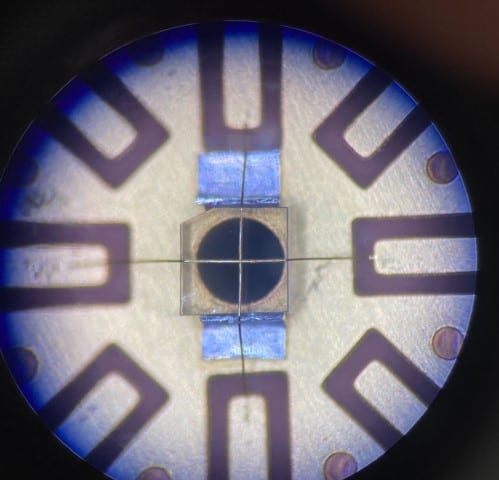
To improve on this accuracy, Hatano’s team measured the current using a pair of diamond quantum sensors based on NV centres. An NV centre is an impurity in which two carbon atoms in a diamond lattice are replaced by a single nitrogen atom and an adjacent empty space.

An NV centre behaves as a tiny spin magnetic moment that is very sensitive to external magnetic fields. These fields can be measured very precisely by probing NV centres using light and microwaves.

Differential measurement

In their study, the researchers placed a pair of the diamond sensors on either side of an EV busbar, which is a thick strip of metal that connects an EV’s battery to its motors and other electrical components. As a current passes through the busbar, it creates a magnetic field that is measured by both diamond sensors. Because the sensors are located on either side of the busbar, one sensor measures a positive value for the magnetic field and the other measures a negative value. Crucially, they both measure the same levels of noise – so subtracting one measurement from the other eliminates the noise.

Using this differential technique, the team measured currents in the busbar as high as 130 A, and as low as 10 mA – even in noisy environments. The team then cranked up the current to ±1000 A and operated the sensor in the –45°C–85°C temperature range and observed good measurement performance.

The team says that the sensors could reduce the weight of EV batteries by 10%, which would lower the energy required to both run and produce EVs. They estimate that the commercial rollout of the sensors could ultimately reduce the carbon dioxide emitted by the transport industry by some 0.2% by 2030 – potentially bringing the goal of net-zero carbon emissions one step closer.

The research is described in Scientific Reports.

National Ignition Facility’s laser-fusion milestone ignites debate

On 8 August last year, physicists at the Lawrence Livermore National Laboratory in the US used the world’s biggest laser to carry out a record-breaking experiment. Employing the 192 beams of the $3.5bn National Ignition Facility (NIF) to implode a peppercorn-sized capsule containing deuterium and tritium, they caused the two hydrogen isotopes to fuse, generating a self-sustaining fusion reaction for a fraction of a second. With the process giving off over 70% of the energy used to power the laser, the finding suggested that giant lasers might yet enable a new source of safe, clean and essentially limitless energy.

The result put researchers at the Livermore lab in a celebratory mood, having struggled for more than a decade to make significant progress. But the initial excitement soon faded when several subsequent attempts to reproduce the achievement fell short – mustering at best just half of the record-breaking output. With the Livermore management having decided to try only a handful of repeat experiments, the lab put its quest for breakeven on hold and instead tried to figure out what was causing the variation in output.

For critics of NIF, the latest course correction came as no surprise, apparently illustrating once again the facility’s unsuitability as a test bed for robust fusion-energy production. But many scientists remain upbeat and the NIF researchers themselves have come out fighting, recently publishing the result from their record-breaking shot in Physical Review Letters (129 075001). They insist that they have, after all, achieved “ignition”, reaching the point at which heating from the fusion reactions outweighs cooling, creating a positive feedback loop that rapidly boosts plasma temperature.

Omar Hurricane, chief scientist of Livermore’s fusion programme, maintains that this physics-based definition of ignition – rather than the simple “energy breakeven” description – is the one that really counts. Describing the eventual achievement of breakeven as “the next public relations event”, he nevertheless says that it remains an important milestone that he and his colleagues want to reach. Indeed, physicists from beyond the Livermore lab are confident that the much-discussed target will be hit. Steven Rose at Imperial College in the UK believes that “there is every prospect” breakeven will be achieved.

Record gain

Attempting to harness fusion involves heating up a plasma of light nuclei to the point where those nuclei overcome their mutual repulsion and combine to form a heavier element. The process yields new particles – in the case of deuterium and tritium, helium nuclei (alpha particles) and neutrons – as well as huge amounts of energy. If the plasma can be kept at suitably immense temperatures and pressures for long enough, the alpha particles should provide enough heat to sustain the reactions on their own while the neutrons can potentially be intercepted to power a steam turbine.

Fusion tokamaks use magnetic fields to confine plasmas over fairly long periods. NIF, as an “inertial-confinement” device, instead exploits the extreme conditions created for a fleeting moment inside a tiny quantity of highly compressed fusion fuel before it re-expands. The fuel is placed inside a 2 mm-diameter spherical capsule, which is located at the centre of a roughly 1 cm-long cylindrical metal “hohlraum” and implodes when NIF’s precisely directed laser beams strike the inside of the hohlraum and generate a flood of X-rays.

In contrast to tokamaks, NIF was not designed primarily to demonstrate energy but instead serve as a check on the computer programs used to simulate explosions of nuclear weapons – given that the US ceased live testing in 1992. However, after switching on in 2009 it soon became apparent that the programs used to guide its own operations had underestimated the difficulties involved, in particular when dealing with plasma instabilities and creating suitably symmetric implosions. With NIF missing its initial target to achieve ignition by 2012, the US National Nuclear Security Administration, which oversees the lab, put that objective aside to concentrate on the time-consuming task of better understanding implosion dynamics.

In early 2021, following a series of experimental modifications, Hurricane and colleagues finally showed they could use the laser to create what is known as a burning plasma – in which the heat from alpha particles exceeds the external energy supply. They then made a series of further tweaks, including shrinking the hohlraum’s laser entrance holes and lowering the laser’s peak power. The effect was to shift some of the X-ray energy to later in the shot, which raised the power transferred to the nuclear fuel – pushing it high enough to outpace the radiative and conductive losses.

In August 2021 NIF researchers recorded their landmark “N210808” shot. The hotspot in the centre of the fuel in this case had a temperature of around 125 million kelvin and an energy yield of 1.37 MJ – some eight times higher than their previous best result, obtained earlier in the year. This new yield implied a “target gain” of 0.72 – when compared to the laser’s 1.97 MJ output – and a “capsule gain” of 5.8 when considering instead the energy absorbed by the capsule. 

More importantly, as far as Hurricane is concerned, the experiment also satisfied what is known as the Lawson criterion for ignition. First laid out by engineer and physicist John Lawson in 1955, this stipulates the conditions in which fusion self-heating will exceed the energy lost via conduction and radiation. Hurricane says that the NIF results satisfied nine different formulations of the criterion for inertial confinement fusion, thereby demonstrating ignition “without ambiguity”.

Three shots and you’re out

Following the record-breaking shot, Hurricane and some of his fellow scientists at NIF were keen to replicate their success. But the lab’s management were not so enthusiastic. According to Mark Herrmann, then Livermore’s deputy director for fundamental weapons physics, several working groups were set up in the wake of N210808 to assess the next steps. He says that a management team consisting of around 10 experts in inertial confinement pulled those findings together and drew up a plan, which it presented in September.

Herrmann says that the plan contained three parts – attempting to reproduce N210808; analysing the experimental conditions that enabled the record-breaking shot; and trying to obtain “robust megajoule yields”. Discussion of the first point involved what Herrmann describes as “a large variety of opinions” among the roughly 100 scientists working on the fusion programme. In the end, given “limited resources”, and a limited number of targets in the batch containing N210808, he says that the management team settled on just three additional shots.

Hurricane has a slightly different recollection, saying there were four repeats. Those experiments, he says, were carried out over a roughly three-month period and achieved yields that ranged from less than a fifth to around half of that reached in August. But he maintains that these shots were still “very good experiments”, adding that they also satisfied some formulations of the Lawson criterion. The difference in performance, he says, is “not as binary as people have been portraying”.

The plasma-coating process is a recipe, so just like baking bread it doesn’t come out exactly the same every time

Omar Hurricane

As to what caused this huge variation in output, Herrmann says that the leading hypothesis is voids and divots in the fuel capsules, which are made from industrial diamond. He explains that these imperfections can be amplified during the implosion process, causing the diamond to enter the hot spot. Given that carbon has a higher atomic number than deuterium or tritium it can radiate much more efficiently, which cools the hot spot and lowers performance. 

Hurricane agrees that the diamond likely plays an important role in varying the shot-to-shot performance. Pointing out that large variations in output are to be expected given the nonlinearity of NIF’s implosions, he says that the scientists involved do not fully understand the plasma-coating process used during fabrication of the capsules. “It’s a recipe,” he says, “so just like baking bread it doesn’t come out exactly the same every time.”

The road to fusion energy

Hurricane says the team is now investigating several ways to raise NIF’s output in addition to improving the capsule quality. These include altering the capsule thickness, changing the size or geometry of the hohlraum, or possibly increasing the laser pulse energy to around 2.1 MJ to lower the precision required for the target. He says there is “no magic number” when it comes to the target gain but adds that the higher the gain the larger the parameter space that can be explored when doing stockpile stewardship. He also points out that a gain of 1 does not mean the facility is generating net energy, given how little of the incoming electrical energy the laser converts into light on the target – in the case of NIF, less than 1%.

Michael Campbell of the University of Rochester in the US reckons that NIF could achieve a gain of at least 1 “over the next 2–5 years”, given adequate improvements to the hohlraum and target. But he argues that getting up to commercially relevant gains of 50–100 would probably require a switch from NIF’s “indirect drive”, which generates X-rays to compress the target, to the potentially more efficient but trickier “direct drive” that relies on the laser radiation itself.

Despite the several billion dollars that are likely to be needed, Campbell is optimistic that a suitable direct-drive facility can demonstrate such gains by the end of the 2030s – particularly, he says, if the private sector is involved. But he cautions that commercial power plants would probably not start operating until at least the middle of the century. “Fusion energy is for the long term,” he says, “I think people have to be realistic about the challenges.”

Ultrasound technique captures micron-scale images of brain activity

Functional ULM

Neuroimaging has increased our understanding of brain function. Such techniques often involve measuring blood-flow variations to detect brain activation, exploiting the fundamental interaction between the brain’s vascular and neuronal activities. Any alterations in this so-called neurovascular coupling are strongly linked to cerebral dysfunction. The ability to image cerebral microcirculation is particularly important, as neurodegenerative diseases such as dementia and Alzheimer’s involve dysfunction of the small cerebral vessels.

Researchers at Institute Physics for Medicine Paris (Inserm/ESPCI PSL University/CNRS) have now developed a method called functional ultrasound localization microscopy (fULM) that can capture cerebral activity at the micron scale. The team published the first micron-scale, whole-brain images of rodent vascular activity in Nature Methods, along with a detailed explanation of the fULM image acquisition and analysis procedures.  

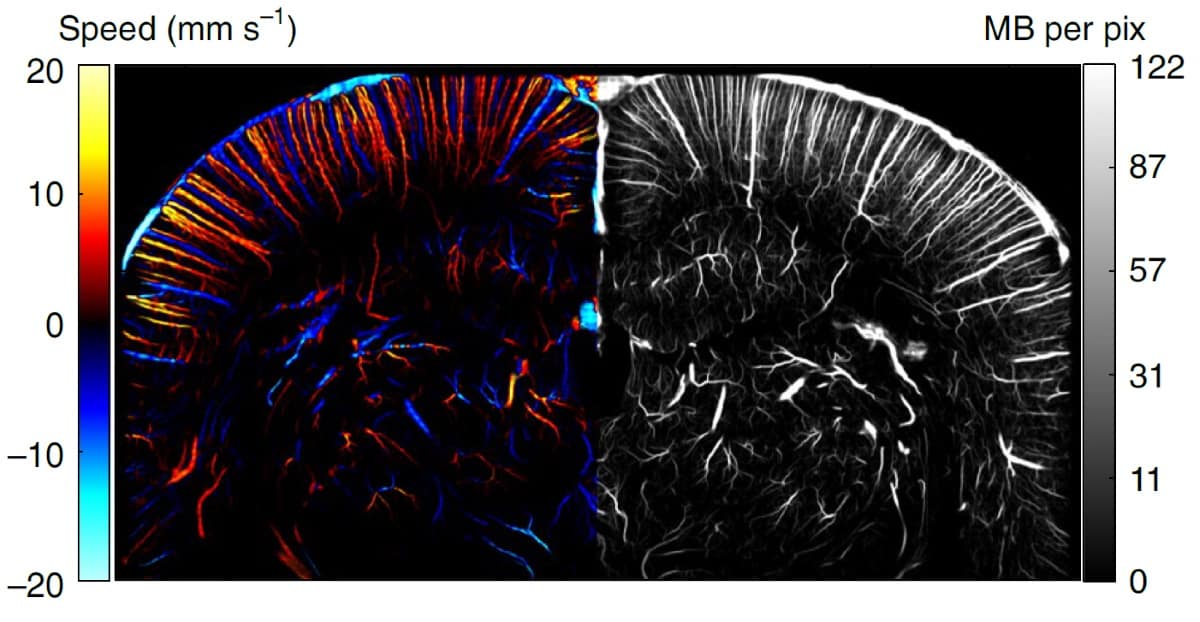
Unlike invasive electrophysiological or optical approaches to study brain function at the microscopic scale, ultrasound localization microscopy (ULM) can be non-invasive. The imaging technology tracks biocompatible micron-sized microbubbles injected into the blood circulation and by accumulating the tracks of millions of microbubbles, reconstructed images can reveal subtle changes in the cerebral blood volume with micron-sized accuracy, across large fields-of-view.

Researchers have previously used ULM to reveal microvascular anatomy at the whole-brain scale in rodents and humans. The spatial resolution of ULM is 16-fold better than that achieved with functional ultrasound imaging. But because the acquisition process is slow, ULM can only produce static maps of blood flow induced by the neuronal activity.

The fULM technique overcomes this limitation. In addition to imaging the brain microvasculature, the technique detects local brain activation by calculating the number and speed of microbubbles passing in each vessel. When a brain region activates, neurovascular coupling causes the blood volume to increase locally, dilating the vessels and allowing more microbubbles to pass. fULM provides local estimates of multiple parameters that characterize such vascular dynamics, including microbubble flow, speed and vessel diameters.

According to principal investigator Mickael Tanter and colleagues, integrating fULM into a cost-efficient, easy-to-use ultrasound scanner provides “a quantitative look at the cerebral microcirculatory network and its haemodynamic changes by combining a brain-wide spatial extent with a microscopic resolution and a 1 s temporal resolution compatible with neurofunctional imaging”.

In vivo studies

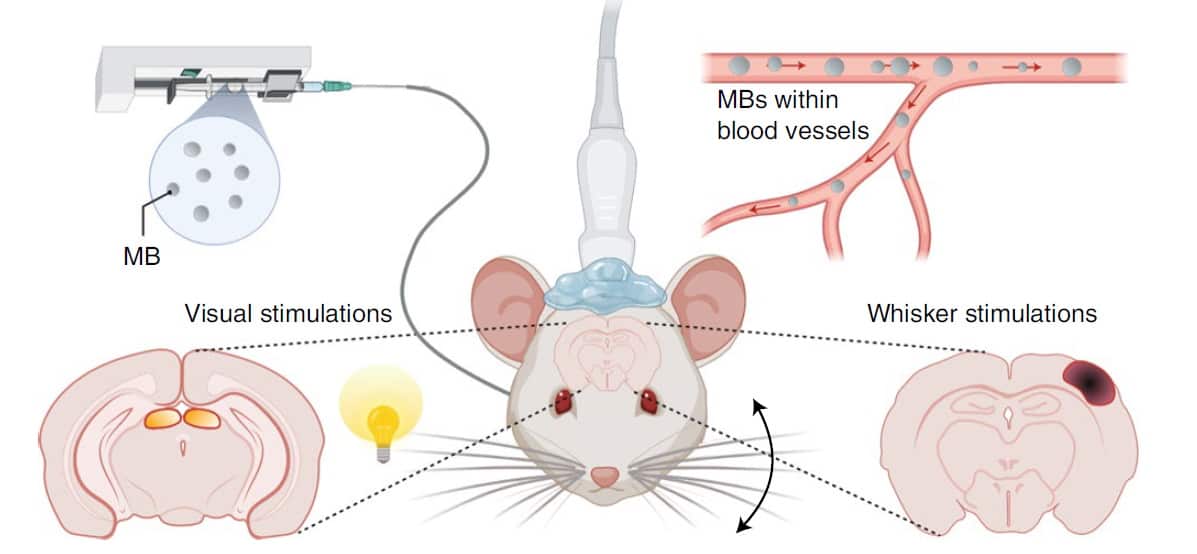
To demonstrate the fULM concept, the researchers first imaged laboratory rats with functional ultrasound (without contrast), followed by ULM in the same imaging plane. They combined sensory stimulations (whiskers deflections or visual stimulation) in anesthetized rats with continuous microbubble injection. For ULM, the rats received a continuous slow injection of microbubbles during a 20 min imaging session, leading to roughly 30 microbubbles per ultrasound frame.

Schematic of ULM brain imaging

During ULM processing, the researchers saved every track with each microbubble position and its respective time position. They constructed ULM images by selecting a pixel size and sorting each microbubble within each pixel. Only pixels with at least five different microbubble detections during the total acquisition time were used for analyses.

The technique allowed the researchers to map functional hyperaemia (increased blood in the vessels) in both cortical and subcortical areas with 6.5 µm resolution. They quantified the temporal haemodynamic responses during whisker stimulations for four rats and during visual stimulations for three rats, by measuring the microbubble flux and velocity.

The team quantified the involvement of blood vessels during functional hyperaemia. They observed increases in microbubble count, speed and diameter for a representative arteriole and venule (very small arteries/veins leading into/out of the capillaries), noting that control animals did not exhibit any changes. They also introduced a “perfusion” and “drainage area index” to quantify further the involvement of each individual blood vessel. These increased by 28% and 54% during stimulation for the arteriole and venule, respectively.

Due to the large field-of-view, the researchers could perform quantitative analyses simultaneously for every vessel across the whole rat brain slice image, even in deep structures such as the thalamus for whisker stimulations and superior colliculus for visual stimulations.

“The achieved spatiotemporal resolution enables fULM to image different vascular compartments in the whole brain and to discriminate their respective contributions, in particular in the precapillary arterioles known to have a major contribution to vascular changes during neuronal activities,” write the authors.

They add: “fULM shows that the relative increase in microbubble flow is greater in intra-parenchymal vessels rather than in arterioles. fULM also confirms depth-dependent characteristics for blood flow and speed in penetrating arterioles at baseline, and highlights a depth-dependent variation in blood speed during activation. It also quantifies large increases of microbubble flux, blood speed and diameter in venules during activation.”

As a new imaging research tool, fULM provides a way to track dynamic changes during brain activation and will offer insights into neural brain circuits. It will aid the study of functional connectivity, layer-specific cortical activity and or neurovascular coupling alterations on a brain-wide scale.

Tanter notes that researchers at Institute Physics for Medicine are collaborating with the Paris-based medical technology company Iconeus, to make this technology available for the neuroscience community and for clinical imaging very rapidly.

US government calls time on open-access embargoes

The US has announced a new open-access policy that would make the results of research supported by the government available to the public at no cost and with no embargo period. Alondra Nelson, acting head of the Office of Science and Technology Policy (OSTP), has called on federal research bodies to implement the new policy by the end of 2025. 

Researchers in America who publish papers based on US federal funds currently have two options. They can either make an article open access on publication by paying an article-processing charge to the publisher. Or they can publish it in a subscription-based journal but then put the accepted paper in a publicly available repository following a one-year embargo. 

The new mandate effectively ends the 12-month embargo period, allowing researchers, from 2025, to put their paper in an open repository as soon as it is published in a journal. “The American people fund tens of billions of dollars of cutting-edge research annually,” says Nelson, who is an anthropologist by training. “There should be no delay or barrier between the American public and the returns on their investments in research.”

Wide welcome

The move has been welcomed by the Scholarly Publishing and Academic Resources Coalition (SPARC), which has advocated greater openness of research results for more than two decades. “[W]e express our heartfelt thanks to the Biden Administration and OSTP…for enabling this giant step towards realizing our collective goal of ensuring that sharing knowledge is a human right – for everyone,” says SPARC executive director Helen Joseph.

Learned societies that publish their own journals and those of partner organizations have also welcomed the OSTP’s announcement, although they warn that open access should not be implemented too aggressively. “Through partnership and co-ordination, we can develop effective implementation plans that lead to rapid progress in open access and open data,” the American Institute of Physics (AIP) noted in a statement requested by Physics World. “We look forward to working collaboratively with these agencies and stakeholders across the scholarly publishing ecosystem to establish solutions that benefit the research communities we serve.” 

IOP Publishing, which publishes Physics World, takes a similar view. Noting its determination “to make universal access to research a reality”, an IOP Publishing statement adds that the “transition needs to be carefully managed to ensure access to publishing for researchers and to ensure there is sufficient funding in the system to support publishers and others for the contribution they make to ensuring quality and integrity in research and in communication”.

Yet the wider commercial publishing industry, which has traditionally relied on journal subscriptions, takes a different view. “How will publishers, especially small publishers, sustain the accuracy, quality and output that the public interest requires?” says Shelley Husband, senior vice president for government affairs at the Association of American Publishers. She feels the guidance “will have sweeping ramifications, including serious economic impact” and criticizes it for coming “without formal, meaningful consultation or public input”.

Individual commercial publishers have taken a more guarded stance. In a statement to Physics World, the Dutch-based publisher Elsevier says it will “look forward to working with the research community and OSTP to understand its guidance in more detail”. Elsevier adds that “nearly all” of its 2700 journals enable open access, including 600 that are “fully open-access journals”. 

Global barriers

Despite the drive to greater openness, however, there are still significant barriers to open access worldwide. These were confirmed by a global study of more than 3000 researchers in physical science – released in August by the AIP, the American Physical Society, IOP Publishing and Optica Group Publishing. It found that while some 53% of respondents want to publish open access, some 62% say that a lack of money from funding agencies prevents them from doing so.

About 80% of respondents in Latin America and South Asia reported that a lack of grants is preventing them from publishing their papers in open-access form. Meanwhile, 61% of respondents from Europe, which has spearheaded many developments in open access in recent decades, regards obtaining grants as the most significant barrier to such publishing.

“Strategies that limit researchers to only publish their results in fully open-access journals, or that undermine the viability of high-quality hybrid journals through zero embargo policies, could result in physics researchers no longer having an adequate range of options or freedom of choice in where they publish their work,” the study concludes.

Robot learns how to laugh using AI, LEGO Kibble balance inspires table-top metrology system

We do love a good LEGO story here at Physics World. Indeed, this is the 55th article on the plastic blocks that we have published on the website. In this instalment we travel to Gaithersburg, Maryland where in 2013 Leon Chao and colleagues at the National Institute of Standards and Technology (NIST) were asked to make a miniature LEGO version of the 2.5 metre tall Kibble balance that they were building at the time.

Also known as a Watt balance, a Kibble balance provides a way of defining the kilogram in terms of Planck’s constant. It is an essential piece of kit in national metrology labs like NIST because this is how the kilogram has been defined since 2019 by the International Committee for Weights and Measures.

Chao and colleagues followed through on the request and even described their LEGO version in the American Journal of Physics. Much to the team’s surprise and delight, people from around the world built their own versions and sent photographs to NIST (see figure).

Design journey

In NIST’s Taking Measure blog, Chao describes what happened next. Inspired by their small-scale LEGO version, the team embarked on a design journey to make a table-top Kibble balance that could be used in labs and by industry. The first incarnation was called KIBB-g1 and could determine gram-level masses to six-digit accuracy. Chao and colleagues are now working with the US Army to develop KIBB-g2 and also with the Air Force to develop a torque standard based on a Kibble balance.

Shared laughter

I’m guessing that robots are a popular thing for people to make with LEGO, but how many of those robots have a sense of humour? Very few I am guessing, but that could soon change thanks to researchers at Kyoto University in Japan, who have used artificial intelligence to teach a robot to laugh and enjoy the funnier side of life.

The team focussed on the phenomenon of “shared laughter”, whereby an individual in a group laughs and this causes others in the group to into laugh as well. It turns out that it isn’t as simple as simply having the robot laugh when it hears a human laugh. Analysis of speed-dating conversations revealed that most laughs don’t elicit a shared laugh – and working out why is a tricky business given the nuances of human behaviour.

Koji Inoue and colleagues in Kyoto carefully characterized the laughter responses in their data and used their results along with artificial intelligence to train a robot called Erica in the art of shared laughter.  They tested the robot’s laughing ability by having people listen to its responses during a brief dialogue with a human.

You can read more about Kyoto’s laughing robot in Frontiers in Robotics and AI.

Site-resolved microwave control of diamond qubits achieved using focussed light

Addressable NV centres article

A technique for addressing individual electronic and nuclear spins in a diamond crystal has been developed by researchers in Japan. The scheme combines optical and microwave processes and could lead to the creation of large-scale systems for the storage and processing of quantum information.

Electronic and nuclear spins in some solid-state crystals are promising platforms for large-scale quantum computers and memories. These spins interact weakly with their local environment at room temperature, which means that they can operate as quantum bits (qubits) that store quantum information for very long times. Furthermore, such spins can be controlled without significant losses. Typically, the spins respond to both optical light and microwaves. Optical light is good for spatial precision in addressing individual spins because of its shorter wavelengths. The longer microwaves, on the other hand, provide higher-fidelity control of all the spins in a crystal at the cost of no spatial resolution.

Now, Hideo Kosaka and colleagues at Yokohama National University in Japan have developed a way to address individual spins that combines the strengths of both optical and microwave control. They used microwaves to control individual spins in diamond by precisely “spotlighting” them using optical light. They demonstrated site-selective operations for information processing and generated entanglement between electronic and nuclear spins for information transfer.

Diamond NV centres

For its spins, the team used nitrogen–vacancy (NV) centres in a diamond crystal. These occur when two neighbouring carbon atoms in a diamond lattice are replaced with a nitrogen atom and a vacant site. The ground state of an NV centre is a spin-1 electronic system that can be used as a qubit to encode information.

To perform computation, one needs to be able to change the spin state of the qubits in a controlled manner. For a single qubit, it suffices to have a set of four cardinal operations to do this. These are the identity operation and the Pauli X, Y, Z gates, which rotate the state about the three axes of the Bloch sphere.

Universal holonomic gates

These operations can be implemented by using dynamic evolution, where a two-level system is driven by a field at or near resonance with the transition to “rotate” the qubit to the desired state. Another way is to implement a holonomic gate, where the phase of a state in a larger basis is changed so that it has the effect of the desired gate on the two-level qubit subspace. Compared to dynamic evolution, this method is considered more robust to decoherence mechanisms because the phase acquired does not depend on the exact evolution path of the larger state.

In this latest research, Kosaka and colleagues first demonstrate the site-selectivity of their technique by focussing a laser at a specific NV centre. This changes the transition frequency at that site such that no other site responds when the entire system is driven by microwaves at the right frequency. Using this technique, the team was able to spotlight regions a few hundred nanometres across, rather than the much larger areas illuminated by the microwaves.

By selecting sites this way, the researchers showed that they could implement the Pauli-X, Y and Z holonomic gate operations with good fidelity (greater than 90%). Gate fidelity is a measure of how close the performance of the implemented gate is to an ideal gate. They use a microwave pulse that flips its phase in between which makes the protocols robust to non-uniformities in power. They also show that a spin coherence time of about 3 ms is maintained even after gate operations that take a comparable time.

Quantum memories and networks

In addition to the electronic spin states, an NV-centre also has accessible nuclear spin states associated with the nitrogen nucleus. Even at room temperature, these states are extremely long lived because of their isolation from the environment. As a result, the NV-centre nuclear spin states can be used as quantum memories for storage of quantum information for long times. This is unlike qubits based on superconducting circuits, which need to be at sub millikelvin temperatures to overcome thermal noise and are more susceptible to decoherence caused by interactions with the environment.

Kosaka and colleagues were also able to generate entanglement between an electronic spin and a nuclear spin in the NV centre. This enables the transfer of quantum information from an incident photon to the NV centre’s electronic spin and then on to the nuclear spin quantum memory. Such a capability is critical for distributed processing where the photons can be used to transfer information between qubits in the same or different systems in a quantum network.

Writing in Nature Photonics, the researchers say that with modifications to their optical addressing process, it should be possible to improve its spatial resolution and also make use of coherent interactions between multiple NV centres. Combining a few different techniques could enable “selective access to more than 10,000 qubits in a 10×10×10 µm3 volume, paving the way to large-scale quantum storage”. Kosaka says that his group is now working on the challenging task of making two qubit gates using two nearby NV-centres.


From ATLAS to the control room: a high-school student’s week at CERN

In the last week of the summer term, my school – Hayesfield Girls’ School in Bath – asks all year-12 students (aged 16 or 17) to undertake a week of work experience. I was really lucky to get the chance to do my work experience at CERN, the particle-physics laboratory near Geneva, Switzerland, which houses the Large Hadron Collider (LHC). Much to my delight, my week was organized by electronics engineer Eva Gousiou, who is part of CERN’s Women in Technology group, so I got to spend time with many female scientists and engineers.

Monday

I started my week with high-energy physicist and University of Pittsburgh research associate Marilena Bandieramonte, who works on the ATLAS experiment, the largest detector at CERN. She initially showed me around the CERN visitor centre, which gives a great introduction to the overall purpose of the research at CERN.

In the afternoon, she described her work to me, which includes creating simulations for the ATLAS detector. She explained how her models can be employed by the ATLAS users to simulate their detector experiments and predict the likely outcomes.

Tuesday

The next day, I continued shadowing Bandieramonte, as she worked on improving the user interface for the ATLAS simulations, and I had the chance to visit the ATLAS control room. This was an exciting opportunity – while I had visited CERN previously on a guided tour, I’d only been able to see the control room from outside. But this time I was allowed to enter the room itself and see exactly what goes on in there.

Massive screens full of data and figures cover all the walls, showing information about the condition of the ATLAS detector. If anything were to go wrong, the researchers in the control room could make necessary adjustments. In the afternoon I attended a weekly ATLAS debrief, which included a general status update where they noted that the previous week the LHC had recorded collisions at its highest ever energy.

Wednesday

My third day’s plan was to meet Sophie Baron, an engineer in the experimental physics department, but this could not go ahead, as she had come down with COVID-19. However, I was able to learn about the group on a Zoom call with her instead.

I later met up with Baron’s colleague Philippa Hazell, who showed me around their laboratories, where they design and test the electronic systems and components used in the various experiments at CERN. She explained that the electronic chips they use could be affected by radiation from the particle collisions. To prevent this, the chips are designed with the digital logic repeated three times – and the majority decision used as the outcome.

Thursday

I spent the penultimate day with electromechanical technician Ellen Milne in the radiofrequency (RF) department, where they generate the signals used to accelerate particles in the RF cavities of the Super Proton Synchrotron (SPS) accelerator. This is the second largest machine at CERN, and it provides the accelerated particle beams for the LHC. I was able to see how they generate the power, including seeing tests done on an 800 MHz radio-frequency klystron.

After this I was driven out to visit the LHCb and CERN Axion Solar Telescope (CAST) experiments. LHCb studies the beauty (bottom) quark, and is looking to find a reason for the differences in the amounts of matter and antimatter within our universe. Meanwhile, CAST is an experiment searching for axioms – theorized particles that, should they exist, could be found in the centre of the Sun. They are also a candidate dark-matter particle, and their existence might help in explaining the matter–antimatter discrepancy, by tapping into the weak force.

Friday

On my last morning, I spent time with computer engineer Florentia Protopsalti, who works in the IT department. She took me into the control room for the Data Centre, from which CERN’s entire scientific, admin and computing infrastructure is run. Protopsalti explained that all the data from the experiments are sent there to be sorted. The majority of this information is not scientifically significant, so algorithms are used to decide which data to store and which to discard.

In the afternoon, I had the chance to meet with Eva Gousiou, who had arranged the whole job-shadowing week for me. She took me to see the CERN Control Centre. This is where they monitor and control the accelerators, including the Linear Accelerator 4 (LINAC4), SPS and the LHC, as well as controlling the cryogenics and tunnel access. I got to see lots of the screens displaying information surrounding the condition of the accelerators. Generally, the older the accelerator, the more that has to be done manually from the control room, whereas newer accelerators such as LINAC4 are more automated and require less input.

Overall, I really enjoyed my week at CERN. Everyone was really welcoming and, as well as my hosts, lots of other people offered to show me round their labs and explain things to me. I was particularly surprised by how many people had programming skills and how this was needed for their jobs. It made me think about my future career and the possible job options available at labs like CERN.

Trouble on the Horizon for UK-based researchers

Researchers in the United Kingdom are facing an uncertain future, due to a political spat about the UK’s participation in Horizon Europe – Europe’s flagship research funding programme. Following Brexit, the UK was set to become an official associate within the scheme, which brings funding and leadership opportunities within European projects. This is now threatened by a political disagreement over trading arrangements in Northern Ireland.

In this episode of the Physics World Stories podcast, science communicator Andrew Glester speaks with physical scientists affected by the issue. Rachel Armstrong, an experimental architecture researcher explains why Brexit repercussions led her to relocate from the UK to KU Leuven in Belgium. Medical physicist Karen Kirkby, based at the Christie Hospital in Manchester, explains why failure to associate with Horizon Europe will damage European partnerships developed over years.

Glester also catches up with science policy researcher Graeme Reid from University College London, a former engineer who has been advising the UK government on its post-Brexit science strategy. Reid outlines the government’s recently mooted ‘Plan B’, which would involve launching an alternative national funding body. The issue, as Reid explains, is that it would take years to develop, and the UK science community is almost unanimous in its desire to remain associated with Horizon Europe.

Find out more about the political debacle around the UK’s status in Horizon Europe in this analysis article by science writer Michael Allen.

Floating artificial leaves could produce solar-generated fuel

Leaf-like devices that are light enough to float on water could be used to generate fuel from solar farms located on open water sources – an avenue that hasn’t been explored before, according to the researchers from the University of Cambridge in the UK who developed them. The new devices are made from thin, flexible substrates and perovskite-based light absorbing layers, and tests showed that they can produce either hydrogen or syngas (a mixture of hydrogen and carbon monoxide) while floating on the River Cam.

Artificial leaves like these are a type of photoelectrochemical cell (PEC) that transforms sunlight into electrical energy or fuel by mimicking some aspects of photosynthesis, such as splitting water into its constituent oxygen and hydrogen. This is different from conventional photovoltaic cells, which convert light directly into electricity.

Because PEC artificial leaves contain both light harvesting and catalysis components in one compact device, they could in principle be used to produce fuel from sunlight cheaply and simply. The problem is that current techniques for making them can’t be scaled up. What is more, they are often composed of fragile and heavy bulk materials, which limits their use.

In 2019 a team of researchers led by Erwin Reisner developed an artificial leaf that produced syngas from sunlight, carbon dioxide and water. This device contained two light absorbers and catalysts, but it also incorporated a thick glass substrate and coatings to protect against moisture, which made it cumbersome.

New, lightweight version

To make the new, lighter version, Reisner and colleagues had to overcome several challenges. The first was to integrate light absorbers and catalysts into substrates that are resistant to water infiltration. To do this, they chose a thin-film metal oxide, bismuth vanadate (BiVO4), and photoactive semiconductors known as lead halide perovskites, which can be coated onto flexible plastic and metal foils. They then covered the devices with micron-thick water-repellent polyethylene terephthalate. The result was a structure that works and looks like a real leaf.

“We placed the light absorbers at the centre of the devices, to shield them from water,” explains Reisner. “The moisture-sensitive perovskite in particular needs to be completely isolated.”

The catalysts are deposited on both sides of the device. The perovskites and BiVO4 harvest solar radiation, but instead of producing electricity like a photovoltaic panel, they use the harvested energy to power a chemical reaction with the support of the catalysts. “This allows us to essentially drive chemistry on a solar panel – in our case, converting the greenhouse gas carbon dioxide with water to produce syngas, an important industrial energy carrier,” Reisner tells Physics World.

The researchers tested their leaves floating on the River Cam in Cambridge and found they convert sunlight into fuels as efficiently as natural plant leaves. Indeed, a device containing a platinum catalyst achieved an activity of 4,266 μmol H2 g−1 h−1.

Farms for fuel synthesis

“Solar farms have become popular for electricity production; we envision similar farms for fuel synthesis,” says team member Virgil Andrei. “These could supply coastal settlements, remote islands, cover industrial ponds, or avoid water evaporation from irrigation canals.”

“Many renewable energy technologies, including solar fuel technologies, can take up large amounts of space on land, so moving production to open water would mean that clean energy and land use aren’t competing with one another,” Reisner adds. “In theory, you could roll up these devices and put them almost anywhere, in almost any country, which would also help with energy security.”

The researchers say they will now work on scaling up and improving the efficiency and stability of their devices. “Our team is also studying new catalysts to widen the chemistry scope of artificial leaves to allow us to make other products from abundant feedstocks and ideally, in the long term, many different chemicals on demand,” Reisner says.

The present study is detailed in Nature.

Copyright © 2026 by IOP Publishing Ltd and individual contributors