Racing to save the planet

Cars – and in particular racecars – might seem the villains in a world grappling with climate change. Racing Green: How Motorsport Science Can Change the World hopes to convince you of exactly the opposite, with science journalist Kit Chapman showing how motorsports not only pioneers new, planet-friendlier machines and materials, but saves lives on and off the track too.

The first part of Chapman’s argument tracks the historical development of cars and competition. His stories show how, from its start, racing has served as a research lab and proving ground for new technologies. The first organized motor races were competitions to encourage innovation, akin to today’s X-Prizes. In 1894 Le Petit Journal offered a purse for the first car to make it from Paris to Rouen, while later races emphasized pure speed or, like the legendary 24 Hours of Le Mans, endurance. Chapman provides a whirlwind tour through the development of the internal combustion engine-powered car and its damning limitations, including the copious greenhouse-gas emissions and the inability to ever achieve more than 50% thermal efficiency.

He then introduces us to new racing series like Formula E and Extreme E, which have changed electric cars “from an eccentric folly to the undisputed future of the automotive industry”. Chapman highlights the advantages of electric vehicles without glossing over their drawbacks: recycling challenges, the potential for difficult-to-extinguish fires resulting from thermal runaway, and ethical/sustainability issues surrounding the materials used. Throughout this section, he links motorsport advances with “real-life” applications. For example, the same flywheels that enabled Audi’s hybrid racecars to take all three podium spots at the 24 Hours of Le Mans in 2012 made London buses more energy efficient. Some connections are a little more tenuous than others, but they are uniformly fascinating.

Chapman’s brand of reportage often involves extensive travel. While the COVID pandemic limited his range, it provides some of the most interesting stories in the book’s second section, which focuses on lives saved and improved because of racecar technology. At the start of the pandemic, idle race teams built everything from face shields to ventilators. Britain’s National Health Service estimated it would need 30,000 ventilators, but a collaboration between University College London and Formula 1’s Mercedes-AMG realized that, even if they could provide the ventilators, there weren’t enough trained personnel to utilize all of them. Instead, this group exploited the race team’s expertise in aerodynamics and fast prototyping to produce continuous positive airway pressure (CPAP) machines that kept patients from needing ventilators in the first place.

Other racing-centric techniques, such as remote sensing, predictive analytics and highly choreographed pit stops have been adapted to monitor patients outside hospital, evaluate budding surgeons, and minimize risks while transferring vulnerable patients. The scientists and engineers profiled by Chapman chose motorsport because it demands flexibility, versatility and – of course – speed.

The book’s third and final section on materials is my favourite because this area rarely gets its due in popular-science literature. As in previous chapters, Chapman considers the ethical and ecological costs of problematic materials before introducing us to alternatives. For example, carbon-fibre composites are heavily used in racecars because they have superior strength-to-weight properties compared with metals, but are energy-intensive to make and difficult to recycle. Chapman recounts efforts to replace carbon fibre with flax, bamboo or hemp to create materials just as strong, but with significantly reduced carbon footprints. Another material Chapman focuses on is the rubber used in tyres. I had no idea of the horrors committed in sourcing rubber during the Second World War, or how these actions existentially endangered the world’s rubber tree population. Chapman leaves each section on a more positive note, however, explaining, for example, how scientists hope to replace or augment natural rubber with the saps of the guayule shrub and the “rubber dandelion”.

Kit Chapman expertly places scientific developments in context while making you feel like he’s sharing stories over beer at the local pub

Chapman expertly places scientific developments in societal and historical contexts while making you feel like he’s sharing stories over beer at the local pub. His wry sense of humour permeates the book, especially in his footnotes, which are (sometimes distractingly) hilarious. His best personal stories come at his own expense. He relates how he – a 6 ft 5 in tall former university rugby forward – literally got stuck in the world’s fastest electric racecar. “I don’t want to make you feel bad,” an onlooker told him as he struggled to extract himself, “but a 70-year-old man does this in under 10 seconds.”

Chapman does an outstanding job including women’s contributions, which is saying something in a sport where women have been (and, in series like NASCAR and Formula 1, continue to be) scarce. He introduces us to the early 20th century “Fastest Girl on Earth” Dorothy Levitt who popularized the rear-view mirror, as well as to contemporary Formula E engineer Delphine Biscaye, a contributor to one iteration of the flywheels I mentioned earlier. (By way of disclosure: Chapman quotes me four times as he compares NASCAR with other forms of motorsport.)

Although the book covers plenty of science, it is not a nuts-and-bolts-level explanation of how racecars work. Even within the topics covered, I found myself wishing for photographs or drawings to clarify some of the text. Those without knowledge of racing and, in particular Formula 1, may find it challenging to keep straight the many people and events referenced.

Because he is a race fan, Chapman understands the intimate connection fans have with the sport. This is most evident in his dramatic recounting of the excruciating 27 s it took Formula 1 driver Romain Grosjean to escape a fiery wreck in 2020 caused by a 192 kph, 67 G crash. Miraculously, Grosjean emerged with only minor burns on his hands and a sprained left ankle. Then Chapman flashes back to 1994 and remembers his mother crying the morning after the great Ayrton Senna died in a crash at San Marino.

Because of this emotional attachment, motorsports may be able to do what science sometimes struggles with: convince people to change their minds about cars. Formula 1, the world’s most popular motorsports series, claimed a viewership of 1.55 billion in 2021. Lewis Hamilton – seven-time Formula 1 World Driver’s Champion – reaches many of these fans in a way Bill Nye or Brian Cox cannot.

If you’re not a racing fan, you probably know one. Racing Green would be an excellent way to get them interested in the science behind the cars. But I also highly recommend Chapman’s book to scientists as a case study in how story can be just as powerful a force for change as fact.

  • 2022 Bloomsbury Publishing £20hb 320pp
Astronomers launch new asteroid-classification system based on animal sizes

A new system for classifying the sizes of small planetary objects using animals has been launched by the European Space Agency (ESA) in a bid to clear up misconceptions introduced after an asteroid was reported to be “half the size of a giraffe”. Senior officials at the Paris-based agency unveiled the plan in response to claims that the giraffe comparisons were undermining serious astronomical research. ESA hopes its new system will bring “much-needed clarity” to asteroid and meteoroid sizes, which will now officially stretch from “blue whale” to “tardigrade”.

Preliminary discussions of the new system began in 2017 after one media outlet described asteroid VL2 as being “the size of an elephant”. Further developments came in 2018 when NASA said another space object resembled a rubber duck. However, ESA’s hand was forced after asteroid 2022 EB5, which struck the Earth on 11 March, was said by the Daily Mail to be “half the size of a giraffe”. That description prompted much ridicule on Twitter, with many users wondering “which half of the giraffe” the metric referred to.

The 3-metre-wide asteroid fortunately caused no damage, landing in the North Atlantic between Norway and Iceland. But Cooper Veldt – ESA’s head of asteroids – argues that the giraffe analogy was “flippant and inaccurate” and that it “could lead the public to underestimate the true risks of dangerous planetary bodies”. The recent impact of the Hollywood asteroid-disaster movie Just Look Up  also encouraged ESA to release the new classification.

Size matters

Known as the Animal Proportion Formula (APF), it divides asteroids and meteoroids – their smaller counterparts – into 10 simple categories. “Blue whale” is the biggest, covering asteroids ranging in size from 20 to 30 m. “Colossal squid” refers to anything between 10 and 20 m, with smaller sizes being “elk” (5–10 m), “bear” (2–5 m) and “lion” (1–2 m). Controversially, giraffes have been excluded from the new system as they lack spatial symmetry.

Meteoroids, in turn, are split into “dog” (0.5–1 m), “cat” (0.2–0.5 m), “gerbil” (0.1–0.2 m) and “cockroach” (0.01–0.1 m) with “tardigrades” below that. Objects lying between those sizes may be sub-divided further into “halves”, “thirds” and “quarters”. ESA suggests astronomers should refer to, for example, a 3 cm meteoroid as being “one third the size of a gerbil”.

Many people told us they were confused by the idea of ‘half a giraffe’ and we believe the APF will bring much-needed clarity and rigour to this important topic.

Cooper Veldt, European Space Agency

“Many people told us they were confused by the idea of ‘half a giraffe’ and we believe the APF will bring much-needed clarity and rigour to this important topic,” Veldt says. “A bit like the Richter scale for earthquakes, we’re confident the system will give astronomers and the public alike a simple and commonly accepted description of asteroid sizes.”

Veldt told Physics World she had previously suspected the system’s introduction might need to be brought forward in response to the creeping use of “double-decker buses” as a metric, since these vehicles are rarely seen in continental Europe. “But when I saw all the crap on Twitter about giraffes, that was the last straw. It was threatening to open scientists up to ridicule, so I pushed for a 1 April launch.”

Other ESA officials hope the system will also boost the agency’s outreach efforts and highlight the contributions of space science to environmental protection. In fact, the agency drew up the asteroid names in partnership with European wildlife charities to highlight threats to the continent’s native species.

A bit like the Richter scale for earthquakes, the system will give astronomers and the public alike a simple and commonly accepted description of asteroid sizes.

Cooper Veldt, European Space Agency

Astronomers who fail to use the new system face a tough time. “Strict penalties will be in place for contraventions,” says Veldt. “Giraffe is an absolute no-no and don’t even think about likening a meteoroid to a tortoise.” Veldt also warned that there will be “special post-Brexit measures for any British scientists who continue to insist on double-deckers”.

Brian Cox was unavailable for comment.

Neutron capture destroys tumours from the inside, dead stars are born again, commercializing quantum sensors

In this episode of the Physics World Weekly podcast Bruce Bauer, CEO of TAE Life Sciences, explains how boron neutron capture therapy (BNCT) can destroy tumour cells without exposing surrounding healthy tissues to damaging levels of radiation. He also chats about how the company is developing technology that will make BNCT more accessible to cancer patients.

Also on hand is astronomer Ramlal Unnikrishnan of Chalmers University of Technology, who talks about a recent study of the born-again star V605 Aquilae. He explains how dead stars can sometimes come back to life and how observing this process could boost our understanding of stellar evolution.

We also chat about the business prospects for quantum sensors and how their commercialization could be held back by the lack of a high-return application.

Geophysical surveys reveal Yellowstone’s hydrothermal underworld

The iconic hydrothermal attractions of Yellowstone National Park attract millions of visitors each year. Now, using geophysical imaging, a US–Danish research team has mapped the extensive natural plumbing system beneath the park for the first time. As Yellowstone’s waters host a menagerie of hardy micro-organisms, the findings could shed light on how life emerged on the volatile early Earth.

Contained mainly within the US state of Wyoming, Yellowstone is one of the world’s largest active volcanoes. The park sits roughly 5 km above a magma chamber that is fed from below by a mantle hotspot. It has been shaped by three major eruptions in the past 2.1 million years, and water flows easily between its multiple layers of volcanic rock.

Thanks to this complex plumbing system, park visitors enjoy a witches’ brew of hydrothermal features. These include the famous Old Faithful geyser, which belches hot water and steam around 20 times a day, and roughly 500 other geysers – more than half the world’s total. Other phenomena include the evil eye-resembling Grand Prismatic Spring, bubbling mudpots and “fumarole” vents through which hot sulphurous gases escape.

Underfloor heating

The heat for all these surface phenomena stems from thermal fluids deep within the Earth’s crust. When water trickles down vertical faults created by seismic activity in the area, it ends up in the zone overlying the magma chamber. As the hot, chemically enriched fluids return to the surface, they mix with colder groundwater, leading to the surface fireworks.

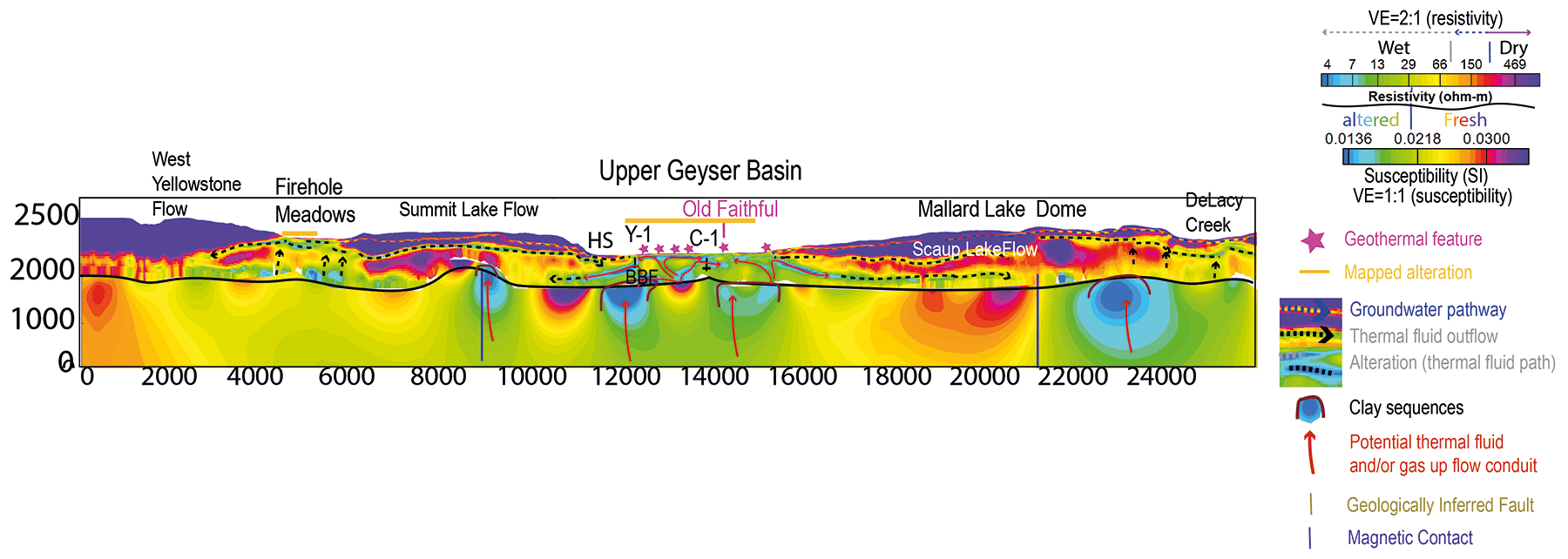
Until now, however, the locations of these deep fluid pathways have not been clear. To map them, the research team flew a helicopter over the park with a 25-m diameter electromagnetic loop dangling below at an average height of 48 m above ground. “It’s like a giant wireless phone charger, as both exploit Faraday’s law of induction,” explains Carol Finn of the US Geological Survey in Denver, who led the study published in Nature.

As with any such set-up, a current induced in the loop generated a magnetic field. This field extended into the ground beneath the park, inducing eddy currents that, in turn, generate secondary magnetic fields that the loop picks up. Because electricity conducts better in wet rocks and clays than in dry, unaltered volcanic rock, the magnetic field data enabled researchers to build a picture of the subsurface hydrogeology. To extend their view down to 2.5 km, they also measured subtle variations in the Earth’s magnetic field caused by the presence of magnetic materials such as volcanic rock.

A map of the Yellowstone hydrothermal system

Previously, geologists assumed that deep hydrothermal vents must underlie much of Yellowstone. The new map, however, shows that they exist in discrete areas. “We don’t have the resolution to connect features like Old Faithful with a specific conduit, but we now have the overall picture,” Finn says. “It’s like we can see the city water supply coming into your house but we can’t see the pipes entering your bathroom and kitchen.”

A map with many uses

The map could help park officials avoid areas directly above the hydrothermal system when building new infrastructure. It could also help identify risk sites for one of Yellowstone’s biggest hazards: large hydrothermal explosions caused by sudden releases of pressure. These explosions throw water, steam and rocks into the air, and events large enough to leave 100-m wide craters are expected every few hundred years.

A further use relates to energy production. When similar hydrothermal sites such as New Zealand’s Taupo volcanic zone were tapped for geothermal energy, the behaviour of surface geysers changed – sometimes significantly. Although Yellowstone National Park itself is off-limits to energy companies, the surrounding area does host a few geothermal projects. This map will help geophysicists understand how regional heat sources are connected, and thereby avoid disrupting a US national treasure.

Having an unprecedented view of the subsurface could also help bioscientists identify hot springs with interesting geochemical and biological properties. Yellowstone’s waters can be acidic or alkaline, and are known to harbour a rich variety of bacteria and archaea.

“Given that early Earth was volcanically more active than the present day, developing a more concrete understanding of how geology supports biology in hydrothermal systems like Yellowstone is critically important to understand the processes that led to the emergence of life,” says Eric Boyd, a microbiologist at Montana State University who was not involved in the study. Indeed, organisms in Yellowstone’s hydrogen-enriched hot springs might be the ancestors of primordial life that relied on chemical forms of energy.

Such research could guide our search for signs of life beyond Earth, perhaps in the known geysers on moons of Jupiter, Saturn, Uranus and Neptune. Boyd says that Yellowstone’s most productive hydrothermal ecosystems are sourced by fluids in chemical disequilibrium. Space missions could search for subsurface features that might give rise to similar conditions.

Photonic system is very good at locating radio transmitters

A new analogue photonic platform that can rapidly identify the locations of radio-frequency sources has been unveiled by Guillaume Bourdarot, Jean-Philippe Berger and Hugues Guillet de Chatellus at Université Grenoble Alpes–CNRS in France. Their device works by cross-correlating the signals detected by a pair of antennas and operates over a wide bandwidth. The system is low-cost and uses off-the-shelf components. Potential applications include radio astronomy and telecommunications.

Cross-correlation is a useful technique for measuring the similarity between two or more signals. When signals originating from the same source are detected by two spatially separated antennas, their similarity can be calculated as a function of the relative time delay that occurs if one source is closer to one antenna than the other. This this enables a cross-correlation system to identify the location of the emitting source.

The cross-correlation of radio-frequency signals can be done using either digital or analogue techniques – but each of these has its own intrinsic limitations. In a digital correlators signals must fist be digitized and this makes it difficult to analyse real-time signals with bandwidths exceeding a few 100 MHz. This limit does not apply to analogue systems, but they have different constraints associated with the limited performance of their radio-frequency components.

Promising alternative

Photonic devices use light to process information and have emerged as a promising alternative to the analogue processing of wideband radio-frequency signals. These systems take advantage of the huge bandwidth of the optical spectrum, as well as the availability of cheap, high-performing optical components. In its study, the Grenoble team used these advantages to develop a new correlator architecture, based on a simple photonic platform.

Featuring no moving parts, the team’s system uses a pair of frequency-shifting fibre optic loops to up-convert radio-frequency signals into optical frequencies. It can simultaneously calculate the cross-correlation function for 200 time-delay intervals – which is many more than previous photonic systems. This means that the technique can be used to locate time-dependent signals.

Furthermore, the platform’s time-delay step can be adjusted over several orders of magnitude: ranging from nanoseconds down to just picoseconds. This means that radio frequencies ranging from megahertz to several gigahertz can be processed.

Once the cross-correlation function as calculated, it is then converted into a digital format for further processing. When tested, the system was able to locate a radio-frequency transmitter at 1 m distance from two receiving antennas a precision of about 3 mm.

The system could have important applications in astronomy by allowing researchers to cross-correlate signals detected by multiple radio telescopes in real time. The team is planning to use two antennas to capture gigahertz signals emitted by the Sun; and then cross-correlate the signals to produce radio-frequency images of the Sun.

Through further adjustments, the team hopes that their photonic platform could correlate signals from three or more antennas at once – enabling the 3D localization of emitters such as mobile phones, tracking tags, and signal jammers.

The research is described in Optica.

Fast electrons accelerate the production of medical isotopes

A novel method for producing medical radioisotopes has passed its first milestone, by exposing a target to an electron beam at energy densities several orders of magnitude higher than found at the core of the Sun. This achievement paves the way for alternative radioisotope production methods using electron accelerators that do not require enriched uranium and produce little nuclear waste.

Medical radioisotopes

Technetium-99m (99mTc) is a metastable radionuclide that emits gamma radiation which can be detected in the body by a medical gamma camera. It is used in tens of millions of diagnostic procedures annually, making it the most commonly used medical radioisotope in the world. 99mTc is formed by the decay of its parent nuclide molybdenum-99 (99Mo), which comes from fission products created in neutron-irradiated uranium-235 targets in nuclear reactors.

Currently, the majority of 99Mo is produced from high-enriched uranium at five nuclear research reactors around the world. Smaller amounts are produced from low-enriched uranium in at least three reactors. But this dependency on nuclear reactors creates issues in itself, as several are ageing and cannot keep up with the demand.

Accelerating the production

An alternative concept, and one that does not require the use of nuclear reactors, is being developed by the SMART project – an international collaboration led by the Belgian Institute of Radio Elements (IRE) and also including the Dutch companies Demcon and ASML. The idea is to produce 99Mo by irradiating the non-radioactive molybdenum-100 (100Mo) with an intense beam of accelerated electrons. The approach requires no enriched uranium and produces hardly any long-lived radioactive waste.

ASML originally studied accelerated electron beams for use in a free electron laser to generate extreme ultraviolet light for lithography applications. The company then realized that, in contrast with present electron accelerators, its technology could be scaled to meet the specifications needed for large-scale radioisotope production. The SMART project aims to turn this idea into a commercial production facility.

With the SMART electron accelerator still under development, the researchers needed to pass several critical design milestones. One of these was to show that their 100Mo target could withstand prolonged exposure to the extreme intensity of the irradiation. The tests were performed on a 1:1000 scale, compared with the intended size for 99Mo production, using the ELBE superconducting electron accelerator at the Helmholtz Zentrum Dresden-Rossendorf (HZDR).

Feeling the heat

During these tests, the team exposed a millimetre-sized molybdenum target to a tightly focused 30 kW electron beam for 115 hours straight, which is the time needed for isotope production. The biggest obstacle with such extreme exposure is that the target would evaporate within milliseconds if not properly cooled.

With temperatures reaching between 200 and 600 °C, using water for cooling is not an option. Also gas cannot remove heat quickly enough. Instead, the researchers turned to liquid metal. The advantage of liquid metals is their high specific heat capacity and conductivity, which makes them highly effective in removing heat.

The team chose liquid sodium as a coolant as it is already used in other nuclear applications – although it does bring its own challenges. Sodium reacts heavily with air and water and can dissolve other metals. It is also solid at room temperature and, if some crucial parts in the system malfunction, it will cool down and clog the pipes, jeopardizing the entire process. The test run, however, demonstrated that liquid sodium is an effective coolant for this task. The target survived five consecutive days of extreme radiation.

According to lead engineer Bas Vet from Demcon, the challenges brought together several disciplines: “Not only is the liquid sodium extremely challenging to work with, it is also used in one of the most extreme conditions that we can ever produce on Earth”. He points out that the power density deposited in the target is nine orders of magnitude higher than produced in the solar core, adding that the radiation environment is comparable to that received by a reactor vessel wall in a nuclear plant over 10 years – but delivered in just five days.

Even though the tests were done with a target scaled down in size, the experiments achieved the intended power density. Further steps will involve scaling up to final industrial proportions. The SMART project has defined the design of the final factory, including specifics for the target, its environment and the cooling, as well as the system that processes the irradiated target. The international consortium is hopeful that by 2028 there will be a factory producing radioisotopes for hospitals worldwide.

  • At the Canadian Light Source (CLS) in Saskatoon, Canadian Isotope Innovations is already using electron beams to produce medical radioisotopes. Back in 2008, scientists at the National Research Council Canada demonstrated the production of 99Mo from 100Mo targets using an electron linear accelerator, as well as extraction of 99mTc. Their approach used a high-energy electron beam to produce high-energy X-rays, which then strike a target of enriched 100Mo, knocking out a neutron from some of the target atoms to create 99Mo. This research led to a pre-commercial site being set up a decade ago at the CLS, and in 2014, Canadian Isotope Innovations produced its first commercial shipment of Mo-99.

This article was updated on 8 April 2022 to include the ongoing research at the CLS.

The sky is (not) the limit: commercial concerns in space

Shortly before the turn of the millennium, a NASA spacecraft called Lunar Prospector plunged into a crater near the Moon’s south pole. For its controllers, the crash was the end of a successful mission to find water ice on the lunar surface. In the view of science writer Andrew May, though, it also heralded the dawn of a new era in space exploration. We are now in a world in which commercial concerns (like finding valuable resources) outweigh purely scientific or political interests, while tight cost controls (at $63m, Lunar Prospector was a snip by NASA standards) have gradually replaced the bloated fixed-fee contracts of the Apollo era.

For readers with an interest in how this new era came into being, and how it might evolve in the future, May’s book The Space Business: From Hotels in Orbit to Mining the Moon – How Private Enterprise is Transforming Space makes an entertaining and drily humorous guide. While it opens with the headline-grabbing space-tourism activities of SpaceX, Blue Origin and Virgin Galactic (the brainchildren/vanity projects of multibillionaires Elon Musk, Jeff Bezos and Richard Branson, respectively), later chapters have a welcome focus on less-heralded firms.

Examples include the New Zealand launch firm Rocket Lab, which uses an electric rather than a mechanical pump to compress its fuel. Then there is the UK-based firm Reaction Engines, which is developing an engine that could power the first true “single-stage-to-orbit” vehicle (if it ever gets built).

While May is somewhat too enthusiastic about space billionaires for my taste, describing them unironically as “people who have a genuine concern for humanity’s long-term future” (as opposed to, say, “egomaniacs on a giant tax-avoiding power trip”), he is right to say that they are not thinking small. It will be fascinating to see where the trend that began with Lunar Prospector leads in the future.

  • 2021 Icon Books 176pp £8.99/$16.95pb

Conceptual juggling: discerning scientific principles through play

I remember once while I was at school being asked to fill in a questionnaire in class to discover my personal learning style: visual, auditory or kinaesthetic. That last one sounded exotic, but the teacher told us that it meant you learned best by being physically involved in activities, rather than absorbing information through listening to explanations or watching demonstrations.

Although categories like this can offer useful insights, they have their limitations when it comes to real life. Most students in the class, myself included, turned out to be a little bit of each type of learner. Each academic subject lends itself more to one learning style than another, too. Physics, with its emphasis on what we observe physically happening in the 3D world, probably has more scope for kinaesthetic learning than most subjects.

After all, children are learning kinaesthetically about gravity every time they drop something (or fall over); about friction every time they go down a slide with their shoes on instead of just socks; about circular motion when they feel themselves being pulled to the outside of a spinning roundabout. This is how we first learn about cause and effect, and develop a physical intuition about how objects interact.

Children are learning kinaesthetically about gravity every time they drop something (or fall over)

Using playful exploration to introduce scientific principles is the thinking behind a series of workshops on the physics of circus skills, developed by a Bristol-based theatre group last year. The Oddly Moving Theatre Company teamed up with the Institute of Physics, and the physics-education charity The Ogden Trust, to deliver the workshops to local schoolchildren between the ages of 10 and 14, focusing on three tricks: juggling, spinning plates and diabolo.

Oddly Moving was founded in 2016 by circus and theatre performer Grania Pickard, and creates circus-theatre shows, which combine both art forms. Although circus entertainment has historically involved tamed animals doing various stunts, Oddly Moving takes the more modern approach of showcasing the agility and ingenuity of human performers.

These kinds of circus tricks are a great entry point for sparking curiosity and unlocking new ideas. After all, the tricks are surprising and impressive because they defy our expectations. We know from a young age, perhaps from building towers out of blocks, that it’s very hard to put a larger object on top of a narrow platform without toppling it. This might be described as an intuitive understanding of centre of mass. So it’s surprising to find wide plates balancing with ease atop beanpoles, at least the first time you see it. But, as any physicist will tell you, having your expectations defied is a sign that you’re about to learn something new.

The workshops begin with a member of the theatre group demonstrating one of the circus tricks and teaching the technique, after which a volunteer physicist describes the physical principles behind how it works. For example, they explain how conservation of momentum leads to gyroscopic effects, which stabilize the spinning plates and stop them from falling off the sticks, as you would expect them to do if they were still. The physicist also explores the concept of friction and how the plates gradually lose energy, so need to be sped up occasionally to maintain their balance. After these explanations, the children have the chance to try the trick themselves, getting direct experience of these principles in action.

Sam, a student from the University of Bristol who volunteered to help out with the workshops, says that the children find it harder to grasp some concepts than others. When learning to juggle, they might quickly understand the idea that the force from your hand throws the ball up, but they are often confused by the idea of kinetic energy being converted into gravitational potential energy. Perhaps this is to be expected; potential energy is a much more abstract and less tangible concept, and doesn’t lend itself to being directly experienced, unlike the angular momentum of spinning plates.

After having a go at spinning plates and juggling, the children get to try their hand at diabolo, but this time the physicist doesn’t go through the principles underpinning it first. Instead, after attempting various diabolo tricks, the children are asked to explain the physics involved in this new context. Stability due to the conservation of angular momentum is a key aspect here, as are friction, transfer of energy and centre of mass. Wave motion also crops up, since generating a wave along the string transfers energy to the diabolo to set it spinning.

Sam found that, in general, the children who are most keen on mastering the circus skills tend to also be the ones who are most interested in the physics. Perhaps this is because the more you want to get good at something, the more motivated you are to learn how it works, so you can apply that knowledge when you practise it.

That said, it’s perfectly possible to be a pro at the theory while struggling with the practical side, or vice versa. Sam also noted that he found it both amusing and slightly embarrassing that many of the children were better at – and quicker to learn – the circus skills than he and the other student volunteers were. He found this surprising because he thought his more sophisticated understanding would be a big advantage. Having the theoretical knowledge might give you a leg up in figuring out how to improve your technique, but it’s no guarantee that you’ll pull something off in practice.

Society opens up electrochemical research

The intense global effort to produce more sustainable power sources has swelled the ranks of scientists and engineers who depend upon electrochemistry to develop better solutions for energy storage and generation. At the same time, experimentalists in many other disciplines are increasingly turning to novel electrochemical techniques to probe and understand fundamental processes in both physical and biological systems.

That growing interest in electrochemical science and engineering has prompted The Electrochemical Society (ECS), an international non-profit scholarly organization, to find new ways to widen access to the crucial knowledge contained within its various publications. From 3 April, in an annual event called “Free the Science Week”, the society will lift the subscription paywall on more than 170,000 articles across its entire digital library – which includes journals, conference proceedings, and the society’s Interface magazine – allowing researchers across the globe to explore the archive as well as the latest research results.

“Free the Science Week is a great way to introduce our articles to people who might not normally be able to access them directly,” says Robert Savinell of Case Western Reserve University in Cleveland, Ohio, who is editor-in-chief of the 120-year-old Journal of the Electrochemical Society (JES). “The future of publications, the future of science, is open access, and Free the Science Week is an important initiative towards making all of our publications open access in the future.”

Robert Savinell ECS

During Free the Science Week, which launched in 2015, article downloads across all ECS publications typically see an uplift of around 25%. “The mission of the ECS is to advance electrochemical and solid-state science and allied technologies, and to encourage research, discussion, critical assessment, and dissemination of knowledge in these fields,” comments Adrian Plummer, Director of Publications at the ECS. “This creates an obligation for us to use our time, talent, and resources to remove barriers to our world-class content, and Free the Science Week is one way to achieve this.”

One key goal, says Plummer, is to ensure that scientists in any part of the world can access the scientific information they need to advance their research. “ECS is deeply committed to fostering diversity, equity, and inclusion, which includes physical and cultural demographics as well as socio-economic factors,” she says. “Free the Science Week opens access to ECS content to regions of the world that might otherwise be excluded due to socio-economic barriers.”

Building the readership of ECS content is one thing, but in the last year the society has also launched two new open-access journals to enable the growing community of electrochemical scientists and engineers to share their latest research findings. “Electrochemistry and electrochemical engineering is an expanding field,” comments Savinell. “We felt that our two established journals [JES and the Journal of Solid State Science and Technology (JSS)] were not really big enough to serve our whole community, so we wanted to widen the opportunity for researchers to publish novel work in an ECS journal while also maintaining the scope and ethos of our existing publications.”

The idea behind the first of the new journals, ECS Advances, is to provide an outlet for the full diversity of modern electrochemical research – ranging from innovative engineering approaches through to interesting new data and novel analytical techniques. “These papers are vital to advance the field, but they may not be the best fit for our current journals,” says Savinell. “ECS Advances allows us to reflect the broadening range of electrochemical research, from energy storage and fuel cells through to the development of new measurement techniques to help understand both physical and biological phenomena.”

While ECS Advances is designed to attract a wider range of papers, Savinell says that quality will be maintained through a rigorous and supportive peer-review process. “Our aim is to provide professional and constructive feedback, which will help our authors to publish better papers,” he says. “As a society journal, our authors can also be sure that the readership of ECS Advances will appreciate their valuable contributions.”

The other new addition, ECS Sensors Plus, offers a dedicated publication for any research related to sensor technologies and systems. “Sensors are the gateway to the world, and are an important enabler for sustainable development,” says editor-in-chief Ajit Khosla, who is based at Yamagata University in Japan. “They are the fundamental driving factor that provide the data needed for all modern technologies, whether for healthcare, ecosystem monitoring, or space technology, robotics and industry 4.0.”

Ajit Khosla ECS

While sensor technologies have previously featured in both JES and JSS as a joint technical interest area, Khosla points out that ECS Sensors Plus will encompass all types of devices and systems – not just those that rely on electrochemistry. His main goal, however, is to provide a forum for researchers from different disciplines to consider all the elements needed to develop a practical sensor system. “Sensors must be small enough to be fitted in any location, plus they need a viable source of power as well as some form of wireless communications,” he explains. “We want to bring the whole community together into one journal to provide a focus on building practical, integrated sensors.”

As with ECS Advances, one key objective for Khosla is to encourage contributions from all parts of world. “We need to encourage authors from emerging scientific nations who write a paper that adds some value to the community, even if it is not at the cutting edge,” he says. “They are going through a learning curve, and we can help them to develop and improve.”

That desire for diversity is reflected in the editorial team that Khosla has assembled to oversee the journal and its peer-review process. A small number of associate editors, plus a much larger advisory board, includes scientists and engineers of different genders, from different geographic regions, and at different stages of their career. “We need to give opportunities to everyone who is part of the scientific community, and we need to give them representation,” he insists. “They need to be equal stakeholders, and to be in a position of authority where they are able to bring change.”

Both new journals will be published on a gold open-access basis, although all article processing charges (APCs) will be waived for at least the first year. Even then, the APC will be set at an affordable $1350, with full waivers available for some authors and significant discounts for ECS members and students.

The launch of these two open-access journals, along with the continuing success of Free the Science Week, represent important stepping stones towards the society’s long-term ambition of making all of its research content free to read and free for authors to publish. “The ultimate goal of Free the Science is to provide open access to readers and authors at no cost,” says Christopher Jannuzzi, CEO and Executive Director of the ECS. “It is a bold, aspirational initiative that is already having enormous impact on the broader ECS community.”

Indeed, more than a third of articles in ECS publications have been published open access since 2020, and Jannuzzi points out that various initiatives – including the fee-waiver programmes already established for JES and JSS – have ensured that fewer than half of those authors have paid an APC. “This is an excellent start, but we still have farther to go,” he says. “That is why Free the Science Week is so important. It shows the value that free, unlimited dissemination of the society’s highly peer-reviewed content can have on the broader technical community.”

  • This year’s Free the Science Week runs from 3–10 April 2022. Visit the ECS Digital Library to explore and download more than 170,000 articles.

Science Week save the date graphic

Ultrathin film delivers photoelectrons at high quantum efficiency

An ultrathin photocathode that is up to 10 times more efficient at producing electrons than comparable devices has been unveiled by a team led by Christopher Parzyck and Alice Galdi at Cornell University in the US. The photocathode is also 10 times faster than existing materials. The advance could benefit a wide range of instrumentation from electron microscopes to particle colliders.

When a photon of light strikes the surface of a photocathode material it can dislodge an electron in what is called the photoelectric effect. These electrons can then be gathered and focussed into beams for use in a wide range of technologies. To create more intense and higher-quality electron beams, researchers are trying to boost the efficiency of photocathodes as well as narrowing the spread in momenta of the emitted electrons and reducing the time it takes for emission to occur.

Ultrathin single crystals of semiconductors containing alkali metals should offer high efficiency, low momentum spread and short response time, but it has proven difficult to create photocathodes from such materials. This is because photocathodes are either grown as polycrystals, which are often rich in crystalline defects; or produced by activating a semiconductor surface with an alkali metal, creating a disordered material.

Molecular-beam epitaxy

To fabricate a smooth, defect-free photocathode, Parzyck and Galdi’s team instead used molecular-beam epitaxy to create ultrathin films of caesium antimonide. Ultra-pure stocks of caesium and antimony were first sublimated and then condensed onto a single-crystal silicon carbide substrate in a high vacuum. The deposition occurred one atomic layer at a time and resulted in films as thin as 4 nm. This approach ensured that the atoms in the films assumed the crystalline orientation of those in the substrate beneath – avoiding disorder.

The researchers then analysed the structure and performance of their photocathodes using a variety of techniques including high-energy electron diffraction and a combination of X-ray, ultraviolet, and angle-resolved photoemission spectroscopy. This allowed the team to characterize the both the crystal structure of the films as well as the energies, momenta, and polarizations of the photoelectrons emitted.

From this detailed analysis, the researchers found that when converting green visible light into electrons, the quantum efficiency of a 4 nm film exceeded 2%. This means that 2% of the photons absorbed by the surface resulted in the emission of an electron. They also found that the photoemission procession can take as little as 10 fs to occur, which is an order of magnitude faster than other photocathodes. This speed means that the photocathode could be used in ultra ultrafast microscopes and high time-resolution streak cameras.

The team hopes that its research could pave the way for dramatic enhancements in brightness for ultrathin photocathode electron sources, which would benefit a wide range of technologies that rely on intense and high-quality electron beams

The study is described in Physical Review Letters.

Copyright © 2026 by IOP Publishing Ltd and individual contributors