


Winter wonder worlds: an exploration of other planets’ seasons
For most of the astronomy community, the long-delayed James Webb Space Telescope (JWST) cannot get off the ground soon enough. For exoplanet scientists, though, its repeated postponements brought a substantial silver lining. During the JWST’s lengthy sojourn in development hell, NASA’s Kepler and TESS spacecraft, among others, got on with the business of discovering new planets outside our solar system. As a result, when the JWST finally launches on 25 December, it will have an entire catalogue of promising new worlds to explore.
John Mather, the telescope’s senior project scientist, accepts that the project’s delays have an exoplanet-shaped upside. “The surveys have been done, and we have our list of transiting exoplanets, and we wouldn’t have had that list even a few years ago. That’s a pretty clear benefit of being late,” he tells Physics World.
The JWST’s main exoplanet task will be to probe the atmospheres of the planets as they pass between the telescope and their parent stars. During these transit events, the atoms and molecules in the exoplanet’s atmosphere will absorb some of the light from the parent star, creating tell-tale gaps in the star’s spectrum that the JWST can detect. And thanks to that painstakingly compiled target list, Mather says, they won’t have to be lucky to spot one. “We now know where to look for transiting exoplanets, and exactly when to look,” he says.
One of the worlds that will fall under the JWST’s gaze during its first cycle of science observations is the hot, rocky planet LHS 3844b, which could harbour the first known volcanoes outside our solar system. Then there’s 55 Cancri e, a super-Earth with “weather” that may include lava raining from the sky, and HD 189733b, a hot, Jupiter-like planet that may have clouds and rain made from vapourized minerals. Astronomers are also keen to study a relatively young exoplanet, CT CHa b, which may be surrounded by a disc of gas and dust that is gradually accreting onto its surface.
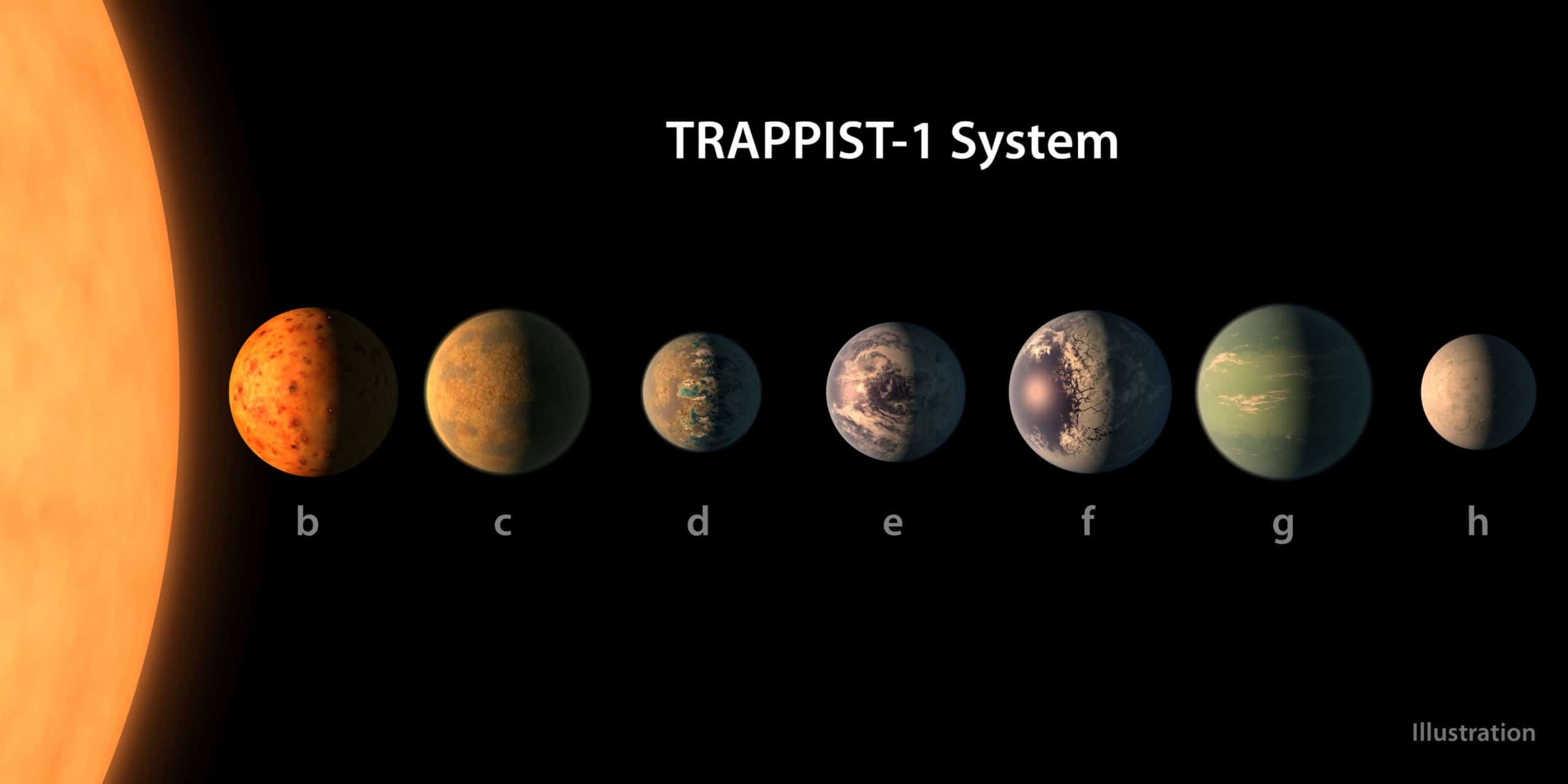
A further target is the TRAPPIST-1 system, which consists of seven terrestrial exoplanets orbiting a red dwarf star 40 light-years away. Astronomers are planning to use the JWST to scrutinize this system in several ways, including a general reconnaissance of all seven worlds and two sets of observations on its third planet, TRAPPIST-1c, which may be in the system’s so-called habitable zone, where conditions may allow water to exist as a liquid on or near the surface.
With many of these transiting, habitable-zone planets, the JWST will be looking for biomarkers – the absorption signatures of oxygen, water, carbon dioxide, ozone, methane and indeed anything else that could be produced by living creatures or indicate a potentially life-supporting environment. But the telescope’s exoplanet studies will go deeper, too. Using its infrared instruments, the JWST will peer into the dusty confines of star-forming nebulae and circumstellar discs around young stars, collecting data that should give scientists a better idea of how new planetary systems form.
The ten-billion-dollar gamble: How the JWST will see deep into the universe’s past
Given that planets beyond our solar system weren’t really on the menu when the first conceptual studies for the JWST were drawn up in the mid-1990s, it’s fair to say that the telescope’s mission has undergone a significant shift. “We did not even know there were exoplanets when we started work on Webb,” Mather notes. “People were just starting to make the first observations of them, so we asked, how can we use Webb to see them?”
Today, nearly one-third – 70 out of 286 – of the science proposals chosen for Cycle 1 of JWST operations are related to exoplanets. The telescope’s long delays have been a headache for astronomers and NASA administrators alike, but they have also changed its mission beyond recognition, making what was once a side-line into a priority for the largest telescope ever launched into space.
Materials and nanotechnology have long attracted some of the best physicists in academia and industry. This year saw some fascinating research done in this field, and in particular work that focused on natural materials and the environment. Here is a selection of some of our favourite materials and nanotechnology research in 2021.
Food spoilage is an important health and environmental issue and this year Tae Jung Park and colleagues at Chung-Ang University in South Korea have used quantum dots to reveal when fresh fish has begun to spoil. Their technique targets odourless histamine, which is produced when some types of fish go off and can trigger nasty allergic reactions in some people. The team’s detector comprises carbon quantum dots that are coated with chemicals that are removed if the dots come into contact with histamine from fish. This increases the optical fluorescence of the dots, causing them to light up when irradiated with ultraviolet light. The team is now adopting the technique for other chemicals related to spoilage as well as medical applications.
The world produces than 40 million tonnes of electronic waste each year, yet only about 20% of this e-waste is recycled. Improving on this is an environmental imperative as well as a commercial opportunity. This year, a team at Rice University in the US led by James Tour developed a “flash Joule heating” method to recover metals like rhodium, palladium gold and silver from e-waste. The technique was first used by the team to create graphene from waste food and plastic. It involves vaporizing metals a flash chamber by applying a brief (less than 1 s), intense pulse of electrical current to the waste, rapidly heating it to 3400 K. The metals are then captured from the vapour and further refined in an overall process that is described as quicker and cleaner than existing methods.
Today, physics is undergoing a second quantum revolution, with new technology allowing scientists to study ever more weird and wonderful systems. So perhaps it’s not surprising that physicists at Rutgers University in the US are claiming that quantum materials known as Mott insulators can “learn” to respond to external stimuli in a way that mimics animal behaviour. Subhasish Mandal and colleagues studied the Mott insulator nickel oxide. When they monitored how the material’s electrical conductivity changes as the concentration of its atomic defects is reversibly modulated using external stimuli such as oxygen, ozone and light, they found that it mimics non-associative learning seen in living creatures. Mandal says, “We find that nickel oxide insulators, which historically have been restricted to academic pursuits, might be interesting candidates to be tested in the future for brain-inspired computers and robotics.”

Some industries are harder to decarbonize that others, and aviation is proving to be a difficult one. While interest is growing in electric aeroplanes, much of the current environmental focus is on making fossil-fuel driven aircraft more energy efficient. This year, Sepehr Mosadegh and colleagues at the University of British Columbia Okanagan Campus and Zentek in Thunder Bay Ontario have shown that the addition of graphene oxide nanoparticles to liquid ethanol boosts the burning rate of the fuel by up to 8.4%. They say this improvement is the result of the increased atomization of the fuel – the creation of tiny droplets that burn very efficiently. The team says that aircraft engines that run on nanoparticle-doped fuels could emit lower amounts of carbon; while simultaneously becoming more powerful.
Wood is a fantastic material with a wide range of useful properties and applications. What is more, it locks in atmospheric carbon for its lifetime and can be produced in a sustainable way. However, there are some things that natural wood cannot do such as be moulded like metals and plastics. Shaoliang Xiao, Bing Hu and colleagues at the University of Maryland, have shown how useful components can be made by breaking down the molecular structures of wood cell walls, and then moulding the material into desirable shapes. The researchers shaped flat sheets of hardwood into versatile 3D structures: including a honeycomb composite material. This structure was about six times stronger than the original wood – giving it a similar tensile strength to aluminium alloys, but with a far lower density.

We are seeing a growing number new materials made by processing wood, and another one that caught our eye in 2021 was the use of a fungus to make wood much more piezoelectric – and therefore capable of generating useful amounts of electricity. Ingo Burgert, at ETH Zurich, and his colleagues infected balsa wood with the white rot fungus Ganoderma applanatum. After ten weeks they found that the wood could be compressed much more than uninfected wood, but would also return to its original shape. What is more, this compression generated a nearly 60-times higher voltage than untreated wood. Nine of the decayed-wood blocks connected in parallel were able to power an LED when compressed. Energy-generating floors could be one application, say the researchers.
Nature is clearly a great inspiration for materials scientists and shellfish such as mussels are no exception. These creatures fix themselves to surfaces such as rocks, ships and water-inlet pipes with a tenacity that puts superglue to shame. So, it is no surprise that researchers such as Tobias Priemel at McGill University in Canada are interested in how mussels mix chemicals together the create their glue. His team found that the mollusks use a network of microchannels to combine a liquid protein with metal ions to form sticky threads called byssus, which is the “beard” that some mollusks use to stick to things. Further research could point to ways of mimicking this process to create artificial byssus. Priemel and colleagues also want to find out why mussels rely on the rare metal vanadium to create the threads.

Physics World‘s Breakthrough of the Year coverage is supported by Bluefors, a leading supplier of cryogen-free dilution refrigerator measurement systems with a strong focus on the quantum computing and information community. Our aim is to deliver the most reliable and easy to operate systems on the market which are of the highest possible quality.
One of the James Webb Space Telescope’s (JWST’s) scientific tasks will be to revisit the so-called Hubble deep fields. These famous images are the product of the Hubble Space Telescope’s most penetrating gazes into our universe’s past, recording light emitted up to 13.2 billion years ago and redshifted by as much as a factor of 12 as the expansion of the universe carries these old, distant galaxies away from us. Thanks to its larger mirror (6.5 m in diameter compared to Hubble’s 2.4 m), the JWST will be able to see even further back in time, routinely imaging objects at redshift 15 and occasionally seeing some at redshifts between 25 and 30, according to senior project scientist John Mather.
Objects at these redshifts will appear as they existed up to 13.5 billion years ago, just 300 million years after the Big Bang. Any galaxies among them would be some of the very first to exist, which could make them hard to spot: the currently favoured model of galaxy formation involves smaller galaxies colliding and merging with each other to form larger ones, meaning that the earliest galaxies are predicted to be small and faint. Nevertheless, Mather is confident that imaging them is within the JWST’s reach. “They’re not expected to be common, they may be a little hard to find, and we may need some luck to find them, but we’ll certainly be looking,” he says.
Seeing the first galaxies is only one part of the equation. Astronomers also want to understand galaxies’ full life-cycle, from their formation all the way through to the present day. The JWST will have a role here, too, making observations of galaxies throughout time that will help build a more complete picture of how elliptical and spiral galaxies develop and how star formation spurs their physical and chemical evolution. The telescope will also explore the role of dark matter in bringing galaxies together, and the effects of feedback from active black holes in controlling star formation.
With so many topics to investigate, Mather says the hardest part for astronomers may be waiting for mission scientists to get to grips with the telescope’s quirks. “The Hubble deep fields will be hard to do better, because we know from Hubble that when you try to take lots of time exposures and average them together, things can go wrong,” he tells Physics World. “We have to learn what those things might be before we invest the amount of time in something so precious.”
Next: Why the JWST’s delays were a boon for exoplanet science
In keeping with our festive tradition, the December episode of Physics World Stories is all about physics books. Host Andrew Glester is joined by Physics World’s reviews and careers editor Laura Hiscott and the magazine’s editor-in-chief Matin Durrani to discuss a handpicked selection of popular-science books reviewed in 2021.
One of the year’s most memorable titles is Hawking Hawking: the Selling of a Scientific Celebrity by Charles Seife. Stephen Hawking’s status as an exceptional scientist and human being are beyond question. But Seife takes a warts-and-all look at the role self-publicity played in the British cosmologist’s public persona as the smartest scientist since Einstein.
Hawking Hawking is discussed in the first part of the podcast and there is a fun quiz for you to test your knowledge of Hawking’s life. In the second part, the Physics World journalists discuss these other books and the wider talking points that they raise:
Scientists get stuff wrong all the time. Mistakes are an essential part of the pursuit of knowledge, so the history of science tends to be kind – immortalizing its pioneers in the names of their most successful equations and theories – rather than emphasizing their failures.
But if a scientist is publicly involved in a pivotal debate, and if it later transpires that they were wrong, they might become an unlucky exception and end up being remembered for where they went awry. Whether or not the universe had a beginning is certainly a big enough debate, and Fred Hoyle, the physicist who coined the term “the Big Bang” but didn’t believe in it, is one such scientist.
Hoyle’s most vocal opponent in the argument was the Russian-Ukrainian-American physicist George Gamow. It is their lives and research that are the subject of the new joint biography Flashes of Creation: George Gamow, Fred Hoyle, and the Great Big Bang Debate by Paul Halpern, a physicist at the University of the Sciences in Philadelphia and author of 17 popular-science books.
After recounting how Edwin Hubble announced in 1929 that more distant galaxies are flying away from us more quickly – implying that the universe is expanding – Halpern describes how two schools of thought emerged. According to one side, the universe must have started off in an extremely compressed state that exploded a long time ago and continues to evolve. The other theory, known as the steady-state hypothesis, held that the cosmos had always looked roughly the same, with new matter being gradually created to maintain its density and structure as it grew in size.
While many scientists advocated for each side of the argument, Gamow and Hoyle became the public faces of it, appearing on radio shows and writing articles in popular magazines to voice their views. In the early 1950s each published a book, Hoyle’s called The Nature of the Universe and Gamow’s The Creation of the Universe, whose titles neatly summed up their differences.
Though Gamow and Hoyle might seem to have been in polar opposition, their research was beautifully complementary when it came to understanding how the different elements formed. Gamow co-developed a theory that they were created within the first few minutes of the universe’s beginning, while Hoyle, believing in no such beginning, thought the elements were fused together in stars. In fact, the correct answer was a combination of both their ideas.
Stellar fusion alone could not account for the huge abundance of helium in the universe, but Gamow’s ideas failed to explain the formation of elements heavier than the unstable isotope beryllium-8. In a flash of brilliance, Hoyle inferred that beryllium-8 and helium-4 could reliably fuse into carbon-12 inside red giant stars if carbon-12 had an energy level at 7.65 MeV – the sum of the two smaller nuclei’s own energies.
The existence of the 7.65 MeV level was soon confirmed by experimental physicist William Fowler and his colleagues, gifting us that fairy-tale fact that I remember learning in school: we are all, quite literally, stardust. Hoyle would continue to collaborate with Fowler, along with physicists Margaret and Geoffrey Burbridge, to elucidate the formation mechanisms of elements heavier than carbon inside stars.
But, as a joint biography, Flashes of Creation tells much more than just the scientific work of Gamow and Hoyle. I found the description of the scientists’ early lives fascinating, particularly as they are set against a backdrop of political turmoil in Europe. In one memorable story, Halpern tells how Gamow and his wife attempted to escape their increasingly autocratic Russian homeland in 1932 by travelling 170 miles across the Black Sea in a kayak.
Their plans were scuppered by a storm, but they later managed to get out when Soviet officials allowed them to attend the seventh Solvay Conference in Belgium in 1933. Niels Bohr, who was a friend of Gamow, had strategically arranged for the French physicist and known communist sympathizer Paul Langevin to extend the invitation. Gamow would never return to his home country.
The book also portrays the scientists’ personalities and senses of humour entertainingly. For example, after completing a paper with his student and long-term collaborator Ralph Alpher, Gamow listed a third author, the physicist Hans Bethe, “in absentia”. Bethe had not been involved, but Gamow wanted the author list to read “Alpher, Bethe, Gamow” in reference to the Greek alphabet.
Elsewhere, Halpern refers to Hoyle’s “dagger-sharp wit”, and describes his coining of the term “Big Bang” as a mocking name for a theory that he considered ridiculous. Hoyle first used it during a BBC radio programme in 1949 and it’s clearly a catchy name; in 1993 the astronomy magazine Sky and Telescope ran a competition to come up with an alternative, but out of 13,099 submissions they found nothing better.
There is some uncertainty around whether Hoyle said “Big Bang” disparagingly. In Eight Improbable Possibilities, a book published this year by veteran science writer John Gribbin, the author asserts in a footnote that Hoyle told him he just wanted a snappy expression to contrast with “Steady State”. Whatever his feelings about the theory, Hoyle had the utmost respect for its main proponent, with his son quoted in the book as saying “I never heard my father say a bad word about Gamow.”
It certainly seems like they disagreed amicably, though they met only a few times in person. I enjoyed Halpern’s recounting of their meeting in the summer of 1956, when Gamow was working in California and Hoyle was doing research at Caltech. While driving around in Gamow’s white Cadillac, the two physicists talked about what they each thought the temperature of space was, based on their preferred theories. If only all disagreements could be had in such good humour.
The debate was eventually settled after astronomers Arno Penzias and Robert Wilson observed an unexpected radio-wavelength hiss coming from all directions in space in 1964, and notified the experimental physicist Robert Dicke, who identified it as evidence of the Big Bang. But this wasn’t a perfectly jubilant triumph for Gamow. Halpern relates how Gamow was actually upset for some time, feeling that Dicke got too much credit for the discovery, while he and his collaborators didn’t get enough recognition for their earlier prediction that the Big Bang would leave this background radiation.
Later on, Hoyle also felt underappreciated, and was particularly hurt when he was overlooked for a Nobel prize. Fowler was awarded half the 1983 Nobel Prize for Physics for studies of the nuclear reactions that led to the formation of chemical elements – work that Hoyle had begun and continued in collaboration with Fowler and the Burbridges. Sadly, Hoyle’s son relates that “after 30 years of a very close friendship, he never had direct contact with Willy Fowler again”. This human side of science is a picture that the book paints beautifully and poignantly, ranging from friendship and camaraderie to clashes of personality and the desire for fair recognition.
It’s impossible to know the full story behind every discovery, so careers are often reduced to trivia
It’s understandable that scientists want to be acknowledged for their contributions, but it’s impossible to know the full story behind every discovery, so careers are often reduced to trivia. Perhaps the fact that the Big Bang was named by the person who most famously disputed it was simply too good not to become the most often-repeated anecdote about Hoyle. I must admit, until I read this book, that was pretty much all I knew of him. Of Gamow I knew even less. But as Halpern shows, there is much more to this story – and it’s a tale that’s well worth discovering.
Given the hype surrounding its scheduled launch on 25 December, you’d be forgiven for thinking the James Webb Space Telescope (JWST) is the only major astronomy facility due to come online in the 2020s. In fact, it is one of three: the Vera C Rubin Observatory will see first light in Chile in 2022, while the Nancy Grace Roman Space Telescope is currently scheduled to launch in 2027. Both facilities will be leaders in all-sky survey work, where the emphasis is on observing as many objects as possible across a wide swathe of sky. Such surveys are vital for collecting data on large numbers of objects; among other projects, they provide the statistics behind efforts to measure the strength of dark energy.
The current leader in this field is the Nicholas U Mayall four-metre telescope at Kitt Peak National Observatory, where the Dark Energy Spectroscopic Instrument (DESI) can make 5000 spectroscopic observations at once. That figure is well beyond the JWST’s capabilities, but the new space telescope will nevertheless do its fair share of astronomical surveying thanks to its Near Infrared Spectrograph (NIRSpec). This instrument can collect spectroscopic data on 100 objects at once, granting the JWST a capability that no other space telescope has ever had and giving astronomers a fresh eye for their surveys.
To make the JWST fit for survey work, its designers had to look beyond the technology already in use at DESI. In the past, making simultaneous observations was a laborious process, one that involved manually fixing optical fibres at holes punched in an aluminium plate. DESI avoids this thanks to robotic actuators that position the fibres anywhere across the instrument’s field of view and can be moved every 20 minutes, allowing a huge number of observations to take place in a single night. Unfortunately, this solution was deemed unworkable for a space-based observatory. “We looked at DESI’s robotic fibres when we were choosing what to do on [the JWST], and we were completely in awe of the robotic capabilities that it would take to do that in space,” senior project scientist John Mather tells Physics World.

With robotic actuators unable to operate reliably at the JWST’s cryogenic temperatures, and no human technicians available to change the position of its optical fibres manually, Mather and his colleagues needed a different solution. In fact, they needed a solution that didn’t involve optical fibres at all, since “there are no optical fibres that would cover the whole range of wavelengths that we want to cover”, Mather says.
The NIRSpec team’s answer is an ingenious one. The instrument’s focal plane is divided into four quadrants, each about the size of a postage stamp and filled with 62,000 microshutters. Each microshutter measures just 100 × 200 μm and is made from silicon nitride, which has a high tensile strength and is tough enough for the shutters to open and close many times without fatiguing. During each observation, the shutters that need to open will receive an electrical signal from a magnetic arm that sweeps over the quadrants. This system will allow the telescope to study the spectra of thousands of the most distant galaxies during its mission, learning about their chemistry, star-formation rates, redshift and more.
Next: How the JWST will see deep into the universe’s past
The late theoretical physicist Steven Weinberg once wrote an essay entitled “The trouble with quantum mechanics”. Published in the New York Review of Books in 2017, it lamented the fact that “physicists who are most comfortable with quantum mechanics do not agree with one another about what it all means”. Weinberg’s statement seems paradoxical. If physicists are so untroubled by quantum mechanics, why squabble over its significance?
Most other branches of physics do not experience this problem. Even where there is uncertainty, physicists assume that any mysteries – the fine details of, say, superconductivity – will be cleared up with more physics. But quantum mechanics is different. No amount of physics can dispel oddities like Schrödinger’s cat being neither dead nor alive before being observed, or single electrons creating interference patterns in the double-slit experiment.
Philosophers of science are pursuing at least three approaches to these puzzles
Philosophers of science are pursuing at least three approaches to these puzzles. The first investigates how (and why) quantum mechanics seems to contradict our assumptions and habits about what humans can know. The second examines the origins of quantum mechanics: how and why physicists had to build such a perverse theoretical structure in the first place. Finally, philosophers are looking at whether we should modify our assumptions about knowledge so we can agree on what it all means.
The first approach involves analysing the mismatch between quantum mechanics and our expectations of a physics theory. This tactic ignores the historical path that led physicists to develop quantum mechanics. Instead, it studies the logic of the formalism they produced and how it collides with that of classical mechanics. Can we, this approach asks, reconcile the two formalisms by gaining a better understanding of the terms and structure of quantum mechanics?
Unfortunately, we cannot reconcile them if we assume that a pre-formed reality exists “out there” independent of human thought. What’s more, preserving this notion of “realism” comes at a cost. As the Dartmouth College philosopher Peter J Lewis put it in his book Quantum Ontology: a Guide to the Metaphysics of Quantum Mechanics: “Any attempt to reproduce the predictions of quantum mechanics using physical properties will result in ascribing contradictory physical properties to the system”. The price of preserving realism is, in other words, contradiction or mystery.
By clearly distinguishing between two contexts – the discovery and the logic of quantum mechanics – this first approach pinpoints why we have so much trouble with its meaning. It also prepares us to appreciate the significance of the second approach, which combines those two contexts in examining why physicists a century ago found themselves forced to create a formalism whose meaning they still can’t agree on.
In The Structure of Scientific Revolutions, the philosopher and historian Thomas Kuhn drew a sharp distinction between “normal science”, which turns up results that fit snugly with the rest, and “revolutionary science”, in which the findings are puzzling and force us to change our “paradigm” before they fit in. The two paradigms are so discontinuous, Kuhn said, that scientists have to make a conceptual leap from one to the other. In fact, he treated the switch from classical to quantum mechanics as emblematic of this paradigm change.
But in her 1999 book Quantum Dialogue: the Making of a Revolution, the philosopher and historian Mara Beller detected something different in the papers, correspondence and reflections of the founders of quantum mechanics. They didn’t make conceptual leaps from classical to quantum mechanics, she found, but instead engaged in an “intricate flux” of dialogue. It was only through “openness, selective borrowing and communication”, Beller wrote, that they forged a collective conceptual shift. In fact, she viewed quantum mechanics as the most dramatic example of how this type of shift has happened in science.
Finally, the third philosophical tradition unearths a path that addresses the question of meaning more directly. In an essay in the 2020 book Phenomenological Approaches to Physics, the French philosopher Michel Bitbol argues that it is hopeless trying to mine “the elusive depths hidden behind phenomena” for a way to represent the quantum world. More promising, he finds, are approaches such as QBism.
QBism views the data obtained by measurements of quantum states as reflecting not real states of affairs that exist “out there” prior to measurement, but as “subjective” probabilities orienting the experimentalist’s thinking. QBism treats the Born rule, for instance – the probability that an experimentalist will measure a quantum system with a certain result – not as prescriptive but as a guide to their decision-making about what to expect.
What disturbed Steven Weinberg was that the breakdown of meaning was happening in his own part of physics, which is supposedly concerned with fundamental knowledge
This approach, which the physicist Chris Fuchs of the University of Massachusetts calls “participatory realism”, successfully dispels many of the traditional puzzles and paradoxes in the interpretation of quantum mechanics that make it so at odds with conventional expectations. It copes with the lack of realism, not by studying what we have to give up to keep it, or why we were forced into it, but by revising what it means to know the quantum world at all.
What disturbed Weinberg most was that the breakdown of meaning was happening in his own part of physics, which is supposedly concerned with fundamental knowledge. Philosophy, as a field, ought to be able to help, because it focuses on another kind of fundamental knowledge – on meaning, and on exploring and clarifying cases of its breakdown. But philosophers may be learning as much as physicists. As Bitbol has said, a precondition of finding quantum mechanics meaningful, is nothing less than a “revolution in our conception of knowledge”.
Bone fracture or loss, caused by trauma, surgery or disease, is a serious medical problem. After bone damage, the healing process depends largely on the severity of the fracture. Several approaches have been developed to accelerate bone repair, including both physical and biological methods. However, existing techniques come with limitations, such as the inability to fully restore the bone’s functionality with minimal scar formation. Bones can be re-combined, but achieving bone regeneration remains a complex task.
Scientists at Osaka City University (OCU) have therefore explored the properties of non-thermal atmospheric pressure plasma (NTAPP) to induce direct bone regeneration within damaged bones. Plasma, the fourth state of matter in which gas becomes ionized, is composed of electrons, ions, high-energy photons and neutral particles. Most artificial plasmas are generated using electrical energy.
Following on from its use in industrial applications, plasma is now also used in medicine and bioengineering, accelerated by the development of NTAPP sources. While typical plasmas have estimated temperatures of around 10,000 K, NTAPP can be generated at room temperature and atmospheric pressure. This can create unusual situations in which strongly reactive species exist near biological targets such as cells, tissue and bone. It is thought that low levels of these plasma-generated reactive species can stimulate cell proliferation, although above a threshold dose, they can cause cell death.
Principle investigator Jun-Seok Oh previously developed a helium microplasma jet that minimizes thermal damage to the biological target and maximizes generation of reactive species. Co-principal investigator Hiromitsu Toyoda suggested investigating the use of this plasma for bone regeneration in an animal model.
In their latest study, published in PLOS One, researchers at OCU’s Graduate School of Medicine and Graduate School of Engineering describe the configuration and assembly of this microplasma jet system. The device generates reactive oxygen and nitrogen species, including positive and negative ionic species in the glowing plasma jet, and excited neutrals in an invisible downstream gas flow, into which the biological tissue is placed.
Plasma has been used previously as a direct treatment for wound healing or to indirectly generate reactive oxygen species by provoking stem cell proliferation. However, orthopaedic surgeons have faced challenges deploying plasma as a single approach for treating bone fractures. As such, Toyoda and Oh consider NTAPP to be a new therapeutic method.
In this investigation, the team examined 10 female rabbits with an average weight of 3.5 kg. Following sedation and creation of a 10 mm critical bone defect in the animals’ ulnar shaft, the rabbits received a single session of plasma irradiation for 5, 10 or 15 minutes. X-ray images acquired at two-week intervals for eight weeks showed that the plasma-treated bone defects were healed.

Eight weeks after the plasma treatment, the researchers surgically removed and further analysed the animals’ ulnar bones to assess the potential of NTAPP for bone regeneration. Micro-CT images revealed that a single session of plasma treatment stimulated bone fusion in the injured bones without the need for an artificial bone support system. In another histological evaluation, the researchers discovered that ingrowth of new bone in the plasma-irradiated animals was improved compared with a non-irradiated control group. This further confirms that plasma treatment can create a near-perfect continuity with the neighbouring bones following injury.
The helium microplasma jet system deployed in this study delivers plasma discharge close to the injury. The authors suggest that plasma interaction near to the tissue surface could stimulate the generation of reactive oxygen species and may contribute to an increased biological effect during the bone regeneration process. However, the plasma dose and rate of discharge required to optimize fracture healing are unexplored, and it is currently unclear whether the dose-to-surface distance during treatment will affect the healing capacity of plasma irradiation in injured bones.
The researchers are now exploring the cellular and biological processes that occur after plasma irradiation, to lay the foundation for effective clinical translation in the future.