A new way to extract lithium from contaminated water could make this technologically important metal much easier to produce. The technique, which involves passing aqueous brines through lithium-selective polymeric membranes, works in a way that mimics the potassium channels that regulate the balance of ions in biological systems.
Lithium has several applications in low-carbon energy and is widely employed in electrochemical technologies. Lithium-ion batteries, for example, dominate today’s market for rechargeable power storage thanks to the element’s low mass, large reduction potential and high energy density.
As electric vehicles become more popular, industrial demand for lithium is set to increase still further. This creates challenges, because although lithium is an earth-abundant metal, extracting it from natural sources is not easy. Currently, it is sourced from deposits of a mineral called pegmatite and salt brines via solar evaporation – a costly and inefficient process that can take over a year.
Crown ethers
Researchers have previously explored ways of using polymer membranes to extract lithium from aqueous solutions. Conventional polymer membranes typically separate solutes based on differences in either the size or the charge of ions, but this is not specific enough to target lithium alone. Most such membranes allow sodium ions to permeate at a greater rate than lithium ones.
A team led by Benny Freeman of the University of Texas at Austin has now succeeded in reversing this behaviour by developing a novel polymer membrane containing crown ethers – chemically functionalized ligands that can bind certain ions. These ligands hinder the permeation of sodium but “ignore” lithium, meaning it passes through the membrane at a greater rate than sodium. Indeed, the team’s lithium transport measurements revealed that the material boasts an unprecedented reverse permeability selectivity, preferring lithium over sodium by a factor of roughly 2.3 – the highest selectivity ever documented for a dense, water-swollen polymer.
“Lithium is currently extracted from brines through the use of evaporation ponds, which is a slow and laborious process,” explains Freeman. “Using membranes such as ours that can extract lithium is advantageous because they are energy efficient, scalable and can have a much higher throughput than evaporation ponds.”
Solute specific selectivity
By tuning a polymer’s interactions, it is possible to make the material’s selectivity specific to the desired solute, he tells Physics World. “Such selectivity is observed in biological systems, such as potassium channels, which motivated the design of our material system.”
As well as lithium extraction, the researchers say the new membranes might also be useful for removing toxic solutes from water. Further ahead, the team plan to study the factors that affect the “host-guest” interaction between solutes and the polymer membranes at the molecular scale. “These studies will include looking into the polymer structure as well as identifying new ligands for making the membrane more selective to lithium,” Freeman says.
In this episode of the Physics World Weekly podcast, the Canadian Nobel laureate and laser physicist Donna Strickland talks about how winning the prize in 2018 was a life-changing event.
Sunday 24 October is the start of #BlackInPhysics week and Physics World is celebrating by publishing a series of essays from outstanding Black physicists on the theme of “burnout and how to avoid it”. The atomic, molecular and optical physicist Garrett Williams of the University of Illinois Urbana-Champaign joins us to talk about his experiences of burnout and what strategies he uses to mitigate its effects.
Also on the podcast is astrophysicist Zach Meisel of Ohio University, who shares his knowledge of the nuclear processes that power the Sun and other stars. He also previews future studies of stellar burning that will use the next generation of nuclear and astrophysical experiments.
There have been enormous improvements in radiation therapy over the last 20 years. MR-only workflows and the invention of MR-guided Linacs brought new perspectives.
This webinar, presented by Raphael Schmidt, addresses questions such as:
Are lasers important for the alignment of patients in RT?
What kind of different laser workflows are currently practised in RT?
We will also be giving you an overview of laser solutions from LAP for new and conventional treatment techniques.
Raphael Schmidt is responsible for the product management of laser systems for CT and MRI from LAP. During his studies at KIT (Karlsruhe Institute of Technology) he gained broad experience in different workflows in radiation therapy while analysing them. The topic of his final thesis dealt with the improvement of workflows in RT through to new information and assistance systems. Raphael holds a degree in industrial engineering and management.
Think big, recruit well, move fast: that’s the ambitious mantra informing the leading-edge research effort and undergraduate education programme within City University of Hong Kong’s Department of Physics. Although it only came into being in 2017, after the university chose to create distinct disciplinary specialisms from the former combined physics and materials science programme, the CityU Department of Physics demonstrates a unity of purpose and collective endeavour that suggest its ultimate goal – to create one of the leading academic centres for physics education and research in the Asia-Pacific region – is a realistic proposition over the medium term.
Progress has been swift – notwithstanding all the disruption and uncertainty caused by the COVID-19 pandemic over the past 18 months. In the latest Research Assessment Exercise, commissioned by the University Grants Council of Hong Kong, the CityU physics department fared well, with an independent international panel rating 38% of its research output as four-star (i.e. “world-leading”). Unsurprisingly, growth and recruitment are also hard-wired into the CityU physics roadmap, with significant scale-up planned across PhD, postdoc and junior faculty positions over the next five years – all of that underwritten by generous funding from CityU’s Global Scholar Recruitment Campaign to attract the brightest and best early-career physicists with a breadth of international experience.
The next generation
While that’s the research context, clearly the future of any academic physics endeavour lies in its undergraduate education programme – and CityU is no exception. “The BSc physics curriculum here provides a rigorous training in fundamental science and a solid foundation for students seeking a pathway to a long-term research career,” explains Wing Chi Yu, an assistant professor specializing in theoretical condensed matter physics and deputy leader of CityU’s undergraduate physics programme. Equally, for students intent on following an industry pathway, there’s a wide selection of elective course modules covering specialist applied topics such as financial engineering, medical physics, optics and photonics, and materials science.
Another notable feature of CityU’s BSc physics programme is the level of one-to-one support afforded to each undergraduate. “Every student has their own academic adviser to help them plan their career,” Yu explains. “In addition, they have a direct line into what we call a senior peer consultant, a student further along in the undergraduate programme.” The relative youth of CityU’s physics faculty is also significant, with around a third of the academic staff under 40 and many of them having gained experience at leading European and North American institutions. “CityU’s research and teaching culture ensures an open and collective conversation between lecturers and undergraduates,” adds Yu.
Top of the class
More broadly, the CityU Talents Programme provides an operational framework to enable outstanding undergraduate physics students to realize their full academic potential. The joint bachelor’s degree programme between CityU and Columbia University (New York) is a case in point, with successful applicants spending their third and fourth years at Columbia University to earn a BSc degree from CityU and a BA degree from Columbia.
Wing Chi Yu: deputy leader of CityU’s undergraduate physics programme. (Courtesy: CityU Hong Kong)
“This is a highly competitive programme that typically enrols two or three elite-performing students annually from our second-year undergraduate cohort,” explains Yu. “It’s a fantastic opportunity,” she adds, “combining the academic rigour of two world-renowned universities with the social and cultural traditions that play such a big part in a student’s intellectual formation.”
Another CityU Talents initiative is the undergraduate plus taught postgraduate degree programme (BSc physics + MSc applied physics), which aims to nurture high-calibre undergraduate students through integrated learning, such that they can benefit from research elements normally taught exclusively at postgraduate level. Upon successful completion of the course requirements – typically over four or five years – students receive two separate degrees (BSc and MSc), positioning them on a fast-track to further study at PhD level.
For elite-level students more interested in the commercial exploitation of scientific discoveries and physics-based innovations, there’s the option of applying to study physics within the Global Research Enrichment and Technopreneurship (GREAT) initiative. The four-year GREAT degree comprises specialist courses on entrepreneurship, intellectual property rights, patent applications and high-impact research proposals and business plans. Students also benefit from at least one semester of overseas exchange (course modules and research) alongside opportunities for independent research commencing as early as year two of the degree programme.
The right connections
One of the defining features of CityU’s BSc physics programme is its emphasis on external connection and collaboration. Undergraduate students, for their part, are encouraged to enrich their learning experience through exchange studies (usually one or two semesters) at CityU’s partner institutions – among them the University of Illinois at Urbana-Champaign (US), University College London (UK) and National Taiwan University. “Upon completion of the relevant courses at the host university,” Yu explains, “students participating in all levels of the exchange programme can apply to transfer their earned course credits to their CityU BSc degree.”
Closer to home, CityU offers physics students further development opportunities through the Undergraduate Research Attachment Scheme, which allows young scientists to join a faculty member’s research team on a project basis to participate in day-to-day laboratory work. At the same time, students can access work-placement opportunities through a range of CityU internship schemes, providing full-time job attachments at companies in Hong Kong, the Pearl River Delta region and further afield. Similar research internships are available at the China Spallation Neutron Source in nearby Dongguan, while final-year research attachments are often provided via the medical physics departments of prominent Hong Kong hospitals.
Internally as well, there are opportunities for undergraduates to broaden their skill base. The PHY Student Ambassador Enrichment Programme, for example, aims to recruit passionate students to co-host the department’s learning support network. The priority is to provide mentoring and peer consultancy to first-year undergraduates as they adjust to life at CityU and make their elective course selections. “Furthermore, the PHY ambassador programme give students an opportunity to develop their leadership, presentation and interpersonal skills to support CityU physics outreach activities,” says Yu. “By working with other ambassadors, they become solid team players along the way – skills that will come in handy for their future job-hunting and academic interviews.”
Fundamentally, though, CityU physics is all about bringing together a diverse mix of undergraduate students, creating the conditions for their collective curiosity, energy and talent to flourish and forge a deeper understanding of how nature works. “The physics programme trains students’ logical thinking and problem-solving skills,” Yu concludes. “That training and scientific rigour will benefit our students over the long term, whether they stay in academic research or move on to a career in industry and business.”
Further information
To find out more about CityU’s undergraduate physics programme, register now for the CityU Virtual Information Day: Talents Beyond Boundary on Saturday 23rd October 2021. Details of CityU entrance scholarships and funding opportunities for international students can be found here.
Scientists and engineers have for many years relied on atomic force microscopy (AFM) to reveal the secrets of materials at the nanoscale. This powerful and versatile technique, first invented by scientists at IBM and Stanford University in 1985, offers a 3D view of the sample’s surface with sub-nanometre resolution, while different measurement modalities allow researchers to map material phenomena that include frictional, nanomechanical, electrical, magnetic and thermal properties. AFM can also image any type of material in ambient conditions as well as under vacuum and in liquid, which has made the technique a vital tool in all areas of science and technology.
Customer focus Ryan Yoo, executive vice-president of business development and strategic growth at Park Systems, wants to bring the benefits of automation to users. (Courtesy: Park Systems)
The problem is that time, patience and skill are needed to extract reliable and reproducible data from such a high-precision instrument. “Compared with other microscopy techniques, wide-scale acceptance of AFM is still hampered by complex operation and handling,” says Ryan Yoo, executive vice-president of business development and strategic growth at Park Systems, one of the world’s leading manufacturers of AFMs. “More robust and easier operation will allow more users to adopt AFM for their daily measurement needs.”
An AFM works by scanning a cantilever with a very sharp tip across the surface, with an optical system then used to monitor small deflections of the cantilever caused by surface forces. Before collecting any data the user must first fit the correct tip, often using tweezers, and then manually position it close enough to the sample for the cantilever to interact with the surface. The optical detection system and viewing optics must also be aligned correctly, while a number of different imaging parameters must be chosen or tuned before scanning can start.
Speedy imaging
Park Systems is well aware of these complications, and in recent years has sought to make its AFMs easier to use with features such as pre-mounted tips and a point-and-click software interface. But the company’s latest instrument, the Park FX40, represents a paradigm shift. It integrates robotics and machine learning throughout the design to produce the first research-grade AFM that fully automates the imaging process. “The Park FX40 takes care of all the set-up before and during scanning,” says Yoo. “All the tedious and time-consuming manual processes are now a thing of the past. The Park FX40 performs them all autonomously.”
The Park FX40 takes care of all the set-up before and during scanning. All the tedious and time-consuming manual processes are now a thing of the past
Ryan Yoo, executive vice-president of business development and strategic growth at Park Systems
For a start, the Park FX40 uses a robotic system to automatically change and replace its own tips. Up to eight different cantilevers can be loaded onto a cassette, each one marked with a QR code to enable easy identification, and then a magnetic mechanism attaches the selected tip to the AFM head. Beam alignment is also automated, with an optical system used to locate the tip and ensure that the laser beam reflects off the cantilever onto the optical detector. “Tip exchange can be very frustrating for people who are unfamiliar with AFMs, and the beam alignment procedure can be very tiresome,” says David Faddis, the company’s technical manager for the Americas. “Automating these processes really improves the ease of use.”
The Park FX40 also features a unique dual-camera design that makes it much simpler to locate a region of interest. The first camera offers a view of the whole sample stage, which can accommodate up to four samples at a time, to allow the user to quickly find and select the target location. The stage then automatically moves to the chosen position, at which point the system switches to a high-resolution camera for a closer view that allows any final adjustments to be made.
Automatic for the people The Park FX40’s automatic tip exchange showing (a) the slots with cantilevers; (b) the QR code that allows the system to recognize the selected probe and automatically upload the cantilevers profile; and (c) the probe cassettes, which can easily be removed and exchanged. (Courtesy: Park Systems)
Once in the correct location, the system automatically brings the probe close enough to the sample’s surface for measurements to be taken. The tip is first guided to within a few microns of the sample using an optical system, and then mechanical oscillations induced in the cantilever can be measured and input into a feedback mechanism that fine tunes the approach to the sample’s surface.
This feedback mechanism also allows the instrument to automatically adapt to the type of surface being scanned. “The system does a couple of global overview scans to get an idea of the topography, and from that sets up the initial feedback parameters,” explains Faddis. “During scanning the system looks ahead to the next line of the scan, and adjusts the feedback parameters to accommodate any rapid changes in topography. This also enables faster scanning, since the system can slow down to image rougher features, but can then speed up when it knows that the next line is flat.”
The result of all these innovations is that users no longer need to handle or understand the inner workings of the AFM to obtain high-quality measurements – and that’s a real benefit for researchers who typically need to acquire experimental data from several different instruments. “It’s great for large shared-user facilities, whether in industry or academia,” Faddis adds “It’s about focusing on the research, and not spending an excessive amount of time learning how to operate the system.”
Automating the manual processes will also enable scientists to measure more samples more quickly, which is a crucial advantage when many scientific advances depend on the speed and efficiency of experimentation. “The breakthroughs in automation of AFMs using artificial intelligence and robotics technology will dramatically boost our productivity and drive innovation across the field of nanometrology,” says James Hone, a professor at Columbia University and the first user in North America to have hands-on experience with the Park FX40.
Industrial focus
Although the Park FX40 is a major advance for research users of AFMs, it builds on Park Systems’ prior experience of building highly automated systems for industrial applications, such as semiconductor manufacturing. These high-end systems for the factory floor have been designed from the outset to enable first-time users to extract the same quality of data as more experienced personnel, and already include features such as automatic tip exchange and beam alignment.
Such large-scale industrial systems were also the main driver for developing the SmartScan operating software, now included with all of Park Systems’ AFMs, that allows the instrument to be controlled through a simple point-and-click interface. “For these industrial systems we designed as many ease-of-use features as we could,” says Faddis. “We have now brought the same level of automation to our research systems.”
Technical benefits The Park FX40’s optical cantilever alignment and laser beam detection showing (a) the superluminescent diode beam path; (b) how machine learning is used to centre the cantilever; and (c) how centring the cantilever automatically aligns the beam-bounce system. (Courtesy: Park Systems)
Meanwhile, the optomechanical design of the Park FX40 has also been updated to boost the data quality and the precision of measurements. Here again, Park Systems engineers have benefitted from the experience gained from earlier designs, in this case a fast and accurate non-contact mode that has been achieved by decoupling the horizontal and vertical scanners. “That decoupled technology has been the hallmark design for all our AFMs,” says Faddis. “It gives you very precise measurements with no out-of-plane background motion, while the non-contact mode means that a single tip can be used for hundreds of scans with no loss of resolution.”
Faddis explains that more recent models, including the Park FX40 and the previous NX series, have more effectively integrated this non-contact mode into the instrument design. Mechanical noise has also been reduced to enable more accurate measurements to be made on larger samples, with the Park FX40 reducing the raw out-of-plane motion without image correction to less than 2 nm over a scan range of 80 μm. “The FX40 is the culmination of all the work we’ve done to optimize non-contact mode in the past,” he says.
Park Systems believes that combining such high precision with much simpler operation will widen the appeal of AFMs to more users working with different materials and in more diverse applications. “More than a business strategy, automation is a fundamental advance that will grow the AFM industry itself,” says Yoo. “Such innovation may finally push the boundary and enable AFM to capture opportunities that are currently dominated by established microscopy industries such as electron or optical techniques.”
It might sound impossible to explain something as complex as the mechanisms of climate change both simply and accurately. But this is exactly what David Nelles and Christian Serrer – students at the University of Friedrichshafen, Germany – have achieved with their book Small Gases, Big Effect: This is Climate Change.
Approved by more than 100 scientists, Small Gases, Big Effect starts with a breakdown of the components of the Earth’s climate, before detailing the many interconnected factors that can influence it. The book then lays out evidence on how climate change is affecting different regions of the globe and their ecosystems; the positive and negative feedback loops that come into play; and ultimately the impacts on humans, both direct and indirect.
Fitting with its aims of concisely presenting the “nuts and bolts of climate change”, the book is written very matter-of-factly, in short, easily digestible chunks that don’t tire the reader’s attention. Every double-page spread features a graphic, either illustrating a concept to help you properly grasp it or showing the data on various impacts that global warming has had.
While the book acknowledges that the people worst affected by climate change are generally those who have contributed the least to the problem, it includes many examples of effects already being observed in European countries.
For instance, one graphic shows that some animal and plant species in Switzerland have migrated to higher altitudes in the mountains in recent years, while another highlights the increasing spread of tiger mosquitoes – which can transmit the Dengue virus – into European countries between 2000 and 2017. For readers in Europe, it’s a timely reminder that climate chaos is not a distant problem but something that will also manifest close to home.
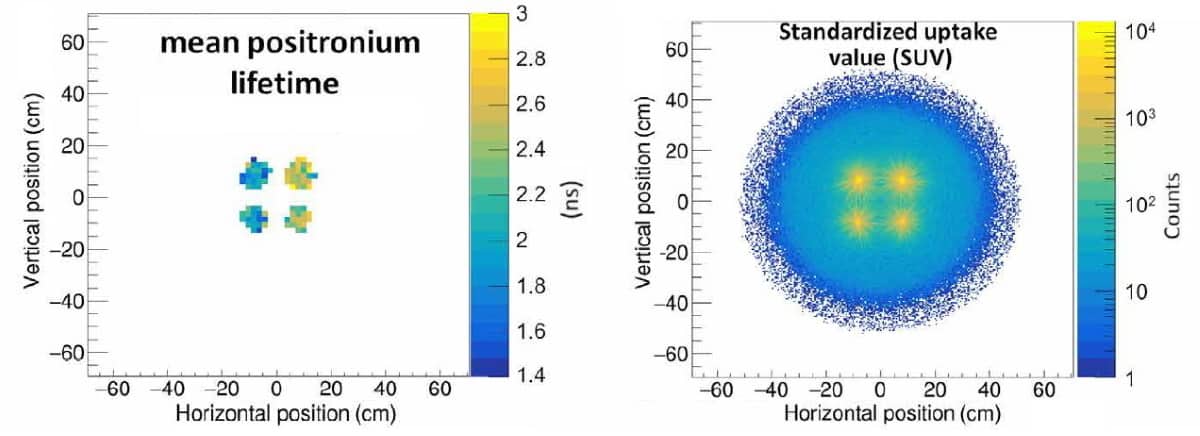
Simultaneous scans: Positronium lifetime image (left) and standardized uptake value image (right) of a phantom containing tumour and adipose tissue samples, recorded using the Jagiellonian-PET scanner. The positronium image reveals differences between cancerous and healthy tissues. (Courtesy: CC BY 4.0/Kamil Dulski, Jagiellonian University)
Positron emission tomography (PET) is a molecular imaging method used for cancer diagnosis. During the imaging procedure, positronium is also generated in the patient’s body, but current PET systems are not able to acquire positronium images. Now, researchers in Poland have created the first-ever positronium image recorded during a PET scan, reporting their results in Science Advances.
“Our goal in introducing positronium imaging is to increase the specificity of cancer diagnosis such that one can determine the degree of cancer malignancy in vivo without the need for surgical biopsy,” explains co-first author and inventor of the positronium imaging Paweł Moskal from Jagiellonian University.
“We believe that the positronium image will enable better distinction between the healthy, cancer and inflammatory tissues and that it will enable us to determine the degree of a tumour’s malignancy,” adds Ewa Stępień, the head of medical research in the group.
During PET scanning, positrons emitted from an injected radionuclide annihilate with electrons in the patient’s tissue and release a characteristic pair of 511 keV photons. This positron–electron annihilation may proceed directly or, in almost 40% of cases, via the formation of an intermediate positron–electron bound state, known as positronium.
Three quarters of the positronium formed is ortho-positronium (o-Ps), which decays (in vacuum) into three photons after a mean lifetime of 142 ns. In tissue, this lifetime is significantly shorter (roughly 1.8 to 4 ns) due to processes such as annihilation of an o-Ps positron with an electron from a surrounding molecule (pickoff) or interaction with oxygen or other biomolecules converting the o-Ps to para-positronium.
These pickoff and conversion processes make the mean o-Ps lifetime highly sensitive to the size of inter- and intramolecular voids and the concentration of biomolecules within them. As such, measurements of positronium lifetime may reveal tissue alterations at the molecular level, providing important information about early-stage disease progression.
Triple coincidence
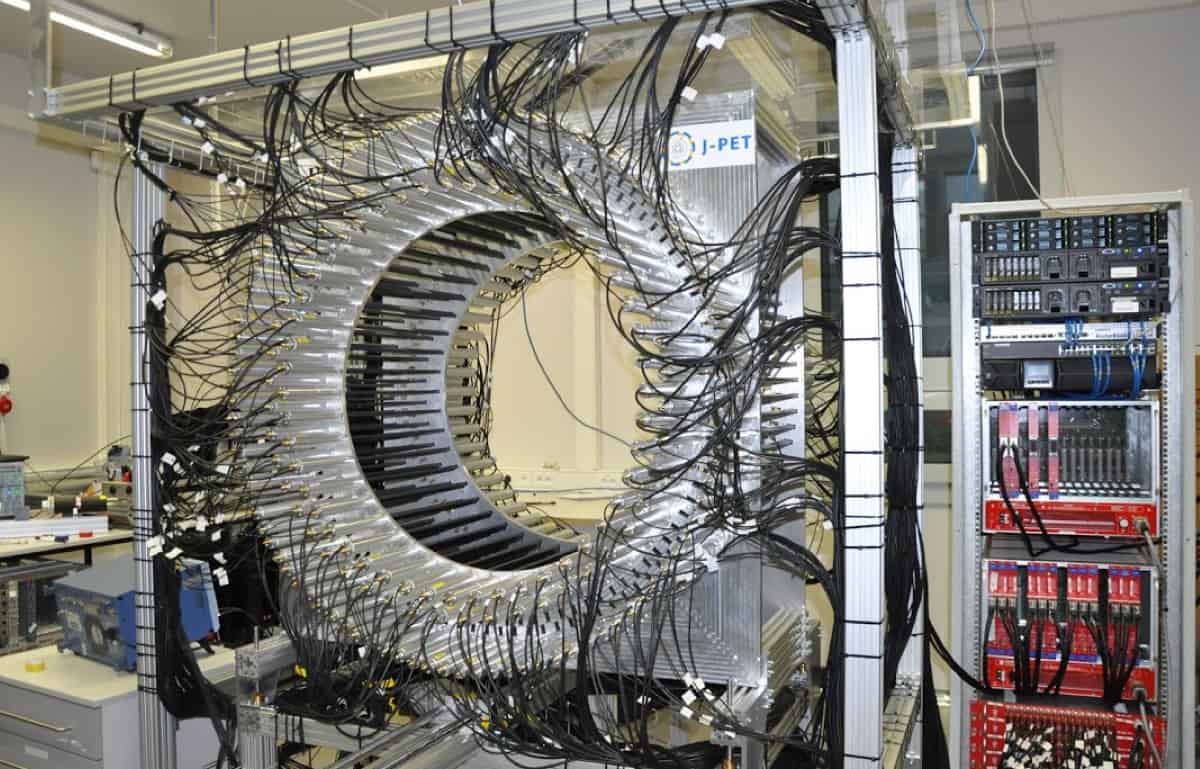
Moskal and colleagues have developed a method for positronium lifetime imaging using the Jagiellonian-PET (J-PET) scanner. The J-PET scanner incorporates 192 plastic scintillator strips arranged in concentric layers and read out by photomultipliers connected at both ends. To create a positronium image, the system examines triple coincidence events corresponding to the registration of two annihilation photons and one prompt gamma photon.
“PET scanners are usually designed to register two photons from the positron–electron annihilation,” explains co-first author Kamil Dulski. “The J-PET system is designed for simultaneous registration of both the photons from the annihilation process and photons emitted by the radionuclide.”
Full-scale prototype: The Jagiellonian-PET detector is made of three cylindrical layers of plastic scintillator strips (black) and vacuum tube photomultipliers (grey). (Courtesy: Kamil Dulski, Jagiellonian University)
To test the new imaging technique, the researchers created a phantom comprising samples of tumour and adipose tissue excised from two patients. Each of the four samples was inserted into a holder along with a radioactive 22Na source, and inserted into the J-PET tomographic chamber. The 22Na acts as the source of positrons for the experiment, and also emits a 1.27 MeV prompt gamma ray with each decay.
The team used the interaction times and positions of the annihilation photons in the scintillator strips to reconstruct the annihilation rate distribution, which is an analogue of the standardized uptake value (SUV) in a conventional PET image. In this set-up, this SUV image reflects the geometrical configuration of the tissue samples and the activity of the 22Na sources.
Next, the researchers reconstructed the prompt gamma emission times, which are near-equivalent to the times of positron emission and positronium formation. For every voxel of the SUV image, they determined the difference between the annihilation time and the time of positron emission. They then used these time difference distributions to determine the mean o-Ps lifetime on a voxel-by-voxel basis, thereby creating a positronium mean lifetime image.
“Reconstruction of the positronium image required development of novel data analysis and image reconstruction methods that enable simultaneous reconstruction of a standard PET metabolic image and the positronium image,” notes Dulski.
The researchers observed visible and significant differences between the o-Ps lifetime in cancerous and healthy tissues, with mean lifetimes of approximately 1.9 ns in the tumour samples and 2.6 ns in the adipose tissues. This finding suggests that images of positronium mean lifetimes could indeed provide a means for in vivo cancer classification and serve as a virtual biopsy, says Stępień.
The next step of the project, says Moskal, will be to construct a high-sensitivity total-body J-PET scanner and perform positronium imaging in vivo. “The J-PET tomography system based on low-cost plastic scintillators enables about five-fold cost reduction [over crystal-based technology] when building a total-body PET scanner,” he tells Physics World. “J-PET technology constitutes a realistic, cost-effective total-body PET solution for broad clinical applications.”
In this episode of the Physics World Stories podcast astronomers discuss the search for signs of extraterrestrial technologies. Fingerprints might include traces of pollution in exoplanet atmospheres, lights on the night sides of planets, and even the waste heat from megastructures such as Dyson spheres.
Podcast host Andrew Glester meets the following guests:
Jacob Haqq Misra, senior research investigator at Blue Marble Space Institute of Science;
Thomas Beatty, an astronomer at the University of Arizona who is also part of the team for the NIRCam instrument on James Web Space Telescope – scheduled to launch in December;
Amedeo Balbi, an asrophysicist at the Tor Vergata University of Rome.
Find out more by reading ‘Scanning the cosmos for signs of technology,’ a feature article by science writer David Appell, originally published in the December issue of Physics World.
In 1802 the young German mathematician Carl Friedrich Gauss suggested a way to make our presence known to would-be Martians – by clearing a huge area in the Siberian forest, planting it with wheat, and creating a pattern indicative of the Pythagorean theorem. Some 80 years later, astronomer Percival Lowell – founder of the Lowell Observatory at Flagstaff, Arizona, and proponent of the idea that astronomers had spotted canals on Mars – suggested digging our own canals in the Sahara desert. His plan was to fill the canals with oil and set them alight, thereby attracting the attention of residents of the red planet.
Astronomers have been drawing up plans for the technosignatures that might be viewable with the next generation of space telescopes
While neither idea was ever implemented, both were examples of a “technosignature” or a “technomarker” – a tell-tale indication of past or present technological activity, pointing out the existence of an advanced planetary civilization. Such searches might sound like science fiction, but over the last couple of years, astronomers have been drawing up plans for the technosignatures that might be viewable with the next generation of space telescopes, such as the James Webb Space Telescope (JWST), due to be launched in December.
Searching the skies
For about 60 years now, radio astronomers have trained their increasingly sophisticated telescopes at the sky, looking for signals that might have come from extraterrestrial intelligence. While no definitive technosignature has been captured to date, we have picked up a few intriguing signals over the years. These include the famous 72-second-long “WOW!” signal, detected on 15 August 1977 by Ohio State University’s Big Ear radio telescope. There was also the Breakthrough Listen Candidate 1 (BLC1) radio signal observed in April and May 2019 by the privately funded Breakthrough Listen project at the Berkeley Search for Extraterrestrial Intelligence (SETI) Research Center at the University of California. While the WOW! signal bore many of the expected hallmarks of extraterrestrial origin, it was never detected again. BLC1, which came from the direction of our next closest star Proxima Centauri, is still being analysed.
Another huge upheaval for the field in recent decades has been the exoplanet revolution. Since the discovery of the first two exoplanets in 1992, astronomers have made breathtaking use of the Kepler Space Telescope and others to discover more than 4400 confirmed exoplanets around distant stars, with about as many candidates awaiting closer study. Exoplanets come in many sizes and types, from terrestrial rocky worlds to super-Earths, Neptune-like exoplanets, hot Jupiters and more (see “Planets galore” April 2014). On average each star has one planet, but many host a family similar to our solar system.
With the discovery of all these exoplanets, astrobiologists have been studying “biosignatures”. Analogous to technosignatures, these are the signs of life on alien worlds, intelligent or otherwise. They do this by analysing the electromagnetic absorption spectra of an exoplanet’s atmosphere as it transits its sun, seeking the presence of gases such as oxygen, methane, water vapour and ozone (a proxy for oxygen). The atmospheres of a few Jupiter-sized exoplanets have already been scoured in this way, and the JWST should allow similar searches for smaller, Earth-like exoplanets.
As the science of biosignatures progressed, astronomers realized that similar searches in various wavebands could be carried out for technosignatures too. These don’t have to be dedicated searches; they could piggyback on the same data used to search for biosignatures – so-called commensal observing – or even exploit archived astronomical data going back decades. “Data is king in this part of science,” says planetary scientist Ravi Kopparapu at NASA’s Goddard Space Flight Center. NASA and the National Science Foundation in the US have for the first time funded at least three projects in the technosignature field, and issued two grants, for a workshop and a symposium.
Who’s out there, and how do we spot it?
As we hunt for signs of intelligent life, is anybody really out there? Today, we know that 22% of Sun-like stars harbour an Earth-size planet in their “habitable zone”, where the surface temperature allows for liquid water to exist. With 100 to 400 billion stars in the Milky Way alone, there are tens of billions of planets where life may have developed and evolved.
But can we see them? Assuming that any detectable technosignature must be within the bounds of our past “light cone” (the path that light from any single event would take through space–time), theoretical astrophysicist and astrobiologist Amedeo Balbi of the University of Rome Tor Vergata in Italy has derived some simple but strong conclusions. To be able to pick up a signal, a civilization must have been established in our past, and the light from it had time to travel to us. So long as there is no preferred epoch for the appearance of exo-civilizations over the history of our galaxy (i.e. they appear uniformly over the history of the galaxy), Balbi reasons that a key factor in detecting a signal from such a civilization is that the technosignature must be as long-lived as possible – preferably on the scale of 100 million to a billion years (AJ161 222).
Bright lights, big alien city One visible sign of humanity’s presence on Earth is city lights. We can look for similar artificial light signatures on the night side of exoplanets. (Courtesy: Joshua Stevens, NASA Earth Observatory/Miguel Román, NASA GSFC)
“We shouldn’t think in terms of civilization or species longevity,” said Balbi at TechnoClimes 2020, a NASA-sponsored online workshop, “but in terms of technosignature persistence.” As for an observing strategy, it’s better to focus the search on a few long-lived technosignatures than on lots of short-lived technosignatures, he says.
Over the years, there have been many suggestions about the kind of technosignatures we might see from Earth. A brief list includes nightside city lights; atmospheric industrial pollution; solar-energy collectors like silicon-based photovoltaic arrays that would leave an imprint on a planet’s reflected light. We may spot artificial surface constituents; dense orbiting satellite constellations; waste heat from megastructures such as Dyson spheres; and even odd or fading objects observed as they transit their star. Another extreme possibility is “stellar engineering”, where an advanced civilization may go as far as to alter the appearance of stars and other celestial objects in otherwise inexplicable ways.
Other indicators include electromagnetic beacons such as radio-waves or laser pulses; or even a space probe sent out by an advanced civilization, making its way to our solar system. We’ve already done this ourselves, with the Pioneer 10 and 11 and Voyager 1 and 2 space craft, which are currently in interstellar space. This so-called artefact SETI is a legitimate part of the technosignature field, despite being abused by ridiculous claims, such as that a face on Mars had been spotted when it was in fact just a rock.
Another possibility is that there could be artificial objects in our solar system or outside it, in the Kuiper Belt or Oort Cloud, that we might recognize by the way they reflect light. While sunlight reflected from a natural, moving object would fade as 1/r4, where r is the object’s longitudinal distance from us; a moving, artificially illuminated source would fade only as 1/r2, a detectable difference.
A technological civilization could well produce artificial lighting, and the aliens may live in dense settings that approximate our urban areas. One intriguing technosignature that’s been suggested is to look for city lights on the nightside of a planet as it passes alongside its star, using a coronagraph to block out the star’s image. To work out if such lights could be detected, astronomer Thomas Beatty at Steward Observatory at the University of Arizona, investigated the possibility using direct imaging of Earth-like commercially available high-power lights on generic Earth-like exoplanets around stars in our galactic neighbourhood (arXiv:2105.09990). We know of about a dozen potentially habitable terrestrial planets orbiting stars within 10 parsecs of the Sun.
Noting that only 0.05 % of the Earth can be considered “heavily” urbanized (with peak night-time illumination of cities such as New York or Tokyo), Beatty calculates that planets around nearby M-dwarf (red dwarf) stars (which are cooler, and therefore dimmer, than the Sun) could be detected by two space-based telescopes that could be funded, as NASA gears up to publish its Decadal Survey in Astronomy and Astrophysics (Astro2020). These are the Large Ultraviolet Optical Infrared Surveyor (LUVOIR) observatory and the Habitable Exoplanet Imaging Mission (HabEx) telescope, which includes a coronagraph and starshade occulter spacecraft to directly image Earth-like planets.
Exoplanetary investigator The Large UV/Optical/IR Surveyor (LUVOIR) is a multi-wavelength space observatory proposed by NASA that could be ideally placed to spot technosignatures. It is one of the projects under consideration in NASA’s Astro2020 decadal survey. (Courtesy: NASA)
Beatty found that by using coronagraphs, the lights could be detected using 100 hours of observing time, with urbanizations levels of 0.4% (eight times Earth’s) to 3% of the planetary surface. Planets around Sun-like stars would be detectable with urbanization levels of 10% or higher (since their brighter star makes detection more difficult). Beatty also considers the idea of an “ecumenopolis”, a planet-wide city. Assuming a typical cloud cover for Earth, and that most light seen from space is reflected off concrete and roads, he found that such a planet would be detectable around roughly 50 nearby stars, by both potential telescopes.
Possible signal?
In 2015 citizen scientists from the Planet Hunter project noticed odd fluctuations in the light curve from an F-type main-sequence star, some 450 parsecs from Earth. It drew the attention of professional astronomers, including Tabetha Boyajian of Yale University, who detected an irregular dimming of the star’s brightness of up to 22%. These unexpected observations of “Tabby’s star”, as it is now known, led to conjectures of everything from a planetary debris field, to an extraterrestrial megastructure, to freed exomoons, before finally concluding the most likely cause was space dust.
Despite the ultimately mundane explanation, the incident motivated Ann Marie Cody, an astronomer from NASA’s Ames Research Center, to survey data from the Transiting Exoplanet Survey Satellite (TESS), which has been monitoring the brightness of tens of millions of stars on 30-minute timescales since 2018. Cody is currently working to automate searches through TESS light curves for rare events such as substantial fading or brightening.
By using more than 100 different statistical measures, she hopes to differentiate between ordinary anomalies – such as eclipsing binary-star systems – and rarities including occulting materials around the star, solar panels, orbiting megastructures that are harvesting energy, or other unknown technosignatures. Such anomalies will ultimately be referred to ground-based telescopes for more dedicated searches, including radio SETI searches.
Picking up pollution
Another technosignature could be the pollution that aliens in the early stages of technological development are pumping into the atmosphere of the planets they inhabit. Indeed, atmospheric chemical pollutants could be identified in the same way as biosignatures like oxygen and methane – by looking at the spectral data.
In 2014 astronomer Henry Lin and colleagues from Harvard identified certain chemical pollutants – such as chlorofluorocarbons – in the Earth’s atmosphere that have significant absorption features in the spectral range covered by the JWST. They found that these chemicals could be detected by the telescope, in the atmospheres of transiting Earth-like planets around white dwarfs, over roughly a day and a half of observing time, if these compounds are present at 10 times the current Earth level (ApJL792 L7).
Another suggested technosignature pollutant is nitrogen dioxide, NO2, which is found here on Earth as a byproduct of combustion from vehicles and fossil-fuelled power plants. In a study published this year (ApJ908 164), Kopparapu and colleagues examined whether NO2 could be detected in the atmospheres of exoplanets within 10 parsecs. If the planet was cloud-free, Earth-like NO2 levels – which can reach 5 parts per billion in urban areas – could be detected in the infrared with about 400 hours of observing time using the proposed LUVOIR telescope. Some 40 years ago, NO2 levels in the US were about three times higher than today, so a nascent alien industrial civilization might be detectable with less viewing time.
Spectral templates will come from running climate models that depend on a planet’s features, its host star and the viewing instrument
Characterizing the signatures of NO2 and chlorofluorocarbons is half of the first NASA non-radio technosignature grant ever awarded, in June 2020, to Adam Frank of the University of Rochester in New York. Called Characterizing Atmospheric Technosignatures (CATS), the $287,000 grant is being used to build an online library of spectral lines. Frank is looking at what kind of signature a planet’s technology might leave in its spectra. The spectral templates will come from running climate models that depend on a planet’s features, its host star and the viewing instrument, all of which can be compared with what astronomers actually observe.
The second half of the CATS project is to build similar templates for potential ground-based solar panels, which would leave an imprint in the exoplanet’s reflected light from the minerals in the panels, after the light passes through the atmosphere’s constituents. “The hard core of CATS is running climate models,” says Frank.
Alien megastructures
A notable technosignature would be the detection of a Dyson sphere – a hypothetical megastructure first proposed by Freeman Dyson in Science magazine in 1960. Originally conceived as a hollow shell that an advanced exocivilization might construct surrounding its host star, the sphere would capture all of the star’s energy – in our case, two billion times more energy than falls on the Earth’s upper atmosphere. The US theorist John Wheeler later extended the idea to a similar shell around a spinning black hole.
Recently Tiger Yu-Yang Hsiao from National Tsing Hua University in Taiwan and co-authors found more favourable energy-extraction possibilities from a black hole’s accretion disc, corona or relativistic plasma jets (MNRAS 10.1093/mnras/stab1832). A super advanced civilization might even go as far as to surround a galaxy to capture the total electromagnetic energy emitted by its stars and black holes. For the Milky Way galaxy, that’s at least 400 billion stellar luminosities, or ≳1038 W.
Energy harvester The classic Dyson sphere is a ‘shell’ (top left) that completely surrounds a star. This would be mechanically unstable, but other Dyson megastructures that are more likely to work include the ring (top right), bubble (bottom left) and swarm (bottom right). (Courtesy: iStock/dottedhippo; CC BY/Vedexent; CC BY/Kevin Gill; CC BY/PNG crusade bot)
An actual shell, perhaps constructed out of a system’s planets and asteroids, would be mechanically unstable (as Dyson knew) but other megaconstructions, such as a spherical “cage”, “swarm”, “bubble” or “ring” would work. Solar collectors on these structures could beam microwaves down to the planet’s surface for power, which could drastically modify the star’s spectrum, creating an infrared blackbody. In the case of our Sun, which is a G-type main-sequence star, a shell at the Earth’s orbital distance would glow with waste heat with a blackbody spectrum at a temperature of about 300 K, radiating at a maximum wavelength of 10 μm. The researchers also found that a hot Dyson sphere around a stellar-mass black hole in the Milky Way within 10 kiloparsec of us would be detectable in the ultraviolet, optical, near-infrared and mid-infrared, making it viewable by current instruments such as the Wide Field Camera 3 on the Hubble Space Telescope.
Several searches for Dyson structures have been carried out over the years, both within our galaxy and beyond, starting with data from the Infrared Astronomical Satellite launched in 1983. “Today, the Gaia mission by the European Space Agency is measuring precise distances to hundreds of millions of stars, which will greatly improve the efficiency of searches for Dyson spheres in the Milky Way,” says astronomer Jason Wright, from the Center for Exoplanets and Habitable Worlds at Pennsylvania State University. “No longer will our searches be confused by the millions of quasars and other objects that confuse searches using the WISE survey. We are also honing our detailed models for what the observational characteristics of Dyson spheres would be, which helps us know exactly what to look for.”
Ultimately, finding proof of extraterrestrial life will come from collecting vast amounts of data on technosignatures and biosignatures – unless the aliens pay us a visit. “We are unanimous in our conviction that the only significant test of the existence of extraterrestrial intelligence is an experimental one,” wrote Carl Sagan in a “petition” to Science in 1982 (218 426) that included more than 60 other signatories. “No a priori arguments on this subject can be compelling or should be used as a substitute for an observational programme,” he wrote, urging a “co-ordinated, worldwide and systematic search”. Hopefully, the coming century will see Sagan’s vision of detecting some sign of extraterrestrial intelligence fulfilled.
Solar power has a major role to play in cutting carbon emissions, but producing photovoltaic cells from silicon – the long-time market leader – is an energy-intensive process. Cells made from perovskites offer a promising alternative, and recent advances have pushed their efficiencies beyond 25.5%, just shy of silicon’s record. Now, researchers at the University of California, Santa Barbara (UCSB) in the US report that even higher efficiencies may be possible – but only if scientists re-direct their efforts towards a previously discredited class of perovskites based solely on inorganic elements.
Within the perovskite research community, the entrenched view is that all-inorganic perovskite cells are inherently inferior to those that include an organic cation. The new study by Chris Van de Walle and colleagues turns that thinking on its head. While experts have long assumed that introducing an organic molecule makes the cells more efficient, the UCSB team’s supercomputer-based state-of-the-art quantum mechanical calculations show that the opposite is true, with the organic molecule, in fact, providing an additional channel for energy loss.
Recombination losses
In a perfect solar cell, every incident photon would spawn an electron and a hole, and the resulting electron-hole pair would never recombine, allowing all the energy in these charge carriers to result in power generation. In real cells, however, various non-radiative recombination processes also take place, dragging down efficiency.
In the new study, members of the team (including lead researcher Xie Zhang and senior graduate student Mark Turiansky, who helped write the code) compared the recombination rates of a common hybrid perovskite with those of a prototypical all-inorganic sibling. Both materials are halide perovskites, with the general chemical formula ABX3, where A is a cation; B is lead or tin; and X is iodine, bromine or chlorine. For this investigation, the team compared the all-inorganic CsPbI3 to a common perovskite containing methylammonium (a relatively simple organic molecule), lead and iodine.
In all perovskite solar cells, the dominant centres for nonradiative recombination are the iodine atoms. According to the calculations by Van de Walle and colleagues, their presence creates a loss mechanism that is similar in both types of device.
Crucially, though, the UCSB team discovered that while the presence of methylammonium makes the material more chemically stable, it also adds a significant second source of non-radiative loss. This loss stems from the removal of a hydrogen atom from the organic molecule, which may occur during synthesis of the hybrid perovskite, and can also be triggered by photons incident on the cell or the flow of current through the device when it is operating. Either way, its removal is associated with the introduction of a very strong defect-assisted recombination. “That is really detrimental for efficiency,” Van de Walle says.
The value of calculations
Van de Walle argues that computational insights like these have considerable value, given the tremendous challenge of unveiling loss mechanisms in these materials using experimental approaches alone. While optical excitation can reveal the presence of non-radiative recombination in perovskites, the process can proceed through multiple channels, meaning the technique fails to pinpoint the specific defects behind the losses. “You would need to do electrical measurements, optical measurements, and magnetic resonance measurements that tell you about the quantum mechanical nature of the states of the defect that you are observing,” Van de Walle explains. The time and energy required for such a comprehensive study makes it not surprising that the potential inferiority of hybrid perovskites has gone unnoticed for so long.
The UCSB team’s calculations piqued the interest of Ted Sargent, a nanotechnologist and solar-cell expert at the University of Toronto, Canada who was not involved in the study. “They indicate the possibility – in future – of higher efficiency for inorganic perovskite solar cells compared with their conventional counterparts having similar bandgap,” he says. Sargent adds that the team’s theoretical work is also likely to stimulate additional interest and effort towards developing efficient inorganic perovskite solar cells.
If this happens, the work by Van de Walle and colleagues, which appears in Cell Reports Physical Science, could lead to a re-think in the perovskite sector of the solar-cell industry. This sector generated sales of $671 million in 2020 and is forecast to grow by 33% per year, according to market analyst 360 Research Reports.



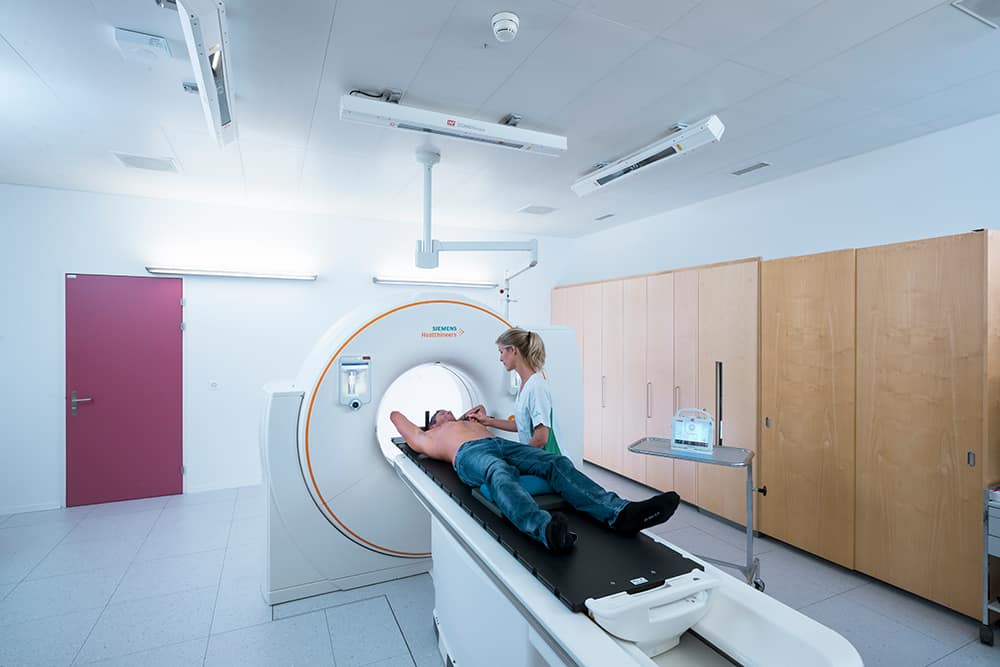 There have been enormous improvements in radiation therapy over the last 20 years. MR-only workflows and the invention of MR-guided Linacs brought new perspectives.
 Raphael Schmidt is responsible for the product management of laser systems for CT and MRI from LAP. During his studies at KIT (Karlsruhe Institute of Technology) he gained broad experience in different workflows in radiation therapy while analysing them. The topic of his final thesis dealt with the improvement of workflows in RT through to new information and assistance systems. Raphael holds a degree in industrial engineering and management.