

Ask me anything: Deji Akinwande

What skills do you use every day in your job?

Communication is very important, as are other “soft” skills such as networking and collaboration with peers, students and leaders in the field. I think that basically every student (and indeed everybody involved in research) will eventually need to become skilled in project management. Knowing when to end a project, when to pivot it in a different direction and how to manage risk are all really important. Failure is an option – and often the experience when you’re doing research – so individuals have to be resilient. They have to embrace failure, learn from it and move on.

Knowing when to end a project, when to pivot it in a different direction and how to manage risk are all really important

Of course, technical skills are also very important. We use statistics frequently to analyse our data, and we also use ideas from algebra, calculus (curvature, slopes and vectors) and matrix mathematics. Those skill sets are often needed because we’re constantly dealing with data. And then there are specific physics skills, like an understanding of electromagnetics and (especially) solid-state physics. Because we work on devices, we deal with concepts in solid-state physics on a day-to-day basis in order to understand the materials the devices are made from and what we should expect from them. All those technical skills are very prominent.

One of the most challenging aspects of my work is that the materials we’ve known about historically are bulk materials – steel, copper, gold, iron. These materials have been well studied for 50 or 100 years, maybe more. But the atomically thin materials that I work with are not well studied. There are a lot of unknowns. We have to learn the basics of their materials science: their kinetics and thermal dynamics, what their phase diagrams look like, and so on. These are not things that I was privy to in my undergraduate degree or even my graduate education, but they are necessary, and you also need to know how to characterize these materials with advanced tools.

What do you like best and least about your job?

For me, and perhaps for many of my kind, what we like best is discovery. The whole point of doing research, to some extent, is to discover things that haven’t been discovered before. That’s always a thrill for us.

With every career, there will be things that you doesn’t necessarily like. I don’t really enjoy the paperwork and bureaucratic bottlenecks that are abundant in our field, but those are things that we have to deal with. They’re not fun, but they are necessary, so we accept them.

What do you know today, that you wish you knew when you were starting out in your career?

In retrospect, there are many things that I wish I knew, but I think I would go back and emphasize the soft skills. Of course, I had an idea when I was younger that they were important, but I wish I had become more involved and acquainted with skills such as networking and communication. Those skills are very important and often they are not adequately taught, or opportunities to get this experience are not abundant when one is an undergraduate or postgraduate student.

Fractionated heating could improve cancer therapy with thermosensitive drugs

Thermosensitive liposomes

Improving the delivery of chemotherapy drugs to solid tumours while minimizing harmful side effects is key to optimizing cancer treatments. One promising approach lies in the use of thermosensitive liposomes (TSLs) that release encapsulated drugs upon heating, such as doxorubicin-loaded TSL (TSL-Dox), for example. TSL-Dox has shown encouraging outcomes in some patients, but its widespread clinical adoption is hindered by a lack of effective temperature control.

MRI-guided focused ultrasound (MRgFUS) could provide such control, enabling non-invasive heating of tissues to the hyperthermia regime of 41–43 °C. Previous preclinical studies of MRgFUS with TSL-Dox showed that raising tissue temperatures for tens of minutes to hours led to drug release and anti-tumour effects. But respiratory motion and cooling by blood make it difficult to maintain hyperthermia effectively. Instead, researchers in Canada propose a novel new approach: using MRgFUS to create fractionated ultrashort thermal exposures that release the encapsulated drug.

“It is very difficult to induce uniform temperature elevation and maintain it over long periods of time in a clinical setting, and even more difficult in an organ that moves with breathing, such as the liver,” explains lead author Kullervo Hynynen from Sunnybrook Research Institute and the University of Toronto. “Our aim was to use short ultrasound exposures that are short enough to be delivered during a patient breath-hold, thus eliminating the motion problem.”

Reducing each burst of heating to just 30 s also means that the temperature elevation is not highly dependent on the tissue’s blood perfusion rate, which is unknown and heterogenous throughout the tumour. As such, it should allow uniform thermal exposure over the entire tumour volume.

In vivo assessments

To determine whether the proposed ultrashort FUS exposures can release doxorubicin from TSL-Dox, the researchers first tested the approach using a dorsal skinfold chamber on a mouse with implanted tumour cells. After injecting TSL-Dox, they exposed the tumours to ten 30 s FUS thermal exposures, using thermocouple-based temperature-based feedback to heat the tissue to 41°, 42°, 43° or 45°C.

The experiment showed that the ultrashort thermal exposures could effectively release the doxorubicin and that the drug was subsequently taken up by tumour cells. Heating to 42 °C appeared to give the most consistent increases in drug delivery to the mouse tumours. Thus the team chose this temperature to evaluate the therapeutic efficacy of fractionated ultrashort MRgFUS heating with TSL-Dox in rabbit thigh tumours.

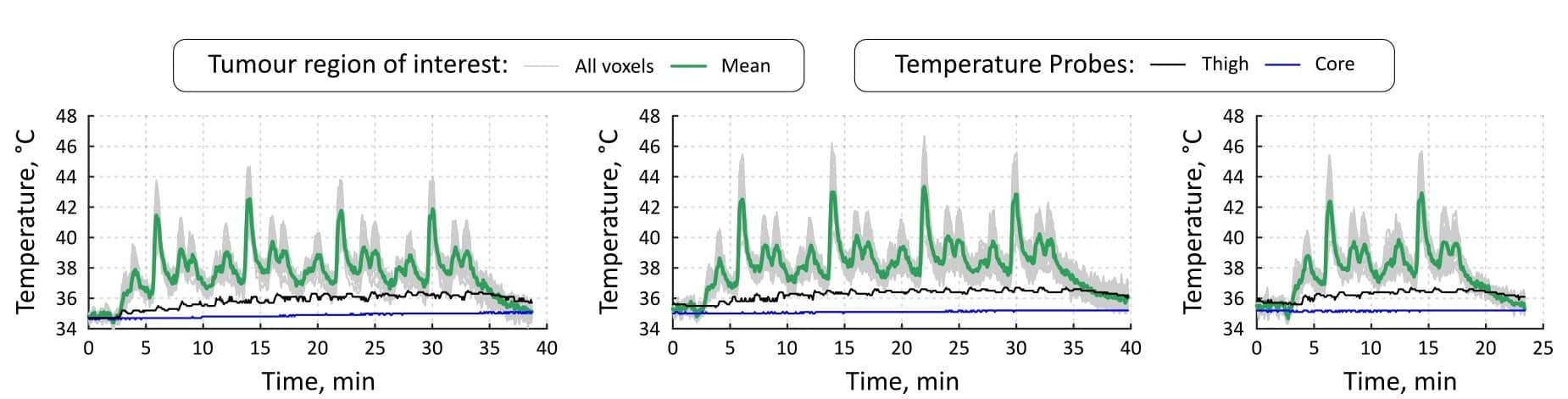
For the studies on rabbits, the researchers employed a custom MRI-compatible FUS system to deliver short-duration heating, with MR thermometry providing real-time temperature feedback during the treatment. They used MRI to identify the tumours and define discrete regions-of-interest (ROIs) to encompass the tumour. After administering either TSL-Dox or a control dextrose, each ROI was heated 10 times, to 42 °C for 30 s. The FUS was delivered via a single-focus transducer translated through a series of discrete locations to achieve tumour coverage.

Temperature profiles

Examining drug delivery to excised bilateral tumours (one heated, one not heated) demonstrated that the level of doxorubicin fluorescence was markedly increased in the heated versus the unheated tumour sections – indicating the release of drug, which does not fluoresce when in liposomal form.

The researchers also evaluated the anti-tumour efficacy of the treatment. They saw a significant improvement in survival for rabbits receiving MRgFUS plus TSL-Dox compared with animals receiving MRgFUS alone or TSL-Dox alone. Of six rabbits treated with MRgFUS plus TSL-Dox, three survived to 120 days following treatment, four showed complete tumour destruction and only one reached the tumour size-related endpoint.

Follow-up MR images showed a marked decrease in tumour size in rabbits treated with MRgFUS plus TSL-Dox. Conversely, all 11 rabbits that received either MRgFUS or TSL-Dox alone showed tumour growth, and all reached the tumour size-related endpoint within 28 days.

One week after treatment, tumours in the group that received MRgFUS alone were significantly larger than in the group receiving MRgFUS plus TSL-Dox. Two weeks after treatment, rabbits in both the MRgFUS alone and the TSL-Dox alone groups had significantly larger tumours than those treated with MRgFUS plus TSL-Dox.

The researchers conclude that these results have considerable implications for the widespread clinical adoption of thermosensitive drugs in oncology. Hynynen tells Physics World that the team is now working on translating the method for clinical testing.

The findings are published in Science Advances.

History and fundamentals of tip-enhanced Raman spectroscopy (TERS)

Want to learn more on this subject?

TERS gives the vibrational information of a sample with nanometric resolution. Obtaining physico-chemical information with such resolution opens up possibilities to characterize materials at unprecedented levels, which allows research findings unsuspected until recently.
This webinar introduces the fundamentals of TERS through the history of near-field spectroscopic optics. From the great idea of Synge more than 90 years ago to the technical progress of scanning probe microscopy, the history of near-field optics crosses the emerging plasmonics field and the discovery of the amplification of the Raman signal by Richard Van Duyne.

During this webinar, Marc Chaigneau will also briefly introduce this nanospectroscopic technique for 2D materials and other semiconductors, but also present the current applications of this for biological samples such as viruses and DNA.  

Want to learn more on this subject?

Marc Chaigneau received his PhD in solid-state physics from the University of Nantes in 2007. He joined the Laboratory of Physics of Interfaces and Thin Films (PICM) at Ecole Polytechnique in 2008 and was appointed tenured researcher in 2010. His research activities were concentrated on the development and applications of Tip-Enhanced Raman spectroscopy (TERS).

Marc is the author of three patents, one book chapter and more than 50 articles in peer-reviewed journals.

He joined HORIBA France in 2015 to oversee global R&D, applications and marketing of Raman spectroscopy products coupled with Scanning Probe Microscopy (SPM). He received the IP Award from the HORIBA group for innovative intellectual property in 2016.

Martian buildings could be made of chitin-based material

Early settlers on Mars could build their homes using a material that includes chitin, which is a a fibrous substance made by a wide variety of living organisms from fish to fungi. The versatile new material was developed by Javier Fernandez and colleagues at Singapore University of Technology and Design. They used it to create objects ranging from cartoon figures and basic tools, to scale models of sturdy Martian shelters.

Crewed missions to Mars have been discussed for decades, but NASA has now expressed hopes that a long-term settlement on the Red Planet could be achieved by the late 2030s. Among the immense challenges that colonizers will face is the scarcity of basic resources on the Martian surface. This is also becoming an issue here on Earth, where certain resources are being rapidly consumed and there is a movement towards sustainable and circular manufacturing processes.

One promising solution is to create materials using chitin – an abundant biological polymer that is made by a wide range of living things. While it is highly unlikely that chitin-producing organisms currently live on Mars, they could easily be part of an artificial ecosystem created on the planet.

Obtainable on Mars

Fernandez’s team created their new material by extracting a form of chitin from shrimp exoskeletons, through treatment with sodium hydroxide. This chemical would be easily obtainable on Mars through the simple chemical process of electrolytic hydrolysis.

The researchers then dissolved the chitin in a low concentration of acetic acid – a common product of fermentation, which would be crucial to the food supply on an early Martian settlement. Finally, they mixed the chitin solution with a powdered material simulating Martian soil, forming a thick sediment. The only other ingredient necessary for the process is water – which can be readily found in Mars’ subsurface ice.

After fine-tuning the ratios of these ingredients to optimize the structural properties of their material, Fernandez’s team demonstrated a wide variety of manufacturing methods. These included casting techniques for producing cartoon figures and basic tools, including a functional wrench strong enough to tighten a hexagonal bolt. The team also used the material as a mortar to repair holes. Finally, they exploited the sediment’s self-adhesive properties to 3D print a 5 m scale model of a proposed Mars habitat called MARSHA.

Fernandez and colleagues have shown that their chitinous material not only requires minimal energy to produce; its ingredients are also readily available on Mars, and do not compete with food production. These advantages avoid the need for complex polymer synthesis and the shipping of expensive equipment – enabling the earliest Martian settlements to operate independently from Earth’s resources. With some adaptation, these techniques could inspire new routes towards a circular, sustainable economy on Earth – which would operate without unleashing further damage on natural ecosystems.

The new material is described in PLOS One.

Machine learning and Doppler vibrometer monitor household appliances

A way of monitoring household appliances by using machine learning to analyse vibrations on a wall or ceiling has been developed by researchers in the US. Their system could be used to create centralized smart home systems without the need for individual sensors in each object. What is more, the technology could help track energy use, identify electrical faults and even remind people to empty the dishwasher.

“Recognizing home activities can help computers better understand human behaviours and needs, with the hope of developing a better human-machine interface,” says team member and information scientist Cheng Zhang of Cornell University.

The system, dubbed VibroSense, comprises two core parts: a laser Doppler vibrometer and a deep learning model, which is a type of machine learning system.

Wall or ceiling

The vibrometer detects tiny vibrations by measuring the distortion of a laser beam reflected from a surface. For single-story houses, VibroSense’s laser is targeted at a central interior wall within the home, whereas in two-story residences, the researchers aim it at a ceiling. The researchers’ prototype device is cable of detecting vibration velocities of up to 1.25 m/s with a resolution of around 0.2 µm/s.

The deep learning model learns how to identify individual appliances based on their characteristic noises and distinct paths that these vibrations follow through the building. Training the model involves using samples of individual vibration patterns for each target appliance. It takes around 1-2 h, depending on the number of vibration sources being monitored.

In tests undertaken across five households over two days, the VibroSense prototype could identify the activities of 18 different common household objects with a 96% accuracy rate – even when the appliances were spread across different rooms and floors. This included picking out the signals generated by an electric kettle, a range hood, a microwave, a washing machine, an exhaust fan and even a dripping tap. In addition, the device was capable of distinguishing between different stages of individual appliance use with an average accuracy of more than 97%.

Energy-saving advice

“Since our system can detect both the occurrence of an indoor event, as well as the time of an event, it could be used to estimate electricity and water-usage rates, and provide energy-saving advice for homeowners,” says Zhang.

In addition, VibroSense may even be able to help homeowners detect electrical faults before they become critical. “The theory is that if there is any abnormal condition to certain appliance, their vibration pattern would change, which VibroSense probably can pick up and detect with appropriate training,” Zhang explains.

In the future, Zhang believes that it may be possible to create a more advanced version of the  machine learning system that uses vibration data for assorted appliances to accommodate the addition of new appliances to a home without needing additional training.

Privacy issues

The concept is not without some inherent issues, however – specifically as regards to the privacy implications of the device being able to “spy” on the activities going on in neighbouring flats, should it be used within an apartment complex. For this reason, the researchers say, the design is perhaps best suited for implementation within detached dwellings.

Commercial development of VibroSense, Zhang commented, “would definitely require collaboration between researches, industry practitioners and government – to make sure this was used for the right purposes.”

Michael Connelly, an engineer at Ireland’s University of Limerick comments, “The VibroSense technology has the potential to greatly enhance the understanding of the complex home environment and find applications in other areas of vibration measurement”. However, Connelly, who was not involved in the development of VibroSense adds, “laser vibrometers are expensive thereby it will be challenging to commercially exploit the VibroSense system, particularly as the deployment of the Internet of Things in the home increases.”

This is an issue that the researchers are aware of. According to Zhang, the current version of VibroSense would cost around $1000–$2000.  However, he adds that similar results may be possible using cheaper sensors such as accelerometers or geophones.

With their initial study complete, the researchers are now moving to explore the potential of using similar, minimally intrusive sensing devices to monitor human activities within broader settings – with the goal of using the data gathered to both enhance human–computer interactions and also to explore potential diagnostic medical applications.

The research is described in the Proceedings of the Association for Computing Machinery on Interactive, Mobile, Wearable and Ubiquitous Technologies.

The promises and pitfalls of peer review

This week’s podcast focuses on Peer Review Week, an annual event honouring the vital role that peer review plays in maintaining the quality of published scientific papers. But while peer review is important, it’s certainly not perfect. The quality of reviews is not always up to scratch – as the darkly comic website Shit My Reviewers Say demonstrates. The pool of peer reviewers is nowhere near as diverse as the scientific community itself. And the many helpful, conscientious reviewers aren’t getting the rewards and recognition they deserve.

Joining us to talk about these challenges (and strategies for addressing them) are Kim Eggleton, the Research Integrity and Inclusion Manager at IOP Publishing (which publishes Physics World), and Bahar Mehmani, who is Reviewer Experience Lead at the scientific publishing giant Elsevier. Kim and Bahar also discuss how the coronavirus pandemic is affecting peer review. With so much at stake for public health, the need for published scientific research to be as accurate, robust and transparent as possible has never been greater.

Dog-like robot measures patients’ vital signs remotely

A team of US-based researchers has created an innovative robotic platform that can remotely measure hospital patients’ vital signs – and could help to significantly reduce the infection risk faced by healthcare workers assessing people with symptoms of COVID-19.

The platform consists of four cameras attached to a dog-like robot developed by Boston Dynamics. The robots, which are operated via a remote handheld device, can also be equipped with a tablet that allows doctors to ask patients about their symptoms without the need to be in the same room.

The results of the research have been published on the preprint server TechRxiv, but have not yet been peer-reviewed by scientific or medical experts. The paper describes how researchers based at Massachusetts Institute of Technology (MIT), Boston Dynamics and Brigham and Women’s Hospital used the robotic platform to measure vital signs – including skin temperature, breathing rate, pulse rate and blood oxygen saturation – in healthy volunteers, from a distance of two metres. The team is now making plans to test the robot’s efficacy in patients with COVID-19 symptoms.

Vital signs

As Hen-Wei Huang, post-doctoral researcher at MIT and one of the lead authors, explains, the measurement of vital signs is an “essential aspect of the initial patient clinical evaluation”.  This is particularly true in the case of COVID-19, which is often associated with significant changes in vital signs, including fever, which can be detected via elevated skin temperature, and shortness of breath, which can be detected through measurement of the respiratory rate, as well as an increase in heart rate and a decrease in blood oxygen saturation.

“Identifying abnormal vital signs like these helps clinicians to triage patients and determine who needs the most urgent care,” says Huang. “However, current standard procedures require healthcare workers to put sensors and devices on patients, thus increasing the risk of the workers being infected with COVID-19.”

Using the robotic platform to measure the patient’s vital signs can mitigate the risk of spreading infection and reduce the consumption of personal protective equipment.  Moreover, an agile mobile robot allows measurements to be taken in a dynamic indoor environment, such as an emergency department.

Next steps

In Huang’s view, one key advantage of using the robotic platform in a clinical environment is that the camera setup enables simultaneous monitoring of four vital signs that are highly relevant to COVID symptoms.

“As the setup is mobile and enabled with artificial intelligence, the robot would dominate the measurement procedures instead of asking patients to adapt to it.  Moreover, the agile platform could follow and track patients’ movements, and thus give much freedom to patients during the measurement,” he explains.

Following an initial evaluation of the platform on healthy volunteers, Huang and his team are now amplifying efforts to evaluate patients presenting with symptoms and signs of concern for COVID-19.

“Our next steps include development of a fully autonomous robotic system that can handle the vital signs monitoring by itself without intervention from the clinical staff,” he says. “In addition, we aim to further reduce the cost to maximize the cost-effectiveness of the system and its reach globally.”

Attosecond pulses track electron motion in liquid water

Researchers at ETH Zurich in Switzerland have tracked the ultrafast movements of electrons in liquid water for the first time – an important step towards understanding the fine details of how chemical and biochemical reactions begin in liquid environments.

According to the classical Bohr model of the atom, an electron takes roughly 150 attoseconds (10-18s) to orbit the proton in a hydrogen atom. Measurements on a timescale of a few dozen attoseconds have been possible for several years now, notes team leader Hans Jakob Wörner of ETH’s Laboratory of Physical Chemistry, and even at lower resolutions of 10 femtoseconds (10-15 s) it is already possible to observe certain subatomic-scale processes – up to and including the breaking of chemical bonds. “Electron movements are the key events in chemical reactions,” he says. “That’s why it’s so important to measure them on a high-resolution time scale.”

Wörner’s team were among the first to detect electron movements at the attosecond scale. However, because the wavelength of their attosecond pulses is in the extreme ultraviolet (XUV) range, which is easily absorbed by air, they had to carry out their measurements in a vacuum chamber. This restriction meant that they were only able to perform attosecond measurements on molecules in the gaseous state.

Novel measuring scheme

The researchers have now developed a novel measuring scheme that relies on comparing photoemissions (that is, emissions of electrons prompted by light striking a material) from liquid water with those of water vapour. In their experiment, they inject a microscopic jet of liquid water into their vacuum chamber through a quartz nozzle with an inner diameter of roughly 25 mm. This jet flows smoothly (laminar flow) for a few millimetres before breaking up into droplets, which then freeze upon contact with a liquid-nitrogen cold trap. “The laminar-flow region of the microjet allows us to study liquid water in a quasi-equilibrium state, very close to room temperature,” Wörner explains.

To make their attosecond measurements, the team focus an XUV train of attosecond pulses (obtained from a 30-femtosecond near-IR laser pulse in an argon gas cell) onto the evaporating water. In addition to this XUV pulse train, they also focus a strongly attenuated replica of the IR pulse onto the liquid microjet. This set-up allows them to detect electrons photoemitted from the liquid and gas phases at the same time.

The ETH Zurich researchers observed that photoelectrons from liquid water molecules are emitted 50-70 attoseconds after those emitted from gaseous water molecules. This time difference stems from the fact that the molecules in liquid form are surrounded by other water molecules, Wörner explains. This affects the molecules’ electronic structure, producing a measurable time delay.

An important step forward

Going from measurements in gases to measurements in liquids is an important step forward, since most chemical reactions – especially those that are biochemically interesting – take place in liquids, Wörner notes. Reactions such as photosynthesis in plants and the biochemical processes on our retina that allow us to see are also triggered by light, just like photoemission in water – which is also the dominant source of DNA damage due to X-rays or other ionizing radiation. “With the help of attosecond measurements, scientists should gain new insights into the most elementary steps of these processes in the coming years,” he says.

The research is detailed in Science.

New class of supergiant stars could explain missing supernova progenitors

A new class of stars called “fast yellow pulsating supergiants” has been identified by astronomers in the US and Switzerland. The discovery could solve the “red supergiant problem” of astrophysics, which refers to the lack of observations of Type IIP supernova progenitor stars with masses in the range of 16–30 solar masses.

Stars heavier than about 8 solar masses are thought to spent their final phase of life as red supergiants, before undergoing core collapse and exploding as supernovae. The mass of a Type IIP supernova progenitor can be determined by measuring the star’s brightness just before it collapses – which itself occurs before the star explodes. Although red supergiants have been observed in the 16–30 solar masses range, none so far have been identified as progenitors of Type IIP supernovae. This contradiction of the current theory of stellar evolution is known as the red supergiant problem.

It seems that only the lower-mass RSGs explode, which raises the question: what is the fate of the more massive RSGs? One possibility is that many RSGs evolve back to their previous yellow or blue stages of their lifecycle. Such post-RSGs would end their lives as something other than RSGs, thereby resolving the red supergiant problem.

Evolving to yellow and blue

Recently, a team of astronomers sought to observe such post-RSGs. Trevor Dorn-Wallenstein at the University of Washington and colleagues reasoned that stars called pulsating yellow supergiants might be candidates for post-RSGs. If an RSG were to lose enough mass, it would evolve towards yellow and blue on the Hertzsprung-Russell (HR) diagram and pulsate noticeably. The HR diagram plots stars’ luminosity against their effective temperature.

“The red supergiant problem has been around for years,” notes Philip Massey of the Lowell Observatory in Arizona, who was not involved in this latest research. “One explanation is that these stars ‘turn around’ and return to the blue side of the HR diagram. Then the question becomes: how do you distinguish between a post-red supergiant star from a pre-red supergiant star? One way to do it would be to look for pulsations – only post-RSGs should display unusual pulsations. And that’s just what [Dorn-Wallenstein and colleagues] did.”

The team used data from the Transiting Exoplanet Survey Satellite (TESS), which collects light curves of the brightest stars across 85% of the sky. TESS takes observations every two minutes and light curves are graphs that show the brightness of a star as a function of time. Dorn-Wallenstein and colleagues analysed the variability of 76 supergiants in their search for stars that have the predicted properties of post-RSGs.

New class of supergiants

Their search revealed a group of five yellow supergiants that show rapid multiperiodic variability with periods of less than one day. These stars are also more luminous and warmer than typical Cepheid variables (stars that fluctuate periodically in brightness), fainter than out-bursting yellow “hypergiants”, and cooler than the coolest Alpha Cygni variables, which are another type of supergiant. The five yellow supergiants are also concentrated on a region in an HR diagram not previously associated with pulsating stars. As a result, Dorn-Wallenstein and colleagues say that the stars appear to belong to a class of never-before-seen supergiants, which they have called fast yellow pulsating supergiants (FYPSs).

“They established that this variability could not have been a coincidence,” says Massey. “All massive stars have some variability, but they made a convincing case that this is a unique set of objects.”

Tantalizingly for the red supergiant problem, the lowest estimated mass of the observed fast yellow pulsating supergiants is close to the highest mass of the red supergiant supernova progenitors. Thus, rather than immediately dying in supernovae, it is plausible that the more massive RSGs evolve into FYPSs as part of their lifecycle.

Dorn-Wallenstein and colleagues leave it to future work to determine the exact evolutionary status of these FYPSs. While these objects may indeed have evolved from RSGs, more theoretical and observational work needs to be done to tell whether or not these FYPSs are definitively the solution to the red supergiant problem.

The study is described in a preprint on arXiv that has been accepted for publication in The Astrophysical Journal.

Could there really be life in the clouds of Venus?

The news last week that scientists had spotted a potential signature of life in the clouds of Venus was always likely to cause a stir. But arriving the middle of the COVID-19 pandemic – during which our everyday lives have changed significantly – the story has truly captured the public imagination. In the latest episode of the Physics World Stories podcast, Andrew Glester takes a broad view of the discovery: an inspiring example of lateral thinking, persistence and collaboration.

The deduction that Venus could be harbouring life is linked with the detection of phosphine gas in the planet’s atmosphere. For terrestrial planets such as Venus and Earth the only known processes to generate phosphine in such a location are connected with metabolism. To learn more about astrobiology, Glester catches up with two members of the team behind the discovery, both based at Massachusetts Institute of Technology.

Clara Sousa-Silva is a quantum astrochemist who for over a decade has studied phosphine as a potential signature for extraterrestrial life. She is joined by Sara Seager, an astronomer and planetary scientist, who among other things speaks about future missions to Venus to help resolve this mystery. As both researchers explain, the “life hypothesis” came as a last resort following a rigorous search for alternative explanations.

Copyright © 2026 by IOP Publishing Ltd and individual contributors