Protons could be lighter than we thought

IonTrap

The most precise measurement to date of the proton-electron mass ratio suggests that the proton may be lighter than previously thought. The result, from researchers in the Netherlands and France, provides a crucial independent cross-check with previous measurements of the ratio, which yielded inconsistent values.

The proton-electron mass ratio is an important quantity in physics and a benchmark for molecular theory. It can be determined by measuring the rotations and vibrations of ordinary molecular hydrogen ions (H2+) and comparing them to similar ro-vibrational measurements in their deuterated cousins (HD+). Both entities are the very simplest bound systems that can be termed “molecules”, and as such they are ideal for probing models of fundamental physics. Indeed, when researchers first performed measurements of ro-vibrational transitions in HD+ 40 years ago, they suggested that the results could be used to test the theory of quantum electrodynamics (QED) in molecules.

Most precise determination of the proton-electron mass ratio

Recent measurements of the relative atomic masses of light atomic nuclei – including deuterons and helions (helium-3 nuclei) as well as protons – have, however, uncovered values that differ from earlier results by several standard deviations. For example, a proton-mass measurement made in 2017 using a traditional method, Penning-trap mass spectrometry, determined the mass with a precision of 32 parts per trillion (ppt). While this precision of this measurement was three times higher than that of the previously accepted value (termed CODATA-2014), the actual value measured was nearly 300 ppt smaller.

“This value was taken along with the earlier values to compute the 2018 CODATA value of the proton mass, but all uncertainty margins had to be stretched by a factor of 1.7 to cover the difference,” explains study team leader Jeroen Koelemeij of VU University in Amsterdam. “This currently limits the precision of the ‘official’ proton-electron mass ratio to 60 ppt – and affects theoretical calculations of HD+ at a similar level.”

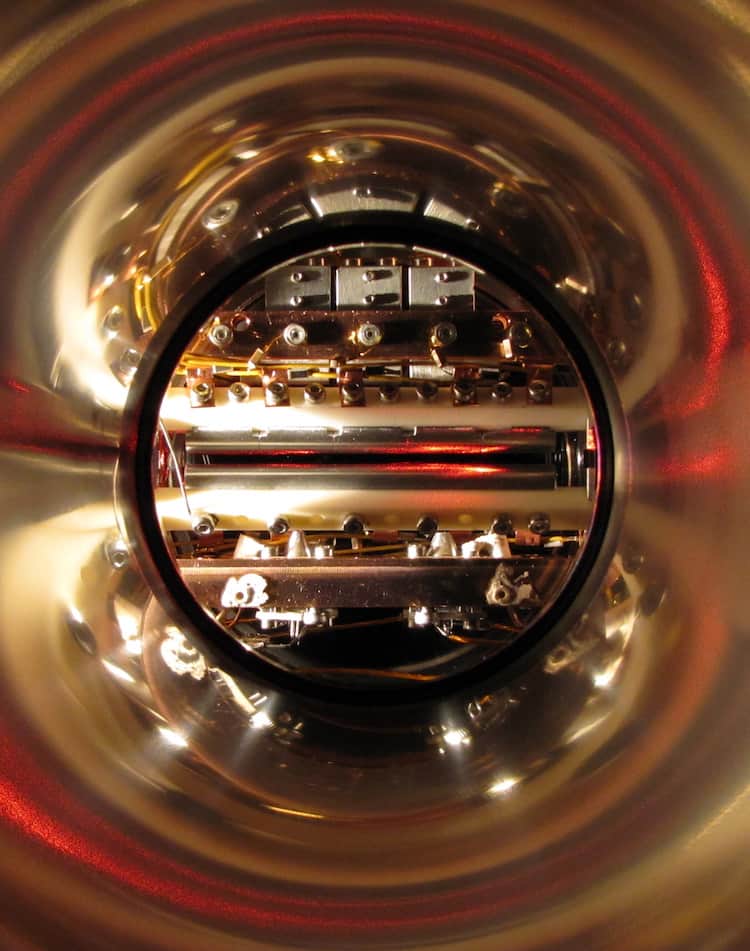
In their new work, Koelemeij and colleagues used a different technique, Doppler-free two-photon laser spectroscopy of trapped HD+ ions, to measure a proton-electron mass ratio of 1,836.152 673 406(38), where the brackets contain the statistical uncertainty. At 21 ppt precision, this measurement is the most precise determination of the proton-electron mass ratio to date – a record shared with a very recent value obtained from rotations of HD+ in a concurrent experiment in Düsseldorf, Germany.

Getting rid of the Doppler effect

In measurements like these, Koelemeij explains that the Doppler effect – the apparent detuning of the laser frequency from resonance with the HD+ ion, depending on the ion’s velocity – is a nuisance. Even at the very low temperatures (10 mK above absolute zero) that prevail in their experimental trap, the molecules in the trap can still move around. To eliminate the Doppler effect entirely, the ions would ideally need be brought to a complete standstill – an experimental impossibility.

“Fortunately, quantum mechanics is forgiving,” Koelemeij says. “If we want a laser to ‘see’ a particle at rest, we just need to ensure that it doesn’t move around by more than the wavelength of the laser light” – a condition known as the Lamb-Dicke limit.

Koelemeij and colleagues met this condition in a roundabout way by shining two lasers on the molecule from opposite directions. When the wavelengths of these counter-propagating laser beams are tuned to the right values, the molecule will absorb a photon from each beam and, in effect, add the energy from both photons to its own vibrational energy. The resulting “two-photon” transition between the molecule’s energy levels has an apparent wavelength equal to the difference between the two laser wavelengths. “Since both lasers have nearly the same wavelengths, the apparent wavelength becomes very large – larger than the volume in which the HD+ ions are confined,” explains Koelemeij. “According to quantum mechanics, the ions appear to be standing still: no Doppler effect.”

With the Doppler effect removed, the true purity of the vibrations becomes visible, Koelemeij tells Physics World. Indeed, the vibrations of the molecules under these circumstances is nearly as pure as the oscillations in the best atomic clocks – meaning that they can be measured with high precision.

Another advantage of the technique is that by using two photons, the researchers can select molecular vibrations in a way that is relatively insensitive to magnetic fields, which helps improve the precision of the measurement.

QED theory works for molecules

The new work, which is detailed in Science, confirms that QED, which is very successful at describing single particles and atoms, also works for more complex matter such as simple molecules – something that Koelemeij says was previously unclear. “While there have been comparisons (and agreement) between QED theory of molecules (notably the HD+ ion) and experiment, the experiments were never more precise than theory,” he explains. “This means that the finest details of the theory calculation could not be tested.”

The new result, he says, has turned the situation on its head. For the first time, experimental measurements of these molecular vibrations are significantly more precise than values generated from theory – meaning that theoretical predictions can now be tested to the fullest extent. What’s more, predictions from theory can be used as a tool to translate the measured vibrations into a new value of the proton-electron mass ratio – as predicted more than four decades ago.

“Intriguingly, the proton-electron mass ratio we have measured is in fact compatible with the recent measurements of the proton mass, which were unexpectedly smaller than previous reference values,” adds Koelemeij. “This means that the proton indeed seems to be lighter than we thought.”

The very precise measurements in HD+ could also help solve several important and hotly debated mysteries in physics, including the puzzle of why the radius of the proton appears to be smaller than expected. Knowing the mass of the proton (and the anti-proton) to high precision could also help researchers understand why there is much more matter than antimatter in the universe, even though equal quantities of each were thought to have been created in the Big Bang.


Time crystals interact in rotating fridge, Cold Tube keeps you cool, singing physicist is back

Time crystals were first proposed back in 2012 by the Nobel Laureate Frank Wilczek, and since then we have been scratching our heads at Physics World as we try to understand the concept. If you are as perplexed as we are, the article “In search of time crystals” by Philip Ball is a good place to learn the basics.

Since Wilczek’s proposal, physicists have tried to create time crystals in the lab. Now researchers in the UK and Finland claim to have created two time crystals that interact with each other. And where does this interaction occur? In a rotating refrigerator, of course.

“Controlled interactions are the number one item on the wish list of anyone looking to harness a time crystal for practical applications, such as quantum information processing,” explains Samuli Autti at Lancaster University. The team’s research is outlined in a paper in Nature Materials.

Cold Tube

The mini heatwave here in Bristol has broken as storm Ellen bears down on us – but I’m sure it’s hot elsewhere and many readers are sitting next to a fan or air conditioner. But would you use a “Cold Tube” to keep cool? This is the brainchild of researchers in Canada, the US and Singapore. Adam Rysanek of the University of British Columbia explains how it works: “The Cold Tube works by absorbing the heat directly emitted by radiation from a person without having to cool the air passing over their skin. This achieves a significant amount of energy savings”. You can read more about how it works in this open-access paper in the Proceedings of the National Academy of Sciences.

Physics World’s favourite singing physicist Sabine Hossenfelder is back with another tongue-in-cheek video. This time she is lampooning physicists with theories of everything and it’s a catchy little ditty. You can watch it above. On a more serious note Hossenfelder is also speaking at the HowTheLightGetsIn Global 2020 festival of ideas on 19-20 September.

European synchrotron reopens following €150m upgrade

Officials at the European Synchrotron Radiation Facility (ESRF) in Grenoble, France, have announced the completion of a major upgrade to one of Europe’s premier X-ray facilities. Dubbed the Extremely Brilliant Source, or ESRF-EBS, the revamp boosts the brilliance and coherence of the X-ray beams at the facility by around a factor of 100 over its predecessor, allowing the structure of matter at the atomic level to be studied much faster and in greater detail than before. The first users are expected to start using the machine when it officially begins operation on 25 August.

Since opening in 1992, the original ESRF storage ring was the most powerful synchrotron radiation source in Europe, providing intense beams of X-rays that were used each year by more than 6000 visiting scientists in a variety of disciplines from condensed-matter physics to protein crystallography.

In December 2018 the ESRF closed to allow construction work on the ESRF-EBS. The upgrade involved replacing the entire 350 m-diameter storage ring, which accelerates the electrons in a circular path where they emit X-rays that are then used by researchers. This involved installing seven “bending” magnets as well as a brand-new device – the Hybrid Multi-Bend Achromat – that allows the production of an electron beam with a much smaller “emittance” than before. The new beam will be 2 microns high and 20 microns wide – compared with around 250 microns wide in the previous beam.

Within budget

After the first electrons were injected into the new machine last year, engineers first optimized the parameters of the beam, ramped up the current and used the beam to condition the storage ring vacuum system. Early this year, the ESRF put out a call for proposal to use the new machine. According to Harald Reichert, director of research at the ESRF, 1238 proposals were submitted, of which around a third were granted. Work at the facility in the coming months and year is expected include mapping the human brain at the synapse level, tracking nanoparticles in soil samples as well as following lithium atoms during battery cycling.

Francesco Sette, director-general of the ESRF, says that the EBS has been delivered within budget and well within schedule. “This is a moment of pride for the whole of the synchrotron community,” says Sette. “With the opening of this brand-new generation of high-energy synchrotron, the ESRF continues its pioneering role to provide an unprecedented new tool for scientists to push the frontiers of science and address vital challenges facing our society today, such as health, and the environment. ”

The new facility has already been operational since March, and from April has been used to study the SARS-CoV-2 virus that is responsible for the COVID-19 pandemic. This has involved examining the molecular structure of the virus as well as imaging organs impacted by the disease.

Prime phantom: Periodic End-to-End QA in SRS

Want to learn more on this subject?

This webinar will share the results of End-to-End dose measurements for stereotactic radiosurgery quality assurance on a periodic basis. The RTsafe Prime anthropomorphic head phantom was used to verify the accuracy of single isocenter multiple metastases cases simulating each step of the SRS treatment chain. The unique characteristics of the Prime phantom in combination with the option for point, 2D and 3D dosimetry allow for a multilevel evaluation of SRS accuracy from imaging to dose planning and delivery.


The webinar, presented by Niko Papanikolaou and Daniel Saenz will cover:

  • Periodical End-to-End QA.
  • Verification of stereotactic radiosurgery accuracy.
  • Implementation of real 3D dosimetry.
  • Characteristics of Prime anthropomorphic phantom.

Want to learn more on this subject?

Niko Papanikolaou is a professor of radiation oncology and radiology at the University of Texas Health Sciences Center San Antonio. He also serves as the chief of the division of medical physics and the director of the doctorate programme in medical physics at the Graduate School of Biomedical Sciences. Dr Papanikolaou has contributed to more than 600 peer-reviewed research papers that have been published either as journal manuscripts or conference proceedings. He is a fellow of the American Association of Physicists in Medicine, the American College of Medical Physics and the American College of Radiology. His clinical and research interests are in the areas of dose calculation and optimization, image-guided radiotherapy, stereotactic and adaptive radiotherapy, and radiobiological modeling of radiation treatments.

Daniel Saenz is a medical physicist at Mays Cancer Center at the University of Texas Health Science Center at San Antonio. He earned his PhD in medical physics at the University of Wisconsin-Madison focusing on MRI-guided radiation therapy. Today, his research focuses on stereoscopic radiosurgery and radiotherapy operations in radiation oncology including image guidance for lung SBRT as well as single-isocenter multiple-target SRS.

Fibre dosimeter could improve the accuracy of prostate cancer brachytherapy

Low-dose-rate (LDR) brachytherapy, in which tiny radioactive seeds are permanently implanted into the tumour site, is a common treatment for prostate cancer; but its success is dependent upon accurate placement of the seeds into the prostate. This placement is performed under image guidance, but errors do occur, as well as subsequent seed migration.

To increase the treatment accuracy, researchers from Ireland have developed an optical fibre sensor for in vivo dose monitoring during LDR brachytherapy procedures. The sensor can be placed within the brachytherapy needle used to implant the seeds, locating it within the prostate itself, or in the transrectal biopsy guide of an ultrasound probe. This dual capability provides real-time monitoring of the radiation dose received by the tumour and the surface of the rectal wall.

According to principal investigator Peter Woulfe, from the Optical Fibre Sensors Research Centre of the University of Limerick, in vivo dosimetry is the most direct method for monitoring radiation dose delivery. By providing real-time measurements during the brachytherapy procedure, deviation or errors can be detected and seed placement optimized.

The sensor is based on a radiation-sensitive scintillator – terbium-doped gadolinium oxysulphide (Gd2O2S:Tb) – embedded in a 700 μm diameter cavity micromachined into the core of a 1 mm PMMA plastic optical fibre. When exposed to ionizing radiation, the Gd2O2S:Tb fluoresces. The emitted fluorescent light penetrates the fibre core and propagates along the fibre to a multi-pixel photon counting module.

The researchers tested the performance of their fibre dosimeter using an in-house prostate phantom and iodine-125, the radioactive source most commonly used in LDR prostate brachytherapy. Writing in Biomedical Optics Express, they report that the device demonstrated a high sensitivity of 152 photon counts/Gy and a temporal resolution of 0.1 s.

To measure stability and repeatability, the researchers inserted and removed a single iodine-125 seed with an activity of 0.361mCi over three consecutive cycles. The largest repeatability error between measurements was 4.1%, within current acceptable standards for brachytherapy dosimetry. They also confirmed that the sensor could detect activity at distances of up to 3 cm.

The researchers also investigated the angular dependency by monitoring the variation in optical signal at different angles to the dosimeter, reporting a noticeable difference in the response at different angles, with a maximum error of 1.9%. To measure the sensor’s response to accumulated radiation activity, they inserted eight seeds in various positions around the sensor. The sensor could monitor the placement of individual seeds, in addition to determining the overall radiation dose, with a maximum percentage error of 4.13%.

 “This is a potentially exciting advance in monitoring the quality and safety of LDR prostate brachytherapy,” says second author Frank Sullivan, director of the Prostate Cancer Institute at NUI Galway, who is collaborating on the clinical assessment of the device. “The ability to track the actual doses being delivered, in real time, and during the implant, might well allow us to improve the quality of the ultimate outcome for patient. We look forward to linking this data with our PCI outcomes database, as a part of our future collaborative research here.”

The Origin project

Woulfe tells Physics World that this research has led to a project entitled Origin that is being coordinated by the University of Limerick. The project has the potential to dramatically reduce the risk of errors in treatments of prostate and gynaecological cancers, according to the university.

“Origin aims to deliver more effective, photonics-enabled, brachytherapy cancer treatment through advanced real-time radiation dose imaging and source localization,” Woulfe explains. “One of the project’s goals is to develop a new optical fibre-based sensor system to support diagnostics-driven therapy through enhanced adaptive brachytherapy. Optical fibres are an ideal solution for this due to their small size, flexibility and electrical passiveness.”

The three-year project aims to develop a dose-monitoring system for both LDR and high-dose-rate brachytherapy, with novel algorithms to provide 3D dose imaging and source localization. The project has been awarded funding of almost €5m from the European Union’s Horizon 2020 research and innovation programme, of which the University of Limerick has received close to €1m. Other project partners include the Galway Clinic, Vrije Universiteit Brussel, Queens University Belfast, the University of Insubria, DoseVue and Eckert and Ziegler.

A matter of trust

What a difference a few months can make. When science historian Naomi Oreskes was writing her latest book Why Trust Science? a large part of the context seemed to be climate change. Indeed, this is a topic on which she has previously exposed the deceits of denialists in her 2010 book with Erik Conway, Merchants of Doubt. That problem remains: huge numbers of people continue to ignore or deny the stark facts that science – and indeed experience – confronts us with: the world is warming dangerously fast and is likely to change catastrophically unless urgent action is taken.

But suddenly the most pressing scientific issue is another one entirely: the global COVID-19 pandemic. Whereas the scientific evidence on climate change warns of serious perils, including massive social disruption and fatality, within decades, for COVID-19 those things came upon us in a matter of weeks. While it would be unwise to draw the parallels too closely, the pandemic has become a lens that focuses many of the same issues about why, when and how to trust science; and reading Oreskes’ arguments in this light is eye-opening.

Arising from a series of lectures Oreskes gave at Princeton University, and incorporating essay-length responses by experts from several disciplines, the book begins with a primer on the philosophy of science that all scientists would do well to read. Many still labour under the conviction that the philosophical foundation of their enterprise is either Karl Popper’s notion of falsifiability (theories can never be proved, only disproved) or Thomas Kuhn’s concept of paradigm shifts. But philosophers of science have long recognized the shortcomings of both frameworks, and many now take the pragmatic view that science is a makeshift affair, beyond any one universal “method”, that nevertheless mostly works well enough to generate knowledge proved reliable by experience.

Oreskes explains how that happens – and why sometimes it goes awry. In certain cases – such as the 19th-century “limited energy” theory that “explained” why higher education was not good for women, eugenics and the recent controversy about the efficacy of dental flossing – she explains both the social and technical factors that can distort the evidence. But Oreskes argues that science as a whole has enough error-correcting mechanisms and a good enough track record to warrant public trust. Reliable knowledge, she says, is produced by five factors: crucially, method and evidence, but also consensus, values and humility. When science has gone astray, it is often because of powerful scientists who lacked the humility to listen to all the evidence.

The inclusion here of “values” might surprise some – but it shouldn’t. The popular idea that science is “value-free” flies in the face of science’s history. Besides, acknowledgement of values is vital to social dialogue. Scientists, says Oreskes, “have made the mistake of thinking that people would trust them if they believed that science was value-free”. On the contrary, people are often more ready to listen to others with whom they can see some shared values. It’s well attested that people are less suspicious of medical innovations when told they have been developed to solve specific health problems, rather than just “because we can”.

Oreskes also dismantles the notion that science is a meritocracy that rewards only excellence, and has no need of initiatives for diversity and inclusion. She points out that diversity of viewpoint is precisely what can make science so powerful – and shows how several past errors, especially in the science of “race” and gender, were highlighted by precisely those groups who suffered from them.

Although always readable, Why Trust Science? is not pitched in a manner that seems likely to convert antivaxxers and climate-change deniers – but that is not really its goal. It’s better to see the book as an aid to scientists and their advocates. The sometimes-shrill insistence from scientists that they have a perfectly designed, intellectually rigorous truth-generating machine is not only philosophically unconvincing, but demonstrably false. As Oreskes argues, the thing that discomfits many scientists – that science is a social process – is actually its real strength. For instance, those who seek to undermine scientific findings by claiming that consensus has no place in science are wrong; it is precisely because science is fallible that consensus – a “social condition” – matters.

And it really is not hard to spot when consensus arises among trustworthy experts. “Most climate-change deniers are not climate scientists, and…objections to evolutionary theory largely emerge from non-scientific domains”, she points out. Sure, conflicts of interest – climate-change deniers funded by oil companies – can be hidden, but rarely very well. And they should weigh heavily on the balance of our judgements. We should trust scientists just as we do other experts, such as plumbers and dentists: not because they have a hotline to truth, but because they have been specifically trained to do their job, which is “studying the natural world and sorting out the complex issues that arise in it”. (There are bad plumbers and dentists, but plumbing and dentistry still work.)

The idea “that scientists follow a magic formula (‘the scientific method’) that guarantees results”, Oreskes says, “persists in textbooks and in the popular imagination, but it does not stand up to historical scrutiny. What does stand up is a portrait of science as a communal activity of experts, who use diverse methods to gather empirical evidence, and critically vet claims deriving from it.” It is this social process, she says, that enables science to do that rather marvellous thing of producing both stability and novelty.

And we shouldn’t exaggerate the problem of trust. Despite all the crazed COVID-19 conspiracy theories about the 5G network and bioweapons, there is no massive anti-science sentiment out there. Most people are desperate to know what “the science” is saying about the pandemic, and will be delighted to see a vaccine. As science historian Susan Lindee points out in her essay, most people do trust science on the whole – they just don’t always realize it. Indeed, scientists have so determinedly separated technology from science, for rhetorical reasons, that people don’t even appreciate that a faith in iPhones entails trust in science.

Climate-change scepticism, then, is not the same as generalized science-denial. As the overlap between that group and those questioning scientific expertise on COVID-19 has revealed, this is not about ignorance but ideology – it signals a difference in values. (Lockdown and mask-wearing, like climate action, seems to constrain the liberty to do as you please.) The problem with getting someone like Donald Trump (or at least, many of his supporters; Trump himself defies categorization as well as belief) to heed science is almost orthogonal to the question of whether he “trusts” it or not.

So when science is traduced or ignored, the answer is not to formulate an airtight philosophical argument for its veracity. That problem is vastly complex, connected for example to cognitive biases, access to information, political tribalism and the boundless human capacity for self-deception. It needs to be understood as a social, psychological and political issue. All this is far too much to be tackled in so short a text, but Oreskes does an excellent job of showing scientists and their advocates where they might usefully focus their energies.

  • 2019 Princeton University Press £22hb 376pp

Time-varying signals control sound waves in topological metamaterials

Researchers have succeeded in controllably propagating sound waves along the boundaries of topological metamaterials using a modulation technique that breaks time-reversal symmetry. This feat, which was accomplished by a team of researchers based at Georgia Tech and the City University of New York (CUNY) and led by Andrea Alù, could lead to applications in areas as diverse as ultrasound imaging, sonar and low-power electronic devices that can operate in harsh or hazardous environments.

Research on topological materials took off in the early years of this century with the discovery of topological insulators – materials that conduct electricity extremely well on their surface, while acting as insulators in their bulk. Electrons on the surface of such insulators can travel in only one direction and cannot backscatter from impurities or defects in the material without reversing the direction of their spins. This remarkable behaviour allows topological materials to carry electrical current almost without dissipation, which means they could someday be used to make electronic devices that are far more energy-efficient than any that exist today.

Topological control of phonons

More recently, researchers have also developed topological insulators that can control the propagation of phonons (vibrations of the crystal lattice in solids) along static and dynamical edge states. In particular, Alù and CUNY’s Alexander Khanikaev exploited geometrical asymmetries to produce topological behaviour in 3D-printed acoustic metamaterials, with the result that sound waves were confined to travel only along the edges of the metamaterial – including around sharp corners.

These earlier materials, however, had an important shortcoming: the sound waves were not fully constrained, and could travel forward and backward along the insulator’s edges. This freedom of travel occurred because certain types of disorder or imperfections in the material could reflect the sound as it propagated along the object’s boundaries.

Time-reversal symmetry breaking

The new work, which is detailed in Science Advances, overcomes this drawback by showing that time-reversal symmetry breaking, rather than geometrical asymmetries, can also induce topological order in a material.

The concept of time-reversal (TR) symmetry in electronics dates back to 1987, when physicists in the Soviet Union predicted the existence of electronic states that behave like a magnetic field, pointing in a different direction when the “arrow of time” is reversed in the equations that describe them. Such states are said to have TR symmetry.

In a topological insulator, TR symmetry can be broken by doping the material with magnetic atoms or interfacing its surface with a magnetic layer that causes an electronic energy gap to open at the point at which its electron valence and conduction bands just touch each other (the Dirac point). In their experiments, Alù and colleagues created such conditions in a topological insulating device made of hexagonal arrays of circular piezoelectric resonators bonded to a thin disk of polylactic acid. They connected their system to external integrated electronic circuits, which provided electrical signals that they could then use to modulate the resonators in space and time. These signals impart a “synthetic angular momentum bias” that in turn induces a strong topological protection on the device’s edges.

Using this approach, the researchers found that sound propagation became truly unidirectional and robust against disorder and imperfections. “The result is a breakthrough for topological physics, as we have been able to show topological order emerging from time variations, which is different and more advantageous than the large body of work on topological acoustics based on geometrical asymmetries,” Alù stated in a press release issued by CUNY. “Previous approaches required the presence of a backward channel through which sound could be reflected, which inherently limited their topological protection. With time modulations we can suppress backward propagation and provide strong topological protection.”

And that is not all: the design also enables the researchers to guide sound waves along a variety of different reconfigurable paths, with minimal loss. According to Alù, the system may find applications in acoustic emitters and mechanical logic circuits, as well as ultrasound imaging, sonar and electronic systems that exploit surface acoustic wave technology.

Why LHCb is so good at discovering tetraquarks, medical sensors that are drawn on the skin

This summer, physicists working on the LHCb experiment at CERN have announced the discovery of two new tetraquarks. In this week’s podcast, CERN’s Dan Johnson and Tim Gershon of the University of Warwick explain why these exotic hadrons are special and also chat about why LHCb is a champion when it comes to spotting tetraquarks.

Physics World’s Tami Freeman and Hamish Johnston also look at two new technologies that involve drawing or printing electronic circuits onto substrates including skin. It turns out that draw-on-skin medical sensors can be more reliable than contact-style devices such as fitness watches and have the added bonus of being able to speed up wound healing.

The future of flying antennas

Antennas are used for a huge range of applications, from mobile phones and “smart” WiFi-connected appliances to GPS and systems that track aircraft and help pilots land safely. These systems usually have a few things in common: the antenna itself, which manipulates electromagnetic radiation in the radio and microwave parts of the spectrum; a receiver (if the system receives signals); and a transmitter (if the system transmits). Over the years, several distinct types of antennas have come into common use, with designs, frequencies and operating power levels that depend strongly on their purpose. Examples include patch antennas in mobile phones, wire antennas in household radio receivers, and reflector antennas for satellite TV.

Within this antenna “zoo”, the antennas attached to flying structures are unique in several respects. Stringent mass and size restrictions make their design more complicated, and they must be able to cope with several challenges over and above meeting basic radio-frequency (RF) requirements. These problems are most acute for radar systems, which require a highly directional beam that can be scanned in different directions.

Purpose and options

A radar antenna at the front of an aeroplane, helicopter, drone, missile or other flying structure is there to scan its surroundings, identify objects (such as terrain, buildings, cars, ships and aeroplanes), and then either avoid them or track them. To accomplish this, the beam of the antenna needs to be moved around in a controlled pattern such as a raster scan. The results of this scan and subsequent computer processing will produce a picture of the area around where the antenna is looking.

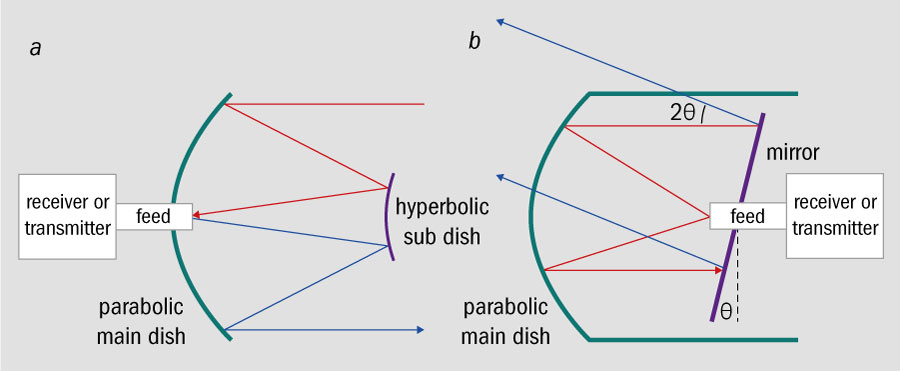
There are three basic ways of making the antenna beam move. From an RF design perspective, the simplest approach is to use a reflector antenna that moves around in its entirety. These types of antenna are normally of a Cassegrain design (figure 1a) and are often seen at airports, where radar systems employ large, spinning reflector dishes, and on radio telescopes where the dish moves to track the object as it moves across the sky. In both cases, the antennas are made from conductive materials that strongly reflect RF signals, and their collecting area focuses this reflected RF energy onto a feed element that routes the signal (via a transmission line) to the receiver for further processing.

The major problem with physically scanning the entire antenna in airborne applications is that the available space at the front of a flying object is often small. Allowing extra room for physical movement means the antenna itself must be made smaller – a compromise that leads to worse resolution and lower sensitivity relative to a design that uses all the available space. However, if the flying structure is large – say, an aircraft – then this can be an acceptable solution. Many specimens of mechanically scanned airborne antennas exist, including the Foxhunter radar on the Royal Air Force’s (now-retired) Tornado F3 jet.

figure 1

The second way of making an antenna beam move is to move only part of the antenna, such as its primary reflector. However, this generally produces a degraded antenna beam that performs worse when it is scanned significantly away from straight ahead. Again, this compromise is often acceptable, and some designs have been developed to minimize the degradation in performance. The twist reflector design, for example, introduces a moving planar reflector to the basic reflector antenna, enabling the beam to be scanned without defocussing the system (figure 1b). This makes it possible to maximize the available aperture for the RF collecting area, while scanning the beam with the mechanical moving plate. Such designs do exhibit some degradation of antenna performance at high angles, but for the most part they work well.

A variant of this solution is to use a different type of antenna known as a flat-plate array. Antennas of this type contain small radiating elements such as a slotted waveguide, patch or helical wire antennas. These elements are connected to a common transmitter and receiver, producing a coherent beam that can be scanned by moving the plate with motors and push rods. This method uses most of the available aperture of the antenna as a collecting area, while losing only a small amount to allow for the beam movement, and without introducing any distortion of the pattern at high scan angles.

Electronic alternatives

Flat-plate arrays and twist-reflector-based designs are both viable solutions on flying platforms, with many successful implementations. However, mechanically scanning all or part of an antenna is not the only way to steer a beam. The third way of scanning an antenna beam is to control the beam direction purely electronically, without any moving parts.

One such electronically steered antenna is known as a phased array. Like the flat-plate antenna, phased arrays incorporate multiple small elements that are connected to the same transmit-and-receive hardware and combine to produce a coherent beam. Phased arrays have been in use since the 1960s, but a variation of this design known as an Active Electronically Steered Antenna (AESA) was developed more recently. In an AESA, each element in the array has its own transmitter and receiver. This set-up enables the elements to be controlled independently, while software is then used to combine the signals from all the elements to create a single beam.

RAF radome

From a tracking radar perspective, the interesting thing about the AESA design is that having individual control of each element makes it possible to produce multiple beams in different directions and at different frequencies at the same time. These multiple beams and frequencies are especially beneficial for flying antennas, as they make it more difficult for external sources to interfere with the signal.

The main drawback of electronically steered antennas is that they have a maximum scan range. While it is possible to electronically scan an antenna beam 60° from perpendicular, the beam inevitably degrades as scan angle is increased, and getting to 90° of scan (let alone 180°) is not possible. Practical systems that need wider scanning therefore need some way of addressing this.

Design iterations

The first examples of AESAs were ground-based. In these applications, the space behind the antennas is not at a premium, so there is room to house (and cool) all the AESA’s connecting electronics, transmitter and receivers. An early naval example is the large Sampson AESA radar used on the Royal Navy’s Type 45 class destroyer, which tracks targets and communicates this information to the guided missiles onboard. Because these systems typically aim to survey the entire sky, it is crucial that they overcome the limitation on maximum scan angle. Some ground and naval based AESAs do this by having multiple faces to the antenna (often in a triangular formation) and/or mounting the antenna on a revolving gimble to produce 360° of coverage.

For airborne applications, the limitation on scan angle may also need to be overcome via mechanical movement or multiple arrays. One airborne example can be found in the KLJ-7A AESA radar to be installed on the JF-17 fighter plane, which was developed by the Nanjing Research Institute of Electronics Technology in China. This aircraft uses two types of AESA: a single moving flat-plate AESA and a variant with one front AESA antenna and two side AESA arrays.

When designing a radar system, the trade-offs between electronic and mechanical scanning are complicated. It is certainly not the case that electronically steered arrays have replaced mechanical ones entirely. While mechanically scanned antennas have moving parts that can break, and that need to be maintained and calibrated, the antennas themselves are less complex and cheaper to manufacture than AESAs. The data they produce are also more easily processed, which has kept them in circulation for a long time.

naval AESA

AESAs do address some of the issues with a traditional scanned antenna. They allow the use of the full aperture, thereby maximizing the available space, and enable the beam to be scanned to a reasonably wide range of angles. However, for flying antennas, space is especially limited, and restrictions on mass make it more difficult to design AESAs that fit in these smaller spaces. In a flying object the size of an aircraft, an AESA is a viable and indeed a popular choice today, with AESAs used in combination with mechanical solutions on Rafale, Seaspray and Wedgetail aircraft, to name but a few. However, in smaller craft such as missiles, drones or other unmanned aerial vehicles, the space, mass and cooling difficulties of AESAs are harder to mitigate. Companies have been working on this problem for many years, but barriers remain, and there have been some unfortunate errors along the way. The first attempt to use an AESA on a missile (the AAM-4B) resulted in the missile being too large to be carried in the weapons bay of the aeroplane.

In the longer term, moving towards a purely AESA solution is clearly desirable for small flying objects. A purely electronic antenna will remove the problems caused by mechanically scanning and allow the system to look in more than one direction at a time. It may even be possible to track more than one object at a time, which would greatly improve performance and usability. This option is currently being investigated by various companies, but it brings new challenges to the table.

Because the beam steering of such an antenna will need to be at least 180°, flat AESAs can no longer be used, but changing the profile of the AESA from 2D to 3D will make signal processing much more difficult. A 3D AESA will also further restrict the space available for the electronics behind the antenna. This brings major challenges for the design and manufacture of the antenna, both to fit everything in and to allow sufficient cooling. Two developments that may help address these problems are progress in electronic miniaturization and the emergence of new substrates for solid-state hardware. Rapid prototyping technologies may also make it possible to manufacture structures that cannot be made with traditional techniques. Perhaps the area where there is most room for novel approaches, however, is in understanding how the RF signals interact in a 3D structure and the signal processing required to extract meaningful measurements. Despite the outwardly slow pace of change in the aerospace industry (due to safety considerations and legacy systems), there are plenty of interesting problems within it for instrument designers to get stuck into.

Bioinspired material can’t be cut

YtNFTtzA

A highly deformable material that cannot be cut, even with tools such as angle grinders or power drills, could find use in a wide range of security and safety equipment. The new material – dubbed “Proteus” by its developers in the UK and Germany – is only 15% as dense as steel and is made from ceramic spheres encased in an aluminium sheath with a cellular structure that mimics that of grapefruit skins and mollusc shells.

Hierarchical structures – which contain the same base structure repeated at different length scales – are ubiquitous in nature, where they serve to protect plants and animals from extreme loads and impacts. A grapefruit, for example, can fall 10 metres without suffering damage to its pulp thanks to its tough outer skin and the open-pored cellular structure of its interior, which is reinforced with “struts” made of pith (parenchymatic cells). Similarly, the Arapaima fish, which is native to the Amazon river, resists the attack of razor-toothed piranhas thanks to its highly mineralized external layer of scales, which boast sinusoidal grooves with a periodicity that is out-of-phase with the spacing of piranha teeth. Molluscs have also evolved an extremely hard, fracture-resistant material for their shells. Known as nacre, it consists of aragonite tiles interlinked with an organic, flexible interlayer.

Dynamic interaction over passive resistance

In designing the new non-cuttable material, Stefan Szyniszewski, a materials engineer at Durham University in the UK, says that he and his colleagues at the University of Surrey, the University of Stirling, and the Fraunhofer Institute for Machine Tools and Forming Technology IWU in Chemnitz, Germany, were “intrigued” by the way the cellular structure of grapefruit and the tiled structure of mollusc shells prevent damage to the fruit or creatures inside. “These natural structures informed the working principle of our material, which is based on dynamic interaction with the applied load, in contrast to passive resistance,” Szyniszewski says.

While nacre and grapefruit pith are protective despite being made from relatively weak organic building blocks, Szyniszewski and colleagues chose to use hard alumina ceramics and a flexible aluminium foam matrix. To create the flexible matrix, they began by mixing aluminium powder with a foaming agent, titanium dihydride. They then consolidated this powder in a compressor and extruded it to produce dense rods of material, which they cut into smaller pieces. Next, they stacked the compressed aluminium powder rods in an orthogonal “grillage” pattern around the ceramic spheres. Finally, after enclosing the structure in a steel box using spot welds, they heated the entire ensemble in a 760°C furnace for roughly 15 minutes.

“Doubly destructive” effect

When they tried to cut the material, the researchers found that the cellular aluminium structure wrapped around the ceramic spheres had a “doubly destructive” effect on their tools. The first element of the effect comes about because the act of cutting creates high-speed motion at the points where the material interacts with the tool. Although the ceramic spheres can be partially cut, their vibrations quickly blunt the cutting disc or drill bit.

“The working principle of the material is based on local resonance and vibrations of the interface between the fast-moving cutting tools and the ceramics embedded in the metallic cellular structure,” Szyniszewski explains. “This interaction creates an interlocking, vibrational connection that resists the cutting tools indefinitely. The blade is gradually eroded and eventually rendered ineffective as the force and energy of the disc is turned back on itself and the cutting disc is weakened and destroyed by its own attack.”

But that is not all. When the spheres come into contact with the cutting tools, the researchers found that the spheres fragmented into fine micron-sized particles. These fragments then fill the cellular structure of the composite material, creating an abrasive interface that becomes harder as the speed of the cutting tool increases, thanks to interatomic forces between the ceramic grains. The adaptive nature of the material thus further repulses any attack.

“Like cutting through a jelly filled with nuggets”

The net effect, Szyniszewski explains, is like cutting through a jelly filled with nuggets. “If you get through the jelly, you hit the nuggets and the material will vibrate in such a way that it destroys the cutting disc or drill bit,” he says. He also likens the material to a sandbag, which can be pierced with a stick, but will resist and stop a bullet at high speed.

In addition to metal cutting tools, the researchers tried cutting their material with a high-pressure jet of water. This strategy proved similarly ineffective because the convex surfaces of the ceramic spheres widen the jet, thereby reducing its speed by two orders of magnitude and dramatically weakening its cutting capacity.

Szyniszewski’s team has dubbed the material “Proteus”, after the shape-changing god in Greek mythology, because its excellent resistance requires it to undergo internal transformations. According to the team, the new material could find applications in security, such as doors and bicycle locks, and personal health and safety equipment, such as non-cuttable elbow pads or reinforced shoes for people working with potentially dangerous cutting tools.

The researchers, who detail their work in Scientific Reports, are now studying how shock waves travel in their material and convert mechanical energy into chemical transformations of the base materials. They have a patent pending for their technology and hope to work with industry partners to develop products for the marketplace.

Copyright © 2026 by IOP Publishing Ltd and individual contributors