The e-bike revolution

Ortis Deley with a Cytronex-adjusted bike

We’re finally, cautiously, emerging from the global lockdown designed to halt the spread of COVID-19. It will be interesting to see what real and lasting changes the pandemic brings, but as I mentioned last month, I suspect our travel and transport habits will never return to pre-lockdown ways. The UK government already said in May that it would invest in “pop-up” bike lanes with protected space for cycling as well as wider pavements and safer junctions. Cycle and bus-only corridors were also due to be created in England “within weeks” as part of a £250m emergency travel fund.

As UK transport secretary Grant Shapps put it, social-distancing requirements mean that even if public transport reverts to a full service, there will be an effective capacity for only one in 10 passengers on many parts of the network. ”Getting Britain moving again is going to require many of us to think carefully about how and when we travel,” he said. Shapps claimed that some parts of the country had already seen a 70% rise in the number of people cycling to work or the shops, adding that “when the country does get back to work, we need those people to carry on cycling and walking, and to be joined by many more”.

There’s also been good news for fans of motorized scooters, or “e-scooters”, which are basically two-wheel scooters with an electric motor added. Currently illegal in many countries, a trial e-scooter rental scheme is set to begin in Birmingham this month. It will let the government explore the benefits of e-scooters and possibly make them – and other novel forms of transport, like Segways – legal on British roads. It won’t be simple: a similar trial in San Francisco led to angry “e-scooter wars” between residents and commuters riding these devices illegally on pavements.

Wheel of fortune

I already own an Inmotion V3 self-balancing electric unicycle, which has a gyrostabilized wheel and looks a bit like a Segway. Problem is, you’re not meant to use one of these on the road or pavement, only on private land. During the lockdown, it’s therefore been gathering dust in my garage and instead I’ve preferred my old-fashioned pedal bike, which I can use legally on the road and keeps me at a safe distance from other people. But are ordinary bikes a realistic way forward – especially for those who have to travel long distances or up steep hills?

The future, I think, lies in electric bikes. Sales of e-bikes are rising, currently totalling about 50,000–60,000 a year in the UK. That figure’s dwarfed by conventional bike sales of more than three million, but the evidence points to serious e-bike growth over the next 30 years, according to the car-part and bike retailer Halfords. But, wow, these dedicated e-bikes are expensive. Bosch will sell you one for £2000, while its top-of-the range model with full suspension will set you back more than £6500. I’d be nervous about leaving one of those locked up anywhere on the street.

With a battery fully integrated into the bike’s frame, they’re heavy too. I suspect there will be a limit to how many customers will want to pay for something that costs more than a decent used car. The high price was also one of the problems that stalled sales of Segways in the early 2000s and why other firms stole a march with other self-balancing scooters that had cheaper and better designs. As Lotus cars founder Colin Chapman famously said, the trick is to “simplify, then add lightness”.

I bought a simple piece of kit that I retrofitted to my existing pedal bike

That’s why I bought a simple piece of kit that I retrofitted to my existing pedal bike, turning it into an e-bike at much lower cost. I’d first seen the device on TV’s The Gadget Show a few years ago, watching in amazement as presenter Ortis Deley fitted his ordinary bike with a C1 lithium-battery-powered kit from the UK firm Cytronex and then raced British hill-climbing champion Dan Evans over a 7 km uphill course. The combined battery and motor controller are disguised as a water bottle and attached to the bike frame, giving Deley an additional 250 W of power via a motor fitted to the hub of the front wheel. Although Deley didn’t beat Evans, it was very close (he might have won if UK regulations didn’t prevent an e-bike going faster than 25 km/h).

Uphill challenge

I’ve had a lot of fun with my new e-bike conversion. I’d previously tried cycling to work with my ordinary bike but the uphill sections were a killer and I always ended up a soggy mess at the office. But now I found myself passing local, hardcore Lycra-clad cyclists up hills in my business suit without even breaking sweat. And thanks to the water-bottle kit, no-one knows you’re on an e-bike. Even better, when I’ve reached my destination, I can simply lock my bike, unclip the “bottle” and take it with me.

The Cytronex kit gives me roughly 40 km of assistance range, helping me to build up my fitness – I save the joules for the hills or when I’m tired. The kit and motor, which add just 3.6 kg to my bike, couldn’t be easier to use. In fact, its inventor Mark Searles recently fitted one to a Brompton folding commuter bike and then attempted the dreaded 22 km-long climb of Mont Ventoux in southern France. Rising vertically by 1600 m, it’s a regular part of the Tour de France, but Searles completed it in just 84 minutes – on a par with the best riders in the world.

Surely that makes the Cytronex-adapted Brompton the ultimate lightweight environmentally friendly commuter vehicle. And with potentially quieter roads once the COVID-19 pandemic is over, what better way to keep fit, get to work or go shopping? As with many things, the simplest solutions are sometimes the best.

Stiffer road surfaces could cut greenhouse-gas emissions

The efficiency of the US transportation sector could be improved significantly by increasing the stiffness of road surfaces, US researchers have shown. Randolph Kirchain and colleagues at the Massachusetts Institute of Technology came to this conclusion through a detailed analysis of the road networks in each US state. Their findings could lead to a meaningful dent in the greenhouse gas emissions produced by US transportation, without the need for costly new technologies.

Although road surfaces may seem completely rigid when we walk on them, it is a different story for large vehicles. As they drive, the wheels of large vehicles compress and elastically deform road surfaces, creating temporary “valleys” from which they must continually escape. Even when driving on flat surfaces, these vehicles are always driving slightly uphill. Kirchain’s team calculates that this is results in an excess fuel consumption of over 2.5 billion tons across a 50-year period.

The researchers suggest that this problem could be alleviated by simply making roads more rigid – reducing the deformation produced by heavy vehicles. They examined several methods to achieving this goal: in one approach, they found that road stiffness could be increased by up to 93% by incorporating carbon nanotubes into various construction materials, at a proportion of just 0.1% by weight. Improvements could also be made by adjusting the sizes of the grains used in concrete mixtures, which would increase their densities. Yet perhaps their simplest method was to replace existing asphalt roads with more expensive, yet stiffer and more durable concrete.

Southern opportunities

Kirchain’s team then performed a state-by-state analysis of the current rigidity of US roads, accounting for factors including climate, road length and usage, and the properties of construction materials. They found that the potential to offset excess fuel consumption was highest in the southern states – whose roads are primarily made from asphalt, which is deformed particularly easily in their warmer climates.

The researchers calculated that by resurfacing 10% of the road network each year with the stiffer materials, the US could eliminate 18% of the greenhouse gas emissions associated with road deformation across a 50-year period. This corresponds to a 0.5% reduction in emissions across the entire US transportation sector.

The results present a robust basis for improving the efficiency of the US road network, with no need for technological innovations, novel construction materials, or unfamiliar manufacturing processes. In future work, Kirchain and colleagues will explore how further aspects could affect vehicle efficiency; including road roughness and reflectiveness, and the emissions associated with material production and demolition.

The work is described in Transportation Research Record.

Transabdominal oximetry offers non-invasive monitor of foetal health

Researchers in the US have designed and tested a novel oximetry system that offers a non-invasive approach for monitoring foetal blood-oxygen levels, an indicator of foetal wellbeing, during active labour. A more objective and accurate measure of foetal blood oxygenation could improve both mother and infant birth outcomes.

If left unaddressed, foetal asphyxia, or oxygen deprivation, can cause long-term disabilities, developmental delays or even death. Therefore, any indication of foetal asphyxia during active labour commonly prompts an emergency Caesarean delivery, or C-section.

The current method of evaluating foetal wellbeing, known as cardiotocography, attempts to indirectly assess foetal oxygen saturation by monitoring the relationship between uterine contractions and foetal heart rate over time. Despite its widespread use for over 50 years, cardiotocography has failed to decrease the rates of complications associated with foetal asphyxia. Instead, it has contributed to increasing rates of C-section, which itself poses dangers to both mother and baby.

A multidisciplinary team of researchers at the University of California, Davis has developed a new transabdominal foetal pulse oximetry system that directly assesses foetal oxygen saturation. The team recently published a detailed description and assessment of the system in IEEE Transactions on Biomedical Engineering.

Pulse oximetry

Pulse oximetry is a non-invasive method used to measure blood-oxygen saturation, similar to the technology commonly employed in smart watches to monitor heart rate.

Haemoglobin, the protein in blood that carries oxygen, absorbs distinct wavelengths of light differently depending on whether it is loaded with or lacking oxygen. Pulse oximetry leverages this characteristic by using a pair of light-emitting diodes, or LEDs, to send a known light signal into the body, and a detector to collect the light that is reflected back to the skin surface.

Standard oximetry systems use LEDs of specific wavelengths such that one is selectively absorbed by oxygen-lacking haemoglobin and the other by oxygen-loaded haemoglobin – commonly 660 nm and 940 nm, respectively. The ratio of the light signals of each wavelength that reach the detector indicates the relative blood-oxygen saturation.

Transabdominal foetal pulse oximetry

Adapting this well-established method to measure foetal blood-oxygen saturation in utero posed interesting obstacles for Daniel Fong and colleagues to overcome.

First, the light must travel deeper into the body to reach the foetus than is possible with conventional oximetry systems. The researchers cleared this hurdle by optimizing the wavelength selection to reduce scattering in the tissue and allow the light to travel further while maintaining a detectable intensity. The team identified the optimal LED wavelengths as 740 nm and 850 nm.

Second, because the light must pass through the mother to reach the foetus, the resulting signal is a combination of maternal and foetal interactions. To address this, the investigators came up with an innovative design involving an additional detector. This extra detector is placed nearer to the LEDs than the primary detector, resulting in a shallow depth of measurement to supply the maternal signal alone. With this information, the software can filter out the maternal portion of the mixed signal and extract the foetal signal for assessment.

The researchers tested their new system on a pregnant ewe. Results from their transabdominal foetal pulse oximetry system agreed with gold-standard, but invasive, measurements of foetal arterial blood gases. Next, they plan to further characterize the system’s performance under various conditions, like active labour, with the ultimate goal of improving the “health and safety of mothers and babies during labour and delivery”, via the start-up spinoff Storx Technologies.

Cryogenics makes the European Spallation Source a hot property in neutron science

Large-scale neutron facilities – one of the mainstays of Europe’s “big science” infrastructure – are routinely used by researchers to understand material properties on the atomic scale, spurring advances across a spectrum of scientific discovery – from clean energy and environmental technology to pharma and healthcare, from structural biology and nanotech to food science and cultural heritage. Industry users, meanwhile, use neutrons to probe deep into engineering components, gaining unique insights into the stresses and strains that affect turbine blades, gas pipelines, fuel cells and the like.

Big science, of course, keeps thinking bigger – and neutron science is no exception. For the neutron user community, in fact, a decade of revolution rather than evolution is hoving into view as construction progresses on the European Spallation Source (ESS), a €1.84bn accelerator-driven neutron source in Lund, Sweden. When it comes online for user experiments in 2023, the ESS will be the world’s most powerful neutron source – between 20 and 100 times brighter than the Institut Laue Langevin (ILL) in Grenoble, France, and up to five times more powerful than the Spallation Neutron Source (SNS) in Oak Ridge, Tennessee, US.

John G Weisend II

That big leap forward represents an industrial-scale undertaking, an amalgam of the most powerful linear proton accelerator ever built; a two-tonne, rotating tungsten target wheel (which produces neutrons via the spallation process); 22 state-of-the-art neutron instruments for user experiments; and a high-performance data management and software development centre (located in Copenhagen). John G Weisend II, group leader for specialized technical services at ESS, explains how liquid-helium cryogenic technologies – which enable production and maintenance of temperatures as low as 2 K – are equally fundamental to the ESS’s long-term scientific success.

What are the main building blocks of the ESS cryogenics programme?

There are three principal applications of helium cryogenics within the ESS. The proton linac’s superconducting RF cryomodules (responsible for the bulk of the particle acceleration) require cooling at 2 K, 4.5 K and 40 K, while the hydrogen moderator (surrounding the tungsten target that produces the neutrons) requires cooling via 16.5 K supercritical helium.

Elsewhere, many of the facility’s scientific instruments will rely on liquid helium to cool hardware like superconducting magnets or to provide low-temperature environments around the instruments and sample chambers themselves.

To meet these needs, we specified a system design with three distinct cryogenic refrigeration plants sharing a largely common recovery, purification and storage system (see “The headline take on ESS” below). After an open tendering process, Linde emerged as our chosen supplier for the accelerator cryoplant and target moderator cryoplant, with Air Liquide contracted to supply the test and instruments cryoplant as well as the recovery and purification system.

How did you approach that engagement with industry?

One of the challenges with a cryogenic system of this scale is the lead time – more than five years from the initial feasibility studies and the writing of the detailed technical specifications through to the on-site installation and commissioning at ESS. As such, it’s vital to get under way early with the cryoplant design studies and equipment procurement. Although the three ESS cryoplants are by no means off-the-shelf solutions, we were careful not to be overly innovative in terms of our requirements-gathering. Instead, the emphasis was on capital cost, best-in-class reliability and minimizing operating expenditure – chiefly through energy efficiency.

Cold boxes

That commitment to sustainability is a unique aspect of the ESS project. What does this mean for the cryogenics programme?

One aspect of the ESS sustainability plan is to recover as much waste heat as possible – at least 50% – and supply it into the domestic hot-water heating system in the Lund metro area. Across all our cryogenics systems, we are recovering the heat deposited in the oil and helium coolers of the warm compressors as well as in the compressor motors.

Does the emphasis on sustainability extend to helium recovery and storage?

Helium is a finite resource and an industrial gas that’s subject to significant price fluctuations. With this in mind, all of our cryogenic operating cycles are closed, designed to limit the venting of helium into the atmosphere to a few, rare failure modes. Over the next five years, as we commission and put the ESS cryoplant through its paces, we expect to replace approximately 50% of our helium inventory each year. Beyond that, we aim to get down below 25% replacement levels per annum.

Many ESS project partners make “in-kind” contributions of equipment and personnel rather than direct cash investments from the member countries. How does this work in terms of the cryogenics programme?

A good example is the cryogenic distribution system, which connects the accelerator cryoplant to the cryomodules in the accelerator tunnel and, uniquely, is set up in such a way that we can independently cool down or warm up any of the cryomodules while keeping the others at their operating temperature. This capability allows us to repair a specific cryomodule in situ while keeping the others at cryogenic temperatures – the aim being to reduce downtime and improve the availability of ESS for the scientific users.

Unlike the rest of the cryogenic infrastructure, the distribution system is provided by in-kind partners, with the bulk of the work carried out by Wroclaw University of Science and Technology in Poland and its local industry partner Kriosystem; the remainder is handled by the Laboratoire de Physique des 2 Infinis Irène Joliot-Curie in France and its industry partner Cryo Diffusion. It’s worth noting that these relationships are very much in the spirit of scientific collaboration rather than contractor/subcontractor arrangements.

Tunnel KrioSystem

How has the ESS construction project been impacted by the coronavirus pandemic?

While most ESS staff are working from home, civil construction proceeds almost as normal and a significant amount of installation of technical infrastructure is still taking place on site. However, ESS depends on deliveries and interaction with our in-kind partners and suppliers, and we see that the supply chain has been affected by the pandemic.

In terms of the cryogenics deployment, current status is that the test and instruments cryoplant is fully commissioned and turned over to us, as is the target moderator cryoplant. The accelerator cryoplant has been commissioned to its highest-capacity cooling at 2 K. Working with Linde, we expect to complete the commissioning this summer. The last part of the cryogenic distribution system has been delayed, but we do expect to commission it in early 2021.

What lessons can other big-science projects learn from your experience at ESS?

We’ve done a lot of things right on the ESS cryogenics programme. Big science is all about collaboration, so the number-one priority, from the off, is to have tight communication with your industry vendors and in-kind project partners. Communication needs to work consistently well at all levels – from the director right down to the project engineers at the sharp end. We also carved out time on personnel and recruitment, building a world-class, 10-strong team of engineers, scientists, designers and technicians to manage and work with a diverse group of stakeholders.

On the flip side, one area to guard against is over-reach. A case in point is a project that we took on in-house and underestimated – building the warm-gas connections between the three cryoplants and cryogen storage systems. While we wound up getting the work done on time, it probably would have been prudent – and less stressful – to allocate more resource earlier. We share all of these lessons via regular conference presentations and exchange visits with our counterparts from other large-scale facilities.

What’s next for you and the ESS cryogenics team?

The pace is relentless and likely to be even more so once we get beyond the pandemic. Commissioning of the accelerator cryoplant and the cryogenic distribution system should be completed in 2020, while installation of the cryomodules in the linac tunnel should start at the end of the year and continue through 2021. The first cooldown of the ESS linac is planned for 2022.

The European Spallation Source: an overview

TCCP hall

Fundamental principles

  • At the heart of the ESS is a linear accelerator that produces up to a 5 MW beam of 2 GeV protons, with the bulk of the acceleration generated by more than 100 superconducting RF cavities.
  • These protons strike a rotating tungsten target wheel to produce a beam of neutrons via a process known as nuclear spallation (i.e. the impact on the tungsten nuclei effectively “spalls” off free neutrons).
  • The resulting neutrons pass through a supercritical hydrogen moderator (at about 17 K), slowing them to useful energies before distribution to a suite of 22 neutron-science instruments.

Cryogenic requirements

  • All the superconducting RF cavities in the proton linac operate in saturated 2 K liquid-helium baths.
  • The supercritical hydrogen moderator absorbs up to 30 kW from the spallation neutrons; the heat is removed by a hydrogen/helium heat exchanger that is in turn cooled by a 15 K supercritical helium flow.
  • The neutron-science instruments require a maximum of 7500 L/month of liquid helium for cooling of components and sample environments.
  • The ESS cryomodule test stand, together with a test stand at Uppsala University in Sweden, allow testing of all cryomodules containing RF cavities at full RF power and various operating temperatures (2 K, 4.2 K and 40 K) prior to installation in the linac tunnel.
  • The test and instruments cryoplant also provides liquid helium to other customers in the Lund region – specifically Lund University and the Max IV synchrotron facility.

Funding and partnership

  • The ESS is a pan-European project with 13 European nations as members: Czech Republic, Denmark, Estonia, France, Germany, Hungary, Italy, Norway, Poland, Spain, Sweden, Switzerland and the UK.
  • Significant in-kind contributions of equipment and expertise – from over 40 European partner laboratories – are expected to finance more than a third of the overall construction costs for ESS.
  • ESS will deliver its first science in 2023, with up to 3000 visiting researchers expected every year once the lab is fully operational.

Advanced MRI methods guide treatments of tremor

Researchers at the University of Texas Southwestern and the Mayo Clinic in the US have presented the latest developments in the use of MR-guided high-intensity focused ultrasound (HIFU) to treat tremor. Writing in the journal Brain, they describe how these advances are expected to lead to improved clinical efficacy and a reduction of adverse effects.

The first-line treatment to reduce the involuntary trembling or shaking associated with neurologic conditions such as essential tremor or Parkinson’s disease is medication. However, around 30% of patients do not respond well to drugs. This led to the investigation of alternative therapies to alter the connectivity of the thalamus, a symmetric structure composed of grey matter that sits on top of the brain stem and serves as a relay for motor and sensory signals between the body and the rest of the brain.

In the 1990s, deep brain stimulation was developed, in which metal electrodes implanted in the thalamus were stimulated via a battery pack, similarly to a pacemaker. A couple of decades later, advances in MRI allowed real-time guidance of HIFU beams to non-invasively heat and eliminate small sections of the thalamus with millimetre precision.

The main challenge in both of these procedures, however, lies in the correct targeting of the ventral intermediate (VIM) nucleus, a pea-sized region located at the centre of the thalamus that’s involved in the coordination and planning of movement. Precise localization of this structure is important to prevent adverse effects due to incorrect targeting during these procedures, such as speech and swallowing deficits, or sensory and gait abnormalities. While these side effects are usually temporary, they can be permanent in 15 to 20% of cases.

Bhavya Shah

In their paper, Bhavya Shah and colleagues highlight the limitations of current techniques for localizing the VIM nucleus. Established targeting methods either use atlases to identify brain areas from a collection of correctly labelled brain scans or require the use of landmarks on the patient’s brain scans.

We now know that such atlases and landmarks are too simplistic, and that the connections and biology of the brain are too complex and patient-specific to be accurately captured through these methods. Indeed, studies have shown that these approaches can introduce targeting errors of up to 5 mm, causing unacceptable adverse effects.

MRI methods to the rescue

In contrast with traditional localization techniques, the researchers highlight three newly refined MRI techniques that are proving better at delineating the target tissue.

Diffusion tractography seems to be the most promising. It creates precise 3D brain images by taking into account the natural water movement within tissues, which allows identification of not only the VIM nucleus location but also its shape.

Another technique hailed as superior to established targeting methods is quantitative susceptibility mapping, which creates contrast in the image by detecting distortion in the magnetic field caused by substances such as iron or myelin. Finally, the researchers cite fast grey matter acquisition T1 inversion recovery as showing promising results. This technique operates much like a photo negative, turning the brain’s white matter dark and its grey matter white, in order to provide greater detail in the grey matter.

All of these MRI sequences are already approved by the US Food and Drug Administration for guiding HIFU beams during localized ablation of the thalamus. The object of an increasing number of studies, they should improve clinical efficacy and reduce adverse effects from the treatment.

Quantum dots help preserve historic limestone monuments

From the Egyptian pyramids to The Pentagon in Washington DC, limestone has long been one of the most popular materials for ornate buildings and monuments. But this rock’s aesthetic qualities and workability come at a price – it can be vulnerable to degradation by natural weathering, air pollution and other processes.

New research by scientists in Spain and Greece might provide a new way of preserving limestone architecture for future generations. The group has created a nano-composite doped with quantum dots, which can be applied to reinforce limestone structures while providing a way of monitoring the changes.

When consolidating historic architecture, you want durability and chemical compatibility, without changing its aesthetic features. Traditionally, limestones have been treated using limewater, a common name for a dilute aqueous solution of calcium hydroxide. Limewater can create a durable seal, but it does not tend to penetrate deeply into the rock. Also, calcium hydroxide has a limited solubility in water.

An alternative developed the past decade are “nanolimes” – calcium hydroxide nanoparticles dispersed in water or organic solvents. The tiny size of nanoparticles enables them to penetrate deeper into stone, while the increased specific surface area can enhance the carbonation process. Indeed, it is the calcium carbonate created in this process that cements the original limestone structure, not the nanoparticles themselves.

Nanolimes are still a relatively young technology so there is uncertainty over how they will perform over long time periods. In some cases, nanoparticles have been known to migrate back to the surface as the solvent evaporates. So, when applying nanolimes in the real world it is important to monitor their performance over time.

Nanolimes with a twist of quantum dots

To help with monitoring, a new type of nanolime has been created by a team led by Javier Becerra Luna from the Universidad Pablo de Olavide in Spain. Dubbed “Nanorepair UV”, the material takes advantage of the optical properties of quantum dots. These are tiny pieces of semiconductor just a few nanometres across that are sometimes described as “artificial atoms” because they absorb and emit light at specific wavelengths.

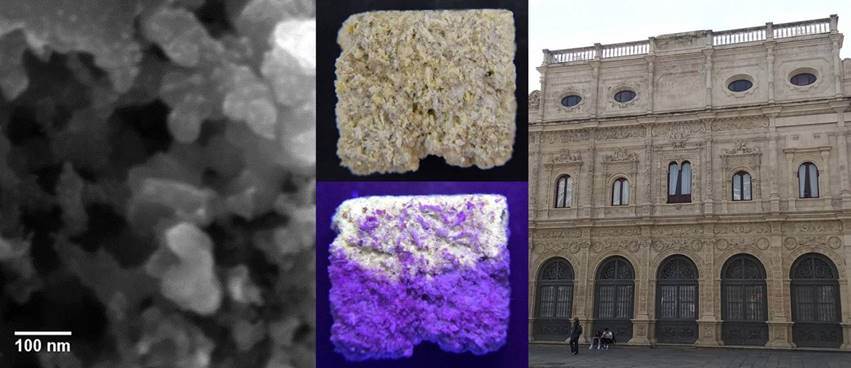
Becerra’s nanolime comprises calcium hydroxide nanoparticles doped with zinc oxide quantum dots, which act as markers. When illuminated with UV light, the quantum dots emit fluorescent light, highlighting the newly formed limestone against the original structure. In practice, conservation workers would remove a small sample from an inconspicuous part of a monument to establish how deeply the consolidant has penetrated and how it is performing.

“The major technical challenge was creating a nanocomposite and not a mixture of two different nanoparticles. It is a key point that the quantum dots are posed on the calcium hydroxide, so we can measure the real penetration depth of the treatment,” Becerra told Physics World.

Seville City Hall

In the group’s latest study, the prototype product was tested against three commercially available consolidants. Two of the alternatives are silica-based, while the other uses calcium hydroxide nanoparticles but without the quantum dots.

All four products were tested on samples from two separate quarries in the Cadiz province of southern Spain. Limestones from these sites were used in the cathedrals of Seville and Cadiz and other important Spanish buildings. Historically, limestone has been widely used throughout southern Europe and northern Africa due to the large amount of calcareous geology found around the Mediterranean Sea.

Describing their findings in Applied Clay Science, the researchers conclude that the two nanolime products had higher effectiveness and better durability than the silica treatments. However, Nanorepair UV had the added advantage of the quantum dots. Shining a UV light on rock cross sections revealed penetration depths of up to 0.8 cm.

A dash of salt

Out in the real world, one of the biggest perils for limestone monuments is weathering by salt crystallization. Water entering the pore network of a stone may contain salts in solution, which can crystallize as water evaporates. This creates pressure inside pores that can lead to micro-fractures, eventually compromising the rock’s surface structure.

In the study, treated samples were subjected to accelerated salt crystallization by being soaked in a sodium sulphate hydrate and baked in an oven multiple times. Sample surfaces were then peeled using a standard sticky tape to reveal the extent to which they had been compromised. The Nanorepair UV-treated sample fared better than the other nanolimes. The team attributes this to the presence of silane in Nanorepair UV, which is included to stabilize the quantum dots.

The results have impressed Roberta Fanatoni, an applied scientist at Italy’s National Agency for New Technologies, Energy and Sustainable Economic Development, who was not involved in the research. “A single product was able to overcome distinct limitations on limestones of the other three commercial products,” she said.

Fanatoni also points out that the presence of zinc oxide might provide an additional benefit of acting as a biocide, reducing stone degradation due to biological processes.

According to Carlos Rodríguez-Navarro, a geologist at Spain’s University of Granada, the Mediterranean basin is full of monuments build from very similar limestones. “You can see very nice examples of monuments built with calcarenite in Sicily, Puglia or the Greek Islands. So, the potential applications of this novel treatments are likely limitless.”

A specialist in cultural heritage, Rodríguez-Navarro does caution, however, that the need to remove samples from historic stonework would be discouraged in lots of real-world situations. He also points out that lab tests can never provide 100% guarantee of how a treatment will behave in the real-world.

Becerra’s group has patented Nanorepair UV and they are currently looking for industrial partners to scale up production.  They are in the process of testing the nanolime on real samples of Roman mortars and they are also studying the use of nanoparticles for other cultural items including books and bones.

The physics of N95 masks, imaging sensitive corals, how Fermilab’s PIP-II accelerator will work

N95 masks are much more than a simple screen filter and use lots of interesting physics – including van der Waals forces – to stop you from breathing in nasty virus particles. The above video does a superb job of explaining how the masks work and also touches on efforts to make them reusable.

Some corals are very sensitive to light, which makes it tricky to obtain high quality images of the organisms. Now, Philippe Laissue at the UK’s University of Essex and the Marine Biological Laboratory (MBL) in Woods Hole Massachusetts and colleagues have created a custom light-sheet microscope that allows the gentle and non-invasive observation of corals and their polyps over eight hours and at high resolution.

Coral image

They used their microscope to obtain this stunning image (left), which shows the re-infection of an Astrangia coral polyp (in cyan from reflected light) with algae (red from chlorophyll fluorescence).

The researchers, including MBL’s Loretta Roberson, describe the technique in Scientific Reports.

PIP-II at Fermilab will be the first accelerator built in the US with significant contributions from other countries — with India, Italy, UK, France and Poland building major components.

Described as the new heart of Fermilab, PIP-II will be an 800 MeV superconducting linear accelerator that delivers a high-intensity proton beam. It can operate in both steady-state and pulsed mode and some of its protons will be used to create an intense beam of neutrinos that will travel 1300 km underground to a detector in South Dakota. The video below describes how PIP-II will accelerate protons.

Light-activated catalysts make nearly perfect water-splitters

Kazunari Domen. Courtesy: Shinshu University

Using sunlight to decompose water could be a clean and renewable way to produce hydrogen fuel, but the photocatalysts traditionally used to promote the process are relatively inefficient. Researchers in Japan have now developed a model system based on strontium titanate that has an external quantum efficiency of 96%, proving that almost perfectly efficient catalysts are possible.

Because the combustion of hydrogen yields only pure water as a waste product, it is often touted as an environmentally-friendly alternative to fossil fuels. The caveat is that to be truly “green”, the hydrogen itself needs to be produced using renewable energy. Solar water splitting, in which sunlight is directed onto an aqueous suspension of light-activated semiconducting particles, is one way of cleanly producing hydrogen. When these particles absorb solar photons, the resulting electron-hole pairs catalyze the breakdown of water, liberating the hydrogen.

Several roles

The drawback of this method is that the catalytic process is highly complex, requiring the semiconductor particles to play several roles at once. First, they must be able to absorb light in the solar spectrum range, which means they need to have narrow bandgaps near the 500nm peak of the Sun’s emissions. Second, they need to generate and then separate electron-hole pairs. Third, they must allow these holes and electrons to travel to the particle-water interface and catalyse the production of hydrogen (a process that requires electrons) and oxygen (a process that requires holes) from water. Last, but not least, they need to minimize unwanted side processes (which can lower the overall efficiency of the system) occurring at each step along the way.

That is a long list, and although researchers have long been searching for efficient photocatalytic materials, typical photocatalysts have an external quantum efficiency (EQE) – that is, the fraction of photons impinging on the system that end up being used to produce hydrogen – of less than 10%.

Strategies for reducing loss mechanisms

In their work, a team of researchers led by Kazunari Domen of Shinshu University in Nagano and the University of Tokyo focused on strontium titanate (SrTiO3), a photocatalytic water-splitter that was discovered in the 1970s. Although SrTiO3 is impractical for making real-world photocatalysts (it produces electron-hole pairs by absorbing near-ultraviolet light rather than visible light), the researchers argue that it is nevertheless a good model system because the mechanisms responsible for its efficiency losses are well understood.

Domen and colleagues studied several ways of reducing loss mechanisms in SrTiO3. The first involved suppressing charge carrier recombination, which occurs when electrons and holes recombine before they can take part in the water-splitting reaction. Since defects in the crystal lattice act as potential recombination hubs, the researchers used a flux treatment to improve the crystallinity of the photocatalyst particles, thereby reducing the number of lattice defects. They then reduced the number of chemical defects in the lattice by aluminium doping.

The team’s second strategy was to further suppress charge recombination by taking advantage of the fact that electron and holes in SrTiO3 crystals collect at different crystal facets. They did this by selectively depositing specific co-catalysts on the different facets to enhance hydrogen production at the electron-collecting facets and oxygen production at the hole-collecting ones. Although this approach is not new, and was developed and refined by other research groups, Domen tells Physics World that in the present work, his team was able to demonstrate the approach’s effectiveness “more clearly than any former study”.

Finally, the researchers prevented an unwanted side reaction (the oxygen-reduction reaction) by encasing the rhodium co-catalysts for the hydrogen-producing reaction in a chromium-based protective shell.

Near-unity internal quantum efficiency

By combining these three strategies, the team demonstrated an EQE of up to 96% for their material when it was irradiated with light in the 350-360 nm range. This translates into an internal quantum efficiency (IQE), which is the fraction of absorbed photons that can be used to produce hydrogen, of near unity, which implies that the photocatalyst is almost perfect.

Domen and colleagues hope their strategies to improve the efficiency of SrTiO3 will also work for photocatalysts driven by visible light. They have published their results in Nature and Simone Pokrant of the University of Salzburg in Austria, who was not involved in this work, details their findings and their implications in a related Nature News and Views article.

From virus spikes to narwhal tusks, physicists discover universal design for stingers

From virus spikes to narwhal tusks, the stingers of many living organisms have the same basic mechanical design. Now a team of physicists led by Kaare Jensen has studied the mechanical properties of more than 200 natural and manmade stingers to discover why.

The researchers at the Technical University of Denmark found a clear relationship between the structural properties of stingers large and small – thereby solving a long-standing evolutionary mystery. As a bonus, their work could lead to artificial structures that better mimic the desirable properties of natural stingers.

A staggering variety of living organisms come equipped with pointed outgrowths for purposes ranging from catching prey to combating rivals. These stingers range in size from tens of nanometres to several metres, yet are remarkably similar in terms of their design and mechanical properties – even in very different organisms. This similarity also extends to artificial structures such as nails and pointed weapons.

Resistance to elastic deformation

To understand this ubiquity of design, Jensen’s team experimented with artificial stingers made from the polymer polydimethylsiloxane and compared their results with previous studies of natural stingers. For simplicity, the team define a stinger as being straight and rigid with a long, slender tapered shape and a roughly circular cross-section. Their definition also includes strong resistance to elastic deformation.

Within these constraints, they constructed a database of stingers from over 200 objects, including viruses, algae, and larger vertebrates and invertebrates: both marine and terrestrial. They also included manmade objects such as nails used in construction, hypodermic needles, and spears from ancient warfare.

The experiments revealed how stingers buckled and broke when subjected to a load. When combined with the results of previous studies described in the scientific literature, these data revealed an optimal relationship between the diameters, lengths, stiffnesses, and friction forces per unit area of different stingers.

A crucial insight revealed by the study is that stinger structures exist at the mechanical limits imposed by friction, elastic stability, and costs incurred by maintaining tissue. This constraint ultimately explains the universality found in stinger structures: no matter their size, living organisms evolve until their outgrowths reach these limits, causing their stingers to converge at the same shape.

Having explained this long-standing mystery, Jensen’s team will now explore how their findings could apply to biomechanics and the evolution of animal weapons, and potentially lead to new medical applications. Elsewhere, they could inform engineers as to how manmade structures which mimic natural stingers could be precisely manufactured on different scales to improve performance and reduce material costs.

The research is described in Nature Physics.

Bipartisan bill aims to revamp National Science Foundation

A bipartisan group of US senators and representatives has introduced legislation in Congress that would significantly change the operation of the National Science Foundation (NSF). Proponents of the bill say that the proposal aims “to solidify the United States’ leadership in scientific and technological innovation through increased investments in the discovery, creation, and commercialization of technology fields of the future”. To do so, the so-called Endless Frontier Act would expand the NSF’s remit, rename the organization and provide more than $100bn in support. The proposal has gained approval from many, but some have objected that it may undercut the NSF’s main objective, which is to fund basic scientific research.

Those behind the bill – four prominent US congresspeople – say that its introduction stems from the perception that international competitors, and particularly China, threaten to overtake the US technologically. “To win the 21st century, we need to invest in technologies of the future,” says Ro Kahana, a Democratic congressperson from California. “That means increasing public funding into those sectors of our economy that will drive innovation and create new jobs.”

Chuck Schumer, a New Yorker who leads the Democratic minority in the Senate, says that the US “cannot afford” to continue to underinvest in science while still “lead[ing] the world” in advanced research. That view is backed by Republican senator Todd Young of Indiana. “By virtue of being the first to emerge on the other side of this pandemic, the Chinese Communist Party is working hard to use the crisis to its advantage by extending influence over the global economy,” he claims. The new act, adds Republican representative Mike Gallagher of Wisconsin, who is the fourth member of the group introducing the legislation, “is a down payment for future generations of American technological leadership”.

The group announced the bill shortly after the 70th birthday of the NSF on 10 May. The legislation is named after a report – Science: the Endless Frontier – by Vannevar Bush, who was at the time director of the US government’s Office of Scientific Research and Development. That report, published 75 years ago on 5 July, laid the foundations for the US’s postwar boom in science and technology.

Ringing the changes

The changes envisioned by the group start with the name. The NSF would become the National Science and Technology Foundation (NTSF), with the additional “T” creating a new technology directorate – with its own deputy director – that has “flexible personnel, programme management, and awarding authorities”. The new directorate would fund research in 10 specific areas including: artificial intelligence and machine learning; high-performance computing, semiconductors, and advanced computer hardware; quantum computing and information systems; robotics, automation and advanced manufacturing; and advanced energy technology.

The transformation, however, would not come cheap, costing $100bn over five years. The bill authorizes an extra $10bn over five years to enable the Department of Commerce – another science-related government agency – to designate at least 10 regional hubs across the country. These would act as global centres for research, development and manufacturing of key technologies. That amount would finance a series of authorized activities. They include increased research spending at universities, which could form consortia with private industry to create focused research centres and develop other ways to advance new technologies. It would also include programmes to facilitate and accelerate the transfer of new technologies from the laboratory to the market as well as increased spending on research collaborations with US partners.

Leaders of research institutions have shown their enthusiasm for the bill. “To maintain global competitiveness and nurture future job creation, our country must prioritize research that will be fundamental to innovation and discovery,” says New York University president Andrew Hamilton.

Rafael Reif, president of the Massachusetts Institute of Technology, agrees. “Supporting fundamental research with an eye to real-world challenges is the kind of thinking that drove the Defense Advanced Research Projects Agency to develop what became the Internet,” he wrote in The Hill. “Such use-inspired basic research, funded by NSF…is what’s needed to retain US leadership in both science and technology, to keep us prosperous and secure.”

Yet the proposal has drawn some criticism. Former NSF director Arden Bement told Science of his concern that the bill could indicate to Congress – which appropriates agencies’ funds – that investments in the bill’s innovative technologies override the importance of the NSF’s core mission of funding fundamental, curiosity-driven research. But Bement’s successor France Córdova, who completed her six-year term as NSF director in March, argues that current-day science involves more seamless integration between fundamental and applied research.

The relevant committees of the House of Representatives and the Senate have yet to schedule hearings on the bill. Given the impact of coronavirus and protests from the Black Lives Matter movement as well as the forthcoming presidential election in November, an early decision on the legislation looks unlikely. Nevertheless, the bipartisan group that promotes the legislation has given legislators and the US scientific community indications of a new approach to the relationship between government-funded research and application.

Copyright © 2026 by IOP Publishing Ltd and individual contributors