Randomized measurements reveal topological quantum states

Topological materials – materials that have surface properties very different to those found in their bulk – are currently revolutionizing condensed-matter physics thanks to their unique characteristics. Researchers in Austria, France, the US and Germany, have now put forward a new technique to identify and characterize the global invariants that mathematically describe these materials in various experimental platforms in the laboratory. The work could advance our understanding of these structures, which might be used in next-generation energy-efficient electronics and quantum-computing applications.

Topology – sometimes called “rubber sheet geometry” – is a branch of mathematics in which two objects are assumed to be equivalent if they can be continuously deformed into one another by bending, twisting, stretching or shrinking (but not tearing or cutting). In this framework, a circle is topologically equivalent to an ellipse, for example, and a doughnut to a coffee mug. In both cases, the objects can be deformed into the other by stretching.

Topological materials show similar geometries on the molecular scale, which gives rise to several unusual mechanical and electrical properties. Topological insulators, for example, do not carry electrical currents in their bulk, but current does flow along their surfaces through special “edge” states. Crucially, the electrons in these states can only travel in one direction, and they also steer around imperfections or defects on the surface without backscattering. Since backscattering is the main energy-dissipating process in electronic devices, these “topologically protected states”, as they are known, might be useful ingredients in next-generation energy-efficient devices.

Another benefit is that in topological materials, a surface electron with a certain momentum cannot scatter into a state with opposite momentum because to do so it would have to flip its spin. Topologically protected states might thus also be ideal for quantum-computing applications, in which defects usually destroy quantum information (the spin state) carried by electrons.

Topological invariants

While characterizing these topologically protected states is important for classifying the different topological phases that can be realized for potential applications, doing so in laboratory experiments is difficult. This is because the mathematical invariants that describe them are considered as global, overall, quantities and thus cannot be probed on small, local scales.

A team of physicists led by Peter Zoller from the Centre for Quantum Physics at the University of Innsbruck and the Institute for Quantum Optics and Quantum Information at the Austrian Academy of Sciences and Benoit Vermersch from the University of Grenoble-Alpes in France have now put forward a new measurement technique that overcomes this problem.

“The topological invariants in these states of matter are very complex functions of their quantum states, which makes a direct measurement in an experiment an impossible task,” explains Vermersch. “What we propose instead is to extract ‘many-body’ topological invariants (MBTIs) from a data set, which we obtain from several measurements.”

Random operations

The experimental recipe consists of subjecting a quantum state to a number of different random operations and studying how it reacts, Vermersch says. “By then using random matrix theory, we have proven that we can estimate MBTIs from this data set obtained from such randomized measurements.”

The specific feature of this technique is that although the topological invariants are highly complex, non-local correlation functions, they can still be extracted from statistical correlations of randomized measurements, he adds. Such random measurements are possible in synthetic quantum matter (or “quantum simulators”) made from tried and trusted experimental platforms such as cold atoms, trapped ions and superconducting quantum bits, to name but three. “Our protocol for measuring the topological invariants can therefore be directly studied in these existing systems in the laboratory,” says Vermersch.

Spurred on by their preliminary results, which they report in Science Advances, the researchers say that they would like to generalize their toolbox to be able to classify different types of topological phases beyond the ones studied in the present work. “Such phases include exotic ones, like those with ‘intrinsic topological order,’” Vermersch tells Physics World. “Doing this will of course be a great technological challenge.”

Vermersch and Zoller worked with colleagues Andreas Elben and Jinlong Yu to develop their measurement technique. They also collaborated closely with Guanyu Zhu and Mohammad Hafezi from the Joint Quantum Institute in Maryland and Frank Pollmann from the Technical University of Munich.

Solitons from new fibre laser could improve eye surgery

A fibre laser that emits high-energy, dispersion-free light pulses has been produced by researchers in Australia and the US. These soliton pulses are held together by a high-order term in the optical dispersion equation that had previously been a nuisance to scientists producing solitons. The researchers hope that their work will encourage the study of higher-order terms in the dispersion equation. Practical applications of high-power solitons include laser eye surgery.

Optical dispersion occurs when light at different frequencies (colours) travel at different speeds in a medium – causing a light pulse containing different frequencies to spread out in space and time. Familiar examples of dispersion are light being broken into different colours by a prism and the formation of rainbows. The equations governing dispersion, however, are complex. Adding second-order effects leads to non-dispersive solutions called solitons. In this case first and second order effects balance each other out and the pulse does not spread out.

Solitons in optical fibres were first observed in 1973 and have since have found applications in areas such as laser spectroscopy. However, their power is limited. In the early 1990s, researchers attributed this to higher-order terms in the optical dispersion equations, which become increasingly important as pulse power increases. This makes the pulses increasingly unstable and eventually causing them to break apart. Today, lasers that are used to produce high-power ultrashort pulses are complex and expensive. They produce pulses that chirp (change in frequency as the pulse progresses) and use additional equipment to reshape these chirped pulses into stable pulses.

All the heavy lifting

In 2018, Martijn de Sterke of the University of Sydney and colleagues found that fourth-order (quartic) dispersion is not necessarily destructive when they discovered a new type of optical soliton in a silicon waveguide. By “serendipity” de Sterke and colleagues found that, rather than being a perturbation “[the quartic dispersion] really did all the heavy lifting”: “The waveguide was not designed that way,” he explains, “it just happened to be that way, and our colleague Andrea Blanco-Redondo was clever enough to recognize that.”

In this latest work, de Sterke, Blanco-Redondo (now at Nokia Bell Labs in the US), Antoine Runge and Kevin Tam demonstrate the value of that serendipitous 2018 observation using an ultrafast fibre-laser that emits “pure quartic solitons”. The laser cavity incorporates a spectral pulse shaper that engineers the second- and third-order dispersion to be zero, while imparting a strong quartic dispersion. The resulting pulses agree well with the researchers’ theoretical predictions.

Crucially, Runge notes that much higher-power soliton lasers than previously possible may be achievable. “In a normal, quadratic soliton, if you halve the pulse duration, the energy goes up by a factor of two,” explains Runge, “In these new pure quartic solitons, if you halve the pulse duration, the energy goes up by a factor of eight.” This could allow them to be used in new applications: “A 100 fs quartic soliton could contain nanojoule energies with peak powers in the tens or hundreds of kilowatts,” he says. “For laser surgery and non-linear imaging that’s probably enough.”

Simplification needed

He says, however, that their device needs simplification to eliminate the pulse shaper before it could be commercially viable as a soliton laser: “At present, we don’t have fibres with the right dispersion,” he says, “but in future, if you managed to fabricate fibre like that – and we already have designs – then you wouldn’t need to do phase modulation or anything like that, and you would have a laser that was much simpler. What we did here was a proof of principle that these pulses exist and have these properties, but we’re still far away from a commercial pure quartic soliton laser.”

Runge hopes the work will encourage researchers to explore the potential of higher-order optical dispersion terms: “Now we have potentially an infinite family of pulses we can generate because we can tailor the dispersion the way we want and see if there’s something interesting for such or such application.”

Ultrafast laser spectroscopist Georg Herink of the University of Bayreuth in Germany is cautiously optimistic: “You definitely would get more energy into a soliton, and it definitely makes it interesting to look at even higher order terms,” he says. He cautions, however, that current de-chirping schemes produce orders of magnitude more energetic and shorter pulses than does the Sydney technique.

Herink suspects, however, that tuning the dispersion inside an optical cavity and producing multiple stable solutions of the optical dispersion equation has significant research potential: “Can you do something that hasn’t been observed before? Now you can explore a lot of academic questions that are maybe uniquely accessible with this platform experimentally.”

The research is described in Nature Photonics

So you think you know your physics and music trivia?

1 At which institution in London did Queen guitarist Brian May study physics? A. King’s College B. University College C. Imperial College D. Queen Mary

2 What instrument is Albert Einstein best known for playing? A. Piano B. Trumpet C. Cello D. Violin

3 Which of these was not a song by German electronic band Kraftwerk? A. Electricity B. Radioactivity C. Uranium D. Transistor

4 US physicist and polymath Douglas Hofstadter once wrote a book that in part examined the work of which composer? A. Bach B. Beethoven C. Berlioz D. Brahms

5 German pop star Lena Meyer-Landrut won the 2010 Eurovision Song Contest with a song that likens her relationship to her lover to which piece of hardware? A. Satellite B. Laser C. Fusion reactor D. Magnet

6 In 2017 hip-hop star, philanthropist and entrepreneur will.i.am met physicists on a tour of which UK university? A. Aberdeen B. Birmingham C. Cardiff D. Durham

7 Which 1970s rock band sang the lyric “I’m a Spaceship Superstar… got a solar-powered laser beam guitar”? A. Slade B. Prism C. Sweet D. Wizzard

8 Which of these was not a song by British rock band Muse? A. Supermassive Black Holes B. Starlight C. Neutron Star Collision D. Quasar

9 Which of these terms is not used to describe the shape of a concert hall? A. Shoebox B. Vineyard. C. Shell D. Horseshoe

10 Who sang this appallingly stereotypical description of a physicist? “The lasers are in the lab/The old man is dressed in white clothes/Everybody says he’s mad/No one knows the things that he knows”? A. Joni Mitchell B. James Taylor C. Neil Young D.Linda Ronstadt

Stuck for the answers? The solutions are given below.

Musical_Sound,_Instruments,_and_Equipment_original lores2Offering readers a basic understanding of sound, musical instruments and music equipment, Musical Sound, Instruments and Equipment by Panos Photinos from Southern Oregon University is an ideal book for anyone wanting an introduction to the fundamental properties of sound waves and acoustics. Perfect reading for those budding musicians and sound engineers, it’s free to download until 6 June 2020.
 

Solutions 12345678910 C

Fluids flow faster in liquid-walled channels

Blood may be thicker than water, but in a narrow enough tube, both liquids flow like treacle. This sluggish behaviour arises because, as you reduce the size of the channel, friction between the liquid and the channel wall comes to dominate the flow dynamics. Researchers have tried various ways of engineering surfaces to reduce this effect, but now a team from France, Switzerland and Ireland has gone a step further by doing away with solid channel walls altogether. Instead, the researchers confine their fluid within a conduit that itself consists of a liquid.

Writing in Nature, Peter Dunne (University of Strasbourg), Takuji Adachi (University of Strasbourg and University of Geneva) and colleagues describe how they form the walls of their conduit using ferrofluid – a colloidal suspension of magnetic nanoparticles in oil.

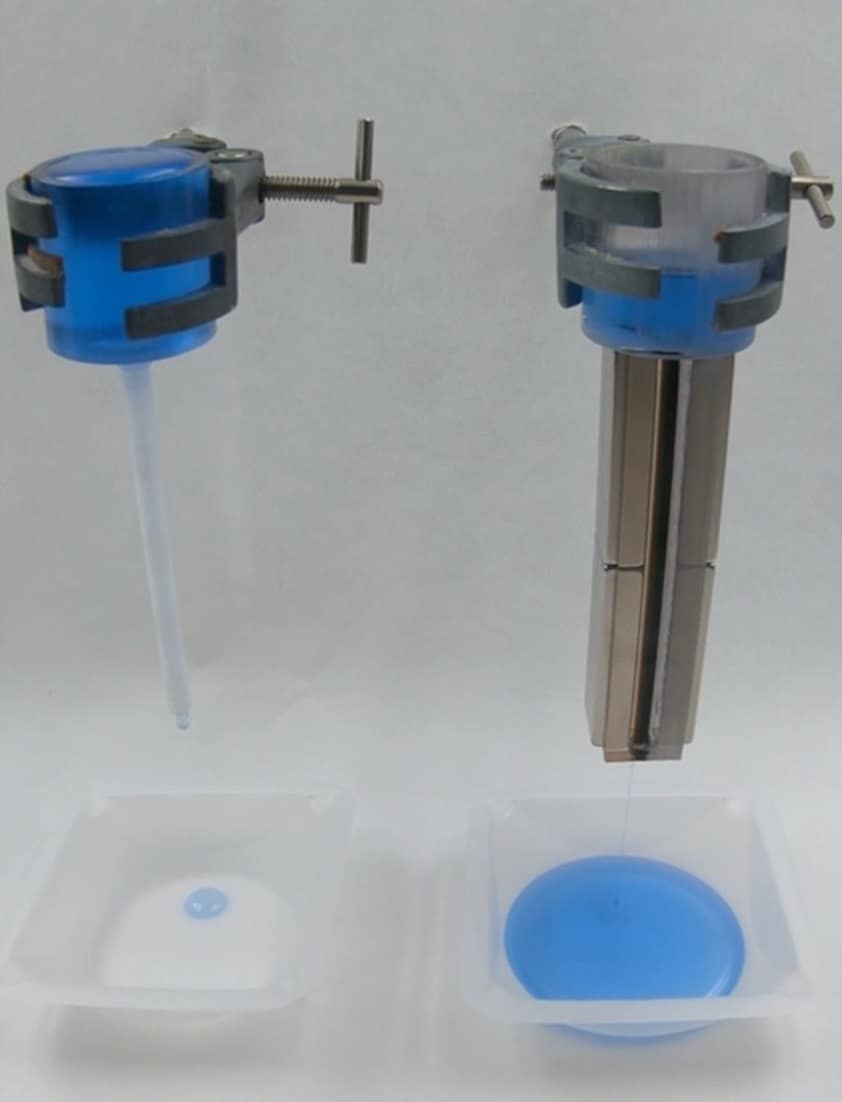
The researchers outlined the shape of their desired channel using long, rod-shaped neodymium magnets held in a 3D-printed framework. With four such magnets arranged with alternating polarities around the channel, they created a quadrupolar magnetic field whose strength fell to zero at the centre. This meant that the ferrofluid stuck to the inner edges of the framework, while the water that they channelled was confined to a narrow stream at the conduit’s centre.

By varying the properties of the ferrofluid and the distance between the magnets, the researchers created water “antitubes” approximately 14 µm across. They calculated that the right combination of parameters could yield antitubes thinner than 1 µm, though this was beyond the detection limit of the team’s equipment.

Glycerol flow

The ease with which a fluid flows over a surface is described by the slip length. In fluids that interact with the channel wall, flow is fastest at the centre and decreases along an approximately parabolic trend towards the solid–liquid interface. The slip length defines the distance beyond this interface at which the flow velocity would fall to zero. A fluid that is held stationary at the channel edge has a slip length of zero, while longer slip lengths indicate more freely flowing fluids.

That, at least, is the case when the sides of the channel are solid and immovable. In the experiments reported by Dunne and Adachi, the magnetic fluid making up the conduit walls moves too, flowing along with the water near the centre of the channel, and recirculating back to the start along the outside edge, next to the magnets. This results in an effective slip length much longer than could be achieved if the conduit walls were static.

“What is amazing is that we get a slip length of millimetres, whereas normally this is measured in nanometres or micrometres,” says study co-author Thomas Hermans, of the University of Strasbourg.

Magnetic control

While this very-low-friction fluid conduit was achieved with a static arrangement of magnets, the researchers found that they could manipulate the flow by altering the magnetic field configuration. Bringing an external magnet near to the conduit, for example, severed the water antitube, stopping its flow and functioning as a magnetic valve. When the external magnet was removed, the antitube repaired itself and the flow of water resumed.

The team used a similar effect to create a “magnetostaltic” pump, which they call the Qpump. In this device, concentric rings of magnets define a circular conduit, except that the water antitube is periodically disrupted by magnetic polarity reversals along the length of the inner ring. When the inner ring rotates, these localized blockages move along the channel’s circumference, driving water as they go.

Damage-free pumping

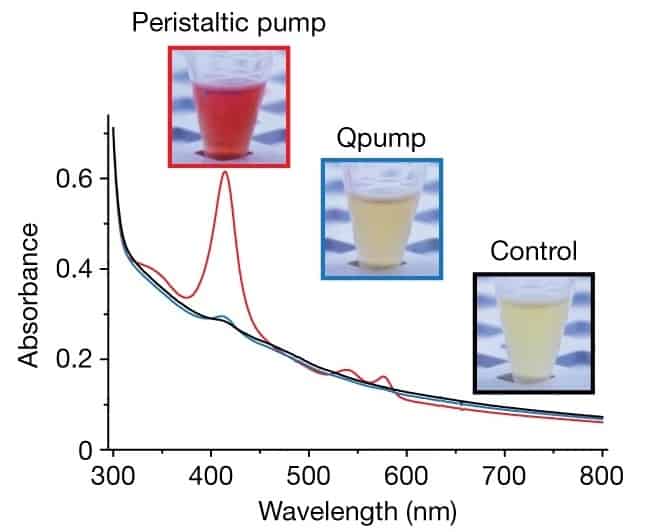
When they tested the Qpump with blood instead of water in the central channel, Dunne and colleagues found it to be a much gentler way to drive fluid flow than conventional peristaltic pumps. Peristaltic pumps work by squeezing the walls of the conduit, but this induces shear forces that can rupture blood cells. The Qpump avoids such forces, meaning it could be used to drive a heart–lung machine, for example, without damaging the blood in the process. First, though, the team intends to prove the principle by applying it outside of the clinic.

“Our start-up company, Qfluidics, just entered the Merck global accelerator programme, where we will see if Qpumps can be used to pump delicate biologicals other than blood,” says Hermans. “The regulations for such uses are very much reduced as compared to medical applications, so this will be the first real application we will pursue.”

Artificial eye has the potential to outperform human vision

An artificial device that closely mimics the structure and function of the human eye has been unveiled by Leilei Gu and colleagues at The Hong Kong University of Science and Technology. The team based its design around a hemispherical arrangement of light-sensitive nanowires, which imitate photoreceptor cells in the human retina. Their device has the potential to produce images at higher resolutions than the human eye and could lead to significant new advances in robotics.

Our eyes provide us with around 80% of the information we perceive from our environment. They give us a field of view as wide as 160°; quickly adapt to different lighting and visibility conditions; and resolve details as small as 30 cm from 1 km away. This is possible thanks to our retinas – concave hemispheres that contain 10 million photoreceptor cells in every square centimetre.

While some other parts of the body have been successfully mimicked by technology, the eye has proven far more difficult to copy. At the heart of the problem are the flat configurations of today’s most advanced image sensors, which make them all but impossible to integrate into hemispherical structures to create artificial retinas.

Light-sensitive electrodes

Gu’s team circumvented this issue by mimicking the eye’s photoreceptor cells using perovskite nanowires, which served as light-sensitive electrodes. The wires were deposited onto the inside surface of a porous, hemispherical shell of aluminium oxide, and attached to liquid-metal wires which simulated the nerve fibres behind the retina.

An opposite-facing, tungsten-coated aluminium hemisphere then acted as the countering electrode to the nanowires; while the space between the hemispheres was filled with an ionic fluid electrolyte, comparable to the vitreous fluid found in human eyes. Finally, a lens and adjustable aperture were placed over a hole in the second hemisphere.

Gu and colleagues have built a prototype of their design with a nanowire arrangement that creates 100 pixels – enough to reconstruct images of different letters projected onto the device’s lens. Although this is far from the capabilities of the human eye, the researchers calculate that the nanowires they use could be packed in densely enough to allow for images with resolutions ten times higher than those that our eyes produce.

Applications for a fully functional artificial eye could include human-like robots that carry out autonomous tasks and excel at interacting with humans. In addition, the design could inspire the development of prosthetic eyes that entirely reconstruct the sight of visually impaired people. Gu’s team now aims to realize the full potential of their device, and hope to produce biomimetic eyes that outcompete our own eyes in the near future.

The artificial eye is described in Nature.

Saving The Scream

Edvard Munch’s painting The Scream (ca. 1910) is often described as the ultimate expression of the anxiety-ridden existence of modern man, but after more than 110 years, this evocative artwork is showing its age. The degradation is especially severe in areas where Munch used cadmium-sulphide (CdS)-based pigments, and the painting has become so delicate that it is rarely exhibited, remaining instead in a protected storage area in the Munch Museum in Oslo, Norway. An international team led by researchers at the National Research Council (CNR) in Italy have now used a combination of in-situ non-invasive spectroscopic and synchrotron X-ray techniques to show that moisture is the main cause of the degradation. According to the Munch Museum’s Irina Crina Anca Sandu, the team’s work could help conservation experts develop new conservation strategies to better preserve this and other works of art.

Munch created several versions of his masterpiece: two paintings, two pastels, a series of lithographic prints and several drawings and sketches. The most familiar are two paintings, created in 1893 and around 1910, which belong to the National Gallery and the Munch Museum, respectively.

The Scream is considered Munch’s most central work of art, and its impact comes from his intensive use of rhythmic wavy lines and contrasting straight bands typical of the Art Nouveau period. In The Masterworks of Edvard Munch (Museum of Modern Art, 1979), Munch is quoted as saying: “I walked one evening on a road—on the one side was the town and the fjord below me. I was tired and ill—I stood looking out across the fjord—the sun was setting—the clouds were coloured red—like blood—I felt as though a scream went through nature—I thought I heard a scream—I painted this picture—painted the clouds like real blood. The colours were screaming.”

Some screaming colours have chemically transformed

To make the “screaming” colours, Munch experimented with combinations of diverse binding media (tempera, oil and pastel) and brilliant and bold synthetic pigments such as zinc white, Prussian blue, synthetic ultramarine blue, chrome yellow and green, and cadmium orange and yellow. He did not know, however, that these novel materials would chemically transform over time, altering in colour or becoming structurally damaged. Today, some yellow areas of the sunset cloudy sky, as well as the neck area of the central figure in the ca. 1910 painting, show clear signs of degradation: the cadmium yellow brushstrokes have become off-white, and the lake water, which Munch thickly painted with opaque cadmium yellow, is flaking.

Earlier studies that applied scanning electron microscopy-energy dispersive X-ray and Fourier transform infrared (FTIR) techniques to microsamples of The Scream revealed that cadmium carbonate makes up most of the paler yellow tones of the sky and the main subject’s neck. These studies also showed that the cadmium carbonate had been mixed with varying amounts of sulphur, chlorine and sodium compounds in the lake region of the painting.

These observations, however, left the CNR-led team with several unanswered questions. Was the extent of the degradation in the CdS-based paint surface linked to its chemical composition? Into which compounds had the cadmium yellow compounds degraded? And finally, what caused these paints to deteriorate?

Non-invasive spectroscopy and synchrotron radiation X-ray techniques

To answer these questions, the researchers studied selected CdS-based areas of the painting using a series of spectroscopic analyses through the European MOLAB platform – a network of facilities from Italy, France, Poland, Greece and Germany that provides portable equipment for in-situ non-invasive measurements on artworks. They combined these analyses with the study of micron-sized samples from the painting that they obtained by scraping off an area from a spot of the flaking yellow surface of the lake region. They analysed these minute samples using micro X-ray diffraction, micro- X-ray fluorescence and micro X-ray absorption near-edge structure spectroscopy, mainly at the ID21 beamline at the ESRF (the European Synchrotron) in Grenoble, France. “This beamline is one of the few in the world where we can perform imaging X-ray absorption and fluorescence spectroscopy analysis of the entire sample at low energy and with sub-micrometre spatial resolution,” explains team member Koen Janssens of the University of Antwerp.

Annalisa Chieli, Letizia Monico and Gert Nuys

The team compared their results to those obtained on artificially-aged oil paint mock-ups that had a similar composition to the lake material. They prepared the latter using an early 20th century cadmium yellow pigment powder and a cadmium yellow oil paint (labelled as Jaune de cadmium citron) that once belonged to Munch himself. They also obtained another set of oil paint mock-ups by mixing powders of cadmium sulphide with equal amounts of sodium sulphate and cadmium chloride, explains study lead author Letizia Monico of the CNR.

To artificially age the samples, the researchers exposed them first to UVA-visible light and a relative humidity (RH) of 45% and then a RH of more than 95% at 40°C for up to 100 days in the absence of light. “The goal of these experiments was to extrapolate the causes that can lead to deterioration,” Monico says.

Moisture is the culprit

The results of these experiments, which are detailed in Science Advances, reveal that the original CdS transforms into cadmium sulphate (CaSO4) in the presence of chloride-containing compounds in high moisture conditions (a RH of 95% and above). This occurs even in the absence of light. The results also show that exposure to moisture causes (Cd,Cl) species to migrate through the paint along with the oxidation of the original CdS to CdSO4. This phenomenon does not occur on Cl-free oil paint mock-ups aged under similar conditions.

To mitigate further degradation of the cadmium yellow pigment in The Scream (ca. 1910), Monico says the painting shouldn’t be exposed to moisture levels higher than 45% RH, while lighting conditions should be kept at “normal values for lightfast painting materials”. Currently, the Munch Museum stores and exhibits paintings at a RH of about 50% and a temperature of around 20°C.

Since Munch’s contemporaries, including Henri Matisse and Vincent van Gogh, also used cadmium-sulphide-based yellows, the findings could aid the development of preservation strategies for works by these artists too, explains MOLAB coordinator Costanza Miliani.

“This kind of work shows that art and science are intrinsically linked and that science can help preserve pieces of art so that the world can continue admiring them for years to come,” she states.

Exploring the philosophical, historical and sociological dimensions of physics, researchers ponder their return to the lab as lockdowns lift

This episode features the philosopher of science and Physics World columnist Bob Crease in conversation with Matin Durrani – who has edited Crease’s Critical Point column since its inception 20 years ago.

Crease explains how he finds inspiration for his columns from both his personal experiences and by interacting with Physics World readers. He also talks about the highs and lows of writing the column, including an embarrassing early-morning appearance on BBC radio.

Thankfully, it looks like some countries are at the point of relaxing COVID-19 restrictions and allowing some people to go back to work. But how will experimental physicists go back to their labs, and what will working conditions be like with some social distancing rules still in place?

Physics World’s Margaret Harris is on hand to chat about the challenges of returning to the lab and explains how one group in France is managing the transition.

Two members of the French team have written a Physics in the Pandemic blog for Physics World and Harris also talks about how this series of articles has chronicled how physicists around the globe have adapted to the pandemic.

This podcast is sponsored by Teledyne Hastings Instruments.

Anyons bunch together in a 2D conductor

Anyons – the particle-like collective excitations that can exist in some 2D materials – tend to bunch together in a two-dimensional conductor. This behaviour, which has now been observed by physicists at the Laboratory of Physics of the ENS (LPENS) and the Center for Nanoscience and Nanotechnologies (C2N) in Paris, France, is completely different to that of electrons, and experimental evidence for it is important both for fundamental physics and for the potential future development of devices based on these exotic quasiparticles.

The everyday three-dimensional world contains two types of elementary particles: fermions and bosons. Fermions, such as electrons, obey the Pauli exclusion principle, meaning that no two fermions can ever occupy the same quantum state. This tendency to flee from each other is at the heart of a wide range of phenomena, including the electronic structure of atoms, the stability of neutron stars and the difference between metals (which conduct electric current) and insulators (which don’t). Bosons such as photons, on the other hand, tend to bunch together – a gregarious behaviour that gives rise to superfluid and superconducting behaviours when many bosons exist in the same quantum state.

Within the framework of quantum mechanics, fermions also differ from bosons in that they have antisymmetric wavefunctions – meaning that a minus sign (that is, a phase φ equal to π) is introduced whenever two fermions are exchanged. Bosons, in contrast, have symmetric wavefunctions that remain the same when two bosons are exchanged (φ=0).

Completely different situation in 2D

In two-dimensional systems, however, bosons and fermions are joined by other, more exotic types of elementary particles. In 2D electrical conductors, for example, the electrons interact very strongly with each other, and their collective movements can be viewed in terms of the motion of new elementary objects known as anyons.

The existence of anyons – which get their name from the fact that their behaviour is neither fermion-like or boson-like – was predicted in the early 1980s by the theoretical physicist Frank Wilczek. Soon afterwards, another physicist, Bert Halperin, found that anyons could explain certain aspects of the fractional quantum Hall effect, which describes the changes that take place in electronics at low temperatures in strong magnetic fields. Then, in 1984, Dan Arovas, Bob Schrieffer and Wilczek proved that a successful theory of the fractional quantum Hall effect does indeed require particles that are neither bosons or fermions.

As well having a different – fractional – charge from fermions or bosons, anyons are also predicted to obey different quantum statistics. To investigate these statistics, researchers have sought to devise experiments that can probe how the properties of an ensemble of particles are affected when two particles are exchanged.

Previous efforts have focused on directly measuring the phase that appears in the anyons’ wavefunctions when two of them are exchanged in an interferometer (a device that measures the phase difference between two waves). So far, however, LPENS team leader Gwendal Fève says that such experiments have proved tricky thanks to external effects that combine to modify the phase of the anyons’ wavefunction. These effects, known collectively as decoherence, tend to “wash out” quantum interference, and they are particularly strong in correlated systems.

Mini “anyon collider”

To overcome these problems, Fève and colleagues developed an anyon collision experiment that can measure the quantum statistics of particles and, in particular, determine whether the particles repel each other or bunch together. They began by using the weak coupling of electrons between two edges in a fractional quantum Hall fluid (in this case, a 2D electrical conductor made of an GaAs/AlGaAs electron gas) as a means of emitting anyons randomly – something that Fève says is not easy to do. They then collided the anyons on a beam splitter and measured the currents at its outputs.

The LPENS team created their miniature anyon collider using an electronic chip fabricated by their colleagues at C2N. To safeguard the anyons’ quantum properties, they kept the 2D electrical conductor on this chip at ultralow temperatures of 30 mK, and generated the collisions by applying a strong magnetic field (13 Tesla) perpendicular to the conductor.

In such a high magnetic field, all the electrons in the 2D electron gas will occupy the same energy level, and their interactions are very strong. This leads to the emergence of so-called “Abelian” anyons, which are predicted to appear when ν, the fraction of the energy level that is filled by electrons, is equal to 1/3, 1/5 and so on (that is, all fractions of 1/m, where m is an odd integer), Fève says. For ν=1/3, anyons are known to carry a fractional charge of e/3 (where e is the charge on the electron) and to obey fractional statistics. Their wavefunctions pick up a phase φ= π/3 when two anyons are exchanged, leading to behaviour that is intermediate between fermions and bosons.

Measuring current correlations

The researchers measured correlations in the electric current by measuring the currents at two outputs (labelled 1 and 2) of the beam splitter in their collision experiment. They amplified these currents – denoted by i1(t) and i2(t) – using custom-made cryogenic amplifiers since the signatures are very small. They then digitized them, computed the product of the two output currents, i1(t) x i2(t), and averaged this quantity over a large number of collisions.

“For uncorrelated currents, the average of the product i1(t) x i2(t), which we write < i1(t) i2(t)>, equals the product of the average currents, < i1(t)><i2(t)>,” explains Fève. “In the case of collisions between anyons, we measure negative correlations, meaning that <i1(t) i2(t)> is smaller than < i1(t)><i2(t)>.”

This negative correlation allowed the team to characterize the anyons’ tendency to regroup in packets of particles when they collide – a behaviour that demonstrates that they do not behave as electrons even though they originate from an ensemble of electrons, he says.

“After a careful analysis and comparison with theoretical predictions for anyon collisions, we found that the degree of negative correlations we observe agrees well with the prediction that φ= π/3 for anyons at a filling factor ν=1/3,” he tells Physics World. This result corresponds to the quantum behaviour of anyons, thus demonstrating conclusively the existence of these exotic quasiparticles that are neither fermions nor bosons.

Non-Abelian anyons for topological quantum computing

For now, these findings are primarily of importance within fundamental science, says Fève, as they demonstrate that it is possible to manipulate new exotic particles with properties that differ from those of fermions and bosons. In the longer term, though, he suggests that the work could have implications for quantum computing. Although the anyons in this study were Abelian, in other (non-Abelian) anyons, exchange operations do not commute and thus cannot be described by a simple change in the phase of the wavefunction.

“In this case, exchanging particles could be used as elementary computing operations,” he explains. “A topological quantum computer making use of such operations would be much more robust compared to a conventional quantum computer (whose performance is currently strongly limited by fluctuations in the environment).”

The team, reporting its work in Science, says it would now like to investigate other filling factors corresponding to anyons with different quantum statistics. Now that recent experiments have shown that an energy-level filling factor of ν=5/2 can give rise to non-Abelian anyons, Fève says, “the filling ν=5/2 is one that we are looking at in particular”.

Multidisciplinary collaboration: the engine-room of opportunity

Like many postgraduate physicists, Hannah Hare was confronted with the classic stick-or-twist dilemma upon completion of her PhD studies at the University of Oxford, UK. Stick would have meant following the traditional academic path – most likely building on and developing her graduate research on the use of noninvasive functional MRI techniques to enhance diagnosis and treatment of stroke patients. She decided to twist, as it turns out, and headed in an altogether different direction after securing a role as a scientific consultant at TTP, an independent technology company where a multidisciplinary staff of 230+ scientists and engineers delivers breakthrough product innovations for clients across a range of industries – from telecoms and computing to healthcare and advanced manufacturing.

What attracted Hare to TTP is a working model that starts and ends with multidisciplinary collaboration. “I really got the sense that I’d continue to learn and do all sorts of new science here,” she explains. “After completing my PhD, I knew I didn’t want to end up as a hyper-specialist within a large R&D organization, making incremental improvements in a narrow field of research.”

Since making the transition to industry in 2015, Hare has grasped the opportunity to broaden her experience at the interface between science, engineering and business. Working as part of TTP’s Sensors and Devices group, she focuses largely on new biosensing technologies for healthcare applications – for example, blood glucose sensors, blood pressure monitors and neurostimulation devices. “The common thread here is you’re working on product innovations that are close to market,” Hare adds, “so TTP is a great place for someone who wants to stay in an R&D environment but also have an impact on the real world – whether that’s for our clients, their customers or patients [in the case of the biosensing programme].”

Focusing on impact

Operationally, TTP is structured around custom R&D projects for a diverse client base, ranging from technology start-ups to established blue-chip organizations. While customer-facing activity predominates, there are also many internal R&D projects under way at any one time, some of which will yield spin-out technologies and new commercial opportunities – for example, TTP’s LEX thermal control technology for DNA amplification in point-of-care diagnostics.

Hannah Hare

Given that backdrop, every day is different for TTP consultants, whether they’re working in the lab – performing experiments or running computer simulations to elucidate the underlying physics of a customer problem – or out in the field pitching the business to prospective clients. “As a new consultant,” notes Hare, “you’re part of the conversation with the client very early on.”

It’s a steep learning curve. As well as getting to grips with a broad spectrum of new science, there’s the effective communication of that science – with the emphasis on interpretation, analysis and recommendation over granular technical information. Is there a market for this technology? Can this new product deliver the desired price:performance at scale? What other technology options can achieve the desired outcomes?

“These are the sorts of questions that TTP consultants seek to answer,” says Hare. “It’s a big culture change for sure: the shift from writing academic papers – essentially for other experts in your field – to concise business reports and presentations that address the commercial questions and concerns our clients really care about.”

Translational science

That commercial mindset also frames and informs the multidisciplinary conversations that happen day in, day out at TTP. (In normal times, all of the firm’s consultants are co-located at TTP headquarters near Cambridge, UK, though most staff are currently working from home as a result of the Coronavirus restrictions.) “It’s a two-way street – you learn from your colleagues and they learn from you,” Hare says of the firm’s collaborative culture, while at the same time acknowledging that not all scientists and engineers speak the “same language”.

“I have found that biologists and engineers, for example, sometimes struggle to understand one another during the early phases of a project,” Hare explains. “They use different words for similar things, but more crucially their focus is very different.” Biologists need to keep “pesky little cells alive at all costs”, she notes, and the way that different molecules and cells interact with each other is often unpredictable, making the development of new diagnostics challenging and unpredictable. Engineers, by contrast, tend to lay out detailed plans and follow them linearly, as their work is more predictable and often highly regulated.

Physicists fall perfectly between these two extremes, making them ideally placed for “translation” between fundamental scientific research – whether internal to TTP or carried out by its clients – and the needs of high-volume, robust and reliable engineering. “This interface is where the biggest opportunities lie, bringing together different disciplines to create truly ground-breaking new products,” Hare adds. “It means we as physicists are able to learn from both ends of the spectrum, explain the needs of one discipline to another, and help make crucial decisions to balance conflicting requirements such as accuracy, cost, reliability, lifetime, development time and commercial risk.”

That upside extends to the many clients who approach TTP having already demonstrated a new lab technique but needing to scale up to a commercially viable product. “In these cases,” says Hare, “physicists are usually first on the scene, understanding from our clients how their technology works and where its limits lie, so that we can develop a set of requirements to pass on to the engineers.”

Personal growth = commercial growth

From an employee perspective, a unique and attractive aspect of TTP is its flat management structure, with most consultants having a direct stake in the business (the firm is privately owned by current and former employees). As such, the company prioritizes autonomy and self-directed personal development and career progression.

Consultants, for example, will often lead on one project while providing lab-based support on several others. Hare is a case in point. After just six months in post, she led a project to design a new blood-pressure monitor and has since progressed to more complex briefs with bigger teams and bigger budgets. Right now, she heads a project to develop a low-cost disposable device for peripheral nerve stimulation – a collaboration with Neurent Medical, a start-up based in Galway, Ireland. The aim is to come up with a clinically approved treatment for rhinitis (an allergic inflammation of the inside of the nose) by stimulating nasal nerves with a small amount of electricity.

You’re not micromanaged here. There’s a lot of freedom to pursue the career track that best fits your skill-set.

Hannah Hare, TTP

“You’re not micromanaged here,” says Hare. “There’s a lot of freedom to pursue the career track that best fits your skill-set. Day-to-day there’s also a lot of variety – a morning of lab work might be followed by a few hours drafting a client pitch or a brainstorming session with colleagues on a new project.”

Hare, for her part, has gravitated towards business development activities, on which she currently spends most of her time. She’s currently applying her background in neuroscience and medical imaging, alongside TTP’s engineering know-how, to develop commercial opportunities in neural interfaces – whether that’s smart brain implants to reduce the life-limiting symptoms of Parkinson’s disease or novel noninvasive techniques to help patients with neurological conditions such as Alzheimer’s, severe depression or epilepsy.

While the commercial objectives are clear, this is slow-build, client-facing work that requires direct engagement with established manufacturers and start-ups in the medical device sector – though it’s often the latter pushing truly game-changing innovations. “Putting together a full team for hardware development is a massive undertaking for any start-up,” says Hare, adding that this is where TTP comes into its own by providing a tailored science and engineering team to match their ambitions.

“Ultimately,” she concludes, “it’s the combination of skill sets – from fundamental science to large-scale engineering – that sets us apart, that allows us to create ground-breaking new technologies, and that makes TTP such an exciting place to work.”

• Find out more about TTP careers and current vacancies at Why TTP

Graphene quantum dots could treat autoimmune disorders

Quantum dots made from graphene could be used to treat the inflammatory bowel disease ulcerative colitis, a study in a mouse model has found. Graphene quantum dots (GQDs) effectively regulated the excessive immune response that is characteristic of ulcerative colitis, reducing intestinal inflammation and preventing tissue damage. This finding indicates that GQDs are promising therapeutic agents for the treatment of autoimmune disorders, the researchers say.

At least 300,000 people in the UK have ulcerative colitis or Crohn’s disease – the two main forms of inflammatory bowel disease. These autoimmune diseases can cause inflammation, swelling and ulceration of the digestive system. Ulcerative colitis affects the rectum and colon, while Crohn’s disease can affect any part of the digestive system.

There is no known cure for these life-long conditions. Patients can experience a range in severity of symptoms, with treatments including surgery and medication, such as immunosuppressants and biological therapies that target the immune system. But there are risks in taking these powerful drugs, particularly of catching serious and opportunistic infections, and developing cancers. Alternative therapeutics with less side effects are urgently needed.

Kyung-Sun Kang, director of the Adult Stem Cell Research Center at Seoul National University in South Korea, explains that inflammatory bowel diseases are characterized by a “hyperimmune state”, with over-active macrophages and T cells. “T helper cells produce inflammatory cytokines in ulcerative colitis and you then have inflammation in the intestine,” he explains.

There is previous evidence to suggest that GQDs have an impact on the immune system and now Kang and Byung Hee Hong, head of the Graphene Research Laboratory at Seoul National University, have found that they reduce intestinal inflammation in mice models of ulcerative colitis by suppressing excessive T cell activity. They also found that the GQDs switch the macrophages involved in the inflammatory response to a different type of macrophage that regulates the immune system. GQDs appear to “help maintain a homeostatic balance in the immune system”, Kang says.

For their study, described in Science Advances, Kang, Hong and colleagues injected GQDs with an average size of 29 nm into the abdominal cavity of colitis model mice. GQD-treated mice had increased survival rates and reduced weight loss compared with untreated mice, and scored lower on a disease activity index based around weight loss, activity, stool consistency, bleeding and hair condition. They also had lower levels of a biomarker of ulcerative colitis and reduced shortening of the colon – a characteristic feature of the disease.

When the team looked at levels of cytokines in the mice, they found marked reductions in interferon-γ, the major cytokine involved in inflammatory bowel disease, in mice treated with GQDs. These animals also had lower levels of other pro-inflammatory cytokines. The researchers conclude that the GQDs had preventive and therapeutic effects, and reduced disease severity.

The exact mechanism behind the immune regulation is still unclear, but Hong tells Physics World that GQDs have very interesting properties that probably enable it to stabilize the immune system. This is likely to be due to their known powerful antioxidant effect and ability to scavenge reactive oxygen species, which helps reduce inflammation, and their random, non-universal structure that seems to stop them provoking an immune response.

The GQDs showed negligible toxicity and were naturally cleared from the mice. “We increased the concentration up to 100 times more than the therapeutic condition, and all the mice survived,” Hong says. “In addition, we confirmed that GQDs are excreted through urine in a few weeks without accumulation in any organs.”

The team is now looking to develop an oral version of the therapy and moving towards clinical trials. “After studying the pre-clinical research this year, we are targeting stage 1 clinical trials in 2022,” Hong tells Physics World.

Copyright © 2026 by IOP Publishing Ltd and individual contributors