Phase-contrast imaging could improve breast cancer diagnosis

Propagation-based phase-contrast CT (PB-CT) is an advanced X-ray imaging technology that can generate higher quality diagnostic breast images than absorption-based CT (AB-CT), at a glandular radiation dose comparable to, or lower than, conventional mammography and digital breast tomosynthesis (DBT). The technology is currently limited to use with synchrotron light sources, but the evolution of compact light sources may make clinical application feasible, improving the detection and diagnosis of breast cancer.

A multidisciplinary collaboration – including scientists from the University of Sydney, University of Melbourne, Monash Health, Maroondah Breastscreen and the Australian national science research agency CSIRO – is working on the clinical application of PB-CT using the Imaging and Medical Beamline at the Australian Synchrotron. The researchers have now optimized the technique using 12 mastectomy samples that included different tumour types or benign lesions. They showed that PB-CT achieved significantly higher image quality than AB-CT and demonstrated that substantially lower doses could be used with PB-CT (Acad. Radiol. 10.1016/j.acra.2020.01.009).

Phase-contrast imaging, which exploits both the refraction and the absorption of transmitted X-rays, offers potential to overcome the limitations of current breast imaging modalities. The 3D images produced by DBT reduce the tissue superimposition effects of 2D mammography, but have lower sensitivity in detection of calcifications. Breast MRI has higher sensitivity than mammography, but lower specificity. It is also a highly expensive examination. Breast CT, meanwhile, visualizes mass lesions better than mammography, but underperforms with respect to depiction of microcalcifications and has poorer spatial resolution. In addition, its radiation dose is the highest of the breast imaging modalities.

PB-CT, one technique for phase-contrast imaging, is based on free-space propagation and the use of phase-retrieval algorithms to fully use the refraction information. The PB-CT method measures the phase shift as intensity modulation at the detector by simply positioning the detector a few metres from the object. Unlike other phase-contrast imaging techniques, it does not require any special X-ray optical elements in order to render the X-ray refraction visible. The only key requirements for PB-CT are a long propagation distance between the object and the X-ray detector, and the use of highly spatially coherent incident X-rays, produced by synchrotrons or compact X-ray sources.

The group previously demonstrated that PB-CT could reconstruct images with high quality and high diagnostic value, with a dose comparable to that of 2D mammography. In this latest study, led by Patrick Brennan, the team employed 32 or 34 keV X-ray beams from the synchrotron to scan the mastectomy specimens using PB-CT and AB-CT techniques under varying conditions.

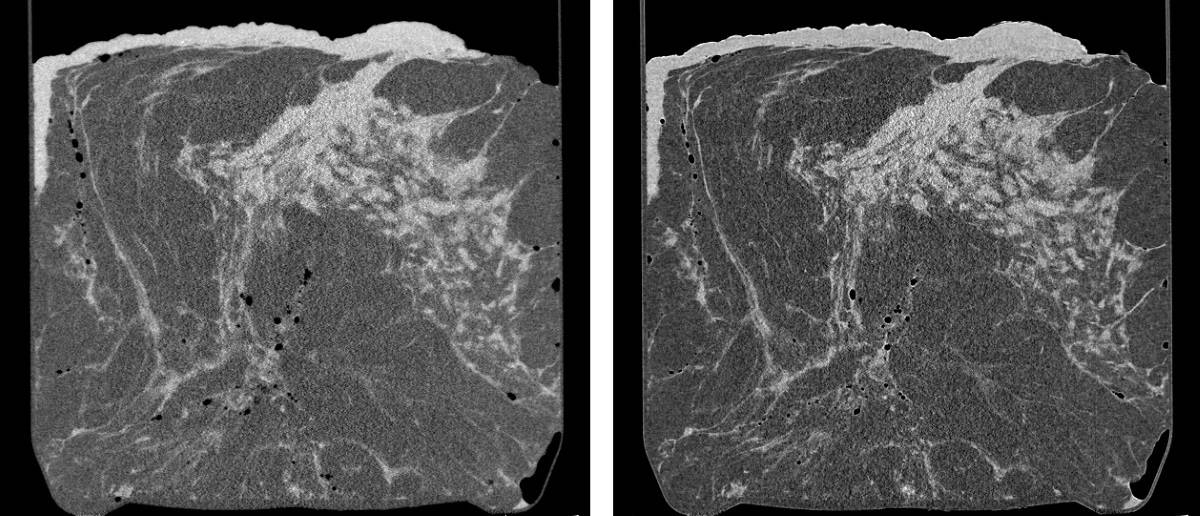
The researchers collected images at two sample-to-detector distances: 0.19 m to represent an AB-CT scan and 6 m for a PB-CT scan. All AB-CT images were collected at a “standard” mean glandular dose of 4 mGy, using 2400 projections with 0.075° angular steps. PB-CT images were collected at both 4 mGy (2400 projections with 0.075° angular steps) and 2 mGy (1200 projections with 0.15° angular steps). The team used an ionization chamber to measure the photon fluence rate and the corresponding rate of the surface absorbed dose to air at the ionization chamber plane.
AB-CT vs PB-CT

After three radiologists selected the best quality AB-CT image set for each mastectomy specimen, 11 radiologists independently compared the overall image quality in PB-CT images, prepared in axial and sagittal planes, with the corresponding AB-CT images. They evaluated lesion sharpness, visibility of calcifications, image noise, perceptible contrast, visible artefacts and normal tissue interfaces.

The radiologists reported that PB-CT images acquired at both standard and low dose were of significantly higher image quality than the AB-CT images. The researchers also determined that PB-CT images obtained at 32 keV and reconstructed using half phase retrieval (rather than full phase retrieval) had the best overall image quality.

First author Seyedamir Tavakoli Taba tells Physics World that the team will soon start a receiver operating characteristic (ROC) study to compare the diagnostic efficacy of PB-CT with conventional breast imaging techniques, such as mammography and DBT. To date, the researchers have scanned over 75 fresh breast mastectomy samples and anticipate scanning another 50 before launching the first clinical trial, planned for early 2021.

“Our plan is to establish a world-first mammographic PB-CT clinic at the Australian Synchrotron in three to four years, to be used mainly for staging and treatment options,” says Taba. “The widespread clinical implementation of PB-CT can be delivered via commercially available compact X-ray sources in the future. This will allow PB-CT to be widely translated into specialist cancer care facilities across Australia and overseas.”

Condensed-matter physics pioneer Philip Anderson dies aged 96

The US condensed-matter physicist Philip Warren Anderson died yesterday aged 96. One of the most celebrated condensed-matter physicists of his generation, Anderson’s theoretical research into the electronic structure of magnetic and disordered systems led to an improved understanding of metals and insulators. For this work he was awarded the Nobel Prize for Physics in 1977, which he shared with the British physicist Sir Nevill Mott and the US physicist John Hasbrouck van Vleck.

Born on 12 December 1923 in Indianapolis, Indiana, Anderson was raised in Illinois, where his father taught plant pathology at the University of Illinois in Urbana. In 1940, Anderson went to study physics at Harvard University but during the Second World War was drafted to work at the US Naval Research Laboratory, spending the period from 1943 to 1945 researching antenna design. He then returned to Harvard working on a PhD under the supervision of  van Vleck, graduating in 1949.

Anderson then joined Bell Telephone Laboratories in New Jersey, which was part of the telecoms firm AT&T. It was there that he developed his theory of the electronic structure of solids.

Much of what we know about the electronic properties of metals and semiconductors is based on the idea that electrons with certain momenta can travel freely through a crystalline lattice, while others cannot. This is embodied in Felix Bloch’s 1928 quantum theory of conduction, which describes the lattice as a periodic electric potential through which some electrons (behaving as “matter waves”) diffract with ease. In the 1960s, Anderson worked out what would happen in such a system if the potential lost its periodicity. This could happen, for example, if the lattice remained periodic, but the potential has a different value at each lattice site.

Anderson found that electrons would be unable to move through such a “disordered” lattice, and instead become trapped by specific atoms. If the disorder is sufficiently strong, the electrons cannot form an electric current due to destructive interference between different scattering paths. Instead, they become localized and unable to propagate in space.

For this prediction of what became known as “Anderson localization” he was awarded the 1977 Nobel Prize for Physics, which he shared with van Vleck and Mott for their “fundamental theoretical investigations of the electronic structure of magnetic and disordered systems”. Anderson localization has since been seen in several systems including those based on light, microwaves and in atoms held in a Bose–Einstein condensate.

A ‘wonderful’ lab

The 1960s was a particularly productive time for Anderson. He also worked on the theory of superconductivity, in which the electrons in a material can flow without resistance, and explored the properties of helium-3. In 1967, Anderson spent eight years on a part-time basis at the University of Cambridge before returning to the US to work at Princeton in 1975, while still being affiliated to Bell Labs.

Anderson retired from Bell Labs in 1984 when the US government disbanded AT&T and began working full-time at Princeton where he continued his research on spin glasses – nonmagnetic metals embedded with randomly spaced magnetic elements – as well as high-temperature superconductors.

In an interview with Physics World in 2006, Anderson said that he mostly enjoyed his 35 years at Bell Labs. “For the first three decades it was the most wonderful laboratory in the world,” he said. “We had freedom, an enlightened management and a personnel department that never had any say in the direction of the research department. We had a very high opinion of ourselves, but it was justified. Those were the years when we invented modern technology.”

The ‘arrogance’ of particle physics

Anderson also made crucial contributions to other fields in physics. In particular, in 1962, he published a now-famous paper on how the photon acquires mass. It was cited two years later by Peter Higgs in his own paper on the discovery of a mechanism for understanding the origin of mass – a theory for which Higgs and François Englert won the 2013 Nobel Prize for Physics. The mechanism was later confirmed by the discovery of the Higgs boson at CERN’s Large Hadron Collider in 2012.

While Anderson had noted that the Higgs boson could have been called the “Anderson–Higgs boson” in recognition of his work, in 2013 he told Physics World that the Swedish Academy made “a perfectly reasonable decision” to award the prize to Higgs and Englert. “I also think the fuss over the theoretical part of the work a bit excessive relative to the gigantic experimental effort,” he added.

In the late 1980s, Anderson was a vocal critic of the $4.4bn Superconducting Super Collider (SSC), which the US was planning to build in Waxahachie, Texas, as the next big machine in particle physics. In 1987, Anderson famously gave testimony to the US Senate, in which he worried that the huge costs of the 87.1 km circumference circular collider would force cuts to other science budgets. He was far from the only physicist who had such concerns and, despite some $2bn eventually being spent on digging parts of the SSC’s underground tunnel and constructing various buildings, the collider was cancelled in 1993, by which time the project’s estimated final price tag had almost trebled to  $12bn.

Indeed, Anderson held a sceptical view of particle physics and the belief in the field by some that it deserved more funding that other areas. “There is a great arrogance and immodesty about that whole field, which gets on my nerves,” he told Physics World in 2006. “Particle theorists say [they’re] discovering ‘the mind of God’. It’s not the mind of God at all. In the first place, there’s no God, and in the second place, particle physics cannot explain things like superconductivity, life and consciousness. It makes no contribution to explaining how the world actually works.” He also held the view that particle theorists owe more than they realize to condensed-matter theorists like himself, particularly for having developed the concept of “broken symmetry” in the 1950s.

Emergent views

During his career, Anderson wrote several scientific books, including Concepts of Solids, Basic Notions of Condensed Matter Physics (1997) and More and Different (2012). He also contributed to the philosophy of science, writing a now famous article “More is Different” for Science in 1972. This set out the limitations of “reductionism”, according to which all of science can, in theory, be derived from just a few fundamental principles.

Anderson instead believed in “emergence”, which states that everything we observe at one level obeys the laws at a more primitive level, but that those observations cannot necessarily be deduced from that level. He even dubbed it the “God principle” but told Physics World that it did not reflect any religious beliefs. “I’m not quite as atheistic as [Oxford biologist] Richard Dawkins, but I’m very close,” he said.

Anderson received the National Medal of Science in 1982 and was involved with the formation of the interdisciplinary Santa Fe Institute, which explores the science of complexity. He joined as an emeritus professor in 1985 and in 1996 Anderson became an emeritus professor at Princeton.

Indeed, Anderson remained active as a physicist well into his 80s and 90s, even being named as the “world’s most creative physicist” by one statistical analysis in 2006. He continued to review books, including a review for Physics World in 2013 of a biography of his near-contemporary Freeman Dyson, who died in February. His last letter to Physics World was published in 2017.

Outside physics, Anderson was a keen hiker and gardener as well as an enthusiast of the Chinese board game Go where he was a certified “first-degree master”.

Physics in the pandemic: ‘I learned that my students miss the structure and support that the university provides’

It’s been two weeks since Trent University shut down. We all knew it was coming, but its abruptness came as a real shock. On Thursday night, I was making final preparations for Friday lectures (one of my heavy teaching days), and on Friday morning everything was closed. Now, the term is winding down and we’re all trying to figure out how to move exams online.

Despite the upheaval, it’s easy to feel removed from everything that’s going on in the wider world. Peterborough is a small city two hours north-east of Toronto, plunked in the middle of lakes, cottages and farmland. Birds have been streaming back into the area now that winter has ended, and the seasonal renewal contrasts strangely with the constant messaging around the virus. Social distancing is almost effortless here: I can easily wander the streets around my neighbourhood without crossing paths with another person, and a 10-minute drive takes me out onto quiet railway trails through the countryside.

In many ways, my life has become simpler since the shutdown. I still have lots of work to do, but the interruptions have disappeared. As I have recently learned, this is not necessarily true for my students. Indeed, the strangest aspect of the shutdown has been losing touch with them. Trent is a small university, with a lot of interaction between students and faculty, and I hadn’t realized how much student feedback informs my teaching.

Twelve time zones away

To fill the void, I posted a survey with one question (“How are you doing?”) and discovered that they were eager to share. Most have left town, and are back in their parents’ houses, including the international students who are now up to 12 timezones away. For some, the return home comes with emotional stress that makes it hard to focus on coursework; others are grateful for the extra support that their families provide; and more than a few confessed that they have been “on vacation” since the shutdown.

More seriously, a few students are anxious because they have family members with serious health problems that make them susceptible to the virus. Ultimately, I learned that my students miss the structure and support that the university provides. But they adapt: some continue to study together using Discord, a Skype-like app specifically designed for gamers, while others build new daily routines. I hope they are ready for the real challenge that comes next week: exams.

Black hole ‘subrings’ could be seen by putting a telescope on the Moon

Adding a space telescope to the earthbound Event Horizon Telescope (EHT) should reveal the delicate series of light rings surrounding a supermassive black hole – according to a team of astrophysicists in the US. As well as providing more precise values for the mass and spin of a black hole, observing these “subrings” could also be a benchmark test of long-baseline interferometry using telescopes on Earth and in space.

In April 2019, scientists working on the EHT observed a glowing ring of light surrounding the supermassive black hole that lies at the heart of the M 87 galaxy. This first observation allowed the EHT team to determine the mass of the black hole to 6.5 billion solar masses, give or take 10%. EHT scientists we also able to work-out the direction of rotation (spin) of the black hole.

This light comes from hot matter swirling around the black hole. The light is deflected by the black hole’s immense gravitational field, making it appear like a ring to a distant observer. However, what the EHT was not able to discern is a series of subrings within this ring that should provide important information about the black hole.

A glimpse of complexity

“With the current EHT image, we’ve caught just a glimpse of the full complexity that should emerge in the image of any black hole,” says Michael Johnson of Harvard University, who was involved in this latest research.

Each of these subrings corresponds to a specific set of trajectories taken by the deflected light. Most of the light in the ring is the result of small deflections, which create a diffuse halo-like subring that is denoted n=0. Light can also follow a parabola-like path, doing a half-orbit of the black hole before escaping. This light is focussed into a thinner ring within the halo denoted n=1 because the light has made one half-orbit of the black hole.

Some light will complete one orbit of the black hole before escaping to create the even thinner n=2 subring. Indeed, a series of increasingly thinner rings are created by light that completes increasingly higher numbers of half-orbits of the black hole. As the number of half-orbits increases, the subrings also shrink in diameter and become less bright.

Very, very large arrays

Now, Johnson and colleagues have calculated the structure of these subrings and concluded that it should be possible to observe them using telescopes that are separated by very large distances.

The EHT is a network of radio telescopes that span a hemisphere of the Earth. Using a technique called very-long-baseline interferometry, the EHT is effectively an Earth-sized radio dish, which gives it extremely high angular resolution. In this latest work, the researchers have calculated that even this huge telescope is not good enough to discriminate between the first few subrings.

One way of spotting the n=1 subring, they say, could be to use a ground-based array of telescopes that are sensitive to lower-wavelength signals than the EHT. Another, possibility would be to launch radio telescopes into low-earth orbit. Detecting the n=2 ring would require a telescope on the Moon and seeing n=3 would require a telescope at the L2 Lagrangian point beyond the Moon.

The team says that one future option would be to use the Russian Millimetron mission which is expected to launch to L2 in 2029.

The research is described in Science Advances.

How physics is helping in the war against COVID-19

The COVID-19 pandemic has led to a state of global emergency. In such an interconnected world, the virus is spreading fast and cares little about national borders. Fortunately, scientific knowledge and public health responses are more advanced now than ever before.

Medical doctors, nurses and other medical staff are on the frontline of dealing with the consequences of the pandemic. Behind them, scientists from a range of fields are working intensely to better understand the virus behind the pandemic: SARS-CoV-2.

How exactly does it infect humans then spread between us? Who is most at risk? Can we develop a vaccine and drugs to defend ourselves? Where should we focus our resources? These are just some of the many difficult questions faced right now by healthcare professionals, research scientists and politicians.

This short video looks at how physics and physics-based technologies can play a role in tackling these questions. To find out more about how physics is helping in the global response to COVID-19 see this article by science writer Jon Cartwright.

Physics in the pandemic: ‘I’m worried about paying for medical treatment’

Haley Harrison in front of her computer

I am a third-year doctoral candidate in nanoscience at the University of North Carolina, Greensboro, US, and my research focuses primarily on nanoscale surface modification. On most of my workdays, I’m in a typical wet chemistry lab or doing spectroscopy, but I also spend one week every month at NASA’s Glenn Research Center in Cleveland, Ohio.

Two weeks ago, when everything began shutting down and the US Center for Disease Control was increasingly urging people to travel home and stay there, I was doing work at Glenn Research Center and my five-year-old daughter was with my sister, who graciously watches her when I travel. When I got back, I briefly went to my university campus to finish up some last-minute experiments, although this was discouraged. Things happened fast, and my university has been diligent about shutting things down, but the labs are still open with some restrictions in place – for example, using gloves to open doors and only having one person in a lab at a time. They have also cancelled all instrument training, and technicians are operating most instruments for now.

Since then, my PhD adviser has pretty much ordered us not to work in the lab, so I won’t be back until May. I am currently working remotely and communicating with colleagues via e-mail and in shared Word documents. I know my project trajectory will be significantly altered if I can’t be in the lab this semester, which is hard to accept. I am sad that my research isn’t going to go as planned, but with the health of the world at stake it is a small price to pay.

Family concerns

On the personal side, my mom and I live together, and she just finished her cancer treatment. Normally, this is a momentous occasion, but due to the restrictions at hospitals she went to her last treatment alone and we didn’t get to see her ring the “I beat cancer” bell. She then drove directly to work. It is stressful knowing she is putting herself at risk, but her job isn’t guaranteed if she doesn’t go in. My daughter and I are taking extra precautions because Mom’s immune system is compromised from her cancer treatment, which means she is at a higher risk of complications from COVID-19. We send one family member to get groceries once a week and rely on various delivery services in the meantime.

My sister has been unofficially “furloughed”, which means she is on unpaid leave from her job. And she works for the state government! Don’t even get me started on how embarrassing it is that they would put her on unpaid leave. Although some employers are being proactive, others are clearly showing their complacency and leaving their employees to fend for themselves at this uncertain time.

As for me, I have a kindergartener at home and my priority will always be to make sure her needs are met. That means I’m at the mercy of the school system: as long as her school is closed, I’ll be at home, and caring for and educating a kindergartener doesn’t leave much time for doing anything that isn’t kindergarten.

Facing uncertainty

Apart from that, my biggest concern is the uncertainty. I am a graduate student, and our health insurance and pay is never guaranteed outside of our nine-month contracts. I am worried about paying for medical treatments if I do get sick, or if someone else in my family gets sick. I am worried about what will happen for us financially if social distancing goes into the late spring and early summer, as summer funding is always precarious even in a normal year and taking internships/childcare may not be an option.

There are some silver linings for me, though, at least temporarily. Because I have a bad habit of filling my lab notebooks with ideas and collecting lots of data all at once, I have lots of writing and analysis to catch up on. I find this one of the hardest parts of being a PhD student, so I could really benefit from taking this time to go through my work slowly and dig out mistakes so I can meticulously strengthen the skills I feel are weakest. Also, at my university, we have an open office setting, so it is nice to be able to think without having a colleague walking past every few minutes asking what I’m up to.

A final benefit is that I love spending unstructured time at home with my daughter. I’ve been a graduate student for most of her life, so I haven’t had this kind of time at home with her since she was very little. I suffer from “mom guilt” as a result – putting her into daycare was hard. Now I love sitting and listening to her tell me about all the things that go on in her little mind. We have been making the most of this time by playing, drawing, watching movies and catching up on endless craft videos on YouTube.

First-principles calculations shed light on semiconductor defects

Gallium nitride (GaN) is the world’s second-favourite semiconductor, present in devices ranging from light-emitting diodes and photodetectors to high-temperature electron mobility transistors. When these devices are exposed to irradiation from high-energy particles – as they often are in fields such as satellite communications, aerospace, defence and the nuclear industry – they are prone to developing defects that degrade their electronic properties.

Researchers at East China Normal University in Shanghai and Shanxi University in Taiyuan have now performed the first systematic study of a class of GaN defects known as defect pairs. Such structures have been little studied to date, and the researchers say that understanding them and the mechanisms that cause them may help boost the radiation resistivity of GaN-based devices.

For equipment in low-Earth orbit, the most common forms of damaging radiation are proton, electron and gamma radiation. In a nuclear-industry context, the chief culprit is usually radiation from neutrons. These high-energy particles can create a dizzying array of defects in GaN, including point defects, defect pairs and complexes, and disordered regions in the material’s semiconductor lattice.  The point-defect “family” alone contains six sub-types of defect, known as VGa and VN vacancies, GaN and NGa anti-sites and Gai and Ni interstitials.

21 different types of defect pairs

The properties of these point defects have been well-studied over the last three decades. However, defects of this type can also bind with each other to form less-common defects, including double-site defect pairs and multiple-site defect complexes. In principle, 21 different types of defect pairs can form, each with its own structural configuration.

Fortunately for GaN device designers, these exotic defect pairs usually require much higher energy to form than single-point defects. Freshly-synthesized GaN typically contains them only in low concentrations, and for this reason only a handful of defect pairs, such as VGa-VN and VGa-GaN, have been studied in any detail.

In radiation-damaged samples, however, the concentration of the high-energy defect pairs can be much greater. This led Shiyou Chen and his colleagues to study all 21 defect pairs in GaN, performing first-principles calculations of their structures, formation energies and transition energy levels.

Their results show that after a high-energy particle strikes the GaN and triggers a defect-inducing “collision cascade”, the defect pairs that form are generally stable. Such pairs are separated by short distances and nine of them have formation energies lower than 10 eV. In terms of their effect on the material’s properties, they mostly act as electron donors, producing many defect levels in the band gap of GaN and potentially impairing the performance of GaN-based devices.

Fundamental parameters for future multiscale simulations

Among the different defect pairs, the researchers found that the VN-VN vacancy pair has an especially low formation energy and can therefore be produced in high concentrations in p-type and Ga-rich GaN. This fact was overlooked in previous work, Chen says.

“The defect formation energies and transition energy levels we have calculated will be fundamental parameters for future multiscale simulations of radiation damage processes in GaN,” he tells Physics World. “These models may help us find efficient methods to improve the radiation resistivity of GaN and increase the lifetime of devices made from this semiconductor.”

In the present work, which is detailed in the Journal of Semiconductors, the researchers only looked at defect pairs formed by intrinsic defects. They say they will now be investigating pairs and clusters formed by intrinsic dopants (such as Mg, C, H and O) and defects. These defect-dopant structures naturally form in GaN samples grown using techniques such as metal-organic chemical vapour deposition (MOCVD) and hydride vapour phase epitaxy (HVPE).

Physics in the pandemic: ‘Welcome to my new role as university professor, housekeeper, cafeteria lady, school teacher…’

Brrrring! There goes the bell at the school across the street from our home, but it’s unusually quiet. No line of big yellow school buses dropping off little ones; no stressed parents parking across the bottom of our driveway as their charges dash in the front door.

Normally, I would be sitting at my desk at the University of Guelph by now, scrolling through the morning’s e-mails and prioritizing my “to do” list for the day. Instead, I’m making sure that my nine-year-old is starting on her journal-writing assignment and my 14-year-old is finding reliable sources for her project on the forestry industry. Welcome to my new role as university professor, housekeeper, cafeteria lady, elementary- and high-school teacher, principal, secretary and school-yard supervisor.

The university has been working hard to support instructors while we figure out how best to finish up the semester. Switching the final exam to a final assignment, moving to a take-home or online exam, or using the term grade achieved to this point are all possibilities. I wasn’t teaching this semester, so my main pivot to online has been to find creative ways to support my fourth-year physics students trying to finish their honours thesis projects. This semester is research leave for me, which means finalizing the second edition of our textbook and exploring new ways to connect with the community and support science education at all levels. The writing part – that’s relatively easy to do at home, although I’m now in slightly more chaotic settings than I’m used to in my quiet little campus office.

For the community-connection part, I’ve decided to embrace the chaos! Colleagues and I in the department are now working on a series of videos to answer great science questions from kids – we’re calling it Ask Me Anything, Science Edition, or “AMASE!” – and I’ve recruited my home crew to help. My older daughter is providing technical prowess, while my younger daughter will be my co-host. We’ve just finished our first video, measuring the speed of light in our kitchen. You can watch it above.

Is this how I thought that I would be spending my days as winter slowly gives way to spring? Not at all. And I’m worried. I’m worried for our students, especially those in their final semester and already anxious about what comes next. I’m worried for my kids as they struggle with this abrupt upending of their daily lives. I’m worried for our healthcare workers as they face this nightmare. But, regardless of the uncertainty swirling, the one thing I do know is that we need to stay home. So we’ll find creative ways to keep busy, if for no other reason than to try to keep the worries at bay.

Physicists riff on an REM classic, new strategy for finding a parking spot

Physicist and author Sabine Hossenfelder is probably most famous for being the bane of those who believe that physics should have an underlying mathematical beauty. But she is also a talented musician and video producer, as you can see in the above video.

It’s a riff on REM’s “It’s the end of the world as we know it” and there is a guest appearance by guitarist (and climate physicist) Tim Palmer. By the magic of green screen, he joins in from Oxford and plays a nice guitar solo to boot.

And don’t worry, they both feel fine.

This might be the worst possible time to get people interested in research about strategies for finding a parking place. I had a dentist appointment (essential, of course) on Tuesday in the centre of Bristol and there were parking spots galore because of the COVID-19 lockdown. But when things finally get back to normal and you find yourself circling your destination looking for a spot, Paul Krapivsky and Sidney Redner have some advice.

“The dilemma is whether to park far away, which should be easy, and then have a long walk to the destination, or drive close to the venue and then look for a good parking spot, which is likely to be hard,” they explain in the pre-print, “Where should you park your car? The 1/2 rule”.

The pre-print describes a strategy for finding a spot in a 1D carpark, which I suppose could be applied to parallel parking on a road.

How plasmas can improve food and agriculture

David Graves interview

Plasmas are finding a growing number of applications in food production and agriculture. In this interview, Dave Graves of the University of California, Berkeley, talks about the physics and chemistry of non-thermal (or cold) plasmas and explains how these plasmas could improve food and agriculture.

He also talks about a special issue of Journal of Physics D that focuses on plasmas in agriculture and the food cycle.

This is a longer version of the interview with Graves that appeared in the 26 March episode of the Physics World Weekly podcast.

Copyright © 2026 by IOP Publishing Ltd and individual contributors