Molecular self-assembly can produce stable 3D knots in chiral liquid crystals. The knots, which have been dubbed heliknotons by the researchers who discovered them, have particle-like properties and are microns in size. Their shape can be controlled using low-voltage applied fields, which means they could be transformed into highly functionalized materials for use in a host of technology applications, including electro-optical devices, microfluidics and actuators. If found in other chiral material systems, such as solid-state chiral magnets or even light fields, applications in spintronics and optical computing might also be possible.
Topological physics has been undergoing somewhat of a renaissance in recent years, but this field has a long history going back to the Victorian era. Carl Friedrich Gauss postulated, for example, that knots in a field could behave like particles, while Lord Kelvin and his contemporaries Peter Guthrie Tait and James Clerk Maxwell believed that matter could be made of real-space free-standing knots of vortices. What was surprising in these early days was that these models were introduced long before researchers had widely accepted the very existence of atoms.
In more recent years, physicists, including Tony Skyrme (for whom skyrmions are named), have modelled subatomic particles with different baryon numbers as non-singular topological solitons and their clusters. Quantum field theories, fluid mechanics and particle physics and cosmology also postulate the existence of knotted fields. And that is not all: condensed matter researchers have found that arrays of singular vortex lines and analogies of Skyrme solitons are important building blocks in exotic thermodynamic phases in superconductors, magnets and liquid crystals. Most of these knotted fields are however unstable or unable to self-organize into 3D lattices.
A team led by Ivan Smalyukh and Jung-Shen Benny Tai of the University of Colorado at Boulder in the US are now reporting on energetically stable, micron-sized topological knots in chiral liquid crystals that behave like knotted vortices and non-singular soliton knots. These “heliknotons” indeed behave like particles in that they show 3D Brownian motion and self-assemble into 3D crystals.
The researchers observed the structures in commercially available liquid crystals doped with chiral molecules that caused all the molecules to rotate like a corkscrew along the helical axis.By applying an electric field, they created vortex lines, which spontaneously tied themselves into knots in a helical background.
“It is as if the molecules know how to tie a knot and self-assemble into these structures themselves,” explains Smalyukh. “They also know how to then self-assemble 3D crystals from many such knots. Thanks to numerical analyses, we found that these knots are favourable for the material since they lower the total energy of the system.”
The team says it used precision laser tweezers to move these knots around. The knots self-assemble into either 2D or 3D lattices with open or closed structures (such as the Kagome lattice), but they only form the types of crystals that minimize the liquid crystal’s free energy.
Different topologies
“The knots we demonstrate in our work have different topologies that manifest as the crossing, or linking, number,” adds Smalyukh. “By choosing different material parameters, such as sample thickness and applied field strength, diverse types of knots can emerge.
“One important property of these structure is that they are topologically distinct – you can’t smoothly morph from one to another without tearing the continuum of the field. This proves that they are topologically protected.”
This topological protection makes them good candidates for use as information carriers, he tells Physics World. “As with liquid crystals, which are widely employed in displays and can be switched from one state to another by a low voltage, so these knots also strongly respond to applied electric fields, switching between different chiral versions, synclinic- and anticlinic-tilted, of self-assembled crystals of knots in the lattice.”
“The shape and size of these knots and their crystals also show giant electrostriction – that is, their shape and size dramatically change with applied field – a phenomenon that might be exploited in electro-optics devices, for example,” he adds. “This giant electrostriction, together with their facile response and optical properties, could also enable applications in microfluidics and actuator devices.”
The new type of stable knotted field in liquid crystals demonstrated by Smalyukh, Tai and colleagues is of fundamental importance for mathematicians and physicists and it might even appear in materials other than liquid crystals, says Smalyukh. “We are highly confident that this is the case and have begun to look for these structures in chiral material systems, such as solid-state chiral magnets and even light fields.”
This week’s podcast begins with Matin Durrani and Hamish Johnston pondering the significance of a claim of quantum supremacy that has hit the headlines recently.
Then, Tami Freeman dons a hardhat and joins a public tour of CERN, which includes a trip underground to see the Large Hadron Collider.
Tami also reports back from the Medical Physics and Engineering Conference (MPEC 2019), which was held earlier this week in Bristol.
Next up is Anna Demming who explains why carbon is better than oxygen and laments the fact that we might be running out of some “endangered elements” that are crucial for modern technologies.
Physics World‘s Nobel prize coverage is supported by Oxford Instruments Nanoscience, a leading supplier of research tools for the development of quantum technologies, advanced materials and nanoscale devices. Visit nanoscience.oxinst.com to find out more
It’s difficult to pick one favourite Nobel prize among the many achievements that have been honoured over the years, but my personal choice is the 2001 award – which went jointly to Eric Cornell, Wolfgang Ketterle and Carl Wieman for creating and understanding the first Bose–Einstein condensates (BECs). This new form of matter, in which a group of atoms behave as a single particle, was described by the Nobel committee as making the atoms “sing in unison”.
Wieman and Cornell made the first condensate in 1995 at JILA in Boulder, Colorado, by cooling a cloud of 2000 rubidium atoms to within a whisper of absolute zero. Ketterle and his group at MIT created a larger condensate of sodium atoms just a few months later, and then used their experimental set-up to demonstrate interference between two separate BECs as well as a rudimentary atom laser.
This experimental breakthrough was captured by an iconic image that is forever associated with BECs. The image, produced by Cornell and Wieman, records the velocity-distribution data of the rubidium atoms as they are cooled towards absolute zero, and clearly shows how atoms with different energies eventually condense into a distinct quantum state.
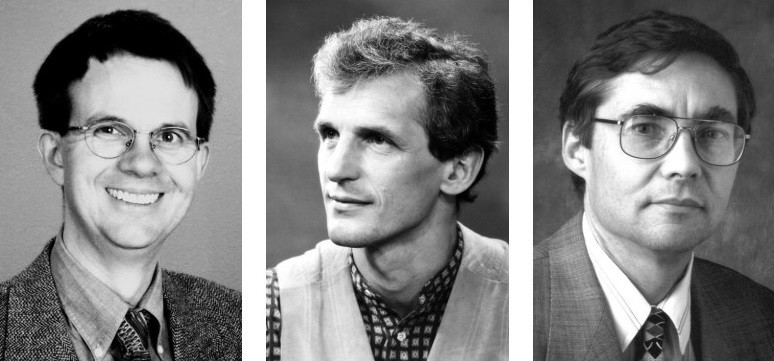
Ultracool scientists: Eric Cornell, Wolfgang Ketterle and Carl Wieman (Courtesy: Nobel Foundation Archive)
To me, this bears all the hallmarks of a classic Nobel prize. The award recognizes an experimental tour-de-force that proves a long-standing theoretical prediction – the existence of BECs as a fifth state of matter was first proposed by Einstein back in 1924, building on a paper by Satyendra Nath Bose – and the early experiments ignited a revolution in ultracold atomic physics that has enabled new research in areas as diverse as quantum physics, precision measurement and cosmology. Since then condensates have also been created with fermions, a much trickier proposition because these particles do not like to occupy the same quantum state as their neighbours, as well as with molecules and photons.
It’s much easier to create a BEC these days, but condensates can only be sustained for a fraction of a second on Earth due to the effects of gravity. Physicists have therefore looked to space, and in 2018 a Bose–Einstein condensate of 105 atoms was created in a rocket, allowing more than 100 experiments to be conducted during a six-minute freefall that preserved the BEC in zero-gravity conditions. The International Space Station is also now equipped with a Cold Atom Laboratory that will allow scientists to generate and study BECs for up to 10 seconds at a time.
I have a personal reason for choosing this prize too. I joined Physics World back in 1994 as a fairly recent physics graduate, and this result was announced just a few months later. Among all the latest research I was getting to grips with, this breakthrough stood out as being a beautifully simple result – perhaps because of that image – but one that goes to heart of our understanding of fundamental physics. I was really pleased when, two years later, I was able to work with Wolfgang Ketterle on an article for Physics World about the discovery of BECs and the latest research findings – which is still available to read today.
Physics World‘s Nobel prize coverage is supported by Oxford Instruments Nanoscience, a leading supplier of research tools for the development of quantum technologies, advanced materials and nanoscale devices. Visit nanoscience.oxinst.com to find out more.
Large-scale experimental facilities such as neutron and synchrotron sources have become an essential element of modern scientific research, allowing visiting researchers to probe the structure and properties of many different types of materials. They also generate huge amounts of experimental data, which can make it difficult for visiting scientists without specialist knowledge of the experiment to extract meaningful information from the raw datasets. As a result, some of the data collected during their valuable beamtime is never properly analysed.
The good news is that this situation has improved dramatically over the last 10 years, with a consortium of leading neutron facilities working together to streamline and standardize the software used to analyse data from neutron scattering and muon spectroscopy experiments. The framework – called MANTiD – supports a common data structure and shared algorithms to enable visiting scientists to easily process and visualize their experimental results.
“This common framework helps visiting scientists to get to grips with instruments at different facilities,” comments Nick Draper, one of Tessella’s senior project managers. “But it also helps researchers to make use of a different instrument at the same facility.”
Next big challenge
According to Draper, who has long been involved in supporting big science projects, the next major challenge is to make it easier for researchers from different scientific backgrounds to analyse and interpret the complex experimental output that can be produced. “Often there’s not just one model that you could fit to your data, there could be 20 or 30 options, and sometimes it’s not absolutely clear which model you should be picking,” Draper explains. “At the moment, it takes expert opinion from instrument scientists who really understand the experiments to lead and guide on which approaches to take.”
But with larger and larger volumes of data to get through, this can create a bottleneck that delays results. One option for speeding up the process is to exploit artificial intelligence (AI) to help with model selection. It’s a concept that some researchers might feel uneasy about, but Draper’s colleague Matt Jones – an analyst at Tessella who keeps a watchful eye on the latest industry trends – has some words of reassurance. “AI is there to help the human, it’s not there to govern and provide the answers – it’s there to augment,” he states.
Matt Jones has followed the rise of AI from early monolithic offerings to today’s cloud-based solutions, and notes its success in aiding pharmaceutical development. An example is AI-augmented analysis when scaling-up drug discovery processes – which in turn frees up experts to work on higher value tasks. And he advocates taking a tailored approach to maximize the benefits. “The most accurate and best solutions are built for solving the immediate problem at hand,” he comments.
The deep-learning revolution
Today, the buzz surrounding artificial intelligence is hard to ignore. We’ve been wowed by computers that can beat grandmasters at chess and Go, and are served by increasingly powerful speech recognition and machine translation tools. To the list of highlights, you can also add breakthroughs in image recognition together with progress in driverless vehicles. But why is it all happening now? After all, many machine learning algorithms have been around for decades.
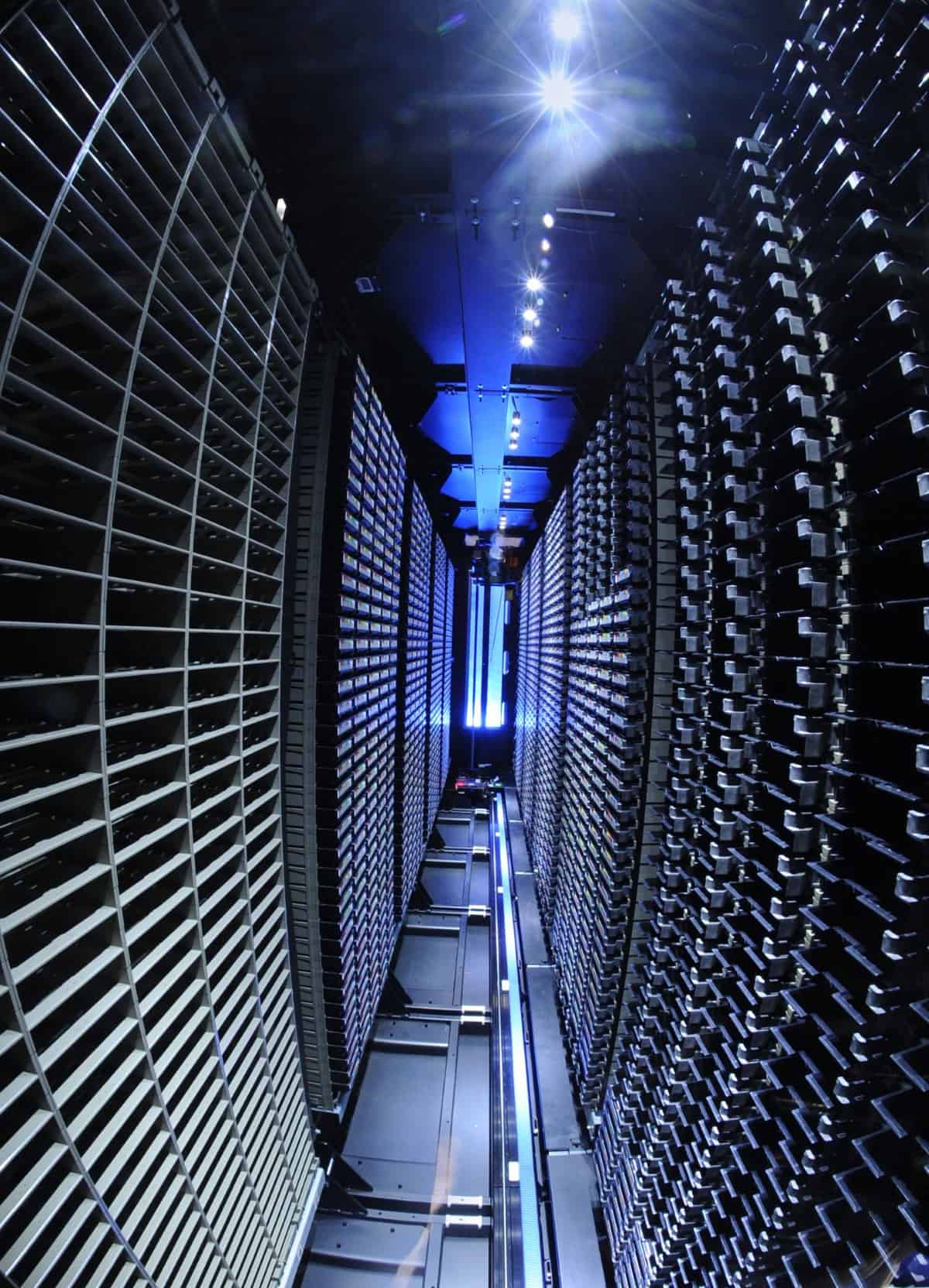
Deep learning relies on high-performance computing (Courtesy: STFC)
The crucial factor is the impact of scale, specifically the parallel growth of data and available computing power. And this has transformed the capabilities of one technique in particular – deep learning – which benefits greatly from the availability of large datasets.
While other methods plateau when you feed them with more information, the performance of deep learning’s artificial neural networks keeps climbing. And the larger (or deeper) the neural network, the greater its capacity to absorb the value of its inputs and deliver meaningful outputs.
Combining big data with large amounts of compute makes it possible to create artificial neural networks with many so-called hidden layers. These deep-learning systems are giant mathematical functions that comprise multiple layers of nodes, equipped with self-adjusting weights and biases, all sandwiched between a series of inputs and outputs.
The rich combination of data and compute – together with a greater understanding of how to train (or propagate) these powerful multi-layered networks – is now taking the performance of machine-learning techniques to new heights.
Engaging the benefit
The flip-side is that research groups need access to large amounts of data and large amounts of compute to engage the full benefits of deep learning, and they need support from teams who can get these systems up and running.
It’s an issue that Tony Hey, Chief Data Scientist at the STFC, and his team are aware of. To help researchers to extract more science, more efficiently, from their experiments, Hey is assembling a Scientific Machine Learning group, working closely with the Alan Turing Institute – the UK’s national institute for data science and artificial intelligence.
Hey is also linked to STFC’s Ada Lovelace Centre, which is being established as an integrated, cross-disciplinary, data-intensive science hub that has the potential to transform research at big science facilities through a multidisciplinary approach to data processing, computer simulation and data analytics.
Objectives for Hey include applying AI and advanced machine-learning technologies to the experimental data generated by STFC-supported facilities at the Harwell Campus: the Diamond synchrotron source; the ISIS neutron and muon source; the UK’s Central Laser Facility; and the NERC Centre for Environmental Data Analytics with its JASMIN super data cluster.
“The analysis of huge datasets requires automation and machine help as the volume goes beyond what used to be possible by hand,” Hey comments. “However, there are lots of opportunities to try to help automate the data flow in the pipeline in getting data from a machine to the point where you can do science with the results.”
Building this pipeline requires helping researchers to understand more about the machine-learning algorithms. “You need transparency and understandability as to how various methods will get you to an answer, not black boxes,” he points out.
Hey is keen to develop what he describes as machine-learning benchmarks. He also wants to leverage existing expertise in communities such as particle physics and astronomy, who have been dealing with petabyte-scale big data challenges for some time. The goal is to create a broader support structure for machine learning and AI that other disciplines can tap into. It means being able to strip out the jargon and make processes such as data classification models understandable outside a given field.
Teaching labs
One way of lowering the barrier to entry is to provide what John Watkins of the CEH calls “teaching labs” – for example, C++ routines that have been packaged into an R library, married with a dataset, and then wrapped in a web-based R-shiny app for convenient access. “They let people look at various algorithms and play with them to learn their particular characteristics and discover how methods may or may not be useful in their work,” he says.
For Watkins and his environmental science colleagues, one size rarely fits all. Researchers in the field commonly need to understand a variety of data from different sources – for example, output from sensors on land and in the atmosphere, as well as oceanographic measurements.
Scientists need the opportunity to experiment with different AI algorithms (Courtesy: iStock/Alvarez)
“Ideally you want access to a range of tools to hit a block of data with and compare the results to identify the most efficient method,” he advises. “You don’t want to be in the position where you can only attack it with one method, because that’s the only capacity that you have.”
There are other considerations too, beyond stripping out the jargon and providing accessible and benchmarked tools. It’s also important to support the optimal workflow for a given task, which might be running models on an HPC, storing the results on a large-scale data cluster, and then switching to a smaller scale operation once the portion of the data that’s important has been identified.
Clearly, it’s a job for multi-skilled teams who can navigate not just the technology, but also the science that the AI is being targeted at. Returning to our earlier example, Draper is encouraged by pilot analysis using small-angle neutron scattering data, where AI is now being used to steer users towards using either a spherical model or a cylindrical model to fit the data. Early results are promising, but the next question is whether the approach remains effective when the choice jumps to as many as 40 different models.
Just the beginning
Draper and his Tessella colleague Matt Jones believe this is just the beginning of a trend that could revolutionize the analysis of scientific data, with interest growing among the research community in the possible benefits of AI. “We are just starting to prick the edges of this future now,” says Matt Jones. He anticipates more conversational type interfaces, as well as visual approaches such as virtual reality, that lend themselves to presenting highly-detailed scientific structures and complex data.
“AI is a really interesting place for the future,” adds Draper, who is also well aware of the hurdles. “You need lots of training data,” he points out, “and that data has to be properly tagged.”
But what happens if training data doesn’t exist, or is only available in limited quantities? One idea is to back-generate images that indicate what a particular model would look like. “If you do that lots of times with different parameters, mixing in static and distorting the images to make them as realistic as you can, then you can create training data,” says Draper. “The challenge is to ensure that you are not simply overtraining your dataset to recognize the things that you have created as opposed to actual experimental results.”
Synthetic data that sums a number of signals has proven useful in enhancing speech recognition – for example, by training systems to overcome background sounds such as in-car noise – so again, it’s possible that knowledge developed in one sector can be transferred across different domains.
Predictive power
Success in deploying AI requires teams with talent across multiple areas: an understanding of the data, knowledge of machine learning algorithms plus statistical methods, and expertise in high-performance or cluster computing. But the potential rewards make the challenges worth conquering and can extend to other areas beyond analysing experimental results.
Google has reportedly saved a fortune by using deep learning to reduce the costs of running its data centres. Algorithms can alert operators when machinery is close to failure and should be replaced, which minimizes downtime. The output can also inform optimal servicing frequencies to keep equipment in reliable working order for as long as possible.
This predictive power can be applied at big science facilities too, notes Tessella’s Kevin Woods – a senior project manager involved in the update of instrument control systems. “By looking at the long-term patterns [in the signals] you can actually spot imminent failures,” he says. One example could be a gradual increase in motor operating temperature, which may indicate that an actuation unit is on its way to overheating.
The results so far suggest that investing in AI puts multiple rewards within reach. Machine learning has the potential to dramatically speed up the analysis of big data across different domains, hopefully allowing research teams to make faster progress in their understanding of increasingly complex phenomena. To succeed, researchers need easy access to extensive data sets, large amounts of compute, and the ability to experiment with and understand which algorithms are best matched to the task.
More than 9000 scientists, including Andre Geim, Carlo Rubbia and eight other Nobel-prize-winning physicists, have signed a letter calling on the European Commission (EC) to reinstate a dedicated commissioner for education and research. The letter claims that that an out-and-out role for education and research is necessary to create a sound basis for innovation in Europe.
News of the apparent sidelining of science emerged when Ursula von der Leyen, the EC’s president-elect, presented her team and the new structure of the next European Commission on 10 September. It included her candidates for the new set of 18 commissioners, but the plan no longer included a commissioner that explicitly represents education and research.
These areas are instead expected to be covered by the commissioner for innovation and youth – the nominee for which is Mariya Gabriel, who is the current commissioner for digital economy and society. In the new set-up, the innovation and youth role appears to be a merger between the current directorate for research, science and innovation with that for education, culture, youth and sport.
This rebranding does not sound like a big deal. But eventually…out of sight, out of mind, people start forgetting that there could be no progress and innovation without science and research
Andre Geim
According to the EC, Gabriel’s focus will be on creating “new perspectives for the young generation”. In her letter offering Gabriel the role, von der Leyen states that education and research will be part of the innovation and youth mission, which includes ensuring agreement and implementation of the future Horizon Europe programme.
Long-term benefits
Scientists have reacted with dismay at the move, with eight prominent physicists, including Alexander Rothkopf from the University of Stavanger in Norway, penned an open letter calling on the commission to reverse the decision. Addressed to David-Maria Sassoli, president of the European parliament — as well as von der Leyen and the current EC president Jean-Claude Juncker – the letter warns that by demoting research and education into innovation and youth, the commission is emphasizing “economic exploitability” and giving the impression that education is only for the young. They call on the European Parliament to request that the name is changed to Commissioner for Education, Research, Innovation and Youth before they confirm the nominees for the new commissioners.
“We created the open letter since the promise of a high standard of living for the citizens of Europe in a globalized world can only be upheld if we explicitly acknowledge the important role played by education and research,” Rothkopf told Physics World. “Both are the foundation for innovation, from which economic prosperity arises in the 21st century. By removing the terms from the title of commissioner Gabriel, the role of education and research is not adequately reflected within the commission.”
The letter has so far been signed by over 9100 scientists including 17 Nobel laureates as well as the leaders of scientific associations and societies across Europe. Teresa Montaruli, an astrophysicist from the University of Geneva, who is chair of the Astroparticle Physics European Consortium, told Physics World that she signed the petition because of the importance of research and education. She says that although research and education are linked to innovation and technological development, they also lead to breakthroughs that “may not be attractive to industry or produce technological advancement”, but are beneficial in the long term.
“This rebranding does not sound like a big deal,” the Nobel Prize-winning physicist Andre Geim, from the University of Manchester told Physics World. “But eventually…out of sight, out of mind, people start forgetting that there could be no progress and innovation without science and research.”
Yet Gian Giudice, head of theory at the CERN particle-physics lab near Geneva who has also signed the letter, says that it is action and not names that matter. “Europe is strongly committed to fundamental research and I trust that Gabriel will be a great advocate for science as a vehicle of intellectual, social and economic progress,” he says. “However, including research in her title will give a clear signal of Europe’s priorities.”
Scientists who think they have accurately modelled chaotic systems on their computers may need to think again. Researchers in the US and UK have uncovered a “pathology” affecting floating-point arithmetic that introduces significant errors when describing systems that are extremely sensitive to their initial conditions. Simulations that could be affected range from those trying to describe turbulence inside fusion reactors to models of the Earth’s climate.
Almost all digital computers represent numbers using the floating-point system. For each number, one bit reveals the number’s sign, several other bits encode its exponent and the rest are used for the mantissa (its significant digits). This is usually done at “single-precision” using 32 bits, or at “double precision”, which uses 64.
The new research investigates the effects of the discrete and uneven distribution of numbers that are characteristics of floating-point arithmetic. Because the quantity of numbers that can be represented by the mantissa remains the same between each successive step up or down in the value of the exponent, numbers will become more widely spaced the bigger they get. There are as many possible floating-point numbers between 0.5 and 1 as there are between 1 and 2, for example.
Extreme sensitivity
These properties of floating-point numbers pose a problem to the modelling of chaotic systems, owing to these systems’ extreme sensitivity to initial conditions. The value of a given physical parameter in the real world is far more unlikely to be a rational number – one that can be represented as a ratio of two integers – than an irrational one. And it is less likely still to be a number that can be represented by the floating-point scheme. This means that there will almost certainly be an error at the start of the computation, which will then be amplified.
To gauge just how bad the problem could really be, computational scientist Peter Coveney of University College London, together with mathematicians Bruce Boghosian and Hongyan Wang of Tufts University in Massachusetts, considered a very simple and idealized non-linear system – the Bernoulli map. This involves taking any value between 0 and 1, multiplying that number by a given factor, known as beta, and taking the remainder if the result of the multiplication is greater than or equal to 1. The operation is then repeated on the remainder, and so on. With beta=2, for example, 0.75 maps to 0.5, which then maps to 0.
Bernoulli breakdown
Scientists know that when beta is 2 the floating-point simulation of a Bernoulli map breaks down completely. Analytical mathematics shows that after a very large number of iterations over a very wide range of starting values there should be an equal probability of the system ending up at any value between 0 and 1. But that is because the vast majority of starting values are irrational numbers. Inside a digital processor the result always converges on 0 – as with the above example of the rational number 0.75 (3/4).
Coveney and colleagues say this problem with beta=2 is usually considered a peculiar consequence of using a binary system, which is base 2. Now, however, they have shown that floating-point simulations of a Bernoulli map also fail when using other even integer values of beta. More worryingly, they have discovered that even non-integer beta values generate errors.
The researchers carried out their simulations on a small cluster computer at Tufts University with a range of beta values. In each case they mimicked as closely as possible an infinite ensemble of starting points between 0 and 1 and an infinite number of iterations in time. They found that, although less severe than for beta=2, the simulations still generated errors of around 10% when compared with the expected results from analytical calculations.
Insidious errors
“The problem here is that most people have no idea that those errors exist,” says Coveney, who describes the errors as “insidious” because the modelling results look plausible and provide no hint of a miscalculation. He adds that the errors are due to the nature of the floating-point representation, rather than a lack of precision. “Even quadruple precision wouldn’t make any difference,” he says. “That’s not going to remove this problem.”
According to Coveney, this problem could affect simulations of a wide range of chaotic systems – from the molecular dynamics of protein folding, which informs drug development, to fusion plasmas, which are very turbulent. He says that weather forecasting and climate modelling could also be affected. Keen not to be too specific about the implications for understanding the climate, he says that some parts of climate models could contain errors “of a similar magnitude to the errors you thought you had”.
Writing in Advanced Theory and Simulations, the researchers point out that the Bernoulli map is too simplistic to reproduce many of the features seen in real chaotic systems, such as subtle correlations in turbulent fluid flow. But they argue that modellers should not draw any comfort from this fact. “Rather,” they say, “we would suggest that if so simple a system exhibits such egregious pathologies, a more complex system will probably exhibit even more devilish ones”.
Shujun Li, a computer scientist at the University of Kent in the UK who has also studied digital representations of chaotic systems, says he finds the new work “interesting but not surprising”. He argues that this and previous research show that the limitations of floating-point arithmetic could have implications beyond academic modelling. One such area, he suggests, is cyber security. Many chaos-based cryptosystems, he says, “are often not secure or at least [there is] no easy proof to guarantee they are secure”.
Photodynamic therapy (PDT) uses light to destroy tumours by activating a photosensitive drug that creates reactive oxygen species that attack cancer cells. This process, however, relies on the presence of oxygen; and many tumours are hypoxic. Now, an international research team has developed a technique based on a light-activated iridium compound that kills in vitro cancer cells, even when oxygen concentration is low (Nature Chem. 10.1038/s41557-019-0328-4).
The new PDT approach – developed by researchers from the University of Warwick in collaboration with colleagues from Sun Yat-sen University, Shenzhen University, the University of Zurich, Heriot-Watt University and CNRS – expands the range of cancers that can be treated. PDT itself is suitable for treating tumours in any regions where light can reach, for example bladder, lung, oesophageal, brain and skin cancers.
The key difference between conventional PDT and the iridium-based approach lies in the mechanism by which the tumour cells are killed. Once light-activated, the iridium photocatalyst attacks nicotinamide adenine dinucleotide (NADH), a vital co-enzyme that generates energy in cells. Cancer cells have a high requirement for NADH, as they need a lot of energy to rapidly divide and multiply. The activated iridium catalytically destroys NADH or changes it into its oxidized form, cutting off the tumour’s source of energy, even under hypoxia.
The researchers investigated the activity of the iridium compound on a range of cancer cell lines, as well as normal human cells. Upon light irradiation, they observed almost equivalent photocytotoxicity under normal levels of oxygen and under hypoxia. Unirradiated normal cells experienced low toxicity from the compound. They also studied a solid tumour model – lung cancer spheroids of roughly 800 µm diameter – and saw promising phototherapeutic effects.
“Now we have a potential new drug that can not only selectively kill cancer cells with normal oxygen supplies, but also hypoxic cancer cells, which often resist treatment by photodynamic therapy,” says Hui Chao from Sun Yat-Sen University.
The selective targeting of PDT will also help reduce side effects of cancer treatment. “The compound that we have developed would not be very toxic at all,” explains Peter Sadler from the University of Warwick. We would give it to the cancer cells, allow a little time for it to be taken up, then we would irradiate it with light and activate it in those cells. We would expect killing of those cancer cells to occur very quickly compared with current methods.”
The researchers also found that as the cancer cells died, they changed their chemistry in a way that generated an immune reaction in the body. This feature suggests that patients treated by this technique might be immunized against that cancer in the future.
“The ability of metal compounds to induce an immunogenic response in the body that may effectively vaccinate a person against future attack by cancer is an exciting development,” explains Sadler. “It is very speculative, but we are looking further into the hallmarks of that.”
I have always found it difficult to get my head around the infinite complexity of our universe. Yet somehow I’m a school science presenter, with the task of teasing out the inexpressible and unknown details of science into a tangible reality for children. It’s somewhat daunting. But I do have an invaluable asset – a giant dome-shaped tent.
Never failing to draw out a child’s innate curiosity, the Explorer Dome’s 5–6 m high portable planetariums just about squish into even the smallest school hall. But the domes are delicate assets, which my colleagues and I regularly fill to the brim with squirming, squealing children of all ages. We ask classes to help us look after the dome, all the while warily scanning faces to spot early signs of a child who wants to test whether or not the dome is a bouncy castle. It is not. But the children are just as delighted to learn they’ll get to crawl inside the dome through the short tunnel on the side (I’ve never quite understood why this causes such glee). And when they reach the inside of the dome, something magical happens.
Although they are just sitting on the floor of their school hall, the children are transported a million miles away from their classrooms – into a new, exciting environment. It’s in this place that I have the opportunity to alter the concept of what science is for those young developing minds. However, getting kids excited about science is rather loud, and it can be difficult to get a word in edgeways – not an ideal situation for a presenter. But as we call the raucous shouts to order, and zoom into the star at the centre of our solar system; eyes widen, jaws drop and voices channel expressions of wonder at our universe.
Using hands-on demonstrations, we show how light and sound waves travel, how animals slowly adapt to survive, and why the body digests food. It’s great to see children process the concepts and build them up into some more complex questions. That’s when we know that they are starting to get it – science is all about questioning how things work.
Questions start to explode out of the older kids – “What’s the biggest star? Why is Mars red? Are there other planets outside our solar system? What happens when black holes collide?” Fantastic questions; although sometimes they get distracted by the science closer at hand – “How does the dome stay up?”
Often, there is at least one child who has seemingly swallowed an encyclopedia, and is keen on regurgitating everything they recall. As presenters, we try to rein in this flow of information, and remind the children that science goes beyond simply knowing facts. Indeed, we stringently guard the sanctity of the dome as a safe place to express wonder and ask questions. Occasionally though, the smarty-pants tell me something I didn’t know.
There are also times when they help us reveal an important aspect of the nature of science. For example, on more than one occasion a child has insisted I’ve got the number of Jupiter’s moons wrong. But this has given me the opportunity to explain that our understanding of the universe is constantly expanding – we’ve now found there are more moons orbiting Jupiter than previously thought. When I get a really good question from a child, one that moves outside of the shows’ usual content, it’s such a pleasure to answer. Or attempt to answer at least – the best questions tend to push the boundaries of what we as a species know about our universe. Queries like these often lead to interesting discussions, speculation and debate. Unwittingly the kids have stumbled on the foundations for building scientific theory.
In the space show, there’s a point under the night sky when we start to spin. Noise levels peak as the kids start to lose their grip on reality, but before anybody might throw up, we switch to the constellations, taking the children back in time to some of the great historic scientists – the ancient Greeks. Through tales of myth and legend, we point to the Greeks’ powers of observation, and so teach the children about another cornerstone of science.
As we cover the various sections of the curriculum that schools book us for, I hope that our shows help the next generation to glean the bigger picture of science, and dissipate any feelings that science is “not for them”. But it is hard to know the long-term impact of these types of science experiences.
Teachers and parents report that the kids go back to lessons and homes more enthused. But with a lifetime worth of potential influencing factors, it’s tricky to figure out how big a factor the dome experience is in developing a person’s understanding of the world around them. The lack of strong empirical evidence makes it difficult for schools to justify spending money on these types of experiences, and leads, at least in part, to the low earnings common within the sector.
It’s a privilege to use the Explorer Domes to convey the mind-boggling awesomeness of the universe that sometimes baffles and bewilders me. Loud, enthusiastic rounds of applause follow every show – I don’t think there are many other jobs where you get thanked so profusely and earnestly. The expressions of gratitude certainly help me to keep going through the back to back shows on a stifling hot day; all the way until we finally roll up the “cave of wonders”, squishing it back into its bag ready for the next school.
In 2015 we created several infographics that illustrate the movement of physics Nobel laureates around the world. Our goal was to understand the relationships between high-quality science and migration. Now, with the 2019 Nobel Prize for Physics to be announced on 8 October we have updated the infographics with data from the latest winners.
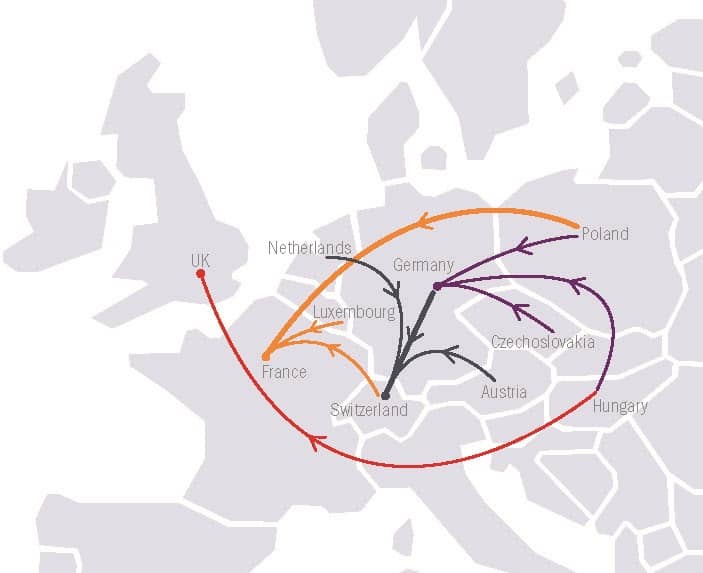
Trans-Europe express: map showing Nobel Laureate migration within Europe. (Courtesy: Paul Matson)
I have no idea who will bag this year’s prize, but it is a reasonable bet that at least of one of the winners will be an immigrant. Out of 209 physics laureates, we have classified 54 as being immigrants. That is more than 25% and I think you would be hard pressed to find such a high percentage of immigrants and the pinnacle of any field outside of the sciences (or professional football).
What do we mean by an immigrant? This is a tough question, especially in science, where people tend to move around a lot. For the purposes of these infographics, we have used a rather crude definition of an immigrant laureate: someone who died or currently lives in a country other than that of their birth. There is more about how we made the infographics later in this post – but first, what do they tell us?
The first infographic (top of this page) paints a geographical picture of migration, with the thickness of the arrowed lines reflecting the numbers of laureates who have migrated from one country to another. There is also a close-up showing movement within Europe.
The most glaring fact is that the US is the clear winner when it comes to inward migration. The country has attracted 33 of these top physicists and only lost two. Another striking observation is the brain drain from Germany, which has lost 14 physicists – 12 of whom went to the US.
Going with the flow: over 100 years of migration. (Courtesy: Paul Matson)
The rise of Nazism in Germany accounts for much of this migration. Indeed, it casts a long shadow because the latest person to make the list of laureates who travelled from Germany to the US is Rainer Weiss. He shared the 2017 prize for detecting gravitational waves, but not before fleeing Germany as a child because his father was Jewish and a member of the Communist Party.
All the numbers and the names of our immigrant laureates are shown in the figure “Going with the flow”. It offers a different perspective on migration with a focus on the receiving nations, which appear on the right.
Second place in terms of influx is France, which has been very good at attracting talent from its French-speaking neighbours. The UK has broken even, gaining as many laureates (five) as it has lost. The latest newcomers to the UK are USSR-born Andre Geim and Konstantin Novoselov, who bagged the 2010 prize. However, Novoselov has just accepted a position in Singapore (while maintaining his affiliation with the University of Manchester), so we may have to update his flow next year.
While we think these infographics do a good job of capturing migration patterns of Nobel winners, they are not perfect. Indeed, when compiling these data we often struggled with whom to include as an immigrant.
Coming home
For example, the 2016 laureate David Thouless was born in the UK, did his prize-winning research in the US, but then returned to his native country five years before his death in April. As a result, we did not count Thouless as an immigrant, although some might argue that he was an immigrant when he did his Nobel-winning work. The same could be said of Canadian Donna Strickland (2018). She won for work done at an American university but now lives in Canada, where she has spent most of her professional career.
Considering where the Nobel-winning work was done introduces another problem. Enrico Fermi – who left Italy for the US shortly after winning his prize – would then not be counted as an immigrant, despite the important contributions he subsequently made to physics in his adopted American homeland.
Shifting borders also posed a challenge when compiling and presenting these data. Some parts of Europe have changed countries three of four times during the 20th century, throwing up some strange instances. One of the trickiest calls was Alfred Kastler, who was born in Alsace in 1902. It was then part of Germany but became part of France in 1918. Kastler pursued his career in France, where he died in 1984, and despite his Germanic surname and apparent penchant for writing poetry in German, we did not include him as an immigrant.
We’ve done our best to navigate through the shifting borders of Europe (and the Indian subcontinent), but if you disagree with any of our data or think we have forgotten someone, please let us know.
Physics World‘s Nobel prize coverage is supported by Oxford Instruments Nanoscience, a leading supplier of research tools for the development of quantum technologies, advanced materials and nanoscale devices. Visit nanoscience.oxinst.com to find out more.
The IPCC says its Special Report on the Ocean and Cryosphere in a Changing Climate, released this morning, provides new evidence for the benefits of limiting global warming to the lowest possible level – in line with the goal governments set themselves in the 2015 Paris Agreement.
“The open sea, the Arctic, the Antarctic and the high mountains may seem far away to many people,” said Hoesung Lee, Chair of the IPCC. “But we depend on them and are influenced by them directly and indirectly in many ways – for weather and climate, for food and water, for energy, trade, transport, recreation and tourism, for health and wellbeing, for culture and identity.”
According to Lee, if we reduce emissions sharply, consequences for people and their livelihoods will still be challenging, but potentially more manageable for those who are most vulnerable. “We increase our ability to build resilience and there will be more benefits for sustainable development,” he said.
A total of 670 million people in high mountain regions and 680 million people in low-lying coastal zones depend directly on the ocean and cryosphere, according to the IPCC. Four million people live permanently in the Arctic region, meanwhile, and small island developing states are home to 65 million people.
“The world’s ocean and cryosphere have been ‘taking the heat’ from climate change for decades, and consequences for nature and humanity are sweeping and severe,” said Ko Barrett, Vice-Chair of the IPCC. “The rapid changes to the ocean and the frozen parts of our planet are forcing people from coastal cities to remote Arctic communities to fundamentally alter their ways of life,” she added.
Barrett explained that the report provides a complete picture of water – “the lifeblood of our planet” – around the globe and its interconnections.
Released this morning in Monaco, the report details that the oceans are warmer, more acidic and less productive. Melting glaciers and ice sheets are causing sea level rise and coastal extreme events are becoming more severe.
The special report was produced by more than 100 authors from 36 countries, and references roughly 7,000 scientific publications.
While sea-level rose around 15 cm globally during the 20th century, it is now rising more than twice as fast, at 3.6 mm per year, according to the report. By 2100 if greenhouse emissions continue to increase strongly, sea-level rise could reach 60-110 cm.
“In recent decades the rate of sea level rise has accelerated, due to growing water inputs from ice sheets in Greenland and Antarctica, in addition to the contribution of meltwater from glaciers and the expansion of warmer sea waters,” said Valérie Masson-Delmotte, Co-Chair of IPCC Working Group I. “This new assessment has also revised upwards the projected contribution of the Antarctic ice sheet to sea level rise by 2100 in the case of high emissions of greenhouse gases. The wide range of sea level projections for 2100 and beyond is related to how ice sheets will react to warming, especially in Antarctica, with major uncertainties still remaining.”
The report can be found in full at the IPCC website.