This week’s podcast begins with the welcome news that at least one form of destructive planetary change – a sudden and dramatic reversal of the Earth’s magnetic field – is much less likely than previously thought. As Susan Curtis explains, careful studies of rock samples and beryllium deposits in Antarctic ice cores indicate that the last such reversal took around 22,000 years to complete.
Next up is a discussion of nuclear fusion, and specifically a visit that Tushna Commissariat made to the Plasma Science and Fusion Center at the Massachusetts Institute of Technology (MIT). In 2018, a group of scientists from the MIT centre set up a spin-off company called Commonwealth Fusion Systems that hopes to achieve “net energy gain” in a fusion plasma thanks, in part, to new superconducting magnet technologies. In the podcast, we discuss the emergence of private industry funding for fusion energy and whether this trend will change sceptical views about this low-carbon, low-radioactive-waste form of energy.
Shifting gears from fusion to fission, we return to the subject of the Chernobyl meltdown – a frequent topic in recent podcasts – in an interview with Kate Brown, a historian at MIT who specializes in researching nuclear disasters. Brown contacted us in response to a Physics Worldinterview with epidemiologist Richard Wakefield which, she felt, mischaracterized her book about Chernobyl. On topics such as this, where opinions in the scientific community differ widely, it can be difficult for journalists to strike the right balance, so please send us an e-mail to offer critical (or favourable!) views on our coverage. We definitely promise to stop consuming Chernobyl-produced vodka (yes, it really exists; no, we’re not actually drinking it) long enough to read and reflect on the feedback.
Researchers have succeeded in making the thinnest ever optical device in the form of a waveguide just three atomic layers thick. The device could lead to the development of higher density optoelectronic chips.
Optical waveguides are crucial components in data communication technologies but scaling them down to the nanoscale has proved to be no easy task, despite important advances in nano-optics and nanomaterials. Indeed, the thinnest waveguide used in commercial applications today is hundreds of nanometres thick and researchers are studying nanowire waveguides down to 50 nm in the laboratory.
“We have now pushed this limit down to just three atoms thick,” says Ertugrul Cubukcu of the University of California at San Diego, who led this new research effort. “Such a thin waveguide, which is at the ultimate limit for how thin an optical waveguide can be built, might potentially lead to a higher density of waveguides or optical elements on an optoelectronic chip – in the same way that ever smaller transistors have led to a higher density of these devices on an electronic chip.”
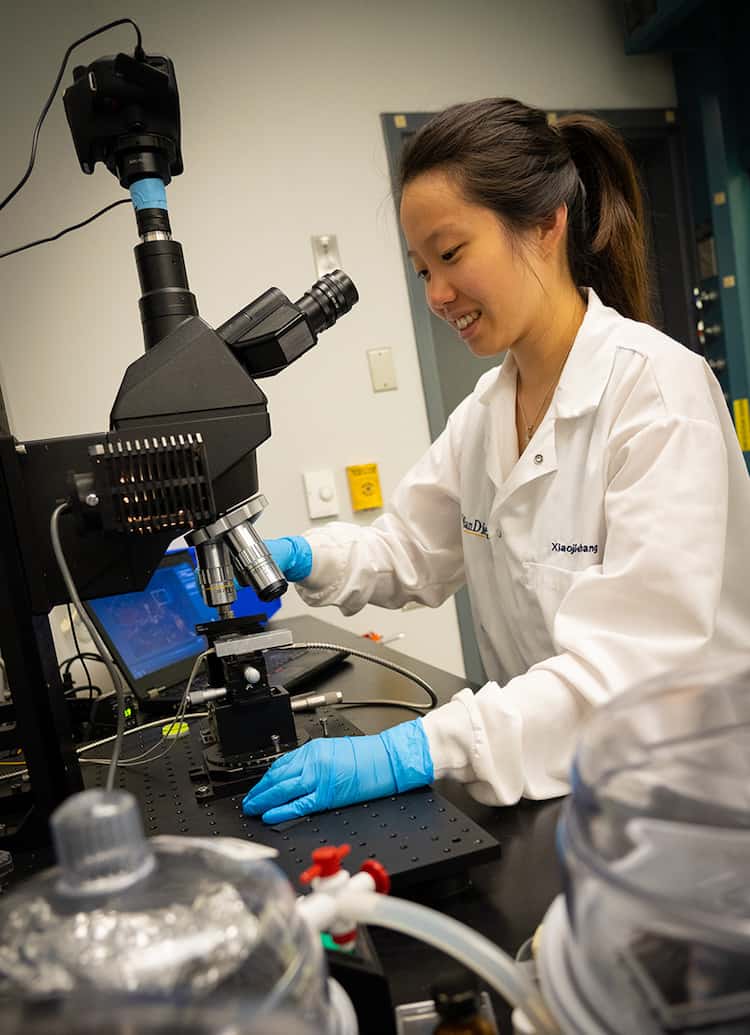
Team member Chawina De-Eknamkul building an atomically thin waveguide. Courtesy: E Cubukcu, UCSD
Cubukcu and colleagues’ waveguide is just six angstroms thick. This makes it 104 times thinner than a typical optical fibre and about 500 times thinner than on-chip optical waveguides in integrated photonic circuits.
Photonic crystal that supports excitons
The device is a monolayer crystal that consists of a single layer of tungsten atoms sandwiched between two layers of sulphur atoms suspended on a silicon frame. The researchers also patterned the monolayer with an array of nanosized holes using an ion-etching technique to form a photonic crystal that supports excitons (electron-hole pairs) at room temperature.
“These excitons generate a strong optical response, giving the crystal a refractive index that is about four times greater than that of air,” explains Cubukcu. “When we send light through the crystal, it is trapped inside and guided along the plane of the material by total internal reflection – which is the basic mechanism for how an optical waveguide works.
“The main challenge for us here was patterning a suspended material that was only three atoms thick,” he tells Physics World. “While the materials we employed are very robust, they can still be damaged by macroscopic forces. Happily, the students in our team devised a way to handle the structures by making use of a sacrificial photonic crystal template that they removed in the very last stage of device processing.”
Device channels light in the visible
The waveguide also channels light in the visible part of the electromagnetic spectrum – something that is challenging to do in a material so thin, he adds. Although other researchers have previously shown waveguiding in graphene (which is a sheet of carbon just one atom thick), this occurs at infrared wavelengths. “We have demonstrated waveguiding in the visible region for the first time in such a thin material.”
Another fundamental problem was to be able to probe the waveguide mode, he says. “By its very nature, a waveguide guides light in the plane of the material, but at this ultimate layer of thinness it is very difficult to distinguish the guided light from that propagating freely in space.”
To address this problem, the researchers say that they used a periodic array of holes that make use of special type of grating surface wave anomalies, known as resonant-type Wood’s anomalies, to scatter a small amount of light out of the plane of the material so that it could be detected. “As such, the light guided in the un-patterned waveguide was first coupled to the photonic crystal region and then scattered out via the Wood’s anomalies,” explains Cubukcu.
Thinnest optical resonator ever for visible light
The fact that the holes allow some light to scatter out of the plane in this way means that the suspended crystal can double as an optical resonator too, he adds.
“This also makes the device the thinnest optical resonator for visible light ever to be demonstrated in an experiment,” says team member Xingwang Zhang, who is first author of the study. “Our system not only resonantly enhances the light-matter interactions, but also serves as a second-order grating coupler to couple the light into the optical waveguide.”
Waveguides are typically used in applications in the photonics and optoelectronics industry. “For example, an optical fibre is a waveguide that forms the backbone of the Internet so we can imagine our device being used in this context,” says Cubukcu. “For the resonator, sensors might be a possible application area.”
The researchers, reporting their work in Nature Nanotechnology 10.1038/s41565-019-0519-6, say they are now looking into some fundamental research questions involving the excitons in their device. “The material we have used exhibits pronounced effects entailing these excitons so we would like to better understand these,” says Cubukcu.
New insights into the inner structure of rapidly-rotating neutron stars have been gleaned by astronomers in Australia and Canada, who have studied the time evolution of a glitch – a sudden increase in the rate of stellar rotation. Their observations of the Vela pulsar suggest that glitches could be governed by interactions between three different rotating regions of the neutron star.
A pulsar is a spinning neutron star that broadcasts a lighthouse-like beacon of electromagnetic pulses at a constant frequency. Occasionally, however, the frequency of some pulsars can increase slightly in a process that astronomers call a glitch.
Vela is a pulsar that is about 1000 light-years from Earth and emits a bright beacon of radio waves. It spins at about 11 Hz and undergoes a glitch about once every three years, speeding-up by about 10-5 Hz.The neutron star has a radius of just 20 km yet has a mass greater than that of the Sun. It is made of neutron-rich matter that is tightly packed at densities on par with that of an atomic nucleus.
Superfluid neutrons
Astrophysicists have a poor understanding of the interior structure of neutron stars, which is why they are keen on understanding why pulsar glitches occur. A popular model describes neutron stars as comprising two solid crustal layers that surround a superfluid core of neutrons. The outer crust is believed to comprise nuclei that are densely-packed in a crystalline lattice that is permeated by an electron gas. In the inner crust, higher pressures fuse some electrons and protons to form a superfluid of neutrons that permeates the solid lattice in this layer. These three regions are believed to be decoupled, and could therefore rotate at different frequencies
Now, scientists at Monash University, McGill University and the University of Tasmania have reanalysed radio observations of a glitch in the rotation of Vela that was observed in 2016. The data appear to reveal a small drop in frequency preceding the glitch. The data also provide the first evidence that the glitch “overshoots” the final rotational frequency of the star and this is corrected by a small rebound in frequency.
To understand this behaviour, the team devised several models of how the internal structure of a neutron star could affect a frequency change and compared their predictions with the data. Statistical analysis suggests that the process is best described by a model that involves an initial slowing of the rotation, followed by a jump in frequency. This favoured model also includes couplings between the lattice crust, inner crust and core of the neutron star in terms of two exponential time constants.
“Second soup”
Paul Laskey of Monash University says the team’s analysis suggest that the glitch occurs when the superfluid inner crust moves outwards, striking the rigid outer crust and accelerating its rotation. “But then, a second soup of superfluid that moves in the core catches up to the first, causing the spin of the star to slow back down,” he explains.
This overshoot had been predicted by astrophysicists including McGill’s Vanessa Graber, who was involved in this study.
The observed slowing before the glitch occurs puzzles the team, as Monash’s Greg Ashton explains. “We actually have no idea why this is, and it’s the first time it’s ever been seen! We speculate it’s related to the cause of the glitch, but we’re honestly not sure”.
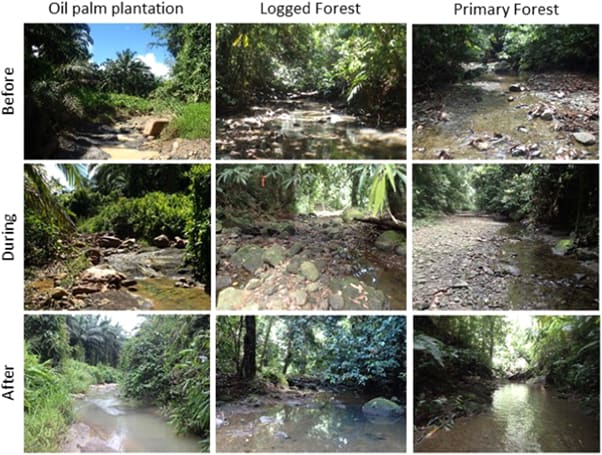
In 2013 Clare Wilkinson from Imperial College London, UK, and colleagues started investigating the impact of land use change on biodiversity in Malaysia. They selected 16 streams in Southeastern Sabah and monitored N. everetti along a 200 m transect of each watercourse over the following four years. Four of the streams ran through primary forest, seven ran through logged forest and five passed through palm oil plantations.
In 2016 a severe El Niño brought drought to the region, drying the streams in the study region into a series of disconnected pools.
Streams in primary forest, logged forest and oil palm plantation streams, before, during and after drought, illustrating the impact of the 2016 El Niño drought on stream conditions. Figure 1 from Resilience of tropical, freshwater fish (Nematabramis everetti) populations to severe drought over a land-use gradient in Borneo Clare L Wilkinson et al 2019 Environ. Res. Lett. 14 045008 doi:10.1088/1748-9326/ab0128
“The drought had a major impact on streams,” says Wilkinson. “Water temperatures rose, oxygen levels dropped and freshwater biodiversity was restricted to smaller areas. This disturbance exceeded any worst-case scenario for climate change-induced warming but served as a useful indicator for how ecosystems might respond to a warming world.”
Using cast nets to capture the fish, Wilkinson and colleagues measured, weighed and tagged the animals before returning them to the stream. The researchers also measured the temperature, dissolved oxygen, pH, water speed and size of the stream each year.
Water temperatures were significantly higher in logged forest and oil palm streams – by 2.5 °C and 5.5 °C, respectively — compared to primary forest streams, the team found. These differences became even more pronounced during the drought. Dissolved oxygen was also lower in logged forest and palm oil streams, and this too was exacerbated by the drought.
For N. everetti logged areas are the least desirable, the results show. Wilkinson and colleagues recorded between 2 and 3000 N. everetti per kilometre of stream in primary forest and oil palm areas, but only 500 or so in logged regions.
“The species feeds on insects falling into the streams, and this is lowest in logged forests,” explains Wilkinson, who published the findings in Environmental Research Letters (ERL).
During the El Niño-induced drought, N. everetti remained a healthy size but tended to travel further the researchers found. In particular, they recorded falling numbers of fish in oil palm regions. However, Wilkinson and colleagues suspect this decline may be an artefact of the cast net catching method, with nets more frequently entangled in vegetation or caught on exposed rocks around the smaller pools during the drought.
Overall the findings suggest that N. everetti is surprisingly resilient to drought, and more affected by land-use change, with logging reducing their numbers most. The researchers anticipate that rarer species are likely to suffer greater impacts from both land-use change and climate change.
People rely heavily on freshwater ecosystems in the region as a source of food and clean water; Wilkinson and colleagues believe that results like these are needed to develop mitigation strategies for dealing with future changes.
An international team of researchers has designed a 3D-printed pill that combines an osmotic sampler with microfluidic channels that can profile bacterial species inhabiting the gut (microbiome). This could have important implications for conditions that affect and are affected by the intestinal microbiome (Advanced Intelligent Systems 10.1002/aisy.201900053).
The role of the gut microbiome in favouring or protecting us from certain diseases is now under the spotlight. Recently, a potential link with the development of Alzheimer’s disease has been highlighted, leading to a focus on the development of technologies that could sample the microbiome constitution in vivo.
Unfortunately, there is currently no noninvasive tool capable of profiling microbiome populations throughout the entire gastrointestinal (GI) tract. Conventional methods analysing faecal DNA and metabolites provide little information about the environment upstream of the distal colon. The new pill, designed by a team led by Sameer Sonkusale from Tufts University, remedies this.
A lab-in-a-pill device…
Covered with a pH-sensitive coating that only dissolves in the higher pH environment of the small intestine, the pill is engineered to specifically sample gut bacteria and stay inactive in the stomach. A small neodymium magnet embedded in the pill also allows it to be held in place externally once it reaches the desired location, in order to sample more from that region.
Once the coating is dissolved, the osmotic pressure that has been built up across the membrane causes gastric fluid to be sucked into the helical channels of the pill – bringing with it the bacteria. Bacteria remains trapped in the channels, while water diffuses across the membrane of the osmotic pump to the salt chamber. Excess salt water discharges through the exit nozzle.
…that can sample gut microbiome
The researchers characterized the pill’s sampling performance using realistic in vitro models and validated it in vivo in pigs and primates. Experiments in intestines freshly dissected from pigs showed that the pill could move inside the GI tract under realistic flow conditions. Meanwhile, the in vitro investigations revealed that bacteria motion pattern (motility) and the solvent pH had no impact on the pill sampling performance.
Finally, the team tested the pill’s ability to sample gut luminal content in a weaned pig and in four macaques. The microbiota profile of samples recovered from the pills’ collection channels closely resembled the profile of samples recovered from the surrounding intestinal lumen or faeces. Additionally, extra bacteria found in the pill but absent from faeces matched the description of the microbiome of more proximal organs found in the literature. These results highlight the pills’ ability to sample the entire GI tract.
By providing spatial information of the microbiome profile, the authors hope that this pill will help advance novel treatments and therapies for a number of diseases and conditions.
At the entrance to the Institute of High Energy Physics (IHEP) in Beijing stands a shiny metal sculpture on a plinth. From a distance, it looks like a face with two spirally eyes – one black, one white – framed by strands of hair shooting off in two directions. It’s almost like something Picasso might have created, had he only curved plastic pipes to work with.
Dong Yuhui, a scientist and administrator at the institute, set me straight when I visited IHEP in June this year. “What you see is the yin and yang symbol representing the inseparable opposites that compose all things,” he explained. So what I thought were eyes were, in fact, the beginnings of each symbol nestled together, and the strands of hair were the tails.
Yin and yang: This sculpture outside the Institute for High Energy Physics in Beijing alludes to its accelerator bringing opposites – electrons and positrons – together. (Courtesy: Institute of High-Energy Physics)
It’s an image, Dong added, that nicely fits the Beijing Electron Positron Collider (BEPC), which has been running at IHEP since 1988. “You bring yin and yang together and you make lots of things – electrons and positrons, other bits of matter,” he told me. The sculpture, he continued, was based on a concept by Tsung Dao Lee, the Chinese-born theorist who shared the 1957 Nobel Prize for Physics with Chen Ning Yang for their work on parity violation.
A lively man who punctuates his conversation with jokes and laughter, Dong is currently the director of IHEP’s Multidisciplinary Research Center. But he has also taken on a new job as vice-manager of China’s newest synchrotron – the High Energy Photon Source (HEPS). The facility is the fourth synchrotron to be built in China, and its groundbreaking took place on 29 June.
Round and round
Synchrotron radiation has nothing intrinsically to do with synchrotrons. It’s a consequence of well-understood laws of classical electrodynamics, according to which any charged particle radiates energy as it accelerates, just as electrons do as they travel round a circular accelerator. The name comes from the fact that the magnetic field that bends the particles around increases with time, being “synchronized” to their increasing kinetic energy.
The phenomenon was first observed in the late 1940s by scientists at the General Electric (GE) Research Laboratory in Schenectady, New York, which then had a world-class programme of accelerator and solid-state research. A small GE synchrotron there happened to be built with a glass vacuum chamber, allowing the scientists to see the radiated light, and the connection with synchrotron devices became cemented into the name of the light itself.
Synchrotron radiation was initially regarded as a nuisance because, beyond a certain point, any additional energy put into the electrons would be promptly radiated away
Robert P Crease
Synchrotron radiation was initially regarded as a nuisance. That’s because, beyond a certain point, any additional energy put into the electrons would be promptly radiated away. It seemed that synchrotron light would limit the size – and hence power – of electron accelerators. But over the next decade, physicists realized it could potentially be used as a source of intense and finely tunable X-rays for diffraction, spectroscopy, imaging and other purposes.
Experimentalists at the Stanford Linear Accelerator Center (SLAC) in California and elsewhere began to use electron-storage rings that had been abandoned by high-energy physicists – or borrowed them when not in use. “The experimenters were parasites on the high-energy physicists,” says Dong, who is equally at home talking about the history of synchrotrons as about the BEPC itself. You could say it was a case of a “bug” being turned into a tool.
New generation
Machines like those at SLAC were the first generation of light sources. But synchrotron-light users wanted their own dedicated machines, ideally with beams that are slimmer in size than those available from high-energy machines built by high-energy physicists. Narrow, more focused electron beams could produce brighter X-ray beams, with “brightness” being a key parameter linked to the intensity of the beam and how it diverged.
In the 1970s two accelerator physicists at Brookhaven National Laboratory – Renate Chasman and Ken Green – devised a magnet array specifically to maximize brightness. The first accelerators built with the resulting Chasman–Green lattice were the second generation of synchrotron-light sources. These included Brookhaven’s own National Synchrotron Light Source (NSLSI), which fired up in the 1980s, as well as the Synchrotron Radiation Facility in Daresbury, UK.
As China emerged on the global scientific stage, it too was keen to get in on the act
Robert P Crease
But as China emerged on the global scientific stage, it too was keen to get in on the act. It therefore built the Beijing Synchrotron Radiation Facility (BSRF) – the country’s first such light source when it opened in 1991. The BSRF uses a modified Chasman–Green lattice, but gets its electrons from the BEPC. “It’s a first-generation machine with second-generation beam parameters,” said Dong, laughing at the unusual hybrid nature of the facility.
Still operating, the BSRF is limited compared to other synchrotrons, of which there are now more than 50 around the world. In particular, it has only 14 beam lines. That’s far fewer than, say, the European Synchrotron Radiation Facility in Grenoble, France, which has more than 40 beamlines, or the NSLS I, which had nearly 80. Still, the BSRF is actively used. Dong himself received his PhD in condensed-matter physics based on work he did there in 1995 – one of the first experiments at the facility.
Fourth and final?
By the mid-1990s, a third generation of synchrotron light sources had arrived, built with long straight sections to accommodate instruments called “wigglers” and “undulators”. These devices, which had been developed from the 1960s onwards, improved brightness by using a series of magnets in a straight section of the accelerator to oscillate the electron beam, making it give off even more light.
The High Energy Photon Source will be China’s first fourth-generation synchrotron source – and one of only a handful of such facilities around the world
Robert P Crease
After the BSRF, two more synchrotron sources were built in China. There was a “proper” second-generation facility in Hefei, followed by a third-generation lab in Shanghai. The HEPS will, however, be the country’s first fourth-generation synchrotron source – and one of only a handful of such facilities around the world. It will have even brighter beams using a still more advanced magnet array called a multi-bend achromat.
But the new technology wasn’t the only challenge. Finding a site for the HEPS was hard too, Dong told me. Planners wanted a location that would be near Beijing so that experimentalists didn’t have far to travel. However, the device also had to be built on relatively uninhabited land with a stable rock base. It took four years before a location was found in Beijing’s northeast region, next to the Jingmi diversion canal, which brings drinking water from Miyun to the city.
The HEPS will be 1.3 km in circumference, have 60 – 70 beam lines with more than 90 experimental stations, and is expected to be completed by the end of 2025. “I am in charge of all the beamlines,” Dong says. “I have to decide what kinds of beamlines need to be built, what experiments go where for every station, and get everything in under budget – all in six-and-a-half years!”
From plants to proteins
Once the new machine is complete, the BSRF will probably be shut down. But for now, it is still highly active, and Dong took me round to show off the kind of research it supports. When I was there, the BEPC was operating in its high-energy physics mode, as it does for about 75% of the time. Some BSRF beamlines work during the high-energy physics mode, but the strong shielding let us walk freely around.
As we entered the BSRF building, a loud, piercing siren went off to signal that the BEPC was being filled with electrons, meaning that there were restrictions on access to the injection area. Dong, who had become accustomed to such painful noises over almost three decades, didn’t flinch. Mercifully, the alarm ceased after about a minute.
The BSRF is 240 m in circumference, and its experimental stations are all located near ports in a sector outside the ring. Though there are only 14 stations, the facility supports 1800 to 2000 users a year, nearly all from China. There were pipes and equipment draped in aluminum foil, and hutches with posters displaying descriptions of the station’s research.
“This one is XFAS,” Dong said as we walked around, “that one diffraction, and over there is X-ray fluorescence.” As at other synchrotrons, the user profile has changed over the years. At first, he said, most users were condensed-matter physicists. Then, protein crystallographers took an interest as they realized how valuable synchrotron X-rays were for solving protein structures – provided they had big enough samples to put in the beam, that is.
Protein crystallography and a few other uses in the life sciences led to an upsurge in biological scientists at light sources. A few years ago, however, solving protein structures began to be taken over by cryogenic electron microscopy (cryo-EM), which uses standalone instruments that do the job better than synchrotrons. You don’t need as much sample to solve a protein structure with a cryo-EM, which slowed the expansion of protein crystallographers among synchrotron users.
Dong and I then stopped at the X-ray fluorescence station, where a poster showed pictures of three different kinds of plants studied at the station. “At this port they are studying environmental pollution,” Dong explained, indicating research into chromium uptake in one of the plants. “This plant is from an area in the south of China heavily polluted by chromium, and the experimenters are trying to see if certain fungi can be used to draw chromium from the soil.”
A rice plant was also depicted on the poster. “This is from the Guizhou province, where there were mercury mines in the Han Dynasty about 3000 years ago,” Dong explained. “We know this because we can image it in the rice!” The mining ceased long ago, but the pollution is still present in dangerous amounts. The researchers had used the BSRF to find ways to reduce the toxicity of the mercury in rice, in particular exploring the use of selenium.
“Selenium combines with mercury and deposits it on the surface of the grain,” Dong explained. “Machines can then polish the surface to remove the grains. At this station they are locating exactly where the mercury and selenium combine.” Although the grain product is not for human or animal consumption, it can be used to produce industrial alcohol. “In highly populated areas,” Dong said, “you have to make the best use of all arable land.”
Like other light sources, the BSRF serves academic and industrial users, the latter being allowed to use the facility without a charge as long as they publish their results; if they don’t, they have to pay the full fee. But the work of pharmaceutical firms at the facility revealed certain differences between Western and Chinese light sources.
In the West, firms such as Novartis, Merck and Pfizer are big, powerful and rich enough to develop a drug from beginning to end. “These companies build beamlines at synchrotron radiation facilities and have experience in cooperating with the machine operators,” Dong said, with the most expensive parts of drug development being the clinical trials. “In China we don’t have such wealthy companies. Ours can only afford to do the ‘cheap’ stage of solving a structure and verifying how it functions with other molecules. They want to keep that testing a secret – sometimes they won’t even tell us what protein they are testing. This makes it harder to work together.”
The critical point
At the BSRF, Dong said, he was beginning to tire of the routine: “Users come, users go, research grows more complicated, researchers don’t know the details of the machine, and the operators have to help them. You have to pay less attention to the machine and more to the users’ needs.” He is also dismayed by the lack of developments in synchrotron radiation source technology. “There have been no new innovations in this century.”
For Dong, synchrotrons appear to be approaching a limit on possible brightness imposed by the optics – limits on the size of the beam spot and focusing. A few years ago, he said, fourth-generation synchrotron sources were even being called “ultimate storage rings”. But at the HEPS, special research centres will be built to connect research teams and the machine’s operators, improving the interactions. Dong also mentioned new ideas for the facilities, such as an energy recovery linac proposed by researchers at Cornell University. Hopefully, such innovations will secure a strong future for synchrotron sources in the decades ahead.
The quantum electrodynamic process of photon–photon scattering has for the first time been confirmed experimentally to a high degree of certainty. CERN’s ATLAS collaboration, which involves hundreds of physicists from around the world, made the breakthrough after analysing a large dataset of candidate scattering events using a neural network. Their discovery could fuel new research into a variety of theories beyond the Standard Model of particle physics.
In classical electrodynamics, photons cannot interact with each other because they have no charge. At the same time, however, quantum electrodynamics predicts that two photons can scatter off each other by exchanging virtual charged fermions or W bosons. Some theorized extensions to the Standard Model predict that these scattering events are sensitive to as-yet unconfirmed particles, including axions and magnetic monopoles.
To test these theories, physicists at CERN’s Large Hadron Collider (LHC) have attempted to induce photon–photon scattering by firing heavy ions towards each other at relativistic speeds. As they pass closer and closer to each other, the ions exchange an increasing number of virtual photons. If scattering occurs between any two of these photons, the ion pair will lose a small amount of energy and emit a pair of real photons. These light flashes will then hit opposite sides of the detector, revealing the characteristics of the original scattering event.
Colliding lead ions
In 2017, both the ATLAS and CMS collaborations, based at the LHC, searched for evidence of these photon pairs during high-energy collisions between lead ions that they had recorded in 2015. From a total of 13 candidate events, the experiments reported photon–photon scattering to certainties of 4.4σ and 4.1σ respectively – which falls short of the widely accepted 5σ certainty threshold required to confirm an experimental discovery.
The ATLAS collaboration has now repeated the experiment using a far larger dataset of 59 candidate scattering events, gathered from a further, more extensive series of lead-ion collisions carried out in 2018. In addition, they developed a neural network to more effectively distinguish the photon pairs that indicate these scattering events from all the background photons picked up by the detector. This allowed the team to greatly increase the certainty to 8.2σ, which is well beyond the accepted threshold.
Several recent theories have predicted that measurements of photon–photon scattering could be sensitive to phenomena beyond the Standard Model. These include particles containing just one magnetic pole, which is forbidden by classical electrodynamics, as well as axions, which are theorized to solve the strong CP problem of quantum chromodynamics. The discoveries of the ATLAS collaboration could, therefore, inform future studies aiming to confirm and constrain these theories, potentially allowing much-anticipated updates to the Standard Model.
“Variety is the spice of life” is often the phrase trotted out when you are justifying why you can’t settle down in your career. You keep switching courses or jobs because there is an itch for something different, a yearning for new experiences.
If this is you, on the face of it, joining a 40-year old company with excellent staff retention seems like a bad move. But Tessella is not your average company – variety is its lifeblood.
Tessella is an international data science, analytics and AI technology consulting services provider. The company has offices across the UK, US and Europe. And its client roster includes some of the biggest names in science and engineering, from AstraZeneca, GSK and Pfizer to Shell, BP and Equinor, and from Unilever and AkzoNobel to the European Space Agency and JET.
The company has developed a reputation for helping clients from a wide range of sectors to address complex technical challenges by unlocking the power of their data, enabling them to make better-informed business decisions.
That might mean helping pharmaceutical companies to solve computational problems in drug discovery and development, ultimately allowing them to get drugs to market faster. Or it may involve writing algorithms and figuring out the complex mathematics needed to control satellites and radar systems.
“Just recently I’ve been working on a year-long project to develop an internal web app for BP that helps them evaluate commercial and financial opportunities,” says Tessella Consultant David Michel. “Before that it was something completely different – completely different domain, completely different technology.”
The “completely different” project Michel refers to is a four-year overhaul of the systems and software used to control the neutron and muon instruments at the Central Laser Facility (CLF), a world-leading centre for high-energy laser research at the STFC Rutherford Appleton Laboratory near Oxford, UK. It provides both high-power and high-sensitivity lasers for a wide range of scientific applications, from atomic and plasma physics to medical diagnostics, biochemistry and environmental science.
Based at the client’s site every day, Michel helped transition CLF’s operation to a more automated instrumentation control system, using open-source distributed soft real-time control software. This has opened up new capabilities, allowed closer collaboration with other scientific facilities across the world, and enabled CLF users and scientists to conduct more advanced experiments.
A good fit
Michel first heard about Tessella in 2008. Originally from France, he completed a PhD in biophysical chemistry at Sheffield Hallam University in 2006 before moving to Göttingen, Germany, for postdoctoral research at the Max Planck Institute for Biophysical Chemistry.
“At the time of this postdoc, I had started to like developing software – I liked doing this as much as the science,” he recalls. “And then I saw an advert in Physics World for Tessella and wondered: would a company like this employ somebody like me?”
“The second interview was thorough, but by the end of the day it felt right to me,” says David Michel
With his application submitted, Michel was immediately impressed by the rigour of the interview process. After a brief telephone interview, he was invited to spend the day at Tessella’s head office for a proper introduction.
“The second interview was thorough, but by the end of the day it felt right to me,” he says. Not only did it give the company enough time to ensure he was a good fit for the team, but it also allowed Michel to assess whether he could see himself working there.
Michel admits that it was a steep learning curve to go from hacking together programs for his theoretical physics and chemistry research, to developing professional software that solves a customer’s problem. Yet Tessella provided the time and resources for him to learn these and other skills. Indeed, the company dedicates 150 hours (1 month) to training every year for every staff member, allowing employees to tailor their own career development based on their aspirations – often leading to recognized professional qualifications.
Moreover, Michel was surrounded by individuals who had been in the same boat. All staff come from a scientific background, and over half have PhDs. “The reason is not that people with PhDs are super-smart compared to others,” he says. “It’s more that a PhD is like the real world in a way, where you have a problem and you have to solve it somehow, as opposed to being fed lectures and exercises.”
Cross-functional and collaborative
Since then, Michel has learned both technical capabilities and leadership skills that have allowed him to take on diverse project roles, including technical lead, project manager and business analyst. “The company has a very flat organizational structure, and we are all cross-functional – a lot of people do a bit of everything,” he says. “We just do whatever is needed for the project.”
For the most challenging customer problems, this can often mean leaning on the wealth of experience within the wider company. “When you don’t necessarily know the answer, it’s quite likely someone, somewhere at Tessella has done something similar,” he says. “We often ask whether anyone has worked with a certain technology or encountered a particular kind of problem before, and there will be dozens of replies.”
As a result, this community of like-minded, intelligent individuals are able to effectively collaborate on hi-tech R&D projects for global companies that are at the forefront of science and technology. But more than this, they create, develop and deliver solutions that make a difference to the world.
“When I talk to friends who are still in academia, sometimes there’s this perception that I’ve sold my soul to the devil, where they think it’s all about money and profit,” says Michel. “Nothing is further from the truth.”
Although the company offers a competitive salary, together with an attractive benefits package and career development opportunities, what Michel cares most about is that Tessella always does the right thing for its customers.
“Coming at this as an ex-scientist, where you really want to have that intellectual freedom and care about the truth, it’s important for me at least that I work for a company that does what’s right – and Tessella does that, to the point where we turn down customers if we’re not the right fit,” he says. “This culture and mindset is something I appreciate very much. It’s not just a sales pitch, it’s real.”
In its latest annual Renewables Global Status Report, REN21, the global renewable energy network, says that renewables are increasingly preferred for new electricity generation. Around 181 GW of renewable power capacity was added in 2018, setting a new record just above that of the previous year. Overall, renewable energy now accounts for around one-third of total installed power generation capacity worldwide and over 26% of global power supply. Nearly two-thirds (64%) of net installations in 2018 were from renewable sources of energy, marking the fourth consecutive year that net additions of renewable power were above 50%.
REN21 also notes that, as of 2017, renewable energy accounted for an estimated 18.1% of total final global energy consumption (TFEC). Modern renewables supplied 10.6% of TFEC. Traditional use of biomass for cooking and heating in developing countries accounted for the remaining share. The greatest portion of the modern renewable share was renewable thermal energy (an estimated 4.2% of TFEC), followed by hydropower (3.6%), other renewable power sources including wind power and solar PV (2%), and transport biofuels (about 1%).
Too slow
However, REN21 says it’s all going too slowly. “While there has been much progress on renewables, energy efficiency, and access to electricity and clean cooking facilities over the past decade, the world is not on track to meet international goals, most notably limiting the average rise in global temperatures to 1.5 degrees Celsius as stipulated under the Paris Agreement,“ the organization says. It warns that in terms of energy: “the overall share of renewable energy (both modern renewables and traditional biomass) in TFEC has increased only gradually, averaging 0.8% annually between 2006 and 2016. This modest rise is due to a negligible change in the traditional use of biomass coupled with overall growth in global energy demand since 2006 (annual average increase of 1.5%). Despite strong demand growth in modern renewables, especially renewable electricity, these two factors have slowed gains in the combined share of renewable energy in TFEC“.
The key problem is that, in 2018, global energy demand increased an estimated 2.3%, the greatest rise in a decade. This was “due to strong global economic growth (3.7%) and to higher heating and cooling demand in some regions”, REN21 says. “China, the United States and India together accounted for almost 70% of the total increase in demand. Due to a rise in fossil fuel consumption, global energy-related carbon dioxide (CO2) emissions grew an estimated 1.7% during the year.“
Best foot forward?
REN21 is not alone in warning that progress on energy, as opposed to just electricity, is too slow. Many others have said the same: see the International Energy Agency (IEA)’s comments below. Energy demand is booming so much, especially in transport, that emission savings in other sectors, and from the spread of renewables, are being overwhelmed. Ramping up renewables faster in all sectors will help, but we also have to get demand tamed — and cut back. Some, logically enough, want to focus on transport but that’s maybe the toughest nut to crack. Some progress is being made, with plans for banning fossil-fueled cars, but if the result is just more electric vehicles (EVs) that may not help too much. Private cars are much less efficient than public transport; do we really want to use precious green power to keep cars running?
Focusing on green heat might be an easier and more productive option. For solar especially, biomass maybe less so, given its eco/land-use issues, although if used in combined heat and power (CHP) plants, linked to heat stores and district heating networks, you get better efficiency. However, many plans at present look to using green power to run heat pumps: will there be enough for that and for EVs? Waiting in the wings, the nuclear industry sees all this as an opportunity to get back in the game, with power, but also maybe heat and hydrogen. While the fossil fuel lobby looks to carbon capture and storage (CCS), or even better carbon capture and utilization (CCU), to let them stay in business. The race goes on…
While renewables do seem to be winning in supply terms, as the IEA noted in a paper produced for the G20 Summit in Japan, that still means that “despite the large investments in wind and solar over the last ten years, these efforts have only compensated for the low growth in other sources such as nuclear and hydro“. The IEA continues: “even if wind and solar PV deployment could be accelerated, other low-carbon technologies like dispatchable renewables, nuclear power and CCUS also need to be expanded at massive scale to decarbonise the power sector“.
Well, maybe. Certainly, there would be room for more wind and solar and for firm power from biomass, hydro and geothermal, as well as cyclic, but predictable, power from tidal projects. The IEA, however, is not convinced. “The level of additional renewable generation sources required to achieve the Sustainable Development Scenario is already extremely high,” it says. “Expanding the level even more to make up for the lack of growth or decline in nuclear power or CCUS implies enormous challenges in terms of not only additional costs but also land availability and local acceptance.” Surely worth a try though, with, as I have reported regularly, several academic scenarios suggesting that a 100% renewable energy mix is credible by 2050.
It gets worse
That is not the message that you get from the new review of scenarios produced by Resources for the Future. Its Global Energy Outlook (GEO) compares forecasts through to 2040 from companies, government bodies, and expert organizations such as the US Energy Information Agency, BP, Exxon, Shell, the IEA and others. None of the “100% by 2050“ NGO/academic studies are, however, included. The result is that, even under the most optimistic scenario looked at, renewables only supply 31% of global primary energy by 2040.
And it gets worse. As Bloomberg has noted, investment in renewables is falling, though Bloomberg says it may pick up, and it’s worth pointing out that, cumulatively, there is still significant capacity growth. Indeed, REN21 says that, as a percentage of total energy consumption, modern renewables still expanded by an average of 4.5% over the last ten years, whereas global energy demand only rose by 1.5% over that period. It may be that continued renewable capacity growth can still be achieved with less investment, since technology costs are falling. Nevertheless, obviously enough, if investment was expanding again, capacity growth would be even faster. If demand keeps rising then that will be vital, but we should also be curtailing demand growth.
Renewables in cities
Meanwhile, moving the scene to another part of the story, REN21 has produced a study of renewable energy use in cities. It says there are now over 100 cities that get 70% or more of their electricity from renewables. Of course, not all of that will be generated inside cities. Given the high population density, there will not be room for enough PV arrays and the like to meet all a city’s energy needs from sources within its boundaries. So much of it will have to be imported from rural or, if available, offshore projects. That will have some interesting implications. Cities are already dependent on rural, and offshore, areas for food, and must import water from rural/ mountainous areas. Now they will have to import a lot of their energy from them too. See my chapter in the new Routledge book Sustainable Cities Reimagined. This book, edited by Stanislav Shmelev, looks at urban sustainability performance using a multi-criteria approach, covering environmental, economic and social indicators, to assess progress and policies in cities around the world, with renewables and smart energy systems to the fore. With more people now living in cities and energy demand rising, for example to power high-rise building air-conditioning as global warming impacts more, the issues the book raises are going to become even more urgent.
Keeping food fresh during its journey to your plate isn’t easy. The clock starts ticking as soon as a lettuce is plucked from the field or a bread roll is removed from the oven, and without some intervention to slow or stop that clock, many food products will become unpleasant or unsafe to eat within days. For consumers who live right next to a farm or bakery, that may be acceptable, but for those of us who live tens or even hundreds of kilometres away from where our food is grown or processed, it is simply not practical.
In the fight to avoid waste and keep food products fresh, cooling is an important weapon. Reducing the temperature of food increases its shelf life, maintains freshness and slows the growth of bacteria that might otherwise cause it to spoil. For this reason, foods are often cooled as quickly as possible after they are produced or harvested, and an entire industry has grown up around meeting this need.
Traditional cooling methods use either air or water to remove heat from food via a combination of conduction and convection. These methods have been around for decades, but they have several drawbacks. It can take hours to cool a pallet of vegetables using forced air circulation or jets of water. During that time, bacteria continue to multiply, and the cooling fluid (air or water) may itself become contaminated with harmful microorganisms unless strict precautions are taken. Conventional cooling also produces an uneven temperature distribution, with food products at the edges of containers being cooled more quickly than those at the centre. And of course, the process is very energy intensive.
An alternative is to cool food by placing it in a vacuum chamber. Vacuum cooling is based on the principle of evaporation: as water evaporates from the product, energy is removed, and the temperature drops. The evaporation process begins as soon as the pressure falls low enough for water to boil, and the desired final temperature can be set by controlling the pressure in the vacuum chamber.
(Courtesy: Leybold)
Compared to conventional cooling, vacuum cooling is fast. With the right equipment, a pallet of vegetables that would take several hours to cool via forced air circulation can be chilled within a few minutes. Vacuum cooling is efficient, too, requiring a quarter of the energy of forced-air cooling. Another advantage is that because evaporation takes place on all surfaces at the same time, the spatial distribution of the cooling is homogenous (especially for products with a high surface-area-to-volume ratio). This gives vacuum-cooled foods a significantly longer shelf life. A final benefit of vacuum cooling is safety. Because the flow of air is entirely in one direction, from inside to outside, there is no opportunity for potentially contaminated air to be introduced and to circulate around the food. The speed of vacuum cooling also enhances safety, as the rapid temperature reduction gives bacteria less chance to multiply.
Not all foods are suitable for vacuum cooling. Because the process is based on evaporation, the product must contain sufficient water for cooling to be effective. In addition, leafy vegetables such as lettuce, which have a large surface area, can be cooled more efficiently than solid ones such as tomatoes. But neither of these requirements is as restrictive as you might expect. Many foods that feel relatively dry in the mouth, such as bread, nevertheless contain enough water to be vacuum cooled. And because vacuum cooling typically only removes a few per cent of the product’s water content, the loss of mass is less than you would get with forced-air cooling – minimizing the loss of revenue on foods sold by weight.
The salad challenge
For vacuum experts, the task of designing a system to meet the needs of a customer in the food industry (as opposed to, say, scientific research) poses some interesting challenges. But the basic principles are the same. In particular, the calculation for how big the vacuum cooling system needs to be is based on the law of conservation of energy: the amount of heat released in cooling the food must equal the amount of heat taken up by evaporating the water, Qreleased=Qtaken.
The left side of this equation is calculated by multiplying the mass of the food by its specific heat and the change in temperature before and after cooling, Qreleased=mfood cpΔT. For example, if we wanted to cool 1000 kg of salad – a material with a specific heat of 3.9 kJ/(kg K), slightly less than that of water – from 25 °C to 5 °C, we would need to dissipate 78,000 kJ of heat. So how much water would we need to evaporate? Well, Qtaken = mwater× Δhvap, where Δhvap, the evaporation heat of water, is 2466 kJ/kg at 15 °C, so the answer is 31.6 kg – a few per cent of the salad’s starting mass.
The next question concerns the flow that the vacuum system needs to handle. If we want the total cooling time for the salad to be 30 minutes, allowing 5 minutes for pumping out between cooling cycles, then we need a system that can pump out msteam= 76 kg of steam per hour. To translate that into an effective volume flow veff, we use the equation veff=msteam×Vm/M×Teff/TN×PN/Peff, where Vm is the molar volume of water (22.4 N m³/kmol); M is its molar mass (18 kg/kmol); Teff and Peff are the effective temperature and pressure; and TN = 273 K and PN= 1013 mbar are the norm temperature and pressure. At Teff= 25 °C (298 K), the vapour pressure of water is 31.7 mbar, so our vacuum system would initially need to pump 3299 m3/hr. At the final temperature of 5 °C, the vapour pressure of water drops to 8.72 mbar, meaning that the system would need to be pumping 11,188 m3/hr.
The right fluff Tests carried out by the vacuum cooling and baking firm Cetravac show that vacuum-cooled bread (left) maintains its volume and structure better than bread cooled using traditional methods. (Courtesy: Cetravac)
In theory, a vacuum pump should be able to remove these flows. In practice, though, you would need a very big (and expensive) system to do it. The more economical choice is often to use a condenser to trap the steam flow and convert it into liquid, which dramatically reduces the gas flow to the vacuum pump. As a rule of thumb, you need about a square metre of condensing surface for each 10 kg/h of vapour flow, so to cool our 1000 kg of salad we would need a condenser of about 8–10 m2.
The remaining considerations are, first, that the vacuum system must be able to evacuate the chamber from atmospheric pressure to final pressure in the desired time (25 minutes in the salad example). This can be determined by a simple pumping speed calculation, s =V/t ln (p0/p1), where V is the volume of the chamber, and p0 and p1 are the starting and desired pressures. Second, the vacuum system needs to be able to handle the gas flow that remains after the condenser. Assuming a typical leakage on the vacuum chamber – around 5 kg of air per hour for a 10 m3 chamber with standard seals – we calculated the flow generated by the non-condensed steam and leaks left behind the condenser for both the starting and ending temperatures. The higher of the two above calculations will determine the size of the vacuum system. In the salad example, the results were 570 m3/hr for the pumping speed and 1500 m3/hr for the flow due to leaks and uncondensed vapour – far less than would have been required without a condenser.
Field work
Vacuum cooling systems for leafy vegetables, salads and flowers all have a similar design. They are either installed in a trailer placed next to the field where the salad is harvested, or they are integrated into the facilities where salads are cleaned and packed before being shipped. The largest stationary chambers can be loaded with up to 20 pallets simultaneously, and are capable of processing more than 300 tonnes of vegetables every day.
Vacuum cooling is a fast and energy-efficient cooling method with a wide range of applications in food processing and other industrial applications
Before being loaded into the vacuum chamber, vegetables such as lettuce are often sprayed with water to compensate for the loss of weight due to evaporation. As soon as the door closes, the vacuum system starts pumping and the pressure drops from 1000 mbar to 15–20 mbar within 5 minutes. At that pressure, and at a temperature of around 20 °C, water begins to evaporate and the cooling process starts. After 15–20 minutes, the pressure drops further, to 5–6 mbar, and the product reaches a temperature of about 2 °C. During the process, a condenser containing a mixture of glycol and water at a temperature of –6 to –10 °C traps most of the water vapour, protecting the pumps. Then the pumping and cooling systems stop and the chamber is vented back to atmospheric pressure within a few minutes. Afterwards, the salads are stored in a cool chamber where they can be kept for 2–3 weeks without spoilage.
As long as the condenser is doing its job well, the demands that this cycle places on the vacuum pumps are straightforward, because the starting temperature is fairly low (freshly harvested vegetables are seldom warmer than 30 °C) and the amount of water to be evaporated is limited. However, the presence of dirt particles or small plant parts can be a challenge, and there are some trade-offs in designing suitably low-maintenance and cost-effective systems. For example, oil-sealed rotary vane pumps are reliable and cost effective, with good water vapour compatibility and a compact, fully air-cooled design that makes them easy to use in mobile systems. However, they do need inlet filters to protect them against particles, and maintaining them requires a regular exchange of oil, oil filters and exhaust demisters.
Screw vacuum pumps have a higher tolerance for particles, and their small size, low noise level and low energy consumption make them ideally suited for industrial food-processing facilities. On the other hand, most versions require water or air cooling, and their up-front cost is higher than a rotary vane pump. Both types of pump may be used in combination with a roots vacuum pump, which boosts the pumping speed of the system at pressures below 50 mbar.
Beyond vegetables
The success of vacuum cooling in keeping vegetables fresh means that similar techniques are now being applied to other food products. Bread and pastries are one example. In this application, the starting temperature is much higher – up to 90 °C when bread rolls are offloaded from the oven – and the amount of water present in the cycle is therefore dramatically larger than it is for vegetables. Rotary-vane pumps do not have a high enough water-vapour tolerance to do the job, so screw pumps are a better solution. They can swallow large amounts of water without breaking and are also very tolerant of small particles (flour, poppy or sesame seeds, and so on). In addition to saving energy and cooling the bread more quickly, vacuum cooling also bestows advantages for consumers: vacuum-cooled bread has a crispy crust and fluffy crumb, providing more enjoyment when eating.
We are also starting to see some non-food applications of vacuum cooling. For example, the grass on the pitch in top-flight professional football stadiums does not really grow there. Instead, it is produced on special farms, harvested in rolls and transported to the stadium in time for games. Thanks to vacuum cooling, these rolls of grass easily survive the transport process, hanging on until their next watering. The requirements of cooling grass are similar to those for cooling vegetables, except that the amount of water that must be extracted to reach the desired temperature is significantly higher, due to the mass of the product (including soil and mud). It is therefore a more demanding job for the vacuum pump. The combination of rotary vane pumps and roots blowers still works well, but the pumps require more maintenance than is common for cooling vegetables.
In summary, vacuum cooling is a fast and energy-efficient cooling method with a wide range of applications in food processing (and, increasingly, outside it). It enhances food safety and extends the shelf life of food products. The challenges it poses to vacuum systems are both novel and highly dependent on the product being cooled: while oil-sealed rotary vane pumps have proven effective in cooling vegetables, other applications require innovative thinking. Dry pumping technology is creating opportunities for new and more sophisticated processes, including the cooling of sushi rice or food prepared for catering.