

Science labs develop innovations for the benefit of society but perhaps surprisingly they can be among the worst environmental offenders. Fortunately, various sustainability advocates are running initiatives and providing ideas to tackle the problem. This short video introduces the issue and you can find out more in this feature by science journalist Ben Skuse, originally published in the June 2019 issue of Physics World.
Casimir effect creates ‘quantum trap’ for tiny objects
Physicists in the US have worked out a way of making the Casimir force repulsive or attractive depending on the size of the gap between two objects. This creates a potential energy minimum with no actual energy input – which the researchers believe it could be useful in the creation and operation of a range of nanomechanical systems.
The Casimir effect is a bizarre phenomenon in which two electrically neutral surfaces held a tiny distance apart experience a force from quantum fluctuations. Named after the Dutch physicist Hendrik Casimir, who first proposed it in 1948 – the force is normally attractive because, when two parallel plate conductors in vacuum are placed a short distance apart, only a discrete set of quantum fluctuations can exist in the gap between them. The set of permitted vacuum fluctuations outside the gap is effectively unlimited, however. Therefore, the vacuum fluctuations on the backs of the plates exert more pressure than the fluctuations in the gap, pushing the plates together. This can be troublesome in nanotechnology, causing nanoparticles to clump together, for example.
In the 1950s, researchers predicted that repulsive Casimir forces could arise if the vacuum were replaced by a fluid and one of the two materials were switched for a material with lower refractive index than the fluid. This was confirmed experimentally in 2009.
Tuneable combinations
Purely repulsive forces are not much more use than purely attractive ones — but what would be really useful is the ability to create tuneable combinations of attractive and repulsive forces that could hold a particle with no energy input.
In 2010 at the Massachusetts Institute of Technology, Alejandro Rodriguez and colleagues proposed a scheme for obtaining such “Casimir equilibria”. “You need a fluid, and you need some kind of coating [on one of the surfaces],” he explains. “Since then, there have been a whole host of different predictions for how this could be demonstrated using different materials or different topologies, but the crux is using the underlying physics of Casimir forces in fluids to engineer a stable equilibrium.”
In the new research, Xiang Zhang of the University of California, Berkeley and colleagues have demonstrated this effect for the first time. They coat a gold plate in Teflon and, above this, they suspend a nanoscale gold flake in ethanol.
The Teflon has a lower refractive index than the ethanol, so the Casimir force between the gold flake and the Teflon is repulsive. The Casimir interaction between the gold flake and the gold plate is attractive, however – and much stronger than the repulsive interactions between the gold and the Teflon.
These are tiny, tiny forces, so measuring this is a triumph of optical metrology
Alejandro Rodriguez
When the gold flake is very close to the Teflon-coated gold plate, the relative difference between the distance to the Teflon surface and the distance to the gold surface underneath is significant, so the repulsion from the Teflon dominates and the gold flake is pushed away. As the flake moves further away, however, the relative distances to the gold and Teflon become similar, until eventually the attraction becomes dominant. The flake remains at the equilibrium point at which repulsion and attraction are perfectly balanced. The exact location of this point above the surface increases with the thickness of the Teflon coating.
The Casimir effect: a force from nothing
Read more
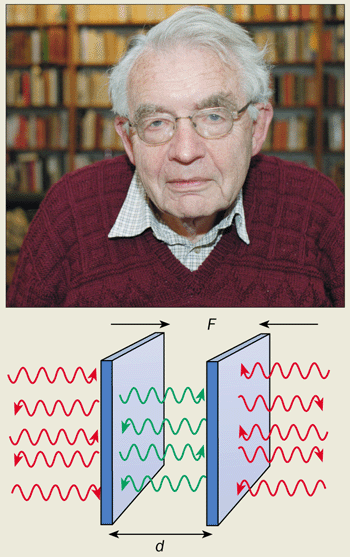
Zhang believes that the system could potentially find various technological applications. “If you have a magnetic slider moving at metres per second speeds against an atomically flat surface in a computer hard drive, then the Casimir force can push them together and cause the drive to crash,” he says. “One of the main causes of computer crashes is stiction, and there are many other examples of such failure in nanomechanical devices that they study in Silicon Valley. If there were a way to do frictionless bearings, that would be very desirable.”
Rodriguez is impressed by result. “This force depends on quantum fluctuations happening at every frequency from zero to ultraviolet,” he says. “It wasn’t clear until very recently that you could do much with this other than get an attractive force, so the really interesting part is the demonstration that this very complicated force can be harnessed and understood to create something as simple as a stable equilibrium”. He adds, “These are tiny, tiny forces, so measuring this is a triumph of optical metrology and the agreement with theory is frankly surprising.” Whether the practical complexities will permit technological applications, he says, remains to be seen.
The research is described in Science.
Battle of the elements: technetium-99m diagnoses disease then decays away
As the medical physics editor for Physics World, it seems apt that I should choose technetium as my favourite element — or more specifically, its metastable nuclear isomer technetium-99m (Tc-99m). Tc-99m is employed in tens of millions of medical diagnostic procedures per year — about 80% of all nuclear medicine procedures worldwide. As such, it is helping to save lives on a daily basis.
Tc-99m, the decay product of molybdenum-99 (Mo-99), is the perfect fit for medical imaging. It emits gamma rays with an energy of 140 keV, which can easily be detected using a standard gamma camera. A relatively short physical half-life of six hours, and a biological half-life of one day, makes Tc-99m ideal for use in procedures such as single-photon emission computed tomography (SPECT). Importantly, soon after the procedure ends, no radioactivity is left in the body.
One vital application, for example, is myocardial perfusion imaging, used to help diagnose heart disease. A Tc-99m-based radiopharmaceutical is injected into the patient and the gamma rays emitted from inside the body are used to create images of the heart muscle, with the patient at rest and during exercise. Comparing the resulting images (which, as an aside, I find highly reminiscent of the recently published first ever image of a black hole) enables doctors to assess blood flow through the patient’s heart.
And there are many, many other important procedures that employ Tc-99m — including whole-body imaging to detect bone metastases, sentinel node imaging before surgery for breast cancer or melanoma, as well as thyroid, brain, lung and renal imaging. Tc-99m certainly lives up to its reputation as the “workhorse isotope” of nuclear medicine.
Shifts in the supply chain
In terms of supply, however, Tc-99m has had a somewhat chequered past. To create Tc-99m, you first need to produce Mo-99, which has a half-life of 66 hours and is more easily transported to hospitals than its short-lived decay product. Mo-99 is traditionally generated via fission of uranium-235, achieved by neutron bombardment of uranium targets and performed in a limited number of nuclear reactors.
Around a decade ago, the nuclear medicine field experienced a large supply shortage caused by two of these ageing reactors being simultaneously shut down for extended periods. To address this vulnerability, governments and industry have since taken action to improve the reliability of the Mo-99/Tc-99m supply chain.
For instance, several countries have plans to develop new capabilities to produce Mo-99. Irradiation facilities and producers also have agreements in place for backup production and supply of Mo-99 in the event of scheduled (or unscheduled) shutdowns, making today’s market more reliable.
In addition, companies are developing alternative production methods that do not require uranium targets. One approach is to use neutron capture, in which the stable Mo-98 isotope captures a neutron and transmutes to Mo-99. Other approaches remove the need for a reactor completely, such as photon-induced transmutation of Mo-100 to Mo-99 using photons from electron accelerators.
The need for Tc-99m is clear, and all stakeholders are working hard to safeguard its supply. The most widely used medical radioisotope, Tc-99m looks set to continue making an invaluable and significant impact on the lives of patients across the globe.
Which is your favourite element? Contact us at pwld@ioppublishing.org with your pick – and the reason why – or via Twitter using the hashtag #battleofelements.
To catch a quantum jump
Is it possible to know if a quantum jump is about to occur? Researchers have been asking themselves this question for a long time, and the answer is a resounding “yes”, according to a new study by a team at Yale University in the US. As well as being of great importance for fundamental physics studies, the result, obtained by measuring the flight of a superconducting artificial three-level atom when it is excited by a beam of microwaves, might even be useful for correcting errors in quantum computing in the future.
It was Niels Bohr in 1913 who first put forward the concept of quantum jumps, which are the sudden transitions of a tiny object (such as an electron, molecule, or atom) from one of its discrete energy states to another. However, many of his peers at the time – including Erwin Schrödinger – strongly objected to their existence, instead postulating instead that they are not instantaneous.
Researchers didn’t actually observe quantum jumps until 1986 (in individual atoms). Since then, they have seen them in various atomic and solid-state systems and have shown that they are an essential phenomenon in processes such as quantum feedback control, and in particular for detecting and correcting quantum errors caused by decoherence in quantum information systems. Quantum error correction is a key challenge in the development of fully-functioning, real-world quantum computers.
Experiments on an artificial three-energy-level atom
A team led by Michel Devoret and Zlatko Minev has now focused on the “canonical case” of quantum jumps between two levels indirectly monitored by a third. This case, they say, corresponds to the 1986 tests of Bohr’s original idea on quantum jumps.
The researchers did their experiments on a superconducting electrical circuit that behaves like an atom with three energy levels. These are: the ground state; an auxiliary “bright” state that can be connected to the ground state by a transition stimulated by microwave light; and a “dark” state into which the atom can jump.
Using a technique called indirect quantum non-demolition measurement, they shone a microwave light beam at the artificial atom, with a frequency corresponding to the ground-bright transition. Thanks to the energy of the light beam, the atom rapidly bounces between the ground and bright state, emitting a photon each time it jumps from the bright to the ground. If the atom absorbs a higher-energy photon, from another light beam, however, it jumps into the dark state. When the atom is in the bright state, it scatters yet another light beam and when it is in the dark state it does not scatter it.
Observing when a quantum jump has begun
“When the atom is cycling between the ground and bright states, we observe a bright scattered light field,” explains Minev. “But, when the atom is in the dark state, we observe no light.”
“What is new in this work is that we can resolve essentially every single scattered photon with near perfect measurement efficiency.”
This perfect measurement efficiency comes thanks to a scheme proposed by Minev and it allows the researchers to observe when a quantum jump has begun, by identifying the missing flash of light scattered from the bright state.
Latency period
Just before a jump occurs, however, there is always a latency period (of a few microseconds), during which it is possible to acquire a signal that warns of the upcoming jump, say the researchers. This “advance warning signal” consists of a lull in the scattered light as the atom jumps into the dark state.
Minev says that he proposed the experiment inspired by a theoretical prediction by Howard Carmichael of the University of Auckland, a pioneer of quantum trajectory theory and a co-author of this study.
“Our experimental result shows that while quantum jumps are unpredictable and discrete (as Bohr thought) on long timescales, they can be continuous (as Schrodinger suggested) and predictable on a short time scale,” says Devoret.
Quantum jumps are not truly instantaneous and random
The researchers did not stop there: they also managed to control the quantum jump once it had started by applying an electric pulse to the artificial atom. In this way, they intercepted it and sent it back to the ground state. They are only able to do this because the quantum jump is not truly instantaneous and random. Instead, quantum jumps take the same trajectory between the two energy levels every time, so it is possible to predict how to send them back.
According to the Yale team, this is an important point: “while quantum jumps appear discrete and random in the long run, reversing a quantum jump means the evolution of the quantum state possesses, in part, a deterministic and non-random character,” say Devoret and Minev. “The jump always occurs in the same, predictable manner from its random starting point.”
“The findings are in complete agreement with the predictions of modern quantum trajectory theory,” Devoret tells Physics World, “with essentially no adjustable parameters.
“One of the applications for the type of experiment performed in our study is an efficient method for detecting very weak signals buried in quantum noise, and real-time intervention based on the results of this detection.”
“The results should also provide new ground for exploring intervention techniques to control quantum systems, such as the early detection of error syndromes in quantum error correction,” adds Minev. An unexpected jump could hint at a mistake in calculations, for instance, and might allow researchers to spot the beginning of the jump and account for the error – or perhaps even reverse it mid-jump.
The researchers, reporting their work in Nature 10.1038/s41586-019-1287-z, say they would now like to generalize their experiment to a situation involving two distant measurements on a common entangled system and see how the two distant jumps correlate. “This would be analogous to dissecting a Bell-inequality violation measurement,” says Devoret.
Art and science light up
Light has been a source of inspiration to artists and scientists since the dawn of time. To celebrate the International Day of Light and World Metrology Day, King’s College London hosted an exhibition of work by 15 scientists and artists working together. Alongside the display, researchers specializing in light-based physics and technology presented their work to peers and the general public. This video gives a taster of the event.
For more great images from the event see Steve Po’s photography.
Could climate change make more of Siberia habitable?
Large parts of Asian Russia could become habitable by the late 21st century due to climate change, new research has found.
A study team from the Sukachev Institute of Forest, Krasnoyarsk Federal Research Center, Siberian Branch, Russian Academy of Sciences and the National Institute of Aerospace, US, used current and predicted climate scenarios to examine the climate comfort of Asian Russia and work out the potential for human settlement throughout the 21st century.
They published their results today in Environmental Research Letters (ERL).
At 13 million square kilometres Asian Russia – east of the Urals towards the Pacific – accounts for 77% of Russia’s land area. Its population, however, accounts for just 27% of the country’s people and is concentrated along the forest-steppe in the south, with its comfortable climate and fertile soil.
The study’s lead author, Elena Parfenova of the Sukachev Institute of Forest, said, “Previous human migrations have been associated with climate change. As civilizations developed technology that enabled them to adapt, humans became less reliant on the environment, particularly in terms of climate.”
“We wanted to learn if future changes in climate may lead to the less-hospitable parts of Asian Russia becoming more habitable for humans.”
For their analysis, the team used an ensemble of 20 general circulation models (Coupled Model Intercomparison Project Phase 5) and two Representative Concentration Pathway scenarios – RCP 2.6 representing mild climate change and RCP 8.5 representing more extreme changes.
They applied the ensemble means of January and July temperatures and annual precipitation of the two scenarios to Asian Russia to find their respective effects on three climate indices that are important for human livelihood and well-being: ecological landscape potential (ELP), winter severity, and permafrost coverage.
Parfenova said: “We found increases in temperature of 3.4 °C (RCP 2.6) to 9.1 °C (RCP 8.5) in mid-winter; increases of 1.9 °C (RCP 2.6) to 5.7 °C (RCP 8.5) in mid-summer; and increases in precipitation of 60 mm (RCP 2.6) to 140 mm (RCP 8.5)”.
“This does not seem like much change for a day, but climatically speaking, this can mean the difference between life and death,” added co-author Amber Soja.
“Our simulations showed that under RCP 8.5, by the 2080s Asian Russia would have a milder climate, with less permafrost coverage, decreasing from the contemporary 65% to 40% of the area by the 2080s,” said Nadezhda Tchebakova.
The researchers also found that even under the RCP 2.6 scenario, the ELP for human sustainability would improve in more than 15% of the area, which could allow for a five-fold increase in the capacity of the territory to sustain and become attractive to human populations.
Parfenova concluded: “Asian Russia is currently extremely cold. In a future warmer climate, food security in terms of crop distribution and production capability is likely to become more favourable for people to support settlements. However, suitable land development depends on the authorities’ social, political and economic policies. Lands with developed infrastructure and high agricultural potential would obviously be populated first. Vast tracts of Siberia and the Far East have poorly developed infrastructure. The speed at which these developments happen depends on investments in infrastructure and agriculture, which in turn depends on the decisions that should be made soon.”
- This article was updated on 11th June with some minor language and formatting edits.
Einstein in Oxford, sustainable labs and another 5G controversy
In the latest Physics World Weekly podcast, Matin Durrani speaks about a feature about Albert Einstein’s time in Oxford in the 1930s. The celebrated physicist seduced – and then shocked – his audiences with his new thinking about how science works. Einstein in Oxford is the subject of a feature article by Andrew Robinson in the June issue of Physics World.
Elsewhere in the podcast we’re speaking about how labs can improve their eco credentials, the fears that the 5G network might hinder weather forecasting, and the curious case of the rising waters of Lake Ontario.
If you like what you hear then please subscribe via your chosen podcast app and we’re also available now to follow on Spotify.
Entangled aluminium ion is world’s best timekeeper
By confining single ions of aluminium and magnesium in an electric trap, cooling them to near absolute zero and probing them with laser beams, physicists at the National Institute of Standards and Technology (NIST) in Boulder, Colorado have built what is in effect the world’s most accurate clock. Having fractionally improved on the performance of another clock at NIST, the researchers have shown that their device would neither gain nor lose a second in 33 billion years (if it could run for that long). Such accurate timekeeping, they say, could boost geodesy and lead to new insights in fundamental physics.
The clocks that currently underpin atomic time rely on precisely measuring the frequency of microwaves emitted during a specific transition in caesium atoms. But such devices are limited by the relatively low frequency of that radiation. To keep time even more accurately, and eventually introduce a new definition of the second, physicists are developing clocks based on higher-frequency optical transitions.
The latest work at NIST features what is known as a quantum-logic clock. Built by Samuel Brewer and colleagues, it uses a positive ion of aluminium-27 as its timekeeper. When exposed to ultraviolet laser light at wavelength 267 nm, the ion undergoes a transition with a very narrow linewidth – making its frequency very well defined. What is more, that transition is largely immune to sources of external noise – such as blackbody radiation – that in other types of optical clock shift the frequency away from its true value.
A magnesium-25 ion is used to cool the aluminium down to the very low temperatures needed to minimize thermal noise. Cooling involves the absorption of photons at another specific frequency, but practical limitations mean that this cannot be done using the aluminium itself. This is because the required frequency in is too high for any practical laser. By entangling the two ions, the magnesium cools the aluminium via Coulomb interactions. This process also allows the quantum state of the aluminium ion to be read-out following exposure to the clock laser.
Achilles’ heel
In their research, Brewer and team have been addressing the clock’s remaining Achilles’ heel – the fact that aluminium has a relatively low mass. Held in a trap using oscillating electric fields, the aluminium can move around the trap more easily than a heavier ion. This creates a problem of relativistic time dilation, a slight shift in the ion’s transition frequency due to its finite speed. An uncertainty of one part in 1018 corresponds to a mere 40 cm/s – “a slow walking speed”, as Brewer puts it. “That has dominated the [clock’s] uncertainty for the last ten years or so,” he says.
The researchers had to deal with two distinct sources of motion. One occurs at the frequency of the trap’s oscillating fields (about 40 MHz) due to a residual field causing the ion to move away from the centre of the trap. By making the trap slightly more symmetrical and reducing the drive frequency, Brewer says that the team has lowered the uncertainty in this source of motion by a factor of ten.
They also reduced time dilation due to “secular motion”, which is related to the temperature of the ions in the trap. Brewer explains that the trap functions as a 3D harmonic oscillator, and with a finite temperature the ion occupies a distribution of motional states. The idea, he says, is to try and put the ion in its ground state in all three dimensions. By getting close to this using what is known as “pulsed Raman sideband cooling”, he and his colleagues were able to reduce the uncertainty in the secular motion by about a factor of 15.
Ytterbium pipped at the post
After fine-tuning some other aspects of the clock mechanism, the researchers totted up all the estimated systematic uncertainties. Their tally came to 9.4×10⁻¹⁹, which just pips the 1.4×10⁻¹⁸ achieved last year by Andrew Ludlow and colleagues, also at NIST, with an optical clock made from a “lattice” containing thousands of ytterbium atoms.
In so doing, both groups have taken the first step along a roadmap that was drawn up by a group of metrologists at the International Committee for Weights and Measures last year. Outlining what needs to be done before the second can be redefined in terms of an optical frequency, the roadmap says that at least three different clocks must demonstrate a systematic uncertainty “about two orders of magnitude” lower than the best caesium devices (which achieve about 1.6×10⁻¹⁶).
With optical clocks evolving quickly, Brewer says it is not yet clear which technology – and hence transition – will be chosen to redefine the second. He points out that lattice clocks tend to be more stable and so can reach their stated accuracies more quickly. But he believes that the aluminium-ion clock is “as good a candidate as any other” being developed. He and his colleagues are currently working on a new version of their clock with a further improved trap and vacuum, which, he says, might reduce systematic uncertainty by a further factor of ten.
As well as bringing in a new definition of the second, Brewer says that optical clocks might also improve geodesy by exploiting the difference in ticking rate that gravitational redshift induces at different altitudes. In fundamental physics, meanwhile, ultra-accurate clocks could be used to search for any variation in the fine structure constant. That, in turn, he says, might even lead to new searches for extremely light dark matter –which could modify the value of the fine structure constant.
The ion clock will be described in an upcoming paper in Physical Review Letters
- NIST team member David Hume talks about the aluminium ion clock in this episode of the Physics World Weekly podcast.
Physics sheds light on how breast cancer spreads to bone
Breast cancer is one of the most common cancers among women, and almost 30% of primary breast tumours metastasize to other organs, with bone among the most frequent metastatic site. To understand why breast cancer spreads to bone, researchers at Indiana University Purdue University Indianapolis (IUPUI) are studying the mechanics of cell migration. Their goal is to explain how cancer cells generate enough force to move from the primary tumour site through the body and then settle in bones (Sci. Reports 10.1038/s41598-019-42132-x).
“From a physics point of view, all the cell migration is driven by mechanical force,” explains Jing Liu, head of the Bioimaging and Biophysics Lab at IUPUI. “We really want to discover the force architecture of a cell and deliver the biomechanical and biophysical explanations toward cellular activities. The major focus of our lab is developing imaging methods to physically interpret cancer biology. We are working with mathematicians and engineers to develop a mathematical model and physical model of the cell migration.”
Liu and colleagues employed a Förster resonance energy transfer (FRET)-based molecular tension sensor to monitor the force dynamics during cell movement. The sensor acts like a spring to measure the tiny amount of force that’s generated by the cancer cell through focal adhesion and which drives the cell to move. As the cancer cell moves, the spring expands. The researchers can then measure the force by monitoring the change of FRET interactions.
To evaluate the focal adhesion forces of tumour cells interacting with osteocytes (mechanosensitive bone cells), the researchers conducted FRET analysis on breast cancer cells transfected with a vinculin tension sensor. They analysed the tumour cells’ migratory behaviour using real-time live cell imaging.
They found that treating tumour cells with osteocyte-conditioned media decreased the tensile forces in their focal adhesions and decreased their migratory potential. Conversely, tumour cells treated with media derived from bone cells exposed to mechanical stimulation exhibited increased tensile forces and migratory potential.
These findings suggest that osteocytes play a critical role in modulating the migratory behaviour of tumour cells, acting as both a stimulator and an inhibitor, depending upon the biophysical condition of the bone microenvironment.
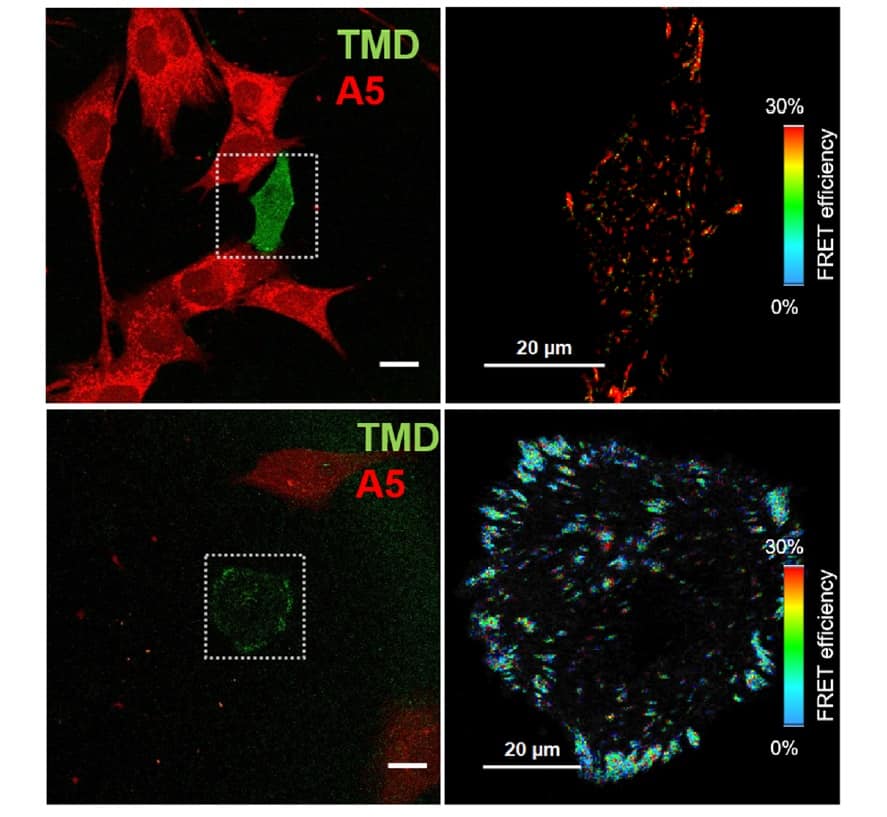
The IUPUI team also observed that focal adhesion tension in individual tumour cells was affected by the distance from bone cells when the two cells were co-cultured: tumour cells close to bone cells exhibited lower tension and decreased cell motility.
The researchers hope that these findings might lead to clues for how to control — and eventually stop — cell migration. “This [technique] gives us a more precise measurement of how fast the cell is moving and where the cell will go to,” says Liu. It will also provide feedback to cancer biologists, showing the impact of a drug or other treatment on the movement of the cells.
“The basic idea is to use imaging as a method to see some of the physical parameters in cancer biology,” Liu says. “Instead of only being able to look at millions of cells at time, technology has enabled us to examine a single cell. When the system is going smaller and smaller, the physical parameters inside the biological system become more and more useful and more and more important.”
The authors conclude that their results might contribute “not only to our basic understanding of tumour growth and migration in the bone microenvironment, but also toward developing novel therapies to prevent bone metastasis associated with breast cancer”.
Single-spin system breaks quantum symmetry
Researchers say they have observed parity-time symmetry breaking for the first time in an experiment. The result was obtained using a “dilation” technique on a single-spin system – a nitrogen-vacancy centre in diamond. The system could be used as a platform for studying new and exotic physics, such as new topological variants, quantum thermodynamics and quantum criticality, in non-Hermitian quantum systems.
According to current physics theories, the universe is governed by certain fundamental symmetries. One of these looks at the relation between parity (P) or “handedness” and time (T) and describes the oddness or evenness of a quantum particle and whether it is moving forwards or backwards in time. When a PT transformation is applied to a quantum system it appears the same as the original.
Physicists are always on the look-out for signs of PT-violation, however, because this would indicate the presence of new physics. They would also like to be able to break the symmetry of quantum systems, like those containing single spins. This would allow them to control these systems – something that should be important for understanding quantum interactions and developing novel devices (such as quantum simulators and quantum sensors) based on these interactions.
Dilated system
Xing Rong from the Hefei National Laboratory for Physical Sciences at the University of Science and Technology of China and colleagues used a nitrogen-vacancy (NV) centre in diamond in their experiments.These defects occur when two neighbouring carbon atoms in diamond are replaced by a nitrogen atom with an extra electron and an empty lattice site. The electron is a single-spin system that is governed by a general (non-Hermitian) PT symmetric Hamiltonian and the researchers can manipulate the system by changing the electron spin state.
The researchers “dilated” their system, which means they extended it to a larger system – in this case, to one that is governed by a non-classical Hermitian Hamiltonian. In quantum mechanics, a Hamiltonian is an operator describing the energy of a system. The PT symmetry and Hermitian are two mathematical terms describing the properties of Hamiltonians.
In their work, Rong and colleagues applied a magnetic field to the axis of the NV centre. They then applied oscillating microwave pulses to it, so that they could finely control the NV centre and change the P and T direction of the system, causing it to break.
A universal platform?
“That the Hamiltonian is Hermitian is a fundamental axiom of quantum mechanics,” explains Rong. “There is a class of exotic non-Hermitian Hamiltonians, however, that also satisfy PT symmetry. While researchers have experimentally investigated the concepts of PT symmetry in various classical systems, one of the most anticipated breakthroughs in this field is to observe PT symmetry breaking in non-classical quantum systems.”
The new experiments have now allowed the researchers to do just this.
“The information we extracted from the dynamics in our system extends and deepens our understanding of quantum physics,” team leader Jiangfeng Du tells Physics World. “The dilation method we employed is a general one and the single spin in the NV centre could serve as a universal platform for studying some exotic physics of non-Hermitian Hamiltonians.”
The research is detailed in Science 10.1126/science.aaw8205.
Copyright © 2026 by IOP Publishing Ltd and individual contributors