Machine learning is implemented on an IBM quantum processor

Machine-learning algorithms have been run on a quantum computer by physicists at IBM. Although the proof-of-concept demonstration did not involve practical tasks, the team hopes that scaling-up the algorithms to run on larger quantum systems could give machine learning a boost.

Machine learning is a type of artificial intelligence that involves a computer working-out how to do a task by analysing large numbers of examples of the task being done. A typical task could be to tell the difference between photographs of cats and dogs. The machine learning system would be “trained” by inputting lots of images of cats and dogs and the system would create a mathematical model that has a clear boundary between cats and dogs.

Many machine learning algorithms are “kernel methods”, which determine similarities between patterns. The strategy is to transform the data – pixels in a digital image, for example – into a higher-dimensional representation that has clear boundaries between classification types. All images of cats, for example, would reside in one region of this higher-dimensional, space whereas all images of dogs reside in another.

Size restrictions

A challenge for those using this method is that computational limitations restrict the size of the higher-dimensional representation – which in turn limits how detailed the classification can be. A system could distinguish the pointy ears of a cat, for example, but not be able to discern more subtle aspects of a cat’s body shape that would be obvious to a human.

The answer could be to use quantum computers, which – at least in principle — are much more efficient than conventional computers at performing calculations in very large representation spaces. In February, Maria Schuld and Nathan Killoran published a paper in Physical Review Letters that describes two approaches for using quantum computers in machine learning. Schuld and Killoran work for Xanadu, a Toronto-based company that builds optical quantum-computing chips and designs software for quantum computers.

Working independently, Kristan Temme and physicists at IBM have proposed similar strategies and have implemented them using a very basic quantum computer. Temme and colleagues describe their work Nature.

Hardware add-on

One strategy involves using a quantum computer as a hardware add-on to a conventional machine learning system. In this scenario, data – images of cats and dogs, for example – are sent to a quantum computer to be classified. Similarity data are then returned to the conventional system, which performs the machine learning.

The second strategy involves performing the learning on a quantum computer, with the assistance of a classical computer.

Quantum computers are still at a very early stage of development, so the IBM demonstrations were very basic. The team used two quantum bits (qubits) of IBM’s smallest commercial quantum computer – which has five superconducting qubits. This meant that that the quantum representation space only contained four dimensions.

While the IBM experiments were successful as a proof of concept, Schuld points out that it is not clear whether scaled-up versions would provide meaning measures of similarity in practical applications such as learning how to classify pictures of animals.

Temme told Physics World that the team is now working on scaling-up their implementations so that they can run on more qubits. IBM, for example, has commercial quantum computers with as many as 20 qubits. He also says that the team are also trying to understand what sorts of data sets would benefit most from a quantum approach.

Quantum snakes, a physics-themed building and the Web at 30

In the latest episode of the Physics World Weekly podcast, we’re talking about a building with a strong physics flavour – the new London office of the Institute of Physics. Later in the show, we also discuss the 30th birthday of the World Wide Web, and a selection of news stories making the headlines this week.

If you enjoy what you hear you can subscribe via Apple podcasts, or your chosen podcast app.


CT system developers utilize AI to boost patient care

Disease detection with CT has benefited greatly from advancements in artificial intelligence (AI) software during the past year. To make the case at the ECR 2019 technical exhibition, many vendors dedicated their CT booth presentations to the integration of AI into the modality. The rewards for patient care are visible for all delegates to see during the recent congress.

With its gaze set firmly on combining AI and CT to enhance care, Siemens Healthineers highlighted its AI-Rad Companion Chest CT, a software assistant for radiology powered by AI technology.

This product is reportedly the company’s first application capable of using AI algorithms to automatically differentiate individual structures on chest CT scans. The algorithms can highlight distinct structures in the thorax and also spot potential abnormalities. The application’s various tasks include detecting lung lesions, determining cardiovascular risk based on CT coronary artery calcification, measuring the diameter of the aorta, and segmenting individual spinal vertebrae for bone density and fracture analysis. To round out its offerings, the application can automatically generate a standardized quantitative report of the data.

Whereas radiologists generally centre their CT interpretations around the primary indication, AI-Rad Companion Chest CT performs a systematic and equal examination of all areas of the chest, potentially finding lesions in regions that the reader may not have made a priority, according to Siemens.

Clinicians can incorporate the product into existing clinical workflows, with all scans and supporting information automatically available in PACS through the vendor’s cloud-based teamplay infrastructure. The vendor-neutral application is suitable for use with data from any CT machine and is currently offered on a pay-per-use basis. It will be available in US and European markets in the spring of 2019.

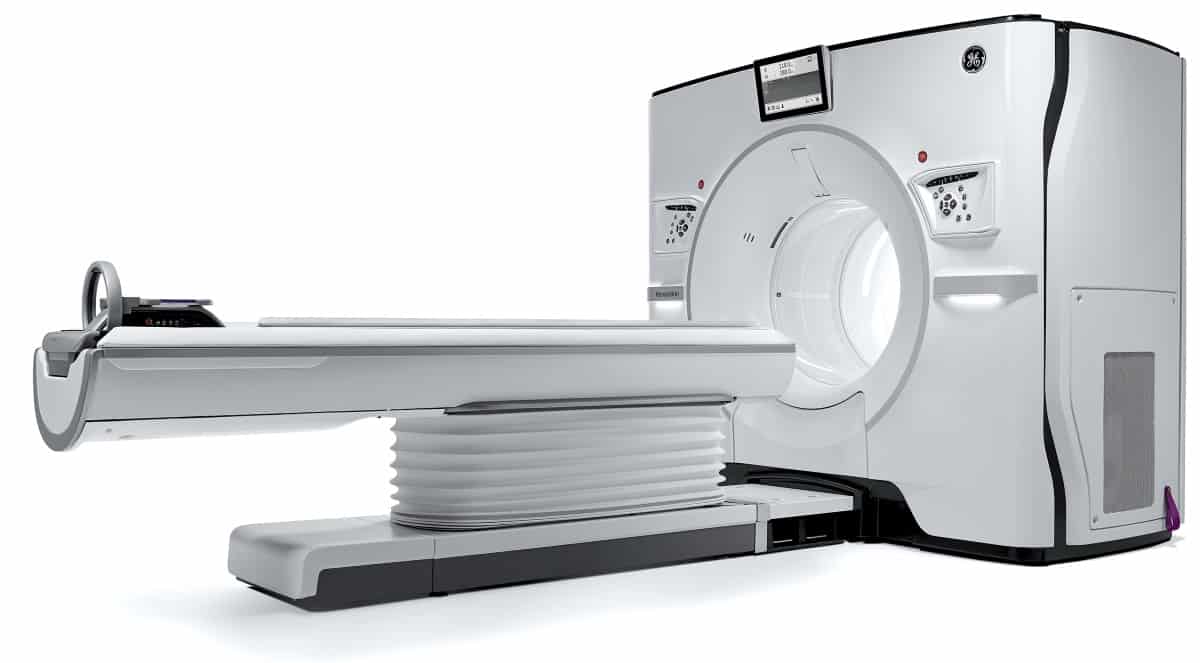
GE Healthcare featured the latest addition to its Revolution line of CT scanners, Revolution Apex. As a next-generation intelligent CT scanner, Apex enlists GE’s Edison deep-learning image reconstruction algorithm to assemble what the company refers to as TrueFidelity images, which are marked by high spatial resolution, natural-looking texture and low-contrast detectability. These images can help boost radiologists’ confidence in diagnosing clinical cases, according to the company.

Revolution Apex CT scanner

Revolution Apex is also equipped with a new imaging chain and the Quantix 160 X-ray tube. The components are collectively designed to improve temporal resolution and coverage, as well as provide spectral capability. As a result, the CT scanner can deliver whole-organ coverage, including for patients with elevated heart rates, high body mass index and compromised renal function, among other conditions.

Keeping in step with previous Revolution CT scanners, Apex produces high-resolution images while maintaining low radiation doses during scanning, GE noted. The company featured its Edison reconstruction technology as a work-in-progress.

Aquilion Precision ultrahelical CT scan

Making its first mark in AI-driven CT scanning, Canon Medical Systems introduced its Advanced Intelligent Clear-IQ Engine (AiCE) deep learning-based image reconstruction technique. The product can reconstruct low-quality, low-dose CT data into high-quality images.

Applying AI to CT reconstruction permits the use of low radiation dose (on the same level as conventional CT scans) without compromising final image quality, according to the company. The images compare to those reconstructed using the company’s forward-projected model-based iterative reconstruction solution (FIRST).

The AiCE algorithm is compatible with the Aquilion One Genesis CT and Aquilion Precision ultrahigh-resolution CT scanners. Together with AiCE, these systems enable high-spatial resolution CT scan reconstruction between three to five times more quickly than the current gold standard of using model-based iterative reconstruction, Canon noted. The increased reconstruction speed of up to 40 images per second is possible because of the scanners’ Nvidia graphics processing unit boards.

In the case of Aquilion Precision, activating AiCE for scanning results in sharp images with a resolution of 0.25 mm and a 1024 x 1024 imaging matrix, compared with the 0.5-mm resolution and 512 x 512 imaging matrix of standard CT. Canon is awaiting regulatory clearance for the technique.

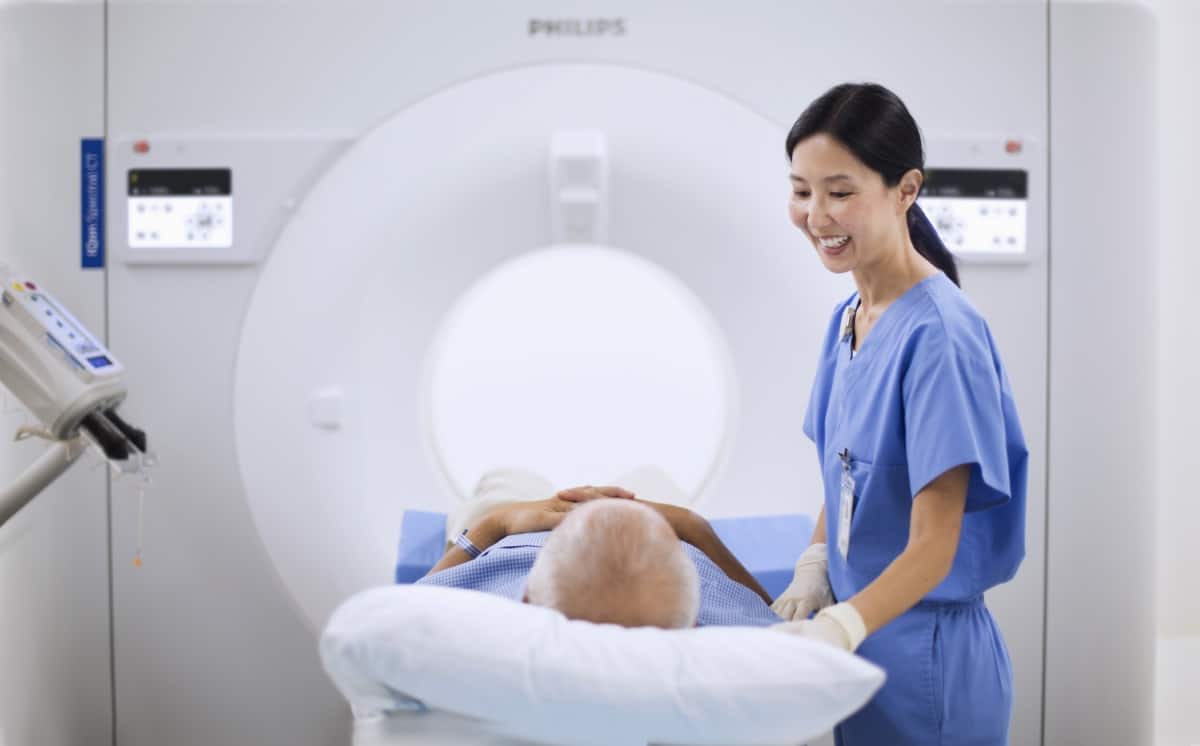
Meanwhile, Philips Healthcare highlighted the financial advantages of using its IQon Elite spectral CT scanner. Multiple studies have demonstrated the technology’s capacity to increase workflow efficiency in hospitals by reducing the occurrence of follow-up scanning, lowering levels of contrast agent and X-ray radiation dose, and accelerating the time to diagnosis, according to the company.

IQon Elite scanner

“The IQon Elite Spectral CT is the first detector-based spectral CT of its kind to deliver more confident patient diagnoses in the first scan, representing a revolution in CT performance,” said Kees Wesdorp, business leader of diagnostic imaging at Philips.

Notable features of the scanner include reconstruction speeds reaching approximately 200 CT examinations per day, radiation therapy planning couch and bariatric tabletop for larger patients, and the ability to estimate electron density for tissue characterization.

Hitachi showcased its Scenaria View CT scanner at ECR 2019. Offering both 64- and 128-slice scanning, the device boasts a larger 80-cm aperture, a lateral shift table with up to 10 cm of adjustment, and an iterative dose-reduction function. The scanner’s open design enables it to accommodate large-sized patients, the vendor noted.

Hitachi also promoted its Supria family of CT scanners, prized for its scalability (16 to 64 slices) and high-speed scanning (less than 1 sec per rotation).

Carestream Health displayed its OnSight 3D extremity CT scanner, which allows for point-of- care, weight-bearing imaging examinations of the upper and lower extremities. The cone-beam CT scanner produces high-resolution 2D and 3D images that may help reveal subtle or occult fractures, the company noted. Its wide opening and capability of 3D adjustment for height, tilt and rotation also make for easy patient access. In addition, the unit includes an advanced scatter and metal-artefact correction algorithm that can be upgraded to second-generation software for further improvements to visibility.

Fujifilm Medical Systems reserved the CT section of its booth for the FCT Speedia and FCT Speedia HD CT scanners. On display was a 64-slice version of the whole-body scanner, equipped with a console that embeds Synapse 3D-reconstruction modules. The manufacturer also highlighted its FCT Pixel Shine, which uses AI algorithms to make efficient image processing viable at extremely low radiation doses, the company noted.

  • This article was originally published in ECR Today on 2 March 2019. Copyright © 2019 European Society of Radiology. Reproduced with permission from AuntMinnieEurope.com.

Storms and heatwaves don’t strike twice, believe residents

People who have been impacted by storms and heatwaves are more likely than other groups to believe climate adaptation is a community responsibility. But they also tend to think they won’t be affected in the future.

That’s one of the surprising conclusions of researchers in the Netherlands and US, who surveyed more than 700 inhabitants of New York City.

The team also found that Hispanic and African American people are more likely to believe that future storms and heatwaves will be severe, and that adaptation is a personal responsibility.

Diana Reckien who was previously at Columbia University, US, and is now at the University of Twente in the Netherlands and colleague Elisaveta Petkova at Columbia believe that perception matters when it comes to who is affected most under climate change, what would help, and who should help. For instance, if someone believes it is the responsibility of a community to help people adapt to climate change, then that person might be less inclined to take action themselves.

On the flip side, Reckien cites cooling centres for use during heatwaves: “If you implement cooling centres in areas where citizens believe it is their own task to adapt, they probably won’t inform themselves about [them] and hence won’t go.”

The fact that people who’d been affected by storms and heatwaves were more likely to see adaptation as a community measure could be due, say the researchers, to those respondents knowing that they are not able to cope by themselves.

But the finding that those people were generally not worried by future storms and heatwaves – or believed they will not be affected – was more surprising. The researchers suggest that such people could be experiencing an “optimism bias”, or even the “gambler’s fallacy” – the mistaken belief that once something happens to you, you are less likely to see it occur in future.

For the finding that minority ethnic communities tend to believe they will suffer from storms and heatwaves, and that they as individuals are responsible for adaptation, the researchers suggest that a neglect, or perceived neglect, of these communities by the government could be the cause.

“Local government support is highly needed,” says Reckien, who thinks this support can help because citizens who have been affected already hold local government responsible for adaptation, and because minority ethnic citizens need “a particular education, communication and awareness-raising process” to encourage a view that the community can take charge.

To expose such perceptions, Reckien and Petkova conducted an online survey with residents of New York, focusing on the effects of – and mitigation schemes for – storms and heatwaves. They took into account factors such as gender, age, ethnicity, housing, family and income. Of some 1200 attempts at the survey, 762 were completed.

Reckien, who reported the findings in Environmental Research Letters (ERL), now plans to investigate which are the best levels within a community to take responsibility for adaptation.

Room-temperature cycling cools down strengthening in aluminium alloys

Aluminium alloys are widely used in many industrial applications including automobiles and aeroplanes, on account of their light weight. However, the wide-spread use of such alloys was contingent on the discovery of precipitate strengthening as a means for improving the tensile properties of these alloys necessary for most applications. Discovered over a hundred years ago, the technique involves heating alloys to elevated temperatures, which allows nanoscale secondary phases to precipitate in the metal. These precipitates hinder dislocation motion throughout the material and greatly increase their tensile strength. Now, however, Australian researchers led by Christopher Hutchinson at Monash University have developed a room-temperature cycling technique that reproduces and improves these material properties much more quickly and cheaply.

The inclusion of nanoscale precipitates into high-performance alloys is a key mechanism for improving their tensile properties for many industrial applications. These precipitates are often of a different phase from the bulk alloy and require large energy barriers to nucleate as well as increased diffusion for their formations. Hence, some of the most used aluminium alloys are “baked” for hours at between 120 °C and 200 °C to promote precipitate nucleation and growth. This technique, though in use since 1906, is highly demanding in terms of both time and energy.

Here, the researchers have developed a novel technique dubbed cyclic strengthening (CS) which, as its name suggests, cyclically stretches and compresses the metal without heating it. This cyclic stress creates vacancies in the materials by dislocation motion, which allows for increased diffusion and hence precipitate formation, leading to improved mechanical properties of the alloys.

From baking to cycling

Christopher Hutchinson

The properties of the aluminium alloys treated by CS give equal or better strengths to heat-treatment but also improved elongation behaviour. This is explained in part due to the different nature of micro-damage sustained by the metals during CS treatment. Indeed, a caveat of thermally aging alloys is the formation of precipitate free zones (PFZs) near grain boundaries. The high diffusion rates at elevated temperatures allow precipitates and vacancies to annihilate at grain boundaries leaving 20–200 nm weak precipitate-free regions near grain boundaries. The CS method, however, does not induce the formation of such zones and instead, homogenously distributes strength throughout the material, which explains in part the improved extension behaviour of the alloys.

The researchers have not yet fully determined the exact nature of the precipitates formed during CS treatment but they are much smaller, on the order of 1 to 2 nm, than those formed during thermal treatment. What is even more notable is that the CS technique is highly rapid allowing for treatments that take only minutes to complete using high cycling frequencies. This new method provides a cheap and extremely quick alternative to traditional precipitate strengthening methods for aluminium alloys overstepping a century-old technique.

Full details of the research are reported in Science.

The sky is not the limit for 2D material space technology

For space missions, mass costs. When every kilo launched costs USD$25000 just to get it to a near-Earth orbital, the low size, mass and power consumption of 2D material devices can start to look very attractive. But the onslaught of radiation involved in space missions also leaves devices prone to damage so that like the astronauts in manned space missions, device high performance needs to be matched with high resilience.

Reporting in Nature Communications Tobias Vogl and Ping Koy Lam at the Australian National University’s Centre for Quantum Computation and Communication Technology, alongside colleagues at the University, present the results of indepth investigations of the effects of the radiation in earth’s atmosphere on various 2D material devices.

“There is a global quest to find smaller, lighter and more efficient materials for space devices,” Lam tells Physics World. “In this work we show how atomically thin 2D materials can be used to build space compatible devices. This work is an example of how quantum technology can be used to enhance space instrumentations.”

Not only do the results confirm that these devices can withstand radiation exposure far greater than the levels likely during low Earth orbital space missions, but they also observe defect healing effects in some of the devices, which may find applications in compact radiation dosimeter or radiation detector applications.

Radiation resilience

Vogl, Lam and colleagues focused their study on single-photon sources based on defects in hexagonal boron nitride, field-effect transistors based on monolayer MoS2 and WSe2, and finally transition metal dichalcogenide monolayers in their native state. They exposed the structures to the most common radiation in low Earth orbitals: proton, electron and gamma radiation.

The Earth’s magnetic field traps high-energy electrons and protons in trajectories oscillating between both magnetic poles called the Van Allen belts. Although this protects the Earth’s surface from radiation from solar wind and cosmic particles it gives rise to high levels of exposure to space craft orbiting through these belts.

To expose the structures to protons they used a 1.7 MV tandem accelerator. Although the fluence was much higher than the exposure in space according to the atmospheric radiation levels calculated from the European Space Agency Space Environment Information System (SPENVIS) software, neither photoluminescence nor carrier lifetime measurements revealed any damage, and both the field effect transistors and single-photon sources remained unaffected. Using a scanning electron microscope to expose the structures to electron radiation also caused no damage according to optical and electronic measurements, despite the fluence exceeding atmospheric levels by three orders of magnitude.

Radiation healing

For the gamma radiation tests the researchers used isotope 22Na, the isotope they had access to that emits radiation most similar to the 60Co predominantly used for space qualification. These experiments inadvertently exposed the structures to radiation levels equivalent to 2170 years at 500 km above the polar caps instead of 4 years as intended. Yet still the structures were mostly unchanged by gamma radiation exposure, with the exception of the WS2 monolayers, where photoluminescence and carrier lifetimes actually increased.

“We initially expected that the high-energy space radiation would only very little, if at all interact with these thin nanomaterials. Being able to observe any changes was thus very surprising for us and initially it was hard to believe,” says Vogl, adding. “A material getting stronger after irradiation with gamma rays – that reminds me of the Hulk.”

The researchers attribute the increased photoluminescence to the healing of sulphur vacancies induced by γ-radiation. In their report they outline a mechanism based on a process similar to Compton scattering where the γ-rays, dissociate atmospheric oxygen, which then chemically reacts with the vacancies. Measurements of diminished defect emission following irradiation, as well as comparison of experiments in vacuum and in air support their explanation. They also add that the low-temperature and vacuum conditions used for the experiments confirm the thermal and vacuum cycling resilience of the structures.

The researchers later extended their simulations to study the effects at higher geostationary orbitals, which require altitudes of more than 35,000 km compared with around 2000 km in a low Earth orbit. Again, they found the devices and structures remained resilient to radiation damage.

“For the future we already integrated an experiment based on the 2D material single-photon source on a pico-class satellite platform (1U CubeSat),” says Vogl. “We received great interest in this direction and will be able to fly with our 2D material experiment in the near future.”

Full details are reported in Nature Communications.

Energy pathways ahead

A new study by the Energy Watch Group in Berlin and Lappeenranta University of Technology (LUT) in Finland outlines a “technically feasible and economically viable energy pathway for Europe, in which the energy sector (comprising power, heat, transport, and desalination) can reach 100% renewable energy and zero greenhouse gas emissions by 2050”.

The report, launched on the sidelines of the COP climate summit in Poland last December, claimed that the transition could be achieved using existing renewable energy technologies: “The energy transition is not a question of technical feasibility or economic viability, but one of political will.” What’s more, it would create at least one million more jobs in energy and be more cost-effective than the present fossil fuel-based system.

Primary energy demand would fall from 21,000 TWh in 2015 to just under 20,000 TWh by 2050, as a result of “massive” energy efficiency gains and an over 85% electrification rate, with fuel consumption reduced by more than 90% from 2015 levels as fossil fuels were almost entirely phased out by renewables. Solar photovoltaics (PV) would lead, becoming the lowest cost energy source and generating 62% of electricity by 2050, followed by wind energy at 32%, hydro at 4%, bioenergy at 2% and geothermal energy at less than 1%. Storage capacity would meet nearly 17% of electricity demand and around 20% of heat demand, from heat stores, but “electric heat pumps will also play a significant role, generating more than 30% of heat on district and individual levels by 2050”.

Despite all these changes, the Energy Watch Group and LUT say that the overall Levelized Cost of Energy would remain stable between 2015 and 2050, at between €50–60/MWh. For electricity, levelized costs are predicted to “substantially” decrease, from around €80/MWh in 2015 to around €57/MWh by 2050, while the levelized costs of heat would increase “marginally” from around €41/MWh in 2015 to around €43/MWh by 2050. But there would be significant employment increases — a total of 3 – 3.5 million jobs by 2050 compared with 2 million now in the European energy sector. Most of the new jobs, some 1.7 million, would be in PV solar. Powerful stuff, though a tad optimistic.

A more cautious view

Looking globally, a somewhat more cautious approach was taken by Jesse Jenkins from Harvard University, US, and two colleagues, who co-authored a paper that summarizes insights from 40 high-renewables studies. The publication outlines two broad global pathways to decarbonize electricity: one relying primarily on wind and solar power with support from storage, demand flexibility, and transmission expansion, and a second harnessing these options alongside “firm” low-carbon resources such as nuclear, geothermal, biomass and carbon capture and storage (CCS). It says that both routes may be feasible but must overcome several challenges.

The study found that high-renewable scenarios, based on wind and solar, relied on a number of factors occurring at once – the construction of long-distance grids, more flexible demand, cheaper batteries and long-duration storage technology that’s not currently available at scale. Otherwise, cost and technical challenges would mount. That’s a bit more cautious than some other studies that, like Jacobson et al. from Stanford University, US, have claimed that near 100% solar-, wind- and hydro-based scenarios could be achieved and balanced using existing technology with no nuclear, biomass or fossil CCS. As noted above, the Energy Watch Group/LUT study, which is part of a suite of LUT studies including a global report, said no new technologies were needed. By contrast, the Harvard study concluded that “improving and expanding the portfolio of available low-carbon resources offers a greater likelihood of affordably achieving deep decarbonization”. It wants a broader mix.

Clearly, there’s no shortage of scenarios with renewables racing ahead, although some of them are less optimistic about the results in terms of carbon reduction. For example, a study by consultants Wood Mackenzie has wind and solar growing to supply under 40% of power by 2040. Hydro also goes up a bit while the small nuclear input falls slightly. However, gas use still rises steadily and although coal use is almost halved and oil falls back slightly, overall in total energy terms it’s still a 77% fossil future.

A similarly sobering view from the American University in Cairo says that although renewables are going ahead around the world, that’s not happening fast enough to cut growing emissions. Renewables will have to scale up massively, in the Middle East especially. That is hardly news; the Saudis have evidently cut back on their ambitious “200 GW by 2030” solar plans to around 58 GW, and the IEA has warned that global emissions will rise unless more is done everywhere.

Can we do better?

So what is the current state of play? It is true that renewables growth has slowed in some places of late, including in Germany, often seen as the pathfinder. A recent article from Yale University, US, discusses a think tank report that if Germany continues on its present course, its carbon emissions will fall by only 62% by 2050. That’s well below its 80% emissions cut target, with transport being a key problem. However, there are plans from the influential German industry federation BDI to try to get back on track. It even looks at a 95% scenario.

The BDI says that 80% is “technically and economically feasible” but 95% “would push the boundaries of foreseeable technical feasibility and current social acceptance”. While “assuming optimal political implementation, the climate paths’ macroeconomic effects would be neutral to slightly positive, for an 80% ambition even without global consensus”, it warns that the 95% path would need a global consensus – Germany could not go it alone.

In the absence of that consensus, with the US outside the Paris COP agreement, we are left with individual countries doing their best independently. In addition to the BDI plan, however, there are other positive signs from within the EU. Spain now reportedly plans to switch to 100% renewable power by 2050, and completely decarbonize its economy soon after. The nation already has around 48 GW of renewables in place, including 20 GW of hydro, 23 GW of wind and (oddly) only 5 GW of PV solar, plus 2.3 GW of concentrated solar power (CSP). Now Spain will install at least 3 GW more wind and solar power capacity every year for the next 10 years.

Denmark is still making good progress; consumption of coal fell by 25% in 2017, while consumption of renewable energy increased by just over 11%, to roughly 55% of electricity. Overall, Denmark’s energy-related carbon dioxide emissions continued to fall, dropping by 38% since 1990. In the Netherlands, meanwhile, new subsidy-free wind projects are emerging. As costs fall, there are also plans for subsidy-free PV projects in the UK, with the Solar Trade Association predicting that PV may get down to £40/MWh by 2030. Onshore wind could reach that too, if the current government blocks were removed. So, with offshore wind booming, the UK could have well over 60 GW of renewables in place by 2030, up from around 43 GW.

The UK is soon, it seems, to be outside the EU. And elsewhere in the EU, progress is more uncertain. Before it took power two years ago, the Five Star party in Italy called for a 100% renewable Italy. Now in power, its leader and deputy prime minister Luigi Di Maio said, “Italy has decided in a serious way to aim for an entirely sustainable energy future”. The country has about 52 GW so far and aims for a 28% energy share by 2030, up from about 18%. But, reportedly, limits may be placed on some projects due to the cost, with geothermal constrained by new draft rulings. Some see that as indicating a change of view and as a sign of the impact of the new populism allegedly sweeping Europe.

That certainly has had an impact in France. The new PPE energy plan calls for a big step up from the 47 GW of renewables — including 25 GW of hydro — currently in place, with wind expanding threefold from 11 GW and solar fivefold from 8 GW, along with the development of other renewables. Given the populist backlash, there may have to be adjustments to the energy tax plan. In response to the riots in Paris, the government backed off the fuel price rises, as did the UK government back in 2000 when faced with lorry driver protests. But no one benefits long-term from burning dirty fuel, except maybe the oil companies, although the costs of cleaning up must be shared fairly and reduced as far as possible. A big issue for the future is whether the fall in cost for renewables will be sufficient to allow them to expand fast enough to keep planetary and political temperatures down.

In my next post, by way of wider context, I will look at the European Commission’s latest — and quite bold — plan for “net zero emissions” by 2050.


Eye scan can detect signs of Alzheimer’s disease

OCT angiography

Diagnosing Alzheimer’s disease remains a challenge, with no practical tools available for early detection or large-scale screening. Instead, the disease is often diagnosed using memory tests or by observing behavioural changes. But by the time symptoms have appeared, the disease is advanced. What’s needed is a rapid, non-invasive and inexpensive way to detect Alzheimer’s at the earliest stages.

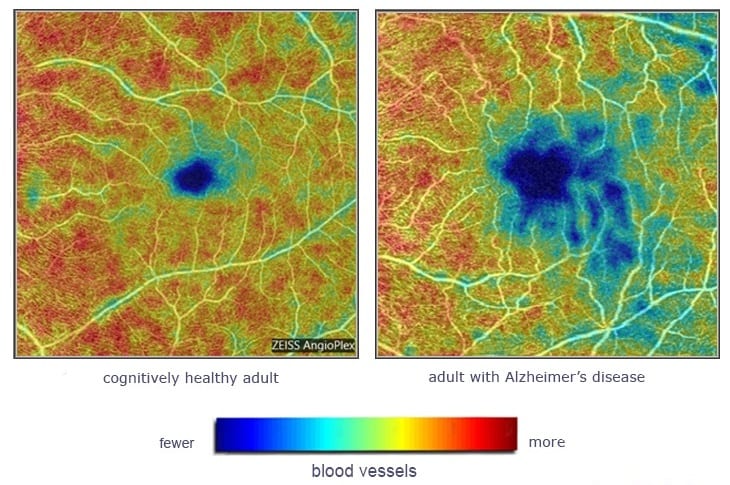
With this aim, researchers from the Duke Eye Center have demonstrated that optical coherence tomography (OCT) angiography can detect signs of Alzheimer’s disease. In a study of more than 200 people, the non-invasive imaging technique showed that blood vessels in the retina are altered in patients with Alzheimer’s. OCT angiography could also distinguish between people with Alzheimer’s disease and those with mild cognitive impairment (Ophthalmology Retina 10.1016/j.oret.2019.02.002).

OCT angiography enables visualization of the smallest blood vessels in the back of the eye, which are thinner than the width of a human hair. The scan could reveal changes in these tiny capillaries before they can be seen on an MR brain scan or cerebral angiogram, which only highlight larger blood vessels. Because the retina shares many similarities with the brain, researchers believe that deterioration in retinal microvasculature may mirror changes in blood vessels in the brain, thereby offering a window into the disease process.

“We know that there are changes that occur in the brain in the small blood vessels in people with Alzheimer’s disease,” explains lead author Dilraj Grewal. “Because the retina is an extension of the brain, we wanted to investigate whether these changes could be detected in the retina using a new technology that is less invasive and easy to obtain.”

“We’re measuring blood vessels that can’t be seen during a regular eye exam,” adds senior author Sharon Fekrat, “and we’re doing that with relatively new non-invasive technology that takes high-resolution images of very small blood vessels within the retina in just a few minutes.”

Grewal, Fekrat and colleagues used OCT angiography to image the eyes of 39 Alzheimer’s patients, 37 people with mild cognitive impairment (often a precursor to Alzheimer’s disease) and 133 cognitively healthy people. In the healthy group, the researchers saw that microscopic blood vessels form a dense web at the back of the eye inside the retina. In Alzheimer’s patients, that web was less dense, with a loss of these small retinal blood vessels.

They also found that a specific layer of the retina was thinner in the Alzheimer’s group than in people with mild cognitive impairment and healthy controls. The differences in density were statistically significant after the researchers controlled for factors including age and sex.

“Early diagnosis of Alzheimer’s disease is a huge unmet need,” says Fekrat. “It’s not possible for current techniques like a brain scan or lumbar puncture to screen the number of patients with this disease. It is possible that these changes in blood vessel density in the retina may mirror what’s going on in the tiny blood vessels in the brain. Our work is not done. If we can detect these blood vessel changes in the retina before any changes in cognition, that would be a game changer.”

The ultimate goal, says Fekrat, is to use OCT angiography to detect Alzheimer’s disease early and to monitor these changes over time in participants of clinical trials studying new Alzheimer’s treatments.

Ice cores reveal huge solar storm struck Earth around 660 BC

An intense blast of high-energy protons from the Sun pummelled the Earth in about 660 BC and left a distinct record of cosmogenic nuclei in the Greenland ice sheet. The discovery was made by an international team of scientists who say the event was one most powerful solar storms known to have struck Earth.

The team calculates that the storm was about ten times more intense than any event that has occurred in the past 70 years. “If that solar storm had occurred today, it could have had severe effects on our hi-tech society”, says Raimund Muscheler of Sweden’s University of Lund, who designed the study.

Our research suggests that the risks are currently underestimated. We need to be better prepared

Raimund Muscheler

The discovery could also mean that huge solar storms are more common than previously thought: “Our research suggests that the risks are currently underestimated. We need to be better prepared,” says Muscheler.

A solar storm can occur when large numbers of highly-energetic protons are ejected from the Sun in solar flares or coronal mass ejections. Under certain conditions determined by where the event occurs on the Sun and the configuration of the interplanetary magnetic field lines, these particles can be directed towards Earth.

Wreaking havoc

Solar protons are normally deflected by Earth’s magnetic field, but high-energy protons can penetrate this shield and enter the atmosphere. These protons will ionize gas molecules, and the sudden presence of large numbers of charged particles in the atmosphere will wreak havoc with the Earth’s magnetic field.

This can lead to huge electric fields building up in the atmosphere and on the surface of the Earth. This can disable electricity grids, telecommunications networks, GPS and electrical and electronic systems aboard aircraft. To make matters worse, the energy deposited by charged particles in digital devices could impede their operation.

In this latest research, Muscheler and colleagues looked for evidence of intense solar storms in two ice cores taken from the Greenland ice sheet. When solar protons collide with molecules in the atmosphere, cosmogenic nuclei such as beryllium-10 and carbon-14 are produced. These isotopes become trapped in the ice sheet and measurements of their abundances can be used to calculate the intensity of solar protons in the atmosphere at the time of deposition.

Oak tree rings

In 2017, some of the team members discovered a peak of carbon-14 at about 660 BC in oak tree rings. Similar peaks are associated with intense solar storms believed to have occurred more recently in the years 775 and 994. However, the carbon-14 peak at 660 BC is not as distinct as peaks associated with the later events and could be the result of an increase in cosmic rays entering the atmosphere rather than solar protons.

To clarify the situation, Muscheler and colleagues looked at beryllium-10 abundance in ice cores and found peaks at around 660 BC in ice from both the North Greenland Ice Core Project (NGRIP) and the Greenland Ice Core Project (GRIP). A peak in the abundance of chlorine-36 – another isotope produced by solar protons – was also spotted in the GRIP data.

According to the team, the storm in 660 BC was comparable to the 775 event, which is the strongest solar storm known to date. Furthermore, the ancient storm was ten times more intense than any solar storm that has occurred over the past 70 years – including storms that have disrupted electricity grids and telecommunications.

Although such storms are rare, the discovery of a third event suggests that they could be much more common than previously thought. Muscheler believes that there should be a reassessment of the threat and calls for a greater awareness of how vulnerable society is to disruption by solar storms.

The research is described in Proceedings of the National Academy of Sciences.


Physics World 30th anniversary podcast series – 30 years of the World Wide Web

On the 30th anniversary of the birth of the World Wide Web at CERN, the Physics World Stories podcast visits the particle-physics lab in Geneva to learn how things developed from an esoteric proposal to something that has changed the world forever.

The Web is for everyone and collectively we hold the power to change it

Tim Berners-Lee

Physics World magazine has also recently turned 30 and we have been celebrating with a five-part podcast series exploring key developments in physics. This fifth and final episode revisits the birth of the World Wide Web at CERN in the late 1980s. In March 1989 British physicist turned computer scientist Tim Berners-Lee produced the now-famous document entitled “Information management: a proposal”. Over the past three decades, this modest origin has evolved into a globally connected web of computing systems, transforming the way we live our lives.

Andrew Glester (left) and Web pioneer Jean-François Groff

To mark the occasion, Physics World Stories host Andrew Glester visits CERN to meet some of the scientists who were there in the early years of the Web. Along the way he meets, Jean-François Groff (see left), François FlückigerBen Segal and Tim Berners-Lee’s former boss Peggy Rimmer.

You will also hear from Tim Berners-Lee himself, who shares his hopes and fears for the future of the Web. The creator of the Web is amazed by the speed and extent of global change brought about by the Web. But, like the majority of us, he also fears the worrying trend for nefarious activities enabled by the Web, including misinformation and the amplified voices of those who choose to spread hate. “The Web is for everyone and collectively we hold the power to change it,” says Berners-Lee. “It won’t be easy but if we dream a little and work a lot we can get the Web we want.”

The 30th anniversary of the Web is also the theme of the March special issue of Physics World magazine. You can enjoy many of that issue’s articles – along with a host of others – in a special online-only collection. The collection includes a brilliant graphic by Jess Wade, a look at the business impact of the Web, and the latest episode of the Physics World Weekly podcast in which Physics World journalists chew the fat over how on earth we got anything done before the Web came along.

If you enjoy the podcast, then take a listen to the first four podcasts in the 30th anniversary series. Glester began in October by looking at the past and future of particle physics before tackling gravitational waves in November. In January he examined the prospects for nuclear fusion, then in February he looked at how high-temperature superconductivity research has evolved over the past three decades since the phenomenon was first observed. Don’t forget you can also subscribe to Physics World Stories via Apple podcasts or your chosen podcast host.

Copyright © 2026 by IOP Publishing Ltd and individual contributors