International product certification regulations are really boring, right up to the point where they become extremely interesting – and if you’re an industry physicist trying to sell your whizzy new device in other countries, you really, really don’t want them to become interesting.
That, at least, was the message I took from a talk by Joe Lomako and Rob Campling, who spoke about “Global Market Access” at the Institute of Physics’ inaugural Business Innovation and Growth Conference on 26 February. Lomako and Campling work for the testing and certification firm TÜV SÜD, and during their talk they explained the principles of product certification, the different approaches taken in various parts of the globe, and the consequences of getting it wrong. In some countries, those consequences may include unlimited fines for the company responsible and prison time for people involved in mis-selling goods.
Like I said: regulations are boring, until they bankrupt your company or send you to jail.
At the beginning of the workshop, Lomako asked the audience of industry physicists at what stage they thought they should start taking regulatory compliance into account. “Maybe when you’re looking to sell into a new market?” suggested one participant. “At the design stage,” offered another. Lomako, however, argued that it should be even earlier, when the product is still just a concept, because some apparently similar technologies fall under very different regulations.
For example, suppose you have an idea for a medical sensor. Naturally, you want your sensor to transmit its data to another machine. If you do this via a Bluetooth connection, the process of getting it certified under, say, the European Union’s CE-marking scheme will cost on the order of £15 000. However, if you build that same sensor with a mobile phone connection instead, Campling estimates that certification costs will run into six figures.
Considerations like these are becoming more important now that so many connective devices are entering the market, as part of the so-called Internet of Things. “A product has to have Bluetooth because it’s the sexy buzzword,” Campling observed. “Even if it’s not needed, like for a vacuum cleaner, it has to have wireless in it.” As a result, products like the aforementioned medical sensor may need to comply with directives about radio equipment and electromagnetic compatibility, as well as those specifically aimed at medical devices and procedures.
Ensuring that a product is safe, and that it won’t interfere with other devices, are two of the main drivers behind these regulations. But other motivations may be in play as well, and Campling urged industry scientists to take them into account when considering where their target markets should be. For example, some governments deliberately make certification difficult, to protect local industries. Others make money from selling certification, especially for devices that use the radio spectrum.
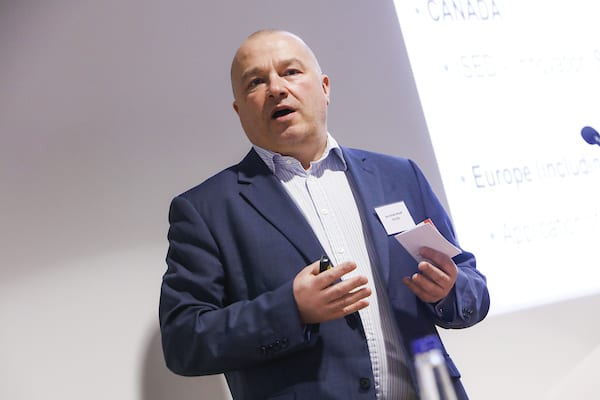
Joe Lomako, business development manager for IoT (Internet of things) products at TÜV SÜD, discusses different countries’ regulatory approach. (Image courtesy of Piers MacDonald Photography Ltd)
The burden of complying with all these regulations can be high, but Campling stressed that the alternative isn’t worth it. Even without fines or criminal penalties, a containerload of non-compliant goods could get tied up in customs for weeks while the requisite paperwork is completed, racking up storage costs of up to hundreds of dollars per product per day. “Some people don’t even know that regulations apply to them until they get stopped at customs,” Lomako observed, adding that even big companies sometimes get caught out – for example, by learning that a particular technology is no longer allowed in a target market after they’ve spent £0.5m designing it.
With all this talk about international trade and regulations, it was inevitable that the B-word – Brexit – would come up at some point. Unfortunately, in this case, the presenters had no answers. Although a new UK-specific certification system is being developed to replace the CE mark in the event of a no-deal Brexit, Lomako observed that “nobody really knows at this stage” what will happen after the UK’s scheduled departure from the EU on 29 March. “The next few weeks will tell,” he concluded.
“The hipster effect: When anticonformists all look the same” is the title of a 34 page preprint on arXiv. Written by the mathematician Jonathan Touboul at Brandeis University in the US, the paper tries to come to grips with why people who want to stand-out from the crowd, can develop a common look. Judging from his photo on the Brandeis website, Touboul is not a hipster – but his plaid shirt does suggest a certain affinity to the look.
There is no shortage of sunshine in Jordan so it is not surprising that the Middle Eastern country is claiming to be home to world’s first large accelerator to be fully powered by renewable energy. That accelerator is the SESAME synchrotron light source, which is now supplied by a new 6.48 MW solar plant.
Flavour, colour and field are seemingly normal words that would be familiar to most, if not all, English speakers. But these and other common words such as wimp and trigger have very different meanings to physicists, as Lauren Biron explains in Symmetry.
Written by some of the leading physicists in the field, the first five articles in the collection cover Canada, the EU, Japan, the US and Australia. Reports from the UK and China will be published later this year.
What have I gleaned from the reports? Well, there is an “Australian approach” to quantum science and technology according to Tara Roberson and Andrew White of the University of Queensland. They say the essence of this approach is captured in the phrase “alloys make the strongest metals”.
Ben Sussman at the National Research Council of Canada and co-authors point out that their country is first amongst the G7 nations in terms of per-capita spending on quantum research. South of the border, Michael Raymer of the University of Oregon and Christopher Monroe of the Joint Quantum Institute in Maryland explain how the ongoing development of quantum science and technology in the US has been enshrined in a law called the National Quantum Initiative Act.
Yoshihisa Yamamoto of the Japan Science and Technology Agency and co-authors describe a raft of new quantum initiatives Japan including the development of quantum inertial sensor technologies based on gyroscopes with matter waves.
As for the EC’s Quantum Flagship, Max Riedel at Siemens University Relations in Munich and co-authors describe it as “an ambitious €1 billion, 10 year endeavour”.
A new synthetic hydrogel that becomes up to 50 times stiffer upon heating just a few degrees has been developed by researchers at Radboud University in the Netherlands. The stiffening process is reversible, and the team believes that the hydrogel could be used in a range of new applications including tissue engineering.
The controlled stiffening or softening of materials is very common in biology, playing roles in processes such as muscle contraction, tissue fibrosis, the enzymatic degradation of tissues and tumour formation. It involves a biological cell converting chemical energy into mechanical stresses, which cause the cell’s cytoskeleton to stiffen with stress. However, mimicking this ability to stiffen and soften in a synthetic material such as a hydrogel has proven very tricky to achieve.
Hydrogels are flexible materials made from crosslinked polymers. Most hydrogels are either soft or stiff depending on their composition. To reduce the stiffness of a given crosslinked network, some crosslinks must be broken. Conversely, stiffness is increased by boosting the number of crosslinks. Either way, a large stimulus is needed to break or create bonds and these processes are often not easily reversible.
Entirely new mechanism
Now researchers led by Radboud’s Paul Kouwer have developed a synthetic hydrogel that can change its stiffness in a reversible way. “We implement an entirely new mechanism, which makes our approach so interesting,” explains Kouwer. “We do not create any new crosslinks in order to stiffen our hydrogel. What we have instead is a material that is sensitive to stress – a property very common in biology but not in synthetic materials.”
Their material consists of two types of polymers interlaced to create an interpenetrating network. One polymeric component is polyisocyanide (PIC), which responds to stress. The other component is poly(N-isopropylacrylamide) (PNIPAM), which responds changes in temperature.
Heating the material by just one degree causes the temperature-sensitive PNIPAM network to undergo a sharp structural transition that the team describes as a collapse. This puts stress on the PIC polymer chains, causing them to stiffen.
“The collapse of one component creates internal stresses that induce a highly nonlinear response in the second component. Increasing the temperature by only one degree induces a very sharp phase transition in the first material and creates a strain stiffening effect in the second one,“ says Kouwer.
The material can become 50-times more stiff and the effect is reversible and can be repeated up to 10 times with excellent reproducibility.
Muscling in
The contraction intensity and forces measured in the new hydrogel are similar to the contraction of a real muscle. Indeed, muscles contain actin fibres that are attached to myosin fibres, which are contracted by myosin motors. Therefore, the stress created by the collapsing PNIPAM network in the hydrogel is playing a role similar to that of the myosin motor.
An important difference, however, is that muscle fibres are aligned in a specific direction whereas fibres in the hydrogel are not aligned. So unlike a muscle, the hydrogel does not contract in one direction.
“If your system is aligned, it would contract in one direction too. On the other hand, our system is a 3D isotropic material. This means that the stiffening effect cannot be seen on a macroscopic level, as it would happen in all possible directions at once,“ says Kouwer. “We realized that if we could guide the direction of stiffening, we would be able to design a real muscle mimic.”
Tissue growth
The team is already working on aligning the polymer chains in their hydrogel. Future work could include creating materials that react to light rather than changes in temperature.
One potential application for such hydrogels is to use them as synthetic matrices that encourage living cells to combine to create artificial tissues in the lab. Local and time-controlled changes in the hydrogel could potentially control the behaviour of the growing cells – a feature crucial for tissue engineering and the growth of artificial organs.
“Placing cells into a stiffer environment could make them respond by expressing different proteins or change their growth rate. This area is currently completely unknown. Theoretically, this could create an entire new field in tissue engineering,” explains Kouwer.
Gijsje Koenderink from AMOLF research institute in Amsterdam, who was not involved in this study, believes that next challenge in developing the material will be to replace the temperature-sensitive gel, which requires external energy input in the form of heating, with a molecularly active source of stress. “Synthetic chemistry has already achieved synthetic mimics in the form of active polymers and synthetic molecular motors,” she says. “The next challenge is therefore to combine such mechanoactive molecules with materials and use them to drive life-like mechanoadaption.”
Last year my colleague Charles Adams and I were invited to write a Physics World Discovery ebook, where e means electronic. This was going to be something new, exciting – and, well, electronic – not a boring old paper book. But does the electronic medium bring anything new to publishing? Or is it just a term we stick on to everything, even plain old paper?
It was a question I started thinking about while writing our ebook Rydberg Physics, which was published late last year. While seeking answers to the question, I turned to the past.
The technologies we use to communicate observations about nature have changed dramatically over the years. In ancient Mesopotamia, people used imprints on clay tablets. Later came manuscripts and the printing press, while more recently we’ve seen graphical data representations, and audio and video recordings. And with the boom in computing power of everyday devices, it’s been possible to bring interactivity into play, initially through online quizzes and occasionally through interactive plots, although they often require cumbersome apps to be installed.
One thing, however, has never changed. We write stories, or – if you want to be technical about it – we pick a single path in a multidimensional space describing some system, and say what happens next. We tell stories because information presented in that way is easy to remember. That’s why we give talks and lectures, and why we write papers and textbooks.
What scientists should be doing with figures and diagrams is offering insights into “untold” stories too.
But even with multimedia, quizzes and simple interactive figures, we’re still just telling a single storyline. What scientists should be doing is offering insights into “untold” stories too. Sure, physicists use mathematical equations to manually explore the space of untold possibilities, but building appropriate examples from equations and representing them visually to help us think takes a lot of time.
I believe interactive figures can help by bridging the gap between different phenomena and between different stories. They allow physicists to freely explore multi-parameter spaces and – when combined with multiple representations of the same phenomena – they could help us to get more of an intuitive feel for equations. When endowed with enough parameters and flexibility, they are “toys for the mind” that can also allow unexpected uses, namely spotting new, interesting paths and letting us write new stories.
Alive and kicking: an interactive figure from the ebook Rydberg Physics.
Take, for example, figure 9 from our Rydberg Physics ebook, which lets readers explore the 3D parameter space of an atomic medium. For each selected point, we offer two representations. One is macroscopic, showing how light slows as it propagates through the medium. The other is microscopic, showing states of two atoms in the medium. Some of the paths in this parameter space are discussed in the ebook, and correspond to stories of light storage, adiabatic control and interactions between single photons.
Crucially, we also see things that are not discussed explicitly. We see limiting cases – imperfections if you like – that force us to adopt different pictures, changing the story about what happens in the system. What’s more, in the continuum of parameter values lie exciting new answers to daring “What-if?” questions.
In fact, as you play with our interactive model, I’d say you’re training your brain to predict the behaviour of this simple system under different circumstances. The question is, though, does that also create physical intuition?
But interactive figures do more than just help scientists reading ebooks. They can also help the public handle complex questions, such as those involving energy and the environment. Such discussions are all too often polarised, resulting in a tug of war between extreme opinions that merely lead to stalemate and no action. I believe it’s our duty, as scientists, to give the public and policymakers the tools to understand the impact and consequences of scientific decisions. Information in diagrams and equations might be good for physicsists, but interactive figures will help non-scientists to really understand what the science is telling us.
Interactive figures will also help non-scientists to really understand what the science is telling us.
Consider, for example, this interactive text inspired by the work of Bret Victor. It describes the environmental consequences of different types of light bulb, with users discovering what happens simply by adjusting either words or numbers in the text. Wouldn’t it be great if we could represent even more fundamental scientific knowledge using similarly interactive documents?
To educate more people in a way that gives them freedom and power to innovate on their own is a difficult challenge. I’m aware, though, that it’s tricky to find the right medium for such matters. But it’s important stuff as it’ll dictate how fast our world can develop.
So are interactive eBooks part of solution? I believe so. After all, simple standard languages like HTML and JavaScript work across devices and can be packaged in new publishing formats like EPUB3. Maybe you can have a go yourself – try downloading templates from GitHub for the examples mentioned above and reimagine and share what you find.
Social media can bring people together for positive reasons, but it can also connect supporters of terror. This short video summarizes an article by Neil Johnson from George Washington University in the US, which investigates how physics can help to understand how online terror networks expand. That feature appears in the March 2019 issue of Physics World, a special issue about the 30th anniversary of the Web.
It was 30 years ago this month that Tim Berners-Lee, then a physicist-turned-computer-scientist at CERN, published a document entitled “Information management: a proposal”. The document described a way to let the thousands of scientists at the lab keep track of all the information needed to build and operate the upcoming Large Hadron Collider. Envisaging the use of hypertext to link documents, Berners-Lee’s proposal was the birth of what became the World Wide Web.
This month you can celebrate the 30th anniversary of the Web with a special issue of Physics World magazine. In the cover feature of the 80-page issue, which you can also read here, Neil Johnson from George Washington University in the US describes how physics can help in the battle against terrorism, by tracking the birth, growth and death of extremist groups who have gathered together online through social media. The video above provides an overview of the feature.
Social-media groups as seen by statistical physicists
Elsewhere in the issue, you can find out how machine learning and artificial intelligence are affecting physics – from statistical and medical physics to quantum and materials science. There’s also a great feature on how computing and simulation have evolved into the “third pillar” of science alongside theory and experiment. Problem is, too many physicists insist on developing their own software from scratch, despite not always being the best coders in the world. Plus, they love to redeploy successful software for new applications, leading to code that quickly gets bloated and inefficient.
For a bit of fun, try our special Internet and Web-themed cryptic crossword and take a peek at a special, two-page graphic by Jess Wade outlining the history of the Web. If you don’t get all her references, you’ll just have to look them up – on the Web. And if you fancy a career of your own in computing, software or IT, check out what Federico Carminati, from CERN’s openlab, has to say.
You can enjoy the January 2019 issue of Physics World magazine via our digital apps for iOS, Android and Web browsers. (membership of the Institute of Physics required). Let us know what you think about the issue on Twitter, Facebook or by e-mailing us at pwld@iop.org.
For the record, here’s a run-down of what’s in the issue.
• Hi-tech firms seek clarity amid Brexit confusion – As the UK prepares to leave the European Union this month, leaders of Britain’s industrial-physics community are eyeing up their options. Margaret Harris reports
• Vague but exciting – James McKenzie reflects on how the World Wide Web has transformed every aspect of our lives since its creation at CERN 30 years ago
• A frame of mind – An ongoing debate in artificialintelligence research reveals productive interactions between cognitive scientists and philosophers, says Robert P Crease
• Out of the margins – Janice Hudgings and Chaelee Dalton describe how integrating pro-equity material into a standard physics curriculum can improve the learning experience of students from under-represented groups
• The dark side of social media – Social media can bring people together for good, but it can also connect supporters of terror, extremism and hate. Neil Johnson shows how physics can shed light on this darker side of our online world
• The third pillar – Computing has quickly evolved to become the third “pillar” of science. But to reap its true rewards, researchers need software code that is flexible and can be easily adapted to meet new needs, as Benjamin Skuse finds out
• A learning revolution – The groundwork for machine learning was laid down in the middle of last century. But increasingly powerful computers – harnessed to algorithms refined over the past decade – are driving an explosion of applications in everything from medical physics to materials, as Marric Stephens discovers
• Life, the universe and everything – Writer, broadcaster and physicist Paul Davies‘ latest book grapples with the laws that govern the emergence of life. Tushna Commissariat reviews The Demon in the Machine and questions Davies about the science and the motivations behind his new work
• What has the Earth ever done for us? – Ian Randall reviews Origins: How the Earth Made Us by Lewis Dartnell
• Particles of the future – Federico Carminati, computerphysicist at CERN openlab, talks to Tushna Commissariat about career opportunities in highenergy physics and computing
• Cyberspace cryptic crossword – As part of the World Wide Web’s tricennial celebrations, put your wetware processors through their paces with this Internet-and-computer-themed cryptic crossword compiled by Ian Randall
A new computational imaging technique promises to improve the resolution of transmission X-ray microscopy (TXM). Fourier ptychography, in which the objective is moved during acquisition, was developed for use at visible wavelengths in the last few years. Now, researchers at the Paul Scherrer Institute (PSI) and ETH Zürich in Switzerland have demonstrated a variation that works with X-rays, providing quantitative phase- and absorption-contrast images at high resolution. The method will allow biological samples to be studied in more detail than is currently possible (Science Advances 10.1126/sciadv.aav0282).
Given a perfect set of optical components, the resolution of an imaging system is limited by the wavelength of the light being gathered. X-rays, then, with wavelengths orders of magnitude shorter than visible light, should allow for images hundreds of times sharper than those produced using optical microscopes. The problem is, X-ray optical components are far from perfect.
One of the sources of compromise in X-ray optics is the objective lens, which focuses light from the target onto the detector. An ideal lens for high-resolution imaging is one with a large numerical aperture, meaning that it captures light over a large angle of incidence. Because X-rays are not refracted significantly by any known material, X-ray optics has no direct equivalent to the glass lens used to focus light in visible-light microscopy.
Simulated objective
Instead of refracting lenses, X-ray microscopes are commonly built around a Fresnel zone plate (FZP), which focuses radiation by diffraction. PSI’s Klaus Wakonig, and colleagues at PSI and ETH Zürich, used just such a device, but they moved the FZP parallel to the imaging plane between acquisitions. This let the researchers sample a much greater portion of the diffracted beam, so when they reconstructed an image from the separate measurements, it was as if they had used a physical objective with a much larger numerical aperture.
An X-ray phase contrast image of a resolution target. (Courtesy: Klaus Wakonig et al)
Although the researchers’ demonstration used coherent X-rays from a synchrotron, they think the same benefits could be realised by making quite simple modifications to existing TXM sources. “This is at the core of our current research interests: how to relax conditions of stability, beam manipulation and coherence such that Fourier ptychography may become applicable at a wider range of instruments?” says Andreas Menzel, the project’s principal investigator.
One aspect that the researchers are confident of improving is the speed of the process. At the moment, reconstructing a given image requires more than a hundred separate acquisitions of a few seconds each, with the objective and detector moved every time.
“Indeed, Fourier ptychography is commonly slower than other full-field imaging techniques,” says Menzel. “However, larger detectors are currently being developed which will enable us to keep the detector at the same position. Due to the small scan range and the low weight of FZPs, the remaining scan can be orders of magnitude faster.”
Biological applications
If current TXM apparatus can be adapted to use X-ray Fourier ptychography, even modestly equipped laboratories could be given a significant new capability. Biological materials typically vary little in how strongly they absorb X-rays, so images can fail to reveal important structural details. The phase of transmitted radiation, on the other hand, is much more sensitive to differences in composition, meaning phase-contrast images can show features too subtle for standard TXM to capture.
Another advantage that makes the technique particularly suited to biological contexts is the relatively small amount of radiation that it delivers to the sample. “X-rays have the tendency to destroy the very structures that you’re interested in imaging,” says Menzel. “But in our experiments, the improvement beyond standard TXM came with a virtually indiscernible increase in required radiation.”
This ability to image delicate structures at high resolution would be invaluable in studying radiation-sensitive samples like tissues and cell cultures, and could yield insights into any number of disorders, from cancer to Alzheimer’s disease.
Are you a member of a Facebook group? I belong to a couple, including one for jazz musicians interested in playing at local gigs. In fact, there are three billion active users of Facebook – that’s roughly half the planet – and each of them is typically a member of more than one Facebook group. So the chances are you’re in a Facebook group too.
Facebook and its international competitors – such as VKontakte in Russia – purposely design their group features to bring people together into relatively tight-knit clusters so that they can focus on some shared interest or purpose (figure 1). Popular Facebook groups include one for fans of the actor Vin Diesel, another for those who love exotically flavoured crisps, and one for self-proclaimed SAHDs (stay-at-home-dads).
However, not all online groups (or their simpler cousins, “pages”) are as benign. That’s because social-media tools – just like any technology – can be used for bad as well as good. So while groups or pages can bring together people from across the planet who like crisps, they can also link those with a potential interest in far more dangerous activities such as terrorism, extremism and hate against a particular sector of society.
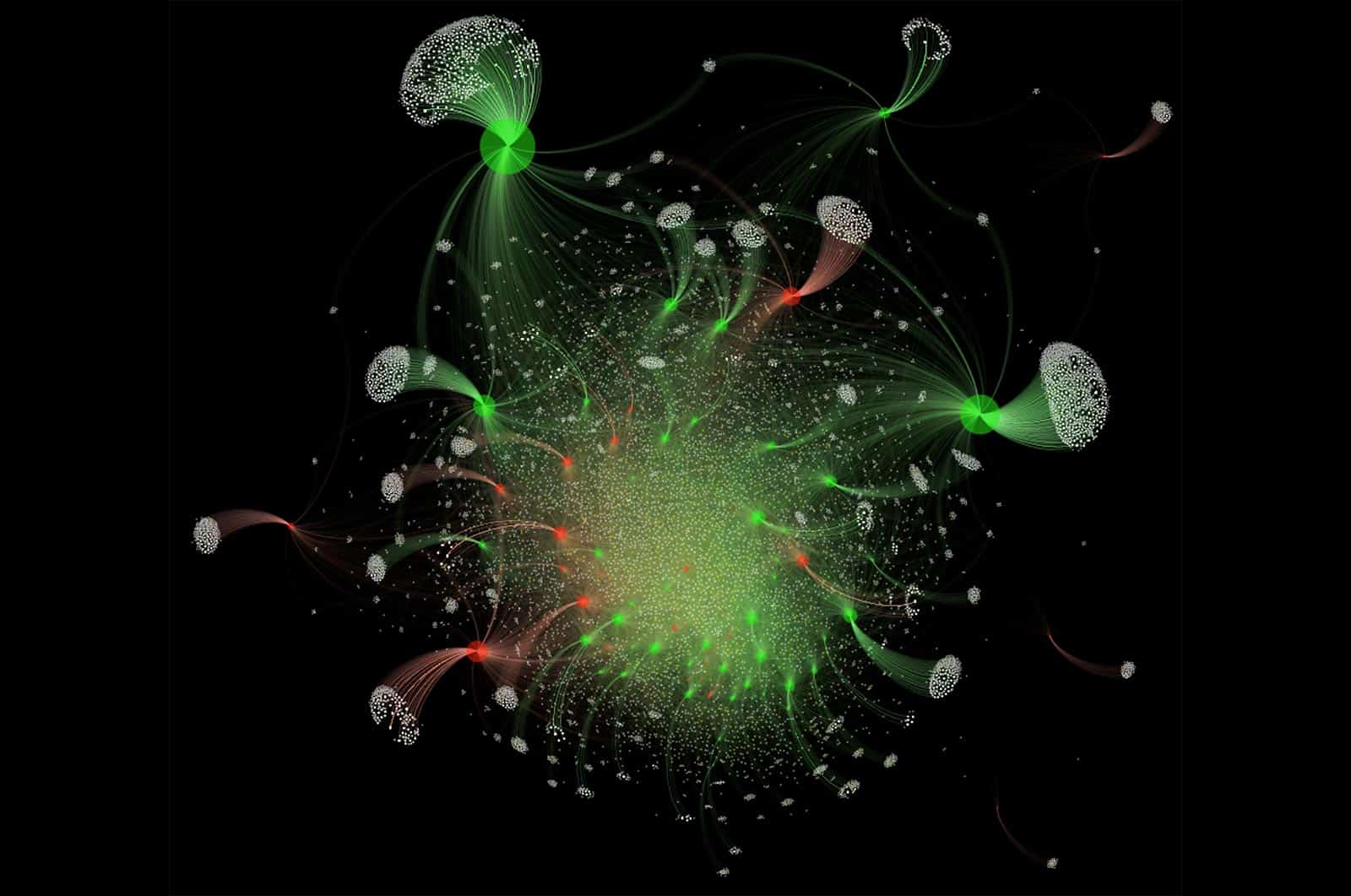
Mapping hate: Snapshot of a sudden burst of new pro-IS groups in January 2015 on the Russian social network VKontakte. Small white circles are individual users; yellow ones are users who were later banned for becoming too violent. Bigger red circles are groups that were later banned for becoming too violent. Bigger green circles are groups that were not banned. (Courtesy: NF Johnson, M Zheng and P Manrique)
There are plenty of examples where online narratives have incited individuals to commit violent acts. On 8 March 2015, for example, there was a post on VKontakte in a group supporting jihadism and the so-called “Islamic State” (IS) that said, “[translation] IS are preparing to attack the city of Karbala [in Iraq], 500 tonnes of explosives are ready”. This was followed a few months later by the discovery of booby-trapped vehicles and IS members in a small town 80 km west of Karbala. Another example of an online group potentially influencing an individual to violence was the fatal stabbing of a black university student in Maryland, US, in May 2017, where the suspect – a white student at a neighbouring university – belonged to a Facebook group called “Alt-Reich: Nation”, which featured white-supremacist content.
The challenge
But could we turn these examples on their head and use such social-media activity to foresee horrible real-world events? That might seem unlikely, given that such attacks appear to come from out of the blue, carried out by “lone-wolf” individuals with no criminal record. And with billions of online users, detecting who will act sounds like looking for a needle in a haystack – especially as, prior to any attack, each “needle” may be effectively indistinguishable from any other straw of “hay”.
This was the problem that I and my colleagues, Pedro Manrique and Minzhang Zheng from the University of Miami, began grappling with back in 2011. That year we had joined a multidisciplinary team that included computer scientists from HRL Laboratories in Malibu and social scientists from Harvard, Boston and Northeastern universities, to take part in the Open Source Indicators (OSI) challenge run by US Intelligence Advanced Research Projects Activity (IARPA).
IARPA’s research question sounded simple on the surface: if you have access (as we all do) to all the public information available on the Internet, can you provide reliable warnings about future societal activity such as civil unrest and violence? With various countries in Latin America acting as a test-bed, our task was to predict the date, location, cause and level of violence of such events. Run as a competition against other combined university–industry teams, all predictions were submitted electronically in real time and later scored by IARPA according to whether the event actually happened and how the details played out compared to the prediction.
We, like all the teams, initially assumed that the answer would lie in the Twitter activity of users. After all, the challenge took place just after the 2010 “Arab Spring” – a series of anti-government protests and armed rebellions across the Middle East – when it had been claimed that Twitter was being used to co-ordinate individuals for street protests. We did indeed find Tweets of this nature – but there were far too many compared to the actual events, meaning that the number of false alarms was huge. As a result, the scores of all teams remained modest.
Then things got worse. Along came the “Brazilian Spring” in 2013 – a huge spate of large-scale street protests that broke out unexpectedly around a range of social and political concerns. All the Twitter-based models, however, had missed this completely. Indeed, the Twitter feeds had looked fairly typical prior to the onset. Where, if any, was the online precursor signal ahead of the offline riots?
Physics patterns
The other teams, who were primarily engineers and computer scientists, immediately turned their attention to finding the individuals whose Twitter feeds had acted as the trigger for these unpredicted protests. In other words, they went in search of a guilty needle in the huge haystack of Tweets – assuming implicitly that there was one. We instead decided to take a step back and think of the underlying physics.
Physics tells us that large-scale changes in a physical system – like water “suddenly” boiling – cannot properly be understood in terms of what a single member molecule is doing. Instead, the answer lies in the collective, “many-body” behaviour – the correlations that develop during the build-up, between molecules from across the entire system. When a system approaches the phase-change, these correlations begin to cluster, and the number and size of these correlation clusters escalates. The precursor signal therefore lies not in the needles themselves, but in how they cluster in time. On social media, by analogy, the precursor can be found in online groups – not with the individuals themselves. Each group, after all, is nothing but a cluster of correlated individuals (figure 1).
1 Group connections: Schematic of a social-media group. (Based on an original by NF Johnson, M Zheng and P Manrique)
With this thinking in mind, we went back and studied Facebook groups in the build-up to the Brazil Spring. And there was the precursor signal we had been looking for – an escalation in the number of Facebook groups (i.e. correlation clusters) debating and discussing disagreements with particular policies and issues. Moreover, instead of a single group growing in size and hence being responsible, we found that the signal lay in the pattern the groups were creating across the system. So just as water starts bubbling feverishly as it approaches its boiling point, the creation of Facebook groups begins to escalate.
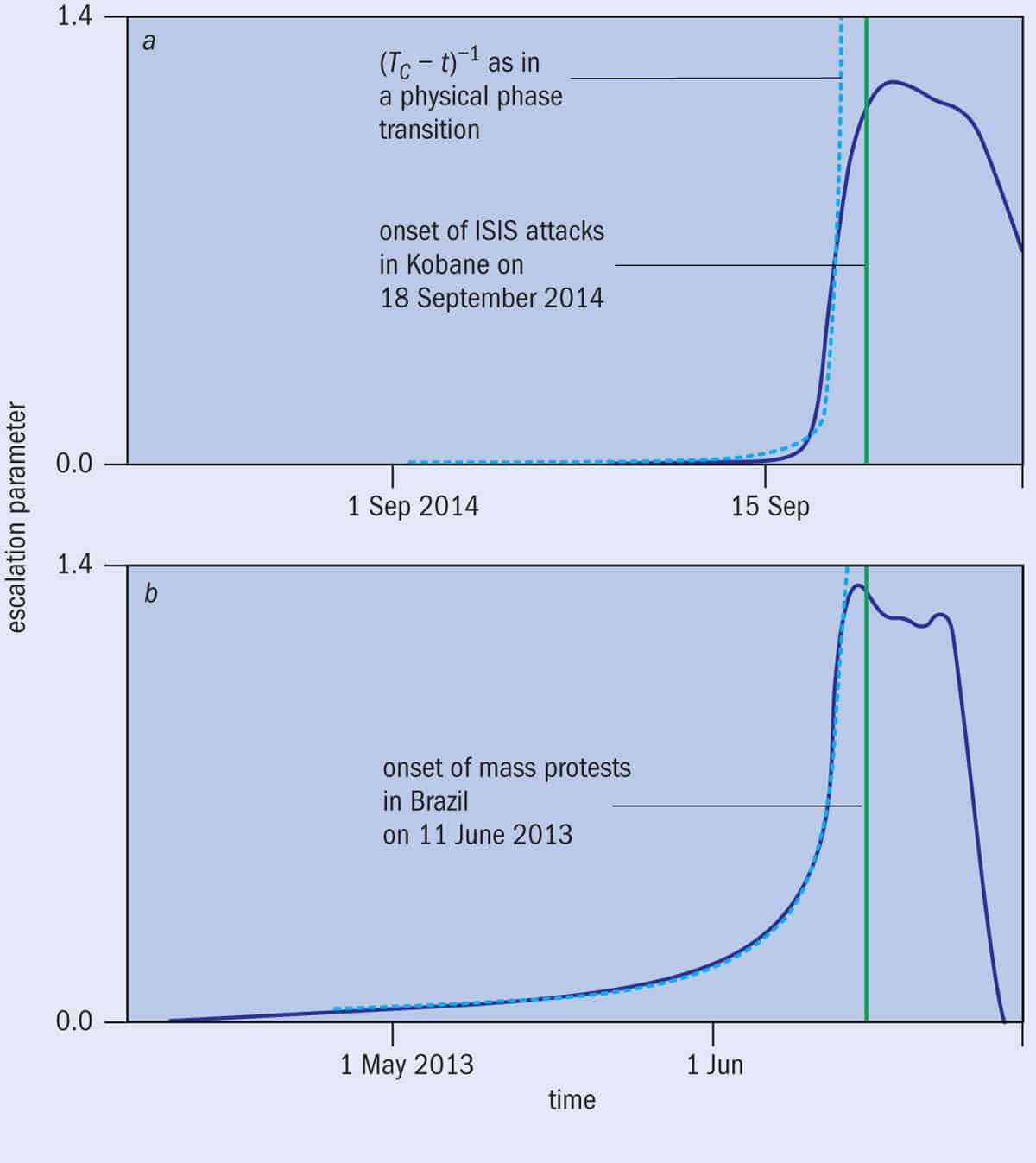
Our 2016 Science paper (352 1459) showed that the escalation rate of Facebook-group creation follows an inverse algebraic divergence (figure 2) as the onset approaches, in a way that is mathematically identical to a physical phase transition – but with the crucial new feature that this is an escalation in time as opposed to an escalation in an external control variable such as temperature. It therefore represents a new piece of physics: a dynamical phase transition in an out-of-equilibrium system.
2 Like a phase transition. Divergence of the growth rate – specifically, the escalation parameter (dark blue line) – of the number of online groups with time, t, ahead of the onset of real-world events in Kobane and Brazil (green line). (Based on an original by NF Johnson, M Zheng and P Manrique)
As well as revealing new physics, this experience taught us an invaluable lesson about social media that paved the way for our subsequent understanding of online support for terrorism, extremism and hate. Unlike online Facebook groups where in-depth discussions can develop organically over time, Twitter acts more like a platform for shout-outs. Just as you probably would not be convinced to change your opinion about a complex issue such as Brexit simply by what an individual shouts out on a busy high street, nor do groups of people gravitate toward collective opinions or actions on complex issues because of individual Tweets. Fans of flavoured crisps, as well as stay-at-home dads, seek an exchange of opinions and advice through social-media groups, not Twitter shouts – and so too do people with a common enemy such as the West, immigrants, or people of a different race, religion or gender.
We therefore expanded our study to look at other forms of shared hatred – not against a political system, but against the West as a whole. It was now early 2014 and IS was starting to develop. Immediately it became clear to us that Facebook was doing a good job of shutting down groups developing extreme pro-IS narratives – a good thing, but bad for our research. However, we did find them on VKontakte – a social-media platform based in Russia that hosts almost one billion people worldwide. Like Facebook, VKontakte has a group tool that enables people with common interests to aggregate together online. However, unlike Facebook, VKontakte is less able to find and quickly shut down extremist and violent groups, making it the “go-to” place for many who wish to share such opinions. Indeed, the platform appears to have been a crucial tool for IS recruitment, particularly among university students, and we found a near-identical algebraic escalation to the Brazil Spring in the pattern of pro-IS groups created prior to IS’s sudden and unexpected attack on Kobane, Syria, in September 2014.
People, not molecules
So, job done? No. This was still a systems-level theory – like thermodynamics – and did not explicitly include the fact that humans, unlike water molecules, are all different. The implicit physics assumption of identical particles therefore invalidates the use of any many-body theories to explain collective human behaviour.
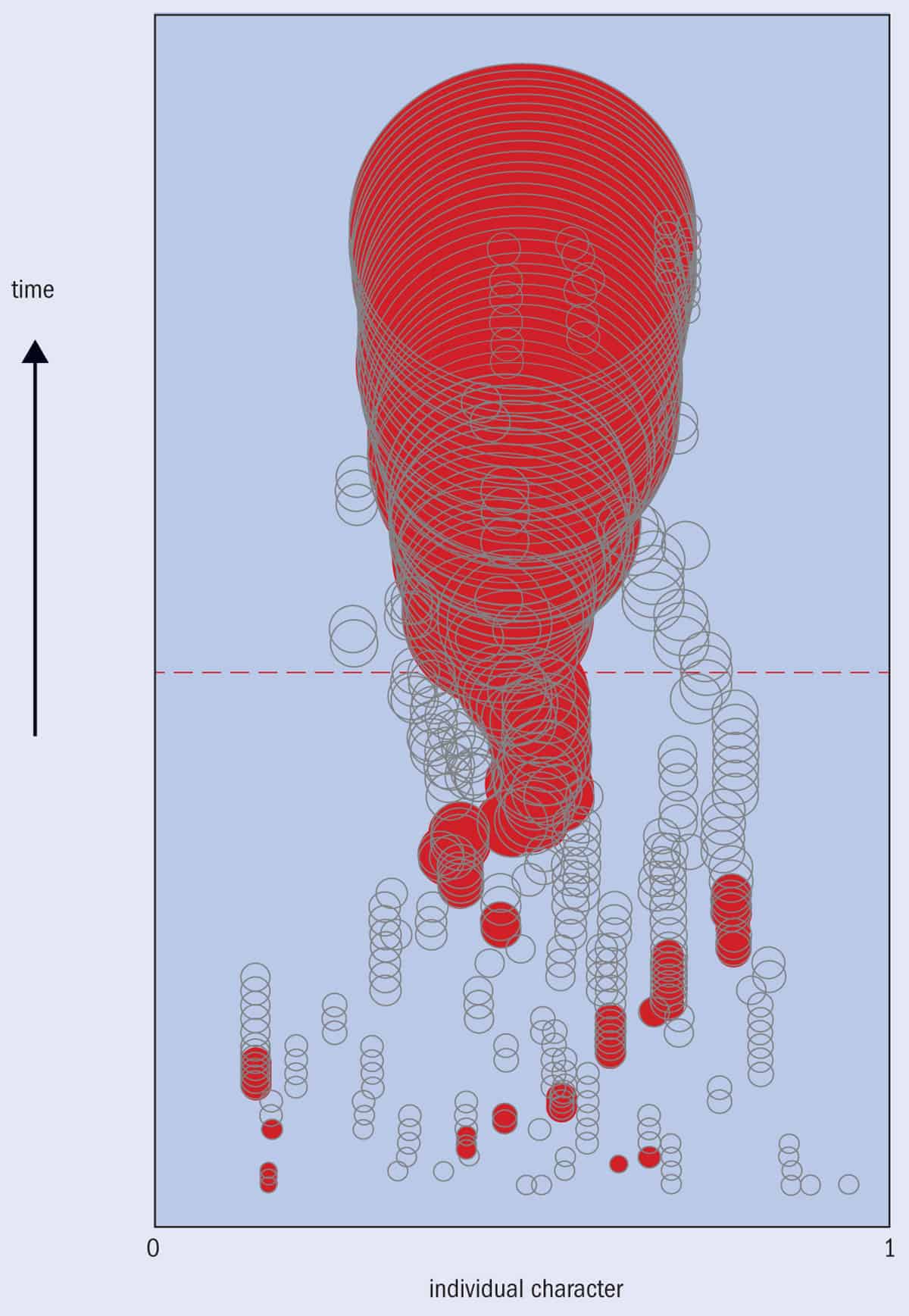
To get a “many-people” theory, we would have to do something that no many-body physics theory had ever done. We could not assume humans are like, say, unconscious, interchangeable atoms but had to include the heterogeneity of living, thinking people. Our hypothesis was that we could take a “mesoscopic” perspective where we sacrifice specific details of each individual in order to capture the overall diversity of the population. Inspired by how wildlife diversity is used to shed light on an ecosystem’s development, we hoped that incorporating a “cartoon” representation – just the basic skeleton of the system – of human diversity might be similarly sufficient. We therefore allowed each human to have a certain “character” typified by a single number between 0 and 1. Though this sounds like a very restricted description for a human being, it turns out it matters little if this character is more complicated – like a multidimensional vector – since the key lies in allowing the individuals to be distributed fairly evenly across the character space between 0 and 1 (i.e. the population is diverse).
3 Group gelation: Growth over time of some pro-IS extremist/hate groups on VKontakte. (Based on an original by NF Johnson, M Zheng and P Manrique)
Making this simplification then allowed us to describe mathematically how the different characters manage to “gel” into groups. For this, we took inspiration from gelation theory, which is well established for identical particles and has been used to describe aggregation in a wide variety of physical systems, such as milk curdling when proteins form inter-molecular bonds. As expected, however, it fails to describe the online pro-IS group dynamics because it assumes that all particles are identical. But as shown in our 2018 paper (Phys. Rev. Lett. 121 048301), our generalized gelation equations “with character” explain not only the timing of the onset of different groups forming, but also their wide range of growth patterns (figure 3). And when we added in the fact that groups that develop strong narratives in support of terrorism and extremism get shut down by social-media moderators, we obtained an almost perfect fit for the evolution of pro-IS groups online.
Human brain or social media?
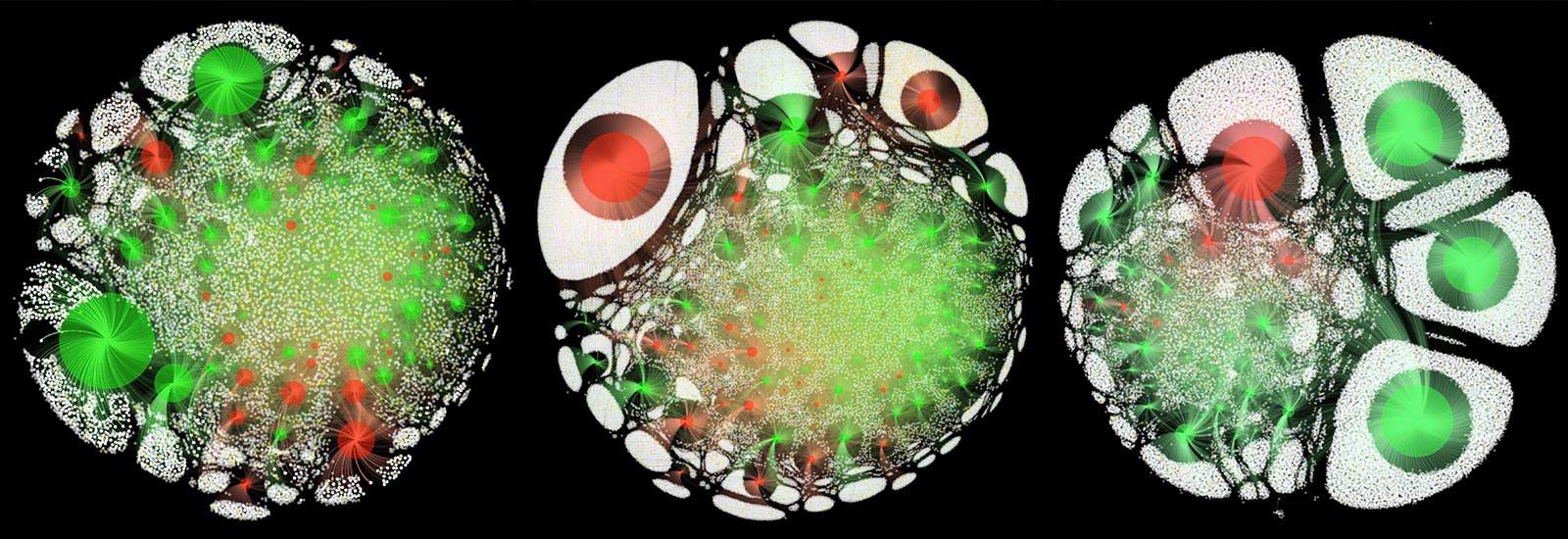
Having understood these moving parts, we could then provide the first ever picture of how a worldwide terror/extremism “organism” evolves in time online. Figure 4 shows snapshots throughout the organism’s lifespan: from its birth in 2014, through a period of rapid growth and evolution, to maturity in mid-2015, and then a gradual decay in activity toward old age and death as the pro-IS groups got shut down more aggressively and their members migrated to encrypted platforms such as Telegram. Not only does each picture look like a brain, but the network behaviour over time is remarkably similar to what is currently known about a brain network during a human’s lifetime.
It turns out that we had stumbled upon a very unlikely but precise connection between online terrorist support and the human brain. In this analogy, each online group acts as a “functional unit” like synapses in the brain, into which “structural units” – users or neurons – connect (figure 1). And just as neurons can engage in multiple synapses, users can be members of more than one online group.
4 Like a brain: Snapshot of IS’s entire global online support at three instances during its lifespan, as detected through the social-media platform VKontakte. (Courtesy: NF Johnson, M Zheng and P Manrique)
The early stages of the pro-IS “brain” in figure 4 show a large amount of redundancy, with many different groups serving similar functions – just as in a real infant brain. Between infancy and maturity, some of these functional units begin to dominate, as in an early adult brain, and there is an optimal blend between specialization and synchrony in the system. By old age, several giant groups (functional units) dominate, but they share very few common users and hence lack overall synchrony – as in a human brain in old age. Moreover, the functional network (i.e. the network of groups) suffers a loss in small-world behaviour as it heads into old age, while the structural network (i.e. the network of users) shows the opposite trend – exactly as in an ageing human brain.
Inadvertently, our study of online support for terrorism/extremism has thrown up a new proxy for a human brain, with the advantage that its individual pieces and connections can be measured precisely over time from public Internet data – unlike its biological counterpart. This in turn makes it a potentially unique model for assessing “what-if” scenarios in a real brain, such as cutting out particular pieces, or delaying or stimulating growth of certain parts. Moreover, our latest work on “hate-speech” groups (arXiv:1811.03590) shows similar phenomena, suggesting that the way in which humans conduct clandestine, anti-societal and/or illicit activities online, follows a common pattern. This in turn may feed into the universality observed in other human contexts (see “Maths meets myths” by Ralph Kenna and Pádraig MacCarron Physics World June 2016).
There is of course much still to do. As you read this, there are undoubtedly individuals online who are developing the intent and capability to carry out further violent attacks. So how might such “many-people” physics theories help detect them before they act? Imagine you meet someone in your university and are interested in knowing the next step in their career. But instead of asking them their current thoughts and getting a potentially vague answer since they themselves may not yet know, you simply ask them what courses they have taken so far. This will then tell you the spectrum of things that they have been exposed to, and hence lets you narrow down what job they are likely to end up in – perhaps better than they themselves could at that stage. In an analogous way, such generalized many-body physics models, in the hands of security specialists, could play a similar role for terrorism, extremism and hate by seeing which individuals have passed through which groups and hence are likely to have the necessary intent and capability.
It is unlikely to be a perfect solution – it is definitely unconventional – but surely it is better than waiting for something horrific to happen before we take any action.
If carbon dioxide concentrations in the atmosphere become high enough, the clouds that shade and cool some of the tropical and subtropical oceans could become unstable and disperse. More radiation would slam into the ocean and the coasts, and surface temperatures could soar as high as 8 °C above the levels for most of human history.
And this dramatic spike would be independent of any warming directly linked to the steady rise in carbon dioxide concentrations themselves, the scientists warn.
In the last 200 years, levels of the greenhouse gas carbon dioxide in the atmosphere have increased from 288 parts per million to around 410 ppm and the average global temperature has already increased by about 1 °C.
Researchers have repeatedly warned that the Paris promises have yet to be turned into coherent and consistent action, and that if the world goes on burning coal, oil and natural gas on a “business as usual” scenario, catastrophic consequences could follow.
Now US researchers warn in the journal Nature Geoscience that they know a bit more about the climate mechanisms by which global warming could accelerate.
If carbon dioxide ratios climb to 1,200 ppm – and without drastic action this could happen in the next century – then the Earth could reach a tipping point, and the marine stratus clouds that shade one-fifth of the low-latitude oceans and reflect between 30% and 60% of shortwave radiation back into space could break up and scatter.
The sunlight they normally block would slam into the deep blue sea, to warm the planet even faster.
Avoidance possible
“I think and hope that technological changes will slow carbon emissions so that we do not actually reach such high CO2 concentrations,” said Tapio Schneider, an environmental scientist at the Jet Propulsion Laboratory, the research centre managed for the US space agency NASA by the California Institute of Technology.
“But our results show that there are dangerous climate change thresholds that we have been unaware of.”
So to resolve what Professor Schneider calls “a blind spot” in climate modelling, he and his colleagues worked on a small-scale computer simulation of one representative section of the atmosphere above the subtropical ocean, and then used supercomputers to model the clouds and their turbulent movement over a mathematical representation of the sea. And then they started to tune up the atmospheric concentrations of carbon dioxide.
Carbon threshold
They found that, once CO2 levels reached 1,200 ppm, the decks of stratocumulus cloud vanished, and did not reappear until CO2 levels dropped to well below this dangerous threshold.
If – and this has yet to happen – other researchers use different approaches to confirm the result, then the US scientists will have established a better understanding of one component of natural climate control.
These, the Caltech team, suggests, would be “implausibly high” CO2 levels. The latest study suggests this might be an overestimate: a mere 1,200 ppm would be enough to set the planetary thermometer soaring.