Schematic and photo of the experimental set-up to test a PML-based robotic arm to carry out simple tasks. (Courtesy: Jarasse et al Frontiers in Bioengineering and Biotechnology 10.3389/fbioe.2018.00164)
Prosthetic limbs are crucial to improve the well-being of people who have suffered an amputation, and have undergone astonishing advances with the recent development of robotic prostheses. However, the protheses technology has advanced faster than the control systems, which limits their actual use in “real life”. This fact is particularly relevant for amputees suffering above the elbow (transhumeral) amputations, which require complex prosthetic arms with several joints and hence, complex control systems.
To overcome the limitations of amputees at controlling their protheses, researchers have investigated systems that recognize patterns of electric signals from the muscle, known as myoelectric signals. One of these systems can recognize phantom limb movement (PLM) signals, which are voluntary contractions of the muscles in the remaining limb to move the amputated extremity. In fact, the researchers have already carried out some preliminary studies employing a prothesis that recognize these signals.
Despite these advances, no study to date has investigated a PLM-based prosthesis that’s able to decode signals in real time to carry out day-to-day activities. Therefore, a team from the CNRS and Aix-Marseille University, in collaboration with the Regional Institute of Readaptation Nancy in France, conducted a study in which two transhumeral amputees tested a complex robotic prothesis with a control system able to decode phantom limb signals in real time to complete simple real-life activities (Front. Bioeng. Biotechnol. 10.3389/fbioe.2018.00164).
In this study, the investigators developed an algorithm that could recognize the PLM signals and reproduce them in a prosthetic arm. With this prototype, patients could carry out designated tasks in real time with very little training. The system is highly intuitive and the patients were able to perform the activities without difficulty, as the research team shows in this online video. In addition, the transmission of the signals did not require surgery, which is a particular advantage for the patient.
These observations are encouraging, since this represents a fast and reliable system to develop a new type of prothesis for arm amputees, who often give up on their prostheses due to their complexity of control. However, the system still needs improvement, since the patients took long times to complete the activities. Future adaptations will also allow the amputees to wear the prothesis, as in this study they were limited to a prothesis connected to an external system. In addition, the research team intends to work to better understand the PLM phenomenon to apply it in future advanced prototypes.
Get knitted! The physics of fabrics is the cover feature of the January 2019 issue of Physics World
Happy new year to all Physics World readers!
I know you’re raring to go with 2019 so why not get up to speed by checking out the latest issue of Physics World magazine. We’ve got some treats for you, including a cover feature by freshly minted PhD physicist Samuel Poincloux, who’s been studying the physics of knitted fabrics.
There’s a great article by Nicola Towsend and Iddo Amit from Durham University about the challenges of using 2D semiconductors to create wearable electronic devices, while Stephen Ornes looks at the discoveries that the technique of “hyperspectral imaging” has made to artworks such as Pablo Picasso’s Mother and Child by the Sea.
Elsewhere in the issue, we’ve got the usual mix of news, opinion, reviews and careers, plus an intriguing Lateral Thoughts article by Sebastian Wood about the physics of turning water into wine.
You can enjoy the January 2019 issue of Physics World magazine via our digital apps for iOS, Android and Web browsers. (membership of the Institute of Physics required). Let us know what you think about the issue on Twitter, Facebook or by e-mailing us at pwld@iop.org.
For the record, here’s a run-down of what’s in the issue.
• The quantum space race – Siddarth Koduru Joshi from the University of Bristol tells Michael Banks why countries are racing to build the first quantum network in space
• It’s a quantum world – With a new era of quantum technology beckoning, James McKenzie examines the opportunities it offers for business and industry
• Revolting physics – Can the growth of solid-state physics be likened to a Star Wars plot? Robert P Crease agrees that it can
• The spirit of science – Liujun Zou says that China needs to do more to support fundamental science so that the country can play a leading part in the technologies of the future
• The future is flexible – Smartphones, tablets and laptops are stacked with computing power, but they’re mostly rigid, inflexible objects. Semiconductors that have been shrunk from 3D to 2D could, however, lead to flexible, wearable electronic devices, as Nicola Townsend and Iddo Amit explain
• Hidden pictures – Hidden beneath some masterpieces there are other paintings, visible only to state-of-the-art spectroscopic imaging techniques. Stephen Ornes looks at some of the secrets that hyperspectral imaging has uncovered.
• Knit and stretch – What do earthquakes, robotics and jumpers have in common? Samuel Poincloux explains why the answer lies with knitting – and how stretching a knitted material is rooted in mechanics.
• An anxious descent – Chanda Prescod-Weinstein reviews Anxiety and the Equation: Understanding Boltzmann’s Entropy by Eric Johnson.
• Hellions of the solar system – David Appell reviews Catching Stardust: Comets, Asteroids and the Birth of the Solar System by Natalie Starkey.
• Levelling the physics field – Female physicists who want to succeed in the workplace often face barriers that their male counterparts do not. Jennifer Dyer looks at how initiatives by the Institute of Physics, and other organizations, can help improve the careers of women in physics.
• Recipe for a miracle – Sebastian Wood wonders about the physics of turning water into wine.
It feels like we are living through the most uncertain of times. Readers in the UK are facing the unknown turmoil of Brexit, while across the globe we are seeing seismic shifts in the socio-political landscape. And while we all must know by now that our planet is changing, we still don’t really understand what the impacts will be in the near- and far-future.
Against this turbulent backdrop, it can be difficult to predict what will happen next week, let alone what will make the headlines in the coming year. But our team of science journalists has risen to the challenge, and have picked out the projects, missions and research trends and that are set to make a splash in 2019.
Michael Banks: projects and missions
Particle physicists will be holding their breath in March, when the Japanese government is expected to announce whether it will host the International Linear Collider (ILC). Over a decade in the making, the ILC is pegged as the successor to CERN’s Large Hadron Collider (LHC). By colliding electrons with positrons, the 20 km linear collider is designed to study the Higgs boson, which was discovered in 2012, in unprecedented detail. A verdict to build the ILC in Japan was expected in December 2018, but the Japanese government postponed a decision late last year for further deliberations.
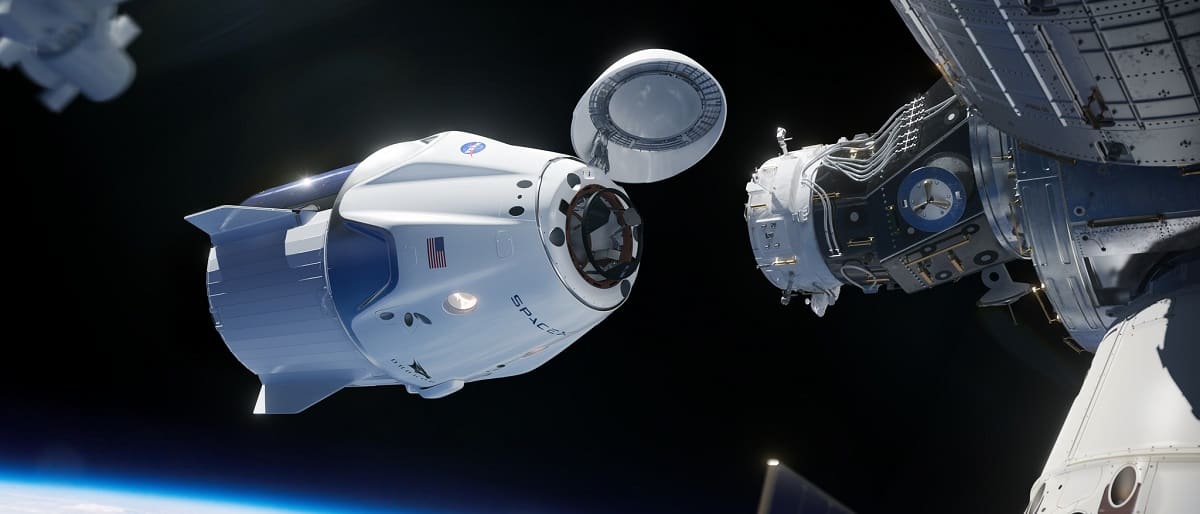
This year could also see commercial space travel really take off. In January, SpaceX is expected to test launch its Crew Dragon capsule. The craft, which will not have any astronauts on board, will dock and undock with the International Space Station (ISS). If all goes well, then that could be followed by the first crewed mission in June, which would end the US’s reliance on Russia to send astronauts to the ISS. Yet SpaceX is not alone in such endeavours. In March, Boeing is expected test launch it CST-100 Starliner crew capsule, with a possible first crewed mission by August.
An artist’s rendition of the Crew Dragon capsule docking at the International Space Station (Courtesy: NASA/SpaceX)
In the UK, all eyes will be on whatever Brexit deal – if any – is reached before the country pulls out of the European Union on 29 March. How that will affect physics remains to be seen, but it could be hit particularly hard under a no-deal scenario. A lot hangs in the balance, no less the UK’s involvement in Horizon Europe – the next seven-year European framework programme – as well as major initiatives such as the Galileo satellite constellation. Not to mention the ability for the country to attract the best scientists.
Tami Freeman: medical physics and the biosciences
Last year we saw the continued development and implementation of proton therapy. And 2019 will likely bring further advances – both in the technologies being developed for treatment planning and delivery, and in the ever-increasing number of installations.
In the UK, for instance, the first patient was treated with high-energy proton therapy in 2018, at the new Rutherford Cancer Centre in South Wales. And Rutherford Cancer Centres plans to open three more UK facilities offering proton therapy over the next 12 months. The first National Health Service proton therapy centre is also now open, at The Christie in Manchester. Indeed, The Christie will play host to the 2019 meeting of the Particle Therapy Co-Operative Group (PTCOG) in June.
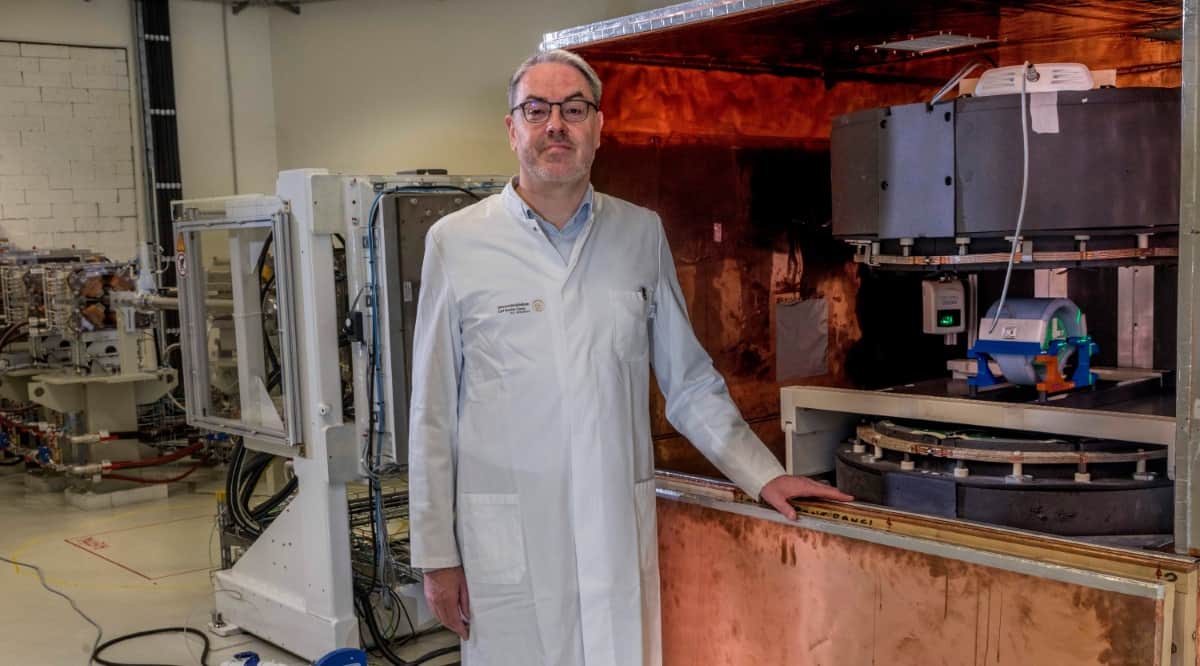
Aswin Hoffmann and his team installed an open MR scanner (seen on the right of the photo) in the path of the proton beam in the experimental room at OncoRay. (Courtesy: HZDR /R. Weisflog)
On the technology side, innovation continues in areas such as proton imaging, which should improve the accuracy of treatment planning. And perhaps we’ll also see more progress in MR-guidance for proton therapy, which is already being investigated and could ultimately enable real-time adaptation.
2018 also saw several fascinating developments in the field of neural engineering. For example, two independent studies reported on the use of electronic spinal cord stimulation to enable patients with lower limb paralysis to walk again. Elsewhere, researchers showed how a brain–computer interface can enable people with paralysis to control a commercial tablet computer with just their thoughts, enabling them to play music, send text messages, perform online shopping or just chat with friends. The coming year may well see many more breakthroughs in this essential field, bringing hope to people faced with paralysis that increased functional control may be possible.
Hamish Johnston: fundamental and applied physics
There seems little doubt that commercial quantum computing will keep growing in 2019 as more companies – big and small – enter the market. They will follow in the footsteps of IonQ, which spun-out of the University of Maryland in 2016 and has just launched its first product. IonQ’s system is the first commercial quantum computer to use trapped ions as qubits – previous systems from D-Wave, Rigetti, IBM and others use superconducting circuits to store and process quantum information. That different qubit technologies are still vying for commercial supremacy suggests that the quantum-computer industry is still in its infancy, but those technologies will now be tested in a nascent marketplace rather than just in the lab.
(Image courtesy: Andy Sproles/Oak Ridge National Laboratory, US Department of Energy)
An important trend that will continue in 2019 is quantum computing in the cloud, whereby companies offer access to their systems via the Internet. An important benefit of this approach is that quantum computer users do not have to become conversant in the dark arts of cryogenics or ion trapping. In 2018, for example, nuclear physicists in the US used cloud quantum computing to calculate the binding energy of the deuteron. Expect more scientists to use quantum computers in this way in 2019.
The Large Hadron Collider (LHC) at CERN has just shut-down for two years as part of the planned high-luminosity upgrade. When completed in 2026, the upgrade is expected to boost the number of proton collisions by as much as a factor of 10. The LHC has been an extraordinary engineering success, so there is little doubt that CERN physicists will achieve their luminosity goal. The big question is whether nature will cooperate and provide particle physicists with interesting things to discover.
Liz Kalaugher: environment and energy
2018 saw headline-hitting hurricanes such as Florence and Michael, wildfires in the US, Canada, Russia, Sweden, Greece, the UK and Australia, along with extreme temperatures and drought. Unfortunately, with climate changing and an El Niño on the horizon, it’s likely that 2019 will see more of the same, maybe even worse. As attribution science progresses and it’s easier to link extreme weather events to carbon emissions, there could well be more legal cases claiming damages from major emitters.
Small remnants of thicker, multiyear ice float with thinner, seasonal ice in the Beaufort Sea on Sept. 30, 2016 (Courtesy: NASA/GSFC/Alek Petty)
Arctic sea ice will hit its seasonal minimum extent in September. Given that, according to the US National Snow and Ice Data Center, the 12 lowest extents in the satellite era have all occurred in the last 12 years, it seems a reasonably safe bet to project that the 2019 extent will be one of the lowest. Next year it will be observed by ICESat-2, which launched in September 2018 and can measure ice elevations with an accuracy of around 1 cm. GRACE-FO, the Gravity Recovery and Climate Experiment Follow On, which was launched in May 2018, will also track ice sheets and glaciers, as well as sea, lake and river levels and soil moisture.
With human-enhanced natural disasters continuing and carbon emissions still rising, let’s hope that there’s a strong focus on solutions, including renewable energy and energy efficiency. It’s likely that debate around negative emissions technologies will continue. And, as discussed at the AGU Fall Meeting session on Geoscience Impact in a Complex World: Successful Collaboration with Social Scientists, it could behoove scientists to understand the political process and offer answers based on current science – rather than requesting more funding to provide information in five or 10 years’ time.
Anna Demming: materials science and technology
There are few real certainties in research, but it’s a pretty safe bet that graphene will continue to dominate the headlines throughout 2019. One specific milestone on the horizon is the roadmap that will be released by the Graphene Flagship as it reaches the midpoint of its 10-year €1bn funding, which will highlight the key achievements to date and set specific targets for the remaining five years. We can also hazard a guess that many of the efforts in 2D materials research will be directed at quantum properties and technologies, with the Quantum Flagship – another €1 billion 10-year project supported by the European Commission, launched in October 2018 – choosing 2D·SIPC (two-dimensional quantum materials and devices for scalable integrated photonics circuits) as one of its first 20 projects. And of course, following the Breakthrough of the Year we will be watching the burgeoning field of twistronics.
2019 will mark the International Year of the Periodic Table
Throughout 2019 scientists will also be celebrating the International Year of the Periodic Table (IYPT2019), which marks the 150th anniversary of Dmitri Mendeleev’s discovery of the periodic table of elements. The year-long initiative will formally open in Paris on 29 January, with a ceremony featuring talks from the 2016 Chemistry Nobel Laureate Ben Feringa, the nuclear physicist who led on the discovery of element 118 “organesson” Yuri Organessian, and Nottingham University’s Martyn Poliakoff, a chemist working in fundamental discovery as well as environmentally friendly chemical processes. As part of the celebrations, 1001 inventions – a UK-based educational organization that works to raise awareness of the Golden Age of Muslim Civilisation – has teamed up with IYPT to produce learning materials that celebrate 8th century polymath Jabir ibn Hayyan, while in February a symposium at the University of Murcia in Spain will celebrate the role of women in populating the periodic table.
Elsewhere, I am willing to hedge a bet that the intense research in materials for energy will produce a new record for energy conversion efficiency in perovskite solar cells. The trend towards multifunctional materials will also gather pace, whether for “massless energy storage” or for real-time disease monitoring and treatment.
Thank you to all our editors for their predictions, and you can let us know on Twitter or Facebook whether or not you agree. From everyone here at Physics World, we hope you all have a very happy and successful 2019.
When the clocks strike midnight on New Year’s Eve, the night sky will be lit up with swirling, whistling, flashing, banging, glittering explosions of colour, noise and smoke. Some of these fireworks will be set off in people’s back gardens, but if you really want a good “ooo” and “ahh”, it’s best to head for a professional display. These events, which can cost big money, are a spectacular mainstay of everything from national celebrations such as Guy Fawkes Night in the UK to sporting events like the World Cup and the Olympic Games.
But given that fireworks are “one-shot” products, which function only once, how do professional pyrotechnicians produce such immaculately arranged displays without practice? How do they know what the display will look like if they can’t rehearse it in advance? The answer lies in having a detailed understanding of the composition and behaviour of fireworks. Fortunately, we have learned a lot about these objects, as they are one of the oldest technical activities with which humans have been involved.
Their history dates back to the 14th-century BC, when people in China would throw dried bamboo sticks onto fires to obtain a crackling effect that, they believed, would scare away evil spirits. Such “firecrackers” were, however, not fireworks like those we know and love today. Indeed, it wasn’t until the Tang Dynasty in the 9th century AD that “black powder” – the foundation of fireworks – was developed from charcoal, sulphur and saltpetre. The performance of these mixtures was gradually optimized to 75% saltpetre, 10% sulphur and 15% charcoal – proportions that are still used today, more than 1000 years later.
Over the centuries and around the world, various types of fireworks were invented by talented craftsmen using trial and error, in what was then more “art” than “science”. Flames, sparks, bangs, crackles, and bright exhausts of gas and particles were the main firework effects, but the colours were limited to faded reds and yellows. Of the pyrotechnic compositions – the chemicals in fireworks – 99% were black powder with additives such as iron and ground charcoal mixed in to generate desired visual effects.
A truly scientific approach to fireworks, however, had to wait until the end of the 18th century and the beginning of modern chemistry. In the 1770s French chemist Antoine Lavoisier demonstrated experimentally that combustion was a process in which a substance combines with oxygen. For fireworks, the oxygen was provided by saltpetre, which was identified as potassium nitrate (KNO3) a few years later. Then in 1787 Claude Louis Berthollet – another French chemist – discovered chlorates, which meant that saltpetre was no longer the only oxidizing agent that could be used in pyrotechnic compositions.
Saltpetre’s capacity to provide chemical reactions with oxygen was reported for the first time by French pyrotechnician Claude-Fortuné Ruggieri in the second edition of Elémens de Pyrotechnie, published in 1811. This was a landmark in the science of fireworks, being the first ever treatise explaining pyrotechnic matters in scientific terms and in full compliance with Lavoisier’s theory of combustion. Ruggieri went on to be the first pyrotechnician to use various chlorates and nitrates to give fireworks “true” colours beyond the weak red and yellow. Barium, strontium and copper salts were quickly shown to give green, red and blue respectively.
Snap, crackle, pop: The earliest fireworks were firecrackers (top left, courtesy: iStock/plej92). Most modern fireworks include an ignition barrage (top right, CC BY Epic Fireworks) and an aerial shell (bottom right, CC BY Epic Fireworks). One of the biggest shows ever fired was at the Burj Al Arab hotel in Dubai (bottom left, CC BY Lacroix).
What’s in a firework?
Enough of the history. What we can now say for sure is that firework effects are produced, projected and propelled in aerial patterns by the chemical reaction of explosive substances that are designed, on ignition, to produce heat, light, sound, gas or smoke.
Most modern-day fireworks contain at their heart a combustible heterogeneous mixture of finely powdered chemicals, which can be tailored to produce a desired display. These pyrotechnic compositions include oxidizing agents (such as chlorates, perchlorates, nitrates and oxides), reducing agents (such as metal powders, charcoal, sulphur, boron and organic compounds), and solid, liquid or paste additives. These additives help to control how fast or slowly a firework burns and make it less sensitive to possible accidental stimuli, such as impact, friction and electrostatic discharge.
Figure 1: Fragmentation star. (CC BY Lacroix)
Usually the mixture is then pressed, cast, moulded, extruded or rolled to form small spheres, cylinders or cubes intended to burn in the air and move as brilliant coloured points under the dark sky. These objects, known as “stars”, can also include an extra pyrotechnic chemical that breaks them into fragments on burning and modifies the resulting visual effect (figure 1).
Figure 2: Lift and burst.
The stars are stored in “aerial shells” (figure 2), alongside two other powders. One is a “lift charge” that projects the shells into the air. The other is a “burst charge” that breaks the shell case, ignites the stars and propels them outward. Lying between these two is a column of compressed chemicals that delays the transmission of fire from the lift charge to the burst charge so that the shell explodes at the intended point on its trajectory. Ignited by the lift charge and burning like a cigarette, this delay fuse sets fire to the burst charge after a time interval determined by its burning rate.
All fireworks also need an initial ignition to start the whole process. This is done via a string of textile yarns covered with black powder that is designed to burn progressively along its length with an external flame. This fuse, known as a “black match”, is generally also wrapped loosely in a paper pipe or sheath, which increases its linear burning rate up to several metres per second.
Journey of a firework
Any object that involves fire and explosives comes with a long list of hazards and risks – even something as simple as a child’s sparkler can be dangerous. Fortunately, many restrictions and international standards exist to ensure that those who make, watch and operate fireworks stay as safe as possible. These regulations include construction and performance requirements for consumer and professional fireworks, test methods to verify compliance with such requirements, and labels to help users light fireworks safely and from the right distance. But these regulations have done more than just improve the safety of fireworks – they have also advanced the accuracy of test equipment, which in turn has allowed pyrotechnists to elevate their art. Such equipment is used to chemically characterize the ingredients of pyrotechnic compositions and check their performance before and after they are integrated into fireworks (see box, below).
Testing, testing
There are many performance-controlling parameters in fireworks that need to be regulated and tested. Here are some, why they’re important and the techniques commonly used to test them.
Particle size and surface area of reactive chemicals determine the burning rate, and are tested using laser diffraction analysis and BET (Brunauer, Emmett and Teller) nitrogen adsorption techniques.
The surface oxidation state of metal particles also determines the burning rate and is probed using optical and scanning electron microscopy.
Chemical reactivity is tested using differential scanning calorimetry and thermogravimetry. This property controls burning rate and heat flow.
Chemical stability and compatibility are important from a safety standpoint, and concern aspects such as storage and the effects of ageing. They are tested by thermogravimetry under vacuum, coupled with gas chromatography.
Colour quality is analysed using colorimetry and visible/infrared imagery to ensure bright displays.
Toxicity of reaction products and their decomposition processes are important for minimizing environmental impact and are characterized by gas chromatography and infrared spectroscopy.
One advantage of the chemical testing of fireworks is that it has allowed new compositions to be developed that cut the risks to workers in factories and to users on firing sites. A lot of effort has also gone into ensuring that ingredients and reaction products have as small an impact on the environment as possible. Some companies and laboratories have carried out feasibility and development studies to eliminate heavy metals and other toxic substances, and reduce smoke production and fallouts of unburnt star components – in the EU, these are governed by the REACH environmental regulations. Pyrotechnicians are particularly interested in using organic chemistry to discover substances and molecules that could be safer and more environmentally friendly than the inorganic compounds that fireworks have traditionally used.
But it’s not just their chemical composition that needs to be strictly controlled. How fireworks behave needs to be fully understood too. Take the height a firework reaches – knowing how far it’ll travel is one of the main parameters for determining where users and spectators should be to stay safe. Measuring such “effect” heights commonly involves using theodolites and analysing images recorded by visible or infrared cameras. The possible benefits of using radar and Doppler tracking are also being evaluated to obtain more accurate values of the effect height.
Performing without rehearsals
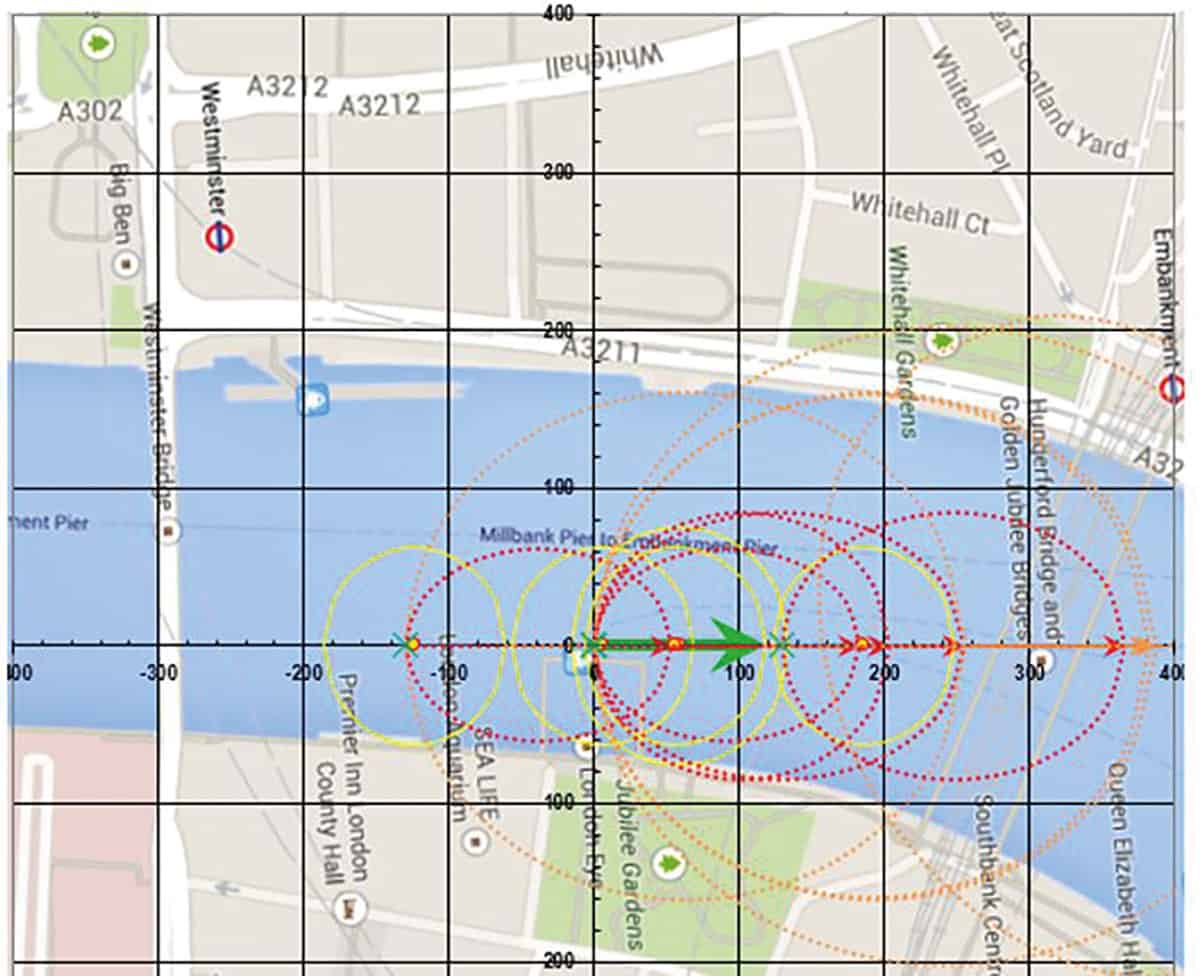
To help assess the risks the public might be exposed to during firework displays, mathematicians have developed models to predict the ballistic behaviour of aerial shells. These take into account factors such as the deviation angle of mortars – the tubes used to fire shells – from the vertical, and the local weather forecast, especially wind speed. Internal ballistics software – which specifically looks at the propulsion of a projectile – uses real gas equations of state to allow pyrotechnicians to predict the velocity of shells at the muzzle of mortars. Meanwhile, external ballistics software, such as ShellCalc, allows shell trajectories to be plotted in 3D (figure 3).
Figure 3: Risk reduction. (Courtesy: ShellCalc)
Such modelling programs are set to become a major tool in designing firework displays, especially in places where people, property and historic monuments are relatively close to the firing site. Not only will they suggest optimal orientations of the firework effects, but they will also make it possible to foresee how fallout zones are affected if the weather conditions change. Given that fireworks can be used only once, no-one wants to waste any on a rehearsal. Therefore other software has been developed to let show designers “play” their firework display virtually and make changes to improve the aesthetic quality of the shows, for example to match the firework effects more precisely with music. Being able to plan and visualize a display is a huge advantage for pyrotechnicians, who can create increasingly intricate and ever-more ambitious shows.
With such big displays, it is particularly important to have reliable firing equipment and networks of electric firing lines. They must be resistant to the electromagnetic environment and to bad weather, while being compliant with the latest international electronic standards. They also need to be fired in a precise sequence, from different distances and in time with music. These challenges have led to three solutions: computer-controlled firing equipment; networks of firing lines organized in sub-groups and equipped with electronic hubs linked to a central firing unit by sophisticated lines or radio transmission; and simulation software that can start successive firing sequences during the show.
This means that it is now possible to automatically fire complete sequences. However, electronic times are much more accurate than pyrotechnic times and humans must remain in the loop to correct the shifts between the firing program and the aesthetic objectives of the show.
Scientific analysis and understanding of fireworks have led to the truly spectacular professional displays we now know and love. And even if you are simply letting off some fireworks at the end of your garden this New Year’s Eve, it’s nice to know that pyrotechnicians have worked hard to make sure they are safe for you and the environment, as well as being bright and colourful against the night sky.
Using ultracold atoms to simulate a model of ferromagnetism that was first proposed 85 years ago has come one step closer because of work done by Matteo Zaccanti of the University of Florence and colleagues in Italy and the US. The team has managed to separate experimental signals from atoms that pair-up to create molecules from signals from free atoms that have aligned their magnetic moments with their neighbours. As well as providing insights into the fundamental nature of magnetic interactions, the research could be used to simulate other interesting systems such as “quantum emulsions”.
While iron is the most familiar magnetic material, the origins of its magnetism are rather murky. It cannot be described simply as a collection of magnetic moments that are fixed in a crystalline lattice because its magnetism arises from the spins of its conduction electrons, which are free to move throughout the material.
In 1933 the British physicist Edmund Stoner came up with a theory of “itinerant ferromagnetism” to explain how these electrons become magnetic. Wolfgang Pauli had already pointed out that electrons with spins pointing in opposite directions can get much closer to each other than electrons with spins pointing in the same direction. However, electrons are charged particles and being up close has a huge cost in terms of electrostatic energy. If the spins point in the same direction, the electrons cannot get close together and the electrostatic energy is much lower — but this comes with the cost of increased kinetic energy. Stoner worked out that at a certain electron density, alignment wins-out and the material becomes a ferromagnet.
Mean field
Stoner expressed the interaction felt by a single electron in terms of a field representing all the other electrons. Working at the University of Leeds, he found that if this field was strong enough, the spins would align. But calculating the field for a material like iron remains a formidable challenge.
Ultracold fermionic atoms offer a way of studying the Stoner model because the interactions between the atoms can be fine-tuned by applying magnetics fields. An important challenge facing physicists doing such experiments is the tendency for pairs of atoms to form molecules comprising atoms with opposite spins. In past experiments, it had been difficult to separate signals associated with ferromagnetic interactions from signals associated with the formation of molecular pairs.
Now, Zaccanti and colleagues have done a “pump-probe” experiment in which they have been able to separate the signals and also show that the ferromagnetic interaction persists for a relatively long period of time. Their experiment involved firing a 150 µs radio frequency (RF) pump pulse at the gas, which initiates the ferromagnetic interaction. Then the system is allowed to evolve for several milliseconds before a probe RF pulse initiates a spectroscopic measurement of the pairing and ferromagnetic interactions.
While the atomic simulation is not the simple ferromagnetic system described by Stoner, it is a step closer. Furthermore, the emulsion-like coexistence of ferromagnetic and molecular states in the atomic gas could itself be a fascinating field of study in itself.
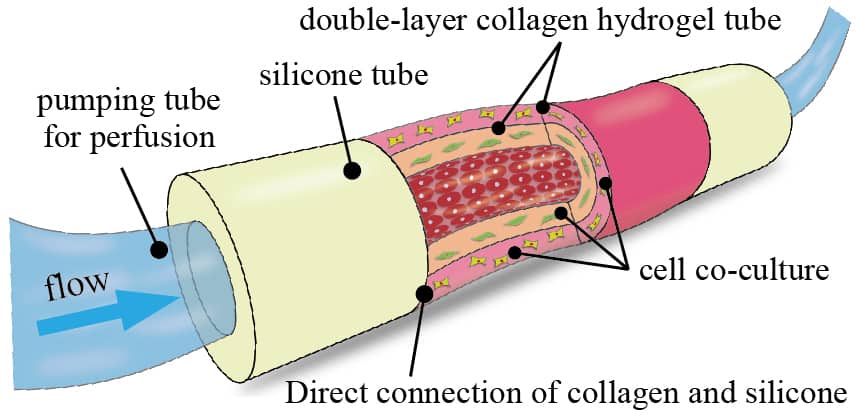
Researchers in Japan have demonstrated a novel collagen-based device that offers a promising alternative to animal testing for assessing the efficacy and toxicity of new drug formulations. The 3D structure, which comprises a double-layer collagen tube attached at both ends to silicone tubes, is easy to fabricate using only moulding techniques and can readily be perfused with cell cultures via an external pump (Biofabrication 11 015010).
The double-layer collagen tube device
The moulded microtube structure overcomes many of the problems normally associated with in vitro 3D tissue models – which typically consist of cells embedded in a scaffold material. Such models also include vascular-like networks, which play an important role in biochemical reactions and the absorption of drugs into the human body.
Various techniques have been used to make these 3D structures, including bioprinting and soft lithography, but they tend to be complicated. It can also be difficult to connect these tissue models to external perfusion systems because it is no easy task to join hard pumping tubes to soft biological tissue. What’s more, the structures that have been created so far have mostly only had one scaffold layer, while multiple layers are need to reliably mimic complex biological structures.
With the new device, developed by Hiroaki Onoe at Keio University in Japan, successive collagen layers can be built up by repeated moulding. “We can also flexibly design the thicknesses of the collagen layers in the device and co-culture heterogenous cell types in the concentration we want in each collagen layer or surface,” explains Shun Itai, a graduate student in Onoe’s group. “And while the collagen tube is directly attached to silicone tubes, the collagen tube can easily be connected to an external pump for perfusion.”
Strong and stable
The device is strong enough to picked up with tweezers, says Itai, and is stable for more than three months in a culture medium. Cell cultures can be perfused into the device using a syringe pump that can be operated at different speeds.
“A collagen tube device such as ours needs to be designed with the target tissue model in mind,” adds Itai. “In this work, we targeted blood vessels as simple tissue models for testing the compatibility and perfusion capability of our device.”
The researchers chose to model medium-sized blood vessels with diameters of about 100–1000 µm – which is similar in size to arteries and veins. “We can change the size of our device by changing the dimensions of the mould used to make it,” Itai continues. “We have prepared several sizes of moulds for fabricating single- or double-layer collagen devices with inner diameters of 300–1000 µm.”
The techniques used in this work could help advance the fabrication of simple-to-make in vitro vascular tissue models, Itai and Onoe tell Physics World. “These models could serve as a pharmacokinetic platform for drug testing, regenerative medicine and general biomedical research that does not involve experiments on animals.”
The researchers, who report their work in the journal Biofabrication, say they will now be developing a method to connect the individual collagen tube devices they have made to different tissue models. This would offer a way to construct multi-organ-on-a-chip models.
Read our special collection “Frontiers in biofabrication” to learn more about the latest advances in tissue engineering. This article is one of a series of reports highlighting high-impact research published in Biofabrication.
Structural analysis . X-ray diffraction studies of superconducting lanthanum hydrides. Cake representation ray diffraction studies of superconducting lanthanum hydrides. The typical X-ray powder diffraction pattern measured for the sample showing a superconducting step at ~249 K under 150 . Credit: arXiv
Researchers at the Max Planck Institute for Chemistry in Mainz, Germany say that lanthanum hydride (LaH10) could be superconducting at the remarkably high temperature of 250 K (–23 °C), albeit at extreme pressures of around 170 GPa. Meanwhile, another team from George Washington University in the US says that it has found evidence of superconductivity in the same material at even higher temperatures of 280 K (7 °C) under 202 GPa pressures. If confirmed, the findings could be a major step towards finding room-temperature superconductors.
Superconductivity is the complete absence of electrical resistance and is observed in many materials when they are cooled to below their superconducting transition temperature (Tc). In the Bardeen–Cooper–Schrieffer (BCS) theory of (“conventional”) superconductivity, this occurs when electrons overcome their mutual electrical repulsion and form “Cooper pairs” that then travel unheeded through the material as a supercurrent.
Long sought-after goal
The best superconductors available today unfortunately need to be cooled down to liquid helium or liquid nitrogen temperatures. “Room-temperature superconductivity (generally accepted as being 273 K or 0 °C) is thus a long sought-after goal for scientists,” says Mikhail Eremets, whose research group discovered high-temperature superconductivity in hydrogen sulphide under 150 GPa pressures in 2014. Room-temperature superconductivity would help considerably improve the efficiency of electricity generators and transmitters, as well simplify current applications of superconductivity, such as superconducting magnets in particle accelerators.
Before 2014, the highest Tc for conventional superconductors was 39 K (–230 °C) for magnesium diboride and many believed that it would be impossible to reach any higher. Although superconductivity has been achieved at 164 K at high pressure in copper-oxide systems, these are known as unconventional superconductors, for which an accepted theory is still lacking.
New family of hydrides
“The discovery of superconductivity at 203 K in H2S, brought attention back to conventional superconductors that can be described by the BCS and Migdal-Eliashberg theories,” says Eremets. “These theories predict that high and even room-temperature superconductivity is possible in metals with certain favourable parameters such as lattice vibrations at high frequencies. We can now predict superconducting materials with the aid of first principles calculations based on density functional theory and these suggest a new family of hydrides with a clathrate structure in which the host atom (Ca, Y or La) is at the centre of a cage formed by hydrogen atoms.
“Indeed, for LaH10 and YH10, superconductivity with Tcs ranging from 240 to 320 K is predicted at megabar pressures.”
Three different kinds of measurements
The researchers say they have now found evidence for this thanks to three different kinds of measurements on LaH10. The first is the characteristic decrease in resistance as the temperature decreases. The second is the so-called isotope effect, in which the hydrogen atoms in the sample are replaced with heavier deuterium. The corresponding shift in Tc (to 168 K as expected) is direct evidence of the pairing of Cooper electrons in conventional superconductivity. Finally, the researchers confirmed the superconducting nature of the transition at 250 K thanks to how it changes depending on an external applied magnetic field. “The magnetic field reduces the Tc in conventional superconductors through the orbital effect or by breaking the spin-singlet state of the Cooper pair, explains Eremets.
“Our experiments are seemingly simple but they are in fact quite challenging to set up,” he tells Physics World. “We place a piece of lanthanum metal in a diamond anvil cell in a hydrogen (or deuterium) atmosphere and then heat it to make a hydride (or deuteride). The pressure can be as high as 200 GPa (2 megabars), so the samples thus need to be very small – just 10 microns across. They also need to be connected to four electrodes for us to be able to obtain direct evidence of superconductivity. Finally, we need to analyse the material’s crystal structure at an advanced synchrotron (APS GeSCARS in our case).”
The Meissner effect
The small size of the samples means that the researchers have not yet been able to measure the Meissner effect (another crucial indicator of superconductivity) in their material. “We detected this effect in the case of H2S, but these samples had a much bigger diameter of 100 microns. Our LaH10 samples are 10 times smaller, which means that their magnetization signal is below the sensitivity of a SQUID magnetometer. We will thus need to develop other experimental techniques to detect this signal.”
Meanwhile, in similar experiments, researchers led by Russell Hemley of George Washington University in the US say that they have observed a sudden drop of electrical resistance at 280 K (7 °C) in LaH10 at pressure of up to 202 GPa. What is more, they have even detected the Meissner effect in this material in follow-up work (not yet published). They did their experiments at the Argonne National Lab in Illinois
Both Eremet’s group’s result and Hemley and colleagues’ still need to be independently confirmed, however, says Jorge Hirsch of the University of California at San Diego, who was not involved in either study. “We have to be careful not to place too high a confidence in experimental results obtained under very difficult experimental conditions when they appear to agree with predictions of BCS theory, and perhaps consider the possibility of experimental artifacts,” he comments.
Eremets and colleagues have published their findings on arXivand Hemley and colleagues will publish their work in Physical Review Letters.
From the physics of the perfect pizza to quantifying the fame of individuals, physics has had its fair share of quirky stories this year. Here is our pick of the 10 best, not in any particular order.
Building blocks
Game theory: Subatomic the board game
When games designer John Coveyou began a crowd-funding page on Kickstarter earlier this year for a new game that he and his colleagues had designed, he probably never imagined the amount of support it would get. Coveyou has a Master’s degree in environmental and chemical engineering from Washington University in St Louis, US, and is the founder of Genius Games. He took to the site in early February to raise $9000 to turn a particle-physics deck-building game called Subatomic into reality. Players start with a hand of cards consisting of up quarks, down quarks and photon cards, which they use to form protons, neutrons and electrons. Cards can then be combined to build certain elements such as helium, lithium, beryllium and boron. Basically, the person with the most “mass” wins. The game is designed for two to four players, aged 10+, and has an estimated playing time of 40–60 minutes. Within 30 days, the Kickstarter had raised more than $250 000 from 4548 backers.
The price of football
This year saw France win the 2018 FIFA World Cup. As with every recent World Cup, Panini released its official sticker album. But how much would you had to have spent to complete the album? There were 682 stickers in the 2018 version with five stickers in a packet that each cost 80p. If you happened to be incredibly lucky and had no duplicates then it would take 137 packets, or £109.60, to complete. In reality, you probably ended up with lots to spare – probably of an obscure Panamanian right back – so Cardiff University mathematician Paul Harper analysed the realistic cost of finishing the album. He found that, if you just bought packet after packet without swapping duplicates with friends, you would need to buy, on average, 4832 stickers or 967 packets to complete the book, at a whopping £773.60. But if you got together 10 friends in a swap group, filling the album would reduce the cost to a mere £247. Bargain.
Spot the difference
Can you spot the changes made to the new logo for the DESY lab in Hamburg (see far left image)? On closer inspection you might make out the addition of a small orange dot after the word DESY, while the lines that go through the six balls now stop rather than sticking out at the other end (and are slightly thicker). So why did the lab feel the changes were necessary? “The new logo is a way of expressing and keeping up with the momentum of our research centre [and] we think [the new logo] is clearer and more dynamic,” a DESY spokesperson told Physics World. “The new orange dot represents the undiscovered, the unknown. If you see it as a punctuation mark it also turns the logo – and with it DESY as a whole – into a statement.” Given that the orange dot has such a deep meaning, do the six blue balls represent anything in particular? “They are completely up to the interpretation of the beholder, so no matter whether you see a simplified model of an atom, the six quarks, lollipops, dumbbells or a particle collision it’s all correct,” adds the spokesperson.
Muhammad Ali: still the greatest
Physicists Edward Ramirez and Stephen Hagen from the University of Florida put their knowledge of physics to use by devising a way to quantify and compare the fame of individuals. Using statistical methods, they determined how famous someone is by looking at various metrics including Google searches and the number of edits to a person’s Wikipedia page. After analysing fame for hundreds of people who died in 2016 and 2017, they concluded the top three celebrities were Muhammad Ali, Fidel Castro and Prince. The researchers also found that the statistical distribution of fame obeys a power law that has similar characteristics to “other natural and social phenomena” such as landslides and market crashes. They even tackle the perception of “celebrity death clustering”, showing that it is rather a “statistical consequence” of the large number of famous deaths each year.
Laws of procession
One event where you’re guaranteed to hear a lot of noise is the annual Rose Monday parade in the German city of Cologne. It occurs on the Monday before Lent and involves the usual fancy costumes, floats and dancing. Physicist Michael Schreckenberg at the University of Duisberg and colleagues are such big fans of the parade that wrote a paper about its dynamics . Having gathered GPS data of the marchers between 2014 and 2017, they found something odd: people at the end of the parade moved along the route much faster than those in the lead – something that goes against conventional wisdom about how traffic jams form. Schreckenberg says that this strange behaviour occurs because a fire engine initially sets the pace, but then leaves after a certain point, resulting in the groups behind speeding up. “Knowing this, one could try to put same decelerators into the procession, like more fire engines,” Schreckenberg told Physics World. “Or from the beginning the fire engine should be fast as the final group.” The team now want to find out if this behaviour is a universal phenomenon and occurs at other kinds of processions too.
The key take-away
What does it take to bake the perfect pizza? That vexing question was answered this year thanks to physicist Andrey Varlamov, who is research director of the Institute for Superconductivity and Innovative Materials in Rome. Teaming up with physicist Andreas Glatz and “food anthropologist” Sergio Grasso, Varlamov looked at the physics of cooking a pizza in both a traditional woodfired brick oven and an electric oven. Describing the heat transfer between the bottom of the brick oven and the pizza, Varlamov found that the cooking time for the perfect pizza is about two minutes – similar to what is seen in a traditional pizzeria. However, if you wanted to replicate this time with an electric oven with a steel surface it would mean heating the interface to 300 °C, which would end up incinerating the pizza. To get a better-cooked pizza in the electric oven requires reducing the interface temperature to around 230 °C and taking 50% longer to cook it – hard to do if there are many hungry customers waiting. Varlamov says that’s why it’s always better eating out at a pizzeria with a traditional brick oven.
The sound of drips
One of the most annoying sounds is surely that produced by a dripping tap. Yet it could become a thing of the past thanks to researchers from the universities of Cambridge and Poitiers. While much work has been done on the fluid mechanics of a falling water droplet into liquid, little research has been carried out on what produces the characteristic “plink, plink” sound as the water droplet hits a liquid surface. By using an ultra high-speed camera, a microphone and a hydrophone, the team recorded droplets falling into a tank of water. They found, perhaps surprisingly, that the sound is not caused by the droplet itself, but by the oscillation of a small air bubble trapped beneath the water’s surface. One way to stop the noise is to add soap to lower the surface tension of the liquid. “[But] I think the best way to stop the sound being produced is to get whatever is causing the drip fixed,” co-author Sam Phillips from Cambridge told Physics World.
Blueberry Earth
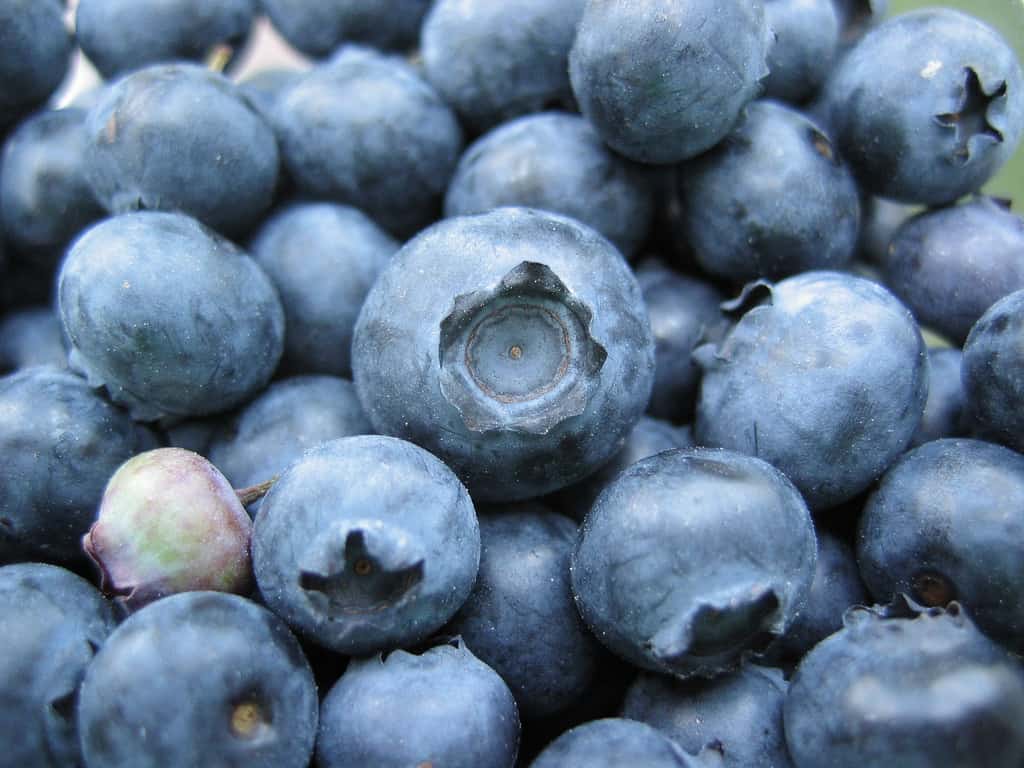
Blueberry world: What would a planet made up of blueberries be like? (Scott Schopieray/CC SA 2.0)
It’s probably not a question you’ve thought about before. But what would happen if the Earth were replaced by an equal volume of blueberries? Well, now you can sleep easy, thanks to computational neuroscientist Anders Sandberg from the University of Oxford. Sandberg, who works at something called the Future of Humanity Institute, was inspired to carry out the work after a user posted the question on the Physics Stack Exchange website. By taking into account the density and compressive strength of blueberries, Sandberg found that a “blueberry Earth” would turn into a “roaring ocean of boiling jam” with an ice-like core much like a “warm granita” — that classic Italian semi-frozen dessert made from flavoured sugar and water. “The final state of blueberry Earth is somewhat similar to oceanic exoplanets, although far lighter than any observed so far,” he writes in the seven-page paper. So is there a chance that a blueberry Earth could be somewhere in the universe or possibly lurking in the Kepler mission’s data? “I would be pretty shocked to find a blueberry Earth,” Sandberg told Physics World. “But a super-light ocean world? Maybe.” Sandberg says that he may study the physics of another “crazy world”, but adds that he suspects that other fruit planets would end up being similar. “There is likely some kind of ‘fruit main sequence’ that is parametrized by the water/solid content or maybe also the density and air content,” he notes.
Noteworthy physics
Many readers will remember answering those tricky electromagnetism exam questions in which you had to use the right-hand rule to calculate the direction of an induced current when a conductor attached to a circuit moves in a magnetic field. In August, Switzerland chose to illustrate its new 200CHF note – worth about £160 – with an image of the rule that is sometimes named after the British engineer John Ambrose Fleming. The chiral note is part of the “ninth banknote” series of the Swiss National Bank and marks its move away from using well-known people on Swiss money. The 200CHF note is about “matter” and contains an image of a proton-proton collision at CERN’s Large Hadron Collider (LHC) on the other side. The LHC was included no doubt to celebrate the success of the Geneva-based collider’s success at spotting the Higgs boson in July 2012, but given the particle’s mass surely the Swiss should have introduced a 125CHF note?
Bitter legacy
Finally, some scientists have laws named after them, or even particles and elements. But how many can claim to have their very own beer? Well, the late Peter Mansfield now does after Matthew Davies from the International Centre for Brewing Science at the University of Nottingham teamed up with the Nottingham-based Castle Rock Brewery to create an ale to celebrate the life of the Nobel-prizewinning physicist. Mansfield, who died in February 2017 at the age of 83, spent most of his career at Nottingham. There he pioneered the development of Magnetic Resonance Imaging, which led to him sharing the 2003 Nobel Prize in Physiology or Medicine with the US chemist Paul Lauterbur. The 4.2% ABV “Sir Peter Mansfield ale” is a “five-malt bitter” with “four hop varieties” that are added at various stages throughout the brewing process. For those in the UK, the beer is available in pubs “across the East Midlands and Yorkshire”.
You can be sure that next year will throw up its fair share of quirky stories from the world of physics. See you in 2019!
Permafrost coasts are susceptible to the combined effects of declining sea ice extent, increases in open water duration, more frequent and impactful storms, sea-level rise, and warming permafrost. That causes them to erode but it’s a complex business.
Benjamin M Jones and colleagues examined satellite observations of a 9 km segment of coastline at Drew Point, Beaufort Sea coast, Alaska. Mean annual erosion for 2007–2016 was 17.2 m yr−1, which is 2.5 times faster than historic rates. The lack of significant correlations between mean open water season erosion and the environmental variables compiled in this study highlight the complexities associated with changing coastal permafrost bluffs in the Arctic.
Find out more in this video abstract published in Environmental Research Letters (ERL) by Benjamin M Jones et al. ERL comes to you from Physics World parent IOP Publishing.