


Augmented reality device aids interventional oncology

© AuntMinnieEurope.com

An Italian-led research team has developed a technique that can use augmented reality instead of conventional intraprocedural imaging to guide needle insertion for interventional procedures, according to research published in European Radiology Experimental.

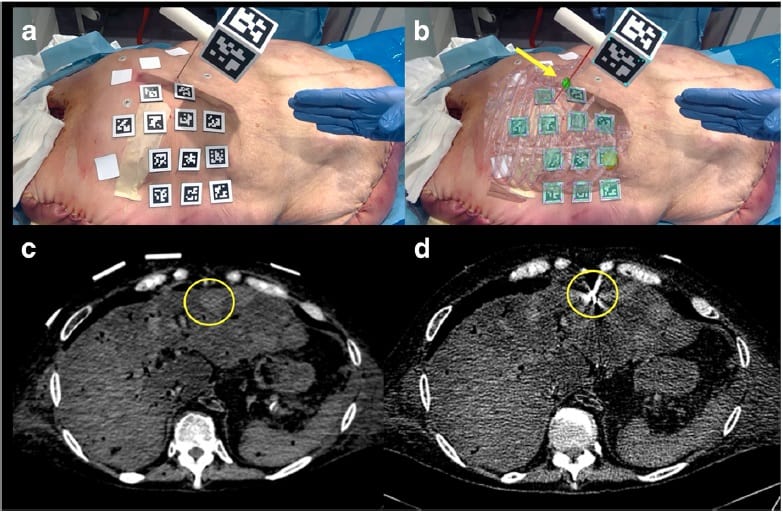
The group, led by first author Marco Solbiati of advanced visualization firm R.A.W., created augmented reality software capable of using a tablet to project 3D models of CT scans directly onto a target. They found that applying this technology to needle insertion — a common first step for the interventional oncology procedure thermal ablation — allowed clinicians to simulate the task well within a 5-mm accuracy threshold (Eur. Radiol. Exp. 10.1186/s41747-018-0054-5).
Augmented reality

This proof-of-concept study for the device was the first time that clinicians were able to target focal liver lesions using augmented reality only, wrote Solbiati and colleagues from various institutions in Italy, Israel and the US.

“Indeed, our investigation demonstrates that an augmented reality system can provide accurate guidance for interventional oncology procedures … without the need for further real-time intra-procedure imaging (such as ultrasound or CT), thereby avoiding possible exposure to ionizing radiation and the need for an additional co-registered modality,” they wrote.

Three-step experiment

Highly accurate image guidance is critical for the success of minimally invasive procedures performed in interventional oncology, a growing offshoot of interventional radiology, the authors noted. During surgery, clinicians in this field most commonly refer to a display of MRI or CT scans to guide intricate procedures such as thermal ablation. But this requires them to frequently look back and forth between the patient and the screen as well as mentally reconstruct the 2D scans into 3D images while performing the operation.

“Efforts have recently been made not only to improve the efficacy of ablative devices, but also to increase the accuracy of image-guiding systems,” the authors noted. “Several navigation systems have been developed using augmented reality techniques … [that] allow the operator to see 3D virtual objects superimposed upon the real world and not on a different screen.”

Seeking to improve the precision and efficiency of image guidance for interventional procedures, Solbiati and colleagues developed a new technique that relies on augmented reality instead of conventional radiographic imaging for visualization.

They created their augmented reality software (Endosight, R.A.W.) in a computer program (Unity 2017.1.1, Unity) and designed the software to superimpose 3D images directly onto a target. The augmented reality device includes a customized needle handle and a tablet (Microsoft Surface Pro 4, Microsoft) attached to a tripod that can display 3D images through its camera.

To test the accuracy of the technology, the researchers simulated needle insertion for thermal ablation using the augmented reality device on three different models: a custom-made silicone phantom, a pig and a cadaver with liver metastases.

First, they placed radiopaque skin markers on each of the models, acquired and processed CT scans of the models, and converted the scans into 3D images for the augmented reality software. Then the investigators used the augmented reality device to project these 3D images directly onto the corresponding model. This allowed the clinicians to visualize the targeted area for insertion in relation to relevant internal structures as they manoeuvred the needle.

High targeting accuracy

Overall, the tests for augmented reality guided needle insertion demonstrated extremely high accuracy — within the threshold of 5 mm from the targeted site. The average distance between the geometric centre of the model and the augmented reality images was 2 mm for the phantom, 3.9 mm for the pig model and 2.5 mm for the cadaver. The mean distance was 2.8 mm for the two liver tumours in the cadaver.

For the pig model, the mean amount of time it took to set up the device was 5.3 minutes, and the average time to perform needle insertion was 7.2 minutes. For the cadaver, the average set-up time was 5.8 minutes and the average procedural time was 9.4 minutes.

With the aid of the augmented reality device, clinicians may be able to visualize 3D models of organs and thermal ablation targets superimposed on real patients rather than on a different screen — improving the treatment result, the authors noted.

They are currently working on additional improvements for the prototype augmented reality device, including reducing the number of skin markers required for alignment and using fibre optics to detect needle bending during insertion in real-time.

“The application of augmented reality to interventional procedures might have a relevant impact in further improving the precision of guidance during ablation and holds the potential for a large diffusion in the near future,” they concluded.

  • This article was originally published on AuntMinnieEurope.com © 2018 by AuntMinnieEurope.com. Any copying, republication or redistribution of AuntMinnieEurope.com content is expressly prohibited without the prior written consent of AuntMinnieEurope.com.

Barnacles are no match for mushroom-shaped microstructures

It could soon be much more difficult for barnacles to cling onto the hulls of ships, thanks to a coating of mushroom-shaped microstructures that has been developed by researchers in Germany. The sea creatures – which are a serious problem in marine environments – are unable to completely wet the coating with their glue and form a strong, reliable bond, the researchers say. They add that their coating could help reduce the use of toxic anti-fouling coatings.

Biofouling is the unwanted accumulation of microorganisms, plants, algae and animals on surfaces. Aquatic biofouling affects the aerodynamics of ships and boats, increasing drag and therefore energy use. It can also corrode the surfaces of watercraft and structures such as bridges and wind turbines – and the build-up of organisms makes visual inspections and structural checks difficult.

Biofouling is also an important vector for invasive species. “Imagine your container ship is somewhere in Asia, in the harbour, and marine organisms from that ecosystem attach to the ship hull and then the ship travels to Europe or the US and the organisms detach, or release offspring,” explains Lars Heepe, a materials scientist and biophysicist at Kiel University in Germany.

Permanent fixtures

Of particular concern are so-called hardfoulers, like barnacles and mussels. These sessile marine organisms use adhesive substances to fix themselves permanently to surfaces. Most current strategies to tackle them use anti-fouling paints that stop larvae settling. But, these toxic coatings release harmful chemicals that contribute to marine pollution.

A barnacle’s cement works like most glues, explains Heepe. It starts as a liquid, so that it can flow across surfaces and into any defects before setting hard. As barnacles rely on thoroughly wetting the surface before hardening, to achieve a strong, permanent bond, Heepe and his colleagues wondered if it would be possible to tackle biofouling using purely physical means. They hypothesized that a non-wetting surface topography that the cement cannot completely coat would reduce the adhesive strength of barnacles.

Mushroom microstructures

To test this, they used a silicone-based material covered with mushroom-shaped microstructures – essentially pillars that bulge at the top. The bulges create an upward force on water droplets that prevents them collapsing into the space between the pillars, keeping the cavities dry. By contrast, on a similar surface with micropillars – without the mushroom-like structures at the top – water flows into the cavities between the pillars.

The researchers placed surfaces covered with mushroom-shaped microstructures and micropillars in the Baltic Sea for 17 weeks. For controls, they also submerged flat surfaces covered in the same silicone-based material and acrylic glass.

For the first three weeks barnacles only attached to the control surfaces. From week four to seven they steadily increased on all four surfaces, reaching an average density of 0.7 per 10 cm2 on the mushroom-shaped microstructure and micropillar surfaces, compared with a density of more than 2 per 10 cm2 on the control surfaces.

Zero coverage

Between week seven and 13 the number of barnacles on the mushroom-shaped microstructure surfaces dropped to zero, while the density on the micropillar-covered surfaces remained stable. The density on the silicone control surfaces also dropped to 0.7 per 10 cm2 by week 17, while the barnacles on the acrylic surfaces increased to 4 per 10 cm2.

Dennis Petersen, who is also based at Kiel University, told Physics World that it was already known that barnacle larvae settle at lower rates on surfaces with pillar microstructures – they appear to sense that they may not be good surfaces to attach to. Over time, however, they do slowly build up on these surfaces. The problem is that at some point the larvae have to attach somewhere. “It becomes a matter of life and death,” explains Petersen.

Because of this, Petersen says that the team were not interested in a surface that would deter settling – although the surface with the mushroom-shaped microstructures does – but one to which barnacles could not remain attached.

Knocked off

Petersen and Heepe say that their results suggest that the right surface topography can prevent the permanent adhesion of barnacles. Specifically, a surface that resists wetting reduces the contact area between the barnacle and the surface, resulting in a weak bond. They are then knocked off by forces such as natural currents and water flows created as the boat moves.

Marine-science expert Tony Clare of Newcastle University says the results “are interesting and show promise”. He encourages the Kiel team to “explore the utility of the approach beyond barnacles”.

The research is described in the Journal of the Royal Society Interface

Brownies get a new space badge, taking NASA selfies, Hey LIGO helps with debugging

Brownies in the UK have a new space badge thanks to a partnership between the Royal Astronomical Society, the UK Space Agency  and Girlguiding UK. For girls age 7-10, the badge “aims to spark girls’ curiosity to explore the universe around them by providing opportunities to develop the skills and confidence to engage in astronomy, planetary and space science,” according to a statement from the organizations. “Badge activities include stargazing with the challenge of identifying constellations on a clear night, creating a sunspot viewer and plotting a sunspot map, and designing an astronaut training programme.”

Cat in space

Once you have bagged your space badge, you could celebrate by taking a selfie that is out of this world using the NASA Selfies app. This puts you in a spacesuit with a selection of back drop images acquired by NASA’s Spitzer Space Telescope. Also new from NASA is the Exoplanet Excursions virtual reality app, which will send you on a tour of the Trappist-1 system of seven exoplanets. Both apps have been released to celebrate the 15th anniversary of the launch of Spitzer.

Moving from infrared astronomy to the detection of gravitational waves, Nikhil Mukund of India’s Inter-University Centre for Astronomy and Astrophysics has created an app called Hey LIGO. Inspired by digital assistants such as Apple’s Siri, Hey LIGO combs through LIGO logbook entries to see if solutions have already been found for specific problems with the huge detectors – something that could save operators a great deal of debugging time.

“If you ask some questions about the interferometer, [Hey LIGO] could intelligently come up with some answers that could help someone in debugging an issue or in knowing more about the detector,” explains Mukund. You can read more about it in Symmetry.

Growing risk of extreme heat and humidity

By the close of the century, the two-fisted assault of extreme heat and humidity could make the North China plain a deadly zone.

As water vapour rises from irrigated farmland, in heat extremes which are likely if humans go on burning ever-greater quantities of fossil fuels, then air temperatures and moisture conditions could become such that outdoor workers could no longer cool by perspiration.

In such circumstances no normal healthy person could survive more than six hours. And since 400 million people already live on the North China plain, by 2070 the consequences of ever-greater temperatures could be devastating, according to new research in the journal Nature Communications.

Simultaneously, a second study in a separate journal confirms that by 2080 excess deaths from extremes of heat will have risen in the tropics, subtropics and even the temperate zones.

In three of Australia’s great cities, deaths from heat waves will have risen by more than 470%.

The warning for China – which already emits more greenhouse gases than any other nation – is based on what meteorologists call “wet bulb” temperature, the combination of heat and humidity. When this climbs towards the natural body temperatures of humans and other mammals, conditions become dangerous. The North China plain covers 400,000 square kilometres of fertile floodplain irrigated by three great rivers.

The alarm is sounded by Elfatih Eltahir and a colleague at Massachusetts Institute of Technology in the US. Eltahir first identified the additional hazard of humidity in extremes of heat with a simulation of close-of-the-century temperatures that pinpointed the Gulf region, between Iran and the Arabian peninsula, as the zone where temperatures could become lethal. But the worst extremes would be over water.

A second examination of likely conditions under what climate scientists call the “business-as-usual” scenario, in which nations go on burning fossil fuels and emitting greenhouse gases in ever-increasing quantities, pinpointed Asia as the continent most at risk of lethal heat extremes for the greatest numbers of people.

The latest study is a refinement of the projections, and is based on evidence from the most recent three decades. Warming in the North China region has been double the global average – 0.24 °C per decade compared to 0.13 °C for the rest of the world. In 2013 there were extremes of heat that lasted for up to 50 days, and maximum temperatures topped 38 °C (around the accepted limit for humans).

Irrigation key

And the potential lethal factor for the region is likely to be irrigation: rainfall in the north is low, and evaporation from the soil moisture adds around another 0.5 °C to local temperatures. Water vapour is itself a greenhouse gas.

“This spot is just going to be the hottest spot for deadly heat waves in the future, especially under climate change,” said Eltahir.

That extremes of heat combined with higher hazards from humidity are already on the increase, and will continue with ever-greater ratios of carbon dioxide in the atmosphere, is firmly established. A second international study, in the Public Library of Science journal PLOS Medicine, looks at the risks for more than 400 communities in 20 countries for the decades 2031 to 2100, and once again it is based on a business-as-usual scenario, and data from recent decades.

If the world goes on warming according to the gloomiest predictions, the levels of heat-related excess mortality, the statistician’s phrase for death by heatstroke or heat exhaustion, then deaths in Colombia will by 2080 have risen by 2000%. Even in Moldova, the sample country with the lowest risk, they will have risen by 150%. In Brisbane, Sydney and Melbourne, the hazard will have soared by 470%.

Inexorable rise

That heat can kill has been known for decades, and the tens of thousands of extra deaths during heatwaves in Europe in 2003, and Russia in 2010, were harsh reminders. More extremes of temperature are inevitable.

Research of this kind is intended to encourage thinking about ways in which health authorities and city bosses could act to reduce the hazard. But for a global problem, a global solution could be the surest answer.

“Future heatwaves in particular will be more frequent, more intense and will last much longer,” said Yuming Guo of Monash University in Australia, who led the research.

“If we cannot find a way to mitigate climate change (reduce the heatwave days) and help people adapt to heat waves, there will be a big increase of heatwave-related deaths in the future, particularly in poor countries located around the equator.”

Portable imager provides insight into eye and brain diseases

A handheld ophthalmology device with resolution-boosting adaptive optics technology has demonstrated the ability to image individual photoreceptors in the eye. The new portable instrument will allow improved diagnosis of eye diseases and could one day enable early detection of brain-related diseases and trauma (Optica 5 1027).

“Until now, the imaging systems required for high-resolution photoreceptor imaging consisted of large, heavy components on an optical table that could only be used with cooperative adults sitting upright,” explains team leader Sina Farsiu from Duke University. “Our portable handheld system could expand this important imaging technique to children and infants, as well as to adults who may not be able to sit upright and stare straight ahead.”

Photoreceptors, specialized neurons that convert light entering the eye into signals sent to the brain, are the only neurons in the body that can be imaged non-invasively. As well as diagnosing eye disease, images of photoreceptors could provide insights into processes occurring in the brain.

For example, preliminary studies have shown that changes in the retina can be observed during the early stages of Alzheimer’s disease and after traumatic brain injuries such as concussions. The system, which measures just 10 x 5 x 14 cm, could also be used to image patients in a reclined position as they undergo surgery.

Currently, doctors image photoreceptors using an adaptive optics scanning laser ophthalmoscope (AOSLO). Adaptive optics technology increases image resolution by using a wavefront sensor to detect light distortion caused by the eye. A deformable mirror then compensates for the detected distortion, leading to clearer images. The components required, however, increase the system’s size, weight and cost.

To shrink these components, the team developed a new algorithm to perform wavefront sensing. “Other researchers have shown that the wavefront sensor can be replaced by an algorithm, but these algorithms haven’t been fast enough to be used in a handheld device,” says Farsiu. “The algorithm we developed is much faster than previously used techniques and just as accurate.”

The researchers also incorporated a commercial MEMS-based deformable mirror measuring just 10.5 mm in diameter. “The optical and mechanical design combined with our new algorithm made it possible to create the handheld device,” notes team member Joseph Izatt. “Adaptive optics systems are very sensitive to slight vibrations or motions, but we designed our system to be very stable.”

The researchers used their handheld AOSLO system to image the retinas of 12 healthy adult volunteers and two children under anaesthesia – representing the first use of adaptive optics to image photoreceptors in children. The system could capture detailed images of even the very small photoreceptors close to the centre of the retina, which play a key role in vision.

Before starting large-scale clinical trials, the researchers plan to incorporate additional imaging modalities for detecting disease into the instrument. To help other scientists adapt their system for specific applications, they have made the optical and mechanical designs, computational algorithms and control software for the handheld AOSLO system available online free of cost.

Live cells survive in bioprinted bone

Researchers in Germany have shown that a material based on calcium phosphate could offer a viable support material for bioprinting replacement bone tissue. The team, led by Michael Gelinksy at the Technical University Dresden, say that the technology opens up new possibilities for plastic and reconstructive surgeries, since it could be used to fabricate patient-specific bone tissue constructs, as well as more complex structures consisting of, for example, bone and cartilage or bone and soft tissue.

According to Gelinsky, calcium phosphate is the ideal scaffold material for these applications because it offers the same mineral structure and mechanical properties as natural bone. His team has been experimenting with scaffolds made from calcium phosphate cement (CPC), a pasty material that is easy to process into various shapes using a low-temperature extrusion-based technique called 3D plotting.

Recent work has shown that sensitive bio-components, like growth factors, can be integrated into printed CPC scaffolds without their biological activity being affected. The problem is that live cells cannot be suspended in the same scaffold because they can’t survive in such a solid and stiff support material.

Gelinsky and colleagues have now overcome this barrier by combining 3D plotting of CPCs with cell printing using a specially developed bioink. “Using a mechanically stable, self-setting CPC as a printable support material that nicely mimics the mineral component of bone, as in our work, is a big step forward to when it comes to bioprinting bone tissue constructs,” he says.

Towards stronger scaffolds

Until now, explains Gelinsky, the only scaffold materials that have been used successfully in bioprinting applications have been thermoplastic polymers (such as PCL/polycaprolactone) or highly concentrated biopolymer hydrogels. “The soft hydrogels typically used for cell printing are mechanically too weak for printing constructs for tissues like bone,” he says. “And since bone is a mineralized tissue (more than half its weight by volume comprises the calcium phosphate mineral phase hydroxyapatite), a polymer like PCL is not really a good substitute here either.”

Gelinsky’s team has already optimized a process for fabricating CPC scaffolds using 3D plotting. They have studied the way that the CPC paste solidifies after extrusion, and have found that pre-setting in a humid environment for three days prevents the formation of micro-cracks that compromise the strength of printed scaffolds. “In our previous work, we already showed that we could co-print CPC with cell-free alginate-based hydrogels,” Gelinsky continues. “So it was relatively easy for us to go a step further and co-print CPC with an alginate-based bioink that is laden with live human cells.”

The challenge for Gelinsky and his team was to find a fabrication regime that would enable the live cells to survive the setting process. Their first task was to co-print the CPC with a bioink laden with human mesenchymal stroma cells, which they did with three-channel extrusion printer that alternates printing between the CPC and the bioink. This creates a biphasic scaffold with an open pore structure, which is vital to ensure that oxygen and nutrients can reach the cells and allow them to grow.

However, setting the CPC in a humid environment for three days would kill the cells, so the researchers tested the impact of reducing the setting time on both micro-crack formation and cell viability. They found that a setting period of 20 minutes in a high-humidity environment was sufficiently long to create mechanically strong scaffolds, while also allowing almost all the live cells to survive (Biofabrication 10 045002).

One remaining issue, say the researchers, is that the fresh CPC paste is slightly cytotoxic for cells that are in direct contact within the bioink strands – which is probably caused by a slight pH shift during the cement setting reaction. “We have already come some way in overcoming this problem by using a novel type of bioink in which we haven’t seen dead cells at the crossing points of CPC and bioink strands,” says Gelinsky.

The team also plans to print bi- or tri-layered constructs with different types of human cells. “Until now, we have simply used fluorescent microbeads to demonstrate proof of principle for such complex implants,” notes Gelinsky.

  • Read our special collection “Frontiers in biofabrication” to learn more about the latest advances in tissue engineering. This article is one of a series of reports highlighting high-impact research published in Biofabrication.

Green light for South African radio telescope

South Africa has given the go-ahead for a radio telescope that will study dark energy, detect fast radio bursts as well as track neutral hydrogen gas on cosmic scales. Costing R70 million ($5m), the Hydrogen Intensity and Real Time Analysis eXperiment (HIRAX) will consist of 1024 dishes, each 6 m in diameter, located in the Karoo region of South Africa and will map about a third of the sky during four years of operation.

One of the main aims of HIRAX will be to pinpoint the location of fast radio bursts – high-energy astrophysical phenomenon that consist of millisecond radio pulses. “The origin of these flashes is still a mystery,” says Kavilan Moodley, HIRAX team principal investigator. “They’re hard to detect and localize since they’re so brief and most telescopes only observe a small region of the sky.” HIRAX’s large field of view will allow astronomers to observe large portions of the sky daily so, in principle, when the flashes happen the instrument will be more likely to see them.

[HIRAX and MeerKAT] could give us a fuller view of some phenomena than one telescope alone could do

Fernando Camilo

Since 2016 researchers have been testing eight prototype dishes at the Hartebeesthoek Radio Astronomy Observatory (HartRAO) outside of Johannesburg. Yet during investigations they identified the need to limit interference so changed the focal ratio – a ratio of the telescope’s focal length to its diameter – of the dishes to 0.25 compared to 0.38.

Engineers are now working to design and build four new prototypes with the smaller focal ratios to install at HartRAO by the end of the year. Engineers will then construct an eight-dish prototype followed by a 128-dish “pathfinder” in the Karoo later next year. A further 512 dishes will be added to the array in early 2020 with the remainder being put in place later that year.

A fuller view

When fully operational, HIRAX will require a petascale computer to process up to 6.5 terabits of data per second as well as infrastructure to compress this data by a factor of 50–100. Moodley adds that the project will lead to many benefits for South Africa such as being used to train students, attract foreign scientists as well as increase collaboration with industry.

Although HIRAX has been developed independently from other radio telescopes such as the MeerKAT radio telescope also located in the Karoo, there will be some overlap in what they study. “Both telescopes could give us a fuller view of some phenomena than one telescope alone could do,” says Fernando Camilo, chief scientist at the South African Radio Observatory. HIRAX’s lowest operating frequency is 400 MHz – much less than MeerKAT’s 580 MHz – and according to Camilo that will let it see further back in time.

The project has so far secured $1.4m from the University of KwaZulu Natal and South Africa’s National Research Foundation. Officials are now looking for funding sources for the remainder of the cash to complete the project.

A calculated risk

What led you to start Swiss Neutronics?

In the 1990s, I began developing so-called “supermirror” coatings, which help to transport neutrons in an efficient way from the source to the instruments. At the time, I worked as a scientist at the Paul Scherrer Institute (PSI) in Switzerland, and my task was to scale this coating technology up so that we could produce many square metres of mirror for the SINQ spallation source at PSI. I was successful at this, but it was a little bit tedious to make the coatings and then watch established manufacturers of neutron guides take our products, glue them together to produce guides, and then sell them back to the PSI. At one point my supervisor, Albert Furrer, said to me, “Peter, why don’t you start a company?” but I responded “No, I’m on my own – the risk is too high.”

Then, in 1999, five of us – three scientists (including Furrer and me) and two engineers – were all sitting together during a coffee break discussing future projects at PSI involving neutron guides. I usually work quite hard and don’t take many breaks, so it really was an accident that we were all there together. Somehow, it came up that this would be a good time to start a business, and within a few weeks we had signed contracts with PSI that allowed us to use their facilities to produce the coatings and also gave us a licence to make and sell them. That was the start of Swiss Neutronics AG.

What skills did the different co-founders bring to the company?

As neutron scientists, we all knew exactly what we needed in terms of the technology, and our engineers were trained in building instruments, so they knew about the importance of making sure the supermirror technology could interface with instrumentation. Beyond that, I would say that Furrer is a very good scientist and organizer, and I had a lot of contacts with people who might be interested in our technology. But it wasn’t like you sometimes read about, where you have one innovative person with lots of knowledge who is looking for a financial officer, an engineer and somebody who does advertisements to help them start a company. We were just good friends who happened to be there drinking coffee, and we were good at speaking to each other and working together in an open way.

How did you get funding for your venture?

At that time, it was fairly easy to found a spinoff from PSI – we simply had to agree to pay a licence fee for the products we sold, and the institute was very generous in allowing us to do business from our existing offices and in permitting us to use laboratories and the facility for producing the supermirror coatings. That was great, because it meant the financial risk was very low; we just paid for our offices and machinery on a daily or hourly basis. It also helped that in the same year we founded Swiss Neutronics, I got a professorship at the Technical University of Munich (TUM), which is very open to entrepreneurship; our university president is very happy when he can tell politicians about professors and scientific personnel getting involved in founding companies. So I had an open door to work at Swiss Neutronics as my side job.

How did the business expand?

At first, we only produced coatings – we did not do anything else. But then – and this was actually before I started my professorship – I was approached by the TUM with a suggestion that we deliver approximately 50% of the neutron guides for their new neutron source, the FRM-II. At that time, we had no experience of building neutron guides, but we got some initial payments when we signed the contract for the FRM-II, and we used it to rent or buy the equipment we needed, such as a laboratory space, a machine for grinding glass and alignment tables to put together the guides. And then we were lucky, because just as the FRM-II contract ran out in 2003, we got a second large contract with the UK’s ISIS neutron source, and that helped us get other customers. In 2004 we took the next big step and bought our own sputtering plant – and, soon after, a building to put it in, because it didn’t make sense to install our new plant in a rented room. Until then, we had used the sputtering plant at PSI, but after that we had our own facilities in addition to the one at PSI and we could start developing them further.

I chair a group that operates five beam lines at FRM-II, and I can bring this knowledge into the company and vice versa. That is a big advantage

What are your plans for the future?

A few years ago, several big neutron facilities – J-PARC in Japan, the SNS in the US and Target Station 2 at ISIS – all completed upgrades at around the same time. The period after that could have been difficult for us, with not much new business, but we saw this coming and we chose to expand into other technologies, such as polarizing equipment and metrology. Now the core business is growing again because several neutron centres are upgrading their beamlines or new facilities such as the European Spallation Source are being built, so we plan to expand, but in a reasonable way. We are going to concentrate on projects that are really interesting for us, such as those that involve supermirrors with large angles of reflection. We are also going to keep developing new technologies. Some of the things we do, such as super-polishing metal substrates so that the only roughness is on an atomic scale, are driving the technology for neutron scattering more than many research centres do. And we can do this because we are involved in neutron scattering: for example, I chair a group that operates five beam lines at FRM-II, and I can bring this knowledge into the company and vice versa. That is a big advantage.

What do you know now that you wish you’d known when you started?

A better question might be, “What do you know now that you’re glad you didn’t know then?” But to be honest, I don’t know what I would have done in a different way. We have always been extremely conservative and we have always concentrated  on improving our performance, but it’s also fair to say that we were very lucky. We made good decisions at the right time. We didn’t expand too quickly. We found the proper moment to leave PSI and rent our own manufacturing facility. We identified the correct moment to buy our own building. We invested in equipment at the right time. And maybe this was possible because we had extremely good technical staff members; people who were very involved in our business and flexible enough to work overtime if required. But you do need to be lucky to some degree. You cannot do business without being lucky.

Do you have any advice for someone starting their own firm?

When you start a company, the first five years are the most difficult. You should not expect to earn a lot of money in that time. So my advice is, if you can, start your company in what I call “luxury conditions”. Throughout my time at Swiss Neutronics, I have always had a position at a laboratory, university or other large-scale facility. That meant I always had an income, so I knew that I (and my family) would survive even if the company failed. So I tell my physics students that they should think about making a business out of their knowledge, but to do it alongside their main profession, at least at the start. Then, as soon as you feel you have enough customers, you may decide to give up your position at a university or at another company and become 100% involved in your own business. If you can do that, that’s what I would propose, because then not much can go wrong.

The universe could be caught in a loop and a natural nuclear reactor

Claims of new evidence that the universe is cyclic and undergoes multiple big bangs is discussed in this episode of the Physics World Weekly podcast. Physics World editors Hamish Johnston and Michael Banks also talk about how a natural underground nuclear reactor could help us deal with radioactive waste.

If you enjoy the podcast then you can subscribe via iTunes or your chosen podcast app.

Liquid metallic deuterium glimpsed by physicists using intense lasers

New insights into how high pressures transform hydrogen into a liquid metal have been gleaned by crushing samples of deuterium using intense laser pulses. The research was done by an international team of physicists, who say that their study of the hydrogen isotope clears-up some discrepancies in results from previous experiments.

Hydrogen sits atop the alkali metals in the periodic table so it is not surprising that hydrogen could have a metallic phase. However, the element forms diatomic molecules over a wide range of temperatures and pressures and this makes it an insulator under normal conditions.

For nearly a century, increasingly powerful calculations have predicted that under very high pressures, hydrogen’s molecular bonds will break and the material will become an atomic solid – or liquid at higher temperatures. Under these conditions, hydrogen is expected to be a metal.

Confusing results

The required pressures are extremely high – in the 100s of gigapascals – and are very difficult to achieve in the laboratory. While several groups have reported evidence for liquid metallic hydrogen, the results have been confusing.

Now, Peter Celliers at the Lawrence Livermore National Laboratory LLNL) in California, Alexander Goncharov of the Carnegie Institution for Science in Washington, DC and an international team have done a series of experiments to try to gain more insight into how liquid deuterium becomes metallic at high pressures and high temperatures.

Deuterium is an isotope of hydrogen that contains a neutron in addition to a proton – essentially doubling its mass. This leads to a significant “isotopic shift” that is expected to cause the insulator-metal transition to occur under slightly different conditions compared with hydrogen. Doing experiments with hydrogen and well as deuterium provides an important test of any theory that claims to describe hydrogen at extreme pressures.

Copper piston

The team began a measurement by condensing a thin layer of liquid deuterium between two solid plates. One plate is a copper “piston”, which is mounted on a hollow capsule called a “hohlraum” and the other plate is a transparent window. When intense pulses from LLNL’s National Ignition Facility laser strike the holhraum, it blows apart and forces the piston plate against the window.

The team made optical measurements of pressure, reflectivity and other properties of the deuterium over a timescale of about 35 ns. The team then calculated the temperature of the liquid using theoretical assumptions – this is necessary because measuring temperature is extremely difficult in such “dynamic” measurements.

During the compression process, a series of pressure waves travel through the deuterium. This ramps-up the pressure of the deuterium to about 600 GPa and the temperature to nearly 2000 K.

On reflection

At low pressures, the liquid deuterium is transparent to light – which means that it is an insulator. As the pressure rose to about 150 GPa, the liquid absorbed light and became opaque. Then, at about 200 GPa the liquid began to reflect light as would be expected if it was making a transition from and insulator to a metal.

The researchers say that their observations provide valuable information to physicists who are trying to develop accurate computer simulations of the properties of hydrogen at extreme pressures and temperatures. This is of great interest to physicists studying the interiors of gas-giant planets such as Jupiter, which are believed to contain liquid metallic hydrogen.

LLNL’s Marius Millot says, “These results are a true experimental tour de force and are particularly important because they provide a very stringent test on the different varieties of numerical simulations that one can use to predict the properties of planetary constituents at high pressure — necessary to model the internal structure and evolutionary processes of Jupiter and Saturn.”

Phase diagram

According to Isaac Silvera of Harvard University, the ultimate goal of this and other experiments is to map-out the phase diagram of hydrogen to determine the boundary between the insulator and metal phases as a function of pressure and temperature. This has proven difficult to do using dynamic experiments, which rely on calculated temperatures.

Indeed, these calculations may be the origin of discrepancies between different dynamic experiments – and could also explain discrepancies between some dynamic and static measurements that are apparent at lower pressures.

Static measurements are made by squeezing hydrogen in diamond anvil cells, where it can be studied for long period of time and its temperature measured accurately. The problem with static measurements, however, is that they cannot reach the same high pressures as the dynamic experiments.

Silvera and colleagues have just performed a series of static studies of dense fluid deuterium (and hydrogen) and his results are in some agreement with the LLNL work. This suggests that the temperature calculations done by Celliers and colleagues are robust. However, Silvera does say that he disagrees with how the LLNL team interprets temperature plateaus in their data as being related to the onset of the light-absorbing phase, rather than the onset of the metallic phase.

The LLNL study is described in Science and Silvera’s recent work is described on arXiv.

Copyright © 2026 by IOP Publishing Ltd and individual contributors