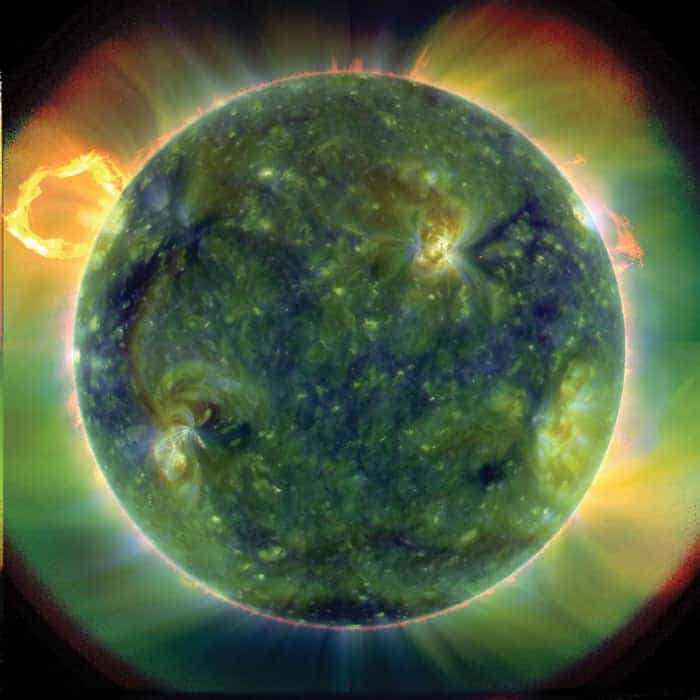
NASA has launched a mission to study the Sun’s atmosphere and solar wind that will come far closer to our star than any other craft before. The Parker Solar Probe took off today from NASA’s Kennedy Space Center in Florida at 03:33 local time aboard a Delta IV rocket. During the mission’s seven-year lifespan, it will perform 24 orbits around the Sun coming as close as 6.1 million kilometres to its surface – well within the orbit of Mercury.
We’ll be going where no spacecraft has dared go before – within the corona of a star
Nicky Fox
The nearest probe to have reached the Sun was the Helios 2 spacecraft, which in 1976 came within 44.5 million kilometres of the Sun’s surface. The 635 kg Parker Solar Probe will come near enough to the Sun allowing it to watch the solar wind speed up from subsonic to supersonic and trace how energy and heat move through the corona. This will allow scientists to gain information about what accelerates the solar wind as well as the high-energy particles coming from the Sun, known as solar energetic particles.
To do so, the Parker Solar Probe will carry four instruments. One instrument, dubbed FIELDS and built by the Space Sciences Laboratory at the University of California, Berkeley, will measure the electric field around the spacecraft with five 2 m-long antennas made of a niobium alloy that can withstand high temperatures. FIELDS will also contain three small magnetometers to measure magnetic fields. The other three instruments are an imager and two dedicated particle analysers.
Hotter than the Sun
To withstand the intense temperatures, which can reach almost 1400 C, the spacecraft and instruments will be protected by a 11.4 cm carbon-composite shield. “We’ll be going where no spacecraft has dared go before – within the corona of a star,” says Parker Solar Probe project scientist Nicky Fox from Johns Hopkins Applied Physics Laboratory. “With each orbit, we’ll be seeing new regions of the Sun’s atmosphere and learning things about stellar mechanics that we’ve wanted to explore for decades.”
The mission is named after physicist Eugene Parker who was born in 1927 and made several breakthroughs of our understanding of the solar wind and also explained why the Sun’s corona is hotter than its surface. Indeed, it is the first NASA mission to be named after a living scientist. Earlier this year the American Physical Society awarded him the Medal for Exceptional Achievement in Research.
Astronomers have shown that an “inside out” planetary nebula could have been created by a “born again” event in a star that was once similar to the Sun. The observation suggests that the Sun could also experience the same fate sometime in the distant future.
Low- to medium-mass stars can be born again during the final stages of their lifetimes. This occurs when ionized gas ejected from a star is attracted back onto its surface, creating a shock that briefly re-ignites thermonuclear fusion. As this process is so brief, however, few examples have been detected, so it is poorly understood.
When stars have exhausted their fuel, several things can happen. Those heavier than about 1.4 solar masses – the Chandrasekhar limit – will explode in a supernova. However, stars of less mass that can no longer produce radiation pressure to resist the force of gravity eschew such drama and simply collapse to form white dwarves. Before they do this, however, they shed their outer layers as ionized gas creating planetary nebulae.
At this juncture about 15-20% of such stars can experience “born-again” events when the ionized gas expelled by their stellar winds is attracted back onto the stars by their gravity. This creates a shock that momentarily restarts thermonuclear fusion and creates a final flash on the star’s surface, expelling a lot of dust that then causes the star to fade from view. Several born-again events have been documented before, most recently in a planetary nebula known as Sakurai’s object observed in the 1990s.
Unpredictable structure
Planetary nebulae normally have predictable structures, with highly ionized atoms closest to the central stars where the radiation is strongest. Now, astrophysicist Martín Guerrero of the Institute of Astrophysics of Andalucia in Spain and colleagues have studied HuBi 1 – a nebula about 19,000 light-years from Earth. It surrounds a rare type of star called a [WC], whose origins have previously been unclear. Guerrero found the structure of the nebula appeared to be inverted, with the most strongly ionized atoms, which have been exposed to the strongest radiation, being furthest from the star. The researchers were mystified by this nebula, which appears to be inside out.
When Guerrero and colleagues looked at images taken in the past 46 years, they found that the nebula’s luminosity had declined by a factor of 10,000. However, the temperature of the star itself had not apparently decreased. As a result, the researchers believe the starlight is gradually being absorbed by a thickening cocoon of dust grains.
When the astronomers studied the starlight’s spectrum, the noticed strong absorption from carbon and oxygen – a characteristic feature of [WC] stars. The team believe that the dust results from a born-again event that ejects carbon-rich material explosively from the stellar surface faster than the general nebular expansion speed. As this material gets further from the star, it cools and coalesces into dust. This therefore shields the nebula from ionizing radiation, and shields the star from view.
Mystery solved?
This model could solve a mystery surrounding the origin of [WC] stars, say the researchers. Previously, a number of carbon-rich nebulae have been detected with [WC] stars at the centre, and some theoretical models have proposed that they could have previously experienced a born-again event. There has, however, been little evidence for this, and several key differences between Sakurai’s object, for example, and HuBi 1 meant that the parallel could not be assumed. Sakurai’s object, for example, faded over weeks rather than decades.
Now, explains Guerrero, the “inside-out” nebula of HuBi 1 provides the first direct observation of a star undergoing this transition: “We see how a normal hydrogen-rich central star of a planetary nebula is evolving into a carbon-rich star,” he explains.
Moreover, say the researchers, the star appears to have similar mass as the Sun. This suggests, says Guerrero, that, when our Sun has exhausted its hydrogen and gone through the red giant phase, it may spend 10,000 years or so as a [WC] star: “If we do the statistics, maybe we’ll find there is a 10% chance of our Sun going through this event,” he explains.
“I think it’s a very interesting finding,” says astrophysicist Albert Zijlstra of the University of Manchester, who was involved in studying Sakurai’s object. “I don’t think it’s the last word on this,” he says, “and it’s possible that the model that will eventually be adopted is not quite what they propose, but that’s the way of research.”
The Harlem Globetrotters are a much-loved exhibition basketball team that has been entertaining audiences for nearly 100 years with zany gags and amazing skills. In their latest stunt, Globetrotter Bull Bullard has sunk a basketball from a flying aeroplane. Watch the above video to see for yourself – and pencil and paper ready to calculate the projectile in what is a text-book physics problem.
Retired US astronomer and teacher Andrew Fraknoi has painstakingly put together a collection of musical pieces inspired by astronomy. Featuring over 250 tunes – including both classical and popular music – the collection is organized into 32 topics such as galaxies, comets, exoplanets and meteors.
Franknoi says the pieces have connections to real science rather than just mentioning astronomical terms. The Beatles’ song Across the Universe, for example, doesn’t make the cut because there is not enough “serious” astronomy. He told Physics World that he has been putting together the collection for over 30 years and even plays excerpts of the music “at appropriate moments” when teaching.
“I believe that it’s helpful for non-science students studying science for their general education to see that there are inspired connections between the humanities and the sciences,” he says. “What I am impressed by [in the collection] is the variety of pieces, and the way so many different ideas from astronomy can serve as inspiration for composers.”
Circular cycling
CERN press officer Sarah Charley has just cycled the “Passport to the Big Bang” route, which approximates the LHC’s subterranean path on the nearest roads and trails. You can read about her odyssey through Switzerland and France in “Tour du LHC” on the Symmetry website. Highlights of her journey include a tour of the LHCb cryognenic control centre and an encounter with an agitated peacock.
This is not the first time someone has done a travelogue based on the LHC. A few years ago the author Will Self recorded a very funny radio programme called “Self orbits CERN” for the BBC.
A theoretical study has modelled how radio waves behave when passing through the Great Pyramid of Giza in Egypt. Mikhail Balezin and colleagues at St Petersburg’s ITMO University in Russia and Germany’s Laser Zentrum Hannover used multipole analysis to approximate how the electromagnetic waves would be influenced by the famous landmark. As well as offering a new way to study interiors of huge structures, the technique is also being used to characterize pyramidal nanoparticles.
The interior of the Great Pyramid has been probed using various forms of radiation including cosmic muons. Indeed, the muon study has found evidence for a previously unknown chamber buried deep within the iconic structure.
Now, Balezin and colleagues have performed the first study of how the pyramid would interact with radio waves. They constructed a numerical model to simulate the behaviour of radio waves with wavelengths of 200-600 m as they passed through a virtual pyramid. Such wavelengths were chosen because they are slightly longer than the physical dimensions of the Great Pyramid, which is about 140 m tall and measures 230 m along each of its four sides.
Solid limestone
The team first modelled the pyramid as solid limestone with no internal chambers. Then, they looked at how the presence of chambers would affect the radio waves. Their simulations predict that the chambers act as resonators, concentrating electromagnetic energy inside the chambers. They also found that the pyramid as a whole focussed radio waves incident from above into a region just below the structure.
The team worked-out that some incident waves would be scattered by internal structures and that others would be absorbed. They were also able to map the distribution of electromagnetic fields inside the pyramid.
The simulations used multipole analysis – a mathematical technique that can approximate interactions between complex objects and electromagnetic fields. The technique involves replacing the object with much simple set of radiation emitters known as multipoles. With a knowledge of the properties of each individual multipole, the researchers could use mathematical functions to approximate how their combined emitted field would be scattered.
Similar scales
Normally, the team studies interactions between light and nanoparticles – where the wavelength of the light is also larger than the size of the structures of interest. This similarity inspired Balezin and colleagues to look at pyramids and show that on very different length scales of nanometres and hundreds of metres the scattering of electromagnetic waves ultimately depends on the size, shape and refractive index of the objects.
The team is now looking at how pyramidal nanoparticles can be used in new and innovative ways to create new technologies such as nanosensors and highly efficient solar cells. The team also plans to do further simulations of the Great Pyramid using radio waves at shorter wavelengths.
Researchers in the US have devised a no-contact measurement technique that can monitor the viability of live cells in a bioprinted tissue construct. Current measurement approaches largely rely on destructive analysis of the synthesized structures by staining and sectioning, while in-process optical imaging tools only provide information on the size and shape of the biofabricated construct.
The new technique, developed by a team of researchers at North Carolina State University, assesses the critical quality attributes (CQAs) of a bioprinted construct by measuring the dielectric impedance of the cells contained within it. This approach can be used to determine the total number of live cells, how these cells are distributed, and even the state they are in. “The work could also help bring bioprinting a step closer to automation, which will bring down costs,” explains Binil Starly, who led this research effort together with Rohan Shirwaiker.
The technique exploits the inherent dielectric properties of living cells, which arise from their double-shell structure that consists of the cell membrane and enclosed cytoplasm. When an alternating electric field is applied, positive and negative charges build up across the membrane, making the cell behave as a capacitor with a permittivity that depends on the frequency of the electric field. This interfacial polarization, which is known as the Maxwell-Wagner effect, is not seen in non-viable cells, which often have ruptured membranes.
“When we apply an alternating current, the cells within the 3D construct either allow the flow of current through the cells, or impede it,” explains Starly. “If the cells are healthy with intact membranes, it strongly impedes the flow. If they are damaged – after having passed through the nozzle of a bioprinter, for example – or stressed by having been in the printer for a long time, the cells are not strong enough to impede the current and allow electrons to pass right through.”
Measuring without destroying
The measurements require no direct contact with the construct, do not cause any damage to the cells, and do not need any fluorescent dyes. “Based on how the cells within the construct behave within this AC field, we can tell how many viable cells there are and assess how many live cells are distributed within a large construct,” explains Starly. “And, even if all the cells are viable, we can also determine whether the state of the construct is different to how it should be.”
While the current study measured cell viability just after the construct had been printed, Starly believes that the technique could integrated into a bioprinter to enable real-time characterization of the biofabricated constructs. Such an approach would have a clear advantage over current in-process metrology tools, which rely on video cameras to take optical images of the construct at regular intervals as it forms.
“While determining feature dimensions in this way is important for measuring how functional the construct is, it does not provide any information on the state of the cells contained within it, either during printing or immediately after the printing process has ended,” says Starly. “Our in-process measurement tool allows us to monitor the biofabrication process and actively control it to produce robust 3D tissue constructs.” he adds.
Probe needs to be modified
The researchers, reporting their results in the IOP journal Biofabrication, tested their technique on human adipose-derived stem cells in 3D hydrogel constructs, and they now want to study how the measurement signals change when there are two or more cell types within a construct. “For example, how could we deconstruct the signal to identify characteristics specific to a particular cell type?” asks Starly.
From a technical point of view, the researchers also plan to modify the dielectric impedance spectroscopy probe in their bioprinter. “The probe used in this study was never designed for such a context but rather for use in large bioreactors and fermenters in the beer brewing industry, in which there are much larger numbers of cells than in our system,” says Starly.
The team, which includes students Lokesh Narayanan and Trevor Thompson, says it also needs to measure the permittivity of the cells within a more focused frequency range of between 150 and 2500 kHz, relevant to mammalian cells. “At present, a frequency scan last for 30 seconds and we obtain permittivity readings across 24 discrete frequencies between 50 and 20 000 kHz, of which only 11 are relevant,” says Starly.
Read our special collection “Frontiers in biofabrication” to learn more about the latest advances in tissue engineering. This article is one of a series of reports highlighting high-impact research published in Biofabrication.
Ask three different people what they enjoyed most about a particular course, and the chances are you’ll get three different answers. But for Megan Taylor, Harvey Johnson and Graham Hemingway – all recent graduates of the University of Bristol’s Masters programme in nuclear science and engineering – the stand-out feature of the course is the collaboration it enables across disciplines and with external organizations in the nuclear industry.
“The best thing was my group research project with Sellafield, which involved four of us from different science and engineering backgrounds,” says Hemingway, who had previously studied an undergraduate course in aerospace engineering. “They came to us with a real-world problem they were facing at the time, and we worked as a group to devise and develop a practical solution. The people from Sellafield thought our proposal was really good, and it was a great opportunity to interact with industry and understand some of their challenges.”
Johnson, who previously studied chemistry at Imperial College, London, and is now working for multinational technical consultancy Fraser Nash, agrees that the group project offered a genuine insight into what it’s like to work in the nuclear industry. “All the team work, communication and business skills needed in the group project perfectly equips you for a real work environment,” he says. “You never work on your own or within a single discipline in the nuclear industry because problems are fundamentally multidisciplinary. You’re always working in teams with people from right across the academic spectrum.”
Collaborating with students from different science and engineering backgrounds was a particular high-point for Taylor, who had studied mathematics prior to joining the MSc. “There were people from physics, chemistry, and engineering, and I was from maths,” she says. “It was really interesting to have people with different scientific strengths coming together and sharing their knowledge and experience.”
Support across subjects
As well as the group research project, students who had studied different disciplines at undergraduate level were able to support each other throughout the course. “That was such a wide range of subjects that we could help each other with, because someone would really understand it well and could help everyone else,” Taylor continues. “I’ve gained so much more knowledge than when I started, and over such a wide range of topics as well.”
The MSc set me up really well, because the industry connections gave me a really good understanding of the problems and challenges in the real world, rather than just theoretically or academically
Graham Hemingway
That multidisciplinary approach is a crucial feature of the course structure. Five compulsory modules cover the fundamentals of nuclear science and engineering – ranging from reactor design to nuclear safety – and then students can choose from a large number of optional modules to complement and supplement their existing knowledge. These optional modules are delivered by senior academics based in different departments throughout the university, including physics, chemistry and various engineering specialisms.
“I really enjoyed the variety – one day you might be learning about nuclear physics, the next it might be engineering,” says Hemingway, who particularly enjoyed some of the more physics-focused topics. “But although the subject coverage was quite broad, it was also really focused around our own individual development.”
MSc students have access to specialist equipment at the South West Nuclear Hub
Johnson agrees that the course lecturers offered valuable guidance to help students navigate the course and choose the best options. “There was very open and free communication with all of the lecturers,” he says. “It was very easy to talk to them, and they would give their honest opinion as to whether specific modules would be suited to me.”
For Taylor, that direct connection with the academics teaching the course convinced her to study for a PhD in Bristol University’s mechanical engineering department. “During the MSc I realized that I still loved doing maths,” she says. “One of course lecturers, Dr Mahmoud Mostafavi, told me that they were looking for some mathematicians to join their group in engineering, and I found it really interesting that they would want me to do a PhD in their group, rather than someone with more engineering knowledge.”
One of the course’s core strengths, according to Johnson, is that it helps students choose whether to continue their academic studies or to move into the commercial sector. “As well as the group project, the MSc included an individual research project that is much more independent – much more like the project you might do as part of a PhD,” he says. “Ultimately the two projects reflect the two paths that students might go down, either working in industry or working in research, really helps to decide which route to follow.”
Focus on industry
Johnson chose to take the commercial route, first with a strategy consultancy that helps international businesses to assess and exploit potential opportunities in the UK’s nuclear industry, and then with Fraser Nash – a large technical consultancy with core capabilities in nuclear power. “I discovered that I most enjoy using the skills I’d learned in my Masters and my undergraduate course to solve practical problems,” he says. “In my current role, I can work on a project and then see it implemented within six months or so. It’s about seeing the results go through.”
The science that underpins the nuclear industry is fundamentally interesting, and it is incredibly diverse in terms of the people who work in it and the projects you can work on
Harvey Johnson
Students who see their future in the nuclear industry have plenty of opportunities to interact directly with some of the largest players in the nuclear sector. Indeed, the Masters programme at Bristol is an integral part of the South West Nuclear Hub, an initiative that supports the UK’s nuclear industry strategy by providing a focal point for research, teaching and innovation in nuclear power. Industrial partners such as EDF Energy, Sellafield and the Nuclear Decommissioning Authority take an active role in the MSc, both through the group projects and through a series of guest lectures that ran throughout the course.
“For me the stand-out part of the course was the guest lectures,” says Johnson. “Senior people came in from across the nuclear industry – from licensed companies to operators and consultancies – and it was really interesting to hear their opinions and to see how they look at a situation. The guest lectures exposed us to all the different aspects of the nuclear industry.”
For Hemingway, the guest lectures played a pivotal role in helping him to find his niche within the nuclear sector. “I joined a two-year graduate scheme with an organization called nucleargraduates, and at the end I will be fully trained to be a nuclear inspector,” he explains. “I applied for the scheme because one of the guest lecturers was from one of the nuclear regulators, and it sounded like the work would be really interesting.”
As well as highlighting the opportunity, the MSc provided Hemingway with the knowledge and skills needed to secure his place on the scheme. “The MSc set me up really well, because the industry connections gave me a really good understanding of the problems and challenges in the real world, rather than just theoretically or academically.” Now that Hemingway is coming to the end of the two-year programme, he can look forward to an almost guaranteed job as a fully qualified nuclear inspector.
Into the workplace
For the course organizers, the ultimate aim is to train a new generation of scientists and engineers who have the skills and experience needed to support the diverse demands of the nuclear industry. And from the students’ perspective, the direct interaction with industry has enabled many of them to find jobs in the areas they want to work in. “I went to networking events I probably wouldn’t have gone to if I hadn’t done the course,” adds Johnson. “You really need to understand the nuclear industry to have meaningful conversations with people at these industry events, and the MSc provided me with a really good overview of what’s happening in the whole nuclear sector.”
For undergraduate students who may still be weighing up their future options, Johnson summarizes the appeal of the nuclear sector for him. “The science that underpins the nuclear industry is fundamentally interesting, and it is incredibly diverse in terms of the people who work in it and the projects you can work on,” he says. “It has enabled me to use my technical in skills in a more commercial and strategic environment, and I have loved every minute of it.”
The minimum entry requirements for the MSc in Nuclear Science and Engineering is a 2:1 in a relevant science or engineering subject, and you can find out more about the course via the University of Bristol and/or the South West Nuclear Hub. Most students can apply for funding through a Postgraduate Master’s Loan.
Global sea levels, too, would rise, by 10 m, or even as much as 60 m, to drown all the world’s great coastal cities. Such a transition might happen “in only a century or two”, but once started, there might be no stopping it.
It would be uncontrollable and dangerous to many and “it poses severe risks for health, economies, political stability…and ultimately the habitability of the planet for humans”.
And, say scientists who have completed a survey of the research landscape, there is no knowing how close the threshold of dramatic change might be. The planet has already warmed by 1 °C in the last century, and the thermometer is climbing at a rate of 0.17 °C per decade.
Even at the ambitious target temperature rise of no more than 2 °C by the end of the century – a target endorsed by 195 nations in Paris in 2015 – humans might already have triggered a cascade of feedbacks that would set the planet sliding to a point hotter than at any time in the last 10 million years.
These feedbacks could turn what are, right now, carbon sinks – stores of atmospheric carbon locked away in the soils and the forests – into sources of greenhouse gases that could accelerate global warming.
“These tipping elements can potentially act like a row of dominoes. Once one is pushed over, it pushes Earth towards another. It may be very difficult or impossible to stop the whole row of dominoes from tumbling over. Places on Earth will become uninhabitable if ‘Hothouse Earth’ becomes a reality,” says Johan Rockström of the Stockholm Resilience Centre.
“In particular, we address tipping elements in the planetary machinery that might, once a certain level has been passed, one by one change fundamentally rapidly, and perhaps irreversibly. The cascade of events may tip the entire Earth system into a new mode of operation.”
The message, although alarming, is a restatement of previous findings and a reconsideration of existing evidence, enhanced by lessons from the more recent geological past, in which rocks and the fossils buried with them tell a story of dramatic changes in temperature and sea level.
Other researchers have raised the hazard of “tipping points” that could send the climate into a state of irreversible change. Steffen three years ago warned that of the nine safe “planetary boundaries” that kept Earth in a stable climate state, four had already been crossed.
The new study however re-examines the possibilities and once again spells out the dangers in language of uncompromising clarity. “The Earth system may be approaching a planetary threshold that could lock in a continuing rapid pathway toward much hotter conditions – Hothouse Earth. This pathway would be propelled by strong, intrinsic, biogeophysical feedbacks difficult to influence by human actions, a pathway that could not be reversed, steered or substantially slowed.”
The authors warn that the impact on human society would be “massive, sometimes abrupt and undoubtedly disruptive”. But, of course, nobody knows at what point such a dangerous slide into a new temperature zone could become inexorable, and the researchers make this clear.
“What we do not know is whether the climate system can be safely ‘parked’ near 2 °C above preindustrial levels, as the Paris Agreement envisages,” says Schellnhuber, “or if it will, once pushed so far, slip down the slope towards a hothouse planet. Research must assess this risk as soon as possible.”
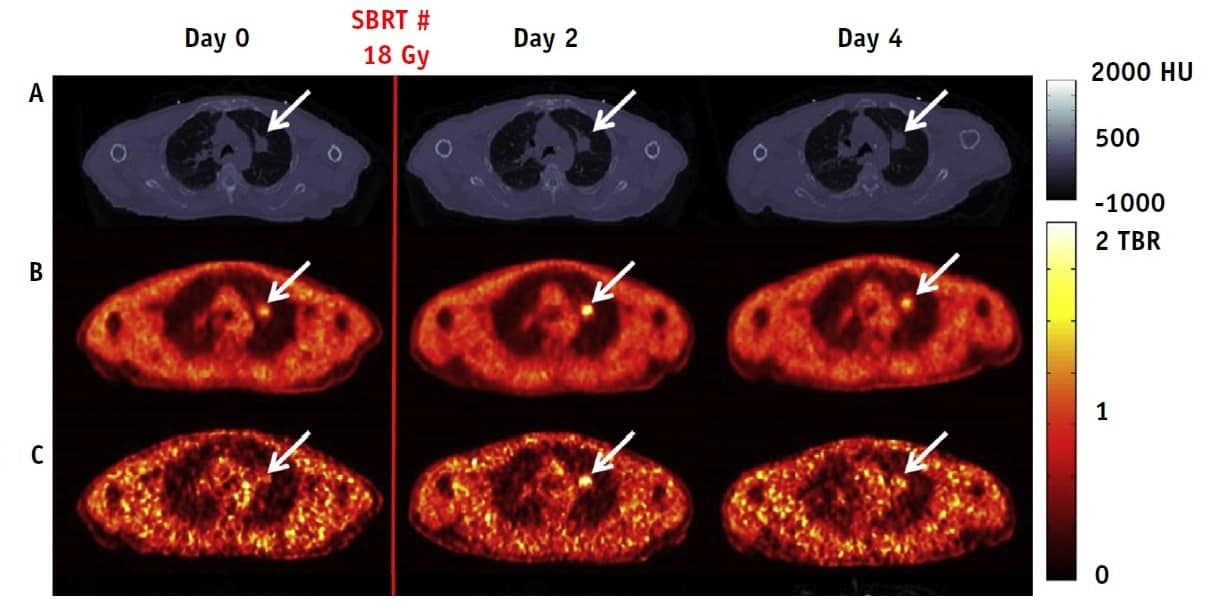
CT and PET images for a patient with baseline tumour hypoxia, showing variation in the tumour hypoxic volume from day 0 to 4. (Courtesy: O J Kelada et al Int. J. Radiat. Oncol. Biol. Phys.102 174)
Tumour hypoxia is known to adversely affect outcomes for patients undergoing conventional radiotherapy. However, there are no published studies examining the influence of hypoxia on clinical outcomes for stereotactic body radiation therapy (SBRT), in which high doses of radiation are delivered in up to five fractions.
Hypoxia may have more of an impact in SBRT due to the fewer number of treatment fractions, which reduces the opportunity for re-oxygenation of hypoxic tumour cells. To investigate this premise, researchers from Yale University School of Medicine have used 18F-FMISO PET to quantify changes in tumour hypoxia in response to SBRT (Int. J. Radiat. Oncol. Biol. Phys.102 174).
“There are two issues at play here,” explains senior author David J Carlson. “The hypoxic fraction of the tumour may be more important in determining treatment response in SBRT. We also show that high single doses of radiation can even increase the hypoxic tumour volume.”
Pilot study
Carlson and colleagues examined six patients with early-stage non-small cell lung cancer (NSCLC) who received SBRT (three 18 Gy or five 10 Gy fractions) as standard of care. For each patient, the researchers recorded dynamic PET images at 0-120 min, 150-180 min and 210-240 min after injecting 18F-FMISO, which selectively binds to hypoxic cells. They performed this scan series immediately before, and two and four days after, the first SBRT fraction. After the final PET scan, they recorded a respiratory-gated 4D-CT.
Authors David Carlson and Olivia Kelada.
For each time point, the researchers quantified the tumour hypoxic volume (HV): the ratio of hypoxic voxels, based on 18F-FMISO imaging, to total tumour voxels, based on a pre-treatment CT. Using end-expiration gate summed 210-240 min PET data, they calculated HV by assigning voxels with a tumour-to-blood ratio (TBR) of 1.2 or above as hypoxic.
Three of the five patients who completed the imaging protocol had detectable baseline tumour hypoxia, with baseline HVs of 23.5, 16.6 and 21.7% for patients 2, 5, and 6, respectively. In these patients, tumour HV increased (by up to a factor of 2.7) after SBRT delivery, to 40.4, 45.2 and 32.7% on day 2.
Between scans on days 2 and 4, the team observed a variable response, with tumour HV either decreasing to baseline level (patients 2 and 6) or remaining unchanged (patient 5). Patients 3 and 4 had no baseline hypoxia, and no increase after SBRT.
“Our preliminary clinical data suggest that hypoxic levels in tumours actually increase post-SBRT delivery, for patients with baseline detectable hypoxia,” says Carlson. “The clinical impact of this is still unclear, however, and we need larger trials to determine whether this phenomenon positively or negatively impacts tumour control. This is the first study to investigate the problem in human tumours and the role of vascular changes in treatment response is still unknown.”
Alternative approach
The team also used tracer kinetic parameters to calculate HV. Here, they used dynamic data (uncorrected for respiratory motion) to estimate the net rate of tracer influx (Ki) for each voxel, and quantified HV using a Ki threshold of above 0.0015 ml·min/cm3. Using this approach, baseline HVs were 20.6, 17.9 and 22.6%, for patients 2, 5 and 6, respectively.
In agreement with the TBR quantification trends, tracer kinetic analysis demonstrated an increase in mean HV between day 0 (20.3%) and day 2 (35.8%). The mean HV on day 4 increased to 41.2%, however, while TBR results suggested a decrease between days 2 and 4.
Patlak tracer kinetic analysis of 18F-FMISO. Axial Ki parametric maps of the rate of tracer influx show variation in the hypoxic volume across imaging days. (Courtesy: O J Kelada et al Int. J. Radiat. Oncol. Biol. Phys.102 174)
As to which calculation is more accurate, Carlson says that there is no simple answer yet. In theory, Ki-based HV estimates will ultimately be more accurate for quantifying hypoxia. In this work, however, the dynamic data used for kinetic analysis were not corrected for respiratory motion (while the static 210-240 min data used for TBR estimates were), which adds uncertainty to the Ki-based results.
In addition, explains first author Olivia J Kelada, “even if Ki is more accurate, it is currently impractical for routine clinical use because of the long dynamic scan times. It may be possible to shorten scan times, i.e. to collect data for the input function at an early time point and tumour uptake at a later time point; making this approach more feasible and comparable to clinical routine static PET scan times”.
“Larger studies with more patients are necessary to confirm our reported results,” says Carlson. “We would also like to further explore the impact of respiratory correction on tracer kinetic modelling results.”
Carlson notes that these results provide strong motivation for accounting for hypoxic volumes in clinical SBRT. For example, the SBRT delivery schedule for patients with more hypoxic tumours could be altered to increase the time between fractions. Another option is to add a therapeutic agent to target and exploit SBRT-induced hypoxia, such as a DNA repair inhibitor or hypoxic cell radiosensitizer. “This gives us another dimension on which we can optimize our radiotherapy treatments to improve patient outcomes,” he says.
While individual sunscreen chemicals do not pose much of a danger to wildlife, researchers in China have found that combinations of these chemicals might have more of an impact. The scientists have studied the effects of multiple organic UV filters on successive generations of zebrafish, revealing that toxic effects appear after 47 days of exposure to highly elevated levels of the chemicals. Although the amount of chemicals they tested is much higher than what is likely to occur in reality, the team insists that further studies are needed to determine how these compounds impact living organisms and their environment.
Sunscreen helps protect us from damaging UV radiation, which can not only cause sun burn, but also skin cancer and premature skin ageing. Organic UV filters are widely used in sun creams, moisturizers and makeup, but they are also found in textiles, plastics and paints to prevent photodegradation and discolouring. As a result, significant amounts of these chemicals are now present in the environment (around 6800 ng/L in water and over 10 000 ng/L in wastewater effluent). These chemicals, which are endocrine disrupters, have also been found to bioaccumulate in animals, including fish, dolphins and birds eggs, and in humans.
Most “worse-case scenario” studies to date have concluded, however, that single UV filter compounds are not present in high enough levels to pose a risk to wildlife, be it marine or terrestrial. A team of researchers led by Kelvin Sze-Yin Leung of Hong Kong Baptist University, has now studied the effects of combinations of different UV filters to find out whether they are more harmful than individual compounds.
Nine common UV filters tested
The researchers analysed the levels of nine common UV filters in surface waters around Shenzhen, one of the world’s most rapidly developing seaside cities. The UV filters measured were benzophenone-1, BP-3, benzophenone-8, EHMC, octyl dimethyl-p-aminobenzoic acid, OC, 4-hydroxybenzophenone, 4-methylbenzylidene camphor and 3-benzylidene camphor. They found that seven of these were present on public beaches, in a nearby reservoir and, to their surprise, tap water. They then fed zebrafish – a widely studied model organism – with brine shrimp that had, in turn, fed on realistic and toxic concentrations of the UV filters (both single compounds and in mixtures).
They found that while the adult fish were not affected, their offspring showed some abnormalities in their early development, such as decreased heart rate and hatching. These abnormalities appeared after 47 days of exposure to toxic levels of the chemicals.
Leung and co-workers say that they would now like to find out which chemicals, either singly or in combination, are causing the effects they observed. “In this way, we might be able to replace the most toxic ones with those that are less so,” team member Adela Jing Li told Physics World. “Another way to mitigate their effect might be to improve wastewater treatment, by removing UV filter residues before release.”
The results from this study clearly show that UV filters are adversely affecting early life-stage zebrafish, she and her colleagues write in their paper, published in Environmental Science & Technology. “Like the canary in the coal mine, could these relatively small, simple organisms be warning of increasing, cumulative risks and dangers to larger organisms and indeed the ecosystem itself?” the researchers ask. “A comprehensive evaluation of the complex effects that these UV filters, and their mixtures, are having on aquatic environments as well as human health should be undertaken. With this knowledge, we could then take appropriate action to curtail their potentially damaging effects.”
In this episode of Physics World Weekly podcast, Physics World’s Tushna Commissariat and Matin Durrani have a lively discussion about two new physics-related films – biopics of Hedy Lamarr and Abdus Salam. The former was a Hollywood star and the latter a Nobel-prize winning physicist, yet their remarkable lives had striking similarities.
Also, Physics World’s Susan Curtis explains how cuprate superconductors become stranger and stranger the more physicists learn about them.
If you enjoy the podcast then you can subscribe via iTunes or your chosen podcast app.