In his famous “Two Cultures” lecture in 1959, the British author and physical chemist CP Snow lamented the widening gap between “literary intellectuals” and “natural scientists”. Snow argued that this blinkered outlook was bad for society and a hindrance to tackling the global challenges of the day. While the book was not without its critics, the central premise has remained relevant over the years – as illustrated by physicists Stephen Hawking and Leonard Mlodinow declaring in 2011 that “philosophy is dead”. Today, the need to bridge this cultural divide is arguably far more grave than in 1959, particularly at a moment when rational debate itself is being threatened by misinformation and identity politics.
In this video for our 100 Second Science series, Lincoln Carr of the Colorado School of Mines in the US argues that for all its great achievements science still has a lot to learn from the humanities. Find out why by watching the video.
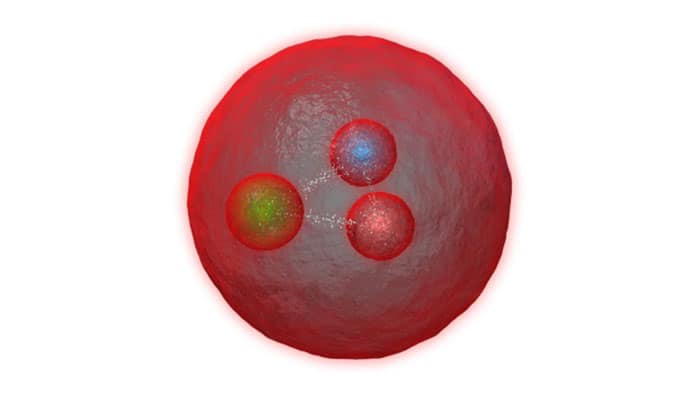
The most precise measurement of the lifetime of the Ωc0 particle has been made by physicists working on the LHCb experiment at CERN. The charmed baryon decays within femtoseconds after being produced in proton-proton collisions at the Large Hadron Collider (LHC). Surprisingly, the newly measured lifetime is about four times longer than the average of previous measurements. The researchers say that resolving the discrepancy could lead to better theoretical understanding of quark structure and interaction.
The Ωc0 consists of two strange quarks and one charm quark, and the LHCb team measured its lifetime to be 268 fs with an uncertainty of about 13%. In contrast, the average of prior measurements, taken during the late 1990’s to early 2000’s, is 69 fs with 17% uncertainty.
“Somewhat of a surprise”
The different result was “somewhat of a surprise,” says Steven Blusk of Syracuse University in the US, who led the work. It is unclear where the discrepancy comes from, or which experiments are correct. One possibility is that one of the experiments could have had an unidentified bias, points out Alexey Petrov of Wayne State University in the US, who was not involved in the work. Blusk adds, “I’d rather not speculate. It’s very hard to go back to a paper from 20 years ago and try to figure out if they did anything wrong”.
Instead, says Petrov, this is an opportunity for theorists to refine their calculations. Current theoretical calculations, based on quantum chromodynamics models, agree with the old average lifetime, not the new measurement. However, these calculations rely on a series of potentially flawed approximations, says Petrov. Blusk adds, “This should really get people thinking about how to make the theory more precise”.
The collaboration measured the Ωc0 lifetime by studying proton-proton collisions at the LHC in 2011 and 2012. Although the particle can be produced directly in collisions, they specifically looked only for Ωc0 particles that were created by the decay of another particle called the Ωb–, which is also produced in proton-proton collisions. An important feature of the Ωb– is that it travels about 1 cm from the collision point before it decays into Ωc0, along with other particles. This means that the subsequent decay signal from the Ωc0 has relatively low noise, making it easier to analyze. The Ωc0 decay signal sought by the LHCb is the production of a proton, two negatively charged kaons, and a positively charged pion.
Limited calculations
The discrepancy in measure lifetimes highlights the limitations of current theoretical calculations, says Alexander Lenz of the University of Durham in the UK. Right now, theorists calculate lifetimes of such baryons using a technique called the heavy quark expansion, which represents the lifetime as an infinite sum. Higher order terms in the expansion describe interactions between quarks in the baryon, such as how the spin of one quark affects another quark. To actually calculate the particle’s lifetime, theorists assume higher order terms are negligible, but these assumptions are just “guesses,” explains Lenz.
In particular, Blusk says that theorists need to figure out the magnitude of a phenomenon called Pauli interference, which affects the lifetime. This is relevant in one of the first steps of the Ωc0 decay process when the charm quark becomes a strange quark along with other particles.
The next step, says Lenz, is to convince QCD theorists to actually refine these calculations. While his colleagues do find the problem interesting, they prioritize trendier topics that hint toward physics beyond the Standard Model, says Lenz. The lifetime of this baryon, on the other hand, falls squarely inside the Standard Model. And it will probably take a few years of work to more precisely calculate these higher order terms. But “it’s doable,” he says.
On the experimental side, Blusk says that the LHCb collaboration plans to re-measure the lifetime, based on Ωc0 particles directly produced in proton collisions. Although the signals from these particles will have about 40 times more noise, the measurement has different systematic biases and this could lead to a better understanding of what the actual lifetime is.
The research is described in a preprint on arXiv that has been accepted for publication in Physical Review Letters.
Some experiments simply can’t be done. It’s a hard truth that physicists learn to face at an early stage in their careers. Some phenomena we want to study require conditions that are out of reach with our current techniques and technologies.
This is especially true when physicists make predictions about the very early universe. Theories hypothesize, for example, that certain particles may have been created during this high-energy period, but our colliders are just not powerful enough to replicate those conditions, which means we cannot create the particles ourselves. The physics that exists only in or around black holes poses a similar problem. Since these massive objects are very far away (the closest known is thousands of light-years distant) and would require hitherto unfeasible amounts of energy to make in the lab, we’re not able to test our theories about them.
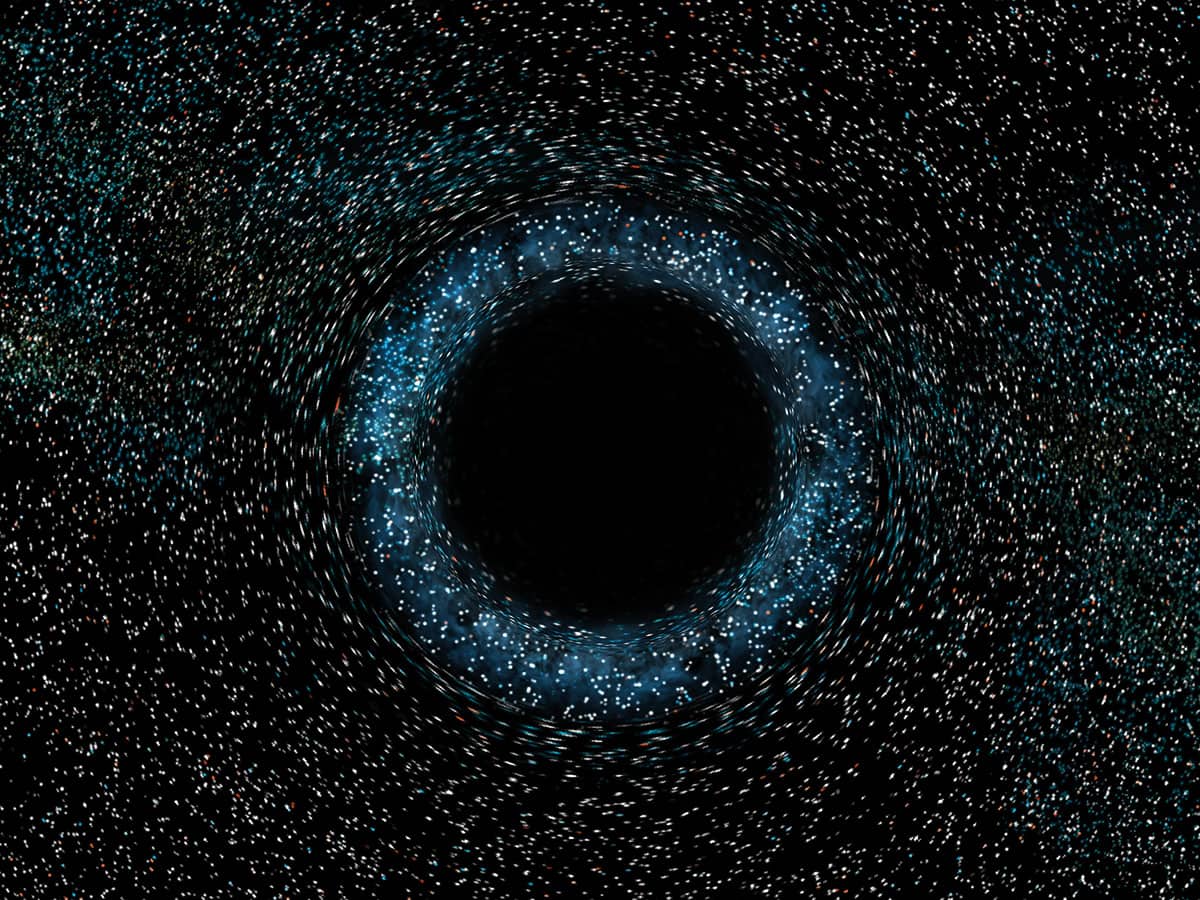
Black hole or plug?: Impossible-to-study systems can be comparable to much more earthly ones. (Courtesy: ESA, NASA, Felix Mirabel (CEA/Institute for Astronomy and Space Physics/Conicet of Argentina) )
At least, we can’t test them directly. Another way to look at these complex processes is by using “analogues”: experiments on systems that look radically different on the surface, but which reproduce the predictions of hard-to-test theories in some manner.
If the equations that describe a very complicated physical system are mathematically like those describing an experimentally accessible system (the analogue) then the outcomes of tests on the simpler system reveals something about the complex one and provides a necessary check on theories. However, analogues aren’t the same thing as a direct experiment, so we don’t always know if the mathematical similarity between two systems tells us if the theory we’re testing describes something real.
Mimicking monopoles
Richard Feynman, who is best known for his work in uniting quantum mechanics with electromagnetism, realized that many quantum systems are ideal analogues. For example, systems of interacting electrons in materials are often far too complicated to simulate on a normal computer, but physicists can create custom materials where the electrons and atoms interact in such a way to produce highly controllable quantum excitations known as “quasiparticles”. These quasiparticles can behave like everything from massless particles to electrons moving near the speed of light. Some of those might exist only as artefacts of the material, but others might correspond to theoretical predictions that are difficult to test with direct experiments.
Magnetic monopoles fall into that second category. Typically, magnetic fields are produced by moving or spinning electrically charged particles, and always come as dipoles: paired north and south poles. However, these hypothetical monopoles act like an isolated north or south pole of a magnet. In a famous thought experiment of 1931, Paul Dirac worked out the interaction between an electron and a hypothetical magnetic monopole particle. He discovered that the existence of a monopole – even a single one existing anywhere in the universe – could explain why electric charge is quantized, only occurring in multiples of the fundamental charge e carried by electrons (Proceedings of the Royal Society A133 60).
Dirac’s theory was an exciting proof of principle, but it said nothing about how massive monopole particles should be. Later theories unifying the fundamental forces of nature predicted that monopoles should exist, but they also should have masses 1016 times that of the proton. Although “passive” detectors look for monopoles likely made in the early universe, even the most powerful particle colliders we have, or could build in the foreseeable future, can’t produce enough energy to make monopoles from scratch.
Mikko Möttönen of the University of Aalto in Finland and his colleagues realized, however, they could mimic monopoles using Bose–Einstein condensates, which are very cold systems of atoms that act together as a single entity described by a quantum wave function. By manipulating that wave function, the researchers could simulate several properties of monopoles – the first of which is how electrons behave in the presence of a monopole (Phys. Rev. X7 021023).
“When we do the experiment on the [analogue] Dirac monopole, we find the wave function of a charged particle (it could be an electron) that is around the monopole,” says Möttönen. “That’s what we have got in the experiment: basically the properties of an electron interacting with the magnetic monopole. We have now produced a system that is an analogue system. It’s not the same system, but it has the same properties.”
While that experiment simulated the behaviour of a charged particle in the presence of a monopole, Möttönen and his collaborators performed a second set of experiments simulating the monopole itself. This took the form of a “topological defect” in the Bose–Einstein condensate: a sort of hole in the quantum wave function. The result of the monopole defect was a shift in the behaviour of the wave function around it, altering the quantum spin and phase of the field in the same way a magnetic field does. The properties of this “synthetic” analogue magnetic field were precisely what was predicted for a magnetic monopole (Nature505 657).
“That was the first time ever experimentally people had observed a point-like topological defect in a quantum system,” Möttönen says. “That tells us on a general level that this kind of point defect does exist in nature.”
It was an important discovery, but as with the Dirac monopole experiment, Möttönen points out that the burden of proof still lies with the particle physicists. “It doesn’t guarantee that they exist as natural particles, as natural magnetic monopoles,” he says. “Do monopoles exist at all in quantum systems? This is certainly something we can say ‘yes!’ they do exist.”
To put it another way, magnetic monopole particles may or may not exist, but if they do, experiments by Möttönen and his colleagues show they likely behave the way theory predicts. It’s an important step and illustrates both the power and limitations of analogues.
Black hole in a bathtub
If magnetic monopole particles are out of experimental reach, black holes are even farther removed. We might get lucky if a monopole particle created shortly after the Big Bang drifts into our passive detectors, such as the IceCube observatory at the South Pole. But for obvious reasons we don’t want black holes to show up near Earth. Meanwhile, we’ll likely have to wait centuries for technology to be able to generate the energies needed to create a subatomic black hole in a particle collider.
However, we know black holes exist, while monopoles are still in the realms of theory. The problem is that there are many theoretical predictions about black holes that we can’t test directly. The most important of those phenomena are close to the event horizon: the boundary inside which nothing can escape the black hole’s gravity.
Most astrophysicists believe event horizons exist, but they have yet to be observed directly. Astronomers are processing data from the Event Horizon Telescope, which is a global network of telescopes that may provide the first clear image of the black hole at the centre of the Milky Way. However, even such an image won’t give us much particle-level information about the physics near the event horizon. Also, the Milky Way’s black hole is “supermassive”, which means gravity at its event horizon isn’t as intense as the gravity near a smaller black hole.
In a set of important papers in the 1960s and 1970s, Roger Penrose, Stephen Hawking, Jacob Bekenstein and others showed that certain physical processes can extract energy and angular momentum from black holes. What’s more, black holes interact with the quantum vacuum – the soup of virtual particles filling space–time – in a process that also extracts energy from the black hole, making them shrink. The end-point of that interaction, known as Hawking radiation, is the complete evaporation of a black hole.
However, Hawking’s prediction involved combining quantum calculations with general relativity, since there is no quantum theory of gravity he could use. In other words, it’s an approximation to an unknown underlying theory governing black-hole behaviour, and it may or may not describe reality. And without a laboratory black hole, we can’t test the ideas directly.
The equations governing small ripples on flowing water are very close to those for particles moving along trajectories governed by gravity, as described by general relativity
Then in 1981 William Unruh realized ordinary water could provide an analogue for black-hole interactions and evaporation (Phys. Rev. Lett.46 1351). He found the equations governing small ripples on flowing water were very close to those for particles moving along trajectories governed by gravity, as described by general relativity. Even more strikingly, the analogue system produced behaviour akin to Hawking radiation and other processes by which quantum particles interact with a black hole. And physicists understand fluid dynamics of this type very well.
It’s an astounding analogy, since water resembles a black hole even less than a Bose–Einstein condensate resembles a magnetic monopole. But it’s similar, in that the equations governing the particles are mathematically similar, even if the physical systems are radically different.
Silke Weinfurtner of the Quantum Gravity Laboratory at the University of Nottingham in the UK is one physicist using such analogues to look at black holes. “I have a set of equations, [and] I have a physical process I want to describe,” she says. “In the analogues, we find the same set of equations [describing a different system], approximately.”
But, Weinfurtner adds, she is more interested in the effects than mimicking exactly a particular space–time geometry. “We want to have something that has the same [event] horizon structure.”
Plug or black hole?: Analogues are not the same as studying the real thing, but they can help provide clues. (Courtesy: iStock/dgstudiodg)
The experimental realization of Unruh’s idea involves a narrow channel, with water flowing in at a controlled rate. The water drains out through a plughole, much like a bathtub, and the rotating vortex simulates the effect of black-hole rotation. This “background” flow is the analogue to the space–time geometry of gravity. A wave generator creates ripples on top of this background flow, which represents particles moving under the influence of gravity.
“Closer to the vortex flow, there is an area where the fluid flow is faster than the ripples can propagate,” says Weinfurtner. “That’s where you have your analogue event horizon. If a little ripple crosses the effective event horizon, it has no choice but to get drained.”
Weinfurtner and her colleagues simulated particles scattering off the analogue event horizon following Unruh’s general scheme, and observed several phenomena analogous to those predicted near black holes. One of these, published this year, was a simulation of Hawking radiation (Phys. Rev. D97 025005), where the ripple splits into two pieces with positive and negative energy; the positive-energy ripple escapes, while the negative-energy ripple crosses the event horizon, reducing the total energy of the flow inside the “black hole”. Other experiments modified the vortex, analogous to how angular momentum can be extracted from black holes via the Penrose process (Nature Phys.13 833).
It’s a beautiful result, but the fluid-dynamics equations governing the system approximate the Hawking theory – which itself may not correspond to physical reality, since it doesn’t come from a complete quantum theory of gravity. “We do not know if that framework truthfully applies to black holes,” Weinfurtner admits. “It’s an approximation of the astrophysical black hole. It’s an ad hoc equation. We didn’t find the analogy that this is a black hole, it’s more like field fluctuations around a black hole.”
In other words, it’s an approximation to an approximation. How well it holds up has yet to be determined.
Not just a metaphor
Weinfurtner’s research examines analogues of systems where even our theories are incomplete. “We think black holes can lose mass through Hawking radiation, but we have not verified that it’s true,” she says. “We have a set of equations, and that gives that prediction. But we have not verified that effect, which means we also haven’t really verified the whole framework. We don’t know if that set of equations actually gives us the right physics.”
These experiments aren’t equivalent to studying “the real thing”, but that’s not to say they don’t tell us anything at all
For the magnetic monopole, Hawking radiation and other analogue experiments, it’s easy to go too far either way in interpretation. On the one hand, these experiments aren’t equivalent to studying “the real thing”, but that’s not to say they don’t tell us anything at all. The results are enough to say if these theories correspond to reality, the analogues show how they work.
Theragnostic radiotherapy involves the use of large amounts of functional imaging data to create a personalized radiation treatment plan tailored to both the geometric and biological attributes of a patient’s tumour. Speaking at the recent AAPM Annual Meeting, Eric Paulson from Froedtert and Medical College of Wisconsin discussed the development of this new treatment approach.
“Theragnostic radiotherapy is an emerging technique, still in its infancy,” Paulson told the conference delegates. “The hypothesis is that non-invasive biological images can be used to derive optimized, non-uniform prescription doses that can then be used in treatment planning.”
Conventional radiotherapy relies on accurate tumour delineation, combined with optimal alignment of the radiation beam to the target, to achieve successful treatments. But radiotherapy can still fail – due to high tumour burden, tumour proliferation or tumour hypoxia, for example. It has been shown, however, that controlled dose escalation can overcome radiation resistance for several tumour types. It may also be possible to lower doses to radiosensitive tumours, thus reducing overall toxicity. In both cases, theragnostics could play a significant role.
One potential approach, which is already employed in some clinics, is to create a “biological target volume”, using PET to identify regions of hypoxia or high tumour burden. But there are challenges with using PET, Paulson explained, including low spatial resolution and high costs. Instead, he proposes the use of a panel of multiparametric quantitative MR imaging (qMRI) techniques to measure parameters such as cell density, oedema, oxygenation, vascular permeability and blood flow.
Hardware options
While this imaging panel could be performed using a standard MRI scanner, the introduction of MRI-guided radiotherapy systems such as ViewRay’s MRIdian Linac or Elekta’s Unity could permit repeat imaging during a course of therapy. This opens up the possibility of adaptive therapy based on functional, rather than just morphological, changes.
Different scanners, however, may employ different field strengths, RF coils, pulse sequences and so on. So does the hardware used affect the qMRI parameters? Paulson and colleagues examined the performance of three scanners at their Institution: 3T and 1.5T MR simulators and a 1.5T MR-linac.
The team used a Eurospin TO5 phantom to test the T1 and T2 bias of the three scanners. For T1 bias, the 3T simulator, 1.5T simulator and MRI-linac exhibited accuracies of 11.4%, 13.8% and 10.3%, respectively, with consistent overestimation of T1 values across the three systems. The respective accuracies for T2 bias were 4.5%, 6.8% and 11.7%, in this case with consistent underestimation. In all systems, the repeatability was very good, at between 0.1 and 1.1%.
The researchers also examined apparent diffusion coefficient (ADC) bias using a diffusion weighted imaging (DWI) phantom. They saw good agreement between the three scanners, with an accuracy of between 2.0 and 2.6%, and a reproducibility of 1.4%.
Paulson also demonstrated the feasibility of acquiring qMRI in vivo, sharing examples of glioma and rectal adenocarcinoma images. He noted that each panel of images was acquired in less than 15 minutes. The next step, therefore, is to determine how to use these images to create personalized dose prescriptions.
Exploiting the data
The panel of MRI techniques produces a set of parameters, each reflecting a different biological aspect of disease. These could be used individually, or combined using regression models or machine learning. “The question now is which parameter to select. This requires prospective evaluation for each tumour site,” said Paulson.
Other decisions to be made include which dose prescription function to utilize, and whether to create the treatment plan using dose painting by contours (in which a threshold defines low- and high-risk regions) or dose painting by numbers (where each tumour voxel is assigned a specific dose based on phenotype). “This is all still very much in the research realm,” Paulson pointed out.
And once this process has been defined, can biologically-based treatment plans be created using existing planning systems? Paulson demonstrated that the Elekta Monaco planning system can create a dose painting by numbers plan without requiring any modifications.
The final step is treatment delivery. For non-uniform dose distributions that deliver escalated doses to high-risk sub-regions, management of intrafraction motion is of the utmost importance. One potential option is to use an MR-guided radiotherapy system to perform retrospective dose reconstruction and accumulation. Looking further ahead, the blue-sky target is real-time adaptive radiotherapy, in which the treatment plan is continuously adapted with each new anatomy update from the MRI.
“Theragnostic radiotherapy has great potential to further personalize radiation therapy,” Paulson concluded. “However, significant progress in a number of areas is still required before large multi-centre clinical trials using theragnostic radiotherapy can begin.”
Two independent groups of physicists have shown that the topology of the electronic states of graphene nanoribbons can be controlled by adjusting the width of the material. Both teams made nanoribbons that alternated between wide and narrow sections and then showed that sections with different widths have different topologies.
Graphene is a sheet of carbon just one atom thick that was first isolated in 2004. It has since been shown to have a wide range of fascinating and potentially useful electronic properties. In this latest research Daniel Rizzo, Gregory Veber and Ting Cao and colleagues at the University of California, Berkeley – and an independent team including Oliver Gröning and Shiyong Wang of EMPA in Switzerland and Xuelin Yao of the Max Planck Institute for Polymer Research in Germany – created graphene nanoribbons that were nine or fewer atoms wide. Crucially, the nanoribbons were defect-free – particularly at the edges, where the carbon atoms had the distinctive “arm-chair” configuration. In both cases, the widths of the nanoribbons varied by just two atoms from a narrow section to a wide section (see figure).
The nanoribbons were made to investigate whether they behaved as topological insulators. Such materials are electrical insulators in the bulk but conduct electricity like metals on their surfaces. This property can arise from the interaction between the spin of an electron and its motion, making it impossible for electrons to scatter when moving on the surface of a material.
Conducting point
In 2017, Steven Louie – who was part of the Berkeley team – calculated that graphene nanoribbons can be topological insulators. Because it is so narrow, a nanoribbon is essentially a 1D structure and this means that its topologically conducting surface is a zero-dimensional (0D) point that behaves like a conducting metal. This point contains just one conduction electron, which, despite its name cannot move. However, if another 0D point is nearby, electrons could quantum-mechanically tunnel between these points.
In their calculations, Louie and colleagues showed that the topology of graphene nanoribbons can change according to nanoribbon width. The also showed that the 0D metallic points can occur at the boundaries between regions with different widths, and therefore different topologies.
Now, the Berkeley and EMPA/Max Planck groups have confirmed that these metallic points exist. Also, by fabricating long nanoribbons with regions of alternating topology, both teams were able to engineer systems that are described by the Su-Schrieffer-Heeger (SSH) model. This was first developed in the 1970s to describe organic conductors and predicts that gapless topological states should exist at both ends of nanoribbons that alternate in thickness.
Qubit array
As well as being of fundamental interest to physicists, these topological states in nanoribbons could have technological applications. The spins of individual electrons trapped at 0D points along a nanoribbon could be used as a 1D array of quantum bits (qubits) of information. This could be used to create quantum computer in which information is processed by having the electrons tunnel from one site to another.
Another possibility is that topological superconductors could be made by putting the nanoribbons next to a superconductor.
Southern California’s most severe wildfires are generally ignited by humans then driven by the region’s offshore Santa Ana winds. That’s according to US researchers who studied 25 years of data on the incidence of the winds and natural causes of fire such as lightning strikes.
“The frequent occurrence of fires during Santa Ana winds – the worst possible fire weather – is largely a result of human activity,” says Jacob Bendix of Syracuse University, US. “Although fire has always occurred naturally in the region, our data show that Santa Ana-driven fires would hardly ever occur naturally because lightning simply doesn’t strike when those winds are blowing.”
The research highlights the importance of devising new, practical measures to reduce human ignitions, especially at times of the year when the Santa Ana winds are common. “Human ignitions can’t be prevented entirely, because some accidents will occur, as will some arson,” says Bendix. “But investments in trimming the trees next to powerlines, in publicizing the danger of parking a car with a hot muffler on dry grass, in discouraging target shooting near dry vegetation really are important.”
Researchers have understood for some time that Santa Ana winds spread California’s severe fires. Originating from areas of high pressure in the dry interior of the western US, the warm winds flow towards the Pacific without losing heat; dropping in humidity as they descend over mountain ranges.
The hot, dry air that results is ideal for driving flame fronts through the region’s Mediterranean-type climate, which is abundant in flammable scrub vegetation. Since the Santa Ana winds occur most frequently towards the winter, fires generally occur in the autumn, between summer drought and winter rains.
Bendix and Justin Hartnett, also at Syracuse, aimed to find out if natural ignitions are the primary cause of wildfires spread by the Santa Ana winds, or if humans are more to blame. They examined the specific dates over 25 years of intense lightning strikes that ignited fires naturally, along with the timings of Santa Ana winds. Lightning strikes occur on average 52 days earlier in the year than the winds, they found, creating a discrepancy in the timing of autumn fires – a result which could only be realistically explained by manmade ignitions.
Fire is a major threat in southern California, annually costing millions of dollars in property damage and suppression measures, according to the researchers, as well as bringing health and safety risks from both fires themselves and their negative impacts on air quality.
“Given both the severe impacts of wildfires in the region and the difficulty and cost of fighting them, we must understand as much as we can about the patterns of fire occurrence, the conditions under which they occur, how they get started, and how they ‘behave’ once ignited,” says Bendix. “These questions have potential significance for how we allocate resources and develop strategies for preventing and containing wildfires.”
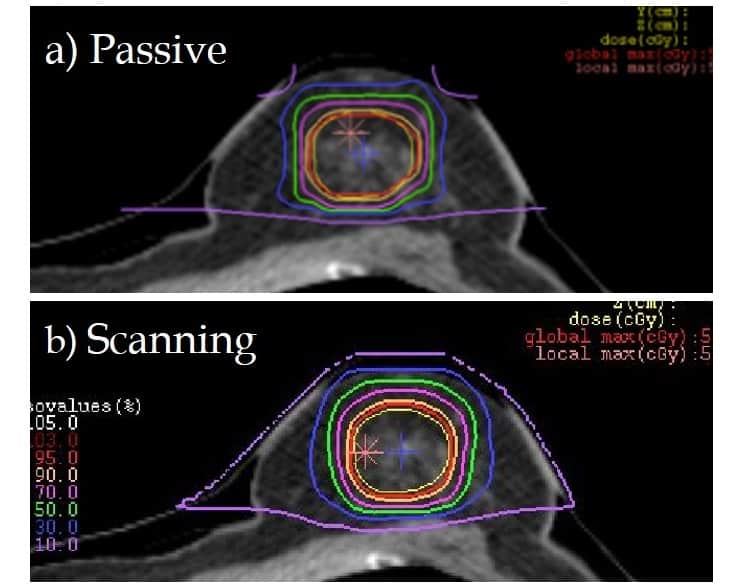
Dose distributions for passive (a) and scanning (b) carbon-ion radiotherapy at the same axial slice (for patient #5).
Carbon-ion radiotherapy, a type of charged particle therapy, provides superior dose distribution to intensity-modulated radiation therapy (IMRT) using high-energy X-rays. In Japan, it is being investigated as an alternative to breast conservation surgery for patients with early-stage, localized breast cancer, in a clinical trial that began in April 2013.
Carbon-ion therapy can be delivered in two ways: via passive or scanning irradiation. A new study comparing dose distributions of the two delivery methods revealed that both were appropriate, and that neither method was superior to the other, owing to the characteristics of stage I breast cancer. These findings imply that this treatment can be safely offered to select patients at any type of facility offering carbon-ion radiotherapy (J. Radiat. Res. 10.1093/jrr/rry052).
The scanning irradiation method of carbon-ion radiotherapy uses scanning magnets to actively scan a target volume in three dimensions. Because this 3D capability may achieve more flexible dose distribution, it is hypothesized that scanning irradiation may be superior to the passive method of carbon-ion radiotherapy. The passive method uses wobbling magnets, which create a broadened beam that covers the target area in two dimensions.
The patient cohort included 11 women who received passive irradiation carbon-ion radiotherapy in lieu of surgery at the National Institutes of Radiological Sciences (NIRS) Heavy-Ion Medical Accelerator in Chiba. All patients had low-risk disease with a distance of less than 5 mm between the tumour and the skin surface. They received doses of either 48.0, 52.8 or 60.0 Gy, in four fractions.
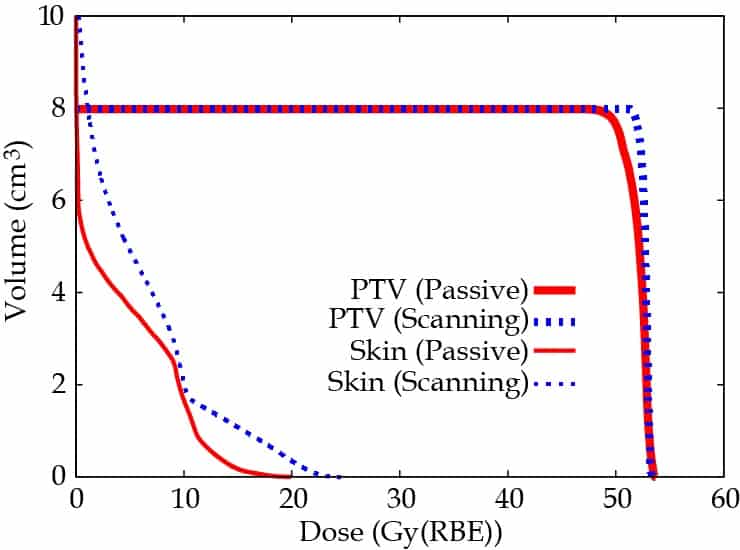
Researchers at NIRS and the Tokyo Women’s Medical University created treatment plans for the scanning irradiation method. They evaluated both plans by examining the dose concentration on the target, assessing the dose delivered to 95% of the planning target volume. The dose delivered to organs-at-risk (OAR) was considered acceptable as long as the skin dose did not reach half of the prescribed dose.
The doses delivered by each method varied among patients, with both plans achieving a high dose for some patients, and other patients having both plans deliver a low dose. However, statistical analysis showed that there was no significant difference in superiority between the two methods. These findings surprised the researchers, according to lead author Hiroaki Matsubara from Tokyo Women’s Medical University.
Dose-volume histogram (for patient #5), showing that scanning irradiation realizes good dose concentration on planning target volume, but causes higher dose to skin than passive irradiation.
The researchers attributed the lack of significant difference in part to the shallow locations of the tumours, which enable a low-energy carbon-ion beam to be employed for the treatment. “As a result, the dose distribution quality by the scanning irradiation method deteriorates owing to blurring of the lateral component of the beam, but the quality of the passive method does not change because of the usage of the patient collimator,” the authors wrote. They did caution that findings might change for treatment of women with deeper tumour locations.
Additionally, because skin was the only organ treated as an OAR, the spatial configuration between the target tumour and the OAR was “simple”. And as the shape of the target of breast cancer is simply globular, this treatment does not require a complicated dose distribution.
“It is valuable to know that the scanning irradiation method may not always be superior to the passive method,” the authors concluded, noting that in some cases the passive irradiation method could provide better dose distribution.
“Enzyme cascades” are important for biocatalytic transformations in biological cells. These processes involve complex networks and take place in spatially confined microenvironments. A team of researchers at the Hebrew University of Jerusalem in Israel has now made such cascades in the lab by encapsulating three enzymes and enzyme cofactors in nanoreactors made from metal-organic framework nanoparticles (NMOFs). The nanoreactors could be used in a variety of biotechnological applications, such as the catalytic reduction of industrially important chemicals to the development of new and efficient solar energy conversion systems.
“We have shown that the three enzymes can ‘inter-communicate’ in the confined porous structure of the metal-organic framework nanoparticles to the extent that the product of one enzyme can be used as a substrate for the subsequent enzyme to yield a three-enzyme cascade,” explains team leader Itamar Willner. “This mechanism eliminates and overcomes diffusion limitations present in bulk, non-confined, dilute solutions. As a result, biocatalytic transformations occurring in the reactor are very efficient compared to non-confined biocatalytic environments, which means that much lower concentrations of enzymatic catalysts (which are expensive) are needed.”
And that is not all: the encapsulated enzymes in the nanoreactor are stable and not easily denatured. They can also be recycled by the NMOFs matrices. “These features make the biomaterial-loaded nanoreactors ideal cost-effective materials for biotechnological applications,” says Willner.
ZIF8-NMOFs
The researchers made their nanoreactor from zeolitic imidazolate framework-8 metal-organic framework nanoparticles (ZIF8-NMOFs). They did this by mixing Zn2+ions with methyl imidazolate at room temperature. In the presence of the enzymes, this technique produces a self-organized porous network on Zn2+ ions cross-linked by the methyl imidazolate ligand in which the biomaterials are encapsulated in the pores and the network matrices exist as highly stable nanoparticles.
“This technique is a versatile approach that can be applied to many other types of biocatalytic cascades that could benefit from being encapsulated in porous confined environments,” Willner tells Physics World. “One example: encapsulating photosynthetic reactions coupled to electron cascades could lead to new efficient solar energy conversion systems.”
In this study, which is detailed in Nature Catalysis s41929-018-0117-2, the researchers encapsulated alcohol dehydrogenase, the cofactor nicotinamide adenine dinucleotide (NAD+) and lactate dehydrogenase in the NMOFs to make a coupled biocatalytic cascade. The enzymes in the cascade catalytically reduce pyruvic acid to lactic acid by ethanol.
“Normally, the two enzymes are made to inter-communicate by the continuous regeneration and recycling of the cofactor,” explains Willner. “This process is inefficient in a bulk solution and is a major obstacle that prevents these systems from being used for biotechnological applications. Confining the enzymes and the cofactor in the porous nanoparticles overcomes this challenge because it produces stable, reusable catalytic nanoparticles.
“Researchers are devoting much attention these days to making catalytic nanoparticles that mimic enzyme functions,” he adds. “These ‘nanozenymes’ and native enzymes in NMOFs could be used to make novel microreactor systems for operating catalytic cascades, and our laboratory is now busy with experiments to make such reactors.”
There are two ways to make vaccines: use a virus or bacterium and kill or modify it; or produce a single part of the virus or bacterium, a so-called antigen, which trains the immune system to recognize the whole pathogen. The first approach carries a small risk of negative side effects; the second is less effective. Theodora Bruun and her colleagues at the University of Oxford have developed a nanoparticle that promises to be both safe and effective (ACS Nano 10.1021/acsnano.8b02805).
Their particles display 60 copies of the antigen. This high concentration of antigens in one place makes it easier for the immune system to recognize them, compared with recognizing 60 individual antigens. While such particles are not new, previous versions were not soluble or stable enough and had a low production yield.
Stable particles from volcanoes
The new nanoparticle that the Oxford University team developed is based on a protein from the bacterium Thermotoga maritima, which was found in hot springs near a volcano. In fact, it is the only bacterium known to live at such high temperatures.
The researchers computationally optimized a thermostable protein from this bacterium to form a dodecahedron. The nanoparticles contained 60 copies of this optimized protein, called mi3. Bruun and co-workers showed that these particles are highly stable and survive temperatures of up to 75 °C, freezing and freeze-drying. The production yield was 10-fold higher than for a previously used particle.
Every one of the 60 copies of mi3 per particle is connected with a “SpyCatcher” molecule, which can covalently bind a “SpyTag” molecule, simply through mixing the two components. By attaching antigens to the SpyTag, a variety of vaccines can be made based on the mi3 particle.
Such a modular system has many advantages. “Developing a modular and robust nanoscaffold … could contribute to major challenges in human and animal health, including vaccines to rapidly evolving pathogens (e.g. HIV, malaria) or zoonotic outbreaks (e.g. Ebola virus, Rift Valley fever),” the authors explain. The particle core could be stockpiled and combined with relevant antigens to enable a rapid response to outbreaks.
But does it work?
To test whether the new particle is suitable for vaccination, the researchers attached a malaria antigen using the SpyCatcher-SpyTag docking system. Compared with individual antigens, the antigen-decorated particle resulted in a more robust immune response, producing more antibodies (one of the two systems of specific immune defences in the body; the other being killer cells). The particle not only produced more antibodies than the individual antigens, but the antibodies produced were more effective, binding the antigen tighter.
So far, it seems that the new nanoparticle developed by Bruun and her team may prove a promising new tool to develop vaccines.
I’m a scientist in nanotechnology and a professor at Lund University in Sweden. I’ve been working with nanotechnology since 1988, and for the past four years I’ve been the director-general at the International Nanotechnology Laboratory, which is situated in Portugal and is an intergovernmental research laboratory like CERN. I usually say that we are working on innovations that make the world a better place.
What role does vacuum technology play in those innovations?
Vacuum systems are used in all kinds of equipment, and not only in the sciences; there is also a very long history of using vacuum for industrial machines and processes. Within the sciences, vacuum is important if you want to understand materials at a very small scale, because to do that you need very clean and stable conditions. In industry, one of the major applications is in industrial machines. For instance, vacuum is used to lift, position and move objects. Simply speaking, without vacuum many industries would not exist. An example is the semiconductor industry. Once upon a time, the electronics industry ran on vacuum tubes: vacuum was an essential requirement for switching electrical currents. Although these switches have since been replaced by solid-state electronics, manufacturing the electronics and circuits still requires vacuum conditions.
I think vacuum is one of the most important elements in modern society, but it’s a paradox because the vacuum itself is maybe not so important – it’s what you do with it that’s important. Vacuum is an enabler, and I hope that an organization like IUVSTA can help people – particularly the younger generation – to “get” the enabling character of vacuum science. It is important to understand that with science and technology, you can do things that will make the Earth a better place, with better conditions for everyone – such as by reducing the level of disease, or reducing the number of unnecessary deaths (from cancer, for example), or by using our resources more effectively to create a sustainable society. Everything in science is about answering the question “why?” and for me the answer to why you do science is not just because it’s interesting and inspires curiosity. It’s mainly because it’s meaningful and needed and will ultimately help to make the world a better place, although of course it is also extremely interesting, fun and creative (as well as challenging, which means you need to be passionate about what you do).
What does your role at IUVSTA involve?
IUVSTA is a member organization, and our members are the national vacuum societies of different countries. We run programmes and conferences to help these societies do things together, and we produce information (such as our new ebook) to facilitate the exchange of knowledge between different countries. We also have divisions for certain areas of the field and these divisions hand out awards to honour notable achievements. My role as president is to help organize and structure this work so that we can accomplish our goals.
What are the major challenges that IUVSTA is facing in these activities?
I think IUVSTA faces the same challenge that science and technology are facing worldwide, which is to get more people into the field. In many countries, there is a tendency for smaller and smaller percentages of students to have a scientific training; they would rather choose something that is “easier”. In the developing world there is still a strong interest in becoming an engineer or a scientist, but in the more industrialized regions that is not the case. One of the ways we are trying to combat this is by articulating the closeness between scientists, engineers and artists/designers in terms of creativity. If you ask people on the street to name a creative profession, they will probably identify artists as being very creative, but typically not scientists, and that limits our ability to attract talented people into science and technology.
An important part of our mission at IUVSTA is to help our national member societies express that science is about doing things that are meaningful, creative and inspiring, with a close connection to the rest of society. In the past, I think scientists were put in ivory towers: you did your science, and people understood that it was being done and that it was important to do, but they did not really think it affected them. Now, however, we are seeing a big diffusion of technology into everyday life, with mobile phones and “Internet of Things” devices, and there is a gap emerging between being a heavy user of technology and being interested in contributing to develop that technology further. So IUVSTA is trying to give recognition to people who make big contributions to science and technology and who also have the ability to articulate how these contributions connect to society. It’s not a case of “science for society” or “society for science” – it’s really science with society.
Could you give us an example of how the vacuum science community can be creative and support positive changes in society?
Again, I would say that vacuum science is an enabler. Without it we would not be able to make a lot of the discoveries that later go on to become practical applications, and every year there are new developments within vacuum science that enhance production capacities in industry, and therefore help more people to enjoy the possibilities that come from technology. One example is the scanning-tunnelling microscope, which makes it possible to image individual atoms on a surface. This would not be feasible outside a vacuum environment, but thanks to vacuum we can start to play with these individual atoms, build artificial structures and start to tailor-make materials with functional properties. The understanding we are getting can then be transferred to the “metre” scale and used in technologies for various applications.
The role that vacuum plays is taken for granted. In a way, that is nice. People don’t think much about it, and they should not think about it because there is no need. However, there is a need to understand that working with this technology is a requirement for the growth of a good society. Take self-driving cars. These cars navigate using sensors, and everything relies on electronic systems (computers, servers, etc) to co-ordinate information so that the car keeps its distance from other objects on the road and does not drive somewhere it shouldn’t. But these technologies are not isolated. There is a risk that a cyberattack would harm the connections between the component systems, so we need to have some ethical discussions and work with society to ensure we get the absolute best out of the technologies we are creating.
What are some of the most exciting technologies emerging within the vacuum industry itself?
One example is the creation of plasmas. These systems of energetic ions are used in various industries to clean surfaces or deposit materials, but we’re now also seeing them used for applications such as wound healing and even creating clean water for drinking. Another example is thin films. These can be used for electronic purposes, such as making sensors that can be used in liquids (including inside our bodies), but they are also gaining applications in the food industry. In some types of food packaging – specifically, for foods with strong aromas such as coffee and chocolate – you need an “aroma protector” to maintain the quality over time. Otherwise, the coffee or chocolate will not taste good if you leave it for a while before consuming it. You may have seen that many food packages have a metallic inner surface, and this is essentially what that does: it protects the aroma. Now, however, we are developing technologies to replace the metal films with something that is more sustainable, such as polymers that have been treated with plasmas to create a labyrinthine porous structure like a bowl of spaghetti. Because of these pores, the pathway for aroma molecules to escape is so long that the aroma stays inside the package, and you don’t have to use silver or other metals to do it.
How has the vacuum industry changed since the IUVSTA was founded 60 years ago?
That is a big perspective to take! Sixty years ago, vacuum was just starting to become an industrial technology. People were developing different kinds of pumps and using them to create different levels of vacuum with a variety of applications. The next big development was the replacement of vacuum tubes within electronic equipment. That was a revolution, and there is still a revolution going on in terms of making electronics smaller and more accessible so that many people – not just a few – can do things that are computationally intensive. The next revolution in the electronics sector is probably going to be quantum computation or the use of quantum materials in devices. Vacuum will be critical here, too, in order to understand how to build the components we need in order to make computers with a quantum element. I think in five to ten years we will see a tremendous change in society based on this quantum revolution.
If you look at history, we can see that every 10 years or so produces some significant discoveries and innovations, and these in turn speed further developments. Without vacuum many of the developments in technology over the past 60 years would not have been possible – we would not have the society we have, for sure.