3D tomography of ice cream, SciMeter.org sorts-out your arXiv papers, using two sticks to measure Earth’s circumference

It has been an exceptionally warm summer here in the UK and that seems to have put a strain on ice-cream supplies. According to researchers at the Diamond Light Source in Oxfordshire, “ice cream is a soft solid, and its appeal is a complex combination of ‘mouthfeel’, taste and appearance, which are all strongly affected by the underlying microstructure”. This microstructure is affected by temperature, and to gain a better understanding of this Peter Lee and colleagues cycled ice-cream samples between -15°C and -5°C for a number of days – the sort of “abuse” that could befall ice cream as it makes its way from producer to consumer during a heatwave. The microstructure of the ice cream was then studied using 3D X-ray tomography. Lee and colleagues found that the ice cream changed in two ways: melting and freezing caused an increase in the size of ice crystals in the material whereas the movement and coalescence of air bubbles created larger bubbles. They also discovered that these two phenomena were linked, with melting and freezing affecting the nature of air bubbles.

The arXiv preprint server has been a runaway success since it launched in 1991. There was a time when I would trawl through daily postings for exciting new physics. However, I gave up several years ago because there are now hundreds of papers uploaded every day. Now, Sabine Hossenfelder, Tom Price and Tobias Mistele have created SciMeter.org that aims to make sense of all those papers and who is publishing them. If you would like to know what a certain physicist (or research group) is up to, SciMeter.org will create a word cloud. Shown above is Hossenfelder’s word cloud – any guesses regarding her research interests?

These are crazy times when scientists feel the need to prove that the Earth is round. Environmental scientist and vlogger Kurtis Baute has taken to a long, straight road on the flat Canadian prairies to do just that. With the help of his bicycle and two sticks, he manages to measure the circumference of the Earth – as he explains in the above video.

 

Rydberg excitations help make nitric oxide sensor

Nitric oxide (NO) plays a crucial role in many biological processes, including vasodilation, immunity and neurotransmission, but it is neurotoxic in excess. Detecting this gas is important for diagnosing inflammatory diseases such as asthma, where it is present in exhaled air, for example. NO also serves as a signalling molecule in carcinogenesis and the growth of some tumours, such as breast cancer.

NO is usually detected using techniques like chemiluminescence and amperometric measurements, but these have their drawbacks and limitations. Chemiluminescence only works for total gas volumes greater than a litre, for instance, and amperometry suffers from large cross-sensitivities to other small molecules such as carbon monoxide (CO).

Sensitivity of 10 ppm in a sample volume of just 10-4 litres

Researchers led by Harald Kübler of of the University of Stuttgart in Germany have now put forward a proof-of-concept for a new optogalvanic gas sensor for NO based on Rydberg excitations that they say could overcome the problems of currently employed methods. The device combines the advantages of optical and amperometric techniques, and a sensor prototype they made can detect NO concentrations of less than 10 parts per million (ppm) in sample volumes as small as 10-4 litres at atmospheric pressures and temperatures.

In their work, Kübler and colleagues used a pair of Nd:YAG pumped dye lasers to create Rydberg-excited NO molecules in a glass chamber. The chamber also contains helium (He) gas, two metal electrodes and a high bandwidth temperature-compensated transimpedance amplifier (TIA). The NO and He are prepared and stored in a stainless-steel vessel.

The Rydberg-excited NO molecules contain an electron excited to a higher state but the electron is only weakly bound, which means that it can be easily ionized by, for example, low-energy collisions in the chamber. The charges coming from the ionization of the excited molecules are detected as a current by the electrodes and this current is then converted into a voltage by the TIA. It is thus read out as a clear and unique indication of the presence of NO.

“Although the measured sensitivities in this proof-of principle-experiment are still orders of magnitude worse compared to other gas sensors such as chemiluminescence based ones, our results do indicate the potential of the proposed Rydberg detection scheme for making a sensitive and selective NO sensor that works at atmospheric pressures,” say the researchers.

The team, which includes scientists from the University of British Columbia in Canada, says that it now plans to construct a mixing apparatus that works in through-flow rather than in static mode and in which stainless steel parts are reduced to a minimum. This will allow all surfaces of the experimental chamber to be saturated with NO, so increasing the device’s sensitivity to the gas. Such a set up could possibly allow for practical applications such as NO detection in breath.

The sensor is detailed in Applied Physics Letters 10.1063/1.5024321.

Max Planck Institute for Astrophysics hit by bullying allegations

The Max Planck Society, one of Germany’s leading science research organisations, aims to improve the way it deals with reports of misconduct following allegations of bullying at the Max Planck Institute for Astrophysics (MPA) in Garching, Germany. Martin Stratmann, president of the Max Planck Society, says that cases of misconduct at the MPA should have been “addressed more effectively” and that the society will now look to improve how staff and students can report such cases. Victims at the MPA are also being encouraged to report any cases of bullying or sexual misconduct to an independent law firm that has been commissioned by the society.

While it has been rumoured for several years that bullying may have gone on at the MPA, it only came to light in February when such allegations were reported by the German news magazine Der Spiegel. The magazine quoted anonymous sources who accused an unnamed female professor at a “Max Planck institute in Bavaria” of bullying. In late June, BuzzFeed then identified MPA as the institute and astrophysicist Guinevere Kauffmann – an MPA director — as the previously unnamed female professor accused of bullying.

There is a general feeling that we are heading in the right direction

Hannelore Hämmerle

In a statement, the Max Planck Society admitted that it had been made aware of the bullying complaints at the MPA in 2016 and at the time “took immediate action by ensuring that the director concerned would receive professional coaching in her day-to-day work (which is still the case today)”. The society adds that “any form of bullying is contrary to the principles of the Max Planck Society” and that it takes the allegations seriously.

Making improvements

Kauffmann did not want to be interviewed for Physics World, but through Hannelore Hämmerle – a press officer at the MPA – Kauffmann confirmed that the statements she gave to Nature earlier this month were accurately reported. Speaking to Nature, Kauffmann said she was “not a racist”. “I am very interested in cultural differences between people and I regret very much that my comments have been taken out of context and distorted,” she said. “Regarding ‘bullying’ — I am of the generation that was subjected to very high-pressure supervision. I realize that this has now become unacceptable. I believe I have modified my behaviour very substantially in the last 18 months since the complaints were made.”

Hämmerle told Physics World that Kauffmann has apologised to her group and the institute. “There is a general feeling that we are heading in the right direction,” adds Hämmerle. In May, the MPA carried out an anonymous survey of postdocs at the institute as well as Masters and PhD students “to gain more transparency” about the student-supervisor relationship at the institute. Of the 115 researchers contacted, 61 responded, with 84% of those “satisfied” or “very satisfied” with their supervisors at the MPA. Three respondents reported bullying and two respondents reported being sexually harassed.

In a recent interview with the Frankfurter Allgemeine, a German newspaper, Stratmann notes that the complaints in 2016 about bullying should have been addressed more effectively. “We have seen through the Garching incident that our complaint structure is not optimal,” he says. “I have to concede that, and for this reason we will improve it.”Part of that process now includes an external law firm hearing complaints from MPA staff members who feel they have been bullied or sexual harassed. Hämmerle says that staff members can remain anonymous and that any reports of misconduct will then be forwarded to the Max Planck Society for review and potential action.

Pre-set bioprinting technique produces complex tissues

Pre-set bioprinting

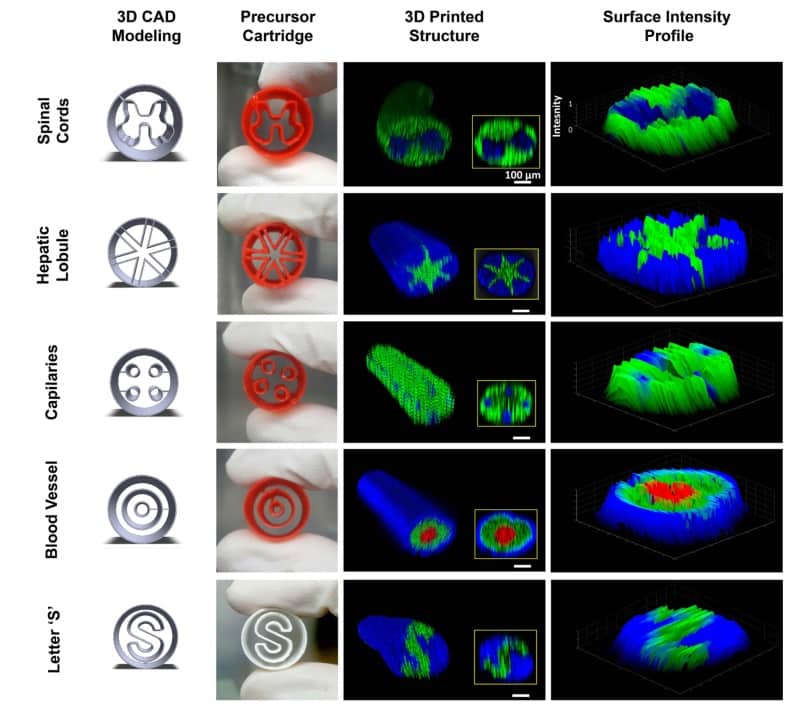
A research team headed up at Korea Polytechnic University has developed a 3D bioprinting technique that enables the biofabrication of complex, multi-material and multi-cellular tissues with a single extrusion print head. The technique uses a special cartridge with multiple compartments that keep the bioink – a 3D culture biomaterial mixed with cells – within a pre-defined formation that is maintained upon printing. The cartridge and bioprinting procedure also allows the extrusion of bioink to create a 3D tissue for use in medical research or regenerative medicine (Biofabrication 10 035008).

The ability to pre-load different materials and cells into the printing cartridge simplifies the bioprinting process from an engineering standpoint, with only one print head and cartridge being needed to form a complex 3D tissue. The alternative, which is used for most extrusion-based bioprinting techniques, is to have multiple print heads filled with different bioinks and cells that are used in conjunction to print the different components of an engineered tissue.

The researchers used a commercial 3D printer to manufacture the special cartridges, which enables the technique to be adapted in line with the user’s needs. The flexible design allows the technique to be applied within different bioprinter systems, as the cartridges can be 3D printed with precise dimensions to fit within a pre-existing a syringe head. This versatility also enables the printing cartridges to be designed for a specific tissue type, which the research group has exemplified by creating cartridges for biofabrication of spinal cords, hepatic lobules, capillaries, blood vessels, and even the letter “S”.

3D printed cartridges

Whilst the cartridges are large (9.3 and 15 mm), the printing nozzles are much smaller (200, 250, 400, 610 and 840 μm), meaning that bioinks loaded into the syringe are miniaturized through the printing process. This miniaturization does not deform the final printed construct from its pre-defined structure, so is not an issue for biofabrication of tissues.

The pre-set technique enables the use of a larger printing nozzle – and subsequently increased post-print cell survival – as the engineered tissue is spatially orientated within the print cartridge; reducing the reliance upon small nozzles and low printing resolutions. The group exhibited this by printing the same construct with the pre-set bioprinting technique and a conventional extrusion bioprinting. They observed a lower rate of cell death from pre-set bioprinting.

The researchers used different bioinks of polymeric protein and polysaccharide origin to exhibit the capabilities of the technique, with differing concentrations of alginate and collagen being successfully printed. This means that different bioinks can be used to mimic the different physical environments of a complex tissue. The extracellular matrix (ECM) that surrounds cells is crucial to cell function and is composed of tissue specific proteins and polysaccharide concentrations, making the ability to bioprint cells in their bespoke bioink a useful feature.

Overall, this technique offers a versatile platform for the biofabrication of several tissues, with a reduced reliance upon microscale printing resolution. In future, it could be applied to print the tissue structures designed in this study, but could also be applied to many different tissue types. The advantage of a 3D bioprinting technique that is pre-defined by a 3D-printed cartridge is the vast scope for versatility that is only limited by the design stage. It will be interesting to see how this technique is used within the field of biofabrication moving forward.

Clean energy is vital – but still not enough

The journey to a world of clean energy without fossil fuels – essential if humankind is to contain global warming to no more than 1.5 °C by 2100 – won’t be easy.

One new study outlines the problems for people who want to provide the cement for tomorrow’s cities, the steel for new structures, and the long-distance transport of heavy goods.

Freight shipping and air travel alone account for 6% of all carbon dioxide emissions that fuel global warming, and cement and steel industries release up to 1.7 billion tonnes of the greenhouse gas a year.

Electric cars may be on the road in increasing numbers, but trucks may have to carry heavy goods for 1000 miles. For some deliveries, there is still no substitute for liquid fuel.

A second new study confirms that humans already have the knowhow to capture carbon dioxide as it is produced and combine it with hydrogen from water to make high quality liquid fuel. The technologies are still at the laboratory stage and the challenge is to get them to large-scale production at ever lower costs.

Both studies address the big picture. Researchers have repeatedly shown that – on paper – renewable sources could provide all the world’s electricity. But that wouldn’t stop all carbon emissions.

US scientists report in the journal Science that they looked at the “tough nuts” yet to be cracked; air travel, long-distance freight traffic by truck or ship, and the making of steel and cement.

They also looked at the range of new possibilities that have begun to emerge from the ingenuity on offer in the world’s laboratories – including even renewable airline fuel – but they want to see more creative thinking and greater steps towards sustainable building.

Shaping the future

“Taken together, these tough-nut sources account for a substantial fraction of global emissions. To effectively address them, we will need to develop new processes and systems. This will require both development of new technologies and co-ordination and integration across industries,” said Ken Caldeira of the Carnegie Institution.

And his co-author Steve Davis of the University of California Irvine said: “For better or for worse, the long-lived infrastructure built today will shape the future. We’re making good progress on things like the cost of solar panels and electric vehicles, but we need to start tackling the more difficult sectors as well.”

A second US team writes in Nature Climate Change to introduce what could be a new buzzword: electro-geochemistry. There is an argument – and wide-scale investment to back it – that biofuels, based on ethanol converted from crops or plantations, or just burned in power stations, could deliver reliable energy.

There is a second argument, yet to be tested at scale, that the carbon dioxide from biofuel exhausts could be captured and buried, to keep it from entering the atmosphere.

New fuel possibility

There is another way, argues Greg Rau, from the University of California Santa Cruz, and colleagues. Electrolysis of saline water could generate hydrogen and oxygen. Reactions between easy-to-obtain minerals could yield a solution that absorbs carbon dioxide from the atmosphere and turns it into a carbonate that could stay in the seas and reduce ocean acidification.

Hydrogen is already a vehicle fuel. From the materials in hand, chemists could make other fuels. And at the end of the process, there could be less carbon dioxide in the atmosphere. The dream of negative emissions becomes more plausible.

And, the researchers reason, these electro-geochemical methods could, on average, deliver 50 times more energy generation and carbon removal than the uncertain and land-consuming approach involving biofuels and carbon capture. But such approaches are still in their infancy.

“It’s early days in negative emissions technology, and we need to keep an open mind about what options might emerge,” Rau says. “We also need policies that will foster the emergence of these technologies.”

Graphene standards, offshore wind and porpoises

In this episode of Physics World Weekly, Anna Demming is in conversation with James Dacey about the “wonder material” graphene. Earlier in the week, Demming was at House of Commons in Westminster for the launch of the world’s first graphene characterization service. Demming explains why it is so important to establish quality standards for graphene and other 2D materials.

Later in the podcast, Dacey speaks about the new short film he has co-produced for Physics World’s Sustainable Futures collection. Its inspiration was a 2011 study that found that porpoises appear to be thriving in the vicinity of the Egmond Aan Zee windfarm in the North Sea. The film picks up the story in 2018, investigating why this porpoise paradise may now be under threat.

If you enjoy the podcast then you can subscribe via iTunes or your chosen podcast app.

Nanocolloidal hydrogel scavenges heavy metals

Water contaminated with heavy metals is becoming an increasingly serious problem in many developing countries. For example, mercury, produced during some types of gold mining pollutes nearby ponds and thus the water used for crop irrigation and drinking. Mercury is dangerous if ingested because it damages the kidney, nervous system and brain. Another example: the copper and nickel from electronic waste, if not recycled properly, can contaminate groundwater. Again, if ingested copper can damage the liver, heart and kidneys and can also lead to cognitive problems.

Hydrogels have proved themselves to be efficient scavengers of heavy metals in polluted water because they have a large surface area and can be functionalized with metal-ion coordinating groups. They can also be recycled.

In recent years, researchers have also found that graphene, noble metal nanoparticles, and semiconducting quantum dots can scavenge heavy metal ions too. Nanoparticle ion scavengers have a large surface area and a high density of surface active sites for these metal ions. However, these materials cannot be easily recycled and separated from water.

“The best of both worlds”

“We have now brought together the best of both these worlds: molecular hydrogels and nanoparticle scavengers,” explains Eugenia Kumacheva of the University of Toronto in Canada, who together with her colleagues has fabricated nanocolloidal hydrogels from cellulose nanocrystals (CNCs) and graphene quantum dots (GQDs) for heavy metal scavenging. “The CNCs are naturally-derived rod-like nanoparticles, which in our work had an average diameter of 15 nm and length of 180 nm. The GQDs are disk-like particles with an average diameter of 6 nm and are one atomic-layer thick.

“These nanoparticles are decorated with complementary functional groups that chemically cross-link to form a hydrogel.”

By varying the concentration ratio of both types of nanoparticles, Kumacheva and co-workers say they can control the hydrogel’s structure and thus its permeability. “In our experiments, we found that the microgels can scavenge four types of metal ions, Ag+, Ni2+, Cu2+and Hg2+, thanks to their high porosity, high surface area and abundant ion-coordinating groups that have a high affinity for ion sequestration,” says Moien Alizadehgiashi, who is lead author of this study. “The heavy metal ions are adsorbed on the constituent nanoparticles via electrostatic forces and other coordination interactions.

“We also found that the scavenging capacity of the microgels increases at a higher content of GQDs, owing to the greater number of active sites on the GQDs than on the CNCs and the larger pore size of the corresponding gels.”

The microgels are also recyclable and are efficient over several ion-scavenging cycles, he adds. “Importantly, they could also be used in practical systems such as packed beads, and could scavenge other heavy metal ions in addition to the ones we studied.”

The team, reporting its work in ACS Nano 10.1021/acsnano.8b03202, says that it will now be scaling up the synthesis of its microgel and improving ion sequestration selectivity. “We will also be expanding on the range of metal ions that can be sequestered and will be focusing on specific applications,” Kumacheva tells Physics World.

The curious case of the porpoises and the wind farm

The Curious Case of the Porpoises and the Wind Farm investigates the case of a wind farm in the North Sea that appears to be attracting harbour porpoises. A study in 2011 found that the population of harbour porpoises (Phocoena phocoena) in the vicinity of the Windpark Egmond aan Zee (OWEZ) is greater now than before the park existed. The film picks up the story in 2018, exploring the science and the politics of offshore wind, where competing needs require carefully considered solutions.

Comprising 36 wind turbines and within view from the town of Egmond aan Zee, OWEZ became the first offshore wind farm built off the Dutch North Sea coast when it began full operations in 2007. Common sense might suggest that imposing this infrastructure on a marine ecosystem could be permanently disruptive. In fact, the turbines’ foundations seem to have created a sheltered reef environment with new foraging opportunities for porpoises.

But while this appears to be a “have-your-cake-and-eat-it” result for a renewable energy, the bigger picture is far more complex. Notably, fishing is now prohibited at the Egmond aan Zee windfarm, which has led to a significant reduction in shipping traffic in the area. So is the thriving marine life just a product of the area becoming a protected zone? Presumably, many of those fishing boats are still active – so has it simply shifted the environmental impact elsewhere?

Some in the local fishing community were unhappy with the shipping ban, especially with the speed at which it came into effect and the lack of consultation. Rems Cramer, a fisherman based in the Hague, is part of a team advocating a return to the OWEZ fishing grounds using more sustainable practices. Meike Scheidat, a marine researcher from Wageningen University who led the 2011 study is sympathetic to the fishing community but has concerns about the reality of multiuse wind farms.

Cramer and Scheidat feature in The Curious Case of the Porpoises and the Wind Farm along with Henk Kouwenhoven an engineer from Dutch utility company NUON, which constructed the windfarm in partnership with Shell. Kouwenhoven speaks about the current state of the wind energy sector in the Netherlands, which is poised for rapid expansion. While Cramer, Scheidat and Kouwenhoven may disagree on certain procedural aspects, they are in clear agreement on one key point: more studies are needed to establish the environmental impacts of offshore wind parks during construction, operation and decommissioning.

Produced by Physics World journalist James Dacey and the independent filmmaker Saskia Madlener, The Curious Case of the Porpoises and the Wind Farm is the third film in our series of films about environmental challenges and their solutions. The first film, looked at how Mexico City’s unique geology makes it difficult to provide a reliable source of fresh water to citizens. The second film looked at efforts in the US city of New Orleans to adapt to live with increasing flood risk in the face of climate changes. You can see those films, along with a range of articles about how science and technology can help tackle environmental challenges, in our Sustainable Futures collection.

Single-atom magnets show stability needed for data storage

Individual holmium atoms adsorbed on magnesium oxide films can form highly stable magnets, according to a study done by Fabian Natterer at Switzerland’s Federal Institute of Technology in Lausanne (EPFL) and colleagues. The team showed that the single-atom magnets can endure relatively high temperatures and strong external magnetic fields. The work could lead to the development of extremely high-density data storage devices.

Increasingly, data centres are coming under strain as we produce more and more information. One potential solution could lie in single-atom magnets, on which bits of data could be stored as long-lived magnetic quantum states. Previous studies have shown that these states can be easily manipulated, allowing data to be easily written and read out from the atoms. Furthermore, densely packing many atoms onto a surface would allow for vast amounts of data to be stored.

“Single-atom magnets offer an interesting perspective because quantum mechanics may offer shortcuts across their stability barriers that we could exploit in the future,” says Natterer. “This would be the last piece of the puzzle to atomic data recording.”

Significant challenges

Single-atom magnets are still in the early stages of development, and the technology faces significant challenges relating to the thermal stability of the atoms’ magnetic quantum states. The coercivity of the magnets –  their ability to resist demagnetization in external magnetic fields – is also low, which is not appropriate for data storage.

In their study, Natterer’s team used a scanning tunneling microscope to observe individual holmium atoms adsorbed to a film of magnesium oxide. This system that had previously been identified as collection of highly stable, single-atom magnets.

To test the atoms’ ability to withstand demagnetization, the team first subjected them to external magnetic fields up to 8 T – which is about 100,000 times the strength of Earth’s magnetic field. Remarkably, the atoms retained their magnetization for many minutes – the highest coercivity yet observed in individual atoms.

Hot and cold

Next, the atoms were exposed to temperatures of over 45 K. Their magnetic states remained stable up to 35::K and began to align with an external field at above 45 K. Although this is about 260 degrees below room temperature, it is very hot for single-atom magnets and reveals an ability to resist thermal perturbations.

While the holmium atoms adsorbed on magnesium oxide are remarkably stable for a system of single magnets, Natterer and colleagues acknowledge that further studies are needed before the system can be implemented in commercial data storage. “We have demonstrated that the smallest bits can indeed be extremely stable,” Natterer continues.  “Next, we need to learn how to write information to those bits more effectively to overcome the magnetic ‘trilemma’ of magnetic recording: stability, writability, and signal-to-noise ratio.”

The team also included scientists at Korea’s Institute for Basic Science and Ewha Womans University. The research is described in Physical Review Letters.

The physicists in the comedy club

Before starting the review, I should come clean – I like facts. It began when I was a child, sitting in the back of a car during long journeys to North Wales, and matured in a shared PhD office in the skies above South Kensington. At one stage my friend and I invented a game called “fact or schmact”, where, during particularly long afternoons of data analysis, we’d come up with fake facts and try to convince each other they were real.

The Element in the Room: Science-y Stuff Staring You in the Face, by Helen Arney and Steve Mould, is a turbo-charged trivia tome, aimed at scientifically minded readers with a sense of humour. It is not just a regular book, either – from recipes for cocktails to instructions on fire vortexes, it encourages you not to take what you are reading for granted, but to have a try yourself. Arney and Mould are two of the three stars of Festival of the Spoken Nerd (FOTSN) – a science-comedy performing trio. Both are physicists who are more familiar with comedy clubs than lecture theatres – they are now professional science communicators. Matt Parker, the “third nerd”, contributes in the preface and blurb – but only to promote his own book. FOTSN has taken live science shows to tens of thousands of people across the UK, gained hundreds of thousands of followers on YouTube and contributed to television and print media. I’ve never actually seen a show, but the writing is so enchanting that after a few chapters, I was searching for when they are next in town.

For those who may shun popular-science and think of themselves as “above” social media – this isn’t all fun, games and festivals. In 2013 Mould asked on YouTube why chains of beads leap out of jars in arcs before falling to the floor, and the video went viral (at the time of writing it has been viewed almost two million times). The video was picked up by two professors at Cambridge, who went on to help Mould explain the “self-siphoning beads effect”, and published their discovery in the Proceedings of the Royal Society A (it also made its way into Nature, Science and  the Daily Mail). The journey from observation to result is detailed in a section that makes the case for the mantra of the majority of science communication and suggests that anyone curious can and should contribute to our understanding of the world. You don’t need a fancy research lab or PhD, you just need to question the world around you.

While I may be reading too much into it, The Element in the Room feels like science communication by stealth. The facts may be loosely collected into chapters such as “Food stuff” and “Body stuff”, but physics is at the heart of most of the “stuff” they cover. Arney and Mould are excellent storytellers, whose accidental discoveries and anecdotes read like science experiments. They show that physics is at the heart of the majority of everyday phenomena. In “Brain stuff”, Arney perfectly describes impostor syndrome with an internal dialogue between three Helens. Arney debunks popular neuroscience myths (left brain/right brain, men’s and women’s hobbies) – perhaps thanks to her physics training – but is so non-judgemental you find yourself laughing with her rather than being angry at how ridiculous society’s biases are to begin with. She’s an incredibly empathetic writer (or a mind-reader) – in the only section I began to find a bit trying, a list of how chemical elements got their names, Arney interjects with “I hope you’re memorizing this, there will be a test at the end.”

Arney and Mould recognize that in an age of social media and globalization their readers won’t all be in the UK, and seem to enjoy translating observations for a trans-Atlantic audience. When describing the science behind instant coffee they take the time to explain what instant coffee is, then use American tea as a proxy for just how awful instant coffee can taste. The Element in the Room is timely, too. A do-it-yourself experiment includes creating smoke-rings from a friend who is vaping. They are aware we live in a time of “alternative facts” and they include a “Trip Advisor for exoplanets”. Despite coming out pre-Cambridge Analytica scandal, there is even a section on the pseudo-science behind personality tests.

This book has been beautifully put together – the illustrations by Richard Wilkinson are technical without being textbook-like and the layout feels like it has been created by people who not only care about what they have to say but how they communicate it. Perhaps not unsurprisingly given their extensive experience, the writing is accessible and light without being patronizing or preachy. Even without seeing the live show, the chemistry between Mould and Arney is perfect – sections are written by either one or the other and you can only tell which if you hunt for Wilkinson’s small symbols in the margin. Of course, as an almanac for nerds, the book comes with instructions. While there is no doubt that this book would make an excellent gift for enthusiastic teenagers or early-career researchers, The Element in the Room isn’t only millennial material, so don’t let them have all the fun.

  • 2017 Octopus Publishing Group £16.99hb 224pp

Copyright © 2026 by IOP Publishing Ltd and individual contributors