Physical versus chemical paradigms play off in nanomedicine

Packaging requires specificity

Patrick Couvreur, professor at UMR CNRS 8612 in Paris, France, was publishing work on nanoparticle drug carriers as far back as 1979. His early work in the field included development of biodegradable polyalkylcyanoacrylate (PACA) nanoparticles that could make doxorubicin (DOX) – a widely used anticancer drug – invisible in vivo, helping it get past the multiple-drug-resistant defences of hepatocarcinoma. Further developments in this technology led to the release of Livatag®, which showed so much promise it was fast-tracked through Food and Drug Administration (FDA) clearance. Speaking to attendees of Nanotech 2018, Couvreur pointed out that in some ways Livatag has been a victim of its own success. In phase II clinical trials the Livatag survival curve was better than the “chemoembolization” control arm, where anti-cancer drugs are injected directly into the blood vessel feeding a cancerous tumor. However in the multicentric (conducted at more than one medical centre) phase III clinical trial, the survival curve overlapped the control arm of “polychemotherapy” treatment involving several different drugs.

Couvreur has gone on to develop other medicines based on the same approach, such as monochrome antibody streptavidin for targeting alzheimers. Despite these successes and the time elapsed since the first demonstration of PACA encapsulated DOX, Couvreur told attendees that the number of nanomedicines on the market or even in phase III clinical trials remains very low. He suggested that reasons for this include issues with loading and the fact that a fraction of the drug remains at the surface of the nanoparticles where they are not protected and their release is not controlled. “What was needed was a move from a physical to a chemical encapsulation paradigm using linkers,” said Couvreur.

Chemistry takes over
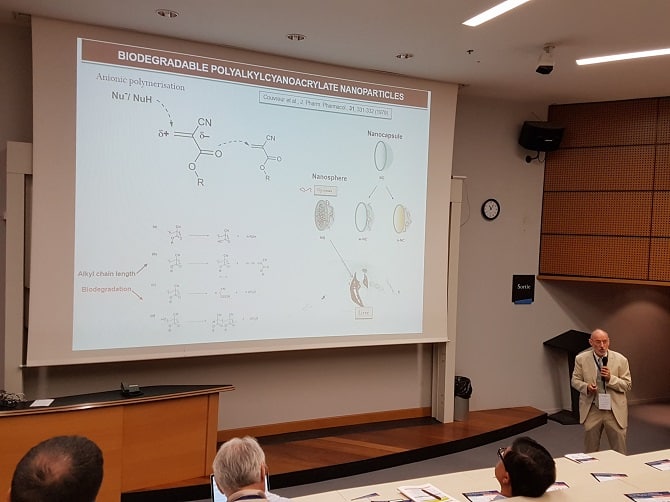
Patrick Couvreur addresses attendees at Nanotech France 2018

Couvreur described “squalenoylation” as “a new platform for nanomedicines”, giving as an example the success of the nanoassembly of anticancer drug gemcitabine with squalene linkers – SQGem. In the case of doxorubicin linked to squalene nanoparticles, features that improve the medicine’s efficacy include the extension of the nanoparticle by blood flow along streams, which gives longer activity post injection. In addition, interactions between SQGem and lipoproteins mean that it is readily transported by them, particularly cholesterol-rich lipoproteins. Tumour cells attract cholesterol to multiply, so this transport provides an indirect targeting mechanism.

Other applications of squalenoylation include nanoparticles of squalene with cis-diamminedichloroplatinum (CDDP) to increase intracellular delivery of platin and ROS production. Couvreur and his team have also investigated the possibility of combining with adenosine to treat spinal cord injury and brain ischemia. Here the blood-brain barrier can pose a challenge, but Couvreur and colleagues found that the nanoparticles interact with peripheral receptors of adenosine, relaxing the brain vessels and inducing neuroprotection of the brain microcirculation. As a result reperfusion improves while the nanoparticles themselves do not cross the blood-brain barrier.

Getting physical with viruses

Antibiotics – which revolutionized medicine in the 20th century – are among the most frequently administered drugs available on account of their broad efficacy against a range of infectious bacterial diseases. However no such drug exists to combat viral infections – yet. Following on from Couvreur, Francesco Stellacci a professor at Ecole Polytechnique de Lausanne (EPFL) in Switzerland, told attendees at Nanotech France 2018 about work using decorated gold nanoparticles that seem to mimic host cells. The nanoparticles lure the virus in to bond and attempt to infect them, but instead the nanoparticle applies a physical pressure on the virus that results in its rupture and disarmament.

This mechanism here is physical, which has the advantage that it is also non-toxic. “There are a lot of virucidal molecules out there, but they are toxic,” said Stellacci, highlighting alcohol as an example. Mild administration of alcohol may have other benefits but its intake is not effective as a viricide.

The gold nanoparticle viricides also work at nanomolar concentrations – significant since most FDA approved drugs are nanomolar. In addition Stellacci and his team tested them against wild-type viruses extracted from patients and found they are not only effective but that the effect is non-reversible. This means that once the gold nanoparticle viricides have reduced viral populations in a sample by a log 2 difference, the population depletion holds even following dilution of the whole sample, something that is not true of some alternative antiviral substances such as heparin.

Stellacci and colleagues demonstrated the approach on respiratory syncytial virus (RSV), which kills half a million each year. They have also demonstrated the efficacy of the puncturing ligands without the gold nanoparticle, attaching them to cyclodextrin instead. His team are in the process of attempts to apply the approach to combat rotavirus, which leads to diarrhoea, one of the main causes of death in children under five across the world.

Catalysis plays a role

Developments in catalysis may also have spin-off benefits for drug delivery. Jean-Pierre Mahy, professor at the Université de Paris Sud in France spoke to Nanotech France attendees about some of the progress in designing artificial enzymes that “combine the robustness of chemical catalysts with the activity of enzymes in mild conditions.”

One of the primary goals of his research has been to mimic the cytochromes P450 hemoproteins for selective oxidation – no small feat. The heme moiety of P450s has been described as “responsible for the remarkable and often exquisite, catalytic prowess of these enzymes”. As natural approaches involve multiple electron transfer processes and are very fiddly to reproduce, Mahy and colleagues turned to artificial hemoproteins (hemoartzymes) with mono oxygenase activity. To provide robust structure, high loading, enzyme protection and potential recycling, their recent work has focused on metallorganic frameworks (MOF).

Mahy and colleagues have shown that microperoxidase 8 (MP8) – a heme octapeptide obtained by hydrolytic digestion of horse heart cytochrome c – can have both peroxidase-like and cytochrome P450-like activities. They combined this with an MOF from MIL 101 nanoparticles (where MIL stands for Material of Institut Lavoisier) and were able to demonstrate charge-selective oxidation activity. They have also designed an artificial reductase based on a water-soluble polyimine polymer decorated with hydrophobic groups that allows use of O2 as an oxidant. “This is the first entirely synthetic heme monooxygenase,” said Mahy.

Alongside these demonstrations of the bioactivity of metalloenzymes, the ability to compartmentalize them in MOFs has suggested potential compatibility with living cells, and it is here that possible therapeutic applications really come into play. Some of Mahy’s most recent work has demonstrated artzymes catalysing organic reactions at the surface of living cells. The cells can then enantioselectively catalyse the abiotic Diels-Alder cycloaddition reaction of cyclopentadiene and azachalcone, and as Mahy told attendees, “This could be used to activate drugs.” In addition there is potential for on site synthesis of drugs and metabolites.

Nanotech France is an annual conference that took place this year in Paris on 27–29 June.

All-optical ultrasound delivers video-rate tissue imaging

Ultrasound is one of the most common medical imaging tools, but the electronic components in ultrasound probes make it difficult to miniaturize them for endoscopic applications. Such electronic ultrasound systems are also unsuitable for use within MRI scanners.

To address these shortcomings, researchers from University College London have developed an ultrasound system that uses optical, instead of electronic, components. The team has now demonstrated the first use of an all-optical ultrasound imager for video-rate, real-time 2D imaging of biological tissue (Biomed. Opt. Express 9 3481).

“All-optical ultrasound imaging probes have the potential to revolutionize image-guided interventions,” says first author Erwin Alles. “A lack of electronics and the resulting MRI compatibility will allow for true multimodality image guidance, with probes that are potentially just a fraction of the cost of conventional electronic counterparts.”

All-optical ultrasound systems eliminate the electronic transducers in standard ultrasonic probes by using light to both transmit and receive the ultrasound. Pulsed laser light generates ultrasound waves, scanning mirrors control the transmission of the waves into tissue, and a fibre-optic sensor receives the reflected waves.

The team also developed methods to acquire and display images at video rates. “Through the combination of a new imaging paradigm, new optical ultrasound generating materials, optimized ultrasound source geometries and a highly sensitive fibre-optic ultrasound detector, we achieved image frame rates that were up to three orders of magnitude faster than the current state-of-the-art,” Alles explains.

Optical components are easily miniaturized, offering the potential to create a minimally invasive probe. The scanning mirrors built into the device enable it to acquire images in different modes, and rapidly switch between modes without needing to swap the imaging probe. In addition, the light source can be dynamically adjusted to generate either low-frequency ultrasound, which penetrates deep into tissue, or high-frequency ultrasound, which offers higher-resolution images at a shallower depth.

The team tested their prototype system by imaging a deceased zebrafish, as well as an ex vivo pig artery manipulated to emulate the dynamics of pulsing blood. The all-optical device exhibited comparable imaging capabilities to an electronic high-frequency ultrasound system, and captured the dynamics of the pulsating carotid artery. The system demonstrated a sustained frame rate of 15 Hz, a dynamic range of 30 dB, a penetration depth of at least 6 mm and a resolution of 75×100 µm.

To adapt the technology for clinical use, the researchers are developing a long, flexible imaging probe for free-hand operation, as well as miniaturized versions for endoscopic applications.

Static electric field suppresses superconductivity

A static electric field can be used to manipulate the superconducting state of metallic superconducting thin films, according to new experiments by researchers in Italy. The effect, which was first put forward by the London brothers, Fritz and Heinz, in their original formulation of superconductivity back in 1935, might be exploited in novel-concept devices such as supercurrent and Josephson field-effect transistors, as well as classical and possibly even quantum bits.

“It seems that we are realizing a novel phase of the superconducting state driven by electric fields,” says Francesco Giazotto of the Consiglio Nazionale delle Ricerche (CNR) and the Scuola Normale Superiore in Pisa, who led this research effort. “At the moment, we are unclear as to the type of phase transition we are inducing but our finding definitely represents something very intriguing from the fundamental physics point of view.”

Electrostatic fields should not affect either a metal or a superconductor

Superconductivity is the complete absence of electrical resistance in a material and is observed in many materials when they are cooled to below their superconducting transition temperature (Tc). In the Bardeen–Cooper–Schrieffer (BCS) theory of (“conventional”) low-temperature superconductivity, this occurs when electrons overcome their mutual electrical repulsion and form “Cooper pairs” that then travel unheeded through the material as a supercurrent.

According to the theory of electrostatic screening, an electrostatic field should not have any effect on either a metal or a superconductor. Giazotto and colleagues have now turned this idea on its head and have found that an intense electric field can dramatically affect the superconducting state, be used to control the supercurrent, and, at sufficiently intense fields, quench the superconductivity altogether.

Spatial deformation of the Cooper pairing parameter?

The researchers obtained their results by applying intense static electric fields on the order of about 10V/m through either the side or bottom gates of all-metallic supercurrent transistors made of two different BCS superconducting thin films (a titanium- and an aluminium-based one). The devices were made using standard lithography and simple metallic thin film deposition techniques.

Giazotto and colleagues say that the superconductivity quenching might come from a spatial deformation of the Cooper pairing parameter by the electric fields localized at the surface of the superconductor. This leads to a reduced available area through which supercurrent can flow. More experiments will be needed to confirm this hypothesis, however.

“From the basic physics point of view, our results suggest that there are still some very important aspects of conventional superconductivity that need to be understood,” says Giazotto. “In this context, I’d say that we are still rather far from understanding the microscopic mechanism driving the phenomena we have observed. We believe that such a field-effect-driven phase transition in superconductivity could represent a valuable platform for developing new theories within the BCS model.”

A whole new area of research?

As for applications, it might be exploited to make new-concept devices, including all-metallic superconducting field-effect transistors and advanced quantum information architectures, he tells Physics World. Other possible devices include tunable Josephson weak links or interferometers and Coulombic and coherent caloritronic structures.

Reporting their study in Nature Nanotechnology 10.1038/s41565-018-0190-3, the researchers say they are now busy trying to better understand the microscopic origin of the field effect. “From the experimental side, we are looking at this effect in a wider range of metallic superconductors and investigating the impact of electric fields on Josephson interferometers,” says Giazotto. “In principle, our work may have opened up a whole new area of research focusing on the role of intense electric fields on superconductivity. Time will reveal whether this is the case or not.”

Fooled by time

In ordinary experience, time is permanently present in the world. Continuous and flowing, it moves in one direction – from past to future, the border being a momentary “now”. Thanks to this movement, humans remember, perceive, plan and act consciously and deliberately. Humans do so as individuals and in groups, transforming themselves and the world, creating culture, history and science. Even doing physics, in which you creatively use what you already know to make fresh discoveries, requires living time this way.

Yet many physicists declare such everyday experience of time a mirage. “For we convinced physicists,” Einstein wrote, “the distinction between past, present, and future is only an illusion, however persistent.” Brian Greene wrote in the New York Times that “the temporal categories of past, present and future” are “subjective” and that the “everyday conception of time appears illusory.” One chapter in theoretical physicist Carlo Rovelli’s book, Reality Is Not What It Seems, was even entitled “Time does not exist.”

The fog of time

Rovelli appears less dismissive in his new book The Order of Time (for more information on it see this interview). Time can be approached in two ways, he writes – either as something foundational to human experience or as foundational to the world itself. He describes the former as a “fog” or “blur” that results from us seeing nature at a distance. Sure, this fog is important in the sense that it opens up a space or dimension for us to be human – “we are this space”, he writes – and to encounter the cosmos. But time, he insists, is not a part of that cosmos. It is a mere “epiphenomenon”, like seeing the Sun “set”.

Rovelli admits that time is “perhaps the greatest remaining mystery”. But physics promises to dispel that mystery, for it sees the difference between the two approaches and studies “the nature of time free from the fog caused by our emotions”. To help us picture this dual view of time, Rovelli invokes Paul McCartney’s song Fool on the Hill, who – as Rovelli puts it – “sees the Earth turn when he sees the setting sun”. Just as the fool can appreciate something deep – the Earth spins – from watching the Sun go down, so we ought also to be able to perceive the  “profound structure of the world [even though] time as we know it no longer exists”.

Rovelli’s book seems to leave room for the everyday experience of time. Still, he does not call that kind of time fully real in the sense of belonging to the ultimate elements of the world that physicists study. Everyday time is not an illusion, he thinks, but not real either. One might compare his approach with that of the philosopher Immanuel Kant, who said that time is “empirically real”, encountered and measurable in the world we live, yet “transcendentally ideal”, or part of that world only insofar as it is a precondition for having any experience of the world at all – a feature of the mind’s programming software if you like.

But experienced time comes first, even before the distinction between it and physicists’ time. Without experienced time, humans lack any encounter with the world at all, from storms to supernovae. The world is disclosed in, and thanks to, experienced time, which therefore has a kind of priority over what appears.

For centuries, philosophers and scientists have been tempted to seek some seemingly permanent, unchanging stuff in experience – quantum fields, say – that give rise to everything else, including human experience, and name this the “real”.  The trouble with the “reality trick” is not just that we keep changing our minds about the fundamental stuff. It also downgrades the importance of everything else, most notably our lived experience. Rovelli seems to recognize this in a chapter on how language can promote certain erroneous assumptions about reality and existence. Still, it is all too tempting to revert to language that suggests that storms and supernovae are not real but merely epiphenomena.

To study a melody, for instance, you have to experience it. Only after that experience can we break it down and use a clock to say that such and such note occurred at 17 or 92 seconds into it. Only because of a continuous qualitative movement is there a unified melody in the first place to which that note belongs. This upsurge of reality was dubbed “duration” by Henri Bergson, who regarded it as the font of the abstract, homogenous time measured by clocks; Martin Heidegger described something similar under the name of “temporality”. This is not wordplay, but part of an attempt to describe fundamental features of the world evocatively that is not merely “poetic” but indicative of qualities not otherwise accessible.

The critical point

You can’t explain time by putting physicists in charge of “what time really is” and then trying to stitch this together with experienced time. That inevitably results in experienced time having a secondary status – discussed only in humanities courses that get axed from the curriculum when the next budget crisis hits. The task for philosophers of time is to explain that physicists’ conceptions of time are highly selective, mathematized ideas that are useful, but grow out of human concerns that arise in experienced time.

You can’t explain time by putting physicists in charge of “what time really is”

“He never listens to them,” runs the final verse of McCartney’s song. “He knows that they’re the fools.” That’s where McCartney’s lyrics annoy me, for I hear the reality trick being played yet again. Yes, I know the guy on the hill can see simultaneously both the Sun setting and the Earth spinning, which is good. And I know I’m over-reading the song. But the lyrics claim superciliously that this guy sees deepest of all, and that those who see otherwise are deluded. To clear up the mystery of time, and many other issues dividing philosophers and physicists, we must stop insisting there is just one right way to see these things. That makes fools of us all.

Remote sensing reveals olive tree infection early

Europe’s olive trees are succumbing to a bacterium spread by sap-feeding insects. But remote imaging from planes or drones could detect infected trees before their symptoms appear.

Although common in the Americas, the Xylella fastidiosa bacterium spread to Europe only recently. It has destroyed many olive orchards in Italy’s Apulia region. There is no cure so culling of infected trees to prevent further spreading of the disease is the only option. That means earlier detection is crucial.

“The spread of plant diseases is predicted to become an increasing problem with climate change, including for the UK,” said Rocio Hernandez-Clemente of Swansea University, UK. “International cooperation is essential for early detection, to control damage and prevent spread. This study demonstrates the possibility of detection of symptoms at an early stage, and may be adapted to drones and aircraft for widespread use”.

Xylella causes disease in more than 350 plants but olive trees are particularly vulnerable. Infection causes their branches and twigs to wither, and their leaves to scorch.

Infographic of increasing severity of Xylella fastidiosa symptoms in olive tree crowns in colours from green to red detected by thermal images. Courtesy: Alberto Hornero - Swansea University

The remote sensing technique discovers the infection using cameras that perform hyperspectral and thermal image analysis. The team also tested trees on the ground to confirm their findings were accurate.

“Our study found that the effects of the bacterial infection can be remotely detected before any visible symptoms appear, allowing for rapid and accurate mapping of Xylella-infected olive trees across target orchards,” said Peter North of Swansea University, UK.

The team reported their results in Nature Plants.


Theory and simulations reveal why propagating cracks sometimes repel each other

New insights into why propagating cracks sometimes repel each other have been made by a team of physicists led by Loïc Vanel at France’s University Claude Bernard. The curious effect has been modelled for the first time by the physicists, who have combined theoretical and numerical methods to provide an explanation of why the repulsion occurs. Their work could explain how cracking occurs on geological scales and could also find a wide range of industrial applications.

When solid materials such as wood, metal and concrete are placed under stress, cracks may start to form on their surfaces. Over time, these cracks can grow in order to minimize the stress in the material. Where a single crack will propagate can be predicted by the physics of linear elastic fracture mechanics. However, when multiple cracks are present it becomes difficult to predict their trajectories.

Fracture mechanics explains how when two relatively long, collinear cracks approach each other nearly head-on, they will initially move towards each other through mutual attraction. However, when they have almost met, the cracks will repel each other for a short distance. Then, the will attract each other – forming a hook-like pattern (see figure). This repulsive behaviour appears to contradict the predictions of fracture mechanics, and so far, no previous studies have offered a satisfying explanation why it occurs.

Quantitative prediction

Vanel’s team tackled the problem using finite element analysis, which calculated the forces acting on infinitesimal elements of a material due to stress. Then an integration technique was used to simulate the behaviour of the material at the macroscopic scale. After combining this numerical technique with the theoretical predictions underlying fracture mechanics, the researchers could quantitively predict repulsive behaviour for the first time.

The study reveals that the angles at which two collinear cracks will repel away from each other has a strong dependence on both the distance between the cracks and the lengths of the cracks. Repulsion occurs when the separation is less than 10% of each crack’s length, highlighting a need to consider different length scales when predicting crack repulsion.

The new technique could soon be used to analyse phenomena on geological scales, where cracks hundreds of kilometres long in tectonic plates and ice floes repel each other when separated by a few hundred metres, before overlapping. On much smaller scales, the research could prove invaluable for industrial applications that require control over cracking behaviour in devices such as mechanical sensors and stretchable electronics.

The research is described in Physical Review Letters.

Private-sector space activities require government regulation, says US report

The US Congress must introduce legislation to regulate the activities of private companies operating in space. That is according to a new report by the US National Academies of Sciences, Engineering and Medicine, which says the need for reform has been heightened by the “burgeoning” commercial space sector in the US.

One leader in the booming US private space sector is Space X, which was founded by Tesla head Elon Musk in 2002. The firm, which has had a number of recent high-profile rocket launches, is setting its sights on missions to Mars. Even Jeff Bezos, who founded the online shopping giant Amazon, is getting in on the act with plans for his firm Blue Origin to send a manned mission to the Moon.

NASA is a mission agency and not a regulatory agency

Scott Hubbard

The report – Review and Assessment of Planetary Protection Policy Development Process –  states that no regulatory agency within the US government has the authority to “authorize and continually supervise” non-governmental space exploration as obligated by the international Outer Space Treaty.

To remedy the private-sector gap, the report recommends that Congress pass legislation that “grants jurisdiction to an appropriate federal regulatory agency” to authorize and supervise private-sector space activities that raise planetary-protection issues. While the US has the Federal Aviation Administration, it only authorizes launch and re-entry to Earth with its main concern being to protect the public.  Also, private missions are independent from NASA. “The expertise in the federal government for planetary protection almost exclusively lies within NASA’s capabilities, but NASA is a mission agency and not a regulatory agency,” committee member Scott Hubbard from Stanford University told Physics World. 

Developing a plan

Hubbard, who has about 45 years of experience with space efforts, says that the 15-strong committee that wrote the report found that the private sector was “further along” than they had expected. Yet he is optimistic that government will act quickly to introduce legislation to address the regulatory gap. “I have always found space to be not only bipartisan but often nonpartisan — it creates high-tech jobs, it is national prestige and it is great for scientific discovery,” says Hubbard. “I would hope that a bipartisan solution can be found and can be found rather quickly.”

With NASA planning a Mars sample-return campaign and manned mission to Mars, the report also recommends that the agency develops its own “planetary protection strategic plan”. This would help to reduce potential contamination of another planet’s possible biology as well as Earth’s biosphere when missions return back.

New knit theory could help make smart self-folding materials

As well as being a popular and pleasant hobby, knitting is a thousand-year-old technology and, unlike weaving, it can produce loose yet extremely stretchable fabrics. Researchers in France have now developed a model to describe how individual stitches in a knitted fabric deform when stretched. The work could help in the design of thread-based smart self-folding materials with specific and complex elastic properties for use in applications such as sports textiles or soft robotics.

“Our model and experiments have identified which aspects are purely structural (like the shape of the knitted fabric under tension) and those that depend on the material itself (such as the amplitude of the applied force),” explains Samuel Poincloux of the Ecole Normale Superiéure in Paris. “Our model is based on a Lagrangian approach, which means that we want to find the shape of the fabric that minimizes energy, which is assumed to depend on the bending energy of the yarn, while respecting certain constraints. This assumption implies that the yarn is inextensible, so the first limit in our model is to keep the length of the yarn constant when deforming the entire fabric.

“The second constraint ensures that the topology of the yarn (the stitch pattern) is conserved during the deformation.”

Looking at the behaviour of individual stitches

Unlike woven fabrics, which are made using multiple threads that cross each other, and which can be modelled by the so-called Chebyshev net, knitted materials consist of a single thread that forms intertwined loops, or stitches. Although the constituent yarn does not deform much when stretched, the individual stiches can deform by a great deal because they are curved and because the yarn can slide from one stitch into neighbouring stiches. This is what makes knitted materials so flexible (they can stretch to twice their length) and explains why they can easily drape over other objects.

Previous models of knitted material assumed that it stretches uniformly when deformed, but these theories neglect the position of individual stitches in the fabric. The new model takes into account the fundamental mechanical behaviour of interlocking threads in each stitch.

Knit behaves similarly to a rubberlike material

The researchers crafted a fabric using a model elastic yarn knitted into the common stockinette, or “point Jersey” pattern in which the stiches are organized along rows and columns (called “course” and “wale” respectively). The 27-cm-wide sample was made from a thin nylon-based filament and consists of a grid of 51 x 51 stitches. They then subjected the material to some mechanical tests in which they stretched it along the wale direction at a constant speed of 0.1 mm/s while clamping it along the course direction. They followed the mechanical behaviour using a traction bench equipped with a dynamometer and imaged the stitched pattern using a digital camera.

The team, which is led by Frédéric Lechenault, found that the knit behaves similarly to a rubberlike material: It is very stretchable and has a geometric Poisson ratio of nearly 0.5. The individual stitches also deform by elongating in a way that minimizes the energy associated with bending the thread.

Although the model was specifically applied to the stockinette pattern, it provides a general framework for studying a large class of knitted materials, including those used in advanced engineering and biomedical applications, say the researchers.

Detailing their work in Physical Review X 10.1103/PhysRevX.8.021075, they say that they now plan to study the effects of friction at the stitch crossing points in their knit. “We discovered that this friction adds a fluctuating component to the mechanical response and is similar to avalanching phenomena such as earthquakes or granular materials,” Poincloux tells Physics World. “A paper on these results has been just been accepted in Physical Review Letters and a preprint is available at arXiv:1803.00815.

Sonablate HIFU treats prostate cancer, minimizes side effects

SonaCare Medical has reported five-year outcomes from a study of focal therapy using its Sonablate high-intensity focused ultrasound (HIFU) system. The multicentre study included 625 patients with clinically significant non-metastatic prostate cancer (Eur. Urol. 10.1016/j.eururo.2018.06.006).

With a median follow-up of five years, failure-free survival at one, three and five years was 99%, 92% and 88%, respectively, equivalent to that achieved with surgery. Metastasis-free, cancer-specific and overall survival at five years were 98%, 100% and 99%, respectively. The study reports that 98% of men maintained pad-free urinary continence after their procedure and 85% maintained erectile function – improved outcomes compared with those seen for surgery and radiation therapy.

“Focal HIFU is a major shift in treating men with early prostate cancer,” says contributing author Hashim Ahmed from Imperial College London. “Our study shows that cancer control in the medium term is very good and, importantly, men can expect a low-risk of side effects. All men who are suitable for focal HIFU should be told about this treatment option so they might consider it as an alternative to radical prostatectomy or radiotherapy.”

The study concluded that failure-free survival with HIFU can be equivalent to that of surgery, but with a side-effect profile far more beneficial to the patient’s quality-of-life post-procedure. Mark Carol, CEO of SonaCare Medical, notes that the study encompasses the largest focal treatment patient population to date, followed for the longest period of time.

“Until now, otherwise healthy men with prostate cancer faced the prospect of leaving the hospital after treatment with their cancer treated but with a compromised quality-of-life,” Carol explains. “This study shows it is possible to achieve whole-gland equivalent cancer control rates without the concomitant side-effect profile of whole-gland treatments. Now, otherwise healthy men with prostate cancer can leave the hospital post focal HIFU treatment with their cancer under control yet still healthy. They can even return back to work and activities of daily living the very next day instead of having to wait the weeks required with surgery.”

Magnetic particle spectroscopy may improve stroke diagnosis

Dartmouth‐Hitchcock researchers

A recent research paper in the journal Medical Physics sheds new light on the use of non-invasive magnetic particle spectroscopy to evaluate blood clots associated with a number of different diseases – ranging from stroke to myocardial infarction to deep vein thrombosis – holding out the promise of significantly earlier and more accurate diagnosis.  So, how exactly does magnetic particle spectroscopy work?  How can it be used it to assess blood clots?  And how might this approach be implemented in clinical settings?

The paper describes an investigation into how magnetic spectroscopy of nanoparticle Brownian rotation, a type of magnetic particle spectroscopy that’s particularly sensitive to the Brownian rotation of magnetic nanoparticles, was used to detect and characterize blood clots (Med. Phys. 10.1002/mp.12983).

As co-author John Weaver, professor of radiology at the Dartmouth‐Hitchcock Medical Center, explains, nanoparticle spectroscopy is used to measure the magnetization produced by magnetic nanoparticles in an alternating magnetic field – with an in-depth knowledge of the spectrum allowing users to measure “how free the nanoparticles are to follow the magnetic field”.

“Bound nanoparticles are less free than unbound nanoparticles, so we used spectroscopy to measure the number of bound nanoparticles,” Weaver explains. “If the nanoparticles are coated with antibodies, you can measure the molecular concentration of the molecule the antibody binds.”

The ties that bind

As part of their experiments, the research team coated magnetic nanoparticles with molecules that bind thrombin, the molecule that initiates the clotting process in blood.  Thrombin helps bind both cells and molecules in the initial stage of clotting.  New clots have a great deal of thrombin on their surface and, as the clots age, molecules of fibrin – an insoluble protein formed from fibrinogen during the blood clotting process, which forms a fibrous mesh to impede the flow of blood – become organized and clots present less surface thrombin.

In vitro spectrometer

“We reported an initial study where we measured the number of nanoparticles bound to the clot and how tightly they were bound.  In this preliminary study, we found that new clots have more nanoparticles bound to them and that the nanoparticles bound to the clots are more tightly bound,” says Weaver.

Put simply, this means that the “relaxation time” of the bound nanoparticles reduces as clots become more mature and organized. As such, the total number of nanoparticles that are capable of binding the clot gets lower and lower as clots age.  This discovery allowed the research team to confirm that the way nanoparticles interact with thrombin in clot formation differs over time.  On older clots, the nanoparticles bind the thrombin on the surface, whereas in clots still under development they bind a number of thrombin molecules or even become “trapped” in the clot matrix during formation.

At this stage, Weaver says that he and the rest of the research team are developing technology to evaluate the clot composition and structure in patients who are suffering acute ischemic stroke.  When clots have lodged in the large arteries supplying the brain, it is now becoming the standard of care to remove the clot with endovascular surgery.  However, he stresses that the success of this therapy may depend “on the nature of the clot, especially its mechanical stability”.

“The clinical application of nanoparticle spectroscopy will require the development of in vivo methods to deliver the nanoparticles, obtain sufficient signal from the nanoparticles on the clot and characterize the clot accurately,” Weaver adds.

Copyright © 2026 by IOP Publishing Ltd and individual contributors