Carlo Rovelli: the author of The Order of Time discusses ‘perhaps the greatest mystery’

Writing a popular-science book is not easy: it takes time, effort and dedication. Writing a popular-science book that sells well is even harder. It helps to be famous, of course, which is why the likes of Brian Cox, Michio Kaku and Neil de Grasse Tyson have their books plastered all over the media and piled deep on tables in bookstores. But writing a bestselling popular-science book that drills into some of the most profound questions in physics – and does so with lightness, technical accuracy, brevity and grace – is harder still.

That feat, however, is precisely what theoretical physicist Carlo Rovelli achieved with his breakthrough book Seven Brief Lessons in Physics. It was first published in Italian in 2014 and has since been translated into more than 40 languages and sold more than a million copies. Barely 70 pages long, it is a magnificent example of the adage “less is more”. Tackling everything from quantum physics and cosmology to particle physics, space–time and black holes in so few words might daunt most writers, but Rovelli – who is based at the Aix-Marseille University in France – managed that task with aplomb.

In his new book The Order of Time, Rovelli has adopted broadly the same approach. Focusing here on just one fundamental topic – the nature of time – the book is a little more conventional (and longer) than Seven Brief Lessons on Physics. The first part will be familiar territory to physicists, covering topics such as time dilation, the arrow of time, relativity, synchronization and the notion of the Planck time – the smallest possible length of time, 10–44 s. The second part imagines a world without time, while the third is more speculative, in which Rovelli wonders how we perceive a flow of time in a timeless world.

To me there are two secrets to Rovelli’s success as a writer. First, he has a deep technical knowledge of the subject – basically he knows what the hell he’s talking about ever since hanging a sheet in his student bedroom in Bologna in the 1970s with the Planck length (10–33 m) painted on it as inspiration to understand the world at such tiny scales. Second, Rovelli can condense complex ideas into beautifully written prose, gently guiding the reader through mind-bending ideas without resorting to cliché or stale metaphors. Anecdotes, history, art, philosophy and culture pepper the text.

That’s not to say that The Order of Time is easy; truly fundamental physics rarely is. I got lost several times when Rovelli discussed loop quantum gravity (his own field of research), time emerging in a world without time, the non-existence of space–time (what, really?), and (especially) the idea of “thermal time”. I also felt Rovelli could have been reined in here and there, with his analogies between apple-cider and time along with references to ”our fear of death [being] an error of evolution”. But then as the book is so short, re-reading it wouldn’t hurt or even take much time – assuming we can agree on what time really is.

To find out more about Rovelli’s writing process and thoughts on time, I put some questions to him.

You write in your book that “the nature of time is perhaps the greatest mystery”. What attracts you to this subject?

I got interested in the nature of time because of quantum gravity. It is well known that the basic equations of quantum gravity can be written without a time variable, and I wanted to fully understand what this means. Getting to understand the various sides of this question has been a long  journey.

In a nutshell, how do you understand time?

I think that the key to understand time is to realize that our common concept of “time” is multi-layered. Most mistakes about the nature of time, and much of the confusion, come from taking the full package of properties we attribute to time as forming a unique bundle that either is there or not. Now we understand that many properties we attribute to time come from approximations and simplifications.

Many properties we attribute to time come from approximations and simplifications.

Carlo Rovelli

Can you give an example?

For instance, our common idea that time is one and the same for everybody comes from the fact that we usually move at speeds much smaller than the speed of light with respect to one another. As we drop approximations, time loses properties that we instinctively attribute to it. So we can use the word “time” to mean various things, depending on the generality of the context.

You claim that “divergences of opinion regarding the nature of time have diminished in the last few years”. What are physicists starting to agree upon?

Until a few years ago there were still physicists who thought that the difficult questions raised by quantum gravity about the nature of time could be circumvented simply by using an expansion of the gravitational field around Minkowski geometry to define the fundamental theory. Today few believe this.

Do you think physicists will ever solve the mystery of time?

Yes, I am optimistic. Why not? Physics has solved so many puzzles that appeared mysterious in the past. But I think that a full understanding of why time looks to us the way it does will not be a result that physicists will reach alone. Neuroscientists have to play their part. There are aspects of our intuitive sense of time that, I believe, it is a mistake to search for in physics alone. They depend on the specific structure of our brain.

A full understanding of why time looks to us the way it does will not be a result that physicists will reach alone.

Carlo Rovelli

You say our sense of the direction of time is due to the universe becoming increasingly disordered. Why do you think the cosmos began in such an ordered state?

This is one of the biggest open problems we have today. In the book, I suggest one possible speculative solution to this problem, but this is far from being established or clear. The solution I suggest is that there is a perspectival aspect in the direction of time. The notion of order depends on the ways two physical systems interact, and this may play a role. Remember that we have understood the rotation of the sky as a perspectival fact: our planet and the rest of the cosmos are in relative rotation. I suspect that something of this sort could be in play here.

The Order of Time touches a lot on the philosophy of science; how much philosophy have you studied?

I am not a philosopher, but I have studied philosophy, read philosophy and go to philosophy conferences. The best physicists of the past read a lot of philosophy. Einstein, Heisenberg, Schrödinger, Bohr, Newton – they were all nourished with philosophy. There is a current anti-philosophical fashion in physics, which I think is detrimental for the advancement of science.

Given that time is such a slippery notion, what challenges did you face in writing a book about it?

I had to keep in mind different audiences. I wanted a book that could be read by everybody, but was also meaningful and of interest for the scientists and philosophers immersed in these problems. The challenge was to keep talking to both audiences.

How would you describe your writing style?

I delete more than I write. I keep deleting. I want to say as little as possible, compatible to the main idea I want to transmit. I struggle for clarity, for myself before than the reader. I think that metaphors help. We always think metaphorically. If you read scientists like Feynman or Einstein, they had a concrete visual understanding of what they were doing. I try to get there.

I delete more than I write. I keep deleting. I want to say as little as possible, compatible to the main idea I want to transmit.

Carlo Rovelli

How conscious were you of distinguishing between accepted science and speculation?

Very much so. This is a book that covers both accepted science and new ideas. At the price of repetition, I keep repeating in the book “this is something established”, or “this is something uncertain”, or “this is just an idea I am proposing”, and so on. Before the end of the book, a short chapter summarizes the path made and once again makes the distinctions. I have complained in the past that popular science sometimes forgets this distinction, and I have been careful not to fall into this same mistake.

As a native Italian speaker, do you write in English or Italian?

I write in English when I do science, in Italian when I write for the large public. In spite of having lived outside Italy for 25 years, I find that my mother language is still the one I control better.

So what’s your verdict on the translation?

It was difficult for me to find a good translator because my writing style is unusual, as it mixes scientific precision with literary freedom. The first translators I found were either missing one side or the other: the translation was either imprecise, or flat and boring. Then my UK publisher found Simon Carnell and Erica Segre, a couple of translators who work together, joining their scientific and literary competencies, and I have found their translation perfect. It fully renders the subtleties of the original style without ever losing precision. In fact, there are passages where I like their English version more than my original Italian.

What’s your favourite book about time, not counting your own?

The Direction of Time by Hans Reichenbach. It is full of correct ideas that have not yet been absorbed by everybody.

What’s the most common question you get when speaking about your book?

Can we travel back in time?

And what’s the most surprising question you’ve been asked?

I was once talking abut the role of memory, and coherent traces about the past, in building our idea of temporality and I mentioned something about my father. At the end of the talk, an elderly person raised their hand and asked whether my father had been on stage in a theatre as a young man with a certain theatre company. It was a surreal moment where past time seemed to be constructed from converging memories, realizing in concrete what I was talking about.

What did you make of Benedict Cumberbatch’s audio recording of The Order of Time?

His voice and his interpretation adds depth and meaning to the text, and makes it much better.

You say in the book you don’t fear death. What , if anything, do you worry about?

Oh, plenty of things! Getting old, getting weak, losing love. Plus global warming, increasing belligerence, increasing social inequalities.

If we live in a timeless world, how did you find time to write a book?

I do not know how I find time to write. It is just because I like writing.

  • 2018 Allen Lane 199pp £12.99hb
UK’s access to European funding under threat from ‘third-country’ status

The European Commission (EC) has called for €100bn to be spent on Horizon Europe – the region’s next seven-year framework programme, which runs from 2021 to 2027. The successor to the €80bn Horizon 2020, the budget for Horizon Europe will need to be ratified by the European parliament and member states before it can come into force. Outlining the programme in a speech last month, Carlos Moedas, European Union (EU) commissioner for research, science and innovation, noted that Horizon 2020 had been one of the EU’s success stories.“The new Horizon Europe programme aims even higher,” he said. “As part of this, we want to increase funding for the European Research Council to strengthen the EU’s global scientific  leadership, and reengage citizens by setting ambitious new missions for EU research.”

As part of Horizon Europe, the EC is proposing a new European Innovation Council to “modernize funding for ground-breaking innovation in Europe”. It will aim to bring the most promising high potential and breakthrough technologies from lab to market application, and help the most innovative start-ups and companies scale up their ideas.

Another change to the funding programme regards international partners, dubbed “third countries”. In Horizon Europe, non-EU third countries, such as Canada, Japan and South Africa, will pay as they go, providing they have a free-trade agreement with the EU. But crucially they will not get out more than they put in. The new rules will not apply to countries such as Norway and Iceland, which belong to the European Economic Area.

The UK’s possible third-country status means it could lose access to a lot of extra funding. Indeed, UK scientists have done exceptionally well from EU research programmes. Estimates suggest the UK contributed €5.4bn between 2007 and 2013, but got back €8.8bn.

Close association

The Horizon Europe announcement came after the UK government noted that it would like to “fully associate” with European science programmes after the country leaves the EU. In a speech at Jodrell Bank in Cheshire on 21 May, UK prime minister Theresa May unveiled the government’s vision for EU–UK scientific co-operation. She stated that the UK is willing to pay for a “full association” with Horizon Europe and “close association” of the European Atomic Energy Community (Euratom). “I want the UK to have a deep science partnership with the EU,” she noted. “In return, we would look to maintain a suitable level of influence in line with that contribution and the benefits we bring.”

Not everyone is optimistic. The Nobel laureate Andre Geim from the University of Manchester doubts that the UK government can deliver the proposed plan. “The gang of 27 will place conditions favourable for their own countries,” he told Physics World. “Things for UK science are expected to turn bad for a generation, after the formal Brexit takes place.”

Scientists are particularly concerned about the UK’s future relationship with Euratom. The UK government had ruled out continued involvement with it as members are subject to the jurisdiction of the Court of Justice of the European Union (CJEU). However, the UK’s membership of the ITER fusion experiment is through Euratom, while the Joint European Torus (JET) at the Culham Centre for Fusion Energy (CCFE) in Oxfordshire, is largely funded by Euratom.

To get around the impasse, the UK states that it will now respect the remit of the CJEU when it comes to  participating in EU programmes. “Reaching such an association would allow the continuation of all aspects of our programme,” notes Ian Chapman, chief executive of the UK Atomic Energy Authority, which operates the CCFE.

Analysis: The UK is already losing out

Brexit was always going to be mostly bad news for British scientists. The UK currently gets around 4% of its science funding from the European Union (EU), but wins far more back in return than it gives. Those benefits could evaporate when the UK exits the EU in March 2019 if the UK becomes a “third country” in Horizon Europe. As the European Commission announced last month, third countries will receive only what they put in from the €100bn pot. That seems fair from an EU perspective – why should the UK be out of the club but then get all the benefits?

While the political wrangling will no doubt continue until the UK has struck a final deal, it’s hard to see any scenario where UK science will benefit. UK university departments that are particularly adept at tapping into European funds will either have to find funding elsewhere or scale back activity in areas.

The space sector is likely to be hit too. There is already a fall-out regarding the UK’s participation in the Galileo satellite navigation system. The European Space Agency has approved the procurement of the next batch of spacecraft but with no deal reached between the UK and the EU, British firms are bound to find it harder to win any contracts. The impact of Brexit is already starting to be felt.

Michael Banks is news editor of Physics World magazine

Renewables – limited or big and fast?

In a paper published in the journal Joule, researchers at Imperial College London (ICL) claim that studies that predict whole systems can run on near-100% renewable power by 2050 may be flawed as they do not sufficiently account for the reliability of the supply.

Using data for the UK, the team tested a model for 100% power generation using only wind, water and solar (WWS) power by 2050. The ICL researchers found that the lack of firm and dispatchable “backup” energy systems, such as nuclear or power plants equipped with carbon capture systems (CCS), means the power supply would fail often enough that the system would be deemed inoperable. They found that even if they added a small amount of backup nuclear and biomass energy, creating a 77% WWS capacity system, around 9% of the annual UK demand could remain unmet, leading to considerable power outages and economic damage.

Lead author Clara Heuberger, a PhD student from the Centre for Environmental Policy at Imperial, said: “Mathematical models that neglect operability issues can mislead decision makers and the public, potentially delaying the actual transition to a low carbon economy. Research that proposes ‘optimal’ pathways for renewables must be upfront about their limitations if policymakers are to make truly informed decisions.”

Co-author Niall Mac Dowell, also from the CEP, and director of the Clean Fossil and Bioenergy Research Group, said: “A speedy transition to a decarbonised energy system is vital if the ambitions of the 2015 Paris Agreement are to be realised. However, the focus should be on maximising the rate of decarbonisation, rather than the deployment of a particular technology, or focusing exclusively on renewable power. Nuclear, sustainable bioenergy, low-carbon hydrogen, and carbon capture and storage are vital elements of a portfolio of technologies that can deliver this low carbon future in an economically viable and reliable manner. Finally, these system transitions must be socially viable. If a specific scenario relies on a combination of hypothetical and potentially socially challenging adaptation measures, in addition to disruptive technology breakthroughs, this begins to feel like wishful thinking.”

The study made use of Mark Jacobson’s 100% WWS generic global scenario, but the ICL team had to modify it for their UK version so that they could test its reliability using a system optimisation model. That would not let them retain the wave and tidal inputs that Jacobson had included (2.5% & 1.8% respectively), so proxies were used. The high level of solar PV (~40%) was also not viable in the test model. The final result was that high levels of curtailment were identified (33%), though it was noted that “this could be a loss or an opportunity for processes using this excess power” i.e. power to gas conversion of surpluses, but this wasn’t followed up. It was also noted that “further, demand-side management, which is not included in this model, could alleviate curtailment levels”. There were significant shortfalls, but it might be that the omissions above could go some way to avoiding them.

That’s not to say that full balancing is easy, or that every model does it right, and earlier more extensive ICL work had pointed out the issues. However, the assertion in this new study that nuclear and fossil CCS are vital may raise some eyebrows. Nuclear seems unlikely to be able to make a major contribution to grid balancing (see my earlier post) since it is too inflexible and CCS, with many projects around the world abandoned, seems increasing unlikely to play a major role – an issue I will be exploring shortly in a series of posts.

The promotion of nuclear is, of course, still relentless, despite all the problems. Some claim that nuclear power can scale up quickly enough to meet the global climate threat, while renewables cannot. However, according to US energy guru Amory Lovins, “global and national data show the opposite”. He and his co-authors identify a range of errors, biases and misinterpretations in the studies claiming to prove that nuclear growth has been faster than for renewables. Some focus on programmes in individual countries on a per capita basis. For example, looking at a paper by Cao, Hansen et al., Lovins et al. say “Swedish nuclear power (which in 1976–86 grew 4.4× to 70 TWh/y) is shown as scaling 55× faster than Chinese wind-power (which in 2004-14 grew 124× to 158 TWh/y) – because Sweden’s population averaged 1/158th of China’s. Conversely, China’s unique addition in less than a decade (through 2016) of 25% of global solar photovoltaic (PV) and 35% of global wind-power capacity is shown as the slowest national achievement – an odd description of the nation that in 2016 added over 40% of new global renewable electric capacity, because it’s divided by 1.4 billion Chinese”.

Looking at the global data in absolute terms gives a very different picture. Even comparing specific programmes in specific countries, renewables expansion has been faster relatively than nuclear expansion, as the paper shows in the case of France (nuclear) and Germany (renewables). The former took 30 years to get going, the latter 9 years – as did China’s renewables programme. The timescale comparisons are sometimes even used against renewables. Nuclear has been getting support for many decades, and although that led to growth early on, it has now stalled. Renewables have been ignored until recently. So decadal comparisons are not very helpful since they dilute the impact of renewable’s recent expansion, and even in some cases, by using earlier cut-off dates, ignore it, and the recent nuclear stasis. Similar issues emerge in relation to cost estimates and project completion rates. Nuclear scores poorly on both with, the paper claims, few credible signs of improvement, whereas the costs of renewables are clearly falling rapidly and implementation rates are rising.

There is some room for debate on the cost claims. Variable renewables need balancing, which adds to the cost, and grid integration problems have led to wasteful curtailment of output, notably in China. However, these are not fundamental problems: upgraded smart grid systems with storage and supergrid links can balance variable supply and demand, making the overall system more efficient and cheaper to run than the existing inflexible system, while avoiding the high cost of using nuclear and fossil fuels – points made by Lovins in an earlier study.

In this new paper, Lovins et al. end by saying that they hope their exposition of “how up-start, granular, mass-produced technologies can overtake a powerful centralized incumbent may illuminate whether the pace of global decarbonization must inevitably be constrained by incumbents’ inertias, could be sped by insurgents’ ambitions, or perhaps both”.

Clearly they think renewables can expand fast, which goes against an earlier study by the equally authoritative Vaclav Smil, who concluded that “replacing the current global energy system relying overwhelmingly on fossil fuels by biofuels and by electricity generated intermittently from renewable sources will be necessarily a prolonged, multidecadal process”.

That led to some challenges, including from Ben Sovacool at the Science Policy Research Unit at the University of Sussex, UK, drawing on some historical examples of rapid change, and from a range of other academics.

But perhaps the best challenge comes from the actual progress being made: see the new REN21 annual review, which I look at in my next post.

SUPERINSULATION – Heat Transfer and Influences on Insulation Performance

Date: 25 July 2018, 2 p.m. BST

Presenter: Holger Neumann – Divisional Head of Cryogenics of the Institute for Technical Physics (ITEP) of KIT


Applications of Cryogenics: Past, Present, Future

Date: 27 July 2018, 2 p.m. BST

Presenter: Jorge Pelegrín Mosquera – research fellow at University of Southampton

Jorge Pelegrin attended the University of Zaragoza (Spain) where he completed a Master’s in physics and physical technology and a PhD in physics, the “Study of thermal stability processes in MgB2 and REBCO wires and tapes”. During this period, he was a visiting researcher at the University of Southampton (UK) and the University of Genoa (Italy), studying and manufacturing superconducting wires and coils.

Jorge is currently a research fellow at the University of Southampton where he has been involved in projects such as the application of superconductors in wind turbines and the properties of materials at low temperature used in the construction of cryogenic tanks.


Newborn planet spotted by the Very Large Telescope

A newborn planet orbiting a star just 370 light-years from Earth has been spotted by astronomers using the European Southern Observatory’s Very Large Telescope (VLT) in Chile. Dubbed PDS 70b, the huge planet is the first-ever to be seen orbiting within a disc of planet-forming material. Its discovery could provide important clues as to how systems of planets form around stars.

PDS 70b is a gas giant with a mass that is believed to be several times that of Jupiter. It orbits a very young star called PDS 70, which is about 10 million years old and is surrounded by a dense protoplanetary disc of dust and gas. The disk appears to have a void near its centre, which has probably been cleared by the young planet. Astronomers have known about such voids for decades and have long speculated that they are associated with young planets.

Birthplaces of planets

“These discs around young stars are the birthplaces of planets, but so far only a handful of observations have detected hints of baby planets in them,” explains Miriam Keppler of Germany’s Max Planck Institute of Astronomy in Heidelberg, who led the team that discovered PDS 70b. She adds, “The problem is that until now, most of these planet candidates could just have been features in the disc”.

The discovery inspired a follow-up study that was led by Keppler’s Heidelberg-based colleague André Müller and looked more closely at PDS 70b and how it interacts with the planetary disc. This revealed that the planet is orbiting in the middle of the void at a distance of about 22 au from the star – which in the solar system would put it just beyond Uranus.

The surface temperature of PDS 70b is about 1000 °C and the radius of the planet is 1.4-3.7 times that of Jupiter. According to Müller and colleagues, the upper limit is somewhat greater than expected for the age of the planet – which they estimate to be 5.4 million years. Spectroscopic studies of light from the planet suggest that it has a cloudy atmosphere.

600 young stars

The observations were done using SPHERE, which is a planet-hunting instrument on the VLT that was used by two astronomical survey programmes to study PDS 70. One is called SHINE – which aims to take near-infrared images of 600 nearby young stars in a search for new planets. The other is called DISK, which looks at young planetary systems and protoplanetary discs.

SPHERE detects the faint light from planets by first blocking the much brighter light from the parent star using a coronagraph. Then a series of images is taken of the system over time. The position of the planet will change slightly as it moves in its orbit, while the star will appear stationary. By looking at how the image changes with time, astronomers can extract the light from the planet and reject light from the star.

The studies will be described in two papers to be published in Astronomy & Astrophysics and preprints are now available: Miriam Keppler et al; and André Müller et al.

What type of physicist are you: leader, successor or toiler?

Only around 20% of highly cited physicists can be classed as “leaders”, with the rest being “successors,” and “toilers”, according to a new bibliometric study. Carried out by Pavel Chebotarev from the Institute of Control Sciences of the Russian Academy of Sciences and Ilya Vasilyev from the Moscow Institute of Physics and Technology, it examined citation statistics for top physicists, mathematicians and psychologists, finding that researchers can be broadly grouped together in these three distinct categories.

The researchers used citation data from Google Scholar, looking at a number of indicators including the yearly and total citations per year a researcher receives as well as the author’s h-index – a measure of a researcher’s productivity and impact of their publications. They then performed cluster analysis to identify groups of researchers that had similar characteristics.

“We wanted to ask whether we can automatically form clusters when describing the recognition that scientists receive by the scientific community and whether that varies from one discipline to another,” Chebotarev told Physics World.

Extended analysis

When looking at the citation data for mathematicians, psychologists and physicists, the authors identified three broad clusters that are “loosely based” on how the citations per year changes over time. Leaders tend to be experienced scientists who are widely recognized in their fields, which results in an annual citation increase. The successors tend to be early-career scientists who have had a surge in their citations in recent years. Toilers, meanwhile, may have a high citation count, but this stays mostly constant and may even drop slightly.

In physics, the researchers found that 48.5% of the 500 physicists analysed classified as toilers with 31.7% as successors and 19.8% as leaders. This compares to 52.0% of mathematicians being toilers with successors and leaders making up 25.8% and 22.2%, respectively. For psychology, 47.7% are toilers with 18.3% being successors and 34% leaders.

The researchers say that they are now going to extend their analysis to other disciplines including literature, genomics and economics.

Tool tracks nanoscale clusters in cells

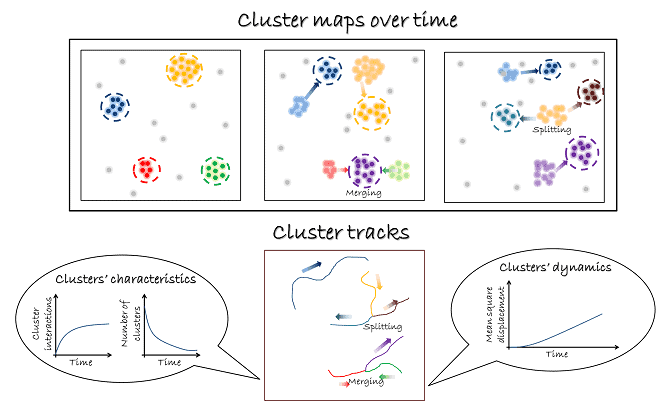
Some of the nanocluster phenomena quantifiable with the new tool

Since the advent of super resolution localization microscopy (SMLM), researchers have raced to extend the technique to live cells. However the time required to obtain each image has so far prohibited applying the technique to study dynamics. In order to get access to the nanoscale machinations of proteins in cells, Juliette Griffié and colleagues developed a tool that tracks clusters of molecules from very sparse SMLM data.

The tool works using a Bayesian statistical framework, and increases temporal resolution, allowing them to image fast processes within live cells that were beyond the scope of previous techniques. With it they show they can track how protein clusters allow cells to dynamically segment tasks on a tiny length scale, providing insights into the mechanism of how the cell functions.

Reframing ‘temporal resolution’

Super resolution localization microscopy works by temporally separating flashes of light from fluorophores – molecules that re-emit light after light excitation – which would otherwise overlap. By making the fluorophores switch on and off, the signal from each light flash is separated from other flashes and its centre can be estimated precisely as a single point.

As these points represent the positions of molecules, the techniques really lend themselves to the study of nanoscale phenomena. However to build up a super resolution image, researchers typically sum the points from thousands of individual time frames, and this is what makes building up an image slow. For instance, a meaningful image composed of molecular clusters may require 500 raw frames: the time between each reconstructed frame could be as much as 15 seconds, even with the most applicable fluorescent protein available today mEos3.2 – .

Usually, researchers think of temporal resolution as something to be improved by altering the microscope or the type of fluorophore. Instead Griffié and colleagues focus on using clever analysis techniques to reduce the amount of input data required to reach the true answer.

How does it work?

The algorithm takes a circle around each point, and counts the points within the circle. If the points exceed a threshold, the group is designated a cluster, and descriptors are extracted from it such as size and density. To test thousands of different circle sizes and thresholds, the algorithm uses a Bayesian approach, assessing the quality of the assignments of molecules to clusters against a user supplied model. The method enables a wide range of clustering phenomena to be investigated with different sizes and densities, even in the same cell.

Using this method, the team performed stress tests. If a cluster really contains 50 molecules and is 100 nm in size, what is the minimum number of detected molecules required to register the correct size and density of the nanoclusters in that sector? By performing simulations, the team found that only 20 detected molecules are required per square micron, so  fewer raw frames need to be summed together to form a single reconstructed frame. By using further computational tricks such as a sliding window of analysis and reduced proposal generation for adjacent reconstructions, the team were able to achieve sub-second temporal resolution.

To prove that the technique is valuable for studying real molecules, they imaged CD3 zeta, part of the T cell receptor by fusing it to mEOS3.2. As well as size and relative density, other characteristics could be described, such as the movement of the clusters, and their splitting or merging with other clusters. These are newly imaged phenomena on this length scale, and are likely to play a role in the regulation of many proteins on the nanoscale within cells. Griffié and colleagues plan to extend the technique to 3D data.

Full details of the work can be found in the journal Small methods

Analysis: less is more

This paper represents a different way of thinking about localization microscopy. There is a move away from high sampling being the goal by proving that small amounts of input data on size and density can produce consistent answers, which can easily be compared between conditions.

Fluorescent protein engineering may also complement this technique. Multi-blinking, easily replenished or reversibly switchable fluorescent proteins may provide fuller and more constant sampling rates. Also, dependent on the fluorophore, low laser powers can be used to produce fewer localizations with nonetheless the same precision as at high laser power. As well as being able to image faster cellular processes therefore, this software technique may also increase the applicability of SMLM to sensitive primary cells or longer-term imaging. It is likely that techniques based on light sheet microscopy will be able to provide reliable live SMLM data in sensitive cells, enabling whole cell sampling and 3D nanocluster tracking.

The combination of advances in the hardware, advances in fluorescent protein based imaging, and advances in quantification will together provide a more holistic picture of temporally regulated nanoscale happenings. Such phenomena may be widespread in cells but have never been identified on this length scale. They are inherently out of the reach of even the best single-molecule tracking techniques, which only look at single molecules. Whole cluster tracking will be especially important in cells such as T cells, which use heretofore uninvestigable spatial regulation of nanoscale clusters to achieve very fast regulation.

Steven Chu talks nanoparticles, cell tracking and ultrasound at Lindau

Steven Chu

“You can observe a lot by watching,” opened physicist and former US Secretary of Energy Steven Chu, at his lecture at the 68th Lindau Nobel Laureate meeting in Germany last week. The quote, by baseball player Yogi Berra, is a nod to the biomolecular and biomedical imaging research that the 1997 physics Laureate now focuses on. Chu presented several new, as yet unpublished findings in the lecture in Lindau.

Based at Stanford University, a major focus of Chu’s lab is rare earth nanoparticle biomolecular probes. Attached to proteins in live cells, these probes emit light when optically stimulated, enabling the molecules to be imaged at high resolution using optical microscopy. Their main application is in basic biology research.

Lighting proteins more brightly

In 2010, Chu’s lab began to develop nanoparticles, after the ones they were using hit a ceiling in brightness and therefore imaging sensitivity. Their new design comprised a 5 nm pure crystal core of sodium yttrium fluoride (NaYF4), surrounded by a shell of the same material, but doped with ytterbium and erbium ions. These, in turn, were enclosed in an inert 28 nm-diameter outer shell. The ytterbium–erbium pairing generates upconversion, where illumination with infrared photons stimulates the emission of shorter wavelength visible light for imaging.

The core-shell-shell structure enabled significantly greater ytterbium doping compared with previously reported nanoparticles comprising a simple doped spheroid. This, in turn, increased upconversion, resulting in dramatically brighter nanoparticles.

In the first tests of the nanoparticles this year, an illumination intensity of 8 W/cm­2 resulted in luminescence 150 times brighter than the simple spheroid nanoparticles. These were the first images of an individual nanoparticle of that size using an illumination intensity less than 1 kW. At the sub-watt illumination intensities used in in vivo animal studies, the difference becomes greater still. Here, the researchers estimate that the new nanoparticles are three orders of magnitude brighter.

Tracking proteins in live cells

A valuable application of the rare earth nanoparticles for biologists is the tracking of proteins in live cells as a means to uncover their inner workings.

In a spectacular example also demonstrated by Chu’s lab this year, the nanoparticles were used to track the transport of nerve growth factor along the axon of a live dorsal root ganglion neuron at room temperature. Imaging with a frame rate of 2.5 ms and spatial resolution of 2 nm, even the individual steps taken by the molecules could be discerned.

Consequently, transport to and from the neuron body could be seen. The capability is a valuable one, as retrograde transport has been implicated in neurodegenerative conditions such as Alzheimer’s disease.

Photostability is an important advantage of the rare earth nanoparticles in tracking experiments. Organic dyes, for example, photobleach in seconds, while the rare earth nanoparticles are fully photostable and continue to luminesce for hour to days, enabling longer observation. Unlike quantum dots, the particles also do not blink, enabling uninterrupted observation. In an additional benefit, the particles are non-toxic.

Future applications will include investigations of immune and cancer cell behaviour and the differentiation of stem cells in animals, predicts Chu.

Guiding tumour surgery

The brightly emitting nanoparticles could also benefit patients directly. In new research, Chu’s group is collaborating with surgeons at Stanford on their real-time use during tumour excision. Traditionally, surgeons rely on visual inspections and touch to identify tumour margins, which can result in incomplete excision.

Instead, the collaboration plan to use the nanoparticles combined with cancer-specific antibodies to target and light up the tumour when excited by low-intensity infrared light. Their goal is for the surgeon to eyeball the tumour margins, without a camera, exploiting the intense luminescence of the nanoparticles.

New approaches to ultrasound imaging

Highlighting a second major area of investigation, Chu described several ongoing projects in ultrasound imaging, the findings of which are still to be published.

Diffraction-limited ultrasound

Speckle is a classic feature of traditional ultrasound images and compound imaging is a well-established strategy to remove it, spatially, by acquiring images from several angles or spectrally using more than one frequency.

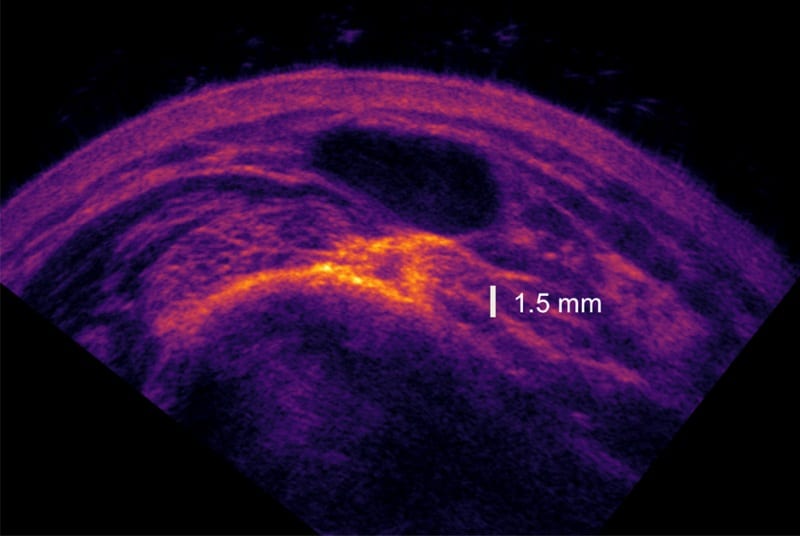
In a new step, Chu’s group has combined both types of compounding. In doing so, they demonstrated overall reductions in speckle that are the multiple of improvements provided by the techniques individually. In an example of a wrist in vivo, a six- to eight-fold reduction over conventional ultrasound was obtained using angular compounding with nine angles and spectral compounding using two frequencies. Spectral compounding alone provided only a two- to three-fold reduction.

The researchers have also extended their technique with an algorithm to correct distortions of the scan volume due to patient motion, transducer pressure and weak acoustic lensing effects by the tissue. To do so, they exploited computational methods developed for convolutional neural networks combined with NVIDIA GPU chips that “mapped beautifully” on to the problem.

Currently, the new techniques take around 10 s, but with advances in GPUs, computational times will drop below one second, predicts Chu. At a frequency of 15 MHz, the approach produces diffraction-limited images with a transverse spatial resolution of approximately 90 µm.

Chu’s lab is also developing a nonlinear ultrasound technique that promises significantly greater image contrast than conventional imaging. The approach exploits a difference-frequency of 1 MHz generated when tissue is simultaneously insonated at 5 and 6 MHz.

Potential applications include tumour imaging. In an example, Chu showed preliminary data of a nonlinear image of a glioblastoma brain tumour in a mouse. It showed bright spots matching the location of the tumour, verified by pathology, which were not discernible in a conventional image.

Steven Chu’s full lecture – Recent Advances in Biomolecular and Biomedical Imaging – can be seen below. (Courtesy: Lindau Nobel Laureate meetings)

Encapsulated cells to regenerate intervertebral discs

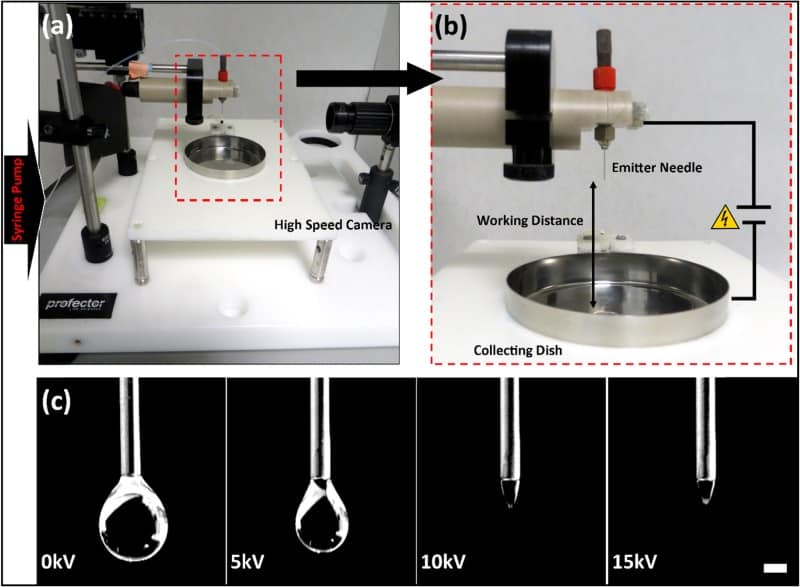
Electrodynamic spray set up

Cell therapy is a promising approach for the treatment of many degenerative diseases. For instance, chondrocytes (cartilage cells) are currently being tested in clinical trials to treat intervertebral disc degeneration, cartilage disease and osteoarthritis. However, the localized delivery of cells still poses some important challenges.

For example, when injecting the cells, most of them can be lost from the affected zone through diffusion to other parts of the body. Meanwhile, the large needles used can cause further damage in the degenerated intervertebral disc. Another limitation is the survival of the cells, which is usually quite low and limits the efficiency of the treatment.

Given these limitations, Conor Buckley and his team from Trinity College Dublin have recently characterized an electrodynamic spray system to encapsulate chondrocytes for delivery to degenerated intervertebral discs (Biofabrication 10 035011). To do this, they optimized the conditions to “trap” and deliver the cells and tested their effects on the viability of the chondrocytes.

Trinity College Dublin team

How does electrodynamic spraying work?

The researchers used an electrodynamic spray microencapsulation system to “trap” cells in protective microdroplets of alginate, a natural polymer. This technique is based on the application of an electric voltage to a needle while pumping through a polymer solution containing cells. The electric potential in the needle overcomes the surface tension forces of the polymer solution and creates a cone at the end of the needle, called a Taylor cone. From this cone, a jet of microdroplets is ejected and collected, containing cells for further application.

However, multiple variables can influence the formation and properties of such microcapsules. Therefore, the team analysed various processing conditions – such as needle gauge size, electrical charge and pumping flow – to understand how they influence the microcapsules.

 Playing with flow, charge and needles

The first stage was to assess how the combinations of the different conditions affected the alginate microcapsules. The researchers found that increasing the voltage and decreasing the needle size decreased the diameter of the particles but resulted in some variability in their size.

Small particle size is a desirable characteristic since it allows use of a smaller needle when injecting the cell-loaded microcapsules into the intervertebral disc, thus decreasing damage to the patient’s intervertebral disc. Moreover, although size homogeneity in the particles could provide positive features such as a more controlled diffusion, the observed slight variation also permits a higher packing density and therefore delivery of denser material.

Increasing the concentration of the polymer increased the particle size, whereas increasing the flow produced more ellipsoidal rather than spherical particles, with no effect on the size. However, increasing the polymer concentration also decreased cell viability, which the authors attributed to the shear forces caused by higher concentrations.

Different sizes and shapes

Based on these results, the researchers chose an operating set up of 10 kV, a 30 gauge (G) needle, 1% alginate and a flow rate of 0.1 ml/min. This parameter set enabled microcapsule injection with a 25G needle, without affecting cell viability, making it suitable for cell delivery.

What about the cells?

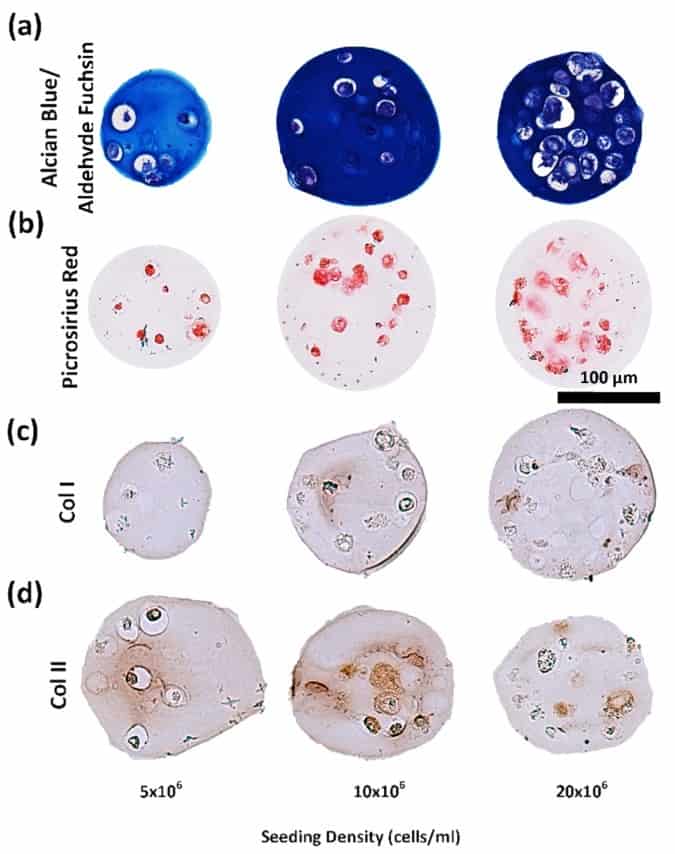
Once the set up was optimized, the team next determined how many cells the microcapsules can carry and how this affects their behaviour. They tested three different initial cell densities: 5 million, 10 million and 20 million cells per ml.

They observed that higher densities decreased cell viability, which can be explained by cell-to-cell signalling and/or by the depravation of nutrients due to the high number of cells consuming them. In fact, the low availability of nutrients is a characteristic of the intervertebral disc environment.

Component production

The researchers also tested whether the cells were producing the main components of the intervertebral disc microenvironment: collagen and glycosaminoglycans (sugar polymers highly present in intervertebral disc and cartilage). They found that chondrocytes in the alginate electrosprayed microcapsules did indeed produce such components, at higher amounts from the high cell density samples, but more efficiently (more collagen/glycosaminoglycan per single cell) at low cell densities.

Moreover, the cells produced these components in a very similar ratio to that found in an intervertebral disc. The authors concluded that the 10 million cell per mL density presented the best balance between viability and intervertebral disc component production.

A minimally invasive cell-delivery system

This study adds important knowledge to the electrodynamic spray microencapsulation technique and may help in the development of further systems employing this powerful approach. The researchers successfully developed a chondrocyte-encapsulation system that preserves the viability of the cells and promotes the deposition of key components of the intervertebral disc microenvironment. In addition, such a system can be delivered through minimally invasive systems, representing a high potential for (though not limited to) intervertebral disc cell therapy.

Copyright © 2026 by IOP Publishing Ltd and individual contributors