In case you haven’t listened to it yet, make sure you check out our new topical podcast, Physics World Weekly. Each week, a selection of Physics World journalists discuss research breakthroughs, key events and some of the most important talking points in physics and its related disciplines.
Now in its seventh week, yesterday’s episode, presented by Hamish Johnston, explored asteroids, the incredible properties of water, and what it takes to create a successful spin-out business from physics research. We were also joined by special guest Lincoln Carr (see photo above) of the Colorado School of Mines who spoke about his research in quantum simulators as well as his passion for bridging the gap between the sciences and the humanities.
Football fans should also take a listen to this episode where Matin Durrani and I chewed the fat about the ways physics interacts with the beautiful game. The only bit of “fake news” is Matin’s World Cup predictions, which included England crashing out in the group stages of the tournament!
As someone who has spent a good few years learning the craft of video production, I must admit it that producing these first few episodes has been a liberating experience. Where video has an endless list of considerations (lighting, composition, exposure, what to wear??), producing a conversation-based podcast is relatively streamlined. There is a satisfying simplicity in setting up a couple of microphones and encouraging our journalists to speak their minds on the issues they are immersed in every day.
If you enjoy what you hear, then you can subscribe to this podcast on Apple Podcasts and other podcast applications. You can also listen to our other podcast Physics World Stories, which takes a wider look at specific themes in the physics community.
“Chinese cuisine is one of the richest and most interesting cuisines in the world,” write the physicists Andrey Varlamov, Zheng Zhou and Yan Chen in a paper on arXiv that explores the physics of Chinese food. Questions explored by the trio include “What is the difference in the physical processes of heat transfer during steaming of dumplings and their cooking in boiling water?” and “Why is it possible to cook meat stripes in a ‘hot pot’ in ten seconds, while baking a turkey requires several hours?”.
Varlamov is based in Italy so it is not surprising that he has also posted a paper on arXiv about the physics of baking pizza. Teaming up with physicist Andreas Glatz and food anthropologist Sergio Grasso, Varlamov compares pizza cooking in traditional wood-fired brick ovens and modern domestic ovens.
Here is something to think about while your pizza is baking. Why can you easily stretch a knitted scarf, whereas its individual strands of yarn are very difficult to stretch? If you are stumped, check out “Stitching together a knit theory” by Michael Schirber – who explains how physicists in France have created a new model of how knitted fabrics respond to stretching forces.
An optical device that uses mechanical rotation to allow light to propagate in one direction along a fibre, but not in the opposite direction has been built by an international team of researchers. The device could find use in optical circuits, where it is very difficult to prevent light from propagating in unwanted directions. However, practical applications may be difficult to achieve.
The idea of using mechanical rotation to allow waves to travel in one direction, but not in the opposite direction, was first developed in 2014 by Andrea Alú and colleagues at the University of Texas at Austin. They placed a fluid into a circular cavity and stirred it so the fluid rotated. Sound waves travelling around the cavity in one direction were pushed along by the fluid, whereas waves travelling in the opposite direction were held back. As a result, the resonant frequency of the cavity was different for sound moving in opposite directions. By judiciously choosing the rotation speed of the fluid, the researchers could ensure that sound waves at a chosen frequency could only travel in one direction around the cavity.
The same ideas can be applied to light waves, however, the speed of light is much faster than the speed of sound, and consequently the frequencies involved are so much higher – making the technique seemingly impractical. Instead, researchers have looked at other ways of achieving one-way transmission – including the use of strong magnetic fields — but these have also proven to be difficult to adapt for practical applications.
Tapered fibre
In the new research, Shai Maayani, Raphael Dahan and Tal Carmon at Technion – Israel Institute of Technology and colleagues have returned to rotation. They use a cylindrical, silica-glass resonator that is 4.75 mm in diameter and is rotated on a turbine at speeds up to 6.6 kHz. An optical fibre that is tapered to be 1088 nm in diameter is located 320 nm above the spinning resonator.
Light travelling along the fibre interacts with the nearby resonator via the light’s short-range evanescent field. In analogy to the rotating fluid, light travelling in the same direction as the spinning resonator perceives it to be less dense than does light travelling in the opposite direction. This difference in apparent density means that the index of refraction of the resonator will be different for light moving in opposite directions.
For this reason, the resonant frequency of the system is different for light travelling in opposite directions. This allowed the researchers to pass light of the same frequency down the fibre from both ends and have light be transmitted from one side but blocked from the other: “Wavelengths that are off resonance with the cavity will be transmitted; wavelengths on resonance with the cavity are absorbed,” explains Maayani, now at the Massachusetts Institute of Technology.
Delicate matters
The team is now looking at the feasibility of creating practical devices: “A tapered fibre will fail after a few hours because of the humidity in the air,” explains Maayani. “But if you encapsulate it in an inert environment, it can last for years. The other big problem is vibration – at present, this is a delicate experiment that requires an optical table.”
Alú – now at City University of New York – is impressed by the researchers’ technical achievement, saying that, “from the fundamental side, they’re proving what we already proved for sound, but they’re doing it for light – which is impressive, because the technology required is much more complicated”. He says that the device could have advantages over optomechanical systems in energy efficiency, but the researchers will need to demonstrate its practicability when scaled down: “As you scale things down, typically the quality factors go down and the requirement on speed goes up. At some point, some trade-offs will have to be made,” he says.
Mohammad Hafezi of University of Maryland, College Park agrees: “I find it very cool that we can rotate something and look at the huge spectral shift in transmission between forward and backward,” he says, “but in terms of non-magnetic non-reciprocity, this whole field has been a challenge, and we haven’t seen a real technological solution yet.”
The use of PET scans to confirm the presence of dementia-inducing amyloid plaque in the brain may be ready for routine clinical use, based on a prospective study published in JAMA Neurology. Researchers found that both positive and negative results influenced the diagnosis and treatment of patients with and without dementia (JAMA Neurol. 10.1001/jamaneurol.2018.1346).
The researchers took the unique approach of enrolling subjects ranging from patients with confirmed cognitive impairment to people with no dementia at all. They discovered the presence of amyloid in both sets of subjects, which could provide a “bridge between validating amyloid PET in a research setting and implementing this diagnostic tool in daily clinical practice,” they wrote.
“Our findings demonstrate that both amyloid-positive and amyloid-negative PET results changed diagnosis and treatment in a significant number of patients,” said lead author Arno de Wilde from VU University Medical Center (VUMC) in Amsterdam. “We observed this in both patients with and without dementia, [so] amyloid PET can be of value in a selection of patients in clinical practice.”
Amyloid factor
The accumulation of beta amyloid in the brain is one key indicator of possible progression to dementia or Alzheimer’s disease. With the development of tracers such as carbon-11-labelled Pittsburgh Compound B (C-11 PiB) and amyloid PET imaging, the modality has become increasingly important in the research of neurodegeneration.
Arno de Wilde from VU University Medical Center.
Researchers at VUMC have been performing amyloid PET scans in selected research patient populations for several years now. More recently, they have begun to make the modality available in clinical practice, using amyloid PET in people seen in the institution’s memory clinic as part of routine diagnostic workup, de Wilde wrote in an email to AuntMinnie.com.
“We offered amyloid PET to all patients visiting our clinic, even if they were not cognitively impaired or there was no suspicion of Alzheimer’s disease,” he said. “This unique approach gave us the opportunity to determine the value of amyloid PET in an unselected memory clinic population.”
VUMC’s amyloid PET protocol includes the radiotracer florbetaben (Neuraceq, Piramal Imaging). It is indicated for PET imaging to estimate beta-amyloid neuritic plaque density in adult patients with cognitive impairment who are being evaluated for Alzheimer’s disease and other causes of cognitive decline.
Florbetaben is one of three F-18-labelled amyloid PET tracers that have been approved by the US Food and Drug Administration and the European Medicines Agency for clinical use. The other two are florbetapir (Amyvid, Eli Lilly) and flutemetamol (Vizamyl, GE Healthcare).
“Amyloid PET has been proven to be a valid and stable technique to visualize cerebral amyloid plaques,” de Wilde said. “However, studies that demonstrate the usefulness of amyloid PET in patients whose diagnosis and treatment are based on amyloid PET status are lacking.”
Clinical subjects
The researchers enrolled 507 patients from VUMC’s memory clinic who were participating in the Alzheimer Biomarkers in Daily Practice (ABIDE) project between January 2015 and December 2016. The subjects had a mean age of 65 years (±8 years) and varying degrees of dementia and cognitive issues.
The subjects consisted of 164 (32%) people with Alzheimer’s dementia, 114 (23%) with mild cognitive impairment, 159 (31%) with subjective cognitive decline, and 70 (14%) with non-Alzheimer’s dementia. Cognition evaluations were based in part on Mini-Mental State Examination (MMSE) test scores and a family history of dementia.
From that information, one of two neurologists who co-authored the study determined whether subjects presented with clinical symptoms of Alzheimer’s, such as dementia, mild cognitive impairment or subjective cognitive decline. The neurologists then determined the suspected aetiology of the symptoms, with causes including Alzheimer’s disease, vascular problems, frontotemporal dementia, Lewy body dementia or a neurodegenerative disease. The physicians then rated their level of diagnostic confidence in the suspected aetiology on a scale of 0% to 100%.
Amyloid accumulation
The researchers found evidence of amyloid on the PET scans of 242 patients (48%). Amyloid was most prevalent among the 164 patients with Alzheimer’s dementia: 128 were amyloid-positive (78%). Subjects with non-Alzheimer’s dementia were the next most prevalent group, with 45 (64%) of 70 being positive for amyloid.
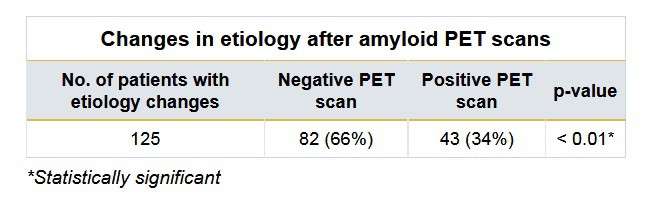
After undergoing amyloid PET scans, the suspected aetiology changed for 125 patients (25%), with a negative PET scan contributing more significantly to the change in diagnosis than a positive PET scan.
Treatment plans changed for 123 patients (24%), the researchers found. A positive amyloid PET scan prompted changes in medication, a clinical trial referral or both, while a negative amyloid PET scan most often resulted in a follow-up FDG-PET scan, genetic screening or referral to a psychiatrist.
Changes in diagnoses did not differ significantly between patients with dementia (50 of 234, 21%) versus subjects without dementia (75 of 273, 28%) (p > 0.05).
As for the neurologists reading the results, the additional information gleaned from the amyloid PET scans boosted their diagnostic confidence by a mean of 80% to 89% (p < 0.001).
“This study goes beyond previous findings, as we also assessed patient-reported outcomes,” the authors wrote. “More than 80% of patients experienced the PET scan as not burdensome. One-fifth of patients expected the PET scan to be burdensome, and a similar fraction, looking back, said to have experienced the PET scan as burdensome.”
In addition, when patients were told of the amyloid PET scan results, their level of uncertainty decreased while their anxiety levels remained stable. That finding, de Wilde suggested, means that disclosing the PET result in clinical practice does not have an adverse effect on patients’ psyche.
“The current study demonstrates that amyloid PET can be valuable in a selection of patients,” he concluded. “We are currently trying to identify those patients who benefit most from amyloid imaging and create a tool that helps clinicians to identify those patients.”
And as it does so, it may slow the rate of inexorable ice melt, as the western part of the continent sheds ice in response to global warming driven by profligate human combustion of fossil fuels.
But for the moment the finding is yet another surprising demonstration of what geophysicists call isostatic response: as mass is shifted from the surface of the continent – and that region of Antarctica has lost three trillion metric tons of ice in the last 25 years – the semi-liquid rocks of the Earth’s mantle, deep below the continental crust, flow below the lightening burden to liftthe crustal rocks higher.
“But the earth also acts a bit like a very hard memory-foam mattress. And it slowly keeps readjusting for several thousand years after the melting. In Scandinavia the bedrock is still rising about 10 millimetres per year because of the last ice age.”
Dr Barletta and US colleagues report in the journal Science that they gathered data from six global positioning satellite stations fixed to the exposed rock around a stretch of West Antarctica called the Amundsen Sea embayment.
They coupled that with seismic studies of the crustal bedrock and then ran an immense number of computer simulations to settle on the most likely explanation – that deep beneath that point of the southern continent, the Earth’s mantle was relatively hotter and more fluid, and could respond to changes in mass more swiftly.
Polar perplexities
At the heart of such research is the puzzle of southern polar dynamics: the complex interplay of ocean, atmosphere, precipitation and topography that keeps Antarctica the coldest, driest, iciest place on the planet: it may be technically a desert, but its continental crust carries almost two thirds of the world’s freshwater in frozen form. If it all melted, global sea levels would rise by 70 metres.
But such is the weight of ice that some parts of the continent are depressed below sea level. In West Antarctica the surrounding sea ice is so thick it is anchored to submerged bedrock, to provide a buffer that slows the rate of glacial flow from inland.
And the fear is that, as the oceans and atmosphere warm in response to ever-rising levels of greenhouse gases in the atmosphere, winds and currents could loosen the great shelves of sea ice and send them floating north, at which point the glacial flow from the high ground of the continent to the sea would accelerate.
Stability explained
So the latest discovery helps explain the wider puzzle of why Antarctica’s ice has been relatively stable over long geological periods: as the ice melts, the bedrock rises, and the ice shelves are more likely to stay anchored to the mainland, at least at that particular “pinning point” above a hotter, more fluid mantle.
There is another factor at work: the gravitational pull of the ice itself, which raises sea level near the great mass of ancient polar ice. As the ice melts, the gravitational tug diminishes, and the sea levels subside.
“The lowering of the sea level, the rising of the pinning points and the decrease of the inland slope due to the uplift of the bedrock are all feedbacks that can stabilise the ice sheet,” said Terry Wilson, of Ohio State University, and one of the authors. “Under many realistic climate models, this should be enough to stabilise the ice sheet.”
But as planetary average temperatures rise, so does the hazard. Rick Aster, of Colorado State University, and another of the authors, warned: “To keep global sea levels from rising more than a few feet this century and beyond, we must still limit greenhouse gas concentrations in the atmosphere, which can only occur through international cooperation and innovation.”
Mesh electronics, a macroporous network of components with mechanical properties similar to that of biological tissue, is a relatively new technology that can be used to probe activity in the brain. Now, researchers at Harvard University in the US have developed an injectable mesh that can record the neural activity of mouse eyes in vivo. The device, which does not interfere with eye movement or light-processing, could help neuroscientists study the fundamental properties of primary vision input retinal ganglion cells (RGCs) and how these cells connect with other vision-related brain regions for the first time. The work could also help in the development of retinal prosthetics for restoring vision through non-surgical procedures.
“Mesh electronics is a submicron-thick, large-area macroporous network,” explains team leader Charles Lieber. “We fabricate the meshes as flat 2D sheets using standard semiconductor photolithography-based techniques and suspend them (like a colloid) in aqueous solution. Our specific design, which we first reported on back in 2015, enables mesh electronics to be rolled up into a tubular structure and drawn into a syringe needle.”
On the scale of a single neuron
“We can deliver these structures into specific brain regions with a spatial precision of 20 microns (which is on the scale of a single neuron) using the controlled injection approach we developed. This allows us to control the rate at which we withdraw the needle during injection and means that the mesh structure remains fully extended in the dense tissue of the brain during injection and does not crumple.”
In their new work Lieber and colleagues “non-coaxially” injected the mesh electronics onto the highly curved retinal cup of the eye. As the structure unrolls it forms a stable recording interface to RGCs, which process visual information received by photoreceptors (rods and cones). The researchers then did a series of experiments.
Monitoring the activity of the RGCs
“First, we monitored the activity of the RGCs using the device and were able to measure the response of different subtypes of these cells in a chronically stable manner,” explains team member Guosong Hong. “We found that some RGCs respond to light intensity while others respond to other visual cues, such as gratings comprising alternating black-and-white stripes and moving in specific directions. We were able to monitor individual RGCs repeatedly over a two-week period.
“Next we monitored the RGCs at four-hour intervals over several day-night cycles and found that some of the cells fire with a higher activity during the day-time circadian phase than during the night time phase, while some others do the opposite. This reveals, for the first time, the idiosyncrasy of circadian behaviours of different RGCs.”
The retina, which processes visual information and sends it to the brain, is an excellent model for studying neural circuitry. Until now, however, most retina studies meant killing laboratory animals and then removing their retinas to analyze. This meant that the information obtained was limited.
First high-resolution measurement of the retina in awake animals
“Existing techniques to measure in vivo neural activity in retinas typically make use of metal microwire electrodes to record from a few RGCs in anaesthetized animals with relatively large eyes over a short period of time,” says team member Tian-Ming Fu. “Or they rely on electroretinography (ERG) to measure the collective activity of a population of neurons in the retina with limited spatiotemporal resolution. Our method is the first high-resolution chronic measurement of the retina in awake animals.”
The researchers, reporting their work in Science DOI: 10.1126/science.aas9160, now have several new projects under way. “For one, we would like to map the entire visual pathway, from the retina through to the lateral geniculate nucleus (LGN), which is a relay centre in the thalamus, to the visual cortex and higher-level brain regions at the single cell level,” Lieber tells Physics World. “We would also like to apply the non-coaxial mesh electronics injection technique, demonstrated for the first time in this work, to other parts of the nervous system, such as the spinal cord and the neuromuscular junction.”
What do a toaster and a quantum simulator have in common? Lincoln Carr of the Colorado School of Mines explains in this episode of Physics World Weekly. Carr, who has worked as a professional actor, also explains why scientists should have a good grounding in the humanities.
Also in for a chat this week is Physics World’s nanotechnology expert Anna Demming, who talks about an exciting new measurement that confirms yet another amazing property of water.
Next up is our industry guru Margaret Harris, who has interviewed many physicists who have become successful entrepreneurs. She shares her insights into what it takes to take a great idea and make it into a viable business.
If you enjoy what you hear, then you can subscribe to this podcast on iTunes and other podcast directories.
A new graphene-based bolometer has been created by Dmitri Efetov and colleagues at the Massachusetts Institute of Technology. A bolometer measures the power of incident electromagnetic radiation and the team says that the new device is much faster and more sensitive than current bolometers – and does not need to be chilled to ultracold temperatures. It could have a wide variety of applications, including heat monitoring in buildings, astronomical observations and quantum information processing.
Conventional bolometers measure the power of incident electromagnetic radiation by measuring temperature changes in a metal sheet as it absorbs energy from the radiation. This setup has important limitations; no matter what metal is used, the bolometer will have a limited sensitivity, and will only be able to detect radiation with wavelengths within certain ranges. Furthermore, in order to achieve a reasonable signal-to-noise ratio, the metal sheet must be connected to a thermal reservoir that is maintained at ultralow temperatures – which makes the devices expensive to run.
Efetov’s team say they have solved these problems by replacing the metal with a single sheet of graphene – a material just one atom thick that contains a 2D gas of electrons. “Unlike a traditional bolometer, the heated body here is simply the electron gas, which has a very low heat capacity, meaning that even a small energy input due to absorbed photons causes a large temperature swing,” Efetov explains. When the graphene is coupled to a photonic nanocavity, the signal is amplified further, allowing for precise measurements of photon energy.
Rapid heating
Graphene-based bolometers offer a host of advantages over their metal counterparts, say the researchers. While metals take a long time to heat up, electron gases can heat up in just picoseconds, allowing the bolometer to operate at ultrafast speeds. Electron gases are also sensitive to photons of all wavelengths, giving the device a much greater bandwidth than previous bolometers. Finally, any incoming radiation will have a far greater influence over the electron gas than the surrounding temperature, meaning the graphene does not need to be kept at ultralow temperatures to minimize noise.
Efetov, who is now at the Institute of Photonic Sciences in Barcelona, is confident that the device will be used for a broad range of applications in the near future. The bolometer’s ability for room-temperature operation means it could be used in thermal sensors for buildings, monitoring heat escaping from poorly insulated houses. In astronomy, it could fill in missing wavelength bands like the terahertz gap, allowing for observations of previously unobtainable signals. The device’s ability to sense tiny changes in radiation could allow for new kinds of quantum sensing and information processing devices. “We believe that our work opens the door to new types of efficient bolometers based on low-dimensional materials,” Efetov says.
NASA has announced that the James Webb Space Telescope (JWST) will be launched on 30 March 2021, delaying the mission by a year. The postponement will add another $800m to the cost of the craft, boosting it to $8.8bn. This extra cash will first have to be agreed by the US Congress, which in 2011 capped the cost of the JWST at $8bn.
A report by the US Government Accountability Office (GAO) in February stated that the JWST was unlikely to meet its then launch date of 2019. Engineers at Northrop Grumman Aerospace Systems in California – the main contractor involved in building the telescope – had been grappling with a number of issues such being able to safely deploy the craft’s huge 21 x 14 m sunshield without tearing the ultrathin fabric.
In March, NASA announced that the launch would be put back to May 2020 at the earliest and established an independent review board, chaired by NASA veteran Thomas Young, to investigate the impact of the delays. In the 63-page report, released yesterday, the independent review board discovered a number of technical issues that have hit the development schedule, including human errors. That includes using the wrong solvent to clean fuel valves and not tightening the sunshield’s fasteners properly, which keep it furled up before the craft reaches space.
The report offers several recommendations, which NASA already has or will implement, including bringing in a “world-class” system engineer as a dedicated commission manager who would already have the experience and technical knowledge of the JWST’s design. “Webb is vital to the next generation of research beyond NASA’s Hubble Space Telescope,” notes NASA Administrator Jim Bridenstine. “Despite major challenges, the board and NASA unanimously agree that Webb will achieve mission success with the implementation of the board’s recommendations, many of which already are underway.”
Analysis: a decade of disappointment
The launch of the James Webb Space Telescope (JWST) was starting to feel within touching distance. Set to blast off next year, excitement was brewing in the community with astronomers writing proposals for observing time on the JWST’s four scientific instruments. But following the telescope’s delay until March 2021, once again it feels a distant prospect.
Initially expected to cost $500m with a launch date of 2007, since then the JWST has had its departure rescheduled on more than 10 separate occasions. To adapt a term widely used by critics of nuclear fusion, the launch always seems a year away and who is to say that it won’t be postponed yet again. And while the US Congress capped the cost of the mission at $8bn, that limit has now been smashed – costs set are to rise by a massive $800m with NASA force to take its begging bowl to Congress.
The engineering challenge to build the JWST is huge. The behemoth can easily be categorized as a “civilization-class” mission – pushing the forefront of engineering. The JWST’s sunshield, for example, which keeps the instruments cool and in a stable environment, is a massive 20 × 14 m while its 6.5 m mirror is made up of 18 hexagonal segments, giving the telescope a collecting area of 25 m2. Both the mirror and the sunshield are folded away for launch and will then unfurl following take-off.
NASA has been burnt before when launching similar civilization-class projects. Weeks after the Hubble telescope was launched in April 1990, images from it were blurred. The culprit was spherical aberration due to the telescope’s primary mirror having been polished to the wrong shape. Given that Hubble was in orbit around the Earth, astronauts were fortunately able to repair the probe in December 1993.
But it still wasn’t easy – it took 11 days and five space walks, a record at the time. Like Hubble, the JWST is expected to open a new vista on the cosmos. Yet the problem for NASA is that the JWST will instead be placed at Lagrange Point 2 – a place 1.5 million kilometres from Earth in the opposite direction to the Sun. No astronauts will be making a trip there if the telescope encounters any problems.
Space science has seen some incredibly successful and daring missions in recent years, including the landing of the Curiosity rover on Mars in 2012 and the European Space Agency’s Philae lander touching down on comet 67P/Churyumov–Gerasimenko in 2014. The JWST will add to that list. Given the amount of money already spent and the delays, NASA can’t afford to get it wrong. This is especially so if the agency wants Congress on its side to fund future large scale missions such as the Wide Field Infrared Survey Telescope, which US president Donald Trump has already tried to defund in his 2018 budget request.
The JWST is a mission too big to fail. It seems wise to delay the launch until NASA can do all it can to make it a success. The question is, what impact will all these delays and cost overruns be for future programmes?
Oral squamous cell carcinomas (OSCCs) are the most common head-and-neck cancers, but are often diagnosed late. Now, researchers in Germany have developed a new cell-based test that could help provide earlier and more reliable diagnosis of OSCCs. They tested the mechanical properties of OSCC cells, and found they were “softer” than benign cells (Converg. Sci. Phys. Oncol. 4 034001).
Lead authors Josef Käs and Torsten Remmerbach, from the University of Leipzig, said: “Early diagnosis and treatment of OSCCs is essential to enabling recovery. But in up to 60 per cent of cases the diagnosis is late because the growth has not been recognised, or has been mistaken as harmless.”
The researchers examined whether the mechanical properties of cells could be used as a marker for malignancy. They used an optical stretcher to analyse the properties of the cells. Their experiments revealed that cells of primary OSCCs were deformed by 2.9%, rendering them softer than cells of healthy mucosa, which were deformed only by 1.9%.
“This new way of drawing distinction between malignant and benign cells could enable an early confirmation of cancer diagnoses, by testing cell samples of suspect oral lesions,” said Remmerbach.
As well as being softer than benign cells, the team saw that cancer cells exhibited a faster contraction than their benign counterparts when testing the relaxation behaviour after stress release. This finding suggests that deformability and relaxation behaviour can be used as distinct parameters to evaluate differences between benign and malignant cells.
“What we found also has implications for the way studies in cancer research are carried out,” explained co-author Jörg Schnauß. “Many studies are performed with cancer cell lines rather than primary cells. When comparing the mechanical properties of both, our results showed that long time culturing leads to softening of cells. This softening in the culturing process could potentially affect the significance of test results. Because of that, we suggest that future research uses primary cells to ensure accuracy.”