

A revolution in a box

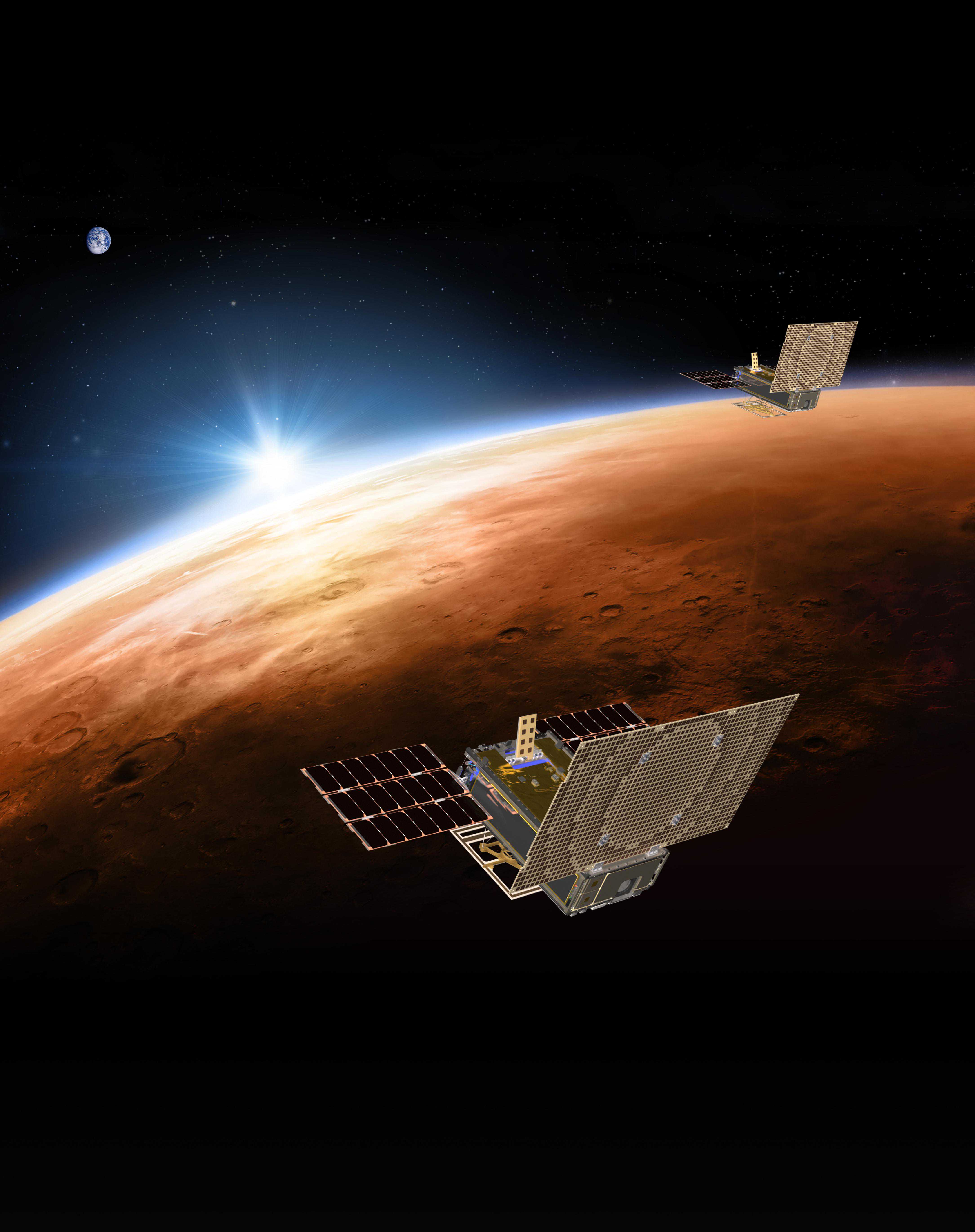
Artist's impression of two satellites over the surface of a reddish planet with a bright light appearing over the horizon and the Earth very small in the distance

Scientists have big hopes for NASA’s Mars InSight mission. When this billion-dollar spacecraft reaches its destination on 26 November, after a six-month trip, a robotic lander will descend to the red planet’s surface. If the lander survives this hazardous final journey, it will spend the next two years studying the interior of our nearest planetary neighbour, burrowing into Mars’ crust with a self-propelled, mole-like hammer and attempting to detect quakes using a special seismometer placed directly onto the planet’s surface. For mission scientists at NASA’s Jet Propulsion Laboratory (JPL), the reward for all this effort and expense will be a wealth of information about the Martian crust, mantle and core.

Even before the lander arrives, though, the Mars InSight mission has already made history – thanks to a pair of briefcase-sized objects that travelled into space atop the same Atlas V rocket. The twin Mars Cube One (MarCO) satellites cost a relatively modest $9m each, and with a combined mass of just 26 kg, they made up less than 4% of the mission’s total payload. Their goals are correspondingly limited: in NASA parlance, the MarCOs are a “technology demonstration”, meant to perform communication and navigation experiments and not to make scientific discoveries. Even so, these unassuming little boxes are pioneers. As the first in a class of miniature spacecraft known as CubeSats to travel beyond Earth orbit, the successful launch of the MarCOs marks the latest milestone in a trend that is sweeping the space industry — changing not only what spacecraft look like but also the types of missions they can perform, and who gets to perform them.

To understand why CubeSats are such a game-changer, consider the Mars InSight mission again, this time in a slightly different light. The lander at the mission’s heart is a highly capable object, but it is also a complete one-off. Most, if not all, of its components were designed specifically for the InSight mission, and before they got anywhere near the launch pad, they underwent a rigorous, lengthy and expensive testing process to reduce the risk of malfunctions. This degree of care and precision is crucial when dealing with instruments and systems that come with six- or seven-figure price tags, but it pushes up the total mission cost, too. The result is an amazing piece of equipment that is, alas, completely beyond the reach of all but a handful of organizations worldwide.

In contrast, CubeSats like the MarCOs have been built and flown by private companies, university research groups, countries without multibillion-dollar space programmes, and even high-school students. Naturally, these miniature satellites can’t do as much as a robotic Mars lander — but then, they don’t cost as much either. In fact, many are such bargains that, in the words of Patricia Beauchamp, a programme manager at the JPL, “you can send up three of them and lose two, and that’s just fine.” The twin MarCOs are a good example of this ethos.  Although somewhat costly by CubeSat standards (thanks in part to the demanding environment of interplanetary space), they are still sufficiently small and inexpensive that there was room and budget to include two in the Mars InSight mission – just in case one of them didn’t work.

Off the shelf

The low cost of CubeSats is partly due to their size, but it’s also a question of shape and standardization. As the name implies, CubeSats pack all of their instruments into a box measuring 10cm on a side. Some CubeSat missions incorporate three, six or even 12 such boxes (the MarCOs, for example, are six-unit CubeSats), but regardless of how many units are involved, the standard size and set of connections for each module means that many components, such as radiofrequency antennae or electronic interfaces, can be purchased off the shelf. That reduces costs even further, to the point where satellite manufacturers are beginning to talk seriously about economies of scale – a concept that has long been alien in an industry dominated by highly specialized, custom-built systems. “We are not handcrafting satellites so much anymore,” says Rafael Jordá Siquier, founder and CEO of Open Cosmos, a UK-based start-up that specializes in building CubeSats and other small satellites. “We are following a mass production process where we make and provide the services for many satellites at the same time.”

Two men holding the framework of a CubeSat stand at a booth next to two completed satellites approximately twice the size of a toaster

Truly mass-manufactured satellites are some way off, and Jordá Siquier cautions that in the space industry “many satellites” might still mean 10 or fewer. However, CubeSats and similarly-sized craft (known generically as smallsats) are already helping to break what had been a vicious circle, where the inherent riskiness of the space business tended to push up already high technology costs, putting off new entrants. “We’re living in a time when I believe there is a big space revolution, and it’s empowered by this technology,” Jordá Siquier says. “I compare it to what happened in the 1980s, when computers stopped being big and expensive and available to a few key players and became small and affordable enough that more people could start using them.”

Small size, big impact

Jordá Siquier also likes to draw parallels between the capabilities of smallsats and those of early microcomputers. “Ten or 15 years ago, people thought that nothing useful could be done with this sort of technology,” he explains. “They didn’t know what they would be using them for. However, as time has gone by and companies like ours have been able to provide technology and services that are more customer-oriented and simple to use, we are starting to see applications emerging in a broad range of domains.”

As examples, Jordá Siquier cites several applications related to Earth observation, including the remote monitoring of crops, major pieces of infrastructure and shipping. The telecommunications industry, too, stands to benefit from the CubeSat revolution: dedicated smallsats could act as relay stations to facilitate satellite-to-satellite communications, while constellations of dozens or even hundreds of CubeSats could bring fast Internet connections to remote areas. On the scientific side, Beauchamp says that groups of smallsats could facilitate new types of missions, such as sending multiple small spacecraft to rendezvous with a single planetary body. “Those are very attractive concepts for getting data that you currently can’t get, or getting it at much lower cost,” she says. “You might have 10 satellites with the same instruments, or you could have all of them have slightly different instruments. There’s lots of games you can play to look at the risks and evaluate what you can do.”

[With CubeSats] you can send up three of them and lose two, and that’s just fine

Patricia Beauchamp, NASA-JPL

Fixing a bottleneck

With so many potential applications for smallsats, and decreasing amounts of money and know-how required to build them, it is hardly surprising that launch providers are struggling to meet demand. Most CubeSat and smallsat missions travel into space on a “rideshare” basis, tucked in alongside bigger, more expensive satellites like stowaways in the hold of a cargo ship. This makes it possible to launch several CubeSats on the same rocket, and helps keep overall costs down, but Jordá Siquier observes that it also restricts customers to whichever orbits the prime contractor wants to reach. In practice, these are often the most crowded geostationary or Sun-synchronous orbits, which may not be suited to the smallsat mission’s needs. Their popularity also means that launch windows are limited, raising the likelihood of weather-related delays.

Sharing a ride restricts the types of payloads that smallsats can carry as well. Natalya Bailey is the CEO and co-founder of Accion Systems, a Boston, US-based start-up that builds ion engines for small spacecraft. She explains that commercially-launched smallsats usually have no onboard propulsion systems because of the attendant hazards. “It’s quite dangerous to put a large pressurized canister of a gas on board,” she explains. “If you were trying to launch your spacecraft as a secondary payload, the primary payload might not accept it. Some of these primary spacecraft are worth one to two billion dollars. They don’t typically want to risk that.”

Limits on payload type and launch slots help to explain why a January 2018 test launch by a small and relatively little-known start-up, Rocket Lab, drew so much attention in the smallsat community. The second-ever launch of the company’s Electron rocket was code-named “Still testing”, but it nevertheless succeeded in placing three customer payloads in orbit: two CubeSats from Spire, a US-based weather data firm, and one from an Earth-imagery specialist, Planet.

Rocket Lab’s first real commercial launch was due to take place on 22 June at its dedicated launch facility in New Zealand’s Mahia peninsula, but was postponed because of a problem with a tracking dish. A company spokesman told members of the press that they hope to try again later in the week. However, even if weather or technical problems produce further delays, the US-headquartered firm appears well-placed to capitalize on the burgeoning launch market for smallsats. According to mission management and integration director Daniel Gillies, Rocket Lab aims to provide affordable, frequent launch services designed specifically for smallsat customers. “You want to go to a 650 km Sun-synchronous orbit with a launch date and time that no-one else wants? No problem,” Gillies told Physics World a day before the scheduled launch. “You can buy the entire vehicle, or at least charter a large proportion of it, and effectively it’s like chartering the private jet. You’re getting to go exactly to the place you want to go, when you want to arrive there.”

With a payload capacity of just 150 kg, Rocket Lab’s Electron is a minnow compared to older launch vehicles like the United Launch Alliance’s Atlas V or SpaceX’s Falcon 9. However, it can carry up to 24 CubeSat-type payloads into low-Earth orbit on a single launch, and it is also relatively quick to construct: Gillies says that 3D printing technology allows them to build up to one engine every day. By the end of 2018, the company hopes to be launching an Electron every month, either from its Mahia facility or from a second launch site at a still-to-be-determined location.

Satellites on the move

Some of the longer-term possibilities for smallsat technology would require all of this launch capacity and then some. Bailey, of Accion Systems, is confident that better, safer propulsion systems (such as the one she and her colleagues have developed, which uses an ionic liquid as a propellant) will significantly extend what smallsat makers can do, and where their craft can go. As an example, she describes a hypothetical customer who wants to launch many satellites at once, then spread them out along a particular orbit — perhaps to conduct ground observations over a large area or set up a telecommunications network. Satellite constellations of this type cannot be constructed without onboard propulsion or separate multi-stage launches, and even the enthusiastic Gillies says that Rocket Lab hopes to replenish mega-constellations of 1000+ satellites, not launch them in the first place.

Photo of a gloved hand holding a square chip with a long tail between thumb and forefinger

Onboard propulsion also gives satellites a longer lifespan, enabling them to nudge themselves back into a higher orbit or take evasive action if they end up on a collision course with a piece of space debris. Such collisions are real possibility: Bailey explains that she was once in the control room of another space start-up when they received an alert from NASA about a potential collision risk to their prized satellite. “They had no propulsion, so the whole room was just silent, holding their breath, hoping that it didn’t happen,” she recalls.

Of course, CubeSats aren’t just at risk of being hit by space debris. They’re also at risk of becoming debris themselves, and the potential environmental implications of launching large numbers of small, expendable satellites into Earth orbit are not lost on the smallsat community. “Space debris is one of the key things that people developing this industry have to be very, very aware of – and very responsible for,” Jordá Siquier says. “We have to be careful of not polluting the environment where we develop our business.”  Beauchamp, however, is less concerned. “Things are beginning to get a little crowded in various spots, but I think it’s going to be a while before it’s a problem,” she says. The reason, she explains, is that most smallsats are launched into low-Earth orbits, and without onboard propulsion, their orbits will decay – ensuring that they self-destruct by burning up in the Earth’s atmosphere within a few years.

It is also possible that CubeSats, far from adding to the collection of space junk, could help to reduce it. In 2017, an Italian start-up called D-Orbit test-flew a CubeSat designed to direct itself (and, in future, any other craft it attaches to) into a doomed orbit on command.  As missions go, it may not be as glamorous as relaying messages from a Martian lander, but if CubeSat technology is to achieve its full potential, an army of little clean-up craft might be just what the industry needs.

Spatial overlap leads to useful quantum entanglement, say physicists

Two independently-prepared identical particles can become entangled when they overlap spatially, even if there is no interaction between the particles. What is more, this entanglement can be used a resource for quantum-information proocessing – according to Rosario Lo Franco and Giuseppe Compagno at Italy’s University of Palermo.

Entanglement is a purely quantum-mechanical phenomenon that allows two or more particles to have a much closer relationship than is allowed by classical physics. While entanglement plays a crucial role in quantum-information protocols such as quantum teleportation and quantum cryptography, not all entangled states are useful as quantum resources.

One important open question is whether identical quantum particles – which are therefore indistinguishable – can be used a practical resource for quantum technologies. One problem, for example, is that identical particles cannot be addressed individually as quantum bits (qubits).

Spatially localized

Lo Franco and Compagno began their study of indistinguishable particles by looking at the “local operations and classical communication”, or LOCC, protocol, which is a quantum-information protocol that involves two distinguishable particles. Then they modified LOCC by considering the effect on two indistinguishable particles (such as photons) that overlap spatially. This could occur, for example, if two photons are in a waveguide at the same time. They call their new protocol “spatially localized operations and classical communication” (SLOCC).

“We have found the novel characteristic that the indistinguishability of identical elementary systems is a source of useful quantum features, especially entanglement,” Lo Franco told Physics World. “We also prove this operational entanglement is physical in that it can be directly exploited by SLOCC to activate quantum teleportation,” he said, adding “the results open the way to new quantum-enhanced applications”.

Lo Franco describes SLOCC as “experimentally friendly” and points out that it can create entangled pairs of photons without the need for an interaction between the particles. As a result, he claims that a source of entangled photons could be created simply by firing two photons into the same waveguide. Such a source has the potential to be much more efficient at producing entangled pairs than current technologies such as those involving parametric down-conversion in nonlinear crystals.

Lo Franco and Compagno describe their calculations in Physical Review Letters and say that as well as working for photons, SLOCC could also be applied to other quantum systems including solid state circuit quantum electrodynamics and Bose-Einstein condensates.

Dust plume in ‘red sun’ event was highly charged

The 2017 red sun event in the UK provided striking images but photographers weren’t the only ones to benefit. Measurements have shown that the airborne particles that turned the sky a deep orange were highly negatively charged, adding more evidence to the idea of “dust electricity”.

Scientists at Reading University used sensors on balloons to find out more about the dust cloud moving overhead. Although the event was unexpected, the team had new instrumentation ready thanks to a recent project focusing on volcanic ash.

“We had to act quickly, but we managed to send one of our balloon probes into the dust plume above,” says Giles Harrison. “The measurements confirmed that there was charge in the plume, near turbulent regions of motion too.”

More details were obtained as winds carried particles above several well-instrumented sites on the ground.

“The surface measurements at Reading showed a particularly dramatic dip in the atmospheric electric field, which turned out to be very similar in measurements at Chilbolton and Bristol,” says Harrison.

Dust plumes strongly influence the local atmosphere by changing the energy balance of incoming and outgoing radiation. As observers witnessed, light scattered by the particles altered the appearance of the sky from blue to orange/red. Direct evidence of charged behaviour could provide new insight into these and other effects.

“Electric fields in the atmosphere have been suggested to encourage alignment of charged particles, rather than being randomly oriented, which changes how sunlight and radiation from the Earth are transferred,” says Harrison. “Some large dust particles have been observed much further from their source than can currently be explained, and it might be that charge reducing their fall speeds helps to explain this.”

The plume of Saharan dust and Iberian smoke responsible for the red sun event in the UK on 16th October 2017 was transported by the remnants of Hurricane Ophelia.

Scientists have been aware for more than 150 years that atmospheric dust can become electrically charged through frictional interactions between colliding particles – a process dubbed triboelectrification.

The researchers were keen to gather as much new information as they could. The balloon-borne sensors highlighted an unexpected dry region within the plume. It’s hoped that this unusual data, which also includes land-based laser measurements, will help to incorporate the electrical effects of dust clouds into analyses.

Harrison and colleagues reported their findings in Environmental Research Letters (ERL).

Optogenetics guides embryo morphogenesis

Optogenetics is a relatively new biological technique that uses light to control the behaviour of cells in living tissue that have been genetically modified (using proteins) to become sensitive to light. Researchers at EMBL in Germany have now used this technique to induce tissue folding and shaping (morphogenesis) in a living embryo for the first time. The work could have implications for tissue engineering and regenerative medicine.

In their work, researchers led by Stefano de Renzis used optogenetics to reconstruct epithelial folding. This is a fundamental process in development in which cells move inwards and fold into the embryo (a process known as invagination), eventually producing internal tissues. They made use of a light-sensitive protein heterodimerization system that allowed them to control a particular protein, which, when present at the plasma membrane triggers a process called phosphorylation and activates a molecular motor called mysosin-II. When activated, this motor pulls on cortical actin filaments and makes the plasma membrane contract.

Rho signalling

“The protein we made light sensitive is the enzyme RhoGEF2, which activates the small GTPase Rho1,” explains de Renzis. “Rho1 then activates a signalling cascade and activates the molecular motor myosin-II. We employed a technique called two-photon illumination, which is very precise because we can activate volumes as small as a femtolitre.”

Surprisingly, we found that we could induce invagination in tissues that normally do not undergo this process by simply activating Rho signalling and apical constriction,” he tells Physics World. “Rho signalling in fact transforms specific chemical inputs into mechanical forces and being able to control this signal pathway and induce morphogenesis in a living embryo was a real thrill for us.

“Equally interesting was the fact that we could make cells and tissues respond in a different way and form into various shapes by modulating the frequency and power of the light. This gave us the feeling of being in total control of morphogenesis. Until now, we had to let the embryo ‘reveal’ its behaviour to us, but now it appears that we can actually start to guide it.”

Towards a synthetic embryo?

The researchers did their experiments on developing fruit flies (Drosophila) but de Renzis says that the technique described in this study could also be applied to other organisms and even ex vivo stem cell cultures. “In this case, optogenetics could be ideal for reconstructing and directing tissue development and be used to re(build) artificial tissue in regenerative medicine,” he explains.

The team, reporting its work in Nature Communications 2366, says that it is now focusing on reconstructing embryonic development in “mutant” embryos that would otherwise not undergo morphogenesis. “Looking longer term, we would like to build a synthetic embryo,” reveals de Renzis. “Can we engineer patterning systems up to the point that we can completely guide embryonic development?”

Glassy antimony makes monatomic phase change memory

Monatomic glassy antimony might be used as a new type of single-element phase change memory. This is the new finding from researchers at IBM Research-Zurich and RWTH Aachen University who say that their approach avoids the problem of local compositional variations in conventional multi-element PCMs. This problem becomes ever more important as devices get smaller.

New-generation non-volatile memory

The worldwide volume of digital information is doubling every two years and could reach 160 zettabytes (10terabytes) by 2025 according to the latest whitepaper from the International Data Corporation (IDC). Phase change memories are one of the new types of non-volatile memory being studied to meet this demand. These memories are based on a material’s ability to switch between two “0” and “1” states: a crystalline state with high electrical conductivity and a meta-stable amorphous state with low electrical conductivity. They are switched using electrical pulses that heat up the material and drive the transitions. The energy of the electrical pulses is lower when there is less material to heat up.

Conventional PCMs are usually made from a complex mix of alloys doped with additional chemical elements to tune their physical properties. While such materials can be used to make chips with good data storage densities, these could be increased further by scaling down the cell size of memory units. There is a problem, however, in that the smaller the device, the more sensitive it becomes to local compositional variations in the alloy, which deteriorates the cell’s properties.

“Our work shows that we can solve this problem by making the PCM from just one simple element instead of these complex doped alloys,” explains Martin Salinga, lead author of this study. “Antimony (Sb) is semi-metallic in its crystalline phase and semiconducting as an amorphous thin film and shows a large contrast in resistivity between these two states. It can also crystallize very easily and quickly. This makes it a good choice for a PCM in a highly-confined structure, which usually slows down the crystalline kinetics.”

Rapid melt-quenching in a nanoconfined volume

The researchers, reporting their work in Nature Materials 10.1038/s41563-018-0110-9, made pure Sb films that are between 3 and 10 nm thick and confined inside thermally and electrically insulating SiOlayers that are 40-200-nm thick. They were able to electrically switch between the amorphous and crystalline states in these films in just 50 nanoseconds.

Until now, it had been difficult to make amorphous Sb because the element rapidly crystallizes at room temperature. Salinga and colleagues have now managed to do this by rapidly cooling (or quenching) the material from the melt at a rate as high as 1010 kelvin per second in a nanoconfined volume. The result: amorphous Sb that is stable for nearly 51 hours at 20°C.

Immediate applications

“The first applications that could benefit from a ‘monatomic PCM’ might be in the area of ‘in-memory’ computing, ‘memory-type storage class memory’ or ‘brain-inspired computing’,” IBM scientist and study co-author, Abu Sebastian tells Physics World. “These devices could be operated with 10-ns-long electrical pulses. We will likely be able to scale these devices down to ultra-small dimensions that will consume very little energy. Their monoatomic nature might also make them more robust to repeated switching cycles.”

It is not all plain sailing though: the amorphous state of Sb only lasts for around 100 seconds at 60-70°C, which is the typical operating temperature inside electronic devices, so the researchers say that this will have to be improved. “This may be achieved, for instance, by further reducing the Sb film thickness, confining Sb in all three dimensions, and designing better confinement materials,” suggest Wei Zhang and Evan Ma at Xian Jiaotong University in China and Johns Hopkins University in the US in a related Nature news & views article. “The voltage pulse (currently 50 ns) required for amorphization (also) needs to be shortened to become competitive with DRAMs and SRAMs.

“What has been achieved by Salinga and colleagues is nevertheless unprecedented and eye-opening, in terms of the perspective that monatomic PCMs are indeed feasible, and that an elemental glass, usually considered impractical due to its poor glass-forming ability, may be rendered useful in memory devices,” they add.

Simulated PET scans verify proton therapy delivery

Researchers have moved closer to the real-time verification of hadron therapy, demonstrating the in vivo accuracy of simulations that predict particle range in the patient. The new Monte Carlo tool is a key component of a system that measures particle range during treatment and compares it with the predictions.

Housed in the synchrotron facility at the National Centre of Oncological Hadrontherapy (CNAO) in Pavia, the INSIDE system is being developed by an Italian collaboration (See INSIDE in-beam PET monitors proton range). It combines a PET scanner that maps positron emitters generated during irradiation and Dose Profiler, a new tracking detector that detects signals from secondary charged particles produced by heavy ion beams.

In their latest study, the researchers used their simulation tool in the first analysis of in vivo PET data, acquired from a single patient in December 2016 (Physica Medica 10.1016/j.ejmp.2018.05.002).

By monitoring particle range during treatment, clinics can identify when changes in anatomy produce unacceptable deviations from a patient’s planned treatment. For example, tumours may shrink as they respond to treatment, while specific anatomy such as the paranasal sinuses can contain air or higher density mucous. Armed with such information, clinicians can better exploit the sharp dose gradients that protons and heavy ions provide to target the tumour and spare healthy tissue.

“An accurate Monte Carlo prediction combined with precision imaging would allow the physician to verify the accuracy of the treatment on a daily basis,” said joint first author Elisa Fiorina of the National Institute for Nuclear Physics (INFN) in Turin. In the longer term, the INSIDE technology could potentially be applied for adaptive particle therapy, where treatments are modified for changes in patient anatomy.

The simulation tool generates 4D PET scans using the treatment plan parameters, such as beam energies and spot positions. The patient’s geometry and composition is provided by the CT scan acquired for treatment planning.  Based on these data, the tool predicts the propagation of therapeutic particles in the patient and subsequent generation and annihilation of positron-emitting isotopes. The resulting gamma rays are used to construct the PET scan. The tool incorporates models of the beamline at CNAO, the spatial and temporal characteristics of the treatment beam, as well as the geometry and composition of the INSIDE system.

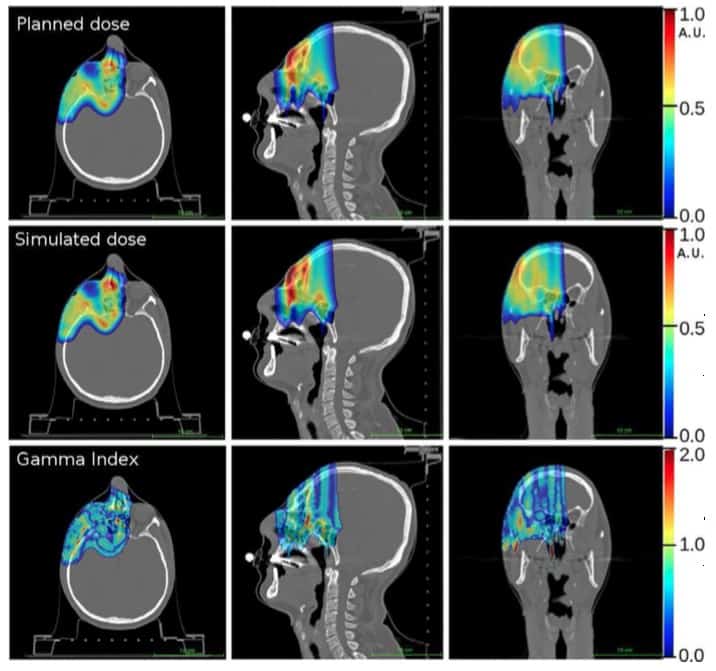
Dose distribution measured by the INSIDE system versus the Monte Carlo simulation. The production of positron emitters increases over the course of the fraction and activity in the beam direction expands due to an increase in proton energy characteristic of the CNAO beam line over time. (Courtesy: E Fiorina et al Physica Medica 10.1016/j.ejmp.2018.05.002 ©2018, Associazione Italiana di Fisica Medica)

Preliminary study

The researchers acquired PET scans during two proton therapy fractions of a 56-year-old patient with carcinoma of the lacrimal gland. Data were acquired over the entire irradiation of one of two fields. Images were updated every 10 s, enabling a visual, qualitative comparison between the measured and simulated data during treatment.

In a comparison with the prescribed treatment plan, dose distributions derived from the simulation proved accurate.  Gamma tests demonstrated 91% of voxels agreed to within 3% or 3mm and 98% of voxels to within 5% or 5 mm.

Dose comparison

Particle range in the predicted and measured PET images was quantified using iso-activity surfaces corresponding to 10% of the maximum voxel intensity in the scans. The researchers demonstrated that the average distance between the surfaces in the two images was less than 1 mm. The analysis was carried out off-line, but the authors envisage that a real-time implementation will be straightforward, enabling a quantitative analysis while the patient is still being irradiated.

“These first in vivo measurements demonstrate that the developed Monte Carlo simulation tool … is accurate enough to be used as a reference in the PET image analysis,” said Fiorina.

Based on their findings, the researchers are beginning clinical trials later this year, in which the INSIDE system will incorporate a more precise detector positioning system. The trials will include more rigorous tests of the system’s accuracy, including that of the Dose Profiler, using a cohort of around 40 patients. The researchers will also investigate how well the system integrates into routine clinical workflow and potential clinical compliance limits in particle range. The cohort will include individuals with cancers known to respond early to treatment, the group set to benefit most from monitoring.

Quantum computing with 1000 quibits

A couple of years ago I met Andrea Morello from the University of New South Wales at the March 2016 meeting of the American Physical Society in Baltimore. My colleague Tushna Commissariat filmed him answering the question: what could you do with a 50- or 100-qubit quantum computer (see video above).

Well, time waits for no-one, and now Morello has written the guest editorial for a new focus issue of the journal Quantum Science and Technology, which contains five Perspective articles by some of the world’s top quantum-technology researchers on the question: “What would you do with 1000 qubits?” (They’re a bit greedy those quantum dudes, aren’t they?)

The articles, which are all free to read for 30 days (until 19 July 2018), offer “a candid and hype-free illustration of how the field of quantum information science is designing the path towards practical quantum computers”. Now if you think I’m just saying that because Quantum Science and Technology is a journal from IOP Publishing, which also publishes Physics World, then I guess you’ll just have to read them for yourself.


Stonehenge builders used Pythagoras’ theorem, pastry goes missing at 16,000 metres, words of wisdom from famous scientists

It was the summer solstice this week in the northern hemisphere. About 45 miles from Physics World headquarters, people at Stonehenge celebrated as the Sun rose at 04:51 Thursday morning. According to a new book called Megalith: Studies in Stone, the builders of Stonehenge were using Pythagoras’ theorem 2000 years before the Greek mathematician was born. You can read more in this article in The Telegraph.

Meanwhile in Derbyshire, pupils at Saint Anselm’s School are looking for a Bakewell tart that was last seen dangling from a high-altitude balloon 16,000 m above the English countryside. The pie-in-the-sky was launched by pupils on Monday as a science project to measure temperature, take photos and track the balloon. Unfortunately, all contact with the balloon was lost as it drifted over Saxilby, near Lincoln. The youngsters are hopeful, however, because a balloon launched last year was found on a beach near Skegness.

Everyone loves a pop quiz about science and the Perimeter Institute for Theoretical Physics in Canada has put together a real cracker that focusses on quotations. Have a go here, but take note that it’s not easy: “Quotation quiz! Who said these wise words about science?”.

UK public has little understanding of quantum technologies, says survey

The UK’s Engineering and Physical Sciences Research Council (EPSRC) has published the results of one of the first public dialogues on quantum technologies. Involving 77 participants from in UK cities, the exercise revealed that the British public is largely in the dark about developments in quantum technologies but can be easily engaged when learning more about them. The survey was carried out in late 2017 by Kantar Media, and the results evaluated by 3KQ.

In the study, a representative sample of the British public was informed about the wide range of devices currently being developed in the quantum technology community. Then, subjects discussed the topic with experts and researchers. As well as engaging participants with the research, the EPSRC aimed use the study to gain new insights into what the public currently knows and thinks about quantum technologies.

Neutral emotions

The results showed that despite the word “quantum” itself being widely familiar, most participants initially knew very little about its meaning and applications; displaying primarily neutral emotional responses towards new developments in quantum technologies. EPSRC concluded that this was likely do to a limited exposure of information about the topic in the media. A small number of participants remained disinterested throughout the dialogue.

However, as most participants learnt more about quantum technologies, they became increasingly curious and excited about them, particularly when gaining an understanding of how the devices could impact their own lives. Many became engaged with the dialogue as they realized the benefits that quantum technologies could have for individuals and society. Potential applications presented to participants ranged from healthcare technologies, to improvements in national and economic security.

Ultimately, the EPSRC aimed to establish a two-way dialogue between experts and researchers, and the public for the first time. By seeking more informed public opinions about the potential uses of quantum technologies, they hope to influence scientists in deciding on the future priorities of their research. The different perspectives of the public also create the potential for revealing new directions in quantum computing research which experts have not previously foreseen.

The Quantum Technologies Public Dialogue Report is available to the public and EPSRC has also produced a summary of the report.

US calls for asteroid-impact plan

International cooperation must be improved to prepare for potential strikes by near-Earth objects (NEOs). That is one recommendation of a new report by a group of US government agencies that outlines methods to deal with asteroids and comets that pass within 50 million kilometres of Earth.

The report – National Near-Earth Object Preparedness Strategy and Action Plan – provides an approach to develop technologies, policies, practices, and procedures for US and global vulnerability to NEO impacts. It sets out five specific goals, which include NASA improving its ability to detect, track and characterize NEOs. Those actions, say the 20-page report, should reduce the current levels of uncertainty about potential strikes on Earth and help the development of more accurate modelling and more effective decision-making.

An asteroid impact scenario is a low-probability but a high-consequence event

Leviticus Lewis

Another goal involves NASA and other agencies developing simulation tools to improve the modelling and prediction of NEOs. The report also calls on NASA to develop fast-response reconnaissance missions and technologies for deflecting or disrupting potentially hazardous NEOs. The final two recommendations are for increased international cooperation and a strengthening and routine practice of emergency procedures for dealing with NEO impacts.

NASA officials and other agencies emphasise that, while such impacts have a very low likelihood, they could cause a lot of damage if they were to occur. “We recognize that an asteroid impact scenario is a low-probability but a high-consequence event,” says Leviticus Lewis of the Federal Emergency Management Agency. “An asteroid impact scenario is a unique emergency and may be just different enough that some degree of preparedness specific to this threat is necessary.”

Lindley Johnson from NASA’s planetary defence office says that implementing the plan will “greatly increase our nation’s readiness and work with international partners to effectively respond should a new potential asteroid impact be detected”.

The report, however, does not provide any specific funding for the actions it recommends. “Most of the actions we’re calling for are things that can be done within existing resources that are already allocated,” says Aaron Miles of the White House Office of Science and Technology Policy. “This is more about figuring out how to use those resources smartly and do so in a coordinated and cooperative way across the US government.”

Peter Gwynne is Physics World’s North America correspondent

Analysis: More needs to be done to study possible impact scenarios

Monitoring near-Earth objects (NEOs) is hardly a new pursuit. NASA has studied them for almost five decades and in the late 1990s the agency expanded its effort by creating a project called Spaceguard to specifically search for them. Since then, several dozen have passed between Earth and the Moon.

The importance of planning for such events was evident on 15 February 2013 when the Chelyabinsk meteor – a 20 m-wide asteroid – exploded over Russia. Its shock wave damaged more than 7000 buildings and indirectly caused about 1500 people to seek medical care. Indeed, the event created the largest explosion on the planet since the one that occurred over the Tunguska river in Siberia in 1908, entering the atmosphere with a mass of 13,000 tonnes.

US congressional hearings following the event led to NASA and other agencies speeding up their plans for effective asteroid detection. Later that year, the space agency rebooted its then dormant Wide-Field Infrared Survey Explorer to begin a three-year mission to search for NEOs and in 2016 NASA created its Planetary Defense Coordination Office to detect, monitor, and characterize all NEOs.

While much work has been focused on characterizing NEOs, more needs to be done to understand how to deal with potentially threatening bodies. In 2015, NASA and the European Space Agency came together to work on the Asteroid Impact and Deflection Assessment (AIDA) mission. This involved two craft travelling to a binary asteroid system called Didymos. One probe, built by ESA and called AIM, would study the composition of the asteroids, while the other – dubbed the Double Asteroid Redirection Test (DART) – would impact into it. Once DART fired into the asteroid, AIM would have studied how the body was affected.

Yet following budget issues, ESA cancelled AIM leaving NASA to go it alone. That means that the asteroid impact of DART, once it arrives at the asteroid in 2022, will be monitored from ground-based telescopes and radar rather than a dedicated mission. ESA is, however, planning to send a mission to Didymos that will arrive three years after DART has impacted.

The report is a timely reminder that dealing with NEOs should be an international endeavour and not just the responsibility of NASA.

Michael Banks is news editor of Physics World magazine

Copyright © 2026 by IOP Publishing Ltd and individual contributors