Gases can permeate through 2D channels made from materials like graphene and boron nitride much faster than predicted by theory. The effect can be explained by “specular surface scattering”, which leads to frictionless flow, and it could be exploited in applications such as filtration and flow control.
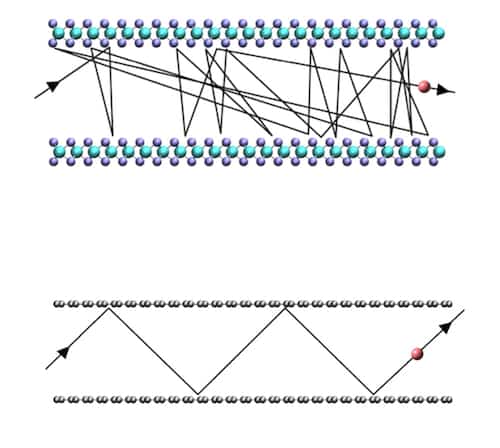
“Gas permeation through nanoscale pores is ubiquitous in nature but it also plays an important role in many technologies,” explains Boya Radha of the University of Manchester in the UK who led this research effort together with Nobel laureate Sir Andre Geim. “Since the size of the pores is usually smaller than the mean free diffusion path of gas molecules, we can describe this flow by conventional Knudsen theory. Here, the diffusing molecules randomly bounce back (or scatter) from confining channel walls, which reduces their flow.
“In channels with atomically-flat walls, however, such as those made from graphene (a 2D carbon sheet) and boron nitride (BN), which are flat at scales of 1 ångström (10-10 m) this theory breaks down. This is because the diffusing molecules only rarely scatter from the walls and so essentially permeate through the channel as if it weren’t there.”
Graphene is flattest
Geim, Radha and their colleagues obtained their results by measuring the rate at which helium gas diffuses through ångström-scale slit-like channels with walls made from cleaved graphite, hexagonal BN and molybdenum sulphide (MoS2). All these materials can be exfoliated, or thinned down, to monolayer thicknesses and have atomically flat surfaces. In the experiments, the researchers made channels using two thin (roughly 10–100 nm thick) crystals of each of the materials and used these as the bottom and top walls of a channel. They plasma etched a third thinner crystal so that it contained long narrow trenches. This crystal plays the role of a spacer between the top and bottom walls.
“We assembled the three crystals, which are held together by van der Waals forces, on top of each other,” explains Ashok Keerthi, who is first author of the study. “We could choose the spacing between them to be just one atomic layer thick or up to as many layers as we required.
“We found that the rate of helium transport is fastest through graphene and slowest in MoS2. Although all the 2D materials we studied are atomically flat, the minute differences in the atomic “corrugations” of graphene, hBN and MoS2 can be ‘felt’ by the scattered helium molecules. This can only be explained by quantum effects, that is the wave-like nature of matter (helium).”
In fact, when the (de Broglie) wavelength of helium is much larger than the atomic-scale roughness of the wall surface, as is the situation for a wall made of graphene, it is specularly scattered. Such scattering leads to frictionless gas flow and ballistic transport. In contrast, helium permeates through MoS2 at a rate predicted by Knudsen theory because it is rougher at atomic scales than graphite (and hBN). This roughness in fact comes from sulphur atoms protruding in between Mo atoms. These corrugations are almost an ångström tall, which is around the same diameter as the wavelength of helium molecules.
Confirming the matter-wave effect
The Manchester team backed up this matter-wave effect by measuring the rate at which deuterium (hydrogen’s heavier isotope) permeates through 2D channels made from graphene and hBN. “We found that hydrogen permeates faster than deuterium, even though it should be the opposite according to the classical Knudsen description,” says Geim. “While the size of both hydrogen and deuterium molecules are the same, their de Broglie wavelengths are not. The de Broglie wavelength of hydrogen is bigger than deuterium’s, and this leads to increased specular reflection of hydrogen from the channel walls and thus faster diffusion.”
These results back up previous findings from experiments on gas transport in various atomically smooth nanochannels, such as carbon nanotubes, nanoporous films made from graphene, graphene oxide and other 2D materials, adds Radha.
The researchers, reporting their work in Nature 558 420, say that they would now like to study size-selective separation of gases in even thinner channels. “While small molecules pass through these channels at high speed thanks to specular rather than diffusive scattering, the larger ones should be excluded due to steric effects,” she explains. “This could come in useful in filtration technologies since we would have fast flow and size exclusion at the same time in one system.”
Dentists are fascinating people. Multiskilled and multidisciplinary by nature, these renaissance women and men of our time need to be consummate and compassionate communicators, able and adaptable scientists, and skilled and artistic creators. Dentists need excellent communication skills to advocate smoking cessation, counsel people on maintaining good oral health, and treat anxious patients with compassion and care. Because dental technologies and treatments are in a state of continual evolution, dentists must also be scientifically literate, critical thinkers; it is essential for clinicians to stay up to date with developments throughout their careers. Since dentists restore teeth that have become unsatisfactory for many reasons – including pain, loss of function, or simply being unsightly – they must be artistically as well as technically skilled, and able to intervene in an environment that is cramped and full of nerve endings. And contrary to what you might expect, their involvement in healthcare is not limited to tooth and gum care: dentists are in fact gatekeepers of whole-body health, as oral problems and symptoms sometimes indicate systemic health conditions.
Tough materials
For a materials scientist like me, though, the most fascinating thing about dentists is that, whether they realize it or not, they are discerning and meticulous materials engineers. Materials underpin so much of a dentist’s daily life: whether they are filling cavities; fitting dentures, crowns and sports mouthguards; or applying tooth-whitening treatments, many of their standard processes require polymers, ceramics, alloys or other advanced materials. Rarely will a dentist pass a day in the clinic without using some sort of material that must function in intimate contact with the hard and soft tissues of the mouth.
The strictures that dentistry places on these materials are also unusually tough. Like any biomaterial, a dental material must be biocompatible – that is, it must not elicit any adverse reaction, and it must be stable and maintain its function for the required period (which could be anything from a few minutes to the lifetime of the patient, depending on the application). But over and above those standard requirements, the material must also be able to survive in a hostile environment: the mouth. As well as constant moisture, parts of the mouth experience pH values that range from near-neutral to less than 3.0 (cranberry juice, for instance, has a pH of ~2.8); temperatures that run from close to 0 to around 60 °C; and pressures of tens of MPa in normal function. Natural tooth tissues – the enamel and dentine – are well equipped to withstand damp conditions with huge variations in force and temperature, but they are less able to cope with the modern low-pH diet, which is a comparatively recent addition in evolutionary terms. Indeed, the tendency of hydroxyapatite – a calcium-containing mineral that makes up 70% of the dentine and more than 90% of enamel – to break down in the presence of acids is known to be the root cause of tooth decay: the acids produced by plaque bacteria cause a slow but steady dissolution of tooth mineral, ultimately leading to the formation of a cavity.
The biomaterials used in dentistry must, therefore, be carefully engineered to be strong in compression, tension and flexure. They must not corrode or otherwise deteriorate when wet, and they must be able to resist frequent and rapid changes in temperature and pH. In recent years the commercial aspects of dentistry have also driven more stringent requirements regarding the physical appearance of the material. In colour, translucency and fluorescence, patients are increasingly demanding materials that are indistinguishable from the adjacent natural teeth, to the naked eye at least.
Freedom to choose
Of course, all of these materials come with a price tag, and those with the best balance of physical, mechanical, chemical and biological properties can be very lucrative for manufacturers. This drives innovation, because dental materials are big business: the global market for dental restorative materials and adhesives was estimated at just over $1bn in 2016, with a compound annual growth rate of more than 5%. Equally important is the fact that dentists are able to innovate; even dentists who work in publicly funded health systems have a degree of choice when selecting materials, and in private dentistry that choice is even wider. This means that dentists can be, and often are, early adopters of new technologies. It is thus in the interest of dental materials manufacturers to continually innovate and release new materials onto the market in a bid to capture this enthusiasm for the “new and improved”; complacency leads to loss in market share.
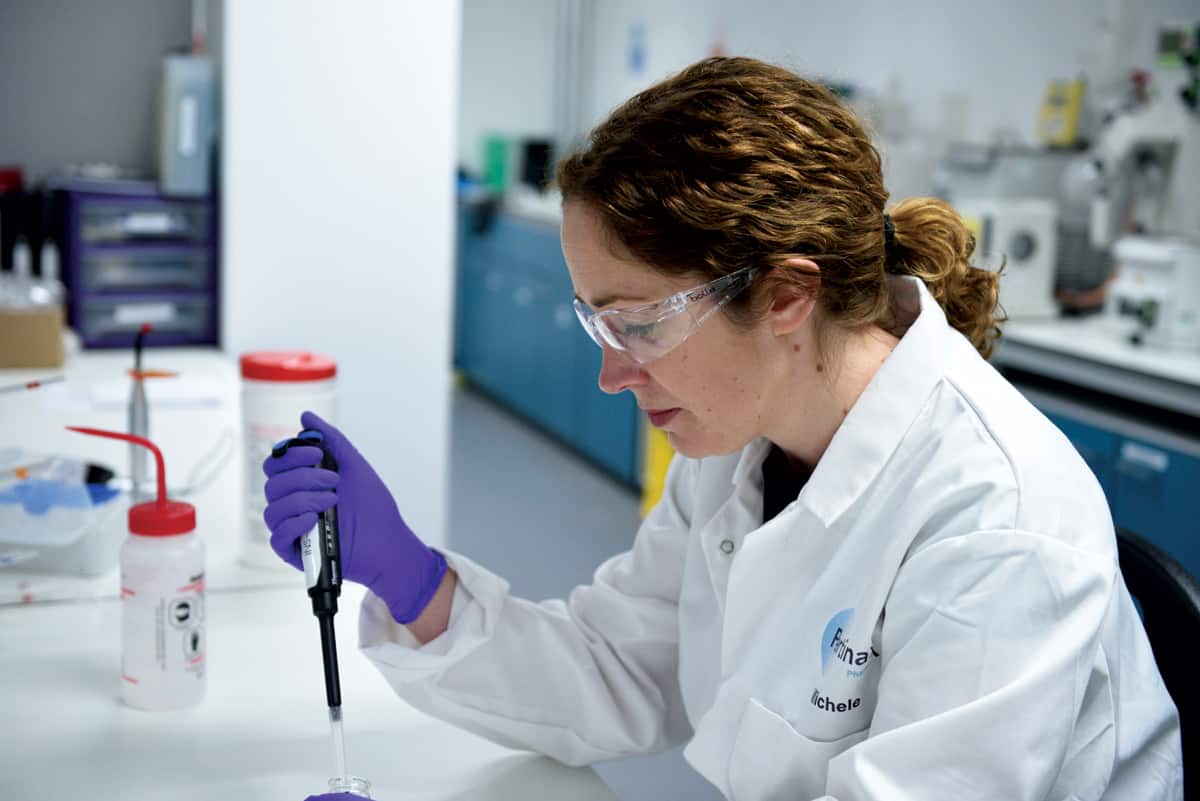
Developing new materials: The author in her lab. (Image courtesy: Pertinax Pharma)
This combination of factors creates a niche occupation: the dental materials scientist. This is the niche I found myself occupying at the outset of my academic career 12 years ago. The dental sector appealed to me because I wanted the materials I develop to have a direct and near-term impact on people’s day to day lives – both the clinicians who use the materials and the patients who benefit from the clinician’s skill. I also came to appreciate the culture of progress and innovation that has grown up around dental materials owing to dentists’ opportunity to choose. This opportunity is significantly greater for dentists than it is for, say, orthopaedic surgeons or urologists, who have a more limited portfolio of materials to choose from when installing a hip implant or a urinary catheter (to take just two examples).
Over the past decade or so, the field of dental materials has seen several interesting developments. The mechanical strength of light-cured polymer composites – which are used to restore teeth in cases where a good aesthetic outcome is essential, for example if the teeth are near the front of the mouth – has improved considerably, and innovations in polymerization methods have reduced the amount of shrinkage usually associated with similar polymers. The field has also been rocked by the Minamata Convention, a legally binding treaty that commits signatories to ceasing the use of mercury across almost all industries. The convention has been signed by 84 countries, and its adoption puts amalgam, an important tool in a dentist’s armoury, under threat.
Smarter infection control
In my opinion, though, the most interesting developments have been in the field of antimicrobial dental materials, where my own research lies. The starting point for our work is a common and widely used antiseptic called chlorhexidine. Dentists use chlorhexidine as a multipurpose antimicrobial for treating gum disease and oral infections; it is also applied preventively before dental surgery. Other uses in the wider medical world include skin disinfection (again before surgery), combatting MRSA outbreaks in hospitals, and as a component of wound dressings for chronic or surgical wounds. Chlorhexidine is used in veterinary practice as well, in wound care and to treat infections of the mouth and ear. Regardless of how they are applied, though, all current chlorhexidine products suffer from the same limitation: the chlorhexidine salts used are highly soluble, meaning that when they are placed in a damp environment, the local liquids rapidly remove the chlorhexidine. For this reason, its activity is limited to a short period after application and it needs to be reapplied regularly, at relatively high concentrations, to provide any lasting protection.
Our approach to this problem is a simple but very effective modification. By sequestering the chlorhexidine in salts of condensed phosphates, we create a material with much lower solubility, one that is stable when dry and that releases chlorhexidine at a steady (close to linear) rate in a wet environment. Naturally, given our background, our first thoughts were to exploit this new material in dentistry. The main cause of failure of modern dental fillings is secondary infection, where bacteria infiltrate the interface between the tooth and the filling material. By incorporating our sustained-efficacy chlorhexidine into the materials used at this interface, we can create a locally chlorhexidine-rich environment with a clinically optimal dose: sufficient to kill any microbes that penetrate, but not to adversely affect human cells. We can even incorporate a degree of “smart” behaviour, whereby the chlorhexidine release is accelerated in response to a fall in pH, which would indicate the very earliest stages of tooth decay in the area.
But of course, since chlorhexidine is also used widely in medicine and veterinary care, we have opportunities to exploit our technology in those areas as well. Although the material’s genesis was in a dental environment, our spin-out company Pertinax Pharma is now developing wound-dressing materials with a lasting antimicrobial effect for conditions such as burns and diabetic foot. The slow release of the antiseptic means that our prototypes do not elicit the adverse response from human cells associated with high doses of chlorhexidine and other antiseptics. We are also now developing a spray-delivery, resilient, water-resistant film of our material that could find applications in diverse fields. It could be used to prevent umbilical-cord infection in newborns, for example, especially in developing countries where the material’s low cost, long-term efficacy and benign storage requirements (with the consequent ease of transport) make it an appealing option. This material could also be used in an actual field, to treat infectious foot disease in cattle.
These are the applications I find the most exciting. There is a great deal of overuse and misuse of antibiotics, and although reducing this (and managing or combatting the antibiotic resistance that results from it) will require a multidisciplinary approach, the development of technologies such as ours – which can be used in place of antibiotics to give a clinically equal or superior outcome – can certainly play a part. I hope to see materials such as our novel chlorhexidine salts make a substantive difference to the global community not only via innovative dental materials that can protect against tooth decay, but in the wider fields of medicine and dentistry where sustained-efficacy antiseptics can serve a multitude of purposes.
A team of clinicians at the University of Wisconsin have used a ViewRay MRI-guided radiotherapy system to perform brachytherapy planning for cervical cancer. So, what motivated the team to use the ViewRay system to perform brachytherapy planning? And how does use of the system fit time-wise alongside its use for treatments?
Time saving
Writing in the journal Brachytherapy, the authors present the results of some 142 fractions of intracavitary brachytherapy, performed between April 2015 and January 2017 on 29 cervical cancer patients – the first ever clinical use of ViewRay-guided brachytherapy (Brachytherapy 10.1016/j.brachy.2018.04.005). They conclude that “time to treatment using this approach was shorter compared to diagnostic MRI” and that the ViewRay system also provided “significant advantage in visualizing the tumour and cervix compared to CT”.
As co-author Cindy Ko, a radiation oncology resident at the University of Wisconsin School of Medicine and Public Health, explains, the motivation to undertake this research came from necessity. This is because, although Ko and her team typically employ a diagnostic quality 1.5-3T MRI at diagnosis and for “at least the first fraction” of brachytherapy – a quality of imaging that they would ideally use for every fraction of brachytherapy planning – a combination of time constraints and limited resources means that they elect to use such MRI levels for only the first and third treatments.
“We used the imaging component of the ViewRay treatment system, which is in and of itself an independent treatment machine that can be used to directly visualize and treat cancers of the lung, gastrointestinal system [and others] with MRI guidance,” says Ko.
“The ViewRay system is within our department, unlike the diagnostic MRI machines, and thus it can save some travel time between the procedure suite, imaging, and back to the procedure suite for treatment,” she adds.
In addition to the benefits of proximity, Ko reveals that the ViewRay MR image acquisition is also faster, “on account of not requiring multiple sequences”. This is because there is only one proprietary sequence officially available for use with the system. This fast sequence, known as TRUFI, is a hybrid of T2 and T1 sequences that the team uses both with and without contrast for its treatments on the ViewRay system.
Scheduling
Since beginning to use the system in the department, Ko and her team found that scheduling a time to use the machine for brachytherapy planning between treatments worked well. Given the unpredictability of procedures, Ko reveals that they tend to “pink slip” individual brachytherapy cases into a block of time on the ViewRay system’s schedule – and continue to treat or simulate scheduled patients until the brachytherapy case is nearly ready. They will then “image [the case] briefly before going back to the other treatments or simulations on the schedule”.
According to Ko, this requires the therapists to develop a familiarity with how the logistics of a ViewRay imaging session with a brachytherapy patient works, as well as a working knowledge of how long the imaging session will take.
“We don’t find that one use of ViewRay system hinders the other – meaning that the schedule is mostly on time using this approach – and we are happy to find multiple uses for the same machine. The ViewRay schedule is busy, but no busier than our other treatment machines,” she says.
Ko also points out that the brachytherapy instrument placement itself “does not require much more than an ultrasound” for the first fraction, although for some patients, placement can take an hour or more.
In view of the fact that performing instrument placement within the ViewRay suite would probably interfere with the normal ViewRay treatment schedule – during which time the imaging function would not be used – the team found that transferring to the ViewRay system after instrument placement, and then adjusting if needed based on the MR image, was sufficient.
“Very seldom do we have to adjust instrument placement after viewing the ViewRay, MRI [or] CT images, but it can happen and, if so, we image again after adjusting to ensure good geometry,” adds Ko.
US-based researchers have confirmed that they can detect the same glow – invisible to the human eye – from trees, grasslands, crops, mangroves, marches and desert plants as the green things put chlorophyll to work and photosynthesise leaves, flowers, fruits and roots from atmospheric carbon.
The pay-off is simple: an easier and potentially more accurate way of calculating the global carbon budget and assessing the climate cost of human exploitation of fossil fuels.
But the same information will help biologists and geoscientists advance what is sometimes called earth system science: how carbon-based lifeforms make their living from sunlight, water and carbon dioxide in a continuous trafficking that has fuelled three billion years of evolution.
And at the heart of the study is a new realization that images from an orbiting satellite deliver better information in a reliable fashion.
Researchers from the University of New Hampshire report in the journal Global Change Biology that years of observation of solar-induced fluorescence – a glow from plants that no human could expect to see, but an instrument can detect – have confirmed that there is a direct relationship between gross primary productivity and the amount of fluorescence registered by the eye in the sky.
No exceptions
It means that what is true for the canopy of tropical forests in the Congo would also be true for a landscape of maize in the American mid-West, or the grasses and wildflowers of the savannah, the dusty maquis of the Mediterranean, or the swamps of the Louisiana bayous.
Up till now, researchers have tried to make accurate and reliable estimates on the ground, playing with air temperature, sunlight, rainfall and other factors to arrive at their conclusions about what they like to call carbon “sinks.” The message from OCO-2, the NASA orbiting carbon observatory, is that the gleam from the foliage below provides an answer more swiftly, and perhaps more surely.
“The importance of these results is that rather than look at several different types of data and computer-based models from information collected on the ground to monitor plant photosynthesis across the globe, using the satellite observations will provide a near real-time option that is simple, reliable and fast,” said Jingfeng Xiao, of the University of New Hampshire, the chief investigator.
“This is a big step towards being able to solely rely on satellite measurements.”
Researchers long suspected that the dielectric constant of water is lower at interfaces with other materials – what no-one knew was how much. “This is a huge issue,” says University of Manchester condensed matter lecturer and National Graphene Institute researcher Laura Fumagalli. “The value of the dielectric constant at the nanoscale was not clear at all and it has a lot of impact on a lot of phenomena.” These range from the study of proteins and DNA to electrochemistry and batteries. Now Fumagalli has teamed up with 2010 Nobel Laureate for the discovery of graphene Andre Geim, as well as colleagues in the UK, Iran, Spain and Japan, to report experimental evidence that the effect of interfaces on the dielectric constant of water is far greater than previously suspected.
The dielectric constant gives a measure of how well electric dipoles of molecules orient in an electric field. Water is a highly polar substance, so although the molecules can readily reorient in an electric field in the bulk, their alignment at surfaces can be inhibited, potentially diminishing the dielectric constant in interfacial water near surfaces compared with values found in bulk water. Establishing definite values for these effects has flummoxed researchers for decades.
Dielectric measurements get ultrasensitive
Fumagalli has long specialized in investigating the dielectric properties of structures at the nanoscale. In 2012 during her time at Institut de Bioenginyeria de Catalunya and Universitat de Barcelona, Fumagalli and colleagues in Barcelona and Madrid reported on a technique using electrostatic force microscopy with piconewton sensitivity that could identify nanoparticles with identical shape but different chemical composition by ultrasensitive measurements of the dielectric constant.
These experiments did not focus on water, but as Fumagalli points out, “Water is everywhere, even where you don’t want it there is a layer of water from the humidity of the environment.” Yet while her interest was piqued, applying the technique to water proved far from trivial. The success of the latest experiment hinged on Geim’s expertise in 2D materials.
Confinement device yields success
One of the challenges was producing a system to confine water at the nanoscale. Happily one of the many things 2D materials are good at is trapping water, so when Fumagalli joined the National Graphene Institute at Manchester, and spoke to Geim about the problem, a solution proved to be in sight.
“We started with something simpler but the results were not so convincing,” says Fumagalli. “We clearly needed the most advanced devices, and Andre Geim was able to produce them.” She describes how in 2016 and 2017 Geim introduced a new technology that allows the assembly of two-dimensional materials into devices with the smallest possible man-made channels. “Among many other possible applications, these devices allow us to study the transport and properties of water inside such tiny channels.”
The final system comprised slit-like channels fabricated from atomically flat crystals of graphite and hexagonal boron nitride. The researchers could set the heights of the channels to be as low as one nanometre in size so that they only accommodated a few layers of water.
“When you reduce the quantity of water you have, and the water is confined near surfaces so that you have just a few molecular layers there, the molecules are not free to move like in bulk water, and the dielectric constant goes down to two,” says Fumagalli. “This is the minimum value imaginable – so low people had not expected it.”
She highlights that this anomalously low value of the dielectric constant in confined water is in stark contrast to the anomalously high dielectric constant of bulk water, which is around 80. “Water is full of anomalies,” she adds.
Water, described as the universal solvent because so many other substances are soluble in it, has been dubbed “the solvent of life”. These solvation properties are directly linked to the dielectric constant, which highlights the impact of these results. No small wonder then that the researchers in Manchester remain very interested in water.
“It would be interesting to see if it behaves similarly with other surfaces and how it behaves near bio surfaces,” says Fumagalli. “How water is polarized near biomolecules makes a difference to the forces they experience and has a huge impact on their structuring and functions.”
Geim also emphasized the significance of the results in a press statement: “This anomaly in the dielectric constant of interfacial water is not just an academic curiosity but has clear implications for many fields and for life sciences, in particular. Our results can help to improve the understanding of the role of water in technological processes, and why it is so crucial for life. Electric interactions with water molecules play an important role in shaping biological molecules such as proteins. One can probably claim that interfacial water shapes life as we know it, both literally and figuratively.”
Other substances that may be subject to the same effect include any polar liquids. Studies of those used in batteries for energy storage may have particular relevance for industry.
This episode of Physics World Weekly kicks off with James Dacey recounting his recent trip to the Netherlands, where he made a series of videos about energy-related research. You will hear David Smeulders of Eindhoven University of Technology argue that we need to rethink our current approach to energy storage and Dacey also describes his visit to a wind tunnel where cycling teams try to gain advantage by improving the aerodynamics of a bicycle and its rider.
Next up is Michael Banks, who explains why CERN is going to spend $1.5 billion to increase the number of proton-proton collisions at the Large Hadron Collider in Geneva. Tune in to learn how crab cavities could give us a glimpse of supersymmetry.
Tami Freeman then talks about radiation beams of a different sort – those used to treat cancer. She explains how a simple and inexpensive invention could provide intensity-modulated radiotherapy to millions of people in low- and middle-income countries, where financial constraints currently restrict access to this life-saving procedure.
If you enjoy what you hear, then you can also subscribe to our monthly podcast, Physics World Stories, which you will find on iTunes and other podcast directories.
Can modified Newtonian dynamics (MOND) explain the curious behaviour of rotating galaxies? Two research groups have independently studied the dynamics of large numbers of galaxies to test MOND and have reached different conclusions. MOND is an alternative to dark matter — a hypothetical substance that is thought to affect the rotation of galaxies via its gravitational pull – and the conflicting studies could help solve problems with our current understanding of galaxy dynamics.
At first glance, Newtonian gravity appears to fail spectacularly when used to calculate the dynamics of galaxy rotation. The problem is that stars far from the galactic centre rotate much faster than predicted and should be flung away from the galaxy. The conventional explanation is that enormous quantities of cold dark matter (CDM) provides additional gravitational glue that binds the galaxies together. This, however, gives physicists the task of explaining the nature of dark matter – which despite its apparent abundance, has never been detected directly.
A minority of physicists, however, take the opposite approach and call for a revision of Newton’s laws. Extraordinary as this suggestion sounds, it does offer potential solutions to some otherwise troubling problems in galactic dynamics.
Curious correlations
Despite being a pillar of the Standard Model of cosmology, CDM does not offer a complete explanation for the observed dynamics of galaxies. In 2016, for example, Federico Lelli of Case Western Reserve University in the US and colleagues studied a sample of 175 galaxies. They looked at the rotation rate at different distances from the centre of each galaxy. They calculated that the radial acceleration at an arbitrary point in each galaxy is correlated with the amount of visible matter attracting it – but the relationship does not match that predicted by Newtonian dynamics.
The CDM model explains this discrepancy by assuming the visible matter is attracted by dark matter as well as other visible matter. However, dark matter could be found in different quantities and different places in different galaxies, so this relationship should have quite a lot of scatter. A mathematically predictable deviation from the predictions of Newtonian dynamics is hard to explain under the CDM model.
MOND, however, proposes that, at very large radii and small accelerations, gravity decays with distance more slowly than Newton’s inverse square law. This removes the need for dark matter, providing a clear explanation for the tight non-Newtonian correlation between visible matter and radial acceleration.
Universal scale
In one of the new studies, Davi Rodrigues of Federal University of Espírito Santo in Brazil and colleagues examine 193 disk galaxies (most of which had previously been studied by Lelli) to see whether there is a fundamental acceleration scale. This would be a universal scale factor relating the predictions of Newtonian dynamics and MOND.
“We do a full Bayesian [statistical] analysis in order to find the error bars of this radial acceleration relation for each galaxy,” explains Rodrigues. Having done this, the researchers conclude that there is no scale factor that is not ruled out at a statistical significance of at least 10σ – which means that it is extremely unlikely that the finding is a result of statistical fluctuations in the data.
The researchers therefore rule out any fundamental theory that extends MOND without amending its underlying dynamics. Instead, they suggest that the apparent correlation between visible matter and galactic dynamics could arise from hypothetical complex interactions between visible matter and dark matter.
Working independently, Lelli and colleagues address the same question using different statistical techniques. The researchers fit the radial acceleration relation to data from their set of 175 galaxies. They calculate a value for the scatter in the data that is much lower than the value arrived at by Rodrigues.
Plane uncertainty
Lelli’s group argue that the other study has ignored the uncertainty in the plane of inclination of disk galaxies relative to the angle of observation – which is an additional source of error in their calculations. Furthermore, says Lelli – now at the European Southern Observatory in Germany – his team found that allowing the scale factor to vary from galaxy to galaxy did not improve the fit. Therefore, the researchers suggest, the observed scatter in the data is better explained by observational errors than by an underlying inconsistency between the data and the fundamental acceleration scale predicted by MOND.
James Binney of the University of Oxford notes that the Rodrigues group’s paper does not question Lelli and colleagues’ 2016 conclusion that there is a mathematically predictable relationship within galaxies between the visible matter and the radial acceleration. Whether that relationship can be fitted by a single parameter that applies to all galaxies is, he says, “subsidiary”.
Every day the expert science writers and editors here at Physics World work hard to bring you exclusive news and analysis of the latest research discoveries, industry innovations and policy developments that affect the global scientific community. Our collective mission is to make Physics World the number-one news website for professional scientists in all parts of the world, and just a couple of weeks ago we welcomed three new subject editors to boost our coverage of fast-moving fields that benefit from an interdisciplinary approach.
We remain committed to making all our online content free to read, ensuring that the widest possible audience can learn about the scientific advances that benefit industry, the economy and society. But we are now asking you to register with Physics World to gain access to all our online content, and to show your support for our independent, informed and innovative science communication programme.
Once you have read three articles in any 30-day period, you will need to register to continue enjoying any further online content. As part of the quick and easy registration process, you’ll be able to choose which e-mail newsletters you want to receive and you can tell us which scientific topics you’re most interested in – which will help us to develop our content programme to better meet your needs. Once registered and signed in, you’ll also find that the prominent messages encouraging you to register will disappear from view.
Finally, in these days of heightened awareness around data protection, a word of reassurance. Your e-mail address and contact details are safe with us: we will use them only to manage your account and to send you the content you wish to receive. You will only receive messages from Physics World and our publisher IOP Publishing if you choose to do so.
If you have previously registered with Physics World, or with any of our sister sites (nanotechweb.org, medicalphysicsweb.org or enviromentalresearchweb.org), you will need to check your details and reset your password before you can enjoy unlimited access to our content. Simply enter your e-mail address into the registration form (or into the box below), and you will be guided through a short process to reset your password, update your details, and confirm your subscriptions to our free e-mail newsletters.
As ever, please contact us at pwld@iop.org to share your views on any aspect of the Physics World site.
The Physics World website is part of the Physics World portfolio, a collection of online, digital and print information services for the global scientific community. To receive a personal copy of Physics World magazine, you will need to become a member of the Institute of Physics.
Small angle X-ray scattering (SAXS) is one of a number of biophysical techniques used for determining the structural characteristics of biomolecules. Daniel Franke and colleagues from the European Molecular Biology Laboratory have recently published a machine learning-based method to classify biomolecules using existing SAXS data (Biophys. J.114 2485).
The method can be used to classify shape, as well as estimate structural parameters such as the maximal diameter or molecular mass of the molecule under study. These estimates may then serve as a valuable method for validating expected values.
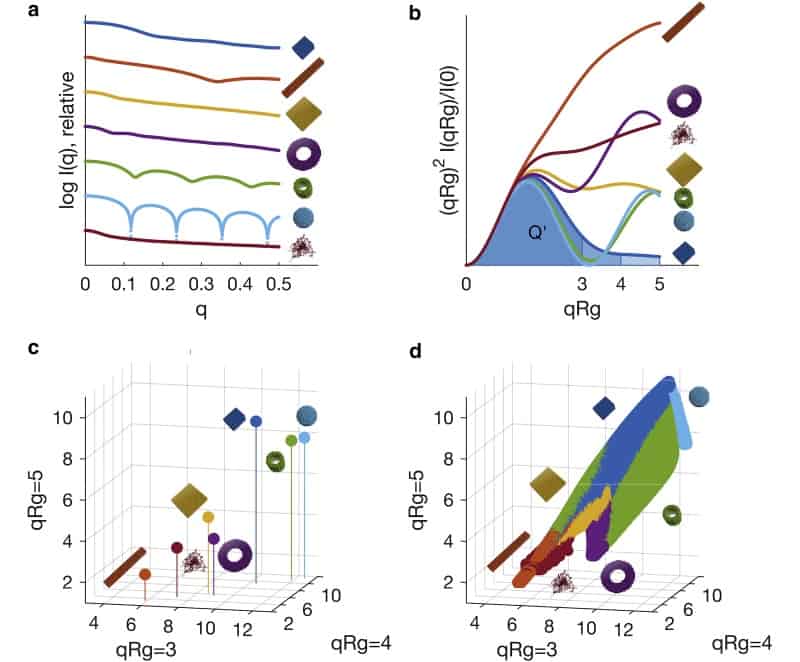
The team decided on a set of shape classifications for biomolecules: compact spheres, flat discs, extended rods, compact-hollow cylinders, hollow spheres and flat rings. They used simulations to obtain idealized scattering profiles of each of these different geometries across a range of heights, widths and lengths ranging from 10 to 500 Å.
The researchers used innovative data reduction approaches to reduce each of the scattering profiles to a point in normalized apparent volume space, V. Representing the data in this way is advantageous because structures that share similar structural characteristics will occupy a similar position in V space.
The process of classifying an unknown scattering profile then amounts to calculating its position in V space and locating the nearest points in V space for which parameters are already known. The new parameters can then be estimated by taking a weighted average of these “nearest neighbour” points in V space. A machine can be programmed to perform all of these steps.
Using machine learning
The team simulated some 488,000 scattering patterns and used these to train an algorithm to categorize different scattering patterns. Each scattering pattern was then removed in turn, and the remaining data used to predict the shape classification of the removed pattern.
This training procedure allowed the researchers to refine the weights assigned to the nearest neighbour structures in V space, so as to maximize the accuracy of the machine classification.
Predicting structural parameters
To test the predictive power of the shape classification method, the researchers harvested scattering data from the Protein Data Bank (PDB) and the Small Angle Scattering Biological Data Bank (SASBDB).
From the atomic structures stored in the PDB, they used CRYSOL software to generate scattering intensities, as well as values of structural parameters such as the maximal diameter and molecular mass. After mapping the known structures to V space, an equivalent algorithm was then used to predict the structural parameters based on the generated scattering intensity. Here, the machine prediction was within 10% of the expected value in 90% of cases.
The SASBDB provides scattering intensity as well as user generated values of structural parameters such as the maximal diameter. The researchers also observed good agreement from the structures collected from the SASBDB, with the machine predicting a small, systematically lower value for the maximal diameter. This offset reflects the fact that molecules tend to occupy an extended configuration in solution.
The protocol developed by the team shows that data mining has significant potential to increase the efficiency and reliability of scattering data, which could have huge benefit for the biophysics community.
Mangrove forests are among the most carbon-dense ecosystems in the world and valuable sinks for carbon emissions released into the atmosphere. Now a global map of soil carbon in mangrove forests at 30 m spatial resolution could support new ecosystem services policy tools for rewarding the preservation of major environmental assets.
“We felt that working at 30 m resolution was critical because of the strong gradients that occur in mangrove forests across the tidal range,” says Jonathan Sanderman of Woods Hole Research Center in the US. “Within a few hundred metres, there can often be a two-fold variation in soil carbon stocks and we wanted to be able to capture this important local variance in soil carbon.”
Sanderman and colleagues developed a machine-learning based data-driven statistical model of the distribution of carbon density at key sites around the world. The tool integrates measurements of mangrove forests from hundreds of studies. The researchers hope it will play a major role in prioritizing conservation efforts and providing a baseline for carbon markets.
“For many nations, including most small island nations, mangrove protection and restoration represent one of the most viable climate mitigation options,” says Sanderman.
Running the model reveals areas of high carbon stock and regions where habitats are disappearing rapidly, helping to inform protection and restoration strategies.
From remotely-sensed data on mangrove forest cover change, the team reports a reduction in soil carbon of 30–122 Tg from 2000 to 2015. More than 75% of this reduction is attributable to deforestation in Indonesia, Malaysia and Myanmar.
A high-performance computing environment allowed the scientists to interpret large amounts of information; they used Google’s Earth Engine application to write the results to a webmap. The output can change on the fly as new data become available.
The researchers plan to offer an even more detailed picture of global carbon stocks. They are keen to understand the rate at which different mangrove forests build soil carbon, motivated by areas such as the Sundarbans on the Bay of Bengal.
“While they only store modest levels of soil carbon, the Sundarbans are likely a large sink because that carbon is being buried at a rapid rate due to the annual sediment load of the three rivers that feed into this large estuary,” says Sanderman. “We would like to develop an ability to predict and then map where high sequestration rates are occurring.”