Algorithm speeds medical image analysis

Medical image registration involves overlaying two images to compare and analyse differences – such as changes in a tumour over time – in great detail. The process, however, can often take two hours or more using traditional systems. In a pair of upcoming conference papers, researchers from MIT describe a machine-learning-based algorithm that can register brain MR scans and other 3D images more than 1000 times faster.

While existing algorithms start from scratch for every pair of images, the new algorithm, called VoxelMorph, speeds the process up by “learning” as it registers image pairs. In doing so, it acquires information about how to align images and estimates some optimal alignment parameters. After training, the algorithm uses those parameters to map all pixels of one image to another at once.

“The tasks of aligning a brain MRI shouldn’t be that different when you’re aligning one pair of brain MRIs or another,” says Guha Balakrishnan, a graduate student at MIT. “There is information you should be able to carry over in how you do the alignment. If you’re able to learn something from previous image registration, you can do a new task much faster and with the same accuracy.”

In a paper presented today at the Conference on Computer Vision and Pattern Recognition, the researchers describe how they trained their algorithm on 7000 MRI brain scans and then tested it on 250 additional scans.

During training, pairs of brain scans were fed into the algorithm, which captured similarities of voxels in the two scans. In doing so, it learns information about groups of voxels – such as anatomical shapes common to both scans – which it uses to calculate optimized parameters. When fed two new scans, the algorithm uses the optimized parameters to rapidly calculate the exact alignment of every voxel in both scans.

The researchers found that their algorithm accurately registered all 250 test brain scans within two minutes using a traditional central processing unit, and in under one second using a graphics processing unit. They note that, importantly, the algorithm is “unsupervised”, meaning that it doesn’t require additional information such as ground truth data or anatomical landmarks.

The second paper, to be presented at MICCAI in September, will describe a refined VoxelMorph algorithm that validates the accuracy of each registration. It also guarantees the registration “smoothness”, so that it doesn’t produce folds, holes or general distortions in the composite image. Across 17 brain regions, the refined algorithm scored the same accuracy as a state-of-the-art 3D registration algorithm, while providing runtime and methodological improvements.

The algorithm has a wide range of potential applications, the team points out. MIT colleagues, for instance, are currently running the algorithm on lung images. It could also pave the way for image registration during operations, potentially enabling surgeons to register scans in near real-time.

Chameleons inspire mechanochromic nanolaser

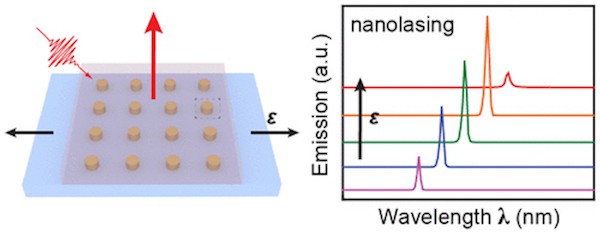
A new mechanically “stretchable” nanolaser based on gold nanoparticles patterned on an elastomeric slab surrounded by a liquid gain can lase at different light wavelengths. The new device, which is inspired by panther chameleons, might be used to make flexible, full-colour optical displays and multi-channel optical communications.

Researchers recently discovered that certain species of chameleon change the colour of their skin (from green to yellow, for example) by actively tuning a lattice of guanine nanocrystals within iridophore cells. These cells are nothing other than tuneable photonic crystals – nanostructured materials in which the periodic variation of the refractive index on the length scale of visible light produces a photonic band gap. This band gap affects how photons propagate through the material – just like a periodic potential in semiconductors affects the flow of electrons defining allowed and forbidden energy band gaps.

In photonic crystals, light of certain wavelength ranges can pass through the materials while light in other ranges is reflected. This allows the colour reflected by the crystals to be tuned by changing the band gap.

Going back to chameleons: in these animals, this gap is determined by the distance between the non-close-packed guanine nanocrystals, which can be adjusted by deforming the surrounding (elastic) skin. This allows for colour changes over the entire visible range of the electromagnetic spectrum.

Mechanically controlling laser colour

“Inspired by nature, we aimed to make a mechanochromic laser source that could also change colour via a similar mechanism,” explains Teri Odom of Northwestern University, who led this research effort. “To make such a device, in which we could mechanically control the laser colour, we exploited a lasing cavity based on a periodic array of nanoparticles in a stretchable, polymer (PDMS) matrix and liquid dye molecules surrounding the nanoparticles.”

The surface of the nanoparticles supports conduction electrons that oscillate collectively. These oscillations are known as surface plasmons, and in the case of the metal nanoparticle arrays are referred to as “lattice plasmons”. It is thanks to these plasmons, which when coupled with light, allows light to be compressed down to the nanoscale and focused to spots smaller than half its wavelength (the so-called diffraction limit).

Stretchable nanolasing based on metal nanoparticles integrated with liquid gain materials

Most plasmon-based lasers made to date have been difficult to tune easily because the optical gain was made from solid materials, like inorganic semiconductors or organic dyes in a solid matrix. The Northwestern researchers recently devised a way to overcome this problem by using a liquid gain material (made of liquid dye molecules) with the plasmonic nanocavity arrays.

There are many advantages in using liquid dye molecules,” explains Odom. “For one, we can dissolve them in different solvents with different refractive indices. This allows us to tune the dielectric environment around the nanoparticles, which also enables us to tune the lasing wavelength in real time. Liquid gain materials can be manipulated easily (in a microfluidic channel, for example), something that also allows us to tune the lasing emission by simply using liquids with different refractive indices.”

High-quality cavity modes

“In this new work, the large (around 260-nm-diameter) nanoparticles we used in our lattice (which has a spacing of 600 nm) produce high-quality cavity modes that tolerate uneven sample surfaces and defects, she adds. “The confined electromagnetic field in these cavity modes results in lasing action from regions close to the nanoparticles that support ‘hybrid quadrupole lattice plasmons’ and small changes in interparticle distance produce a change in the lasing wavelength. By thus stretching and releasing the elastomeric substrate, we can select the lasing emission colour at will.”

This is exactly the principle employed by our friends the chameleons to tune their skin colour, except that they use osmotic pressure to compress the photonic crystal lattice in their skin rather than stretching.

“The technology could find use in future flexible optical displays such as television and cell phone screens that require coherent light sources,” Odom tells Physics World. “Our system can be tuned from the ultraviolet to near-infrared by simply using different gain materials, which is promising for full-colour photonic displays ad multi-channel optical communications.”

Renmin Ma at the School of Physics at Peking University, who was not involved in this research, says that the study is “a significant step” towards making functional nanolasers. “The combination of dynamically changeable gain material and mechanically stretchable crystal lattice overcomes a major barrier to realizing high performance lasers with wide-range tunability.”

Törmä Päivi of Aalto University in Finland agrees: “The combination of stretchable substrate and multipolar nanoparticle resonances enables easy and robust mechanical control of the laser light colour,” she says. “This work will inspire us to think differently about applications of plasmonic nanoparticle arrays.”

The new stretchable nanolaser is detailed in Nano Letters 10.1021/acs.nanolett.8b01774.


The peril of proposals

Jessica Wade is hoping to apply for her first grant next year but is concerned about a lack of transparency. “You have no idea who’s evaluated you or what criteria they are using,” says Wade, a postdoctoral researcher in experimental physics at Imperial College London. Under the current system, she says, a researcher is more likely to get funded if they have been funded before, if they are from certain high-flying institutions or if they have big names on their applications. For Wade – a novice in the grant game – the current system feels “intrinsically unfair”.

Not that grant-application veterans have an easy ride. Senior scientists often gripe about how much time they spend applying for money rather than doing real research – and now there’s evidence to back them up. In 2013 Adrian Barnett, a statistician at the Queensland University of Technology in Brisbane, Australia, and colleagues published a study that found that it took researchers applying for money from the National Health and Medical Research Council of Australia an average of 34 days to prepare a proposal for a grant.

A key part of any successful application is making it through peer review. The success rate at the Engineering and Physical Sciences Research Council (EPSRC), which funds many UK academic physicists, is around 32%. That’s fairly high in the funding world. Recent figures for the Biotechnology and Biological Sciences Research Council, for example, are around 24%.

The situation’s even harder if you’re from a minority group. A 2011 study commissioned by the US National Institute of Health (NIH), for example, found that black applicants were 35% less likely to receive grants from the agency than whites. Since then, the NIH has invested $250m into diversifying biomedical science and examining its own internal biases. What’s more, one recent study in the Netherlands (PNAS 10.1073/pnas.1719557115) has shown that early success with grant applications increases success in later applications.

One study found that black applicants were 35% less likely to receive grants than whites

Elisabeth Pier, a data strategist at non-profit firm Education Analytics in Madison, Wisconsin, thinks funders should assess their own biases. Pier and her colleagues have shown that different grant reviewers evaluating the same applications generally have low levels of agreement.

Stuart Buck, vice-president of research at the private Laura and John Arnold Foundation – which mostly funds work related to criminal justice, public accountability, research integrity and education reform – says his organization doesn’t focus on how many papers a researcher has written, or which journals they are published in. Rather, the foundation carries out more of a direct assessment. For instance, if the applicant is looking to carry out a randomized control trial (RCT) of a public policy issue, they would check to see if they had successfully run an RCT before. In recent years, the foundation has funded studies that attempt to replicate previously published findings. Investing in such studies can highlight the weaknesses of a discipline, such as the lack of data- or code-sharing among its researchers. The foundation also pays reviewers for their work, Buck says, with rates varying on a case-by-case basis.

EPSRC, on the other hand, doesn’t pay reviewers but has been working to recognize their efforts, agency executive chair Philip Nelson, told Physics World. The council, which awards some £800m in grants a year, also monitors reviewers’ performance and makes sure no more than one reviewer recommended by the applicant is appointed. The agency sends reviewers’ comments back to applicants, without disclosing their identities, so if proposals are treated unfairly, applicants get a say. Overall, he argues, the agency’s application success rate is not unreasonable.

Most funders, including EPSRC, rely on single-blind peer review of grant applications, where peer reviewers know the identities of candidates but not vice versa. The general argument for this system is that referees need to know the candidates’ history, to contextualize their new application with their previous work. But it means that researchers who have a good track record will have the edge over junior researchers with less experience. Some, therefore, think “double-blind” peer review – where both reviewers and applicants remain unnamed – would work better. EPSRC is experimenting with this model, but Nelson notes that evidence suggests there are no biases in the agency’s current system.

When it comes to manuscript peer review in physics, double-blind seems to be gaining ground. Last year, for instance, IOP Publishing (which publishes Physics World) carried out a trial offering the double-blind system as an option for two of its journals. It found that around 20% of submissions were filed as double-blind, with the model most popular among authors from India, Africa and the Middle East.

Paul Coxon, a materials scientist at the University of Cambridge, says the double-blind system is sometimes hard to implement, especially for smaller fields, where a reviewer may still be able to guess who the application is coming from.

Another more recent development in the scholarly publishing world is open peer review, where both reviewers and applicants know each other’s names. Wade says she would prefer this system when applying for grants. “It would make people be less nasty,” she says. “But if it’s going to be any type of blind, then it should be double-blind.”

One alternative proposed system is that experts should stop trying to pick the best research to fund, instead relying on a lottery to allocate funds. The New Zealand Health Research Council has been experimenting with such a system for its “explorer” grants, where a brief initial scan of a bunch of proposals will pick out “transformative and viable” projects, which are then randomly allocated money. Lotteries would save a lot of time and eliminate all forms of potential biases, says Barnett. They also allow for more off-the-wall ideas to get funded, he says, which wouldn’t receive money under the traditional system. “Being rejected by a lottery is better than by a person,” he notes.

A lottery is also being tested as part of the “Experiment!” initiative at the Volkswagen Institute in Germany, which funds the humanities and social sciences as well as science and technology in higher education and research. Under the scheme, 120–140 projects are first pre-selected internally, out of which 15–20 grants are selected by a jury of scientists using a double-blind system and another 15–20 are selected by a lottery.

The luck of the draw

Many scientists think that existing funding systems are already pretty much a lottery, even if unintentionally. “Academic careers depend on luck,” Coxon adds. “Maybe having something that is genuinely random and based on the luck of a draw has some sort of appeal.” But Wade prefers conventional peer review for her first grant application, noting that, whether or not she gets the grant, constructive feedback would help her with future applications.

Two years ago, computer scientist Johan Bollen of Indiana University Bloomington and ecologist Marten Scheffer of Wageningen University in the Netherlands proposed yet another funding model, wherein researchers no longer have to apply for grants – instead, they receive an equal amount of funding annually from which they donate a fixed percentage to other scientists (see Physics World August 2016 issue). At first, the model was criticised, but recently the Dutch parliament asked the Netherlands Organization for Scientific Research to initiate a pilot project to test the idea. Wade, however, says Bollen and Scheffer’s system may introduce more bias, since researchers may simply pass on money to their friends instead of those who actually deserve it. Instead, she suggests reinvesting the “pointless money” left over after a project has finished, instead of buying unnecessary equipment.

Barnett has applied for a grant to develop another possible fix, by using video applications to speed things up. But no matter the system, it seems people will find a way to game it. Barnett has heard of academics applying for grants after already doing the work, but before publishing it. “You can write a very good application if you already done the work because you know what happens,” he says. And with that money, they do new work, and repeat the process. Some academics, Barnett notes, also agree to never co-author papers together so they can review each other’s papers and provide them with favourable feedback.

Last year, the NIH discovered some instances of researchers involved in the funding process to have violated its confidentiality rules. Earlier this year, the agency said it was re-evaluating 60 applications and had begun taking disciplinary action against academics who broke the rules.

“A consensus is building that funding should be less contingent on proposal submissions and peer review, should be less all-or-nothing, and should involve less overhead and less inequality,” says Bollen. “I think the future will be more about funding people and teams instead of projects.”


Earthquakes could be detected using undersea telecoms cables

The more than 1 million kilometres of fibre-optic cable that criss-crosses the world’s oceans could be used to create a global seismic network, says an international team of scientists. They have shown that variations in the phase of ultra-stable laser beams sent down optical fibres could be used to detect even quite small earthquakes occurring far out at sea – something that is not possible today.

Although 70% of the Earth’s surface is covered by water, the vast majority of seismometers are located on land. That means that almost any earthquake with a magnitude of about 4 or below generated more than a few hundred kilometres from the coast goes undetected. This makes it difficult to identify the mechanisms responsible for powerful mid-ocean quakes, as well as limiting the study of Earth’s interior using seismic waves.

Installing conventional seismometers on the sea floor is expensive and it has been estimated that an oceans-wide network would cost between $700m and $1bn. Although less sensitive than conventional seismometers, a network using existing telecoms fibres could cover a vast area of the sea floor much more cheaply, according to Giuseppe Marra of the National Physical Laboratory in the UK and colleagues. They say such a network could detect even small quakes occurring within a few hundred kilometres at any point along a fibre. It would require no new work at sea and would use just one of the 100 or so data channels in each fibre. The main cost would come from adding a roughly $50,000 laser at either end of each fibre.

Phase changes

The detection technique involves sending an exceptionally stable beam from each laser in opposite directions along the fibre and monitoring tiny variations in the beams’ phase. Seismic waves from an earthquake cause a characteristic series of very slight expansions and contractions in the fibre, resulting in changes to the optical path length and hence the phase of the optical signal.

With just 1 s of data taking, Marra says it is possible to measure micron-scale length changes over thousands of kilometres of cable. “This relies on having a very stable laser,” he explains. “If you were to use a standard commercial laser you wouldn’t know whether phase changes were due to fibre movement or laser instability.”

These stable lasers have been developed for comparing the time kept by optical atomic clocks using a fibre link. Indeed, it was while monitoring a 80 km link between clocks in England on 26 October 2016 that Marra saw a “wiggle” in the laser signal that he attributed to a magnitude-5.9 quake in central Italy. Looking back in the data, he saw a wiggle that corresponded to the magnitude-6 earthquake that devastated Amatrice, Italy two months earlier. He was also able to confirm that the waveforms of the two quakes seen in the fibre matched those recorded by the British Geological Survey and went on to record quakes from New Zealand, Mexico and Japan.

Confidence at sea

Next, Marra got together with researchers at the National Institute of Metrological Research (INRiM) in Italy to test the technique using two other stretches of fibre. One is a 535 km-long link between Turin and Bologna and the other and undersea link between Malta and Sicily. The undersea link managed to detect a weak (magnitude-3.4) tremor about 90 km from the fibre, which Marra says, “gave us confidence that we can do this on the sea floor”.

The latest research is not the first time that scientists have used optical fibre to detect earthquakes. Last November, Biondo Biondi of Stanford University in the US and colleagues picked up signals from hundreds of tremors using a 5 km-circumference loop of fibre on the Stanford campus. That relied on measuring variations in round-trip travel time of laser pulses that bounced off tiny impurities in the fibre. While it could be used to create dense arrays of seismic sensors in quake-prone California, the range of the system is limited to few tens of kilometres.

Marra and colleagues are now busy refining their technique. Having shown how to establish where a seismic wave hits the fibre, the group plans to use two such links to pin down a quake’s (2D) epicentre and three links to nail its (3D) hypocentre. Working out a quake’s magnitude, meanwhile, might need fresh experiments to calibrate the optical signal.

The number of cables is growing exponentially so the possibilities for us are growing as well

Giuseppe Marra

The team must also persuade telecoms companies to provide access to fibres. Discussions are at an early stage, and Marra is optimistic. With high-bandwidth fibre now being laid down by companies, he reckons that he and his colleagues might be able to “repurpose” old undersea cables, and could also rent channels in existing cables. “The number of cables is growing exponentially,” he says, “so the possibilities for us are growing as well.”

Biondi reckons that averaging signals over the length of a fibre might significantly limit analysis of an earthquake’s “source mechanisms”. But given the cost and sparsity of existing submarine detectors, he thinks the fibre technology is “exciting and will lead to new insights”.

The research is described in Science.

UK space sector set for take-off

What is the Harwell Space Cluster (HSC)?

The HSC comprises 80 organizations and more than 800 people and is the gateway to the UK space sector. Some of the key organizations include RAL Space, part of the UK Science and Technology Facilities Council (STFC), the UK Space Agency, the Satellite Applications Catapult and the European Space Agency (ESA). The HSC provides support to all businesses that want to locate on the campus and/or want to interact closely with the cluster as well as providing access to cutting-edge facilities and business advice.

What is its mission?

The mission is to grow the space industry in the UK and for the HSC to be globally renowned. To do so, we aim to have 5000 people at the HSC by 2030.

What are some of the challenges to meet this?

Recruiting people with the required skill sets is a particular issue. Not only that but also retaining them. The UK has a target of 10% of the global space industry by 2030 and that requires at least 100,000 jobs.

Space is a global industry and UK companies already work with multiple partners across the planet

Joanna Hart

Do you think that is achievable?

The UK currently has around 6.5% of the global space industry, representing £13.7bn in 2014/15 and employing 38,000 people, so we are well on our way. The key to this vision is that we need the continual investment from both government and industry, but if we continue to work together as we have done so far then this should be achievable.

What benefits does space bring for everyday life?

Imagine if you turned off all the satellites orbiting the Earth. So many aspects of our daily lives would suffer. Space now supports so much. Not only that but there are also many spin-out technologies. For example, a spectrometer that has been designed to withstand the harsh environment in space will have numerous applications down on Earth, perhaps in heavy-industry processes.

Why is the UK government interested in the space industry?

The space industry underpins about £250bn of the UK’s gross domestic product and the government sees it as a real growth opportunity. It also has high productivity, in fact, about 2.7 times the national average.

What is driving this growth?

A large proportion of growth is in “downstream” applications or using the data from satellites. For example, Earth-observation satellites can be used to spot illegal fishing or illegal mining.

How will the UK space industry be impacted by the UK leaving the European Union?

It’s too early to say but our membership of ESA is not affected by Brexit. In addition, space is a global industry and UK companies already work with multiple partners across the planet.

What can the UK learn from space sectors in other countries?

Space is a global industry, so many of the companies at the HSC are already collaborating with international organizations, some of which also have a presence at the Harwell campus. The UK has taken a lead in applications using space data. Adding space launch will give the UK the potential to have the full value chain.

What challenges do start-ups face?

The main challenge is getting funding. One important avenue for start-up funding is from ESA’s business incubation centre, which gives firms office space and business advice. Other organizations such as the Satellite Applications Catapult and Innovate UK can also give companies business advice. While funding was a really big challenge in the past, it is getting easier and I see that there is more money coming into the space industry. Many companies at the Harwell Space Cluster have recently had successful fundraisings such as Open Cosmos, Rezatec and Oxford Space Systems.

How did you get involved in the space industry?

I am a particle physicist by training. I did a PhD during which I worked on the ZEUS detector belonging to the HERA accelerator at the DESY lab in Hamburg. I then moved to London working in investment banking. After a career break, I started at the HSC as a development manager.

What excites you most about the industry?

Harwell is such an exciting place to be. When I started almost five years ago, the campus was still in its infancy, but it has grown so much in so little time. When I give talks about the HSC I have to keep updating the aerial image of the campus as it is changing so much every year. For me it is exciting to see companies grow from being initially small to having global ambitions.

What do you think the UK space industry will look like in 2030?

I think the UK space sector will be much broader than it is now with many more services, products and applications from space. The UK is also planning to have its own space port and that will be particularly exciting.

The power of images

Photography is a universal language. Humans are visual creatures and we instantly relate to images that make a subject come alive. Our eyes are immediately drawn to an image on the printed page or on the screen. With just a quick glance, we see all of its complexities: forms, patterns, structures and colours.

Photography is also a science – the science of light and optics. Ever since the French artist Louis Daguerre invented the photographic imaging technology, known as daguerreotype, in 1839, photography and science have formed a lasting bond that is only set to continue in the coming century. Indeed, careful observation of evidence lies at the core of the modern scientific method, with photography having always been valued as an objective observational technique for probing and documenting the natural world

Science has used photography, for example, to gather data that cannot be detected or processed by the eye, or by “slowing down” processes that are too quick for humans to visualize. Indeed, photography in science often has several functions – from being used as scientific evidence to represent a broad concept or idea to even being an independent piece of art. Indeed, photography has always wavered between art and science, often resting in the margins occupied by both fields.

Photography also provides an efficient means of communicating science to the general public and the scientific community. It is simply one of the best ways to make science accessible and understandable. Photography helps researchers demystify science, especially when dealing with concepts that non-scientists do not comprehend. Great photographs help tell a story by creating a visual narrative, captivating and maintaining the reader’s attention and sparking their curiosity.

In our frenetic and social-media obsessed lifestyles, people are losing the ability to invest time in reading beyond 280 characters. And that is exactly where the power of strong photography comes in. Not only does an image quickly synthesize the essence of an article but it also captures the reader’s attention long enough for them to read on.

As a science photographer I am fascinated by how particle physicists construct and utilize extremely large and complex detectors such as CMS and ATLAS at CERN’s Large Hadron Collider. They are some of the biggest machines ever built, searching for the smallest particles in the universe. In astronomy, meanwhile, digital cameras have opened up even more possibilities. Ultra-sensitive light sensors and the use of long exposures (without large colour shifts) were simply not possible before the digital photographic revolution. The added sensor sensitivity and increased time exposures make distant faint objects in the sky now clearly visible.

Eye for beauty

So, what makes a great photograph? Well, that is usually in the eye of the beholder, but besides the obvious correct exposure and an in-focus image, we can certainly agree on a few points. One is a unique and strong composition. This could perhaps reveal an interesting aspect of the instrument or experiment, or show a singular perspective that has rarely been seen before. Another is lighting, which can be used to enhance the photograph by adding drama, or by imbuing it with a particular mood. Finally, giving an image a sprinkling of mystery helps to grab our attention and speak to our emotions.

My own photography (see above) tends to lie more towards the artistic end of the science–art spectrum and is almost exclusively about aesthetics. I look at the geometry and symmetry of an instrument, letting it guide me to the correct composition and unique point of view. I am interested in showing the reader the beauty, as well as the complexity, of these behemoth machines. These detectors have kilometres of wires, pipes and cables criss-crossing each other in endless repeating shapes and patterns and, when photographed just right, these shapes and patterns are pleasing to the eye.

I am interested in showing the reader beauty, as well as complexity

A good image lets us appreciate the ingenuity that was necessary for the conceptualization and realization of these massive experiments. The importance of a good photograph is that its uniqueness, beauty or mystery grabs and holds the reader’s attention just long enough to liberate some of their precious time to read the accompanying article.

If as a photographer I can achieve that, then I have done my job.

UK renewables: a ‘hostile environment’?

The good news is that renewables now supply nearly 30% of UK electricity and the UK’s attractiveness to renewable developers has improved. In Ernst and Young’s latest Renewable Energy Country Attractiveness Index, the UK has moved up three places in the global rankings since October 2017 to hit seventh place – a ranking it last held in September 2014. This has in part been put down to the fact that some projects are now said to be able to generate returns on subsidy-free projects.

That’s not just the case for some large PV projects but also, it seems, for wind farms. The first subsidy-free on-shore wind project has been agreed. It’s an 18 MW extension to an existing 18 MW scheme in Yorkshire.

However, some see these examples as exceptions, only available to developers in special circumstances, e.g. where an existing scheme can cross-subsidise a new one. Certainly the wider investment picture looks grim – clean energy investment in the UK fell 56% last year and the Environmental Audit Committee’s chair said that “a dramatic fall in investment is threatening the government’s ability to meet legally binding climate change targets”.

Alan Whitehead, Labour’s shadow minister for energy and climate change, commented: “It’s clear there is a substantial downward trend in new investment, which is across the board in terms of investment in clean technology ranging from big wind farms right down to the effective collapse of the solar market”. With on-shore wind and PV blocked, “if anything, the country is beginning to introduce a ‘hostile environment’ for green investment for the future”.

It is certainly true that support for on-shore wind and large-scale PV has been significantly curtailed by the government. In answer to a Parliamentary question on 25 May, energy minister Claire Perry, reiterating the Conservative election manifesto position, said that “we do not believe that more large-scale onshore wind is right for England”. Tough planning controls have been imposed, and large on-shore wind projects have been blocked from getting support under the CfD system. It’s the same for large solar farms.

This is all a little odd given that the government’s latest survey of public attitudes shows overwhelming support for renewables, particularly solar (87%) but also for on-shore wind (76%). That is not to say there is no local opposition to some projects, e.g. to a proposed wind farm with to 200-foot tall turbines, but then, as developers look to large, more profitable turbines to win in the tighter subsidy-free market now established, that’s perhaps to be expected.

However, being optimistic, even though it will be hard for most new on-shore wind and PV projects to get into the market without a CfD contract, even one at zero subsidy level, that could change as costs fall. Analysis by Aurora suggests that 9 GW of solar, 5-6 GW of on-shore wind and 3-4 GW of off-shore wind could be built without subsidies by the end of the next decade, with PV and on-shore wind reaching grid price parity in the early 2020s, and off-shore wind getting there in the late 2020s or the 2030s.

The 10 MW Clayhill solar farm in Bedfordshire claims to have already managed to go ahead without subsidy, though its finances have evidently been aided by cash flow from/the asset status of an existing project on the site, while Hive Energy and Wirsol Energy have unveiled plans to build the country’s biggest ever solar farm (350 MW) in Kent, without any subsidies.

Falling costs are, of course, good news, hopefully enabling projects like this to go ahead, but there can be a market downside. A Cornwall Insight study warns that a surge in renewables capacity, stimulated by competition-driven falling costs, could potentially push wholesale power prices down to such an extent that it reduces the incentive for future investment in the renewables sector. It’s a competitive race to the bottom with only the cheapest surviving and not many of them, so the whole thing slows. A gloomy prognosis.

However, that doesn’t have to happen if the market expands, and we do need more capacity. What’s more, there are some other possible ways forward, including direct power links to some users, outside of normal grid power market arrangements (avoiding grid transmission and distribution costs), as well as some interesting repowering investment opportunities – upgrading wind projects with new turbines. That could boost UK generating capacity by over 1.3 GW, according to the Energy & Climate Intelligence Unit. That says “it makes sense to repower sites of the earliest wind farms, which tend to be in locations that have the best wind resource…existing infrastructure including network connections can also be reused or upgraded at costs lower than for new sites”.

So what happens next? For its part, the government has said that it will not be offering any subsidy support for new renewables until 2025, apart from one new £557 million round of the CfD, which is likely to mostly be taken up by offshore wind, which it favours. The focus on offshore wind has certainly been remarkable, since it was initially so expensive. But since it has involved large investments from foreign companies, and offshore wind projects are getting cheaper, that probably explains most of the UK’s rise up Ernst and Young’s attractiveness index. However, that means that, unless things change, on-shore wind and large PV are out on their own.

There are some on-shore wind projects supported under earlier CfD rounds going ahead, and smaller PV projects can still get support from the Feed-in Tariff system, but that is to end next year. The theory is that these technologies are now market ready and do not need subsidies. We will see. They certainly are getting cheaper around the world. So too is offshore wind. But will that all happen fast enough to ensure that renewables expand at the rate envisaged by the government, which sees them reaching 45 GW, supplying around 50% of UK power by 2035?

Probably not without a bit more help, which after all is what new nuclear is continuing to get, despite it being clearly much more expensive. Nuclear is currently only supplying around 18% of UK power and that will fall as more old plants close. Even if all goes well, the new 3.2 GW Hinkley EDF plant seems unlikely to be running before 2027 at the earliest. Meanwhile, there is talk of the taxpayer being asked to shell out something towards the £13.3 billion needed for Hitachi’s Wylfa project.

Priorities do seem a little skewed, as was clearly felt by those who had backed the now evidently blocked proposal for a 320 MW Swansea tidal lagoon. But at £1.3 billion, that was, it seems, too much to ask for, although to be fair, it was argued that, to get a similar £/MWh return, as a first of a kind project, it would need a CfD at a higher level even than nuclear, and over a longer period. Subsequent larger lagoon projects, in areas with higher tidal ranges, should be significantly cheaper and some see the Swansea project as a pathfinder for them. But not everyone agrees – though, as I write, it’s still not finally decided either way. That is adding to the sense of uncertainty about the future of marine renewables in the UK, for example in relation to the next phase of the (eventual) 398 MW Meygen tidal stream project in the Pentland Firth, which didn’t get support under the last round of the CfD system. Will that be sunk too?

3D printed biomaterial promotes tissue regeneration

Researchers at Northwestern University have printed a 3D mini-tissue that mimics the bile duct. They achieved this by combining peptides amphiphiles, which form a scaffold, with bioink consisting of cells and growth factors (Biofabrication 10 035010).

Three-dimensional (3D) bioprinting uses conventional 3D printing methods to mimic natural tissue states and promote self-assembly. 3D bioprinting uses cells and bioinks – natural or synthetic printable materials used with signal molecules such as growth factors and cytokines – to engineer tissue-like structures, or “mini-tissues”.

Cells in vivo need a fibrous scaffold that mimics the extracellular matrix (ECM), along with signalling molecules, to perform a desired function in a tissue. In bioprinting, the ECM is provided by a versatile class of peptide-based molecules known as peptides amphiphiles (PAs). PAs self-assemble into nanofibres and can be modified for different tissue engineering applications such as bone regeneration. Currently, the challenge is to develop and fine-tune bioinks that can be easily printed and meet the requirements for biomedical applications.

A stable bio-nanostructure

With this in mind, Ming Yan and colleagues have successfully 3D printed a nanostructure consisting of bioink, PAs and bile duct cells (cholangiocytes). They mixed thiolated-gelatin, PAs and cholangiocytes at 37°C and 3D printed the nanostructure at 4°C. The bioinks printed into filaments that retained integrity and could support multi-layered scaffolds. The bioink-PA scaffold was made stable by cross-linking a derivative of ethylene glycol with calcium ions. The scaffold remained stable for a long time (more than one month) in culture at 37 °C.

The researchers also investigated the influence on cholangiocytes of including a laminin-derived peptide (Ile-Lys-Val-Ala-Val, IKVAV) within the bioink. Laminin is an ECM molecule (found in the basement membrane) necessary for cell adhesion. After bioprinting, the cholangiocytes remained viable in vitro. Staining showed the formation of functional bile-cell-based tube structures, with enhanced morphology of these nanostructures observed when cultured in IKVAV-bioink. This is the first time that a bioink-based system supplemented with PAs has been used for a specific biological application – bile duct tissue engineering.

3D bioprinted scaffolds show promise in tissue engineering and regenerative medicine. For instance, complex spatial models need to be tested in order to bioprint a functional liver tissue with blood vessels, bile ducts and liver cells.

Building on the present study, the scientists now want to optimize the peptide concentration and test other signalling molecules within the bioinks to enhance the formation of functional tubular structures reminiscent of the architecture seen in natural liver. In addition to bioprinting, the PA-bioinks can help establish adaptable in vitro systems for modelling diseases such as bile duct cancer and discovering new drugs.

Riding the gravity wave

Physicist and writer Anthony Zee has written a number of specialized books on various physics topics, including a trio of (ironically named) weighty tomes for graduate physicists: Quantum Field Theory in a Nutshell (608pp), Einstein Gravity in a Nutshell (888pp) and Group Theory in a Nutshell for Physicists (632pp). But he has also penned more accessible popular-science books – his Fearful Symmetry: the Search for Beauty in Modern Physics, for instance, garnered rave reviews for its exposition of the physicist’s search for an understanding of the universe.

His latest offering, On Gravity: a Brief Tour of a Weighty Subject, is ostensibly neither of these, being written “to help people bridge the gap between popular books and textbooks on Einstein gravity”. Inside, Zee’s deep enthusiasm and wit shine through, as the reader pauses to visit the four fundamental forces of nature, zoning in on Newtonian gravity, before reaching the book’s final destination of Einstein gravity.

Here Zee invites the reader to get off the tour bus and explore concepts familiar to lay physics enthusiasts, such as curved space–time, but also more up-to-date topics such as the great effort required to confirm Einstein gravity through the Laser Interferometer Gravitational-Wave Observatory (LIGO) detection of gravitational waves announced in 2016. The tour ends on a high, revealing continuing efforts to bring gravity and quantum physics together in the form of quantum gravity, and what the LIGO detection may herald in terms of opening a new window to the cosmos, which might just expose the nature of dark matter and dark energy.

Though pop-sci in spirit, there is a sense the author is yearning to break the shackles of simple exposition in the book, frequently halting flow with asides or sending the reader on endless diversions to footnotes and a whopping 177 endnotes. Often coming across like a “Choose Your Own Adventure” children’s gamebook from the 1980s, the reader is constantly impelled to flick back and forth between the paragraph they are reading and the footnotes/endnotes, occasionally more than once in a single sentence. Sometimes this effort bears fruit, providing unusual titbits like the fact that French mathematician Pierre de Fermat’s year of birth is unknown because his father named two sons from two different wives both Pierre. At other times it is highly frustrating, interrupting the story only for the reader to discover the endnote is simply referencing the author’s other more detailed textbooks.

Leaving aside the awkward reading experience and the feeling that the book is simply an abridged version of his weightier back catalogue, Zee is more often than not accomplished in combining analogies and humour to make challenging topics understandable. Like many writers before, he uses the passing train analogy to clarify subtleties in special relativity, and uses Newtonian gravity’s instant influence on distant bodies to explain away the mystery of quantum entanglement that Einstein famously called “spooky action at a distance”. But he also has his own analogies, quirkily likening the least time principle for light to a chiselled Richard Feynman saving a drowning girl by taking not the shortest but the best possible path to the stricken swimmer.

Zee does not rely solely on these tricks of the trade to draw in the reader. In a chapter dedicated to the LIGO experiments, he tones down his idiosyncratic style and provides a clear and concise introduction to gravitational-wave astronomy. This serves as a stalwart explanation of the experiments involved, as well as the scale of the achievement, in terms of both physics and politics.

Zee offers a new and refreshing base from which to delve deeper than most popular-science books

Where Zee shines brightest, though, is in explaining often-ignored concepts and basic mathematics that help the reader gain a more fundamental understanding of the subject. By clearly describing the action principle, for instance, On Gravity offers a new and refreshing base from which to delve deeper than most popular-science books into the most pressing problems in fundamental physics.

The action principle provides a means of looking at a physics problem in a different way, allowing complicated equations of motion in classical and quantum physics to be written concisely. As an example, Zee tells us: “Maxwell’s eight electromagnetic equations are replaced by a single action, specifying a single number for each possible history describing how the electromagnetic field changes.” This neat action formulation is then put to use to help peel back the curtains on the quest for a “Grand Unified Theory” of physics, and why dark energy is the leading candidate to explain the accelerating expansion of the universe.

By refusing to patronize the reader (as some pop-sci authors do when they only include fully established theories or omit mathematics), Zee takes us on a whirlwind tour of gravity that opens a window to advanced topics including Hawking radiation, the cosmological constant problem and quantum gravity. As a result, On Gravity provides a fresh way to understand the concepts behind relativity and a good introduction to the latest challenges in fundamental physics.

  • 2018 Princeton University Press 192pp £14.95hb

Friction has memory, say physicists

Experiments by Sam Dillavou and Shmuel Rubinstein at Harvard University have, for the first time, revealed that the friction between two surfaces has a “memory”. This means that the force can depend not only on the present state of the interface but also on how the interface has reached its current state.

This new insight could have a bearing on how physicists characterize friction in materials such as rock, metals and paper and apply to a wide range of physical systems from micromachines to earthquakes.

Contact area

The amount of friction generated by two surfaces is directly related to their contact area. Microscopic irregularities in the surfaces are gradually flattened as time progresses, increasing the contact area and therefore increasing friction.

Under these conditions, the contact area, and thus friction, increases logarithmically with time in a process known as ageing. “The observed behaviour is always logarithmic,” explains Dillavou, “with the magnitude of the logarithm proportional to the force applied”.

In the new experiments, Dillavou and Rubinstein used two clear acrylic slabs, one on top of the other. By shining light on the interface, they can measure the contact area. In one experiment they applied a constant normal force, which pushed the slabs together. After a certain amount of time, the researchers reduced the normal force to a lower value. Surprisingly, “under the constant second load, the contact area shrank for some time, then spontaneously began growing,” says Dillavou.

Repeating the experiments with different waiting times before reducing the load and different forces, it became clear that the system had “remembered” how it reached its current state and was evolving based on its history, not just its current state.

Out of sync

Next, the researchers conducted the same tests but applied an increasing lateral shear force on one block until the interface slipped.  This allowed them to measure the coefficient of static friction, which should correspond directly with the area of contact.

Once again friction fell and rose again after load reduction, exhibiting the same memory effect. Surprisingly, however, this change did not occur in tandem with the area of contact. Indeed, friction rose while the area of contact continued to fall.

“Finding that the two values could evolve in opposite directions was a bit of a surprise,” says Dillavou, who attributes the discrepancy to certain regions of the interface being more important than others with regards to friction.

Glassy system

To understand these puzzling experimental results in more detail, the team turned to a universal model for ageing in disordered systems. Previously used to describe “glassy” systems such as crumpled paper and elastic foams, the theory was also able to explain the results from the friction experiments.

“The theory is phenomenological, meaning it is not about a single physical process, but rather a class of processes,” explains Dillavou. Hence, plastic creep, adhesive bonding or any analogous thermally activated process could contribute to the ageing, de-ageing and memory effects witnessed. “The process that generates this ubiquitous behaviour may actually be several processes,” Dillavou muses.

Hiroshi Matsukawa from Aoyama Gakuin University in Japan, finds the results “very interesting”, and believes they could “open a new world of tribology in relation to glassy dynamics”.

The research is described in Physical Review Letters.

Copyright © 2026 by IOP Publishing Ltd and individual contributors