Energy storage, LHC upgrade and low-cost radiotherapy

This episode of Physics World Weekly kicks off with James Dacey recounting his recent trip to the Netherlands, where he made a series of videos about energy-related research. You will hear David Smeulders of Eindhoven University of Technology argue that we need to rethink our current approach to energy storage and Dacey also describes his visit to a wind tunnel where cycling teams try to gain advantage by improving the aerodynamics of a bicycle and its rider.

Next up is Michael Banks, who explains why CERN is going to spend $1.5 billion to increase the number of proton-proton collisions at the Large Hadron Collider in Geneva. Tune in to learn how crab cavities could give us a glimpse of supersymmetry.

Tami Freeman then talks about radiation beams of a different sort – those used to treat cancer. She explains how a simple and inexpensive invention could provide intensity-modulated radiotherapy to millions of people in low- and middle-income countries, where financial constraints currently restrict access to this life-saving procedure.

If you enjoy what you hear, then you can also subscribe to our monthly podcast, Physics World Stories, which you will find on iTunes and other podcast directories.

Galaxy rotation study rules out modified gravity, or does it?

Can modified Newtonian dynamics (MOND) explain the curious behaviour of rotating galaxies? Two research groups have independently studied the dynamics of large numbers of galaxies to test MOND and have reached different conclusions. MOND is an alternative to dark matter — a hypothetical substance that is thought to affect the rotation of galaxies via its gravitational pull – and the conflicting studies could help solve problems with our current understanding of galaxy dynamics.

At first glance, Newtonian gravity appears to fail spectacularly when used to calculate the dynamics of galaxy rotation. The problem is that stars far from the galactic centre rotate much faster than predicted and should be flung away from the galaxy. The conventional explanation is that enormous quantities of cold dark matter (CDM) provides additional gravitational glue that binds the galaxies together. This, however, gives physicists the task of explaining the nature of dark matter – which despite its apparent abundance, has never been detected directly.

A minority of physicists, however, take the opposite approach and call for a revision of Newton’s laws. Extraordinary as this suggestion sounds, it does offer potential solutions to some otherwise troubling problems in galactic dynamics.

Curious correlations

Despite being a pillar of the Standard Model of cosmology, CDM does not offer a complete explanation for the observed dynamics of galaxies. In 2016, for example, Federico Lelli of Case Western Reserve University in the US and colleagues studied a sample of 175 galaxies. They looked at the rotation rate at different distances from the centre of each galaxy. They calculated that the radial acceleration at an arbitrary point in each galaxy is correlated with the amount of visible matter attracting it – but the relationship does not match that predicted by Newtonian dynamics.

The CDM model explains this discrepancy by assuming the visible matter is attracted by dark matter as well as other visible matter. However, dark matter could be found in different quantities and different places in different galaxies, so this relationship should have quite a lot of scatter. A mathematically predictable deviation from the predictions of Newtonian dynamics is hard to explain under the CDM model.

MOND, however, proposes that, at very large radii and small accelerations, gravity decays with distance more slowly than Newton’s inverse square law. This removes the need for dark matter, providing a clear explanation for the tight non-Newtonian correlation between visible matter and radial acceleration.

Universal scale

In one of the new studies, Davi Rodrigues of Federal University of Espírito Santo in Brazil and colleagues examine 193 disk galaxies (most of which had previously been studied by Lelli) to see whether there is a fundamental acceleration scale. This would be a universal scale factor relating the predictions of Newtonian dynamics and MOND.

“We do a full Bayesian [statistical] analysis in order to find the error bars of this radial acceleration relation for each galaxy,” explains Rodrigues. Having done this, the researchers conclude that there is no scale factor that is not ruled out at a statistical significance of at least 10σ – which means that it is extremely unlikely that the finding is a result of statistical fluctuations in the data.

The researchers therefore rule out any fundamental theory that extends MOND without amending its underlying dynamics. Instead, they suggest that the apparent correlation between visible matter and galactic dynamics could arise from hypothetical complex interactions between visible matter and dark matter.

Working independently, Lelli and colleagues address the same question using different statistical techniques. The researchers fit the radial acceleration relation to data from their set of 175  galaxies. They calculate a value for the scatter in the data that is much lower than the value arrived at by Rodrigues.

Plane uncertainty

Lelli’s group argue that the other study has ignored the uncertainty in the plane of inclination of disk galaxies relative to the angle of observation – which is an additional source of error in their calculations. Furthermore, says Lelli – now at the European Southern Observatory in Germany – his team found that allowing the scale factor to vary from galaxy to galaxy did not improve the fit. Therefore, the researchers suggest, the observed scatter in the data is better explained by observational errors than by an underlying inconsistency between the data and the fundamental acceleration scale predicted by MOND.

James Binney of the University of Oxford notes that the Rodrigues group’s paper does not question Lelli and colleagues’ 2016 conclusion that there is a mathematically predictable relationship within galaxies between the visible matter and the radial acceleration. Whether that relationship can be fitted by a single parameter that applies to all galaxies is, he says, “subsidiary”.

Rogrigues and colleagues describe their work in Nature Astronomy. Lelli’s team will publish its results in Astronomy & Astrophysics and a preprint is available on arXiv.


Register now for free online access

Every day the expert science writers and editors here at Physics World work hard to bring you exclusive news and analysis of the latest research discoveries, industry innovations and policy developments that affect the global scientific community. Our collective mission is to make Physics World the number-one news website for professional scientists in all parts of the world, and just a couple of weeks ago we welcomed three new subject editors to boost our coverage of fast-moving fields that benefit from an interdisciplinary approach.

We remain committed to making all our online content free to read, ensuring that the widest possible audience can learn about the scientific advances that benefit industry, the economy and society. But we are now asking you to register with Physics World to gain access to all our online content, and to show your support for our independent, informed and innovative science communication programme.

Once you have read three articles in any 30-day period, you will need to register to continue enjoying any further online content. As part of the quick and easy registration process, you’ll be able to choose which e-mail newsletters you want to receive and you can tell us which scientific topics you’re most interested in – which will help us to develop our content programme to better meet your needs. Once registered and signed in, you’ll also find that the prominent messages encouraging you to register will disappear from view.

Finally, in these days of heightened awareness around data protection, a word of reassurance. Your e-mail address and contact details are safe with us: we will use them only to manage your account and to send you the content you wish to receive. You will only receive messages from Physics World and our publisher IOP Publishing if you choose to do so.

If you have previously registered with Physics World, or with any of our sister sites (nanotechweb.org, medicalphysicsweb.org or enviromentalresearchweb.org), you will need to check your details and reset your password before you can enjoy unlimited access to our content. Simply enter your e-mail address into the registration form (or into the box below), and you will be guided through a short process to reset your password, update your details, and confirm your subscriptions to our free e-mail newsletters.

As ever, please contact us at pwld@iop.org to share your views on any aspect of the Physics World site.

Machine learning classifies biomolecules

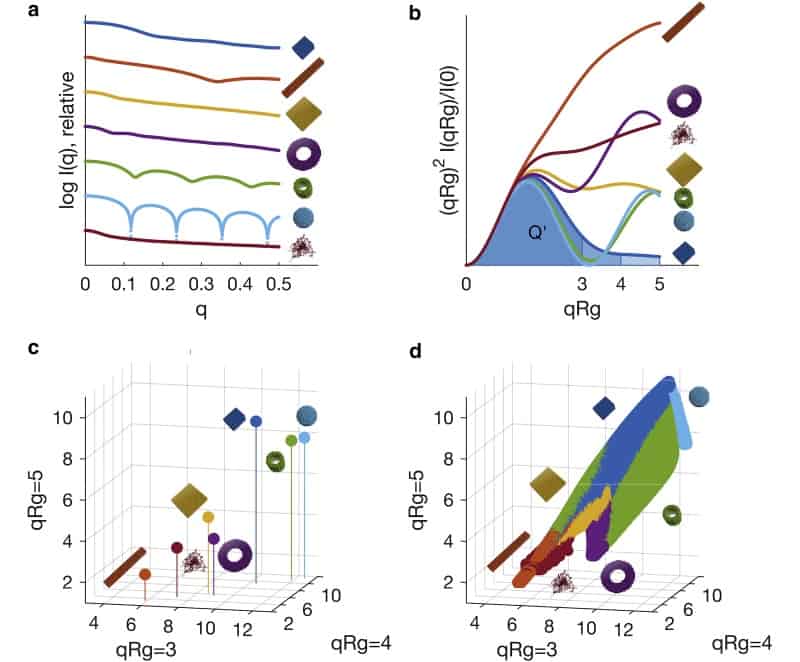
Small angle X-ray scattering (SAXS) is one of a number of biophysical techniques used for determining the structural characteristics of biomolecules. Daniel Franke and colleagues from the European Molecular Biology Laboratory have recently published a machine learning-based method to classify biomolecules using existing SAXS data (Biophys. J. 114 2485).

The method can be used to classify shape, as well as estimate structural parameters such as the maximal diameter or molecular mass of the molecule under study. These estimates may then serve as a valuable method for validating expected values.

The team decided on a set of shape classifications for biomolecules: compact spheres, flat discs, extended rods, compact-hollow cylinders, hollow spheres and flat rings. They used simulations to obtain idealized scattering profiles of each of these different geometries across a range of heights, widths and lengths ranging from 10 to 500 Å.

Shape classifications

The researchers used innovative data reduction approaches to reduce each of the scattering profiles to a point in normalized apparent volume space, V. Representing the data in this way is advantageous because structures that share similar structural characteristics will occupy a similar position in V space.

The process of classifying an unknown scattering profile then amounts to calculating its position in V space and locating the nearest points in V space for which parameters are already known. The new parameters can then be estimated by taking a weighted average of these “nearest neighbour” points in V space. A machine can be programmed to perform all of these steps.

Using machine learning

The team simulated some 488,000 scattering patterns and used these to train an algorithm to categorize different scattering patterns. Each scattering pattern was then removed in turn, and the remaining data used to predict the shape classification of the removed pattern.

This training procedure allowed the researchers to refine the weights assigned to the nearest neighbour structures in V space, so as to maximize the accuracy of the machine classification.

Predicting structural parameters

To test the predictive power of the shape classification method, the researchers harvested scattering data from the Protein Data Bank (PDB) and the Small Angle Scattering Biological Data Bank (SASBDB).

From the atomic structures stored in the PDB, they used CRYSOL software to generate scattering intensities, as well as values of structural parameters such as the maximal diameter and molecular mass. After mapping the known structures to V space, an equivalent algorithm was then used to predict the structural parameters based on the generated scattering intensity. Here, the machine prediction was within 10% of the expected value in 90% of cases.

The SASBDB provides scattering intensity as well as user generated values of structural parameters such as the maximal diameter. The researchers also observed good agreement from the structures collected from the SASBDB, with the machine predicting a small, systematically lower value for the maximal diameter. This offset reflects the fact that molecules tend to occupy an extended configuration in solution.

The protocol developed by the team shows that data mining has significant potential to increase the efficiency and reliability of scattering data, which could have huge benefit for the biophysics community.

Global mangrove soil carbon map aids conservation

Mangrove forests are among the most carbon-dense ecosystems in the world and valuable sinks for carbon emissions released into the atmosphere. Now a global map of soil carbon in mangrove forests at 30 m spatial resolution could support new ecosystem services policy tools for rewarding the preservation of major environmental assets.

“We felt that working at 30 m resolution was critical because of the strong gradients that occur in mangrove forests across the tidal range,” says Jonathan Sanderman of Woods Hole Research Center in the US. “Within a few hundred metres, there can often be a two-fold variation in soil carbon stocks and we wanted to be able to capture this important local variance in soil carbon.”

Sanderman and colleagues developed a machine-learning based data-driven statistical model of the distribution of carbon density at key sites around the world. The tool integrates measurements of mangrove forests from hundreds of studies. The researchers hope it will play a major role in prioritizing conservation efforts and providing a baseline for carbon markets.

“For many nations, including most small island nations, mangrove protection and restoration represent one of the most viable climate mitigation options,” says Sanderman.

Running the model reveals areas of high carbon stock and regions where habitats are disappearing rapidly, helping to inform protection and restoration strategies.

From remotely-sensed data on mangrove forest cover change, the team reports a reduction in soil carbon of 30–122 Tg from 2000 to 2015. More than 75% of this reduction is attributable to deforestation in Indonesia, Malaysia and Myanmar.

A high-performance computing environment allowed the scientists to interpret large amounts of information; they used Google’s Earth Engine application to write the results to a webmap. The output can change on the fly as new data become available.

The researchers plan to offer an even more detailed picture of global carbon stocks. They are keen to understand the rate at which different mangrove forests build soil carbon, motivated by areas such as the Sundarbans on the Bay of Bengal.

“While they only store modest levels of soil carbon, the Sundarbans are likely a large sink because that carbon is being buried at a rapid rate due to the annual sediment load of the three rivers that feed into this large estuary,” says Sanderman. “We would like to develop an ability to predict and then map where high sequestration rates are occurring.”

The team published their work in Environmental Research Letters (ERL).

Algorithm speeds medical image analysis

Medical image registration involves overlaying two images to compare and analyse differences – such as changes in a tumour over time – in great detail. The process, however, can often take two hours or more using traditional systems. In a pair of upcoming conference papers, researchers from MIT describe a machine-learning-based algorithm that can register brain MR scans and other 3D images more than 1000 times faster.

While existing algorithms start from scratch for every pair of images, the new algorithm, called VoxelMorph, speeds the process up by “learning” as it registers image pairs. In doing so, it acquires information about how to align images and estimates some optimal alignment parameters. After training, the algorithm uses those parameters to map all pixels of one image to another at once.

“The tasks of aligning a brain MRI shouldn’t be that different when you’re aligning one pair of brain MRIs or another,” says Guha Balakrishnan, a graduate student at MIT. “There is information you should be able to carry over in how you do the alignment. If you’re able to learn something from previous image registration, you can do a new task much faster and with the same accuracy.”

In a paper presented today at the Conference on Computer Vision and Pattern Recognition, the researchers describe how they trained their algorithm on 7000 MRI brain scans and then tested it on 250 additional scans.

During training, pairs of brain scans were fed into the algorithm, which captured similarities of voxels in the two scans. In doing so, it learns information about groups of voxels – such as anatomical shapes common to both scans – which it uses to calculate optimized parameters. When fed two new scans, the algorithm uses the optimized parameters to rapidly calculate the exact alignment of every voxel in both scans.

The researchers found that their algorithm accurately registered all 250 test brain scans within two minutes using a traditional central processing unit, and in under one second using a graphics processing unit. They note that, importantly, the algorithm is “unsupervised”, meaning that it doesn’t require additional information such as ground truth data or anatomical landmarks.

The second paper, to be presented at MICCAI in September, will describe a refined VoxelMorph algorithm that validates the accuracy of each registration. It also guarantees the registration “smoothness”, so that it doesn’t produce folds, holes or general distortions in the composite image. Across 17 brain regions, the refined algorithm scored the same accuracy as a state-of-the-art 3D registration algorithm, while providing runtime and methodological improvements.

The algorithm has a wide range of potential applications, the team points out. MIT colleagues, for instance, are currently running the algorithm on lung images. It could also pave the way for image registration during operations, potentially enabling surgeons to register scans in near real-time.

Chameleons inspire mechanochromic nanolaser

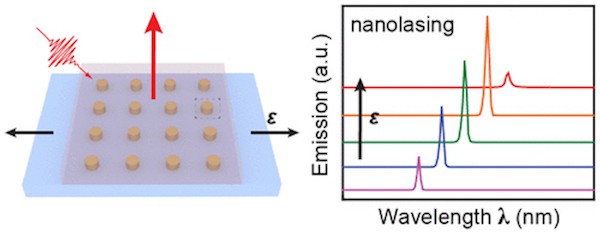
A new mechanically “stretchable” nanolaser based on gold nanoparticles patterned on an elastomeric slab surrounded by a liquid gain can lase at different light wavelengths. The new device, which is inspired by panther chameleons, might be used to make flexible, full-colour optical displays and multi-channel optical communications.

Researchers recently discovered that certain species of chameleon change the colour of their skin (from green to yellow, for example) by actively tuning a lattice of guanine nanocrystals within iridophore cells. These cells are nothing other than tuneable photonic crystals – nanostructured materials in which the periodic variation of the refractive index on the length scale of visible light produces a photonic band gap. This band gap affects how photons propagate through the material – just like a periodic potential in semiconductors affects the flow of electrons defining allowed and forbidden energy band gaps.

In photonic crystals, light of certain wavelength ranges can pass through the materials while light in other ranges is reflected. This allows the colour reflected by the crystals to be tuned by changing the band gap.

Going back to chameleons: in these animals, this gap is determined by the distance between the non-close-packed guanine nanocrystals, which can be adjusted by deforming the surrounding (elastic) skin. This allows for colour changes over the entire visible range of the electromagnetic spectrum.

Mechanically controlling laser colour

“Inspired by nature, we aimed to make a mechanochromic laser source that could also change colour via a similar mechanism,” explains Teri Odom of Northwestern University, who led this research effort. “To make such a device, in which we could mechanically control the laser colour, we exploited a lasing cavity based on a periodic array of nanoparticles in a stretchable, polymer (PDMS) matrix and liquid dye molecules surrounding the nanoparticles.”

The surface of the nanoparticles supports conduction electrons that oscillate collectively. These oscillations are known as surface plasmons, and in the case of the metal nanoparticle arrays are referred to as “lattice plasmons”. It is thanks to these plasmons, which when coupled with light, allows light to be compressed down to the nanoscale and focused to spots smaller than half its wavelength (the so-called diffraction limit).

Stretchable nanolasing based on metal nanoparticles integrated with liquid gain materials

Most plasmon-based lasers made to date have been difficult to tune easily because the optical gain was made from solid materials, like inorganic semiconductors or organic dyes in a solid matrix. The Northwestern researchers recently devised a way to overcome this problem by using a liquid gain material (made of liquid dye molecules) with the plasmonic nanocavity arrays.

There are many advantages in using liquid dye molecules,” explains Odom. “For one, we can dissolve them in different solvents with different refractive indices. This allows us to tune the dielectric environment around the nanoparticles, which also enables us to tune the lasing wavelength in real time. Liquid gain materials can be manipulated easily (in a microfluidic channel, for example), something that also allows us to tune the lasing emission by simply using liquids with different refractive indices.”

High-quality cavity modes

“In this new work, the large (around 260-nm-diameter) nanoparticles we used in our lattice (which has a spacing of 600 nm) produce high-quality cavity modes that tolerate uneven sample surfaces and defects, she adds. “The confined electromagnetic field in these cavity modes results in lasing action from regions close to the nanoparticles that support ‘hybrid quadrupole lattice plasmons’ and small changes in interparticle distance produce a change in the lasing wavelength. By thus stretching and releasing the elastomeric substrate, we can select the lasing emission colour at will.”

This is exactly the principle employed by our friends the chameleons to tune their skin colour, except that they use osmotic pressure to compress the photonic crystal lattice in their skin rather than stretching.

“The technology could find use in future flexible optical displays such as television and cell phone screens that require coherent light sources,” Odom tells Physics World. “Our system can be tuned from the ultraviolet to near-infrared by simply using different gain materials, which is promising for full-colour photonic displays ad multi-channel optical communications.”

Renmin Ma at the School of Physics at Peking University, who was not involved in this research, says that the study is “a significant step” towards making functional nanolasers. “The combination of dynamically changeable gain material and mechanically stretchable crystal lattice overcomes a major barrier to realizing high performance lasers with wide-range tunability.”

Törmä Päivi of Aalto University in Finland agrees: “The combination of stretchable substrate and multipolar nanoparticle resonances enables easy and robust mechanical control of the laser light colour,” she says. “This work will inspire us to think differently about applications of plasmonic nanoparticle arrays.”

The new stretchable nanolaser is detailed in Nano Letters 10.1021/acs.nanolett.8b01774.


The peril of proposals

Jessica Wade is hoping to apply for her first grant next year but is concerned about a lack of transparency. “You have no idea who’s evaluated you or what criteria they are using,” says Wade, a postdoctoral researcher in experimental physics at Imperial College London. Under the current system, she says, a researcher is more likely to get funded if they have been funded before, if they are from certain high-flying institutions or if they have big names on their applications. For Wade – a novice in the grant game – the current system feels “intrinsically unfair”.

Not that grant-application veterans have an easy ride. Senior scientists often gripe about how much time they spend applying for money rather than doing real research – and now there’s evidence to back them up. In 2013 Adrian Barnett, a statistician at the Queensland University of Technology in Brisbane, Australia, and colleagues published a study that found that it took researchers applying for money from the National Health and Medical Research Council of Australia an average of 34 days to prepare a proposal for a grant.

A key part of any successful application is making it through peer review. The success rate at the Engineering and Physical Sciences Research Council (EPSRC), which funds many UK academic physicists, is around 32%. That’s fairly high in the funding world. Recent figures for the Biotechnology and Biological Sciences Research Council, for example, are around 24%.

The situation’s even harder if you’re from a minority group. A 2011 study commissioned by the US National Institute of Health (NIH), for example, found that black applicants were 35% less likely to receive grants from the agency than whites. Since then, the NIH has invested $250m into diversifying biomedical science and examining its own internal biases. What’s more, one recent study in the Netherlands (PNAS 10.1073/pnas.1719557115) has shown that early success with grant applications increases success in later applications.

One study found that black applicants were 35% less likely to receive grants than whites

Elisabeth Pier, a data strategist at non-profit firm Education Analytics in Madison, Wisconsin, thinks funders should assess their own biases. Pier and her colleagues have shown that different grant reviewers evaluating the same applications generally have low levels of agreement.

Stuart Buck, vice-president of research at the private Laura and John Arnold Foundation – which mostly funds work related to criminal justice, public accountability, research integrity and education reform – says his organization doesn’t focus on how many papers a researcher has written, or which journals they are published in. Rather, the foundation carries out more of a direct assessment. For instance, if the applicant is looking to carry out a randomized control trial (RCT) of a public policy issue, they would check to see if they had successfully run an RCT before. In recent years, the foundation has funded studies that attempt to replicate previously published findings. Investing in such studies can highlight the weaknesses of a discipline, such as the lack of data- or code-sharing among its researchers. The foundation also pays reviewers for their work, Buck says, with rates varying on a case-by-case basis.

EPSRC, on the other hand, doesn’t pay reviewers but has been working to recognize their efforts, agency executive chair Philip Nelson, told Physics World. The council, which awards some £800m in grants a year, also monitors reviewers’ performance and makes sure no more than one reviewer recommended by the applicant is appointed. The agency sends reviewers’ comments back to applicants, without disclosing their identities, so if proposals are treated unfairly, applicants get a say. Overall, he argues, the agency’s application success rate is not unreasonable.

Most funders, including EPSRC, rely on single-blind peer review of grant applications, where peer reviewers know the identities of candidates but not vice versa. The general argument for this system is that referees need to know the candidates’ history, to contextualize their new application with their previous work. But it means that researchers who have a good track record will have the edge over junior researchers with less experience. Some, therefore, think “double-blind” peer review – where both reviewers and applicants remain unnamed – would work better. EPSRC is experimenting with this model, but Nelson notes that evidence suggests there are no biases in the agency’s current system.

When it comes to manuscript peer review in physics, double-blind seems to be gaining ground. Last year, for instance, IOP Publishing (which publishes Physics World) carried out a trial offering the double-blind system as an option for two of its journals. It found that around 20% of submissions were filed as double-blind, with the model most popular among authors from India, Africa and the Middle East.

Paul Coxon, a materials scientist at the University of Cambridge, says the double-blind system is sometimes hard to implement, especially for smaller fields, where a reviewer may still be able to guess who the application is coming from.

Another more recent development in the scholarly publishing world is open peer review, where both reviewers and applicants know each other’s names. Wade says she would prefer this system when applying for grants. “It would make people be less nasty,” she says. “But if it’s going to be any type of blind, then it should be double-blind.”

One alternative proposed system is that experts should stop trying to pick the best research to fund, instead relying on a lottery to allocate funds. The New Zealand Health Research Council has been experimenting with such a system for its “explorer” grants, where a brief initial scan of a bunch of proposals will pick out “transformative and viable” projects, which are then randomly allocated money. Lotteries would save a lot of time and eliminate all forms of potential biases, says Barnett. They also allow for more off-the-wall ideas to get funded, he says, which wouldn’t receive money under the traditional system. “Being rejected by a lottery is better than by a person,” he notes.

A lottery is also being tested as part of the “Experiment!” initiative at the Volkswagen Institute in Germany, which funds the humanities and social sciences as well as science and technology in higher education and research. Under the scheme, 120–140 projects are first pre-selected internally, out of which 15–20 grants are selected by a jury of scientists using a double-blind system and another 15–20 are selected by a lottery.

The luck of the draw

Many scientists think that existing funding systems are already pretty much a lottery, even if unintentionally. “Academic careers depend on luck,” Coxon adds. “Maybe having something that is genuinely random and based on the luck of a draw has some sort of appeal.” But Wade prefers conventional peer review for her first grant application, noting that, whether or not she gets the grant, constructive feedback would help her with future applications.

Two years ago, computer scientist Johan Bollen of Indiana University Bloomington and ecologist Marten Scheffer of Wageningen University in the Netherlands proposed yet another funding model, wherein researchers no longer have to apply for grants – instead, they receive an equal amount of funding annually from which they donate a fixed percentage to other scientists (see Physics World August 2016 issue). At first, the model was criticised, but recently the Dutch parliament asked the Netherlands Organization for Scientific Research to initiate a pilot project to test the idea. Wade, however, says Bollen and Scheffer’s system may introduce more bias, since researchers may simply pass on money to their friends instead of those who actually deserve it. Instead, she suggests reinvesting the “pointless money” left over after a project has finished, instead of buying unnecessary equipment.

Barnett has applied for a grant to develop another possible fix, by using video applications to speed things up. But no matter the system, it seems people will find a way to game it. Barnett has heard of academics applying for grants after already doing the work, but before publishing it. “You can write a very good application if you already done the work because you know what happens,” he says. And with that money, they do new work, and repeat the process. Some academics, Barnett notes, also agree to never co-author papers together so they can review each other’s papers and provide them with favourable feedback.

Last year, the NIH discovered some instances of researchers involved in the funding process to have violated its confidentiality rules. Earlier this year, the agency said it was re-evaluating 60 applications and had begun taking disciplinary action against academics who broke the rules.

“A consensus is building that funding should be less contingent on proposal submissions and peer review, should be less all-or-nothing, and should involve less overhead and less inequality,” says Bollen. “I think the future will be more about funding people and teams instead of projects.”


Earthquakes could be detected using undersea telecoms cables

The more than 1 million kilometres of fibre-optic cable that criss-crosses the world’s oceans could be used to create a global seismic network, says an international team of scientists. They have shown that variations in the phase of ultra-stable laser beams sent down optical fibres could be used to detect even quite small earthquakes occurring far out at sea – something that is not possible today.

Although 70% of the Earth’s surface is covered by water, the vast majority of seismometers are located on land. That means that almost any earthquake with a magnitude of about 4 or below generated more than a few hundred kilometres from the coast goes undetected. This makes it difficult to identify the mechanisms responsible for powerful mid-ocean quakes, as well as limiting the study of Earth’s interior using seismic waves.

Installing conventional seismometers on the sea floor is expensive and it has been estimated that an oceans-wide network would cost between $700m and $1bn. Although less sensitive than conventional seismometers, a network using existing telecoms fibres could cover a vast area of the sea floor much more cheaply, according to Giuseppe Marra of the National Physical Laboratory in the UK and colleagues. They say such a network could detect even small quakes occurring within a few hundred kilometres at any point along a fibre. It would require no new work at sea and would use just one of the 100 or so data channels in each fibre. The main cost would come from adding a roughly $50,000 laser at either end of each fibre.

Phase changes

The detection technique involves sending an exceptionally stable beam from each laser in opposite directions along the fibre and monitoring tiny variations in the beams’ phase. Seismic waves from an earthquake cause a characteristic series of very slight expansions and contractions in the fibre, resulting in changes to the optical path length and hence the phase of the optical signal.

With just 1 s of data taking, Marra says it is possible to measure micron-scale length changes over thousands of kilometres of cable. “This relies on having a very stable laser,” he explains. “If you were to use a standard commercial laser you wouldn’t know whether phase changes were due to fibre movement or laser instability.”

These stable lasers have been developed for comparing the time kept by optical atomic clocks using a fibre link. Indeed, it was while monitoring a 80 km link between clocks in England on 26 October 2016 that Marra saw a “wiggle” in the laser signal that he attributed to a magnitude-5.9 quake in central Italy. Looking back in the data, he saw a wiggle that corresponded to the magnitude-6 earthquake that devastated Amatrice, Italy two months earlier. He was also able to confirm that the waveforms of the two quakes seen in the fibre matched those recorded by the British Geological Survey and went on to record quakes from New Zealand, Mexico and Japan.

Confidence at sea

Next, Marra got together with researchers at the National Institute of Metrological Research (INRiM) in Italy to test the technique using two other stretches of fibre. One is a 535 km-long link between Turin and Bologna and the other and undersea link between Malta and Sicily. The undersea link managed to detect a weak (magnitude-3.4) tremor about 90 km from the fibre, which Marra says, “gave us confidence that we can do this on the sea floor”.

The latest research is not the first time that scientists have used optical fibre to detect earthquakes. Last November, Biondo Biondi of Stanford University in the US and colleagues picked up signals from hundreds of tremors using a 5 km-circumference loop of fibre on the Stanford campus. That relied on measuring variations in round-trip travel time of laser pulses that bounced off tiny impurities in the fibre. While it could be used to create dense arrays of seismic sensors in quake-prone California, the range of the system is limited to few tens of kilometres.

Marra and colleagues are now busy refining their technique. Having shown how to establish where a seismic wave hits the fibre, the group plans to use two such links to pin down a quake’s (2D) epicentre and three links to nail its (3D) hypocentre. Working out a quake’s magnitude, meanwhile, might need fresh experiments to calibrate the optical signal.

The number of cables is growing exponentially so the possibilities for us are growing as well

Giuseppe Marra

The team must also persuade telecoms companies to provide access to fibres. Discussions are at an early stage, and Marra is optimistic. With high-bandwidth fibre now being laid down by companies, he reckons that he and his colleagues might be able to “repurpose” old undersea cables, and could also rent channels in existing cables. “The number of cables is growing exponentially,” he says, “so the possibilities for us are growing as well.”

Biondi reckons that averaging signals over the length of a fibre might significantly limit analysis of an earthquake’s “source mechanisms”. But given the cost and sparsity of existing submarine detectors, he thinks the fibre technology is “exciting and will lead to new insights”.

The research is described in Science.

UK space sector set for take-off

What is the Harwell Space Cluster (HSC)?

The HSC comprises 80 organizations and more than 800 people and is the gateway to the UK space sector. Some of the key organizations include RAL Space, part of the UK Science and Technology Facilities Council (STFC), the UK Space Agency, the Satellite Applications Catapult and the European Space Agency (ESA). The HSC provides support to all businesses that want to locate on the campus and/or want to interact closely with the cluster as well as providing access to cutting-edge facilities and business advice.

What is its mission?

The mission is to grow the space industry in the UK and for the HSC to be globally renowned. To do so, we aim to have 5000 people at the HSC by 2030.

What are some of the challenges to meet this?

Recruiting people with the required skill sets is a particular issue. Not only that but also retaining them. The UK has a target of 10% of the global space industry by 2030 and that requires at least 100,000 jobs.

Space is a global industry and UK companies already work with multiple partners across the planet

Joanna Hart

Do you think that is achievable?

The UK currently has around 6.5% of the global space industry, representing £13.7bn in 2014/15 and employing 38,000 people, so we are well on our way. The key to this vision is that we need the continual investment from both government and industry, but if we continue to work together as we have done so far then this should be achievable.

What benefits does space bring for everyday life?

Imagine if you turned off all the satellites orbiting the Earth. So many aspects of our daily lives would suffer. Space now supports so much. Not only that but there are also many spin-out technologies. For example, a spectrometer that has been designed to withstand the harsh environment in space will have numerous applications down on Earth, perhaps in heavy-industry processes.

Why is the UK government interested in the space industry?

The space industry underpins about £250bn of the UK’s gross domestic product and the government sees it as a real growth opportunity. It also has high productivity, in fact, about 2.7 times the national average.

What is driving this growth?

A large proportion of growth is in “downstream” applications or using the data from satellites. For example, Earth-observation satellites can be used to spot illegal fishing or illegal mining.

How will the UK space industry be impacted by the UK leaving the European Union?

It’s too early to say but our membership of ESA is not affected by Brexit. In addition, space is a global industry and UK companies already work with multiple partners across the planet.

What can the UK learn from space sectors in other countries?

Space is a global industry, so many of the companies at the HSC are already collaborating with international organizations, some of which also have a presence at the Harwell campus. The UK has taken a lead in applications using space data. Adding space launch will give the UK the potential to have the full value chain.

What challenges do start-ups face?

The main challenge is getting funding. One important avenue for start-up funding is from ESA’s business incubation centre, which gives firms office space and business advice. Other organizations such as the Satellite Applications Catapult and Innovate UK can also give companies business advice. While funding was a really big challenge in the past, it is getting easier and I see that there is more money coming into the space industry. Many companies at the Harwell Space Cluster have recently had successful fundraisings such as Open Cosmos, Rezatec and Oxford Space Systems.

How did you get involved in the space industry?

I am a particle physicist by training. I did a PhD during which I worked on the ZEUS detector belonging to the HERA accelerator at the DESY lab in Hamburg. I then moved to London working in investment banking. After a career break, I started at the HSC as a development manager.

What excites you most about the industry?

Harwell is such an exciting place to be. When I started almost five years ago, the campus was still in its infancy, but it has grown so much in so little time. When I give talks about the HSC I have to keep updating the aerial image of the campus as it is changing so much every year. For me it is exciting to see companies grow from being initially small to having global ambitions.

What do you think the UK space industry will look like in 2030?

I think the UK space sector will be much broader than it is now with many more services, products and applications from space. The UK is also planning to have its own space port and that will be particularly exciting.

Copyright © 2026 by IOP Publishing Ltd and individual contributors