Growing pains for 3D printing

How did TRUMPF get involved in additive manufacturing?

We started working with additive manufacturing as early as the mid-1990s, when we experimented with using CO2 lasers for powder-type additive manufacturing. We then switched to solid-state lasers and developed a powder-bed additive manufacturing machine – where the laser creates new parts by building up layers from metal powder and fusing them together – that we introduced to the market in 2003. But unfortunately, the market was not ripe for it. People did not understand either the technology or the potential for it, and after three years without much success, we discontinued it.

In parallel, we continued offering powder-nozzle laser-based additive manufacturing, which is a different technique where the laser generates a weld pool on the component surface and powder is continuously added and melted onto it. But after a few years, we saw that the few customers we did have for our original powder-bed machine were really starting to understand its potential, and they began to approach us with requests to buy additional machines. That’s when we decided to restart this activity. Both types of manufacturing have their advantages and disadvantages. With the powder-bed design, for example, the surface quality and the overall part accuracy is much better, but the maximum part size is smaller and the productivity is lower because the process is slower by approximately a factor of five.

What did you learn from that first powder-bed machine?

We only sold 15 units over three years, and what was really discouraging was that the numbers were declining: the first year was the most successful year and it went down from there. We learned two things from that. One is that, obviously, you can be too early with the technology and the market. But we also learned that if you introduce a completely novel process for making parts, educating your users is important. We should have started by spending more effort on educating potential customers before trying to sell them a machine for $500,000 or $750,000.

What happened to make it possible to go ahead and produce those machines again?

A number of things. First is that advances in 3D computer-aided design systems gave people an ability to design intricate parts that simply wasn’t there before. Second, the experience with 3D printing plastic materials led people to understand that this technology has possibilities that can only be realized if you can do the same or similar processes in metal. And third, the powder-bed machines and processes became more productive and reliable than they were just after the turn of the millennium.
Now that the sector is over that initial hump, there’s a lot of hype about additive manufacturing. What are the benefits and drawbacks of that?

One benefit is that because there is a lot of attention being paid to the field, there are a lot of players willing to invest. Another is that for this technology to develop further, a collaborative effort is required – it’s not sufficient for machine builders or powder producers to just focus on what they do in isolation – and the hype helps this collaborative effort. Finally, there is a market there where there wasn’t one before, and that helps the producers and developers of new machines to survive because they can generate sales revenues.

The drawbacks of the hype are the expectations created within the customer base. I think that a lot of CEOs read articles in mainstream media about 3D printing and ask their CTO: “Why aren’t we doing anything?” They have an expectation that within one, two or three years, introducing additive manufacturing will bring about real benefits for the company’s bottom line, but in reality it probably won’t happen that fast. So there is a chance of disillusionment, and I’m concerned about that because it could throw a lot of good players out of the market because they wouldn’t survive a “valley of death” – but that is speculation.

How do you avoid that disillusionment? You talked about education.

At my own company, I spend a lot of time trying to manage expectations about how fast and how big our additive manufacturing business can grow. But yes, I do think it’s important to talk to customers and explain to them what they can expect and how much they need to invest in educating their own staff if they want to be able to reap the benefits. The field of additive manufacturing is growing up, but right now, it has essentially reached puberty. I mention this because I have four children and at least two of them are in puberty right now, so I can see that it’s a wonderful age – they get very enthusiastic very quickly. But they are also a bit too enthusiastic sometimes, and then they get very frustrated at other times.

There is a chance of disillusionment, and I’m concerned about that because it could throw a lot of good players out of the market

What’s your current wish list for improvements or innovations in this field?

I think the robustness of the additive manufacturing process must be improved, and that can be done through intelligent sensing and good use of the data generated through those sensors. If we can learn from things that we see happening in the process and adjust the machines accordingly, that would be very good because we have to be able to adapt to different powder qualities and climate conditions. At the moment, if the Sun shines in the afternoon, sometimes we get a different part quality than we did in the morning. I’m exaggerating a bit, but that’s what it’s like, and better sensing could help.

What about more fundamental advances, such as in materials science or laser optics?

Those are also important – for instance, it might be nice to expand the types of laser sources used, the available wavelengths and so on. However, we have to keep in mind that these processes take a long time. If we develop a new type of laser source for additive manufacturing, we’re talking five years from the beginning of the project until we see the first part being printed and in production, and that’s a long time. The most immediate problems to be solved are the robustness of the process. Once we have that, we can expand the field.

What developments do you expect to see in the next five years?

I expect to see a fragmentation of the market in terms of the processes used for individual parts. We will probably see more hybridization, where different types of additive manufacturing are used in combination with each other or with traditional subtractive techniques. There are a lot of new companies entering the field, and in the next few years we are going to see a learning process where the community will come to understand which technique is best for which type of part.
Water takes the heat off Hong Kong air-con

Using water to cool non-domestic air-conditioning systems could have reduced outside air temperatures by as much as 1.5°C during a heatwave in Hong Kong, researchers have found.

The study shows that water-cooled air-conditioning units are not only more energy-efficient, but also relieve the anthropogenic “urban heat island” effect, which sees cities have greater ambient temperatures than the countryside.

“We cannot ignore the effect of air-conditioning systems on the city environment,” said Yi Wang of the University of Hong Kong.

As air-conditioning units cool us indoors, they expel heat outdoors. The amount of heat displaced can be enough to increase outdoor air temperatures measurably, contributing to the urban heat island effect.

And of course, if it gets warmer outdoors, even more air conditioning is needed indoors.

Not all air-conditioning systems are the same, however. Many rely on air to cool their condensing units, but those that are more energy-efficient use water. One method of water-cooling is known as direct cooling; it involves seawater being fed into the buildings that house condensers. Another type is centrally piped, with a tall cooling tower where air ascends amid a water cascade.

Wong and colleagues wanted to explore how these water-cooled systems affect the urban heat island in Hong Kong, where a subtropical climate has led to air conditioning accounting for some 30% of electricity consumption. Using a meteorological model, the researchers investigated the impact on the heat island had non-domestic consumers used one of the two water-cooled systems, compared with the baseline case of air-cooling. The team performed the simulation for conditions matching 23-28 July 2016, when Hong Kong experienced extremely high temperatures.

The results suggested that, had water-cooled systems been used, outdoor air temperatures would have fallen by 0.5-0.8°C during the daytime, and as much as 1.5 °C between 7 and 8 pm. Wong believes this demonstrates the importance of exploring the effects of air conditioning beyond the immediate environments of the systems.

“Existing studies have concentrated much more on single-building energy-efficiency using new air-conditioning systems,” said Wong. “However, the climate within or around every building is connected to the overall city environment. A city has tens of thousands of buildings, [a] large number of streets and many other facilities, and the environment has impact on each individual building.”

The researchers now plan to extend their study by exploring the effect of air conditioning on urban air quality, and on temperatures in other parts of the world.

They published their findings in Environmental Research Letters (ERL).

Artificial intelligence spots gravitational waves

A deep-learning system that can sift gravitational wave signals from background noise has been created by physicists in the UK. Deep learning is a neural-inspired pattern recognition technique that has already been applied to image processing, speech recognition and medical diagnoses, among other things. Chris Messenger and colleagues at the University of Glasgow have shown that their system is as effective as conventional signal processing and has the potential to identify gravitational-wave signals much more quickly.

Gravitational waves are ripples in space-time that can be observed using the LIGO-Virgo detectors – which are laser interferometers with pairs of arms several kilometres long positioned at right angles to each other. As a wave passes through the Earth it very slightly stretches one arm while squeezing the other, before squeezing the first and stretching the second, and so on. This generates a series of tiny but distinctive oscillations that are recorded as variations in the interference patterns measured by the instruments.

The first gravitational wave to be detected was snared by the two LIGO detectors in the US in September 2015. Unlike signals observed since then, these oscillations were visible to the naked eye within the raw data. Normally gravitational-wave signals are swamped by noise – seismic, thermal motion or photon statistics – that must be filtered out using computer algorithms if the signal is to emerge.

Template matching

Usually signals are picked out from the noise using a technique known as matched filtering. This involves comparing the oscillations recorded by the interferometer with a series of templates representing waveforms produced by different astrophysicals event that are calculated using post-Newtonian and relativistic equations. A significant match between the observational data and any of the templates means a detection, while the type of waveform in the template reveals what caused the gravitational wave in question.

However, the need to compare large numbers of templates to ensure an accurate result means that matched filtering requires lots of processing power and is time-consuming. In the latest work, the team has shown they can potentially reduce the time needed – by using machine learning rather than conventional algorithms. Their system relies on a neural network, which, like the brain, consists of layers of processing units that fire when they receive a certain input.

The system’s input layer holds the raw data that would come from an interferometer – a series of numbers related to variations in the arms’ strain. These data are fed to the first of nine internal layers made up of neurons whose output depends on the input data and a weighting applied to each neuron. With those outputs then forming the inputs of the next layer, and so on, the system ends in a final layer consisting of just two neurons that each generate a probability value between 0 and 1. One neuron reveals how likely it is that the raw data contain a signal while the other, conversely, describes the likelihood of it containing just noise.

Training weights

Initially the neurons’ weights are set randomly and the system is “trained” by exposing it to a series of sample data sets, half of which consist of a gravitational-wave signal from binary black-hole mergers covered by “Gaussian” noise while the other half contain Gaussian noise only. The probability values computed by the system in each case are compared with the (known) data type – signal or noise – and the degree of error is then used to adjust the neuron weights layer by layer in a process called back propagation. The idea is that after enough iterations, the network can distinguish signal from noise reliably.

Having trained their system with half a million data sets, Messenger and co-workers then fed it 20,000 new waveforms to see how many it could correctly identify. They also analysed the same set of waveforms using matched filtering. They found that the two techniques performed nearly equally – their ability to find the buried signals depending in a very similar way on the signal-to-noise ratio and on the probability of mistaking noise for signal. However, because the bulk of computation for deep learning occurs during training, the new technique was far quicker – taking just a few seconds to analyse all the unknown waveforms rather than several hours.

According to Glasgow group member Hunter Gabbard, this greater speed might prove handy as interferometers become more sensitive and detect gravitational waves more often. This, he says, could help alert astronomers to signals from merging neutron stars so that they can point their telescopes to the patch of sky in question and pick up the accompanying electromagnetic radiation before it disappears.

Recognizing glitches

The Glasgow group, however, is not the only one to have applied artificial intelligence to gravitational-wave detection. In particular, Daniel George and Eliu Huerta of the University of Illinois in the US have already published two papers showing that deep learning can operate orders of magnitude faster than matched filtering. They have also used their neural network to estimate properties of gravitational-wave signals, such as the masses of radiating black holes, as well as analysing real, as opposed to simulated, LIGO data. Such data, they point out, can contain what are known as glitches – noise that can mimic a signal – as well as purely Gaussian noise.

Rory Smith of Monash University in Australia is slightly more cautious about the potential for deep learning. He says it “could one day show promise”, suggesting it might prove particularly useful for distinguishing astrophysical signals from glitches, but prefers to develop more physics-based “principled” approaches. “There’s still a lot of room to better understand the signals and data that we have without resorting to black-box techniques,” he argues.

Messenger and colleagues describe their work in Physical Review Letters.


First look at the structure of bacterial cell walls

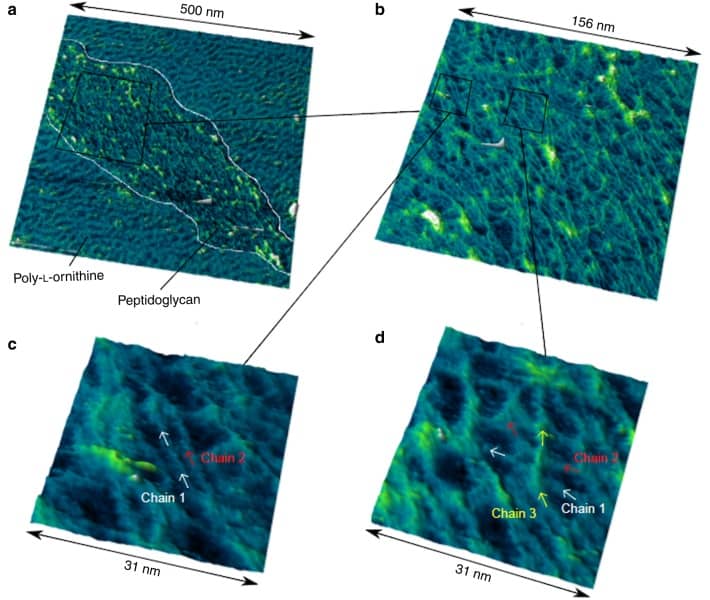
The biopolymer peptidoglycan that makes up bacterial cell walls was always assumed to be highly ordered. Textbook images like the one below have shaped our thinking. Robert Turner and his colleagues have now taken the first high-resolution images of the bacterial cell wall using atomic force microscopy (AFM), revealing that the polymer is much less ordered than previously thought. Additionally, the level of order changes with cell shape: in rod-shaped bacteria, polymer strands are somewhat ordered, while this order disappears when a round cell shape is induced (Nature Communications 10.1038/s41467-018-03551-y).

The team, from the research groups of Simon Foster and Jamie Hobbs at the University of Sheffield, isolated cell wall fragments and imaged them using AFM. This technique can take images at nanoscale resolution. In contrast to the textbook pictures, the images showed that peptidoglycan strands do not run exactly parallel and can even cross over one another. Analysis based on a Fourier Transform calculation showed that there is some order in the polymer, it is just not as high as assumed.

AFM images of peptidoglycan from bacterial cell walls

The fact that the polymer is less ordered than originally thought also opens up the possibility of answering another question: “How do bacteria interact with their outer membrane that lies beyond the cell wall?” Turner’s findings show that pores in the polymer could allow molecules to pass through the peptidoglycan wall and connect the inner and outer membranes. Further studies will need to confirm this hypothesis.

A long road to single-chain images
AFM works by recording the movement of a microscopically small cantilever tip scanning over a surface. The resulting image shows the topology of a surface much like the contour map of a mountain. Despite AFM being a powerful technique, Turner and his colleagues had to optimize the process to obtain images that resolve individual polymer strains. “After about a decade of looking at the bacterial cell wall with AFM, I managed to image individual molecular sugar chains,” Turner stated on Twitter.

Lead author Robert Turner

Round cells are different
The authors investigated the length of polymers using a technique called size exclusion chromatography to separate fragments of different lengths. They found that the rod-shaped bacteria contained long strands of polymers.

When a round shape was induced in the same type of bacteria, by adding chemicals or making genetic changes, the polymer was disordered and contained shorter polymer chains. This might come as a surprise to some who thought that a round cell consisted of two cell poles stuck together. In such a case, the polymer strands would be oriented in a spindle like fashion, which was not observed in Turner’s experiments. It will be interesting to see how peptidoglycan is organized in bacteria that are naturally round.

This works lays the basis for bio-inspired nanostructures and improves knowledge regarding the bacterial cell wall, an important drug target for antibiotics.

Surface phonon polaritons boost heat transfer

New insights into why heat transfer between objects is enhanced at very short separations have been gleaned by Keunhan Park and colleagues at the University of Utah and University of Pittsburgh in the US. The team made exquisitely precise measurements of how heat moves between two quartz plates that are positioned just 200 nm apart. They found that energy transfer is enhanced by about 45 times at tiny separations, which they ascribe to the coupling of surface photon polaritons across the gap between the plates.

Normally, the heat transfer between two objects at different temperatures can be approximated by assuming that the objects are “black bodies”. These are ideal entities that absorb all radiation falling on them and emit thermal radiation according to Planck’s law. Physicists have known for some time that this breaks down when objects get to within a few hundred nanometres of each other, where they exchange heat much faster than predicted by the black-body approximation. Indeed, this “near-field” enhancement has already been used in some technologies including heat extraction and thermophotovoltaic systems.

However, more widespread use of the enhancement has been hampered by a poor understanding of the effect – which is a result of significant experimental difficulties in measuring heat transfer between objects separated by just a few hundred nanometres. These challenges include controlling unwanted heat flow and achieving precise control over the orientation and separation of the two objects.

Parallel lines

Now, Park and colleagues have measured radiative heat transfer between two macroscopic plates of quartz each measuring 5×5 mm and separated by a distance that they could vary between 200-1200 nm. A key feature of their experimental apparatus is that they can keep the plates parallel to within a fraction of a millidegree. Indeed, by varying the angle between the plates, they were able to show that heat transfer is extremely sensitive to how parallel the plates are – dropping off by 5% when the plates are misaligned by just 3 millidegrees.

As well as confirming that radiative heat transfer is enhanced over short distances, the experiments suggest that surface phonon polaritons are responsible for the boost. Phonons are particle-like acoustic excitations that occur in solids. Quartz is a polar crystal and this means that its phonons can generate oscillating electric fields. These fields can couple with photons at the surface of quartz to create surface phonon polaritons, which are photon-like excitations. Measurements reveal that the heat transfer is proportional to one over the square of the separation between the plates, which agrees with the theoretical calculations of how energy is transferred across the gap by surface plasmon polaritons.

Writing in Physical Review Letters, the team says that their technique could be used to measure the near-field thermal radiation properties of a range of different materials and structures.

A better virtual experience

When the Eyephone (no, that isn’t a typo) made its debut in Silicon Valley in 1987, it was meant to be the wave of the future. This early virtual reality (VR) headset was the brainchild of the computer scientist and technology philosopher Jaron Lanier, who popularized the term “virtual reality” and became, with his company VPL Research, one of the field’s pioneers. But despite the Eyephone’s impressive pedigree and futuristic appeal, its flaws soon became apparent. Its headset consisted of a pair of 3-inch-wide liquid-crystal displays, placed near the focal length of a pair of Fresnel lenses and held in place by a headband. Bulky and awkward to wear, it gave users the rough equivalent of 6/60 vision. Worse, it gave them headaches, nausea and dizziness that sometimes persisted for hours after they had left the virtual world behind. And to top it off, a complete Eyephone system set early adopters back almost $50,000 – in late 1980s dollars.

More than 30 years later, and towards the end of a day-long VR symposium held in San Francisco as part of the 2018 Photonics West conference, Lanier reflected on that first, failed dawn of the VR era. “There’s this crazy thing that in the history of technology, sometimes the first people who come into the field can see further,” he mused. Early VR systems garnered some significant successes, Lanier added, noting that his wife’s life was recently saved by a doctor who trained in a surgical simulator. But when it came to the Eyephone and one of its spin-offs, the PowerGlove, he didn’t mince his words. “It was total crap – are you kidding?” he said, laughing. “We sold thousands of PowerGloves and let us say they were not necessarily great.”

Three decades of intermittent innovation and investment have ironed out many of the Eyephone’s flaws. Consumer devices such as the Oculus Rift VR headset are relatively compact and retail for hundreds of dollars, not thousands. Refresh rates on VR displays often exceed 60 Hz, far better than the handful of frames per second typical of the late 1980s and early 1990s. But reports of user discomfort have not gone away, and as companies such as Microsoft, Google and Intel pour money into VR, it is becoming apparent that some of the technology’s limitations have as much to do with the physics of the human eye as they do with device engineering and design.

Real eyes, virtual world

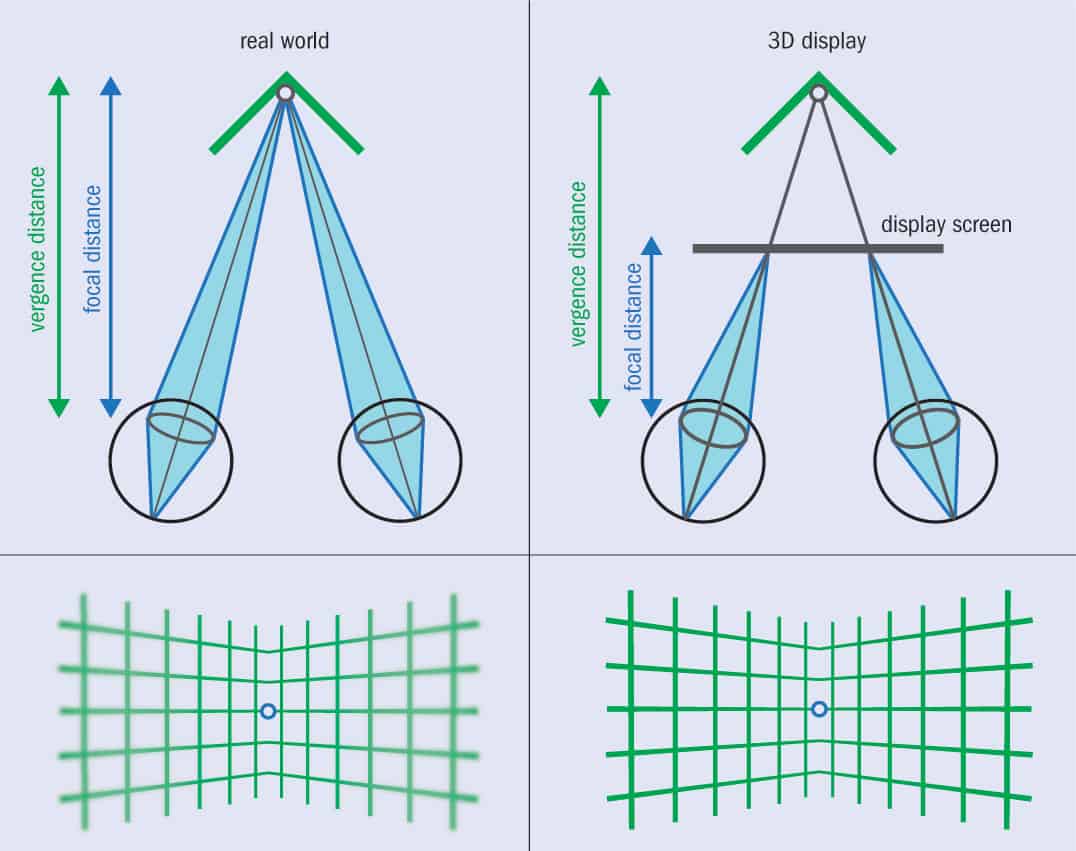
“Hold your finger up in front of you and look at it,” directs Gordon Love, a physicist who heads the computer science department at Durham University in the UK. “When you do that, a number of things have to happen in your eyes. First of all, you have to focus on your finger. Then you have to verge – that is, point your eyes towards it.” In the real world, Love explains, the location at which your eyes focus, or accommodate, is the same as where they point, or verge: your finger, in this case. In a VR display, though, regardless of whether you are examining a virtual object up close, or marvelling at the lush scenery in the background, your eyes are always focused on the display itself, which is typically a few centimetres away (see figure). Vergence and accommodation are therefore decoupled, which is not the normal state of affairs. “You’re effectively forcing the eye to do something that it never has to do in the real world,” Love says.

The vergence-accommodation conflict, as it’s known, is not the only source of eyestrain and nausea among VR users. However, decades of research on VR and human vision – dating back to the Eyephone era and even before it – show that it is a major contributor. It is also a problem that industry scientists are working on in earnest. At the Photonics West symposium, Douglas Lanman of Oculus Research – the R&D division of the company behind the Rift headset – placed it third on his list of challenges for VR developers, after improving the resolution of displays and widening their field of view. “Vergence-accommodation is a good research topic, because focusing in a headset is way down developers’ list of priorities,” Lanman explains, adding that the conflict needs to be addressed before VR can achieve its full potential.

Computing tricks

Proposed solutions to the vergence-accommodation conflict come in many forms. Of these, the computational approach is the simplest. To understand how it works, try staring at your finger again. In the real world, if you do this, your finger will be in focus, while everything in the background will be blurred. In a typical VR display, though, all objects appear to be in focus regardless of where your eyes are pointing. The makers of 3D films – who, like VR developers, simulate depth of field by providing slightly different views of a scene to each eye – correct for this computationally, by rendering the important elements in each scene sharply while blurring the background. “Look at a still image from the film Avatar,” Love suggests. “You’ll see that the main character is in focus, while other parts are blurred. And 99% of the time, that’s fine – at least for a film.”

For VR, however, the problem is more complex, because users want to explore and interact with virtual environments and objects rather than passively consuming a pre-recorded scene. Some VR developers have tried blurring images selectively, depending on where the user is looking, but Pierre-Yves Laffont, a computer-vision expert at VR start-up Lemnis Technologies, explains that computational tricks either don’t affect how our eyes accommodate, or they come with significant drawbacks, such as making the entire image blurry. “It’s a cosmetic change,” he says. “It does not really solve the problem.”

Optics to the rescue

The alternative is to tackle the vergence-accommodation conflict optically, by creating VR systems that more nearly mimic how light behaves in the real world. One approach, first suggested in the mid-1990s, is to use multiple displays, each at a different focal plane, to show different parts of a virtual scene. Unfortunately, the additional displays add bulk, and because they are stacked in front of each other, contrast is often lost. “In optics, there is no free lunch and there is no Moore’s Law,” warns Jerry Carollo, an optical architect at Google. “In software, you can do anything, but every time you add an optical adjustment, you’re adding weight and fecking the comfort.”

Another approach is to replace the passive, single-focus optical components found in most VR displays with adaptive multifocal optics. This is the idea that drew Love, whose background is in adaptive optics for astronomy applications, into VR. In 2009 his group worked with Martin Banks’ vision-science lab at the University of California, Berkeley to develop a switchable lens that could change its focal length in less than a millisecond. By placing this lens between the user’s eye and a display, and then rapidly cycling the lens through a handful of different focal lengths, they produced a more realistic accommodation experience, with test subjects reporting fewer negative visual effects.

The main disadvantage with this system, Love says, is that it places strict requirements on the user’s head position. “When your head moves around in real life, you start to see around objects,” he explains. “In our display, when you do that all you see is these different focal planes kind of moving apart, which is really horrible – much worse than the thing you’re trying to correct.” In lab experiments, test subjects bite down on a bar to help keep their heads in place; whether that level of control is possible in a standard VR head-mounted display is, Love says, “an open question”.

Some VR limitations have to do with the physics of the human eye rather than device engineering

A more practical option, at least in the near term, might look something like the prototype that Lemnis Technologies showed off at Photonics West in January 2018. This Singapore-based start-up was founded in 2017, and its team has developed software that can determine, in real time, the optimal location for the focus in each frame of a virtual scene. The Lemnis prototype also incorporates an infrared eye-tracker to monitor where the user is looking, and this information is fed to mechanical actuators that adjust the position of one or more lenses inside the headset – thereby giving users a more “real-world” visual experience. The company is working with undisclosed partners to incorporate its technology into a consumer device, and Laffont, its co-founder and CEO, is naturally confident about its future. “I believe that eye-tracking is a major component of the next generation of VR headsets,” he says, adding that many start-ups in the eye-tracking field have recently been acquired by tech giants such as Facebook, Google and Apple.

Wide-open field

Another strategy for resolving the vergence-accommodation conflict eschews adaptive optics in favour of light-field technology. Conceptually, light-field VR displays work by mapping multiple views of virtual objects onto a single display, with two or more light rays emerging from each incremental area on the object and manifesting as pixels on a screen. The technology is based on a system demonstrated in 1908 by the optical physicist (and Nobel laureate) Gabriel Lippmann, who used an array of small lenses to record a scene as it appeared from many different locations, and additional arrays to reconstruct composite images for each eye. The result was a 3D image that accurately incorporates parallax and perspective shifts – an attractive attribute for VR developers.

There is, however, a problem: the more rays you add, the more pixels you need in your display. “You end up building a low-resolution display, and that’s a big trade to make,” Love explains. Nevertheless, several prototype light-field VR systems have been demonstrated, notably by Nvidia Research. There is also a strong feeling in the industry that light-field technology needs to be perfected for both VR and its newer cousin, augmented reality (AR), to have mass-market applications. In AR, users interact with virtual and real objects simultaneously, and the vergence-accommodation conflict is, if anything, even more bothersome than it is in VR. “Imagine you want to put a virtual object in your hand just in front of you,” explains Laffont. “With today’s AR devices, either your hand will appear sharp or the virtual object will appear sharp, but you won’t be able to focus on both of them at the same time.”

At the Photonics West symposium, Ed Tang, co-founder and CEO of Avegant, a VR developer, was bullish about light-field’s capacity to get around such problems – and, eventually, to dominate the crowded field of VR technology. “Light-field, at the end of the day, is required for the experiences users demand,” he declared. “I would even go so far as to be sceptical that VR will become accepted without light-field.” Others are more cautious. Lanman, who was a senior research scientist at light-field specialists Nvidia until 2014, called light-field displays “academically interesting but very far away”. Laffont echoes this view. “I think light-field displays are really exciting and definitely the future,” he says. “The problem is that the current technology does not allow you to achieve a high field of view and a high resolution together with a low computational expense. And if we have to trade the resolution or the field of view, that will prevent certain applications from being realized.”

For now, both light-field-based VR devices and their adaptive-optics counterparts still look more like modern Eyephones than, well, modern iPhones. A case in point is the Avegant Glyph, a light-field-based video headset that entered the market in 2016. One prominent reviewer, Dieter Bohn of tech site The Verge, summed up the Glyph as “ridiculous-looking, kind of uncomfortable, and pretty awesome”. Two years later, that description remains valid for most – perhaps all – VR headsets available to consumers. “VR initially took off much more slowly than expected,” says Laffont. “We are still at the very early stage of its history.” Despite significant progress and a promising future, the field of VR has a way to go before the virtual becomes truly real.

Stephen Hawking’s scientific legacy

The time: spring 1984. The place: a lecture hall at the University of Cambridge. 

Students crowd the seats. In front of the blackboard a stage rises a foot above the floor of the hall. On the stage a man in a wheelchair speaks in a murmur to a graduate student. The student has red tinted glasses and is wearing a soft, cream-coloured jacket. The man: murmur, murmur, murmur. The student: “Professor Hawking says, ‘This lecture is about the edge of the universe.’ ” Murmur, murmur, murmur. “The edge of the universe is very far away.” Murmur, murmur. “Nonetheless, we can still picture it as follows…” The student draws a diagram on the board. The lecture continues, Hawking murmuring, and the student translating. The topic is complex, but the flow is clear. Hawking is an exceptional lecturer, and because everything is said twice, once in a murmur and once in translation, there is extra time to think.

The occasion is Stephen Hawking’s seminar on quantum gravity, and he is talking about his latest work. The audience is rapt and Hawking is excited. He is impatient for the student to finish each translation, and while the student is speaking and writing on the board, Hawking fidgets. Confined by a degenerative motor-neurone disease, he can only move his fingers, which he is using to shift his wheelchair side to side – dzzt, dzzt – as the student speaks – dzzt, dzzt. Each time he moves side to side, however, he also moves imperceptibly backwards. Half an hour into the lecture a huge crash breaks the spell. Hawking’s wheelchair topples off the edge of the stage and is lying on its back on the ground. Hawking’s feet dangle in the air and students jump up to right the chair. He is crumpled at an odd angle, shaking violently. Is he dying? No – he’s laughing. Murmur, murmur, murmur. “Professor Hawking says, ‘Fell off the edge of the universe.’ ”

Hawking led a full and complete life, despite his illness, and his scientific work inspired generations of students to study problems of gravity and quantum mechanics. In the weeks since his death on 14 March, many of his colleagues have written of his remarkable life and work. This article will touch upon a few of his primary scientific accomplishments – in particular, his work on classical gravity and singularities, his famous results on black-hole thermodynamics and Hawking radiation, and his efforts to quantize gravity.

Out of the singularity

As a young man, Hawking worked on general relativity, investigating the problem of how black holes form. His mastery of geometrical methods allowed him to prove a set of remarkable theorems about the circumstances under which swirling clouds of matter undergo gravitational collapse, giving rise to gravitational singularities. Working together with Roger Penrose, who had been investigating similar problems, Hawking produced a remarkable paper in 1970 entitled “The singularities of gravitational collapse and cosmology” (Proc. Roy. Soc. Lond. A 314 529). 

Stephen Hawking at the Oxford Students Union

In this work, he and Penrose proved that “reasonable” space–times would exhibit both singularities in the future (either the final singularity in a closed universe, or singularities present in black holes) and singularities in the past (the Big Bang). Here, “reasonable” means that the space–time does not possess causal irregularities – such as closed time-like curves – and matter obeys a strong energy condition, so that the presence of matter focuses neighbouring geodesics (the shortest lines between points on a curved surface) towards each other. 

Taken together, the Penrose–Hawking singularity theorems provide strong evidence for the necessary formation of black holes in our universe. It is a prediction that has been confirmed both by observational evidence of galactic X-ray sources such as Cygnus X-1, and by the recent and spectacular findings from the Laser Interferometer Gravitational-Wave Observatory (LIGO), which has detected the gravitational waves emitted by colliding black holes.

Hawking’s next major work was his most famous. His singularity theorems implied that the area of a black hole’s event horizon increases when more matter and energy is added to the hole, and should never decrease. Consequently, Hawking and colleagues noted that the area of the horizon was analogous to entropy in the second law of thermodynamics: according to which entropy does not decrease, and tends to increase. Building on Hawking’s ideas, Jacob Bekenstein conjectured that the area of the event horizon was in fact equal to the entropy of the black hole, up to a multiplicative constant. 

But now there is a problem. Thermodynamic systems with entropy S(E) as a function of energy E must also possess a temperature, defined by 1/kBT = ∂S/∂E. But what is the temperature of a black hole? After all, it is black and, at least classically, no radiation can escape from it.

Out of the black hole 

In 1974 Hawking solved the problem of black-hole temperature in spectacular fashion. By applying methods of quantum field theory on curved space–time to black-hole geometry, Hawking was able to show that black holes behave like black bodies, emitting thermal radiation with a temperature ħκ/2πkB (where ħ is Planck’s constant divided by 2π and κ is the surface gravity of the hole), corresponding to a black-hole entropy equal to one quarter of the area of the horizon, measured in Planck units. Hawking’s basic conception of the problem was simple and  brilliant.

General relativity is about the reconciliation of different perceptions of the universe. Special relativity reconciles the perceptions of observers moving at different velocities, but all perceiving the speed of light to be the same. General relativity reconciles the perceptions of different observers who choose to assign different coordinate systems to events in a curved space–time. Once quantum mechanics is thrown into the mix, a remarkable feature arises: inertial observers and accelerated observers have an entirely different perception of the vacuum state – the state with no particles. The vacuum, no-particle state for an inertial observer is perceived by an accelerated observer as containing a thermal mix of  particles.  

Hawking radiation artist's concept

In quantum field theory, the vacuum is not empty – it bubbles with virtual particle–antiparticle pairs.  An inertial observer sees those virtual pairs come into existence and then go away again before they can be detected. By contrast, an accelerated observer’s particle detector will detect a thermal mixture of particles – the accelerated detector effectively supplies the energy and momentum needed to create real particles out of virtual particles.    

Einstein’s equivalence principle states that acceleration supplied by, for example, a rocket, can’t be distinguished from the acceleration supplied by a gravitational field. Consequently, gravitational fields can create particles. In an elegant argument based on quantum field theory in a black-hole space–time, Hawking was able to show that the gravitational field of the black hole creates a thermal mixture of particles emanating from the black hole’s horizon.  In the vicinity of the horizon, virtual particle–antiparticle pairs with entangled energies ±E are “promoted” into real particle–antiparticle pairs of outgoing particles with energy E paired with infalling antiparticles with energy –E. Since the energy of the matter falling into the black hole is negative, the black hole’s mass decreases. The black hole radiates. 

Hawking’s discovery that black holes were not actually black stunned the community of physicists. His calculations were confirmed by a variety of alternative approaches, which showed that Hawking radiation was a ubiquitous feature of space–times with horizons, including de Sitter space, and space–time as viewed by an accelerated observer. 

The result also spurred interest in the theory of quantum entanglement. Hawking radiation consists of an entangled state of matter, in which outgoing particles with energy +E are entangled with infalling particles with energy –E. The entropy of the Hawking radiation can then be identified with the entanglement entropy of the black hole, where the number of bits of entanglement is proportional to the area of the event horizon.

Hawking radiation is regarded by physicists as the one truly reliable result that we actually possess about quantum mechanics and gravity. Many other results have followed it, notably work on supersymmetric fields of quantum gravity, and the anti-de Sitter space/conformal field theory correspondence (AdS/CFT) – a remarkable connection between the behaviour of gravitational fields in a space–time and the quantum fields on the space–time’s boundary – as well as work to derive general relativity from area laws. However, it seems safe to say that Hawking radiation is the one result on quantum mechanics and gravity that is accepted by the entire community of physicists working on the subject. 

Many open questions about Hawking radiation remain. Does the radiation contain the information that went into the black hole as it formed, but in some scrambled form? For decades, Hawking said no – there is apparently no way for the information within the hole to get out, at least under the ordinary laws of quantum mechanics on curved space–time. If the underlying laws of quantum mechanics are information-preserving, as suggested, for example, by the AdS/CFT correspondence, then black-hole evaporation is itself an information-preserving process. 

More recently, however, Hawking stated that he believed that information would actually escape from an evaporating black hole, thereby conceding a bet made with John Preskill on the subject. He went on to declare that his statement that information did not escape from a black hole was his “biggest mistake”. In the absence of a universally accepted, self-consistent quantum theory of gravity, or of empirical evidence for the information-preserving nature of black-hole evaporation, however, the question of how or whether information escapes from black holes must remain open.

Quantum cosmology

In the 1980s Hawking went on to do seminal work on quantum cosmology: his work with Jim Hartle and with others on the quantum theory of universes without boundary represents a conceptually compelling method for approaching the perennially difficult problems of quantum mechanics and the history of the universe as a whole. From this approach Hawking and collaborators were able to obtain useful and suggestive results on quantum cosmology, and cosmological inflation.

The no-boundary approach led to what Hawking had previously called his “biggest mistake”, until he decided that declaring that information didn’t escape from a black hole was worse. Upon using the technique to derive a wave function for the universe that was symmetric in time, Hawking declared that a universe that expanded and then contracted would undergo exact time reversal during the contraction phase. Raymond LaFlamme and Don Page were quickly able to show to Hawking that nothing of the sort need occur. The wave function Hawking had obtained was a quantum superposition of two cosmologies, one starting from a state of low or zero entropy and expanding while entropy increased, and the second being the same cosmology as the first but with time t replaced by –t. If the arrow of time within a universe is to be assigned by the inhabitants, however, then the inhabitants of both universes would likely vote to assign the direction of increasing time in the direction of increasing entropy, so that the second cosmology would be experienced by its inhabitants as being the same as the first, rather than as going backwards in time.

Dancing to the music of time

Stephen Hawking in the 1970s

After the publication of his book A Brief History of Time in 1988, and the attendant well-deserved fame, Hawking had less time to devote solely to physics, but he continued to come up with novel and provocative ideas for his entire career. His illness forced him to take things slowly, thinking things out with great thoroughness before putting them forth. But that slow approach served him well.

The scene: a dinner in Mazagon, Spain, at a workshop on the physics of time asymmetry, organized by Jonathan Halliwell, Juan Perez-Mercader and Wojciech Zurek. Hawking is sitting with a bunch of students and postdocs, very slowly eating a very large steak that has been cut up into very small pieces. Everyone is discussing the just-ended conference excursion, which was to a flamenco club in Sevilla. People were asking Stephen how he had ended up dancing with the most accomplished flamenco dancer there. Then the conversation moved on to physics, quantum gravity and so on. Hawking was working away at the keys on his voice synthesizer, and, five minutes later, with a twinkle in his eye, informed us, “I choose my wheelchairs for their…danceability.”

Volcanic thunder heard for the first time

Volcanic thunder, long thought to be impossible to hear on account of the intense sounds produced by volcanic eruptions, has been recorded for the first time. A team from the United States Geological Survey (USGS) and Alaska Volcano Observatory captured the sound during a series of eruptions last year at Bogoslof volcano. The rumbles could tell us more about this volcano’s inner workings.

Advances in the understanding of volcanic lightening, which forms as particles rub against each other, have provided a powerful new tool for volcano monitoring, helping scientists work out the amount of ash emitted. Now, volcanic thunder can join the monitoring toolkit.

Volcanic ash poses a major hazard to aircraft. If sucked into a jet engine, the ash may weld together and form a thick concrete, quickly causing the engine to fail. Monitoring ash plume development and advising aircraft to steer clear can prevent such a disaster.

Volcanic thunder indicates an eruption is under way and producing a significant amount of ash. For a long time, other noises caused by the erupting volcano have drowned out the thunder, but Matt Haney from the Alaska Volcano Observatory and his colleagues have found a way to separate the thunder from other activity. The study is accepted for publication in Geophysical Research Letters (GRL).

Using maps of volcanic lightening and a suite of microphones stationed on an island nearby, the team was able to work out exactly where the sound was coming from. “This opens up new ways to detect and analyse volcanic ash plumes,” said Heaney. “I expect that volcanic thunder will be observed at other volcanoes in the future.”

Bogoslof volcano

However, this technique is limited by the precise weather and eruption conditions needed to record the thunder. With over 60 explosive events during Bogoslof’s 2016–17 eruption sequence, only a handful offered the best conditions.

“The optimal conditions are when the wind is low, when you are downwind of the volcano, and when the eruption quiets down abruptly,” said Heaney.

Recording volcanic thunder offers scientists a new way of detecting volcanic lightning and, potentially, a means of estimating the size of an ash plume, but many questions remain. The next step is to understand how specific properties of volcanic ash translate into lightning patterns. Armed with this information, volcanologists could better map the hazard posed to aircraft.

SuperKEKB achieves its first collisions

The first electron–positron collisions occurred at an upgrade to one of Japan’s premier particle-physics experiments on 26 April. Following six years of work, the start of the SuperKEKB accelerator heralds a new era of particle physics at the KEK particle-physics lab in Tsukuba.

SuperKEKB is a ¥29bn ($370m) upgrade of the 3 km circumference KEKB collider, which consists of two circular accelerators – one carrying electrons and the other positrons. KEKB shut down in 2011 for construction to start on SuperKEKB, which involved upgrading the beam-pipes to allow SuperKEKB to produce electrons with an energy of 7 GeV, while the positron beam has an energy of 4 GeV.

More B mesons

The current of the electron ring has also been ramped up from 1.2 A to 2.6 A, with the positron ring boosted from 1.6 A to 3.6 A to increase the number of collision events by a factor of 40 over KEKB. The beam “spot” will be just 50 nm high at the collision point. The upgraded accelerator is designed to pump out large numbers of B mesons (around 50 billion pairs) as well as other particles such as D mesons and tau leptons that could shed further light on why the universe contains more matter than antimatter.

The original KEKB facility included a detector called Belle that allowed physicists to study the remnants of the particle collisions. It has also been upgraded, and the renamed Belle II can handle the huge increase in the collision rate and survive the radiation damage caused by the flux. Key to this design is the inner vertex detector, which has four layers of conventional silicon strips as well as two layers of pixel detectors made from a depleted P-channel field effect transistor (DEPFET). This material, it is hoped, should make the detector better at pinpointing where particles decay.

“Belle II is a unique universal spectrometer with full capabilities for detecting charged particles, photons and neutrinos with high efficiency,” Belle II’s Thomas Browder from the University of Hawaii told Physics World. “This will allow unprecedented sensitivity to the full range of new physics in the ‘flavour sector’”.

Further difficulties

Collisions will now run for six months to refine the accelerator and detector. KEK director general Masanori Yamauchi says: “Though there will be further difficulties that we must face before the SuperKEKB accelerator achieves its design luminosity, 40 times higher than KEKB’s world record, KEK will strive towards success in research together with many collaborators from all over the world”.

The vertex detector will be installed in Belle II by January 2019, with the full physics programme starting a month after that.

Wicked membranes mimic ultrastretchable spider silk

Take a centimetre of silk spun by an ecribellate spider, stretch it to metres and it won’t rupture, thanks to reserves of excess fibre packed into droplets around the thread. The strategy is replicated in other biological systems such as macrophage cells, which can stretch to five times their surface area to engulf large microbes without rupturing. Now researchers in France have spun synthetic membranes with similar reserves of excess material stored in a venous network so that it stays flat over small areas while drawing on the reserves of material to allow ultrastretchable extensions when pulled. The researchers also show how the reservoir structure allows them to add to the functionality of these stretchable membranes.

A number of studies have sought to replicate some of the extraordinary mechanical properties of biomaterials. Arnaud Antkowiak and colleagues at Sorbonne Université, École Normale Supérieure and Saint-Gobain electrospun a fabric of poly(vinylidene fluoride-co-hexafluoropropylene) with fibres around 300 nm thick. They then infused it with a wetting liquid to form the network of veins made up of ruffles of membrane that provide the excess material for ultrastretchable behaviour. Testing the membrane stretched in planar, cylindrical and spherical geometries, the membrane’s behaviour was similar to a soap film and did not rupture.

“The peculiar behaviour of our wicked membrane stems from its compound nature,” explain the researchers in their report. “Capillarity-induced folds allow it to undergo ample shape changes while remaining taut, while its solid underlying matrix provides mechanical robustness.”

Ultrastretchable and some

The researchers also show that the mechanism behind the stretchable characteristics can be put to use to adjust the chemical functionality of structures, by comparing the wettability of a bare zircon bead with one covered in either a hydrophilic or hydrophobic membrane. They also fix 100 nm gold wires to the membrane surface and demonstrate an elementary electronic circuit that can power an LED while being stretched by a factor of eight.

The work exploits one of the many fascinating features of spider silk in a synthetic product. Antkowiak and colleagues suggest that the material may find use in stretchable electronics, flexible batteries, smart textiles, biomedical devices, tissue engineering, and soft robotics applications.

Full details are reported in Science 10.1126/science.aaq0677 .

Copyright © 2026 by IOP Publishing Ltd and individual contributors