Light is confined to an atom-wide gap

Light has been confined to a gap just one atom wide by an international team of researchers. While their work is very preliminary, it could find a range of applications including the development of tiny but powerful lasers and the extreme miniaturization of devices that use light to transmit and process information.

Photonic devices that use light pulses to transmit and process information offer important advantages over conventional electronics. Optical pulses travel faster through optical fibres and suffer much lower losses than electrical pulses sent along metal wires – and multiple signals can be sent down the same fibre without interacting with each other.

However, miniaturizing components to create nanophotonic devices remains an important challenge. Whereas electronic transistors less than 10 nm in size can be made, optical fibres are best suited for transmitting infrared light with a wavelength of about 1550 nm. Normally light cannot be confined in spaces smaller than its wavelength and so this puts a lower limit on how small photonic devices can be made.

Excited electrons

Particle-like collective excitations of electrons on the surface of a metal – called surface plasmons — could offer a way forward. Plasmons in a narrow gap between two metal surfaces can couple to a photon of light to create a surface plasmon polariton (SPP). This is a photon-like entity that can be confined in regions much smaller than the wavelength of the original photon. What is more, when the SPP reaches the end of the confining gap, the photon can be re-emitted. Another benefit of using plasmons is that they offer new ways for photons and electrons to interact, which could lead to new types of optoelectronic devices.

There are limits, however, on how narrow the gap can be. Below about 15 nm, the electric field of the confined light penetrates below the metal surface, exciting plasma oscillations that dissipate energy in a process called Landau damping. An alternative is to excite plasmons in graphene, which is only one atom thick. However, this has previously required patterning the graphene into nanoribbons: “When you pattern graphene, you have to etch it away where you don’t want it,” explains Frank Koppens of the Institute of Photonic Sciences in Barcelona. “You get rough, non-crystalline edges, and those affect the electronic and optical quality.”

Koppens and colleagues in Spain, France, Portugal and the US have now taken a different approach to using graphene. They begin with a single, crystalline sheet of graphene, that they cover with a layer of insulator. Then they add a periodic array of gold bars on top of the insulator. By shining an infrared laser on to the top of the structure, the researchers were able to excite plasmons in the graphene through the electric field in the tiny gap between the gold bars and the graphene layer. By patterning the external environment rather than the graphene, says Koppens, the researchers could neatly sidestep graphene edge effects.

Plasma frequency

The team experimented with different thicknesses of insulator and found that, down to about 3 nm thickness, the plasmons stayed well confined in the gap and did not penetrate significantly into the gold. Even when the gap was reduced to an atomic layer of boron nitride just 0.7 nm thick, the electric field leaking into the metal did not lead to Landau damping. The researchers believe this is because the resonant frequency of the graphene plasmons is much smaller than the plasma frequency in the metal, so even when the electric field spreads into the metal, it does not excite oscillations or dissipate energy.

In the near-term, says Koppens, the research could offer significant interest for enhancing nanoscale light-matter interactions, allowing much more powerful on-chip infrared emitters and possibly infrared lasers. The researchers also plan to investigate the possibility of plasmonic interconnects for electrical signals: “We have shown already that you can efficiently go from plasmon to electron, but we want to show also that you can go from electron to plasmon,” he says.

“This work is very exciting to me because, ideally, it provides a playground for how we can transmit and modulate light in an atomically thin waveguide structure,” says nanophotonics expert Nicholas Fang of Massachusetts Institute of Technology, who was not involved in the research. He cautions, however, that much work remains to be done before viable devices can be made.

“Massive paradigm shift”

Graphene expert Andrea Ferrari of the University of Cambridge agrees: “If we take this to its most extreme and futuristic implication, then we’re opening a new field where you could have light-driven optoelectronics at a scale similar to electronics: that would be a massive paradigm shift in technology,” he says. “I’m not saying that tomorrow or even in 20 years we’re going to have that, but even if it never goes to practical applications, the conceptual result is it. If you asked me or anybody else a few years ago, everybody would have said this was completely impossible.”

The research is described in Science.

Vertual brings the linac into the classroom

When pilots learn to fly a plane, they train on a flight simulator that artificially re-creates the aircraft environment – enabling them to hone their skills and practise expected and, importantly, unexpected flight scenarios with zero risk. So why not employ the same approach for radiotherapy? That’s the underlying premise of VERT (virtual environment for radiation therapy training) – a training simulator developed by UK company Vertual.

“Around 2000, I was teaching radiotherapy at Sheffield Hallam University,” explained Andy Beavis, Vertual’s CSO and radiotherapy director. “It would have been a lot easier to teach them in a linac bunker, but you can’t do that because it is being used to treat patients. So I had the idea of bringing the linac into the classroom instead.”

To do this, Beavis and colleagues established Vertual, a spin-off company from Hull University and Hull and East Yorkshire Hospital NHS Trust, to create tools for radiotherapy training and education. He notes that the development came about due to a collaboration between scientists from different fields, with his background in radiotherapy physics complementing that of the other founders, who were computer scientists. “It is truly one of those examples where the parts are greater than the whole,” he said.

Vertual’s product – VERT – creates a detailed simulation of a treatment room and linac, and uploads a patient model, using DICOM to transfer real patient data if required. The interactive 3D display shows the planned beam delivery, runs a virtual treatment and can even show the dose deposition inside the patient.

“VERT performs 3D linac simulations, using authentic hand controls from an actual linac, to give students hands-on experience of a treatment machine,” explained James Ward, managing director and a co-founder of the company. “It uses the same rationale as flight simulators, providing a completely safe environment for training. No-one is going to harm the patient. It’s the only simulator of this type in the world.”

When the company launched in 2007, VERT was rolled out to all radiotherapy training schools in England. “In the UK, we changed the way therapy radiography was taught,” said Beavis. “It was a great way to begin, as it also gave us a large bank of users who fed back to us and helped improve the software.”

Today, there are 138 VERT systems installed at 130 sites in 26 countries. While the main users are therapy radiographers, the system is also used to train medical physicists, dosimetrists and oncologists. It has also been used as a tool to explain the concept of radiation treatment to patients and their families.

Next step: protons
At the ESTRO 37 congress in Barcelona, Vertual was showcasing its newly launched Proton VERT, a simulator for proton therapy training. “Adoption of proton therapy has really accelerated, there are systems in operation in the UK now,” explained Ward. “This is a natural extension of our product and we anticipate it being useful for our customers in many countries.”

The initial release incorporates an interactive simulation of the Varian ProBeam proton gantry. It also includes a functional model of the ProBeam robotic treatment couch and integrates the ProBeam hand controls. The company notes that future developments will include modelling of other vendor’s proton systems.

As with its linac counterpart, Proton VERT can be used throughout all stages of the proton therapy process, providing 3D visualizations of treatment plans displayed on the machine, as well as simulated beam delivery. “Proton VERT provides tools to help people thoroughly understand the nuances of proton therapy, and to ensure that treatment is implemented in the right way,” said Beavis.

Beavis noted that one major advantage of both the linac and the proton version is that trainees can simulate what would happen if a treatment goes wrong. “They can see the effects of dose delivered to the wrong place, with no harm done,” he explained. “You’d struggle to find a pilot who hasn’t trained on a flight simulator first. We want to see the same here.”

Why aren’t China’s wind farms producing more electricity?

China has made large investments in wind power over the past decade, but estimates suggest that Chinese wind farms are producing less electricity than hoped for. Writing in Environmental Research Letters (ERL), a team advises that if the country is to achieve national goals and increase utilization up to US levels, in addition to addressing the much-discussed issues related to grid integration, China will need policy measures to address turbine siting and technology choices.

The study concludes that the gap between actual performance and technical potential is driven by delays in grid connection (14% of the gap) and curtailment due to constraints in grid management (10% of the gap). But the analysis doesn’t stop there.

“Our findings show that China’s underperformance is also driven by suboptimal turbine model selection (31% of the gap), wind farm siting (23% of the gap), and turbine hub heights (6% of the gap) – factors that have received less attention in the literature and, crucially, are locked-in for the lifetime of wind farms,” explain the authors, who were supported by Harvard University, US, and are now at the University of Minnesota, US, Florida State University, US, and Cambridge University, UK.

China aims to reach 210 GW of grid-connected wind capacity by 2020, as part of its 13th Energy Technology Innovation Five Year Plan . Today, it’s thought that the country has a capacity in the region of 169 GW, compared with 154 GW for the EU and 82 GW for the US.

However, as the team points out, it’s important to look beyond the installed capacity and examine how much electricity is fed into the electric grid to displace conventional, polluting power sources.

“In 2016, the European Union generated 36% more electricity per unit of installed wind capacity than China, and the United States generated 93% more,” calculate the researchers in their study.

The scientists note that China generated in the region of 241 TWh of wind power from its installed capacity of around 169 GW. These figures imply an approximate capacity factor of 16.5%, which compares with 32% for the US.

By digging deeper into the reasons, scientists hope to improve China’s prospects of maximizing the human health and environmental benefits that wind power has to offer.

A key feature of the work is the use of wind farm-level data to reveal the relative importance of each driver. These rankings highlight that design choices such as location, tower height and turbine model play a major role in whether a project meets its objectives. The overall picture, though, is one of being able to strike a balance.

Trade-offs include land availability and prices, wind resource quality, proximity of the site to the electric grid and service roads, and the level of available feed-in tariffs to guarantee revenue.

Another recommendation from the team is to increase access to multi-year wind measurements at specific locations, particularly where planners currently rely on short-term wind measurements or measurements from nearby weather stations.

Now the researchers are looking to apply these results to inform China’s national greenhouse gas emission reduction policies.

Plasmonic windows by design

A new composite material developed by physicists at Ohio University in the US, together with colleagues in China and Canada, can be used to create cost-efficient glasses and films based on plasmonic crystals that block all ultraviolet and infrared radiation while remaining transparent to visible light. The researchers investigated how nanoparticles of different shapes and materials interact with light, and their findings could help in the development of windows that would reduce the amount of heat entering a room or vehicle, thus ultimately reducing the need for energy-hungry air-conditioning or other cooling systems.

There are several ways to make spectrally selective materials, explain Alexander Govorov and Lucas Besteiro in Ohio, who led this research effort. One involves covering glass with a multi-layered film that reflects infrared light, while transmitting light in the visible part of the solar spectrum. Another is to use near-infrared interacting materials that can block certain solar light wavelengths.

‘Metaglasses’ containing plasmonic nanocrystals

“In our work, we describe an approach to create passive infrared-blocking ‘metaglasses’ containing plasmonic nanocrystals. We show that mixtures of specially shaped plasmonic nanocrystals made of noble metals (silver and gold) and alternative plasmonic materials (titanium nitride, aluminium and copper) can efficiently block infrared solar radiation.”

Plasmonics is a branch of photonics that exploits surface plasmons (SPs) for enhancing light–matter interactions. These SPs arise from the interaction of light with the electrons, which makes them oscillate within the metal. Plasmonic metamaterials are artificially engineered collections of metal nanostructures that can be fine-tuned to interact with light in very specific ways. With these materials, it is possible to adjust the shape, size and arrangement of the structures to support SPs at specific frequencies.

Classic electrodynamic simulations

“Our methodology relies, first of all, on classic electrodynamic simulations of the different nanoparticles that we are studying,” Govorov and Besteiro tell nanotechweb.org. “These calculations provide us with profiles of how the nanoparticles interact with light. Using that information, we can compute the expected light transmission of a glass containing a given ensemble of plasmonic nanoparticles. We can then look for the ensembles that better reproduce our ideal transmission profile target – that is, one that blocks all ultraviolet and infrared solar radiation while remaining transparent to visible light.”

The shape of the nanoparticle is important too. Indeed, the researchers found that glasses designed with plasmonic nanoshells were better at specifically blocking infrared radiation than nanorods and nanocups.

Nanoshell’s rotational symmetry is important

“One of the reasons why nanoshells are better is because they have rotational symmetry,” explains Besteiro. “This means that when they are dispersed in the supporting media (glass or a polymer, for instance), all the particles with a similar size resonate at the same (infrared) frequency.

“Let’s compare this to the behaviour of rods: although we have a good degree of control over their (infrared) resonant frequency (by changing their aspect ratio), only a fraction of the nanorods in a randomly oriented ensemble will be excited at the main resonant mode of the particle, which for a rod is along its longitudinal axis. This means that to achieve a certain level of opacity at that frequency, we must increase the number of rods. This, in turn, increases the overall volume of the material, which has the adverse effect of blocking light at frequencies other than that of the longitudinal mode’s.”

“This is not good for us,” add Govorov and Besteiro, “since we want to avoid increasing their extinction in the visible range, at which we want the glass to remain transparent. A similar argument holds for nanocups. These shapes also have the added disadvantage of having wider light extinction profiles that make it even harder to limit their interaction with visible light.”

Towards creating functional prototypes

That said, these three geometries (shells, rods and cups) are nevertheless better suited for infrared-blocking window applications than the comparatively simpler spherical-shaped nanoparticles. The spectral properties of these spheres cannot be tuned as easily by varying their size. More importantly, they interact strongly with visible light.

The team, which includes researchers from the University of Electronic Science and Technology of China and the Institut National de la Recherche Scientifique in Quebec, Canada, says that its approach could help in the development of cheaper energy-efficient windows. “The next logical step is to work on actually creating functional prototypes of these windows and compare them to those already on the market – not only in terms of optical performance but also regarding their cost. We are talking to applied research labs and companies that work on glasses and windows to this end.”

The research is detailed in Nano Letters 10.1021/acs.nanolett.8b00764.

Upconverting nanophosphors make good radiotracers

A new technique to synthesize radioactive upconverting nanocrystals that was previously used to extract uranium from ore could be used to make efficient radiotracers for biomedical imaging, say researchers at the University of Pennsylvania in the US. The nanophosphors, which emit beta-particles, could be ideal in theranostic applications and even targeted in vivo imaging when combined with CT scanning.

Upconverting materials emit light at a wavelength that is shorter than the wavelength of light they have been photoexcited with and are promising for applications in biomedical imaging. The so-called anti-Stokes shift in these materials limits the autofluorescence of nearby molecules within a sample. This significantly reduces background signals, allowing for better target detection.

Rare-earth compounds for upconversion

Although there are several materials and molecules capable of upconversion, rare-earth compounds are particularly good at converting near-infrared (NIR) light to visible light. These materials transfer the energy from the absorbed NIR photons in the form of excitons (excited electron-hole pairs) so that they are emitted with a higher energy (or shorter wavelength).

Another form of imaging commonly employed in nuclear medicine relies on unstable isotopes within radiolabelled molecules or nanoparticles (known as radiotracers) to produce a signal around the target. Radiotracers do not need to be externally excited, which allows the signals coming from them (beta-emission, for example) to penetrate deeper into tissue than optically-stimulated nanoparticles.

Beta-emission and upconversion in one system

A team led by Christopher Murray made the nanophosphor sodium yttrium fluoride (NaFY) doped with the rare-earths erbium (Er) and ytterbium (Yb), and radiolabelled with 90-Y. This nanocrystal upconverts near-infrared light to the visible thanks to the rare-earth dopants and emits beta-particles thanks to the 90-Y.

The presence of both beta-emission and upconversion in one system is very rare in nature, explains team member and lead author this study Stan Najmr, and allows for deep tissue imaging because the two modalities are involved.

Hydroxide metathesis method

The researchers made their nanophosphors using a hydroxide metathesis method that was previously used to extract uranium from ore. “This method allows us to exchange one anion (for example, chloride) with another (trifluoroacetic acid), which is crucial for homogenously incorporating the radioactive element into the host matrix of the nanophosphor,” says Najmr.

The nanophosphors are produced through the rapid thermal decomposition of the rare-earth trifluoroacetates. “Once they have been synthesised, we silica coat them using the ‘Stober technique’. This allows us to disperse them in water, which is required for biomedical applications. Since these nanocrystals are fluorides, they are fairly inert to their environment.”

Extending the technique to other radioactive rare-earths

“This particle system is an excellent candidate for biomedical trials, especially in theranostics,” Najmr tells nanotechweb.org. “Combined with CT scanning and surface functionalisation, these nanocrystals could be used for targeted in vivo imaging.”

The researchers hope that their work will encourage other groups to consider this synthesis route for developing rare-earth nanocrystals and silica architectures. “For our part, we are eager to extend this technique to other radioactive rare-earths, such as lutetium (Lu) and samarium (Sm),” says Najmr. “These elements will provide new signals like gamma radiation that might lead to additional pathways for multimodal imaging.”

The research is detailed in in Nano Futures 2 025002.

Once a physicist: Tim Head

Tim Head

What sparked your initial interest in physics?

I was always interested in taking things apart to understand how they worked. I think my parents found it a bit stressful at times, so it was cool that physics was a class at school that was all about figuring out how stuff works. It probably helped that getting good grades in physics was easier for me than learning a foreign language. During my final year of my schooling in Germany, we covered special relativity and had a whole week of project work preparing a presentation on the topic for the rest of the school. I think this really cemented my interest in physics and that I wanted to study it at university. I thought that if physics could explain space–time, then what couldn’t it explain? I did both undergraduate and postgraduate physics degrees at the University of Manchester, UK, including a summer studentship at CERN in Switzerland and two years based at Fermilab in the US.

How did you get interested in software development and machine learning?

When I was 13 I saved up my birthday money to buy a computer – I started writing small programs (and playing games). Then I got interested in building websites, and ever since, I have been fascinated with the wide variety of things you can do if you start plugging bits of software together, discover how they work on the inside and then modify them to do something new. It is kind of like gaining a superpower, one that you can learn! My first experience with machine-learning was during my PhD at Fermilab. The task was to identify electrons in the D0 experiment with high purity and efficiency. With youthful naivety I thought we could simply combine all existing discriminative features in an ensemble of decision trees. When that turned out to not outperform existing methods my curiosity grew. After my PhD I got involved with an open-source project called “Scikit-learn”. It is the most widely used software package for machine-learning in the Python programming language. The realization that I, or anyone really, could work with some of the world’s experts on this topic was a great discovery for me.

Did you ever consider a permanent career in experimental particle physics at CERN?

For sure. After finishing my PhD, I moved to CERN to work as a research fellow on the LHCb experiment. Being able to work in that environment for a long time was certainly very attractive. However, my perception was that the high level of competition leads to a large amount of luck being involved when it comes to who, out of a large pool of very good candidates, eventually lands that dream role. With my skills and contacts, I felt I could make a more direct impact on scientific progress by focusing on creating the tools that researchers need and training them in their use. That’s why I decided to leave my postdoctoral position at the Federal Institute of Technology in Lausanne in Switzerland after two years and founded Wild Tree Tech.

What are some of the challenges of moving from academia to setting up Wild Tree Tech?

The biggest challenge was having the self-confidence to take that step into the dark. I was fortunate to already have a good number of contacts all around the world from my open-source work. However, I didn’t know anybody in Zurich, where I had just moved to. So I spent the first few months doing nothing but meeting new people and telling them what I now do, while not being quite sure yet what that was exactly – combine that with trying to land my first contracts and wondering “Am I doing this right?”. Having a network of friends and more experienced entrepreneurs who I could turn to was very important. Navigating the administrative jungle was stressful but less difficult than I thought it would be. The biggest lesson I learnt is that you can just ask people for help. Almost everyone is happy to help you, or recommend someone that can. Most people remember how it was when they started out.

The biggest lesson I learnt is that you can just ask people for help

Tim Head

What are some of the projects you are currently working on at Wild Tree Tech, especially in the field of open-source data?

Wild Tree Tech is a small consultancy that creates and customizes open-source software tools for data scientists and researchers. Our aim is to improve the user experience of analysing data and our motto is “data done better”. We are currently working on Binder – an open-source project makes it much easier to share your software with others. By clicking on a single link, a user can try out someone else’s project from the comfort of their web browser. This is great for sharing research code with colleagues, teaching material with students or even using whole books that contain programming exercises with your readers. Researchers at CERN are also interested in using it for reproducible research purposes, open-data initiatives or outreach events. It is nice to still have a link with my former life. Another favourite project of mine is setting up data-analysis infrastructure for the Open Humans Foundation to make it easier for its users to analyse the data shared via the platform. I also teach hands-on courses for data scientists, programmers and academics who want to learn the ins and outs of machine-learning. It is a great feeling being able to, in just a few days, instil the idea that this is something anyone can learn and understand how powerful these tools are. I feel like I am passing on my computer-given superpowers to others.

How has your physics background been helpful in your work?

Being able to look at very complex problems, and break them down into small chunks that I know how to solve is invaluable. Years of research have given me the confidence that handling unforeseen and as-yet-unsolved challenges on a daily basis is not something that I need to be worried about. After all, that is the definition of research! As a consultant, people come to me for expert opinions and advice. Truth be told, sometimes you just need to say, “I don’t know, but I am sure I can find out for you.” That confidence comes from having done research for several years.

Any advice for today’s students?

Keep learning new things. By trying out new things you will meet new people who share your values and ideas about life. Work with them on (crazy) projects, because like the click-bait headlines on the Internet say “You won’t believe what happened next”. With all your skills in physics, maths, thinking-like-a-scientist and hands-on hardware experience you are pretty much unique, on a global scale. Be confident of the skills you have and humble about the things you don’t know. Also, if you aren’t enjoying what you are doing now, consider switching to something new. I have yet to meet someone who regretted actively making a change, but I know many who never tried and wonder “what if”. Very often the only way to find out if something will work is to try doing it.

Evidence mounts for Majorana quasiparticles in solids

Some of the research discussed in this article is described in a paper in the journal Nature. That paper has since been retracted. 

The strongest experimental evidence yet for the existence of Majorana quasiparticles in solids has been found by two independent groups of physicists. The research could lead to the creation of topologically-protected quantum computers that are robust to the harmful effects of environmental noise.

In 1937 the Italian physicist Ettore Majorana predicted a fermion that would behave as its own antiparticle. While no such particle has ever been found, it turns out that Majorana’s mathematics also describes “Majorana zero modes” in hybrid semiconductor/superconductor systems. This has led to the prediction of Majorana quasiparticles that can be both an electron and a positive hole at the same time.

In 2010, two groups of physicists showed theoretically that, in certain electric and magnetic fields, a semiconductor nanowire coupled to a superconductor should also produce Majorana quasiparticles. This is because an electron tunnelling into the superconductor would be reflected as a positive hole and result in a constant current at zero voltage.

Peak piques interest

Two years later, Leo Kouwenhoven of Delft University of Technology and colleagues observed a current peak at zero voltage, but it was only about 5% of the predicted height. Moreover, they were unable to verify that the height of the peak is independent of parameters such as the length of the nanowire.

“One of the big worries…is that there’s some other zero-energy bound state localized at the end of the wire,” says theoretician Felix von Oppen of the University of Berlin, who was involved in the 2010 research. He adds, “That would also lead to such a zero bias peak, but one would not expect it to occur as robustly at zero bias – one should be able to move it around – and most certainly one would not expect the height to be fixed”. Testing these properties has therefore been high on experimentalists’ wish lists.

Physicists who accept the 2012 results explained the disparity between the theoretical and experimental values by noting that the theory requires a clean interface between semiconductor and superconductor, and this was not the case experimentally. “You basically put a superconductor on top of a semiconductor,” explains Hao Zhang of Kouwenhoven’s Delft group. “The interface was very rough, and you had a lot of disorder and dirt, so when you measured the Majorana signature you also measured this dirt effect and the Majorana signature became very weak.”

Steady improvement

Since then, the Delft researchers have steadily improved the interface, and in the new research, they present results from a single indium antimonide nanowire partially covered with superconducting aluminium. “Now it’s basically atomically flat,” says Zhang: “There’s no defects, no dirt at all at the interface.”

Independently, Charles Marcus and colleagues at the University of Copenhagen arrived at similar results using slightly different techniques and nanowires made from indium arsenide antimonide rather than indium antimonide. Both groups confirmed that the zero-bias peak appears to be quantized at the fixed value theoretically predicted over a range of various different parameters.

These ultra-clean observations of Majorana zero modes have two consequences. Firstly, Zhang predicts that they will “convince most people in the community” of the existence of Majorana quasiparticles. Secondly, by showing that Majorana modes can be carefully manipulated like this, the results could lead to the use of Majorana zero modes for robust storage of quantum states in quantum computing.

Quantum braiding

“In our nanowire, we split one electron into two and put it on the wire’s two ends to create two Majorana fermions,” explains Zhang. “Because the quantum information is stored non-locally, local fluctuations don’t destroy it.” The researchers are now working towards “braiding” quantum information into topologically protected forms by moving Majorana fermions around each other: “The information in a knot doesn’t change if you just shake it – you have to take a pair of scissors and cut the fibres to destroy the information. That’s where the topological protection comes from,” explains Zhang.

Von Oppen reflects on the results, “On the one hand it’s very gratifying and promising to see that these things actually come out,” he says, “and on the other hand it’s really a tribute to fact that these samples have gotten a lot better over the past five or six years and the interface between the superconductor and the semiconductor has improved a lot.”

The Kouwenhoven group describes its work in Nature and the Marcus group’s research is described on  arXiv.

A contrast boost for small-animal PET

Awake small-animal PET provides a powerful tool to gain unique insight into mechanisms underlying cognition and behaviour. Various methods have been developed that allow brain function imaging on conscious and freely moving rodents, with motion tracking and motion compensation algorithms used to realign the measured lines-of-response.

Uncertainty introduced by noise and jitter, however, and brief periods of fast animal motion with insufficient sampling rate, can reduce the resolution of the motion-corrected images compared with their stationary counterparts. An Australian research team has now devised a method to experimentally measure this residual blurring and use the estimated motion-dependent blurring kernel to improve contrast in the motion-corrected images (Biomed. Phys. Eng. Express 4 035032).

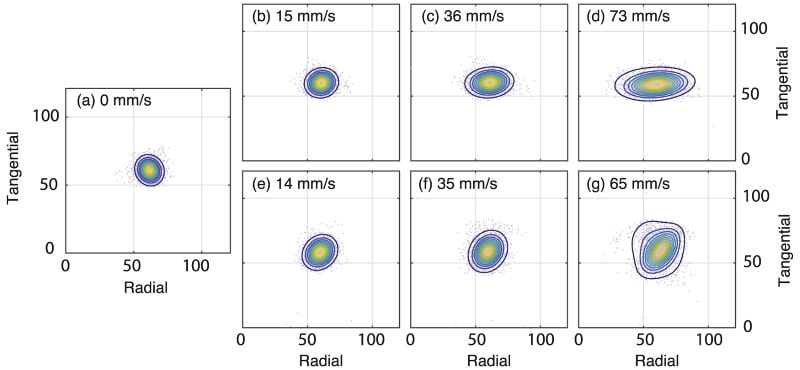
The researchers characterized residual blurring by measuring the point spread function (PSF) in image space using a point source attached to the animal’s optical tracking marker. They hypothesized that the reconstructed PSF should contain information about the animal’s motion, which could then be used to construct a blurring kernel for image deconvolution.

“Point sources have been previously used to measure and mitigate resolution degradation due to physical effects such as parallax errors and positron range,” explained first author Georgios Angelis from the University of Sydney. “Since insufficient motion tracking is yet another factor that degrades image resolution, even when employing motion compensation, we expected that a point source would be appropriate to measure the overall reduction in resolution in motion-affected scenarios.”

Moving phantoms
Angelis and colleagues evaluated their proposed approach by using the microPET Focus220 scanner to image moving phantoms. They constructed point sources from 18F-containing molecular sieves embedded in a cube of tissue-equivalent material. The sources were placed on hot-rod phantoms, which were robotically controlled to perform simple lateral movement, star-like motion and realistic rat head motion. For each pattern, they examined three speed settings.

The researchers reconstructed the emission data using an iterative motion-compensation algorithm. They then manually isolated the point source from the image, modelled it as a mixture of two Gaussian distributions, and extracted the motion-dependent PSF. They observed that the shape of the PSF was dependent on the motion pattern, with lateral motion leading to elongated PSFs and star-like motion giving more rounded PSFs. For both, the width broadened as phantom speed increased.

Isocontours of the fitted motion-dependent PSFs

For PET scans with lateral motion at 15 mm/s – a speed typically encountered during an awake rat study – motion-corrected reconstructed images had slightly lower resolution than an image from a stationary acquisition. For moderate (35 mm/s) and fast (70 mm/s) motion, residual motion blurring was clearly visible. Similar findings were seen for the scans with star-like motion.

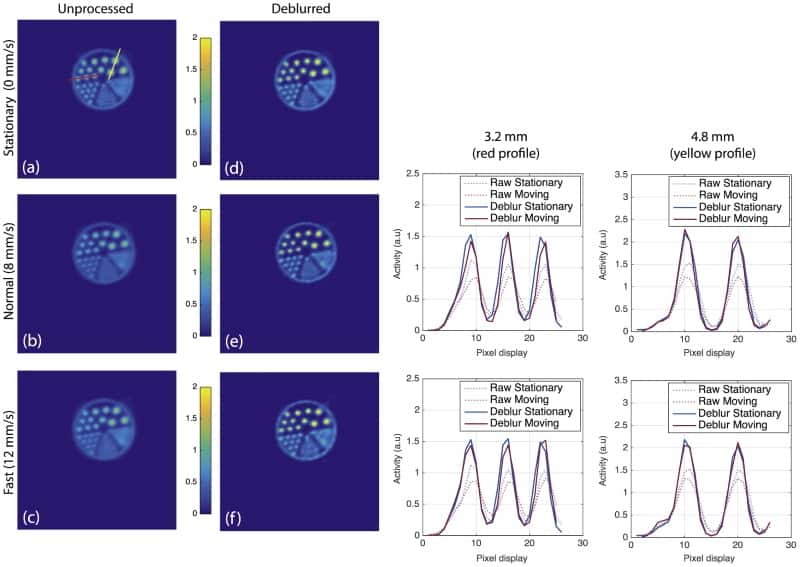
The team then used the PSF within an iterative Lucy-Richardson deconvolution algorithm to mitigate residual blurring in the motion-corrected images. The deblurred hot-rod images appeared highly similar, in terms of resolution and contrast, to their stationary counterparts. In particular, the three larger sets of rods (4.2, 4.0 and 3.2 mm) in the deblurred images appeared more circular compared with the unprocessed images.

To quantify differences in contrast before and after deblurring, the researchers examined line profiles through some of the rods. The profiles showed a clear difference in contrast (peak-to-valley ratio) between the stationary and motion-corrected images. After deblurring, the reconstructed line profiles for stationary and motion-corrected images were highly similar.

Realistic rat motion
The researchers also applied realistic motion (taken from head movements of an awake tube-bound rat) to the phantom using a high-precision robot. Motion parameters included translations and rotations with an average speed of 8 mm/s and maximum speeds of 60-80 mm/s across all three axes. They also emulated a more agitated animal with an average head speed of 12 mm/s.

Motion-corrected hot-rod phantom images of realistic rat head motion

As before, the motion-corrected images were slightly degraded compared with the stationary acquisition, with resolution deteriorating more for the fast-moving case. Comparing unprocessed and deblurred images demonstrated the improvements in contrast recovery offered by the post processing.

The authors note that although they didn’t show results from a moving animal, it should be fairly straightforward to transfer this technique to their routine freely moving animal experiments. “We have previously performed pilot experiments, where the point source was attached to the optical marker glued on the animal’s forehead, which was well tolerated by the animal,” Angelis noted.

In future work, they plan to incorporate the proposed methodology during image reconstruction (rather than post-reconstruction) using a nested deconvolution approach, which should further improve image quality, primarily due to noise reduction.

“Noise reduction is particularly important for other approaches we are working on, such as direct 4D reconstruction algorithms and deep learning neural networks to derive reliable physiological parameters from the brains of conscious animals,” Angelis explained. “Our overall aim is to improve image quality and parameter estimation for awake and freely moving animal scans, and this approach may provide a straightforward means to overcome basic hardware limitations.”

New NASA boss Jim Bridenstine garners praise and disapproval

Jim Bridenstine, a Republican Congressman from Oklahoma, has been sworn in as NASA administrator – the political appointee who leads the space agency. The appointment comes 15 months after former astronaut Charles Bolden resigned as administrator. Brindenstine is 42 and was approved for the job by the US Senate by a single vote margin last week.

“I look forward to working with the outstanding team at NASA to achieve the president’s vision for American leadership in space,” Bridenstine said in a statement. But as he sets out on that mission, the former US Navy pilot faces a series of high-flying opportunities and potential difficulties, including the fate of of manned flight beyond Earth orbit and of advanced observatories and the burgeoning commercialization of spaceflight.

The unprecedented closeness of the Senate vote, which came more than seven months after the Trump administration nominated Bridenstine, indicated the degree of discontent that surrounded his candidacy. Critics in and outside the Senate complained that Bridenstine lacks the experience as an astronaut or manager of space missions that most of his predecessors possessed. They also expressed fears that he will take a partisan approach to managing the traditionally non-political space agency. And they pointed to his less than enthusiastic acceptance, before and during his Senate testimony, of the reality of human-induced climate change, an important factor in NASA’s Earth exploration research.

“Politically divisive”

“The NASA administrator should be a consummate space professional,” said Florida Democratic senator Bill Nelson during Senate debate, noting that Bridenstine’ only direct connection to space issues was as executive director of the Tulsa Air and Space Museum and Planetarium from 2008 to 2010. “What’s not right for NASA is an administrator who is politically divisive and who is not prepared to be the last in line to make that fateful decision of go or no go for launch,” Nelson added. Despite his criticisms, however, Nelson has indicated that he would work with Bridenstine if he were confirmed.

Critics also remain unconvinced by Bridenstine’s moderation of his initially sceptical view of human-caused global warming. “I am aware of his dismissive statements about climate change,” Pennsylvania State University climatologist Michael Mann told Physics World. “I believe that he has the wrong stuff when it comes to the sort of leadership NASA needs in the 21st century.”

Bridenstine’s supporters point out that neither James Webb, NASA’s administrator during the build-up to the Apollo Moon-landing programme, nor Sean O’Keefe, who led the agency from 2001 to 2004, had experience in space projects before their appointment.

Not naïve

Bridenstine demonstrated an interest in space issues in 2016, when he sponsored a bill called the American Space Renaissance Act in Congress. “It’s a very thoughtful look at needed reform,” says John Logsdon, professor emeritus in George Washington University’s Space Policy Institute. “He’s not coming in naïve.”

G Scott Hubbard, former director of NASA’s Ames Research Center and overseer of the agency’s first Mars programme who is now at Stanford University, agrees. “He has exhibited a significant interest in the policy,” he says. “He wasn’t just grabbed from the hallway.”

Bridenstine certainly inherits a tough set of issues from Robert Lightfoot, who leaves NASA next week after service as acting administrator since Charles Bolden’s departure. NASA must rely on Russian and commercial spacecraft to launch its astronauts until it develops its Space Launch System and Orion spacecraft. It must work with Congress on deciding whether or not to pull out of the International Space Station. It must deal with delays in its two major observatory projects – the James Webb Space Telescope and the WFIRST.

Back to the Moon

But perhaps NASA’s biggest challenge will be to carry out the Trump administration’s pivot to the Moon as a gateway on the path towards manned missions to Mars. In those efforts, “Bridenstine will put even more reliance on the commercial sector,” Logsdon says. “There’s no going back, nor should there be.” Meanwhile a new chief scientist, the physicist and former director of NASA’s Planetary Science Division Jim Green, will join Bridenstine in the agency’s headquarters.

As observers see it, the new administrator needs another critical individual on board: a deputy administrator schooled in the culture of NASA and space science. Such an appointment “would tend to quieten the concern about being a political hack,” Hubbard says. So far, no potential nominees have emerged for that post. “We’re all very interested to see what sort of person the administration needs to support Bridenstine,” says Logsdon.

Sting-jet windstorms more likely over Europe as climate warms

A warming climate could worsen European windstorms. That’s according to models that show the proportion of explosively-developing weather systems with sting-jets increasing by 60%. Sting-jets – transient jets of air descending from cloud level – boost wind speeds near the ground and increase the amount of damage caused by storms.

“Our results warn that if we allow climate change to continue unchallenged, European cities are likely to suffer more frequently the devastating effects of high winds, including storm surges in coastal areas,” said Oscar Martinez-Alvarado from the UK’s National Centre for Atmospheric Science. “However, an important detail about our study is that we assumed the most extreme climate change scenario in which the concentration of greenhouse gases keeps increasing throughout the 21st century.”

The team hopes that actions to tackle rising global surface temperatures such as targets on reducing greenhouse gas emissions will mean better news for Europe’s weather.

Advances in computing power allow researchers to explore weather systems – such as the extra-tropical cyclones that dominate autumn and winter weather over Western Europe – in more detail than ever before. But sting jets are particularly challenging for climate modellers to capture.

“They are relatively small-scale features, only a few hundreds of kilometres wide, and therefore can only start to be realistically resolved in models with a horizontal grid spacing of around 12 km,” said Martinez-Alvarado. “However, typical climate models work with horizontal grid spacings of around 60 km.”

To reduce the computational burden, the team inferred the likelihood of sting-jet occurrence indirectly, using precursors.

“In previous work, we showed that sting jets are associated with the occurrence of a certain type of instability in the atmosphere, which would manifest itself as the downward motion of air forming (or enhancing) a sting jet,” said Martinez-Alvarado.

Applying their proven sting-jet diagnostic to present day results, the scientists found that 32% of cyclones exhibited the precursor. When they modelled climate behaviour out to the year 2100, the figure rose to 45%.

“We believe that this increase is due to the enhanced availability of moisture in a warmer climate, but more work is needed to confirm this hypothesis,” said Martinez-Alvarado.

In addition, the group, including scientists based at the University of Reading, the University of Oxford and the UK’s Met Office, is keen to know more about the nature of the energy transport process. In other words, by what mechanisms the energy of sting jets, which are present 1 to 2 km above sea level, reaches the ground.

The team published the results in Environmental Research Letters (ERL).

Copyright © 2026 by IOP Publishing Ltd and individual contributors